Disorder trapping by rapidly moving phase interface in an
undercooled liquid
Peter Galenko1,∗, Denis Danilov2, Irina Nizovtseva1,3, Klemens Reuther1, and Markus Rettenmayr1
1Friedrich-Schiller-Universität Jena, Physikalisch-Astronomische Fakultät, D-07743 Jena, Germany 2Institute of Nanotechnology, Karlsruhe Institute of Technology, 76344 Eggenstein-Leopoldshafen,
Germany
3Ural Federal University, Laboratory of Multi-Scale Mathematical Modeling, 620000 Ekaterinburg,
Russian Federation
Abstract. Non-equilibrium phenomena such as the disappearance of solute drag, the origin of solute trapping and evolution of disorder trapping occur dur-ing fast transformations with originatdur-ing metastable phases [D.M. Herlach, P.K. Galenko, D. Holland-Moritz,Metastable solids from undrercooled melts (El-sevier, Amsterdam, 2007)]. In the present work, a theoretical investigation of disorder trapping by a rapidly moving phase interface is presented. Using a model of fast phase transformations, a system of governing equations for the diffusion of atoms, and the evolution of both long-range order parameter and phase field variable is formulated. First numerical solutions are carried out for a congruently melting binary alloy system.
1 Introduction
Disorder trapping is a known non-equilibrium phenomenon occurring during transformations of congruently melting ordered intermetallic compounds [1, 2]. This phenomenon occurs es-pecially during rapid crystallization of undercooled melts of intermetallics with a superlattice crystalline structure [3–5]. In such systems, the phase interface propagation is sluggish at small undercoolings. The attachment of atoms from the liquid to the phase interface needs short-range atomic diffusion, since atoms have to move to the proper lattice site in the super-lattice structure. If the undercooling increases, the non-equilibrium effect of disorder trapping leads to the formation of a metastable disordered structure. Experimental evidence of disor-der trapping has been demonstrated byin situdiffraction studies using synchrotron radiation on levitation-processed samples, in which a transition from ordered to disordered growth at a critical undercooling was unambiguously shown [6]. The phenomenon of order–disorder transition with distinct change of the order parameter is also important in structural trans-formations with non-monotonic relaxation processes of melts [8] and in liquid–liquid phase separation of undercooled metallic alloys [9, 10].
The disorder trapping was investigated from theoretic perspective by sharp interface mod-els [2, 3, 6], a diffuse interface model [11] and methods of atomistic simulation [1, 12]. In the present work, using an existing approach for fast phase transformations [13], a diffuse
interface model results in a system of hyperbolic equations to describe (i) the rapid interface motion and (ii) the transition from ordered to disordered structures formed from undercooled liquids. The pioneering atomistic model of Chernov [1] and thermodynamic model of Boet-tinger and Aziz [2] consider a process of ordering at the interface only. The present diffuse interface model introduces spatial variation of order parameter such that the order-disorder transition and relaxation of order parameter exist in the diffuse zone between phases as well as in a solid phase far behind the solid-liquid interface. In addition to previous works [1– 3, 6, 11], the present model takes into account highly rapid interface propagation at which locally non-equilibrium states in chemical composition and in atomic ordering are freezing in solid phase with an appearance of metastable states.
In the numerical solutions of the model, we test the existence of pronounced disorder trapping by direct exchange of dissimilar atoms between sublattices at high interface veloci-ties moving in an undercooled binary liquid. The main focus of the present work is to analyze numeric results and to formulate conditions for disorder trapping in rapidly transforming con-gruently melting alloy undercooled in the liquid state.
2 Definitions
2.1 Main functions
We consider a binary mixture consisting of A-atoms and B-atoms. For a given temperature T, the main functions of the model, which should be obtained by solutions, are defined as follows. The first functionisϕthe phase field withϕ=1 in theS-phase (solid) andϕ=0 in the L-phase (liquid). The second function isxB the overall continuous concentration of B-atoms (which can be defined through theL-phase andS-phase concentrations). Concen-trations in theS-phase are given byxij =nij/(nAj +nBj), wherenijis the number of moles of atomi(i=A,B) on the sublattice j(j = α, β). Finally, the third functionis the long-range order parameterη, which is defined by the concentrationsxij=(xαA,xβA,xαB,xβB) of theα−and β−sublattices as
η=xαA−xβA=xβB−xαB. (1)
A completely disordered state in theS-phase occurs withη=0. Atoms exhibit full order on sublattices ifη=1. The concentrations in theS-phase on sublattices are
xαA=1−xB− η 2, x
α B =xB−
η
2, (2)
xβA=1−xB+ η 2, x
β B =xB+
η
2. (3)
2.2 Gibbs free energy
2.2.1 The entire system
The Gibbs free energy for the entire binary system is given by
G(ϕ,∇ϕ, η,∇η,xB)=GS(xB, η)p(ϕ)+GL(xB)p(1−ϕ)
+εϕ
2(∇ϕ) 2+εη
2(∇η) 2+W
ϕgϕ(ϕ)+Wηgη(η). (4)
The double-well functions in Eq. (4) for the phase field gϕ and for the long-range order parametergηare given by
The Gibbs free energy is interpolated between the phases using the following function
p(ϕ)=ϕ2(3−2ϕ). (6)
2.2.2 The phases
In theL-phase we assume the following approximation
GL(T,xB)=(1−xB)GAL(T)+xBGBL(T), (7)
GAL(T,xB)=G0AL (T)+RTln(1−xB)+xBΩL, (8)
GLB(T,xB)=G0BL (T)+RTln(xB)+(1−xB)ΩL, (9)
which can be considered as contribution (7) from elementsA andB, reference termsG0iL, ideal mixture termsRTlnxi, and excess termsxiΩL(where againi=A,B).
In theS-phase, the Gibbs free energy has additional terms related to the disorder param-eter
GS(T,xB, η)=Gre fS (T,xB)+GidS(T,xB, η)+GexS(xB, η). (10)
Assuming that the L-phase transforms into the body centered cubic modification of theS -phase, the following contributions into the free energy (10) are taken into account:
- reference contribution
Gre fS (T,xB)=(1−xB)GbccA (T)+xBGbccB (T), (11)
- ideal mixture contribution
GidS(T,xB, η)= 1 2RT
(xB− η
2) ln(xB− η
2)+(xB+ η
2) ln(xB+ η 2)
+(1−xB− η
2) ln(1−xB− η
2)+(1−xB+ η
2) ln(1−xB+ η 2)
, (12)
- excess free energy
Gex
S (xB, η)= Ω2
xB(1−xB)+ η2
4
+ Ω3η3+ Ω4η4. (13)
3 Governing equations
Following the model of fast phase transformations [13], one can derive governing equations represented by hyperbolic equations for non-conserved and conserved field variables. They were obtained by the condition of non-decreasing entropy in time that, for isothermal systems, is equivalent to the condition of non-increasing Helmholtz free energy in time [14]. Following these approaches [13, 14], one can derive the system of governing equations using the Gibbs free energies from Section 2.2 as thermodynamic potentials accessible from thermodynamic databases. Then, one can find governing equations for
- the phase field
τϕ∂ 2ϕ
∂t2 + ∂ϕ
∂t =−Mϕ δG
δϕ, (14)
- the long-range order parameter
τη∂ 2η
∂t2 + ∂η
∂t =−Mη δG
- the concentration and chemical potential
τD ∂2x
B ∂t2 +
∂xB
∂t =∇ ·(Mx∇μB), μB= δG δxB
. (16)
The hyperbolic equations (14) and (15) are damped wave equations, which extend known parabolic equation for the non-conserved order parameter derived first by Mandel’shtam– Leontovich [15, 16] and known in literature as the time–dependent Ginzburg-Landau equa-tion [16, 17] or Allen-Cahn equaequa-tion [18]. The hyperbolic equaequa-tion (16) generalizes the known parabolic equation for the conserved order parameter derived and analyzed first by Khachaturyan [19] and Cahn and Hilliard [20]. Equations (14)-(16) were applied to non-monotonic relaxation [7, 8], phase segregation [9] and were analyzed in the context of fast dynamics during transitions from un(meta)stable to (meta)stable states [21]. The validity of hyperbolic type models in fast phase transition theory has been verified by comparison with experimental data [22], in molecular dynamics simulations of the solute trapping effect by rapidly moving interfaces [23] and by coarse graining derivations of phase field equa-tions [24].
3.1 Phase-field
In its explicit form, the governing equation for the phase field comes from Eqs. (4)-(14). As a result one finds
τϕ Mϕ
∂2ϕ ∂t2 +
1 Mϕ
∂ϕ ∂t =εϕ∇
2ϕ−W ϕ
dgϕ(ϕ) dϕ −
(1−xB)GbccA +xGbccB
+RT
2
(xB−η/2) ln(xB−η/2)+(xB+η/2) ln(xB+η/2)
+(1−xB−η/2) ln(1−xB−η/2)+(1−xB+η/2) ln(1−xB+η/2)
+ Ω2(xB(1−xB)+(1/4)η2)+ Ω3η3+ Ω4η4
d p(ϕ) dϕ
−
(1−xB)
G0AL +RTln(1−xB)+xBΩL
+xB
G0BL +RTln(xB)+(1−xB)ΩL
d p(ϕ) dϕ
(17)
Without the ordering process, i.e. if η = 0, Eq. (17) transforms into the one derived in Refs. [13, 14].
3.2 Order parameter
Atomic ordering inα- andβ-sublattices is described by Eq. (15) together with the free en-ergy (4)-(13) by the following equation:
τη Mη
∂2η ∂t2 +
1 Mη
∂η ∂t =εη∇
2η−W ηdgη(η)
dη −
RT 2
−1
2ln(xB−η/2)+ 1
2ln(xB+η/2)
−1
2ln(1−xB−η/2)+ 1
2ln(1−xB+η/2)
+1
2Ω2η+3Ω3η 2+4Ω
4η3
From Eq. (18) it follows that the process of atomic ordering is coupled with the phase field by the interpolation functionp(ϕ).
3.3 Chemical diffusion
The chemical potential from Eq. (16) is given by the variational derivative
μB = δG δxB =
Gbcc
B −GbccA + RT
2
ln(xB− η
2)+ln(xB+ η
2)−ln(1−xB− η
2)−ln(1−xB+ η 2)
+Ω2(1−2xB)
p(ϕ)
+
G0BL −G0AL +RT{ln(xB)−ln(1−xB)}+2(1−2xB)ΩL
p(1−ϕ). (19)
The mobility Mxin the diffusion equation Eq. (16) is an interpolation between the bulk mobilities in the liquidMLand in the solidMS:
Mx=ML(1−p(ϕ))+MS(η)p(ϕ)=ML(1−p(ϕ))+
Mdisorder
S (1−η)+MSorderη
p(ϕ). (20)
As follows from Eq. (20), the bulk mobility MS(η) in the solid is interpolated by atomic mobilitiesMorder
S andM
disorder
S in the ordered state and disordered state, respectively.
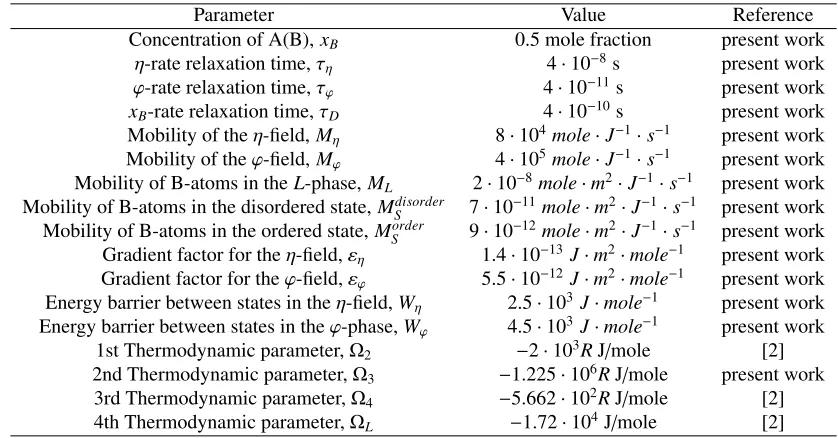
Table 1.Physical parameters of the A50B50alloy used for phase field modeling
Parameter Value Reference
Concentration of A(B),xB 0.5 mole fraction present work η-rate relaxation time,τη 4·10−8s present work ϕ-rate relaxation time,τϕ 4·10−11s present work xB-rate relaxation time,τD 4·10−10s present work Mobility of theη-field,Mη 8·104mole·J−1·s−1 present work Mobility of theϕ-field,Mϕ 4·105mole·J−1·s−1 present work Mobility of B-atoms in theL-phase,ML 2·10−8mole·m2·J−1·s−1 present work Mobility of B-atoms in the disordered state,Mdisorder
S 7·10−11mole·m2·J−1·s−1 present work Mobility of B-atoms in the ordered state,MorderS 9·10−12mole·m2·J−1·s−1 present work Gradient factor for theη-field,εη 1.4·10−13 J·m2·mole−1 present work Gradient factor for theϕ-field,εϕ 5.5·10−12 J·m2·mole−1 present work Energy barrier between states in theη-field,Wη 2.5·103J·mole−1 present work Energy barrier between states in theϕ-phase,Wϕ 4.5·103J·mole−1 present work
1st Thermodynamic parameter,Ω2 −2·103RJ/mole [2] 2nd Thermodynamic parameter,Ω3 −1.225·106RJ/mole present work
3rd Thermodynamic parameter,Ω4 −5.662·102RJ/mole [2] 4th Thermodynamic parameter,ΩL −1.72·104J/mole [2]
4 Material parameters and modeling
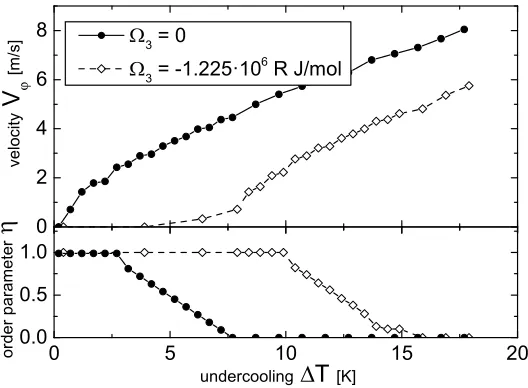
Figure 1.Behavior of the phase field interface velocityVϕand long-range order parameterηas
func-tions of liquid undercoolingΔT =TL−T, whereTLis the liquidus temperature (calculated as the tem-perature for “liquid–ordered phase” co-existence). Two cases show the change of the transformation kinetics depending on the thermodynamic parameterΩ3which regulates the barrier height for atomic
diffusion jumps between sublatticesαandβ, see Eq. (13).
(11) are taken from the thermodynamical data base of elements (CALPHAD) for a Ni50Al50 alloy.
The numerical scheme for the solution of the model consists of a finite difference (FD) scheme of second order with explicit time stepping. The initial concentration distribution was taken as homogeneous,xB =0.5, while both phase fieldϕand order parameterηwere initialized to unity in the solid and zero in the liquid, connected by a smooth transition at the interface, which was described by a Gaussian error function with a width of 1 micron, corresponding to 10 FD nodes. Boundary conditions were Dirichlet type conditions on the solidifying side and Neumann type (i.e., zero flux) conditions in the liquid far away from the interface.
Numerical solutions of Eqs. (16), (19), (20), 17), and (18) were achieved in a one-dimensional space. To obtain steady state results, average values of the interface velocityVϕ for the phase field and the long-range order parameterηwhere determined as follows. The phase-field has a step-like shape withϕ=1 in the solid andϕ=0 in the liquid. Because the solid-liquid interface is a diffuse interface, the conventional definition of the interface position is the pointzf whereϕ(zf)=0.5. In this work we adopt another definition of the interface position.zf =
+∞
−∞ ϕ(z)dzis exact for the case of a symmetric interface profile and allows us
to find an exact interface velocity in case of a steady state profile. During the simulation run, we collect the values of the interface positionzn
f at timestnafter a fixed number (e.g. 2000) of time steps. The current interface velocityVϕ is obtained asVn
ϕ = (znf −z n−1 f )/(t
n−tn−1).
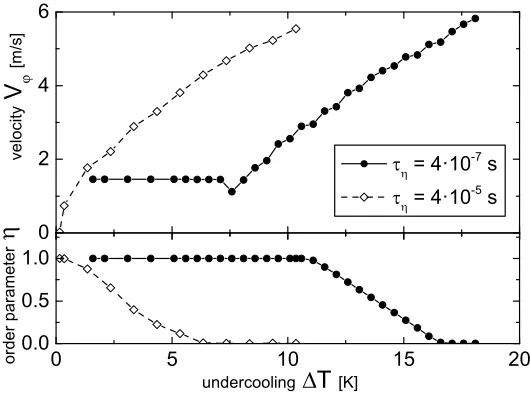
Figure 2. Behavior of the phase field interface velocity Vϕ and long-range order parameter η as
functions of liquid undercoolingΔT =TL−T, whereTL is the liquidus temperature (calculated as the temperature for “liquid–ordered phase” co-existence). Two cases show the change of the trans-formation kinetics depending of the timeτη for relaxation of the ordering rate∂η/∂tto change the regime from inertial (ballistic) to dissipative (diffusive) [21]. Theη-gradient factor has been chosen as
εη=1.4·10−11(J·m2·mole−1).
at a distance of 10 FD spacings behind the interface, i.e. the FD nodes 10 to 20 behind the calculated interface position.
5 Results
Figures 1 and 2 show the influence of various parameters for the ordering process on both the transition from L-phase toS-phase and on the ordering process itself. Namely, Fig. 1 presents the kinetics change due to different values ofΩ3. It can be seen that with a non-zero value of the barrier Ω3 [see Eq. (13)] the kinetics of transformation qualitatively changes with a decrease in Vϕ and a shift in the disorder transformation velocity VDT to its large values. Figure 2 illustrates the influence of gradient factor and relaxation timeτη on the transformation kinetics. The timeτηcharacterizes the relaxation to local equilibrium in the η-field, i.e., the relaxation of the rate∂η/∂t. An increase in the relaxation timeτηmoves the initiation of disorder trapping to smaller undercoolings.
6 Kinetics and temporal conditions for trapping of disorder
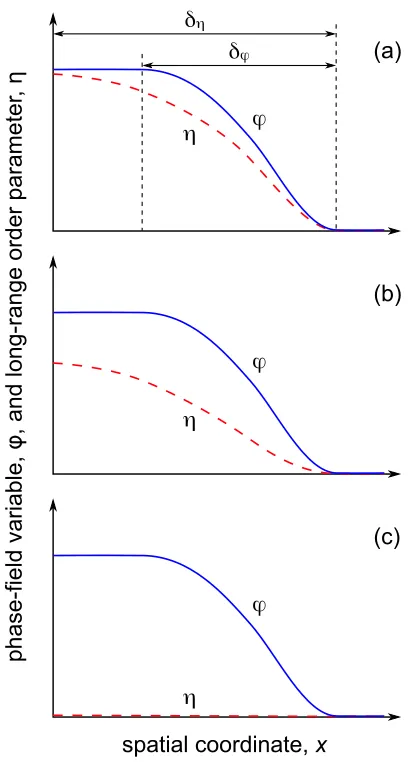
Figure 3.Profiles of the phase fieldφand long-range order parameterηwith their thicknessδϕandδη, respectively. (a) Fully ordered state,VϕVDT. (b) Partial disorder trapping,Vϕ≈VDT. (c) Complete disorder trapping,Vϕ>VDT.
value of the order ofVDT ∝Dη/δη(withDη =Mηεηbeing the characteristic diffusion coeffi -cient in solid phase for the ordering process, andδηthe thickness of the interface for ordering). Indeed, whenVϕ>VDT, the characteristic timeδϕ/Vϕof the diffuse interface of thicknessδϕ becomes smaller than the typical timeδ2
η/Dηrequired for complete ordering within the dif-fuse interface. As a result, disorder trapping by the diffuse interface exists under the velocity conditionV > Dη/δη,or under the time scale condition δϕ/Vϕ < δ2η/Dη = δη/VDT. From these conditions it follows that the critical velocity for the disorder trapping,VDT, becomes smaller as the ratio between the thickness of the ordering zoneδη and the diffuse interface thicknessδϕincreases:
VDT < δη
As follows from the inequality (21), the disorder trapping becomes more pronounced with the increase of the diffuse interface velocityVϕand the decrease of the diffuse interface thickness δϕ. Furthermore, with a “sharper” ordering zone, i.e., with decreasingδη, the beginning of disorder trapping is shifted to larger phase interface velocities. These situations are illustrated in Fig. 3.
7 Conclusions
1. Using a phase field method in the theory of fast phase transformations, a new model for disorder trapping by a rapidly moving interface is formulated. The model consists of a system of hyperbolic equations for mass transport by atomic diffusion, dynamics of the phase field, and dynamics of atomic ordering.
2. The system of model equations has been solved numerically to reach steady-state from initially non-stationary states. For these steady-states, the interface velocity and long-range order parameter are analyzed depending on the type of free energy and relaxation timeτηfor the rate of long-range order parameter∂η/∂t.
3. It has been shown quantitatively that there are critical undercoolings at which the trapping of disorder begins and finishes with the formation of a completely disordered phase. Using the results of our computations, a criterion for disorder trapping by rapid diffuse interface has been formulated.
Acknowledgments
P. G. specially acknowledges the support the Russian Science Foundation (project no. 16-11-10095). I. N. acknowledges the support of Alexander von Humboldt Foundation (ID 1160779) and the Council on grants and scholarships (MK-3124.2015.5, SP-3122.2015.5). M.R. and K.R. acknowledge support from the Deutsche Forschungsgemeinschaft (DFG, grants no. Re 1261/8-2 and Re 1261/18-1).
References
[1] A.A. Chernov, Sov. Phys. JETP26, 1182 (1968)
[2] W.J. Boettinger, M.J. Aziz, Acta Metall.37, 3379 (1989) [3] M. Barth, B. Wei, D.M. Herlach, Phys. Rev. B51, 3422 (1995) [4] R. Ahmad, R.F. Cochrane, A.M. Mullis, J. Mater. Sci.47, 2411 (2012) [5] C. Yang, J. Gao, J. Cryst. Growth394, 24 (2014).
[6] H. Hartmann, D. Holland-Moritz, P.K. Galenko, D.M. Herlach, Europhys. Lett. 87, 40007 (2009)
[7] V.I. Lad’yanov, M.G. Vasin, S.V. Logunov, V.P. Bovin, Phys. Rev. B62, 12107 (2000) [8] M.G. Vasin, V.I. Ladianov, Phys. Rev. E68, 051202 (2003)
[9] P. Galenko, Phys. Lett. A287, 190 (2001)
[10] E. Davidoff, P.K. Galenko, D.M. Herlach, M. Kolbe, N. Wanderka, Acta Mater. 61, 1078 (2013)
[11] H. Assadi, Acta Mater.55, 5225 (2007)
[12] X.Q. Zhang, Y. Yang, Y.F. Gao, J.J. Hoyt, M. Asta, D.J. Sun, Phys. Rev. B85, 041601 (2012)
[13] P. Galenko, D. Jou, Phys. Rev. E71, 046125 (2005)
[15] L.I. Mandel’shtam and M.A. Leontovich, JETP7, 438 (1937)
[16] A.Z. Patashinskii, V.L. Pokrovskii,Fluctuation theory of phase transitions(Pergamon, Oxford, 1979)
[17] E.M. Lifshitz, L.P. Pitaevskii, Physical Kinetics. Course Theoretical Physics, Vol 10, (Pergamon Press, Oxford, UK, 1981)
[18] S.M. Allen, J.W. Cahn, Acta Metall.27, 1085 (1979)
[19] A.G. Khachaturyan,Theory of Structural Transformations in Solids(Wiley, New York, 1983)
[20] J.W. Cahn, J.E. Hilliard, J. Chem. Phys.28, 258 (1958)
[21] P. Galenko, D. Danilov, V. Lebedev, Phys. Rev. E79, 051110 (2009) [22] P.K. Galenko and D.M. Herlach, Phys. Rev. Lett.96, 150602 (2006)
[23] Y. Yang, H. Humadi, D. Buta D, B.B. Laird, D. Sun, J.J. Hoyt, M. Asta, Phys. Rev. Lett.
107, 025505 (2011)