1
Overexpression of MiR482c in Tomato Induces Enhanced Susceptibility to Late Blight
Yu-Hui Hong1, Jun Meng2, Xiao-Li He1, Yuan-Yuan Zhang1, Yu-Shi Luan1*
1School of Bioengineering, Dalian University of Technology, Dalian 116024, China.
2School of Computer Science and Technology, Dalian University of Technology, Dalian 116024,
China.
*Corresponding author
2 Abstract
Tomato is the highest-value fruit/vegetable crop worldwide. However, the quality and yield of tomatoes
are severely affected by late blight. MicroRNA482s (miR482s) are involved in plant immune system.
In this study, miR482c was transiently and stably overexpressed in tomatoes in transgenic plants to
explore its mechanism in tomato resistance against late blight. Tomato in transgenic plants transiently
overexpressed miR482c displayed larger lesion area than the control plants upon infection.
Furthermore, compared with the WT tomato plants, the transgenic tomato plants stably overexpressing
miR482c displayed decreased expression of target genesaccompanied by lower POD, SOD, and PAL
activity activities and higher MDA content, thereby leading to a decline in the ROS scavenging ability
and aggravating the damage of lipid peroxidation product accumulation on the cell membrane,
eventually enhancing plant susceptibility. This finding indicates that miR482c may act as a negative
regulator in tomato resistance by regulating NBS-LRR expression levels and ROS levels.
3 INTRODUCTION
Tomato (Solanum lycopersicum) is the highest-value fruit/vegetable crop worldwide with considerable
significance for human nutrition and health [1, 2]. In the last five years, the average annual production
of tomatoes was nearly 96 million tons according to data from the Food and Agriculture Organization
of the United Nations (FAOSTAT) [3]. The yield and quality of tomatoes are seriously affected by the
late blight in both pre- and postharvest stages [4]. It has been shown that an unprotected tomato crop
(greenhouse, field) can be devastated within seven to ten days once infected with late blight [5]. The
management of late blight is relatively difficult, as this disease destroys foliage and fruits throughout
the whole growth and development period of tomato [5, 6]. Traditional strategies for plant resistance
rely on the frequent use of antimicrobial, leading to the serious pollution of the environment. To date,
genetic engineering resistant cultivars has become the most efficient and economical long-term
approach to strengthen plant resistance to various forms of stress. Due to a long breeding cycle and
rapid pathogen variation, it is difficult for traditional disease-resistant breeding approaches to meet the
needs of agricultural production. Comprehending the molecular mechanism of plant-pathogen
interactions and exploring disease resistance genes are key to enhancing plant resistance.
MicroRNAs (miRNAs), as a class of 22-24 nucleotide (nt) noncoding RNAs, play significant roles in
most eukaryotes by regulating the posttranscription of target genes [7, 8]. MiRNAs have been shown to
bind target mRNA molecules at complementary sites and thereby trigger target degradation or
translational inhibition [9]. In recent years, mounting studies have reported that miRNA cascades
influence the plant response to biotic stress [10]. For instance, using small RNA sequencing, Luan et al
[11]. identified 70 significantly changed miRNAs in tomato in response to late blight. MiR393 in
4
bacteria [12]. MiR164a in rice was down-regulated, and its target transcription factor OsNAC60 was
derepressed correspondingly to enhance plant defenses against rice blast [13]. MiR1916 in tomato was
demonstrated to negatively regulate tomato resistance to late blight and gray mold [14].In addition to
acting as regulators under biotic stress, miRNAs also participate in the response to abiotic stress and
plant development. For example, miR169c contributes to tomato tolerance to drought by regulating
targeted three nuclear factor Y subunit genes and one resistance-associated gene [15]. MiR171b
participates in organ development by downregulating several GRAS genes [16]. The direct binding of
ripening inhibitor (RIN) to the promoter of miR172a in tomato suggested in fruit development and
ripening there was a close correlation between RIN and miRNA expression [17].
Conserved miRNAs mostly exist as gene families in the genome, and more than 90% of the conserved
miRNA gene families are multigene families [18]. The conservation of different member sequences in
the plant miRNA family suggests a similar or synergistic function. For instance, activating
miR166k-166h expression in rice enhanced plant resistance to rice blast and bakanae disease [19].
Tomato plants overexpressing miR172a and miR172b exhibited enhanced resistance to late blight by
suppressing an AP2/ERF transcription factor [20]. Silencing miR2118b (corresponding to sly-miR482d
in the miRBase) and miR482e conferred resistance to late blight to tomato [21]. In addition, several
studies have shown that members of the same gene family may play different roles in the immune
system of plants. For example, Csukasi et al [22]. documented that during the course of strawberry
receptacle development, treatment with gibberellin down-regulated miR159a expression but that
miR159b expression remained unchanged. Ma et al [23]. found via small RNA sequencing that
miR156b and miR156e were significantly induced in two peanut eighth-generation recombinant inbred
5
Moreover, in rice, overexpression of miR164c led to reduced germination rates [24]. while miR164b
negatively regulated drought resistance by cleaving NAC genes [25]. These studies suggested that
members of miRNA families may act differently in response to diverse stresses in various plant
species.
MiR482 is an ancient and extensive family present in all land plants and performs a regulatory function
by cleaving and inhibiting the expression of target nucleotide binding site and leucine-rich repeat
(NBS-LRR) mRNAs [26]. NBS-LRR, as a class of Resistance (R) genes, recognize effectors in a
direct or indirect way and can redirect the defense signaling and trigger R-gene-mediated immunity
[27]. The miR482 family is more labile in sequence than other miRNA families [26-28]. To some
extent, its diversity is a result of the amino acid variation in its target sequence [29]. Additionally, the
expression of miR482 in the Solanaceae is higher than that in other species [26]. The miR482 family in
Solanum lycopersicum possesses five members, namely, sly-miR482a/b/c/d/e [30-32]. The length of all
five members is 22 nt rather than the typical 21 nt [26]. As members of the miR482 family in tomato
display low sequence conservation with sequence variation at 5/6 variable sites [21]. we hypothesize
that the functions of members may differ. A recent study showed that sly-miR482e and sly-miR2118b
(corresponding to sly-miR482d in the miRBase) differed in structure and function, which resulted in
differences in their targets and mechanisms [21]. In our previous study, silencing sly-miR482b with a
short tandem target mimic (STTM) was able to confer enhanced resistance to late blight in transgenic
tomato [33]. The sequence alignment of sly-miR482b and sly-miR482c showed that their sequences
were identical at 19 sites and varied at three sites. This difference indicated the possibility that
miR482b and miR482c target distinct genes and function in different ways. Here, we overexpressed
6
Solyc07g049700 and Solyc11g006530, were predicted to be targeted by miR482c according to previous
studies [26, 34]. The co-regulation of miR482c and these two genes was identified in tomato (S.
lycopersicum cv. Heinz 1706) resistant to Phytophthora infestans IPO-C [34]. The genes
Solyc07g049700 and Solyc11g006530 were selected and named SlCNL1 and SlCNL2, respectively.
Here, our study complemented the previous work and further explained the relationship and difference
between miR482c and miR482b, laying a solid foundation for continued work.
MATERIALS AND METHODS
Plant Strains, Phytophthora infestans Infections
Tomato Zaofen No. 2(susceptible cultivar) plants were raised in a growth room with a 16 hour light (at
22°C) and 8 hour dark (at 18°C) period. The agent of late blight, Phytophthora infestans (P. infestans)
“P12103”, was cultured in oat medium at 20°C without light for 20 days, and the plates covered with
mycelium were rinsed with distilled water until the concentration of spores reached 106
zoospores · mL−1. Afterwards, the spore suspensions were placed at 4°C for 1-2 hours to release the
zoospores. Tomato plants with six fully expanded true leaves were sprayed with the prepared spore
suspension. The control group consisted of tomato plants sprayed with sterile water. Leaf samples were
collected at 0, 6, 24, 48, 72 and 96 hours postinoculation (hpi) according to a prior study [34]. All
samples were quickly frozen in liquid nitrogen and subsequently stored at −80°C until DNA and RNA
extraction.
Construction of the MiR482c-OverexpressionPlasmids
The precursor sequence of miR482c (miRBase MI0020250) was amplified from tomato genomic DNA.
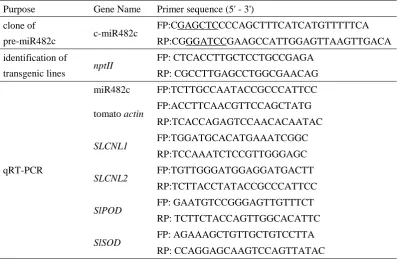
The gene-specific primer pairs (listed in Table S1) were designed by Oligo7 software. The PCR
7 by DNA sequencing.
Transient Overexpression of MiR482c in Tomato
The plasmids pBI121-miR482c were introduced into the Agrobacterium tumefaciens (A. tumefaciens)
strain “GV3101” by the freeze-thaw method [35]. The culture of A. tumefaciens was centrifuged for 10
min at 4000 × g, and the pellet was resuspended in infiltration medium (10 mM MES, 10 mM MgCl2,
and 20 µM acetosyringone; OD600 = 1.0). Next, the A. tumefaciens cultures containing
pBI121-miR482c were agroinoculated into the leaves of the tomato plants. The infiltration with A.
tumefaciens cultures containing empty vectors was used as the control. Three days after infiltration,
each infiltrated leaf was inoculated with 20 µL of P. infestans spore suspension(106 zoospores · mL−1)
at the same position. The necrotic areas were observed after 3 days. Statistical differences in the
diameters of necrotic lesions (DOL) between the control and infections were estimated using Duncan
multiple range tests.
Generation of Transgenic Tomato Overexpressing MiR482c
The transformation of tomato was performed via the Agrobacterium-mediated leaf disk method [36].
Explants were obtained from cotyledons excised from one-week-old seedlings. The putative resistant
buds were selected on 1/2-strength Murashige and Skoog medium containing 50 mg · L−1 kanamycin
and 200 mg · L−1 carbenicillin with a 16 hour light (at 22°C) and 8 hour dark (at 18°C) period. After
nearly two months, the putative positive transgenic lines were further confirmed by PCR amplification
of the kanamycin-resistant gene neomycin phosphoryl transferase II (nptII) (listed in Table S1). The
expression levels of miR482c in the selected transgenic lines were determined using quantitative
real-time PCR (qRT-PCR).
8
The transgenic plants and wild-type (WT) plants with consistent growth were selected for the
evaluation of resistance. In the detached-leaf infection assay, three leaves per plant and three plants per
line were detached from one-month-old plants and placed on filter paper in a glass garden. A pipette tip
(0.5-10 µL) was used to gently stab a wound to the right of the midvein on the abaxial side of the leaf.
Next, 20 μL spore suspensions of P. infestans were injected into the wound. The plates were incubated
in the dark at 20°C. The disease symptoms on inoculated leaves were observed and measured at 5 days
postinfection. Subsequently, the leaves were dyed in trypan blue solution (2.5 mg · mL−1) at 23 ± 1°C
for 12 hours and discolored by being soaked in lactophenol/ethanol solution [14].
In the whole-plant infection assay, the WT plants and transgenic plants were sprayed with the same
zoospore suspension and maintained in the greenhouse without light at 20 ± 1°C. The humidity was
kept at 95%. After one day, a 16 hour light and 8 hour dark period was provided. Five days after
infection, the disease severity rating (DSR) [37]. was counted. Additionally, the abundance of miR482c
and its target genes in the WT and transgenic plants were detected using qRT-PCR.
DAB/NBT Staining and Measurements of Hydrogen Peroxide/MDA Content
At 5 days postinfection,the transgenic plants and WT plants with consistent growth were selected for
analysis of H2O2/O2- with diamino benzidine (DAB)/nitro blue tetrazolium (NBT) staining as reported
by previous methods [38]. Moreover, the activities of peroxidase (POD) and superoxide dismutase
(SOD) were measured according to a previous study [35]. Furthermore, the content of malondialdehyde
(MDA) and the activity of phenylalanine ammonia-lyase (PAL) were determined according to methods
described by Hong et al [37].
qRT-PCR Analysis
9
housekeeping gene actin was selected as the reference gene. All reactions were repeated three times.
Together, three independent biological assays were performed. The relative expression levels of each
gene were calculated using the 2-ΔΔCT method.
Statistical Analysis
Statistical differences in data were estimated by Duncan multiple range tests using IBM SPSS
Statistics19 software. Significant differences (P < 0.05) are presented with different lowercase letters.
All data are presented as the means ± standard deviations (SDs).
RESULTS
Expression Patterns of MiR482c and Its Target Genes upon Infection
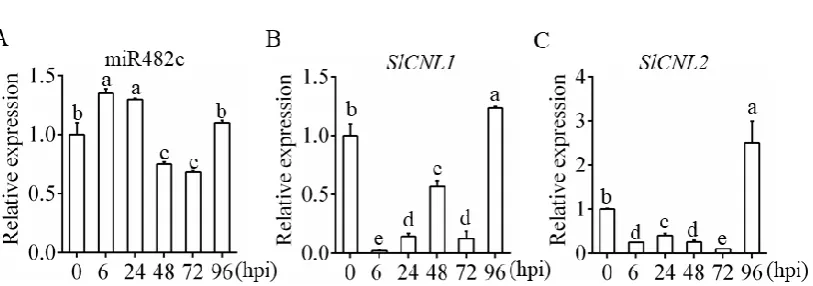
The relative expression levels of miR482c and SlCNLs upon infection are shown in Figure 1. The
relative expression of miR482cwas significantly up-regulated at 6 hpi , subsequently down-regulated
at 48 hpi, and eventually up-regulated at 96 hpi (Figure 1A). Moreover, the expression patterns of
SLCNL1 (Figure 1B) and SLCNL2 (Figure 1C) was significantly down-regulated at 6 hpi, then
up-regulated at 24 hpi, showing contrasting trends to that of miR482c. After 48 hpi, the expression
pattern of SLCNL1 and SLCNL2 were similar to that of miR482c. It is speculated that miR482c and
SLCNLs were induced early in infection, and there is a targeted relationship between miR482c and
SLCNLs.
10
miR482c (A), SLCNL1 (B) and SlCNL2 (C) in WT plants upon infection. hpi: hours postinfection. The
tomato housekeeping gene actin was selected as the reference gene. SDs of three replicates are
indicated with error bars. The letters above the column indicate a significant difference (P <0.05)
between the samples.
Transient Overexpression of MiR482c Compromised Tomato Resistance
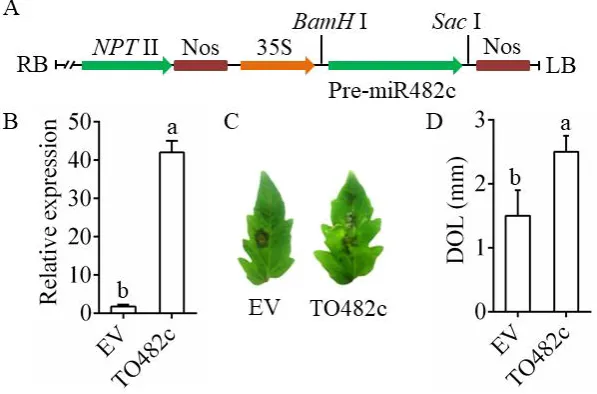
The framework of the pBI121-miR482c overexpression plasmids is shown in Figure 2A. The control
transiently overexpressed empty vector (EV) in tomato leaves. The abundance of miR482c in tomato
transiently overexpressing miR482c (TO482c) was nearly 20-fold higher than that in the control
(Figure 2B). Compared with the control plants, the TO482c plants displayed more necrotic areas at 3
days after leaf infiltration (Figure 2C). In addition, the DOL on the TO482c leaves were larger than
those on the control leaves (Figure 2D). The above results indicated that transiently overexpressing
miR482c might compromise tomato resistance.
Figure 2. Transient overexpression of miR482c in tomato leaves. (A) The framework of the
miR482c-overexpression vectors. (B) The expression level of miR482c in tomato that transiently
overexpressed miR482c. EV: empty vector; TO482c: transiently overexpressing pBI121-miR482c. (C)
11
DOL in EV and TO482c plants. SDs of three replicates are indicated with error bars. The letters above
the column indicate a significant difference (P <0.05) between the samples.
MiR482c Had a Negative Effect on Tomato Resistance
The pBI121-miR482c plasmids were introduced into tomato to generate transgenic plants to further
determine the regulation of miR482c in the resistance of tomato to late blight. Three positive transgenic
lines (L1, L2, and L3) were selected for further examination. The expression patterns of miR482c and
SlCNLsin the transgenic lines were determined by qRT-PCR. As shown in Figure 3A, miR482c was
more abundant in the three transgenic lines than in the WT plants, with the expression levels of the
three transgenic lines L1, L2, and L3 ~2-fold, 2.5-fold, and 2.8-fold higher, respectively, than those of
WT. Moreover, the transcript levels of SlCNLs in the miR482c-overexpressing plants were lower than
those in the WT plants (Figure 3B, C). The decline in SlCNL mRNA levels in the transgenic plants
further demonstrated that SlCNL mRNAs were targeted by miR482c.
Figure 3. Disease resistance of transgenic plants stably overexpressing miR482c. (A, B, C) The
relative expression levels of miR482c (A), SlCNL1 (B) and SlCNL2 (C) in transgenic tomato lines. WT:
wide type; L1: line 1; L2: line 2; L3: line 3. (D) The disease symptoms of WT and L1-L3 in the
12
after infection. (F) Necrotic areas on detached leaves of the WT and L1-L3 plants on the 5th day after
inoculation. Top: necrotic areas; bottom: trypan blue staining of the detached leaves. (G) The ratio of
lesion area to leaf area in the detached-leaf infection assay. SDs of three replicates were displayed by
error bars. The letters above the column indicate a significant difference (P <0.05) between the
samples.
In the whole-plant infection assay, more severe disease symptoms were observed on the leaves of the
L1-L3 plants than on the leaves of the WT plants (Figure 3D). The DSR of the L1-L3 plants was
almost 4-fold higher than that of the WT plants (Figure 3E). In the detached-leaf inoculation assay,
dead cells were detected in the leaves stained with trypan blue after infection. The L1-L3 leaves had
darker blue marks than did the WT leaves, indicating increased cell death in the L1-L3 plants (Figure
3F). Additionally, the ratio of lesion area to leaf area in the leaves of the WT plants was much less than
that of the leaves of the transgenic tomato plants (Figure 3G).
Overexpression of MiR482c Contributed to Changes in Physiological Indicators
In plant-pathogen interactions, oxidative bursts frequently occur and produce large amounts of reactive
oxygen species (ROS), mainly including H2O2 and O2-. In this study, DAB staining and NBT staining
were conducted to determine the accumulation of H2O2 and O2- in the transgenic plants and WT plants
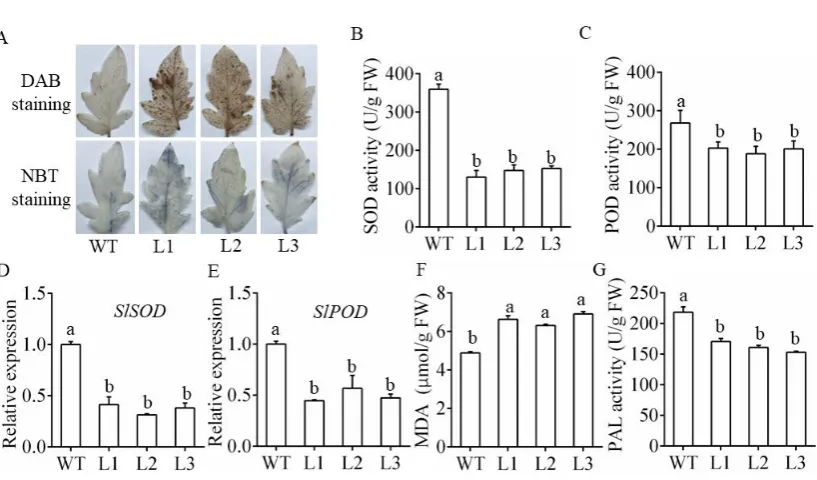
after treatment. As shown in Figure 4A, the leaves of the transgenic plants exhibited more intensely
stained spots than those of WT. Additionally, the enzyme activities of POD and SOD were
significantly lower in the L1-L3 plants than in the WT plants upon infection (Figure 4B, C). This was
consistent with the notably decreased expression of SlSOD and SlPOD (genes encoding the SOD and
POD enzymes in tomato) [20, 35]. in the L1-L3 plants compared with the WT plants upon infection
13 plants.
Figure 4. Detection of physiological and biochemical indicators of the miR482c-overexpression
plants. (A) DAB staining and NBT staining of tomato leaves in the whole-plant infection assay on the
5th day after infection. (B, C) SOD (B) and POD (C) activity of WT and L1-L3 after infection for 5
days. (D, E) The expression levels of SlSOD (D) and SlPOD (E) in WT and transgenic lines on the 5th
day after infection. (F) The MDA content of WT and L1-L3 after infection for 5 days. (G) The PAL
activity of WT and L1-L3 after infection for 5 days. SDs of three replicates are indicated with error
bars. The letters above the column indicate a significant difference (P <0.05) between the samples.
In addition, a higher MDA content was found in the L1-L3 plants, indicating that the L1-L3 plants
suffered more severe membrane damage than the WT plants (Figure 4F). PAL is a key enzyme in the
phenylpropanoid metabolic pathway. The level of PAL activity can also be used as an important
physiological indicator for measuring plant disease resistance. The activity of the PAL enzyme in the
L1-L3 plants was higher than that in the WT plants (Figure 4G). These results suggested that
overexpressing miR482c in tomato aggravated membrane damage.
14
MiRNAs, as key regulators, have been widely suggested to play crucial roles in plant resistance. A
large number of studies have documented that miRNAs function in the plant response to biotic stress.
For instance, osa-miR167d has been reported to act as a negative regulator in rice resistance to rice
blast disease [39]. Osa-miR396 has been demonstrated to negatively regulate the resistance of rice to
brown planthopper (BPH) [40]. In Arabidopsis, miR825 and miR825* were shown to compromise
plant resistance to Pseudomonas syringae pv. tomato (Pst) DC3000 [41]. Tomato plants are generally
subjected to various pathogens leading to severe diseases and substantial losses. However, the
mechanism of miR482c in tomato disease resistance remains elusive. Our study indicated that
overexpression of miR482c in tomato led to enhanced susceptibility to late blight disease.
We found that the expression pattern of miR482c was induced at 6 hpi and 24 hpi, subsequently
declined at 48 hpi and 72 hpi, and finally increased at 96 hpi (Figure 1A). The relative expression
levels of both SLCNL1 and SLCNL2 decreased at 6 hpi and subsequently were up-regulated at 24 hpi in
contrast. Afterwards, at 48 hpi, SLCNL1 increased, whereas SLCNL2 decreased. Both SLCNLs declined
at 72 hpi and were eventually up-regulated at 96 hpi (Figure 1B, C). A previous study demonstrated
that the co-regulations between miR482- NBS-LRRs were not exactly the same [34]. Such differences
in co-regulation suggest that despite active targeting by miR482c in S. lycopersicum, SlCNL1 and
SlCNL2 are likely to be regulated by other mechanisms in addition to the regulation by miR482c.
Furthermore, upregulation or downregulation is not static between miR482 and NBS-LRR mRNA but
can shift between time points. Switches between translational and posttranscriptional may account for
such shifted regulation [34]. Additionally, Jiang et al. demonstrated that the abundance of miR482b in
L3708 tomato (resistant cultivar) was lowest at 24 hpi but increased to a moderate level at 96 hpi [33].
15
To further confirm the participation of miR482c in tomato resistance, three transgenic lines
overexpressing miR482c (L1-L3) were generated. After five days postinfection, the transgenic lines
displayed more severe symptoms than WT (Figure 3D) with greater DSRs (Figure 3E). Moreover, in
the detached-leaf inoculation assay, necrotic areas on the leaves of transgenic lines were larger than
those on the leaves of WT (Figure 3F). This indicated that the resistance was impaired after
overexpression of miR482c. Previous work reported similar results; the mature sequences of
stu-miR482e in potato and sly-miR482c in tomato are identical, and there are only two site variations
between the precursor sequences of stu-miR482e and sly-miR482c. Overexpression of stu-miR482e in
potato was demonstrated to enhance plant sensitivity to Verticillium dahliae infection [42].
In the early stages of plant-pathogen interactions, oxidative bursts frequently occur and produce
large amounts of ROS, mainly including H2O2 and O2- [43]. Excessive ROS may result in lipid
peroxidation and oxidative damage to the membrane or even cell death. In rice, Wu et al. showed that
miR528 acts as a negative regulator in viral resistance and is accompanied by an increased
accumulation of ROS [44]. In our study, the DAB and NBT staining assay showed that there were
more dark spots on the leaves of the transgenic tomato plants than the leaves of the WT tomato plants,
indicating increased cell death and accumulation of H2O2 and O2- in the transgenic tomato plants
(Figure 4A). Plants have evolved a complete antioxidant defense system that removes excess ROS and
maintains homeostasis. The activities of SOD and POD related to ROS clearance in the transgenic
tomato plants were considerably lower upon infection than those in the WT plants (Figure 4B, C).
Together, the relative expression levels of the antioxidant enzyme genes SlPOD and SlSOD were also
down-regulated in the transgenic plants (Figure 4D, E). Similar results have been reported in tomato,
16
ROS upon Botrytis cinerea infection, and slmapk3 mutants showed reduced resistance with an
increased level of ROS content [45].
In summary, we proposed a working model to describe the mechanism of miR482c in tomato
resistance to late blight (Figure 5). Overexpression of miR482c could reduce the expression of its
targeted SLCNL genes and antioxidant enzyme genes, thereby leading to a decline in the ROS
scavenging ability and aggravating the damage of lipid peroxidation product accumulation on the cell
membrane, eventually enhancing plant susceptibility. Compared with the function of miR482b which
was reported earlier [33], miR482c showed analogous negative regulation with miR482b in tomato
resistance to late blight.Thus, despite having individual characteristics, miR482c and miR482b may
play analogous roles in the plant immune system. Results have been reported that coincide with this
finding. For instance, Li et al. reported that miR169a and miR169c in Arabidopsis functioned as
negative regulators under drought stress by cleaving NFYA5 [46]. Furthermore, Zhao et al.
demonstrated that miR169g and miR169n both targeted an NF-YA gene exhibiting distinct and
overlapping responses to salt and drought stresses [47].
Figure 5. The regulation network of miR482c-NBS-LRR involved in tomato resistance.
Overexpressing miR482c in tomato enhanced plant susceptibility to late blight by reducing the targeted
SlCNL genes, accompanied by lower POD, SOD, and PAL activities and higher MDA content. Red
17
gene or function. Red dotted arrow indicates the effectors produced by pathogens invading the host
plant acts on the production of ROS by direct or indirect way.
Our findings provide insight into the method by which miR482c–NBS-LRR participated in the
response of tomato to late blight. Future work should therefore include follow-up work designed to
study whether silencing miR482c enhances disease resistance and whether the miR482c cascade plays
a role in resistance to other forms of stress.
Author Contributions
Methodology and investigation, Y.-S.L., Y.-H.H., X.-L.H., and Y.-Y.Z.; writing-original draft
preparation, Y.-S.L.,Y.-H.H.; supervision, Y.-S.L., J.M.; writing-review and editing, Y.-S.L., Y.-H.H.,
J.M..
Funding
This research was funded by the National Natural Science Foundation of China (Nos. 31872116 and
61872055).
Notes
The authors declare no competing financial interest.
Abbreviations Used
H2O2, hydrogen peroxide; MDA, malondialdehyde; NBT, nitro blue tetrazolium; O2-, superoxide; PAL,
phenylalanine ammonia-lyase;POD, peroxidase; qRT-PCR, quantitative real-time PCR; ROS, reactive
18 References
1.Tieman, D.; Zhu, G.; Resende, M. F., Jr.; Lin, T.; Nguyen, C.; Bies, D.; Rambla, J. L.; Beltran, K. S.;
Taylor, M.; Zhang, B.; Ikeda, H.; Liu, Z.; Fisher, J.; Zemach, I.; Monforte, A.; Zamir, D.; Granell,
A.; Kirst, M.; Huang, S.; Klee, H., A chemical genetic roadmap to improved tomato flavor.
Science 2017, 355, 391-394; DOI: 10.1126/science.aal1556.
2.Fei, Z. J.; Joung, J. G.; Tang, X. M.; Zheng, Y.; Huang, M. Y.; Lee, J. M.; McQuinn, R.; Tieman, D.
M.; Alba, R.; Klee, H. J.; Giovannoni, J. J., Tomato Functional Genomics Database: a
comprehensive resource and analysis package for tomato functional genomics. Nucleic Acids Res.
2011, 39, 1156-1163; DOI: 10.1093/nar/gkq991.
3.Food and Agricultural Organization of the United Nations. http://www.fao.org/faostat/.
4.Fry, W. E.; Birch, P. R.; Judelson, H. S.; Grunwald, N. J.; Danies, G.; Everts, K. L.; Gevens, A. J.;
Gugino, B. K.; Johnson, D. A.; Johnson, S. B.; McGrath, M. T.; Myers, K. L.; Ristaino, J. B.;
Roberts, P. D.; Secor, G.; Smart, C. D., Five reasons to consider phytophthora infestans a
reemerging pathogen. Phytopathology 2015, 105, 966-981; DOI:
10.1094/PHYTO-01-15-0005-FI.
5.Nowicki, M.; Foolad, M. R.; Nowakowska, M.; Kozik, E. U., Potato and tomato late blight caused by
Phytophthora infestans: an overview of pathology and resistance breeding. Plant Dis. 2012, 96,
4-17; DOI: 10.1094/PDIS-05-11-0458.
6.Kelley, B. S.; Lee, S. J.; Damasceno, C. M.; Chakravarthy, S.; Kim, B. D.; Martin, G. B.; Rose, J. K.,
A secreted effector protein (SNE1) from Phytophthora infestans is a broadly acting suppressor of
19
7.Bartel, D. P., MicroRNAs: target recognition and regulatory functions. Cell 2009, 136, 215-233; DOI:
10.1016/j.cell.2009.01.002.
8.Zeng, J.; Gupta, V. K.; Jiang, Y. M.; Yang, B.; Gong, L.; Zhu, H., Cross-Kingdom Small RNAs
among Animals, Plants and Microbes. Cells 2019, 8, 371; DOI: 10.3390/cells8040371.
9.D'Ario, M.; Griffiths-Jones, S.; Kim, M., Small RNAs: big impact on plant development. Trends
Plant. Sci. 2017, 22, 1056-1068; DOI: 10.1016/j.tplants.2017.09.009.
10.Sun, T.; Li, M. Y.; Li, P. F.; Cao, J. M., MicroRNAs in Cardiac Autophagy: Small Molecules and
Big Role. Cells 2018, 7, 15; DOI: 10.3390/cells7080104.
11.Luan, Y.; Cui, J.; Zhai, J.; Li, J.; Han, L.; Meng, J., High-throughput sequencing reveals differential
expression of miRNAs in tomato inoculated with Phytophthora infestans. Planta 2015, 241,
1405-1416; DOI: 10.1007/s00425-015-2267-7.
12.Navarro, L.; Dunoyer, P.; Jay, F.; Arnold, B.; Dharmasiri, N.; Estelle, M.; Voinnet, O.; Jones, J. D., A
plant miRNA contributes to antibacterial resistance by repressing auxin signaling. Science 2006,
312, 436-439; DOI: 10.1126/science.1126088.
13.Wang, Z.; Xia, Y.; Lin, S.; Wang, Y.; Guo, B.; Song, X.; Ding, S.; Zheng, L.; Feng, R.; Chen, S.;
Bao, Y.; Sheng, C.; Zhang, X.; Wu, J.; Niu, D.; Jin, H.; Zhao, H., Osa-miR164a targets OsNAC60
and negatively regulates rice immunity against the blast fungus Magnaporthe oryzae. Plant J.
2018, 95, 584-597; DOI: 10.1111/tpj.13972.
14.Chen, L.; Meng, J.; He, X. L.; Zhang, M.; Luan, Y. S., Sly-miR1916 targets multiple target genes
and negatively regulates the immune response in tomato. Plant, Cell Environ. 2019, 42,
20
15.Zhang, X. H.; Zou, Z.; Gong, P. J.; Zhang, J. H.; Ziaf, K.; Li, H. X.; Xiao, F. M.; Ye, Z. B.,
Over-expression of microRNA169 confers enhanced drought tolerance to tomato. Biotechnol. Lett.
2011, 33, 403-409;DOI: 10.1007/s10529-010-0436-0.
16.Li, H.; Zhang, Q.; Li, L.; Yuan, J.; Wang, Y.; Wu, M.; Han, Z.; Liu, M.; Chen, C.; Song, W.; Wang,
C., Ectopic overexpression of bol-miR171b increases chlorophyll content and results in sterility in
broccoli ( Brassica oleracea L var. italica). J. Agri. Food Chem. 2018, 66, 9588-9597; DOI:
10.1021/acs.jafc.8b01531.
17.Gao, C.; Ju, Z.; Cao, D. Y.; Zhai, B. Q.; Qin, G. Z.; Zhu, H. L.; Fu, D. Q.; Luo, Y. B.; Zhu, B. Z.,
MicroRNA profiling analysis throughout tomato fruit development and ripening reveals potential
regulatory role of RIN on microRNAs accumulation. Plant Biotechnol. J. 2015, 13, 370-382; DOI:
10.1111/pbi.12297.
18.Nozawa, M.; Miura, S.; Nei, M., Origins and evolution of microRNA genes in plant species.
Genome Biol. Evol.2012, 4, 230-239; DOI: 10.1093/gbe/evs002.
19.Salvador-Guirao, R.; Hsing, Y. I.; San Segundo, B., The polycistronic miR166k-166h positively
regulates rice immunity via post-transcriptional control of EIN2. Front. Plant Sci. 2018, 9, 337;
DOI: 10.3389/fpls.2018.00337.
20.Luan, Y.; Cui, J.; Li, J.; Jiang, N.; Liu, P.; Meng, J., Effective enhancement of resistance to
Phytophthora infestans by overexpression of miR172a and b in Solanum lycopersicum. Planta
2018, 247, 127-138; DOI:10.1007/s00425-017-2773-x.
21.Canto-Pastor, A.; Santos, B.; Valli, A. A.; Summers, W.; Schornack, S.; Baulcombe, D. C.,
Enhanced resistance to bacterial and oomycete pathogens by short tandem target mimic RNAs in
21
22.Csukasi, F.; Donaire, L.; Casanal, A.; Martinez-Priego, L.; Botella, M. A.; Medina-Escobar, N.;
Llave, C.; Valpuesta, V., Two strawberry miR159 family members display developmental-specific
expression patterns in the fruit receptacle and cooperatively regulate Fa-GAMYB. New Phytol.
2012, 195, 47-57;DOI: 10.1111/j.1469-8137.2012.04134.x.
23.Ma, X.; Zhang, X.; Zhao, K.; Li, F.; Li, K.; Ning, L.; He, J.; Xin, Z.; Yin, D., Small RNA and
degradome deep sequencing reveals the roles of microRNAs in seed expansion in peanut (Arachis
hypogaea L.). Front. Plant Sci 2018, 9, 349;DOI: 10.3389/fpls.2018.00349.
24.Zhou, Y.; Zhou, S.; Wang, L.; Wu, D.; Cheng, H.; Du, X.; Mao, D.; Zhang, C.; Jiang, X., miR164c
and miR168a regulate seed vigor in rice. J. Integr. Plant Biol. 2019; DOI: 10.1111/jipb.12792.
25.Fang, Y.; Xie, K.; Xiong, L., Conserved miR164-targeted NAC genes negatively regulate drought
resistance in rice. J. Exp. Bot. 2014, 65, 2119-2135; DOI: 10.1093/jxb/eru072.
26.Shivaprasad, P. V.; Chen, H. M.; Patel, K.; Bond, D. M.; Santos, B. A.; Baulcombe, D. C., A
microRNA superfamily regulates nucleotide binding site-leucine-rich repeats and other mRNAs.
Plant Cell. 2012, 24, 859-874; DOI: 10.1105/tpc.111.095380.
27.de Vries, S.; Kloesges, T.; Rose, L. E., Evolutionarily dynamic, but robust, targeting of resistance
genes by the miR482/2118 gene family in the Solanaceae. Genome Biol. Evol. 2015, 7, 3307-3321;
DOI: 10.1093/gbe/evv225.
28.Zhai, J.; Jeong, D. H.; De Paoli, E.; Park, S.; Rosen, B. D.; Li, Y.; Gonzalez, A. J.; Yan, Z.; Kitto, S.
L.; Grusak, M. A.; Jackson, S. A.; Stacey, G.; Cook, D. R.; Green, P. J.; Sherrier, D. J.; Meyers, B.
C., MicroRNAs as master regulators of the plant NB-LRR defense gene family via the production
22
29.Zhang, Y.; Xia, R.; Kuang, H.; Meyers, B. C., The diversification of plant NBS-LRR defense genes
directs the evolution of microRNAs that target them. Mol. Biol. Evol. 2016, 33, 2692-2705;DOI:
10.1093/molbev/msw154.
30.Kravchik, M.; Sunkar, R.; Damodharan, S.; Stav, R.; Zohar, M.; Isaacson, T.; Arazi, T., Global and
local perturbation of the tomato microRNA pathway by a trans-activated DICER-LIKE 1 mutant.
J. Exp. Bot. 2014, 65, 725-739; DOI: 10.1093/jxb/ert428.
31.Mohorianu, I.; Schwach, F.; Jing, R.; Lopez-Gomollon, S.; Moxon, S.; Szittya, G.; Sorefan, K.;
Moulton, V.; Dalmay, T., Profiling of short RNAs during fleshy fruit development reveals
stage-specific sRNAome expression patterns. Plant J. 2011, 67, 232-246; DOI:
10.1111/j.1365-313x.2011.04586.x.
32.Li, F.; Pignatta, D.; Bendix, C.; Brunkard, J. O.; Cohn, M. M.; Tung, J.; Sun, H.; Kumar, P.; Baker,
B., MicroRNA regulation of plant innate immune receptors. Proc. Natl. Acad. Sci. U. S. A. 2012,
109, 1790-1795; DOI: 10.1073/pnas.1118282109.
33.Jiang, N.; Meng, J.; Cui, J.; Sun, G.; Luan, Y., Function identification of miR482b, a negative
regulator during tomato resistance to Phytophthora infestans. Hortic. Res. 2018, 5, 9; DOI:
10.1038/s41438-018-0017-2.
34.de Vries, S.; Kukuk, A.; von Dahlen, J. K.; Schnake, A.; Kloesges, T.; Rose, L. E., Expression
profiling across wild and cultivated tomatoes supports the relevance of early miR482/2118
suppression for Phytophthora resistance. P. Roy. Soc. B-Biol. Sci. 2018, 285, 20172560; DOI:
23
35.Cui, J.; Jiang, N.; Zhou, X.; Hou, X.; Yang, G.; Meng, J.; Luan, Y., Tomato MYB49 enhances
resistance to Phytophthora infestans and tolerance to water deficit and salt stress. Planta 2018,
248, 1487-1503; DOI: 10.1007/s00425-018-2987-6.
36.Khare, N.; Goyary, D.; Singh, N. K.; Shah, P.; Rathore, M.; Anandhan, S.; Sharma, D.; Arif, M.;
Ahmed, Z., Transgenic tomato cv. Pusa Uphar expressing a bacterial mannitol-1-phosphate
dehydrogenase gene confers abiotic stress tolerance. Plant Cell, Tissue Organ Cult. 2010, 103,
267-277; DOI: 10.1007/s11240-010-9776-7.
37.Hong, Y.; Cui, J.; Liu, Z.; Luan, Y., SpWRKY6 acts as a positive regulator during tomato resistance
to Phytophthora infestans infection. Biochem. Biophys. Res. Commun. 2018, 506, 787-792; DOI:
10.1016/j.bbrc.2018.10.155.
38.Cui, J.; Luan, Y.; Jiang, N.; Bao, H.; Meng, J., Comparative transcriptome analysis between resistant
and susceptible tomato allows the identification of lncRNA16397 conferring resistance to
Phytophthora infestans by co-expressing glutaredoxin. Plant J. 2017, 89, 577-589; DOI:
10.1111/tpj.13408.
39.Zhao, Z. X.; Feng, Q.; Cao, X. L.; Zhu, Y.; Wang, H.; Chandran, V.; Fan, J.; Zhao, J. Q.; Pu, M.; Li,
Y.; Wang, W. M., Osa-miR167d facilitates infection of Magnaporthe oryzae in rice. J. Integr.
Plant Biol. 2019; DOI: 10.1111/jipb.12816.
40.Dai, Z.; Tan, J.; Zhou, C.; Yang, X.; Yang, F.; Zhang, S.; Sun, S.; Miao, X.; Shi, Z., The
OsmiR396-OsGRF8-OsF3H-flavonoid pathway mediates resistance to the brown planthopper in
rice (Oryza sativa). Plant Biotechnol. J. 2019; DOI: 10.1111/pbi.13091.
41.Niu, D.; Xia, J.; Jiang, C.; Qi, B.; Ling, X.; Lin, S.; Zhang, W.; Guo, J.; Jin, H.; Zhao, H., Bacillus
24
defense-related genes in Arabidopsis. J. Integr. Plant Biol. 2016, 58, 426-439; DOI:
10.1111/jipb.12446.
42.Yang, L.; Mu, X.; Liu, C.; Cai, J.; Shi, K.; Zhu, W.; Yang, Q., Overexpression of potato miR482e
enhanced plant sensitivity to Verticillium dahliae infection. J. Integr. Plant Biol. 2015, 57,
1078-1088; DOI: 10.1111/jipb.12348.
43.Apel, K.; Hirt, H., Reactive oxygen species: Metabolism, oxidative stress, and signal transduction.
Annu. Rev. Plant Biol. 2004, 55, 373-399; DOI: 10.1146/annurev.arplant.55.031903.141701.
44.Wu, J.; Yang, R.; Yang, Z.; Yao, S.; Zhao, S.; Wang, Y.; Li, P.; Song, X.; Jin, L.; Zhou, T.; Lan, Y.;
Xie, L.; Zhou, X.; Chu, C.; Qi, Y.; Cao, X.; Li, Y., ROS accumulation and antiviral defence
control by microRNA528 in rice. Nat. Plants 2017, 3, 16203; DOI: 10.1038/nplants.2016.203.
45.Zhang, S.; Wang, L.; Zhao, R.; Yu, W.; Li, R.; Li, Y.; Sheng, J.; Shen, L., Knockout of SlMAPK3
Reduced Disease Resistance to Botrytis cinerea in Tomato Plants. J. Integr. Plant Biol. 2018, 66,
8949-8956;DOI: 10.1021/acs.jafc.8b02191.
46.Li, W. X.; Oono, Y.; Zhu, J.; He, X. J.; Wu, J. M.; Iida, K.; Lu, X. Y.; Cui, X.; Jin, H.; Zhu, J. K.,
The Arabidopsis NFYA5 transcription factor is regulated transcriptionally and
posttranscriptionally to promote drought resistance. Plant Cell. 2008, 20, 2238-2251; DOI:
10.1105/tpc.108.059444.
47.Zhao, B.; Ge, L.; Liang, R.; Li, W.; Ruan, K.; Lin, H.; Jin, Y., Members of miR-169 family are
induced by high salinity and transiently inhibit the NF-YA transcription factor. BMC Mol. Biol.
25 Table S1 Primer sequence used in this study.
Purpose Gene Name Primer sequence (5' - 3')
clone of
pre-miR482c c-miR482c
FP:CGAGCTCCCCAGCTTTCATCATGTTTTTCA
RP:CGGGATCCGAAGCCATTGGAGTTAAGTTGACA
identification of
transgenic lines nptII
FP: CTCACCTTGCTCCTGCCGAGA
RP: CGCCTTGAGCCTGGCGAACAG
qRT-PCR
miR482c FP:TCTTGCCAATACCGCCCATTCC
tomato actin FP:ACCTTCAACGTTCCAGCTATG RP:TCACCAGAGTCCAACACAATAC
SLCNL1 FP:TGGATGCACATGAAATCGGC
RP:TCCAAATCTCCGTTGGGAGC
SLCNL2 FP:TGTTGGGATGGAGGATGACTT
RP:TCTTACCTATACCGCCCATTCC
SlPOD FP: GAATGTCCGGGAGTTGTTTCT
RP: TCTTCTACCAGTTGGCACATTC
SlSOD FP: AGAAAGCTGTTGCTGTCCTTA