IJEDR1602356
International Journal of Engineering Development and Research (www.ijedr.org)2025
Enhancement in the performance of channel
estimation for OFDM based system using bacterial
foraging optimization and neural network
1
Deepinder Sharma,
2Dr. Jyoti Saxena
1M.tech (Scholar), 2Prof (ECE) 1Electronics and Communication Engineering,
________________________________________________________________________________________________________ Abstract - Orthogonal frequency division multiplexing (OFDM) is a multicarrier modulation technique used in various broadband systems and has ability to cope with severe channel conditions without complex equalization filters. The benefit of OFDM is spectral efficiency which measures the efficient use of bandwidth. This study combines feed forward back propagation neural network with bacterial foraging optimization (BFO) for the estimation of channel to improve the performance and convergence rate. Minimum mean square error (MMSE) algorithm is used for channel estimation. The performance of bit error rate (BER) and MSE with respect to signal to noise ratio (SNR) is observed.
Index Terms - Channel estimation, OFDM, MMSE, neural network, BER, SNR.
________________________________________________________________________________________________________
I.INTRODUCTION
Over the past two decades, the rapid development of wireless communication technology has brought great convenience to people's lives and work. The goal of next generation of mobile wireless communication system is to achieve ubiquitous, high-quality, high-speed mobile multimedia transmission. To achieve this goal, various new technologies are constantly being applied to mobile communication systems. Academia and industry have reached a consensus that OFDM is one of the most promising core technologies in new generation of wireless mobile communication system [9].
Applications of OFDM to wireless and mobile communications are currently under study. Although multicarrier transmission has several considerable drawbacks (such as high peak to average ratio and strict requirements on carrier synchronization), its advantages in lessening the severe effects of frequency selective fading without complex equalization are its attractive features. In order to obtain the high spectral efficiencies required by future data wireless systems, it is necessary to employ multilevel modulation with non constant amplitude (e.g., 16QAM). This implies the need for coherent receivers that are capable to track the variations of the fading channel.
Channel estimation is an important field of interest in wireless OFDM networks. When signal transmission takes place then due to various factors like multipath propagation, presence of objects etc. the signal strength gets reduced and gets spread into time and frequency domain [6]. So to reduce this effect there is need of channel impulse response (CIR) i.e need of filter. There are various methods of channel estimation which involves two type of techniques, blind and pilot type. Blind technique requires larger number of received symbol for extraction of statistical properties whereas pilot system involves insertion of training sequence comprising known data symbol (pilot) at the beginning of transmission for the initial estimation of channel.
The channel estimation (tracking) in OFDM systems is generally based on the use of pilot subcarriers in given positions of the frequency-time grid. For fast-varying channels (e.g., in mobile systems), no negligible fluctuations of the channel gains are expected between consecutive OFDM symbols (or even within each symbol) so that, in order to ensure an adequate tracking accuracy, it is advisable to place pilot subcarriers in each OFDM symbol.
Many investigators have recently explored various algorithms like Bhasker et al. [1] proposed an OFDM with equalizer namely
Zero Forcing (ZF) and MMSE. Also utilization of modulation technique is done that provides good reliability. Zhao, Z. Peng, Z [2] proposed a pilot design scheme using convex optimization together with the cross-entropy optimization to minimize the mean square error (MSE). Cui and Tellambura [5] proposed different neural networks for implementation of channel estimation in OFDM.Radial basis function networks (RBFN), a type of neural network, has been applied to OFDM to solve the problem of channel estimation. Nawaz et al [13] studied and presented effectiveness of artificial neural network in channel estimation task. Chia-Hsin Cheng et al [17] proposed back propagation neural network for channel estimation and signal compensation. But in this work, the proposed algorithm will be based on BFO optimization method to optimize the effect of channel estimation.
IJEDR1602356
International Journal of Engineering Development and Research (www.ijedr.org)2026
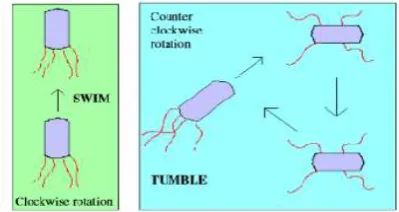
II.BACTERIALFORAGINGOPTIMIZATION(BFO)This technique is motivated by the foraging and Chemo tactic behaviors of bacteria, especially the Escherichia coli (E. coli). Locomotion can be achieved during the process of real bacteria foraging through the tensile flagella set. Flagella help an E.coli bacterium to fall or swim, that are two essential operations performed by a bacterium at the instance of foraging. When they revolve the flagella in the clockwise direction, every flagellum pulls over the cell. That results in moving of flagella separately and lastly the bacterium tumbles with smaller amount of tumbling, while in a damaging place it tumbles repeatedly to find a nutrient gradient. Stirring the flagella in the counter clockwise direction helps the bacterium to swim at a very speedy rate. In this bacteria undergoes chemo taxis, where they like to shift towards a nutrient gradient and shun harmful atmosphere. Usually the bacteria shift for a longer distance in a gracious situation. Figure 2 depicts how clockwise and anti-clockwise movements of a bacterium occur in a nutrient solution.
Figure 1 Swim and tumble of a bacterium
The BFO process can be divided into three parts namely a. chemo taxis b. reproduction and c. elimination and dispersal which is shown in figure 3.
Figure 2 BFO process
Chemo taxis
It is the behavior of the bacteria in which it tries to avoid the deadly substance and then move forward to search nutrients by hiking towards high nutrient area
Reproduction
In reproduction when bacteria get sufficient amount of food its length increases in the presence of appropriate surroundings and then the bacteria break down from the middle to form an exact copy of itself.
Start
Chemo taxis
Reproduction
Elimination & dispersal
IJEDR1602356
International Journal of Engineering Development and Research (www.ijedr.org)2027
EliminationElimination step is required to move to another direction. it involves dispersal which may place the bacteria near good food sources.
III.FEED FORWARD BACK PROPAGATION NEURAL NETWORK
Feed forward back propagation neural network consists of a series of layers: The first layer has a connection from the network input. Each subsequent layer has a connection from the previous layer. The final layer produces the network's output.
Feed forward back propagation neural network can be used for any kind of input to output mapping. A Feed forward back propagation neural network with one hidden layer and enough neurons in the hidden layer can fit any finite input-output mapping problem. Figure 4 represents the model of FFNN in which one input is taken after that in hidden layer 10 neurons are taken and at the end one output is observed.
Figure 3 FFNN model
IV.SIMULATION MODEL
For estimation of channel in OFDM system for pilot based arrangement using QAM modulation evaluation has done in MATLAB. The steps involved in the work are:
Step 1. Random data is taken Step 2. QAM modulation is done
Step 3. Modulated signal is obtained which is passed to serial to parallel converter. Step 4. Modulated signal after parallelization is obtained.
Step 5. Pilot tone is inserted. The pilot symbols are used to correct the phase error and for data security using carrier frequency set and channel estimators.
Step 6. The obtained signal is optimized by bacterial foraging optimization and classified by feed forward back propagation neural network.
Step 7. Estimation is done by using minimum mean square error estimator. Step 8. At last performance of two parameters are calculated i.e MSE and BER.
MSE: The mean-squared error (MSE) between two signals is MSE=(𝑛𝑒𝑤 𝑑𝑎𝑡𝑎 − 𝑜𝑙𝑑 𝑑𝑎𝑡𝑎)2/𝑙𝑒𝑛𝑔𝑡ℎ 𝑜𝑓 𝑑𝑎𝑡𝑎.
BER: Total number of errors during transmission of data V. SIMULATIONRESULTSANDDISCUSSION
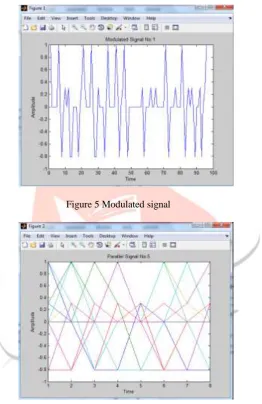
The simulation results for the performance of OFDM for QAM, using MATLAB. Various used parameters are: 96 bit of data is taken on which QAM modulation is done which is shown in figure 5.whuch is then passed to serial to parallel converter and is shown in figure 6 This parallel signal is modified by inserting pilot tone into the sequence which is represented in figure 7 Further one cyclic prefix guard interval is taken, Additive White Gaussian noise model is taken which is shown in table 1.Further for classification random data division is taken, and for training levenberg marquardt algorithm is chosen (figure 8) and the performance is measured in mean square error. For the results 50 iterations were chosen from which 3 to 4 epochs were converged.
TABLE 1SIMULATION TABLE
Parameters Values
Data 96 bits
Type of Modulation QAM
Guard Type Cyclic prefix
Guard interval One
IJEDR1602356
International Journal of Engineering Development and Research (www.ijedr.org)2028
Optimizationtechnique BFO
Classification Method FFBPNN
No. of iterations 50
Data division random
Training Algorithm Levenberg Marquardt
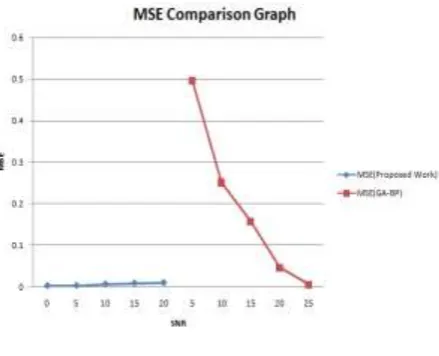
After the execution, two parameters MSE and BER with respect to SNR (which is taken in decibels are 0, 5,10,15,20) are calculated which are shown in figure 10 and 11. These results are compared with the GA-BP [17] and shown in table 2.
Figure 5 Modulated signal
Figure 6 Modulated signal after parallelization
IJEDR1602356
International Journal of Engineering Development and Research (www.ijedr.org)2029
Figure 7 Modulated Signal with Pilot tone insertionFigure 8 Convergence performance of modulated signal
The proposed system uses artificial neural network (ANN) with pilot symbols and data symbols for each of the data signal in channel. This system uses random data divisions, levenberg marquardt training, the number of maximum epochs are taken 50 and 6 validation checks. The best validation performance is found to be 430.7021 at epoch out of 3 epochs.
TABLE 2Comparison of BER between proposed and GA-BP
Proposed Work GA-BP [17]
SNR MSE SNR MSE
0 0.0023 5 0.4955
5 0.0027 10 0.2500
10 0.0063 15 0.1563
15 0.0083 20 0.0446
20 0.0098 25 0.0045
TABLE 3Comparison of MSE between proposed and GA-BP
Proposed Work GA-BP [17]
SNR BER SNR BER
0 0.1310 5 0.2455
5 0.0557 10 0.0759
10 0.0199 15 0.0357
15 0.0065 20 0.0089
IJEDR1602356
International Journal of Engineering Development and Research (www.ijedr.org)2030
Figure 9 MSE verses SNRFigure 9 shows the MSE for proposed work and GA-BP. From the graph it has been clearly seen that MSE is better for proposed work than compared work.its values has been shown in table 2. As after multiple iterations, the input data gradually becomes the target output via learning.
Figure 10 BER verses SNR
Figure 10 shows a graph that details the BER. From the graph it has been shown that obtained BER is .0020 for 20db SNR in case of proposed work and .0089 for GA-BP.The bit error rate is low for estimated channel.
VI.CONCLUSION
The proposed work showed the channel estimation based on pilot based arrangement. Channel estimation is the main area of focus in OFDM system This work has used MMSE algorithm to optimise the channel estimation. From the results of this work it has been concluded that BER and MSE value for QAM is better than normal OFDM system. The results demonstrate that the proposed approach is superior and provided good convergence rate. The proposed BFO and Feed forward backpropagation neural network achieved convergence within 3 to 4 iterations,compared to the 50 iterations.The current research work opens a lot of research areas for the future research workers . The future research workers can use a combination of ATST(advanced television system committe tuner) encoding technique with other encoding technique for the future betterment. In addition to that any other channel like Rayleigh channel can be sued for transmission.
References
[1] Bhasker Gupta, Gagan Gupta, and Davinder S. Saini, “BER Performance Improvement in OFDM System with ZFE and MMSE Equalizers”, IEEE Communications Letters, vol.6, pp. 193-197, April 2011.
[2] Zhao, Z., Peng, Z,” Joint power control and spectrum allocation for cognitive radio with QoS constraint”, Communication Networks, vol. 2, pp. 38– 43, 2010.
[3] Kuixi Chen, Jihua Lu, Bo Yang, Zhilun Li and Zibin Zhang, “Performance Analysis of an OFDM Transmission System Based on IEEE802.11a”, IEEE Communication Letters, pp. 1-6, Oct. 2011.
[4] Tian-Ming Ma, Yu-Song Shi, and Ying-Guan Wang, “A Low Complexity MMSE for OFDM Systems over Frequency-Selective Fading Channels”, IEEE Communication Letters, vol.16, Issue 3, March 2012.
[5] Cui T, Tellambura C,”Channel estimation for OFDM systems based on adaptive radial basis function network,” IEEE 60th vehicular technology conference, pp 608–611, 2004.
IJEDR1602356
International Journal of Engineering Development and Research (www.ijedr.org)2031
[7] T. S. Rappaport, “Wireless Communications, Principles and Practice 2nd edition”, Pearson Education, vol.1, pp. 356–376,2002.
[8] Kai Yu and Bjorn Ottersten, “Models for MIMO Propagation Channels a review in Special Issue on Adaptive Antennas and MIMO Systems”, Wiley Journal on Wireless Comm. and Mobile Computing, vol.2, Issue 7, pp. 653-666, November 2002. [9] Van de Beek, J. Edfors, O. Sandell, M. Wilson, S.K. Borjesson and P.O, “On channel estimation in OFDM systems”, 45th
IEEE Vehicular Technology Conference, vol.2, Issue 7, pp. 815-819, 1995.
[10]Pallavi Bhatnagar, Jaikaran Singh, Mukesh Tiwari, “Performance Of MIMO-OFDM System For Rayleigh Fading Channel”, International Journal Of Science And Advanced Technology, vol.1, Issue.3, May 2011.
[11]Jin-Sung Kim, Sung-Hyun Moon, and Inkyu Lee, “A New Reduced Complexity ML Detection Scheme for MIMO Systems”, IEEE Journals and Magazines, vol.58, Issue 4, pp. 1302-1310, April 2010.
[12]Krishna N. Chaudhari, 2 Dr. Dharmistha D. Vishwakarma, “BER Improvement in MIMO system using OFDM,” International Journal of Advanced Research in Computer Science and Electronics Engineering (IJARCSEE) vol. 2, Issue 1,ISSN: 2277- 9043, January 2013.
[13]Nawaz S J,MohsinS ,IkaramAA,”Neural network based MIMO OFDM channel equalizer using comb-type pilot arrangement,” International conference on future computer and communication, pp 36–41,2009.
[14]J. A. Anguita , M. A. Neifeld and B. V. Vasi, “ multi-beam free-space optical link using space-time coding”, Free-Space Laser Communications VI, 2006.
[15]Rajbir Kaur, CharanjitKaur , “DFT based Channel Estimation Methods for MIMO-OFDM System using QPSK modulation technique”, International Journal of Engineering Research and Applications (IJERA) ,Vol. 2, pp.1239-1243, September- October 2012.
[16]Anshu Jaiswal, Ashish Dubey and Manish Gurjar, “Channel Estimation in BPSK-QPSK-PSK 16 & 64 QAM MIMO-OFDM System”, INPRESCCO, Vol. 4, pp. 2346-2348, 2014.
[17]Chia-Hsin Cheng, Yao-Hung Huang, Hsing-Chung Chen,” Channel estimation in OFDM systems using neural network technology combined with a genetic algorithm”,springer india ,pp.1-10, june 2015.
[18]Neetu Sood, Ajay K Sharma, Moin Uddin, “BER Performance of OFDM-BPSK and -QPSK Over Generalized Gamma Fading Channel”, International Journal of Computer Applications, Vol.3, pp. 11-16, June 2010
[19]Ruchin Magla, Maninder Singh, “Performance Comparison of MIMO-OFDM Transceiver Wireless Communication System using QAM and QPSK Modulation Schemes”, IJAESTONLINE, Vol.1, pp.66-72, 2011.
[20]Jiang Xuehua, and Chen Peijiang, “Study and Implementation of MIMOOFDM System Based on Matlab,” IEEE Computer Society: International Conference on Information Technology and Computer Science, pp. 554–557, 2009.
[21]Bara’u Gafa iNajashi, and Tan Xiaoheng, “A Comparative Performance Analysis of Multiple-Input Multiple-Output using MATLAB with Zero Forcing and Minimum Mean Square Error Equalizers,” American J. of Engineering and Applied Sciences, vol. 4, Issue 3, pp. 425–428, 2011.
[22]Abhishek Sharma, and Anil Garg, “BER Analysis Based on Transmit and Recieve Diversity Techniques in MIMO-OFDM System,” IJECT, Vol. 3, Issue I, Jan-March 2012.
[23]Bhanu, and Lavish Kansal, “Performance Analysis of MIMO-OFDM by Spatial Diversity with STBC4,” International Journal of Computer Applications, vol.48, Issue. 20, pp. 16–28, June 2012.