Implement PAPR Reduction in OFDM System UsingReduced
Complexity PTS with Companding
DHONVAN SRINU1 , DHONVAN SINDHU2, VEMIREDDY KALAVATHI3 1,3
Assistant Professor in ECE dept at Marri laxman reddy institue of technology and Management,Dundigal,Hyderabad,Telangana, India
Abstract:A non-constant envelope with high peaks is a main disadvantage of Orthogonal Frequency Division Multiplexing(OFDM). These high peaks produce signal excursions into non-linear region of operation of the Power Amplifier (PA) atthe transmitter, thereby leading to non-linear distortions and spectral spreading. The probabilistic methodsscramble the signal by computing with phase factors.Partial transmit Sequence (PTS) is one of the techniqueswhich reduces PAPR. The computational complexity ofPTS can be reduced by using cost function Qs for eachOFDM symbol. The symbols with Qn ≥ threshold areconsidered as the signal with lowest PAPR. To promote thelowest PAPR a μ- law and A- law companding is usedwithout amplifying the complexity.
Keywords-OFDM, PAPR, PA, PAPR; DCT;
I. INTRODUCTION
Globally, Multimedia plays a foremost role in this cleveran international with its creation of 4th technology wirelessconversation with high demand but while the spectrumfor verbal exchange stays very less than the quantity ofusers. In Single provider system, the single service engages thewhole conversation bandwidth while in multi-carrierthe to be had communication bandwidths are divided by way ofmany subcarriers. Due to this, every subcarrier receives smallerbandwidth than the bandwidth of single server system. Toconquer this, OFDM may be used which comes up with satisfactorybandwidth performance, high-pace information costs & its proof againstfrequency selective fading marks. The base of all 4Gverbal exchange is OFDM because of its excessive-speed information rate asexcessive as 100Mbps, the sizable potential of some of the subscarriers & giant coverage with excessive mobility. OFDMare broadly & majorly utilized in DAB, DVB& LTE & a great dealextra.
In OFDM, tight frequency synchronization, time offset,peak to average power ratio (PAPR) and channel estimationare the predominant negative aspects. The impartial phases of subcarriers lead to optimistic impact when all subcarriers have the equal phase which ends up in high height amplitude resulting in a signal with high PAPR charge. So, the amplifier Q factoroperates in saturation region which leads to nonlinearamplification due to the more amplitude of OFDM signal thanthe linear range of transmitter amplifier. In those dynamicrange amplifiers, the efficiency lacks by reducing the BatteryLife & Carbon Footprint. Mitigation of such optimistic &unfavorable results are important for stepped forward machineoverall performance[1].
The boom in no. Of sub-companies also will increase the PAPRof OFDM which degrades the system performance of poweramplifier & its efficiency. To triumph over the hassle of HighPAPR few PAPR reduction strategies are used known asDistortion & distortion fewer strategies.The distortionthe method includes clipping, filtering, peak windowing, andcommanding, wherein the data are distorted by means of severalstrategies without affecting the data cost of the signal &with none upward thrust in power of the signal.The Distortion much lessthe technique includes Selected Mapping (SLM), PartialTransmit Sequence (PTS), coding techniques, interleavingand tone reservation and injection technique in which thedata undergoes scrambling technique without anydistortion in data[2,3].
II. RELATED WORK
scheme without side informationfor OFDM signal transmissions was done by Takeda andAdachi (2012).Low complexity PAPR reduction techniquefor OFDM systems using modified widely linear SLMscheme was done by L.Yang et al.,(2012).Precoded DCTand low complexity SLM for PAPR reduction in OFDMsystems was done by Nugrohoand Kim (2013).PAPRreduction scheme with selective tone reservation forOFDMsignals was done by C.-C. Chen et al.,(2013).Linearprecoding schemes for PAPR reduction in mobile WiMAXOFDMA System was done by Jijina and Pillai (2014). AReview on PAPR Reduction Techniques was done by yogitaet al.,(2014)
This method employs a clipper that limits the signalenvelope to a predetermined clipping level (CL) if thesignal exceeds that level; otherwise, the clipper passes the signal. The out-of-band distortion causes spectralspreading and can be eliminatedby filtering the signal afterclipping but the in-band distortion can degrade the BERperformance and cannot be reduced by filtering However,oversampling by taking longer IFFT can reduce the in-banddistortion effect as portion of the noise is reshaped outside ofthe signal band that can be removed later by filtering In thisscheme a predetermined threshold level is defined and if thehigh peak goes beyond this predetermined threshold, it ismultiplied by a weighting function known as windowfunction. The most commonly used window functionsinclude Cosine, Hamming, Hanning, Kaiser and Gaussian.
Windows.author described a scheme to perform windowingon a clipped and filtered signal repeatedly for PAPRreduction and achieved 7dB PAPR reduction at CCDF valueof 10-3 , within 1 dB increase of Eb /N0 at 10-4 BER. Anadvanced peak windowing method is discussed where newweighting coefficients are introduced wheneversuccessive peaks are generated within a half of the windowlength. The successive peaks can be restrained to a giventhreshold level after applying the new weighting coefficients.author introduced sequential asymmetric superposition (SAS)which is a two new peak windowing methods and optimallyweighted windowing (OWW) to deal with closely spacedpeaks to avoid high PAPR values.
III. METHOD OF SOLUTION
This method basically applied for audio signals. Compandingconsist compression and expansion. After companding,the lower peak values are increased but higher peaksremain constant and hence, average power of OFDMsignal is increased. Hence the peak to average power ratiodecreases. Companding transform can be generallyclassified into four classes: linear symmetrical transform(LST), linear asymmetrical transform (LAST), nonlinearsymmetrical transform (NLST), nonlinear asymmetricaltransform (NLAST). Many companding transforms whichbelongs to the above four mentioned classes, are discussed inthe literature. µ-law companding transform is used to reducePAPR. The examined the effect of companding on the BERperformance of the OFDM system in the presence of AWGNand concluded that a reasonable symbol error rate is achievedby properly choosing companding coefficients. A NLAST toreduce PAPR is proposed in reference using the errorfunction transformation given by xc[n]= k1 erf (k2 x[n]),where k1 and k2 are properly chosen coefficients based onstatistics of the transmitted OFDM signal. If k1 and k2are chosen properly, then it projects the high peaks of thesignal envelope into the nonlinear region of the compandingfunction, while the lower magnitudes are projected onto thelinear region. This enhanced the low values, while high peaksare relatively attenuated.
Partial Transmit Sequence (PTS): In PTS, an inputdata block of length N is partitioned into a number ofdisjoint sub-blocks. Then each of these sub-blocks arepadded with zeros and weighted by a phase factor. The schematic is shown in Figure 1.
Fig.1 Block diagram of PTS
distributed envelope orthe exponentially distributed power of the original OFDMsignal into uniform distribution. This method either generatemultiple permutation of the OFDM signal and transmit theone with minimum PAPR or to modify the OFDM signal byintroducing phase shifts, adding peak reduction carrier orchanging constellation points. Major techniques under thiscategory are follows:
The basic idea in SLM technique is to generate a set ofsufficiently different candidate data blocks by the transmitterwhere all the data blocks represents the same information asthe original data block and select the favorable having theleast PAPR for transmission. Side information [SI] about thephase factor is needed to be transmitted separately todecode the OFDM symbol at the receiver side. For Mphase sequences [log2M], side. A lot of computations arerequired to choose best candidate for large block sizes. Tosolve this complex problem, a lot of work has been done inthis field. A method to reduce computational complexity isproposed in where an intermediate k-stage IFFT block isused to partially IFFT the block and then phasesequences are multiplied to it, remaining n-k stage IFFTis done after it. The computational complexity reductionratio (CCRR) is tabulated for various values of n-k, M and N.
For lower value of n-k up to 72% CCRR is achieved. ascheme is proposed to generate a candidate signal bycombining OFDM signals and its cyclically delayed versionof varying delay and phase, same PAPR performance isachieved at reduced complexity of 50% to 76%. In [20],additive sequences are used for generation of newcandidates from the existing one, scheme achieves aCCRR up to 88% for the multiplication and78% for additionat M=40. intermediate IFFT stages are used, howeverin place of multiplying phase rotation, the proposedscheme generates OFDM candidates by cyclicallyshifting the connections at the intermediate IFFT stages,achieved CCRR for multiplications and addition is 70%for 1024 subcarriers and M=8.
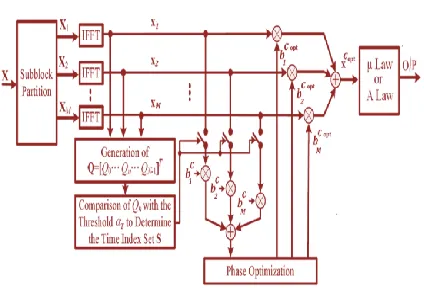
In this method the reduced complexity is combined with linearcompanding techniques as follows: • As shown in Fig. 3 the data signal is divided into V
disjoint subblocks. find
compute
∑ for tabulate as a set (T)
• signals of the samples sϵT are used to computeoptimum signal for PAPR.
• the computed optimum signal of samples sϵT
isagain computed by A-law or µ-law companders
• The companded OFDM signal PAPR is calculated.
Fig. 2 Reduced complexity cwith companding OFDM system
IV. CONCLUSION
In reduced complexity PTS OFDM system [8], the PAPR isreduced compared with conventional PTS. Using this method,the computational complexity is reduced based on the costfunction by summing the samples of the time symbols „s‟inV disjoint subblocks. As the γ decreases, the PAPR decreases.The reduced complexity PTS with compading OFDM systemfurther increases the efficiency of high power amplifiers byreducing the PAPR to lower values.
REFERENCES
[1] T. Hwang, C. Yang, G. Wu, S. Li and G. Y. Li, "OFDM and Its WirelessApplications: A Survey," in IEEE Transactions on VehicularTechnology, vol. 58, no. 4, pp. 1673-1694, May 2009.
[3] S. H. Müller and J. B. Huber, “OFDM with reduced peak-to-averagepower ratio by optimum combination of partial transmit sequences,”Electron. Lett., vol. 33, no. 5, pp. 368-369, Feb. 1997.
[4] L. J. Cimini and N. R. Sollenberger, “Peak-to-average power ratioreduction of an OFDM signal using partial transmit sequences,” IEEECommun. Lett., vol. 4, no. 3, pp. 86–88, March 2000.
[5] S. H. Han and J. H. Lee, “PAPR reduction of OFDM signals using areduced complexity PTS technique,” IEEE Signal Process. Lett., vol. 11,no. 11, pp. 887-890, Nov. 2004.
[6] T. Jiang, W. Xiang, P. C. Richardson, J. Guo, and G. Zhu, “PAPRreduction of OFDM signals using partial transmit sequences with lowcomputational complexity,” IEEE Trans. Broadcast., vol. 53, no. 3, pp.719-724, Sep. 2007
[7] A. Ghassemi and T. A. Gulliver, “A low-complexity PTS-based radixFFT method for PAPR reduction in OFDM systems,” IEEE Trans.Signal Process., vol. 56, no. 3, pp. 1161-1166, Mar. 2008.
[8] S. J. Ku, C. L. Wang and C. H. Chen, "A Reduced-Complexity PTSBased PAPR Reduction Scheme for OFDM Systems," in IEEETransactions on Wireless Communications, vol. 9, no. 8, pp. 2455-2460,August 2010.
[9] X. Wang, T. T. Tjhung, and C. S. Ng, “Reduction of peak-to-averagepower ratio of OFDM system using a companding technique,” IEEETransactions Broadcasting, vol. 45, no. 3, pp. 303–307, September 1999.
[10] X. Wang, T. T. Tjhung, and Y. Wu, “On the SER and spectral analysesof A-law companding multicarrier modulation,” in Proc. IEEE VehicularTechnology Conference (VTC), vol. 52, September 2003, pp. 1408–1412.
[11] S. A. Aburakhia, E. F. Badran and D. A. E. Mohamed, "LinearCompanding Transform for the Reduction of Peak-to-Average PowerRatio of OFDM Signals," in IEEE Transactions on Broadcasting, vol.55, no. 1, pp. 155-160, March 2009.
[12] C. Anjaiah and Hari Krishna Prasad P., "Mu-Law companded PTS forPAPR reduction in OFDM systems," 2015 IEEE InternationalConference on Electrical, Computer and Communication Technologies(ICECCT), Coimbatore, 2015, pp. 1-4.
BIODATA
AUTHOR1
Dhonvan Srinu received his B.Tech in ECE ( Electronic and communication Engineering).at Vaagdevi College of Engineering , Warangal dist. Telangana. And P.G received in ECE (DECS)in VLSI System Design. Aurora College of Engineering , Nalgonda..Dist. Telangana, India. He is currently working as a assistant professor in ECE dept at Marri laxman reddy institue of technology and Management dundigal, Hyderabad ,Telangana, India. She has 7 years of teaching experience.
AUTHOR 2
Dhonvan Sindhu received her B.Tech in ECE in Kodada Onstitute of Technology and Science for women.Kodada.
And P.G received in ECE (Embedded Systems) in
Aravindaksha Educational Society’s Group of
Institutions,Balemla,Suryapeta,SuryapetaDist. Telangana, India.