ISSN 2348 – 7968
Effects of hydrotherapy in balance and prevention of falls
among elderly men
Y. KhanjariP0F
1
P
(M.A) - R.Garooei (M.A)
University of Tehran, University of Kharazmi
Abstract
Background: Hydrotherapy is used to treat rheumatic, orthopedic and neurological disorders. It has been the subject of investigations
regarding balance recovery in elderly people. Objective: To evaluate the effect of a hydrotherapy program for balance, in relation to the risk
of falls in elderly men. Methods: This was a quasi-experimental before/after study without a control group. Twenty-five elderly men were
evaluated using two scales: the Berg Balance Scale and Timed Up & Go. The subjects underwent, subsequently, a low to moderate
intensity hydrotherapy program for balance, which consisted of three phases: a phase of adaptation to the aquatic environment, a stretching
phase and a phase of static and dynamic balance exercises. The program was applied for 12 weeks, with two sessions per week, each
session lasting 45 minutes. The elderly men were reassessed after the sixth and twelfth weeks of the hydrotherapy program. The data were
analyzed statistically by means of Student’s t test for paired samples and the Wilcoxon test. Results: Hydrotherapy promoted significant
increases in the elderly men’s balance, as assessed using the Berg Balance Scale (p< 0.001) and the Timed Up& Go test (p< 0.001). There
was also a reduction of the scores in a scale of risk of falls (p< 0.001), according to the model of Shumway-Cook et al. Conclusions: It can
be suggested that this hydrotherapy program for balance gave rise to an increase in balance and a possible reduction in the risk of falls
among these aged men.
0T
Key words:0T hydrotherapy; physical therapy; musculoskeletal equilibrium; accidental falls; aged person.
Introduction
Nowadays, falls are one of the largest public health problems among elderly people due to the high morbidity, mortality and costs for
the family and society1. The main risk factors for falls in this population are related to functional limitations, history of falls, increasing
age1-4, muscle weakness, use of psychotropic drugs, environmental risks1,3,4, the female gender2,5,6 and visual deficits2. Researchers
have reported that elderly women have a higher propensity for falls because of less lean body mass and muscle strength, a higher
prevalence of chronic-degenerative diseases and exposure to domestic activities2,5,6. Every year, in Brazil2 and the United States7, 30% of
non-institutionalized elderly people suffer falls. Approximately 5% of these cause fractures, especially in the hips2. In the United States,
the annual cost of treating hip fractures among elderly people caused by falls is 10 billion dollars8. The figures gained from the studies in
Iran indicate that 47% of old women and 44% of old men are pron to hipe fracture due to lack of bone density and falling9. To prevent
falls, it is necessary to improve the reception conditions for sensory information from the vestibular, visual and somatosensory systems, so
that the antigravity muscles are activated and balance is stimulated10. One of the means applied for promoting the stimulation mentioned
above is the practice of physical activities11,12.
Thus, it is recognized in the literature that physical activity practiced throughout life can diminish bone and muscle loss, and reduce the risk
of fractures by up to 60%1,3. In addition, physical activity promotes increased muscle strength, aerobic conditioning, flexibility and
balance, and reduces the risk of falls and improves quality of life3,13.Since long ago, hydrotherapy has been used as a resource for treating
ISSN 2348 – 7968 rheumatic, orthopedic and neurological diseases; however, it has only recently become the target of scientific studies. The
physical proprieties of water, together with the exercises, can fulfill most of the physical objectives that are proposed in a rehabilitation
program. The aquatic environment is considered safe and efficient for the rehabilitation of elderly people, because water acts
simultaneously on musculoskeletal disorders and balance improvements14,15. The multiplicity of symptoms such as pain, muscle
weak-ness,balance deficits, obesity,arthritic diseases and gait disorders, among others, make it difficult for elderly people to perform exercises on
the ground. The situation is different with exercises in an aquatic environment, where there is a reduction in joint overload and less risk of
falls and lesions. In addition, floating allows individuals to perform exercises and movements that cannot be done on the ground10,14,16.
Although few studies have reported the effects of hydrotherapy on balance and the reduction of falls, all of them have shown benefits, for
example, of reduced postural oscillations17, increased functional reach16 and greater independence in activities of daily living (ADLs)18.
Given the relevance of this subject, the objective of the present study was to evaluate the effects of a hydrotherapy program on balance and
risk of falls among elderly men.
Methods
This was a quasi-experimental pre/post study without a control group, carried out at the Elderly People’s in Shiraz Niyayesh Health center
in Shiraz. It was carried out following the ethical principles defined for research .
Individuals
To develop the study, 50 elderly people (50 man) were selected. The selected group were choosed of the people who were the members of
the center and subsequently selected in accordance with the inclusion and exclusion criteria. The inclusion criteria were: over 60 years of
age, independence in walking, independence in activities of daily living, the absence of medical contraindications for exercise,
cardiologi-cal and dermatologicardiologi-cal medicardiologi-cal certificate, 80% participation in the treatment and signature of the free and informed consent statement. The
exclusion criteria were: urinary or fecal incontinence, renal insufficiency, open wounds, contagious skin diseases, infectious diseases,
catheters, vascular thrombi, cardiac insufficiency, uncontrolled arterial pressure, dyspnea upon minimal effort, use of psychotropic drugs
(benzodiazepines) or participation in any other physical activity or physical therapy program. After the selection, 40 elderly men fit the
inclusion criteria. Fifteen of them did not complete the study for reasons such as travel and health problems. Thus, 25 elderly men with a
mean age of 72.60 ± 7.11 years composed the sample that was investigated.
Materials
The materials consisted of the following: a questionnaire for interview, the Berg Balance Scale – Brazilian version19, the Timed Up & Go
test20, a chronometer (Sport Timer), a 20-centimeter (cm) graduated ruler, two chairs of 45 cm in height (one of them with arms), a
measuring tape, stethoscope and sphygmomanometer of the Becton Dickinson brand, and a rectangular-shaped swimming pool measuring
7.5 by 11.1 meters, with a sloping bottom with the depth going from 0.8 to 1.2 meters, and with a mean temperature of 30ºC.
Procedures
The evaluation started with an interview to collect information such as age, marital status, number of people living in the home, reports
of diseases, use of medications and history of falls and fractures. After the interview, the elderly men underwent balance evaluation using
the Berg Balance Scale19 – Brazilian version, and the Timed Up & Go20 test. In addition, the prognosis for the risk of falls, in relation to
the Berg Balance Scale score, was evaluated in accordance with the model of Shumway-Cook et al.21. These tests were chosen because
they are functional, validated, internationally accepted, easy to apply and low-cost19,20. The Berg Balance Scale serves various purposes,
ISSN 2348 – 7968 such as quantitative description of functional balance ability, determination of risk factors for loss of independence and falls
among elderly people, and evaluation of the effectiveness of interventions both in clinical practice and research. The scale evaluates static
and dynamic balance based in 14 common items in daily life, such as reaching, turning around, moving away, standing up and getting up.
The maximum score that can be attained is 56 points. It was applied in accordance with the procedures described by the authors who
translated and adapted it for Brazil19. The model for quantitative prediction of the risk of falls among elderly people, which establishes the
relationship between the Berg Balance Scale and the risk of falls (10 – 100%), was also used as developed by Shumway-Cook et al.21. In
this model, the sensitivity of the scale was 91% and the specificity was 82%. The likelihood of falls increases with decreasing scores on the
Berg Balance Scale in a nonlinear relationship. For amplitudes from 56 to 54, each point lost is associated with an increase in the risk of
falls of 3 to 4%. From 54 to 46, each one-point decrease is associated with an increase of 6 to 8%. Below 36 points, the risk of falls is
nearly 100%21. The Time Up& Go test provides rapid monitoring to detect balance problems that affect elderly people’s ADLs. The
shorter the time used to complete the test, the better the balance is. The time it took for the elderly women to get up from a chair, walk a
distance of 3 meters, turn around, walk back to the chair and sit down again was measured in seconds20. The elderly women did the test
once to become familiarized with it and, on the second attempt, the time was recorded. The scales were applied before the treatment
(pre-test) and after six weeks (post-test 6) and 12 weeks (post-test 12) of hydrotherapy. The arterial pressure (AP) was measured before and after
the treatment sessions, with the aim of checking the individuals’ conditions for performing the aquatic activities, without statistical
intentions.The study lasted 12 weeks, with 40-minute sessions, twice a week (on Mondays and Wednesdays). The hydrotherapy for balance
program was carried out with six elderly men per group and included adaptation to the aquatic environment, hydrokinesiotherapy and
inclusion of aquatic exercises from other studies16,22,23that challenge balance. Each session was divided into three phases: aquatic
environment adaptation phase, stretching phase and a phase of static and dynamic exercises for balance. The intensity was low to moderate,
with constant intensity, frequency and speed, for 12 weeks. Each series was performed continuously and between each one there was a
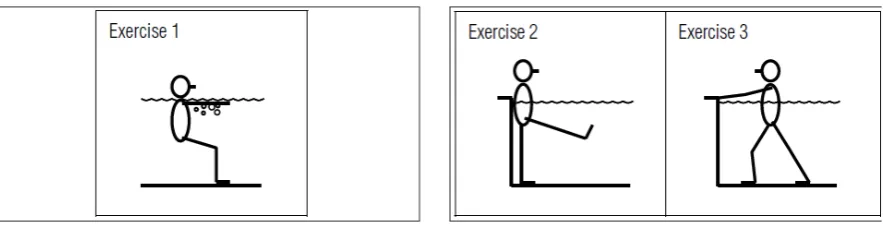
one-minute rest. The program is described in the following and can be observed in Figures 1, 2 and 3.
Phase I – Aquatic environment adaptation.
Exercise 1: Respiratory control.
• Positioning: Semi-seated position without posterior support, with immersion to the shoulder level. Shoulders at 90º flexion and with
extended elbows.
• Activity: Slow and prolonged expiration through the mouth over the water, then with the mouth immersed, and subsequently with
both mouth and nose immersed (2’).
Figure 1.Hydrotherapy program for balance.Phase I – aquatic environment adaptation.Figure 2.Hydrotherapy program for balance. Phase
II – stretching.
Phase II – Stretching. Each stretching exercise was maintained for 30 seconds.
Exercise 2: Stretching of the hamstring muscles
ISSN 2348 – 7968 •Positioning: Orthostatic position with back supported against the wall .
•Activity: Elevation of one of the lower limbs, maintaining knee extension and ankle dorsal flexion.
Exercise 3: Stretching of the triceps surae and iliopsoas muscles
•Positioning: Orthostatic position with hands on the edge of the pool .
•Activity: Taking a large step forward, while maintaining the anterior knee in flexion, the posterior knee in extension, and feet in contact
with the bottom of the pool.
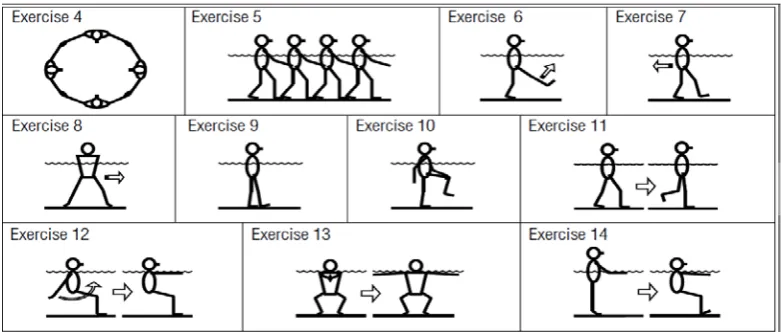
Phase III – Static and dynamic exercises for balance. The speeds and frequencies indicated were approximate averages.
Exercise 4: Walking in circles hand-in-hand with sporadic changes of direction
•Activity: Walking sideways, facing forwards and backwards, alter-nating the direction from clockwise to anticlockwise, three times in
each kind of walk (once for each kind of walk, speed: 0.40 m/s).
Exercise 5: Walking in line
•Positioning: Hands supported on the waist of the individual in front .
•Activity: Moving in the pool making circles and changes in direction. The activity was conducted by the physical thera¬pist (Three times,
speed: 0.40 m/s).
Exercise 6: Walking forward pushing lower members vigorously
•Activity: Walking with higher speed and propulsion (45 me¬ters, speed: 0.50 m/s).
Exercise 7: Walking backwards. (45 meters, speed: 0.50 m/s(
Exercise 8: Lateral walk with large steps. (45 meters, speed: 0.55 m/s).
Exercise 9: Walking with one foot in front of the other
•Activity: Walking supporting one foot immediately in front of the other, and so on successively (45 meters, speed: 0.20 m/s.)
Exercise 10: Walking with trunk rotation
•Activity: Walking forwards taking hand to opposite knee in flexion, alternately (45 meters, speed: 0.30 m/s.)
Exercise 11: Walking with one-leg support pauses
•Activity: Walking and, at the physical therapist’s com¬mand, maintaining one-leg support with the opposite knee in flexion for 10
seconds (12 pauses in 45 meters, speed: 0.50 m/s)
Exercise 12: Bilateral shoulder flexion-extension
•Positioning: Semi-seated position .
•Activity: Performing shoulder flexion and extension, while keeping the elbows in extension. Starting with maximumshoulder
hyperextension and going until 90º flexion (10 repetitions, frequency: 12 repetitions per minute).
Figure 3.Hydrotherapy program for balance. Phase III – static and dynamic exercises for balance.
ISSN 2348 – 7968
Exercise 13: Bilateral horizontal shoulder abduction-adduction
• Positioning: Semi-seated position, shoulders flexed at 90º, extended elbows.
• Activity: Starting in adduction and going until 90º of horizontal abduction (10 repetitions, frequency: 12 repetitions per
minute).
Exercise 14: Ankle pumping
• Positioning: Orthostatic position, with immersion up to the xiphoid process level.
• Activity: Extension of the knees associated with plantar flexion, maintaining this position for 5 s, and then knee flexion
associated with dorsiflexion, also maintaining this for 5 s (10 repetitions, frequency: 3 repetitions per minute).
Statistical Analyses
For comparisons over the course of time for the measurable variables, the Student t test for paired data and the Wilcoxon
test were used, by means of comparing scores or times after the treatment with corresponding results for the same individual
from the preceding evaluation. The data have been shown as mean differences and standard deviations of the difference. The
analysis was carried out with the aid of the “Minitab” software. The significance level adopted was α= 0.01.
Results
According to the initial interviews, the elderly men demonstrated the following characteristics: predominant age group
between 70 and 79 years (64%), 28% were married and 28% lived alone. The mean number of diseases reported per
individual was 2.2: predominantly controlled arterial hypertension (60%) and osteoporosis (28%). The mean number of
regularly used medications was 1.76 per individual. Twenty% of the elderly men had already experienced fractures as a
consequence from falls, and 76% had history of falls. Regarding arterial pressure, there were no variations from before to
after the sessions. According to the obtained results, the hydrotherapy program promoted significant increases in the elderly
mens’ balance, as observed by means of the Berg Balance Scale. The increase occurred after the sixth week (p< 0.001), after
the twelfth week (p< 0.001) and between the sixth and twelfth weeks (p< 0.001) (Table 1).
Likewise, the Timed Up & Go test showed that there was a significant decrease in the elderly men’s times taken to perform
the tests after the hydrotherapy program, after the sixth week (p< 0.001), after the twelfth week (p< 0.001) and between the
sixth and twelfth weeks (p< 0.001), which indicated an increase in their balance (Tables 2 and 3).
The results show that the hydrotherapy program promoted a significant reduction in the risk of falls among these elderly men,
after the sixth week (p< 0.001), after the twelfth week (p< 0.001), and between the sixth and twelfth weeks (p< 0.001). These
results are in agreement with the prediction given by the model of Shumway-Cook et al.21 applied to the Berg Balance Scale
scores (Table 4).
Table 1. Mean differences and standard deviations of the differences, in points on the Berg Balance Scale, among elderly women before
and after the program of hydrotherapy for balance, for the periods from Pre-test (before treatment) to test6 (after 6 weeks), from
Post-test6 to Post-test12 (after 12 weeks) and from Pre-test to Post-test12. pvalues were obtained by means of the Student t test for paired data.
ISSN 2348 – 7968
Table 2. Mean differences and standard deviations of the time differences in seconds in the Timed Up & Go test, among elderly women
before and after the program of hydrotherapy for balance, for the periods from Pre-test (before treatment) to Post-test6 (after 6 weeks) and
from Pre-test to Post-test12 (after 12 weeks). pvalues were obtained by means of the Student t test for paired data.
Table 3. Median differences in time taken in seconds in the Timed Up& Go test, among elderly women before and after the program of
hydrotherapy for balance, for the period from Post-test6 (after 6 weeks) to Post-test12 (after 12 weeks). The p value was obtained by means
of the Wilcoxon test.
Table 4. Mean differences and standard deviations of the differences, in percentage points, of the risk of falls based on the
model by Shumway-Cook et al.21 applied to the Berg Balance Scale scores, among elderly men before and after the program
of hydrotherapy for balance, for the periods from Pre-test (before treatment) to Post-test6 (after 6 weeks), from Post-test6 to
Post-test12 (after 12 weeks) and from Pre-test to Post-test12. p values were obtained by means of the Student t test for paired
data.
Discussion
According to the obtained results, balance increased significantly after conducting the hydrotherapy program, according to
the Berg Balance Scale and the Timed Up & Go test. This was similar to the results obtained by many other
authors14,16,17,22-24, in which the application of a hydrotherapy program increased balance among elderly people.
However, the functional tests and treatment programs used in these studies were different, making it difficult to make
quantitative comparisons. In the present study, the risk of falls among elderly men, evaluated quantitatively, underwent a
significant reduction after the treatment. Studies that have found increased balance after hydrotherapy programs have also
suggested that there is a reduction in the risk of falls, since balance has a direct relation with these risks14,16,22. These
authors did not use a model with scoring that predicted the risk of falls, but was evaluated indirectly. That is, they classified
the elderly people as having a low, medium or high risk of falls according to the score obtained in the balance tests. Thus, it
ISSN 2348 – 7968 can be suggested that subsequent studies should use scales for scoring the risk of falls, in order to directly obtain
results. Other authors are unanimous regarding the indication of aquatic exercises for individuals with fear of falling who are
at risk of falls14,16,22,24. Water is viscous: it decelerates movement and retards falls, which prolongs the time available for
regaining posture when the body gets out of balance. Floating acts as a support, which increases individuals’ confidence and
reduces the fear of falling. In this way, individuals can be challenged beyond their limits of stability without being afraid of
the consequences of falls that would occur on the ground10,25. This hydrotherapy program was effective in reducing the risk
of falls among elderly men, thus, undesirable effects resulting from falls could be prevented. These can vary from small
injuries, mobility restrictions, limitations in ADLs and loss of functional independence, up to social isolation, can create a
vicious circle of voluntary restriction of activities and, thus severely compromises the quality of life2,26.
When analyzing the time intervals between the evaluations according to the scales, it was observed that there was a
greater gain in balance during the first stage of the program (up to the sixth week), as was seen by Simmons and Hansen16.
These results possibly occurred because the responses to physical exercise are more evident during the first weeks of
treatment. In the initial phase, neural changes predominate, and in the intermediate phase muscle adaptations predominate. In
elderly people, the muscle strength increases are mainly due to neural adaptations, which occur with greater magnitude during
the first six to eight weeks of training27,28. In the present study, the same program was applied throughout the whole period.
It is possible that modifying the program during the treatment, with progressive exercises (increasing intensity, frequency and
duration) would allow results of greater magnitude. Another possible hypothesis which may explain this result relates to the
limitations of the scales that were used. This meant that there was no possibility of measuring new abilities in the next period.
The Berg Balance Scale has a maximum score of 56 points, and many of the elderly men came very close to this value after
the sixth week; and the Timed Up & Go test cannot indefinitely show reducing times. As a reference, 10 s is the time
considered normal for healthy and independent elderly people20. Furthermore, other functional tests that were used to
evaluate balance, such as functional reach, Tinetti gait and balance scale and the dynamic gait index resulted in similar
limitations. The proposal of this hydrotherapy program consisted of stimulating balance reactions, in order to promote
increased balance and prevent falls among elderly men. It also sought to create a program that would be easy to replicate,
since each exercise and its frequency, intensity and duration were described, differently from most studies on this same
theme, in which the descriptions of the programs are simple and general14,16,17,22-24. Well defined programs are
fundamental for reproducing new research, and for confirmation of the results.
One possible limitation for this study regarding prediction of the risk of falls may come from the low sensitivity of the
Berg Balance Scale. Thorbahn and Newton29 compared elderly people’s self-reports of falls with the scale scores and
observed that the specificity of the test was high, but the sensitivity was only 53%. Due to the scarcity of tests for quantifying
therisk of falls, it is suggested that the existing ones should be improved and new tests should be created. Although the
sample size was small, and there was no control group, the results indicated that the hydrotherapy exercise program promoted
increases in balance and, possibly, a reduction in the risk of falls among elderly women. Thus, hydrotherapy is a possible
physical therapeutic resource to be recommended for preventing falls among elderly people.
ISSN 2348 – 7968
References
1.Stevens JA, Olson S. Reducing falls and resulting hip fractures among older women. MMWR Morb Mortal Wkly Rep. 2000;49:1-12.
2.Perracini MR, Ramos LR. Fatoresassociados a quedasemumacoorte de idososresidentesnacomunidade. Rev SaúdePública.
2002;36(6):709-16.
3.Gregg EW, Pereira MA, Caspersen CJ. Physical activity, falls, and fractures among older adults: A review of the epidemiologic
evidence. J Am Geriatr Soc. 2000;48:883-93.
4.Newton RA. Standing balance abilities of elderly subjects under altered visual and support surfaces. Phys Can. 1995;47:25-9.
5.Fried LP, Tangen CM, Walston J, Newman AB, Hirsh C, Gottdiener J, et al . Frailty in older adults. J Gerontol A BiolSci Med Sci.
2001;56:146-57.
6.Foldavari M, Clarck M, Laviolette LC, Bernstein MA, Kaliton D, Castaneda C, et al. Association of muscle power with functional status
in community-dwelling women. J Gerontol A BiolSci Med Sci. 2000;55:192-9.
7.Fuller GF. Falls in the elderly.Am Family Fhysician. 2000;61:2159-68.
8.Carter ND, Kannus P, Khan KM. Exercise in the prevention of falls in older people: a systematic literature review examining the
rationale and the evidence. Sports Med. 2001;31(6):427-38.
9.Irans ministry of Health and Treatment, in a report published in 2006.
10.Geigle PR, Cheek WL, Gould ML, Hunt HC, Shafiq B. Aquatic physical therapy for balance: the interaction of somatosensory and
hydrodynamic principles. The Journal of Aquatic Physical Therapy. 1997;5(1):4-10.
11.Masud T, Morris RO. Epidemiology of falls. Age Ageing. 2001; 30(S4):3-7.
12.Province MA, Hadley EC, Hornbrook MC, Lipsitz LA, Miller JP, Mulrow CD, et al. The effects of exercise on falls in elderly
patients.A preplanned meta-analysis of the FICSIT Trials. Frailty and Injuries: Cooperative Studies of Intervention Techniques.
JAMA. 1995;273:1341-7.
13.Barnett A, Smith B, Lord SR, Williams M, Baumand A. Community-based group exercises improves balance and reduces falls in
at-risk older people: a randomised controlled trial. Age Aging. 2003;32:407-14.
14.Booth CE. Water exercise and its effects on balance and gait to reduce the risk.of falling in older adults. Activities, Adaptation
Aging. 2004;28(4):45-57.
15.Caromano FA, Candeloro JM. Fundamentos da hidroterapiaparaidososArqCiêncSaúdeUnipar. 2001;5(2):187-95.
ISSN 2348 – 7968 16.Simmons V, Hansen PD. Effectiveness of water exercise on postural mobility in the well elderly: an experimental
study on balance enhancement. J Gerontol. 1996;51A(5):M233-8.
17.Lord S, Mitchell D, Willians P. Effect of water exercise on balance and related factors in older people. AustPhysio.
1993;39(3):217-22.
18.Rissel C. Water exercises for the frail elderly: a pilot programme. AustJ Physiother. 1987;33(4):226-32.
19.Miyamoto ST, Lombardi Junior I, Berg KO, Ramos LR, Natour J. Brazilian version of the Berg balance scale. Braz J Med Biol
Res. 2004;37:1411-21.
20.Podsiadlo D, Richardson S. The timed “Up & Go”: a test of basic functional mobility for frail elderly persons. J Am Geriatr Soc.
1991;39(2):142-8.
21.Shumway-Cook A, Baldwin M, Polissar NL, Gruber W. Predicting the probability for falls
22.Douris P, Southard V, Varga C, Schauss W, Gennaro C, Reiss A. The effect of land and aquatic exercise on balance score in older
adults. J GeriatrPhysTher. 2003;26(1):3-6.
23.Lord SR, Matters B, George RS. The effects of water exercise on physical functioning on older people. Aust J Ageing.
2006;25(1):36-41.
24.Devereux K, Roberston D, Briffa NK. Effects of a water-based program on women 65 years and over: a randomized controlled
trial. Aust J Physiother. 2005;51(2):102-8.
25.Salzman, AP. Evidence-based aquatic therapy for proprioceptive-training. The Aquatic Resources Network.Atri’s Aquatic
Symposium; Set 1998: H95-9.
26.Fabrício SCC, Rodrigues RAP, Costa Junior ML. Causas e conseqüências de quedas de idososatendidosem hospital público. Rev
SaúdePública. 2004;38(1):93-99.
27.Komi PV. Training of muscle strength and power: interaction of neuromotoric, hypertrophic, and mechanical factors. Int J Sports
Med. 1986;7:10-5.
28. Hakkinen K, Kallinen M, Izquierdo M, Jokelainen K, Lassila H, Malkia. E, et al. Changes in agonist-antagonist EMG, muscle CSA,
and force during strength training in middle-aged and older people. J Appl Physiol. 1998;84:1341-9.
29.BogleThorbahn LD, Newton RA. Use of the Berg Balance Test to predict.falls in elderly persons. PhysTher. 1996;76(6):576-85.