Server-Aided Two-Party Computation with Minimal
Connectivity in the Simultaneous Corruption Model
Ignacio Cascudo∗1, Ivan Damg˚ard1, Oriol Farr`as†2, and Samuel Ranellucci1
1Aarhus University,
{ignacio,ivan,samuel}@cs.au.dk 2Universitat Rovira i Virgili, Tarragona,
Abstract
We consider secure two-party computation in the client-server model. In our scenario, two ad-versaries operateseparately but simultaneously, each of them corrupting one of the parties and a restricted subset of servers that they interact with. We model security in this setting via the lo-cal universal composability framework introduced by Canetti and Vald and show that information-theoretically secure two-party computation is possible if and only if there is always at least one server which remains uncorrupted. Moreover, in our protocols each of the servers only needs to communicate with the two clients, i.e. no messages are exchanged directly between servers. This communication pattern is minimal.
Keywords: two-party computation, simultaneous corruption, universal composability with local adversaries, oblivious transfer.
∗
The authors from Aarhus University acknowledge support from the Danish National Research Foundation and The Na-tional Science Foundation of China (under the grant 61361136003) for the Sino-Danish Center for the Theory of Interactive Computation and from the Center for Research in Foundations of Electronic Markets (CFEM), supported by the Danish Strate-gic Research Council.
†
1
Introduction
This paper considers secure computation, where two parties (Alice and Bob) hold inputs and want to compute an agreed upon function on those inputs in such a way that the intended output is the only new information released.
More specifically, our goal is to implement secure two-party computation with information theo-retic security. It is well-known that this is impossible without assuming either preprocessing, additional auxiliary functionalities, or help from additional parties. The reason why shooting for unconditional security is nevertheless interesting is that information theoretic methods are typically computationally much more efficient than the heavy public-key machinery one needs for the two-party case if no addi-tional help is assumed. In our approach, we assume that the two parties get help fromnservers. This is essentially the client-server model of MPC introduced in [DI05], with 2 clients andnservers.
We depart from earlier work in this model in two ways. First, we strive for minimal connectivity. Our goal is to have each server communicate only with the two clients (i.e., the servers do not talk to each other). This communication pattern is minimal since, in order to be of any use in letting Alice and Bob do secure computation, a server must communicate with both of them. The minimality of the communication pattern has obvious advantages: it is easier to implement a protocol where servers do not need to communicate or even be aware of each other; in fact, as we will see later, in some cases the amount of work made by each of the servers in our protocol can even be made independent from the number of servers; it is also easier to set up the required secure communication channels if the servers only need public keys for Alice and Bob; finally, when running the protocol, a server can proceed as soon as he gets the next messages from Alice and Bob, instead of waiting to hear from all other servers, which would be required if the protocol was synchronous and involved interaction between all servers.
The second point that sets our work apart is the way we model adversarial behaviour. The standard model assumes one adversary who may corrupt one of the clients and some number of servers, typi-cally some constant fraction of them. If we want unconditional security, we need to assume an honest majority (orQ2 for general adversary structures [HM00]). In this paper, we ask whether we can tol-erate more corruptions and still have unconditional security, if we assume two adversaries, A,Bthat operateseparately, but simultaneously. We will characterise the capabilities of these adversaries by two anti-monotone families of server subsetsA,B, so-called adversary structures.
We think of these adversary structures as follows: we want to design protocols such that if you manage to corrupt Alice and a set of servers inA, you have of course broken Alice’s privacy, but you should not be able to break Bob’s – and vice versa forB.
More concretely, Ais allowed to corrupt Alice and a set of servers A ∈ A(it may decide to not corrupt servers). Corruption may be semi-honest or malicious. Likewise we allowBto corrupt Bob and a setB ∈ B. We call this thedouble adversary model. An obvious question now is how we should define security for a protocol in this model. To this end, one can first observe that if eitherAorBdecide to not corrupt anyone, we are back in the standard single adversary model and security means what it usually does. But we also define meaningful security requirements in the more general case where both adversaries operate at the same time. Loosely speaking, we require that an adversary should learn as little information as possible and be unable to affect the result achieved by parties that he did not corrupt. We will discuss this in more detail in a moment. Our main result gives a positive answer to the above question: it says that secure computation is possible in our model even in cases where all but one of the servers has been corrupted by one of the two adversaries, and moreover, this is the best we can hope for.
THEOREM1.1 (INFORMAL) The pair(A,B)is said to beR2if for anyA∈ A, B∈ B,A∪Bis not the entire set of servers. Two-party computation is possible in the double adversary model w.r.t. adversary structuresAandBif and only if(A,B)isR2.
intro-duced by Hirt and Maurer [HM00]1. Q2is necessary and sufficient for statistically secure MPC in the single adversary case assuming also a broadcast channel.
For the case of threshold adversary structures, where we assume that Alice can corrupt at most tA
servers, and Bob can corrupt at mosttB,R2means thattA+tB < n. However, more general cases may
occur as well: assume, for instance, that there is a cost associated with corrupting each server, which does not have to be the same for all servers. Now, if both adversaries have a certain budget they can spend, this corresponds to certain adversary structures containing the sets that they can corrupt. In this case theR2 condition intuitively says that the joint wealth of the adversaries is limited to some extent. Interestingly, we will see that there are even examples ofR2pairs(A,B), yet neitherAnorBisQ2. On the other hand, a pair(A,B)naturally defines an adversary structureU in theextended setP ofn+ 2 players consisting of Alice, Bob and thenservers, where the maximal sets inU are the sets that consist of Alice and a set fromA, or Bob and a set fromB. It turns out that(A,B)isR2if and only ifUisQ2. This last observation means that Alice and Bob could also use general results on MPC forQ2 struc-tures to compute their desired function securely. We want to emphasise that our result distinguishes itself from this approach in several respects: first, we already mentioned that general secure MPC protocols against anactiveadversary with aQ2 structure must assume the existence of a broadcast channel and can only achieve statistical security. In contrast, our protocol does not assume broadcast and achieves perfect security. Second, even if one makes the necessary additional assumptions, using generic MPC protocols would not achieve our minimal communication pattern, where each server only needs to talk to Alice and Bob and does not even need to be aware of the other servers. Finally, we are not aware of any results that imply that known generic MPC protocols are still secure in our double adversary model (see below for a more detailed description of this security notion).
We can already now observe that one part of the theorem is easy to show, namely if(A,B)is notR2
then we cannot hope for an unconditionally secure protocol. This is simply because a secure protocol for a non-R2 case would imply general 2-party unconditionally secure computation in the standard model which is well known to be impossible. This follows by a standard emulation argument: Consider semi-honest corruption and assume we have a multiparty protocol secure against corruption of Alice as well as server setAbyAand Bob as well as server setB byB, whereA∪Bis the full set of servers. Then the entire protocol can be emulated by two players where one plays for Alice and servers inA while another plays for Bob and servers inB. This would give us a secure two-party protocol in the standard model.
Techniques and Details
We now discuss our security notion. As we said, the corruption (if any) done byA,Bmay be semi-honest or malicious, but not all combinations make sense.
The first case is whenBdoes semi-honest corruption. This means that Bob will follow the protocol. Then we require that Bob gets correct output, no matter whatAdoes. Furthermore, we require thatA learns a minimal amount of information, which means that Alearns (of course) Alice’s private input, but nothing more, even under malicious corruption.
The second case is whenBis malicious. Note that we do not put restrictions on the behaviour of malicious parties, and henceBcould choose to send out his entire view to all players. This means that Awould see information from a set inAand Alice’s view as well, in addition to information from its own corruptions. Therefore,in general, we cannot hope to keep anything private fromAin such a case. But a special case where we can give a guarantee is whenAcorrupts no one, since then it will of course learn nothing more thanB. Conditions symmetric to the above two are required whenAis semi-honest, respectively malicious.
We will not treat the case where both adversaries are malicious: since they can choose to broadcast everything they know, it does not make sense to consider this as two separate adversaries.
1A
We also do not explicitly treat the case where adversaries corrupt servers in AorB only (and not Alice or Bob). In fact our model excludes this case. This is because we think of our problem as being inherently a two-party computation to be applied in scenarios where Alice believes that any attack against her will be initiated by Bob (and vice versa). Therefore we insist that if you corrupt a set of servers inA, this counts as if you also corrupted Alice. This distinction may seem unnecessary in that an adversary who corrupts only servers seems weaker than one who may also corrupt Alice or Bob. This is true for semi-honest corruption, but the malicious case is different: with malicious servers only, we need to guarantee that the correct result is output, based on the honest inputs of Alice and Bob (that you cannot change in a simulation proof).
Nevertheless, our protocol does give meaningful (but non-standard) security gurantees for corrupted sets of only servers. We explain these in Appendix A where we also use an impossibility result from [FHM99] to argue that standard security cannot in general be obtained unless we put stronger conditions on(A,B)(and extend the security notion).
A technical detail we need to handle is that it may be the case that both adversaries corrupt the same server. In that case we just assume that both players see the entire view of the server in question. So, in particular, ifAis semi-honest andBis malicious,Acan see the potentially malicious behaviour ofBin that server.
A few works have considered adversaries that operate separately and simultaneously. The closest to our scenario is [KMR11], where several clients are assisted in a (computationally) secure MPC protocol by a single server. They develop special-purpose security definitions for this problem.
Nevertheless, we choose to formalise the above ideas using the notion of Universal Composability with local adversaries of Canetti and Vald [CV12]. This allows us not only to consider separate adver-saries but also to give guarantees for composition. On the other hand, some technical issues arise with respect to how we define the ideal functionality we implement, see more details within.
For the case of semi-honest adversaries, a protocol can be obtain in an almost straightforward manner from the results by Hirt and Maurer [HM00] on MPC secure against semi-honest adversaries, as we explain in Section 5. However, we also show a simpler protocol in that section whose complexity (inn) is essentially that of a linear secret sharing scheme realizing the structureA.
Our protocol for the malicious case, described in Section 6, is considerably more involved. The difficulty comes from the fact that none of the adversary structures may be Q2, as mentioned above, and this means that we cannot directly use known solutions for verifiable secret sharing to commit the players to values they hold. Therefore, we cannot make our semi-honest solution be secure in the standard way. Instead, we use specially engineered linear secret sharings schemes for the two adversary structures to construct a protocol for oblivious transfer (OT) [Rab81, EGL82], and use the fact that OT is complete for two-party computation [Kil88]. The complexity (inn) of this protocol is again essentially that of the linear secret sharing scheme realizing A. Quite surprisingly, the description of both our protocols does not involve the structureB. The idea for our OT protocol is to let each of the servers implement an OT, which may be faulty because of the corruptions, and we suggest a new technique to make a secure OT from thesen imperfect ones. In this regard, our notion is similar to that of OT combiners [HKN+05, HIKN08]. However, the adversarial model we consider is different.
2
Q
2structures and
R
2pairs of structures
We denote byPn the set{1,2, . . . , n}. Furthermore,2Pn is the family of all subsets ofP
n. An
anti-monotone (or adversary) structureA ⊆2Pn is a family of subsets ofP
nsuch that∅ ∈ Aand for every
A∈ AandB ⊆Awe haveB ∈ A.
DEFINITION2.1 We say that an adversary structureAisQ2if for allA, B∈ A, we haveA∪B 6=Pn.
R2 is a generalization ofQ2. More precisely, the pair of adversary structures(A,A) isR2 if and only ifAisQ2. However, there exist adversary structuresA,Bsuch that neitherAnorBareQ2, while the pair(A,B)isR2. For example: n= 4, andAandBare the adversary structures with maximal sets
{1,2},{3,4}in the case ofA, and{1,3},{2,4}in the case ofB.
For an adversary structure A, the dual adversary structureA¯is defined as follows: A ∈ A¯if and only ifA¯6∈ A, whereA¯=Pn\A.
LEMMA2.3 If(A,B)isR2, thenB ⊆A¯.
Indeed, ifB ∈ B, thenB¯ 6∈ AbyR2, and thenB∈A¯by definition of the dual adversary structure.
3
Secret sharing
Our protocols use secret sharing, a well-known cryptographic primitive introduced by Shamir [Sha79] and, independently, Blakley [Bla79]. We recall some terminology and results which will be needed later. LetS be a secret sharing scheme for the set of playersPn. We say that a setA⊆ Pnis unqualified
if the set of shares corresponding to A gives no information about the secret. Note that the family
A ⊆ 2Pn of all unqualified sets ofS is an adversary structure. A setA ⊆ P
n is qualified if the set
of shares corresponding toAuniquely determines the secret. The family of all qualified sets is called the access structure ofS. We say that a secret sharing scheme is perfect if every setA ⊆ Pnis either
qualified or unqualified (there are no sets of shares which give partial information about the secret).
ShareS is a probabilistic algorithm that takes as inputsand outputs a valid sharing for it. We also defineReconstructS, an algorithm that takes as input a set of pairs{(i, ai) :i∈A}whereA⊆ Pn
and for everyi,ai is an element of the space of shares corresponding to playeriand outputssifAis a
qualified set forSand the values{ai :i∈A}are part of a valid sharing of the secrets, and outputs⊥
otherwise (note that ifAis qualified, at most one secret can be consistent with the values{ai :i∈A}).
Let F be a finite field. A linear secret sharing schemeS (over F), LSSS for short, is one where the space of secrets is a vector spaceF`0, the space of thei-th shares isF`i fori = 1, . . . , n, and the shares are computed as a linear function of the secret and a uniformly random vectoru∈Fe. We denote
by[s,u]S ∈ F` the vector resulting of concatenating the shares of secretswith randomnessu, where
`=Pn
i=1`i. When we do not need to make the randomness explicit, then we write[s]S. Moreover, we
say that`is the complexity of the LSSS. We note thatShareS runs in polynomial time in`. It is easy to see that we can define an algorithmReconstructS, based on solving systems of linear equations, that runs in polynomial time in`.
It is a well known result [ISN87] that every adversary structure is the adversary structure of a LSSS.
THEOREM3.1 For every finite fieldF and integer`0 ≥ 1and for every adversary structureA there exists a perfect LSSSSAwith secrets inF`0 and adversary structureA.
In general the complexity of the LSSSSAin [ISN87] is exponential inn.
We say that a LSSS is ideal if `i = 1for alli.2 The complexity of an ideal LSSS isn, which is
smallest possible. Given a fieldFand an adversary structureA, it is not necessarily true that there exists an ideal LSSS overFwithAas its adversary structure. In fact, there are families of adversary structures
Asuch that for any finite fieldF, the smallest complexity of an LSSS withAas its adversary structure is superpolynomial inn. See [Bei11] for more information.
4
Security Model
Our model is the client-server model. We have two clients who wish to realize secure computation with the aid ofnservers. Each client can corrupt a certain set of servers and its corruption capability
2
is defined by an adversary structure. In this paper, we ignore the case where servers are corrupted by an entity which is not one of the players. In our protocol, we will first consider cases where only one player is malicious and corrupts servers while the other player is honest and does not corrupt servers. We will prove security of our protocol in theUniversal Composability (UC)framework, introduced by Canetti [Can01]. We will then also consider the case where they both are corrupted, one semi-honestly and the other either in a malicious or semi-honest fashion, and in addition both may corrupt servers. We use theUniversal Composability with Local Adversaries framework (abbreviated by Local Universal Composability or LUC), introduced by Canetti and Vald [CV12], to prove security in those cases.
Universal Composability is based on the simulation paradigm. Roughly, the idea is to compare the execution of the actual protocol (the real world) with an idealized scenario (the ideal world) in which the computations are carried out by a trusted third party (the ideal functionality) which receives inputs from and hands in outputs to the players. The goal is to show that these two worlds are indistinguish-able. In order to formalize this goal, we introduce a party called the environmentZ, whose task is to distinguish between both worlds. Furthermore, in the ideal world, we introduce a simulatorSim, its task being to simulate any action of the adversary in the real protocol and thereby to make the two views indistinguishable for any environment. More precisely, in the real world execution of protocolπ, with the adversaryAdvand environmentZ, the environment provides input and receives output from both Advandπ. CallRealAdv,π,Z the view ofZin this execution. In the ideal worldZprovides input and receives output fromSimand the ideal functionalityF. CallIdealSim,F,Z the view ofZin the ideal execution. We can proceed to define what it means for a protocol to be secure.
DEFINITION4.1 A protocolπ UC-implements a functionalityF against a certain class of adversaries
C if for every adversary Adv ∈ C there exists a simulator Sim such that for every environment Z, RealAdv,π,Z ≈IdealSim,F,Z.
The cornerstone of the universal composability framework is the composition theorem, which works as follows. Denote byπ◦Ga protocolπ that during its execution makes calls to an ideal functionality G. The composition proof shows that ifπf◦Gsecurely implementsFand ifπgsecurely implementsG
thenπf◦πgsecurely implementsF. This provides modularity in construction of protocols and simplifies
proofs dramatically. It is also shown that proving security against a dummy adversary, one who acts as a communication channel, is sufficient for proving general security.
Universal Composability as we have described it so far considers a single real-world adversary which corrupts parties and chooses their behaviour to attack the protocol and a single ideal-world simulator which generates a view consistent for the given real world adversary. However, this notion does not capture the case where there are more than one “local” adversaries which do not work together or more precisely do not share a view of the system. This means that Universal Composability does not allow us to deal with certain notions of security such as collusion freeness, anonymity, deniability or security in game-theoretic scenarios.
To capture such a notion, Canetti and Vald [CV12] defined the notion of Local Universal Compos-ability. Roughly speaking, instead of having a single adversary which corrupts participants, there are multiple adversaries, each of whom can only corrupt a single participant. In the ideal world, each ad-versary will be replaced by a simulator. The simulators can only communicate with each other either through the environment or through the ideal functionality. Local universal composability also considers hybrid models.
Canetti and Vald describe the power of their notion as follows: “Ifπ is a LUC-secure protocol that implements a trusted party F then each individual entity participating in π affects each other entity in the system no more than it does so in the ideal execution withF.” A general composition theorem is provided which allows the replacement of an ideal functionality with a protocol which implements it. Moreover, it is also proven that security with respect to dummy adversaries implies security against a general adversary. We denote the parties as{Pi : i ∈ I}. As mentioned above, to each party Pi
DEFINITION4.2 π LUC-implements F against the class C if for every (Advi)i∈I ∈ C and every
¯
I ⊆ I, there exists a simulatorSim = ∪i∈I¯Simi such that for every environmentZ, we have that IdealSim,F,Z ≈RealAdv,π,Z, whereAdv =∪i∈I¯Advi.
In our case, since we consider the possibility where both players are semi-honest, it must be the case that the simulators are able to get shares to each other. Since the simulators can only communicate to each other via the ideal functionality or the environment and the environment is untrustworthy, it must be the case that these values can be extracted from the ideal functionality.
5
A protocol for semi-honest adversaries
As a warm-up, we sketch a simple protocol that allows secure computation for semi-honest adversaries, simultaneously corrupting adversary structuresAandB, as long as(A,B)isR2. First, we do not claim any novelty with regard to feasibility in this case, since one could obtain a protocol in a straightforward way from the general results on MPC secure against semi-honest adversaries in [HM00] (which is secure as long as the adversary corrupts aQ2structure) applied to then+ 2players consisting of Alice, Bob and the servers. While in that protocol servers would communicate to each other, we can emulate such communications in our setting by having the sending server split additively its message in two halves and communicating one share to the receiving server via Alice and the other via Bob (so that neither Alice nor Bob learn anything new about the message).
However, this requires the communication complexity to be at least square in n, the number of servers (the actual complexity depending on the complexity of the secret sharing scheme). In contrast, we show a protocol whose communication complexity (inn) is essentially given by the complexity of the secret sharing scheme forAand, hence, it can be as low as linear inn.
We introduce the following notation: for two vectorsa,bof the same length, their coordinatewise product is denoteda∗band their outer (or Kronecker) product is denoteda⊗b. LetSA be a perfect LSSS for adversary structureAand with secrets in a finite fieldF, according to Theorem 3.1. It follows from a construction in [CDM00] that fromSA we can build an LSSSS¯A forA¯, and that furthermore, for any secretss, s0, the product ss0 can be reconstructed as the sum of the coordinates of the vector [s,u]SA ∗[s
0,v] ¯
SA. Note that in [CDM00], it is assumed that the adversary structure isQ2, but this
assumption is only used there to guarantee thatA¯is contained in A, which we do not need and the above product reconstruction property holds even ifA is notQ2. The idea of the protocol is now as follows: Bob believes that Alice may corrupt a set of servers that is inA(but nothing more), so he is happy to share a secret among the servers usingSA. Alice, on the other hand, believes that Bob may corrupt a set inB, but by theR2condition and Lemma 2.3, we have thatB ⊆A¯, so Alice will be happy to share a secret among the servers usingS¯A. This and the product reconstruction property will imply that we can implement multiplication of a value from Alice and one from Bob.
We will represent a secret valuex ∈Fin the computation in additively shared form: we will write < x >to denote a pair(xA, xB)withx=xA+xBwhere Alice holdsxAand Bob holdsxB. Usually
the pair will be randomly chosen such that the sum is x, but we suppress the randomness from the notation for simplicity. We define the sum< x > + < y >via component wise addition to be the pair (xA +yA, xB +yB) and multiplication by a public constant similarly. Then we trivially have
< x >+α < y >=< x+αy >.
We then define a protocol (see Figure 1) for computing securely an arithmetic circuit overF; the parties define representations of their inputs and then work their way through the circuit using the sub-protocols for addition and multiplication, as appropriate. In the end the outputs are revealed.
Semi-honest Secure Protocol.
Input If Alice holds inputx, we define< x >= (x,0), if Bob holdsy, we define< y >= (0, y).
Addition Given< a >, < b >, Alice and Bob compute< a >+< b >=< a+b >by local computation.
Multiplication by constant Given αand< a >, Alice and Bob computeα < a >=< αa >by local computation.
Multiplication Subprotocol Assuming Alice holdsaand Bob holdsb, we want to compute a random repre-sentation< ab >without revealing any information onaorb. Alice creates a set of shares[a,u]S¯Afor
randomuand sends thei-th share toSi. Similarly Bob creates and distributes[b,v]SA. Finally Alice chooses a randomr∈Fand randomr1, ..., rn ∈Fsubject tor=r1+...+rn, and sendsritoSi.
Letai, bi be the shares of a, b received bySi. He now computeswi = ai ·bi −ri (where ai · bi ∈Fdenotes the inner product ofai andbi) and sends it to Bob, who computesPiwi. The final representation is defined to be< ab >= (r,P
iwi).
Multiplication Given< x >= (xA, xB), < y >= (yA, yB), we want to compute a representation< xy >. Execute the above Multiplication subprotocol twice. First, with(a, b) = (xA, yB)to get< xAyB>=
(a1, b1)and second, with(a, b) = (yA, xB)to get< yAxB>= (a2, b2). Then we define the output to
be
< xy >= (xAyA+a1+a2, xByB+b1+b2)
Figure 1: Semi-honest Secure Protocol
One might imagine that the semi-honest secure protocol could be made secure against malicious adversaries in the standard way, i.e., by using verifiable secret sharing to commit parties to the values they hold and in this way allow them to prove that the protocol was followed. However, verifiable secret sharing requires (at least) that the adversary structure used is Q2 and as we have seen this may not be satisfied for any of the two adversary structures.3 In addition, the use of verifiable secret sharing would also introduce the necessity of communication between servers, so we would not attain our goal of minimal connectivity either. Therefore, we follow a different approach in the following section.
6
The protocol
In this section we present our main oblivious transfer protocol. We assume again that the adversary structuresAandBsatisfy that(A,B)isR2.
To simplify the exposition, we first assume thatAis the adversary structure of a perfectideallinear secret sharing schemeSover the field of two elementsF2={0,1}, and in the Appendix we give a more general version of our protocol that does not impose this “ideality” requirement onA.
LetMbe the space of messages. Without loss of generality assumeM = Fm2 for some positive integerm. We fix a default message0∈ M(for example if we see the elements ofMas bit strings of certain length, we can take0to be the all-zero string).
Given S, we construct two other perfect LSSS that we call S0 andS1. The space of secrets is in both casesMand they are both defined on a set of2nplayers indexed by the setPn,2 :={(i, j) : i∈
{1, . . . , n}, j ∈ {0,1}}.Each schemeSi will realize an access structureΓidefined from the schemeS
as follows.
LetV0 ={[0,u]S :u ∈Fe2} ⊆Fn2 be the set of all possible sharings of0with the schemeS. That is,v = (v1, . . . , vn)belongs toV0 if and only if there exists a sharing of 0withS where each player ireceives vi. Now, the minimally qualified sets ofΓ0 (the access structure to be realized byS0) are exactly the sets{(1, v1), . . . ,(n, vn)} ⊆ Pn,2 with(v1, . . . , vn)∈V0. Obviously this means that every
set{(1, w1), . . . ,(n, wn)}with(w1, . . . , wn) ∈/ V0 is unqualified. Similarly, let V1 = {[1,u]S : u ∈ 3
Fe2} ⊆Fn2 be the set of all possible sharings of1withS. The minimally qualified sets inΓ1are the sets
{(1, v1), . . . ,(n, vn)} ⊆ Pn,2with(v1, . . . , vn)∈V1.
The existence ofS0 andS1 is guaranteed by Theorem 3.1. However, we can in fact show a much stronger (in terms of efficiency) result, which we prove in Appendix B:
PROPOSITION6.1 For any ideal linear secret sharing scheme S over F2, there exist twoidealsecret sharing schemesS0 andS1respectively realizingΓ0andΓ1defined fromSas above.
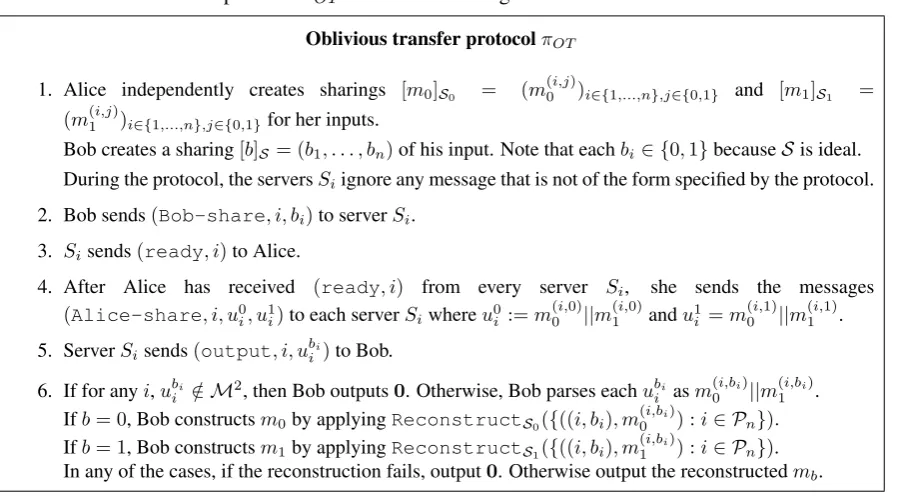
We now construct the protocolπOT as described in Figure 2.
Oblivious transfer protocolπOT
1. Alice independently creates sharings [m0]S0 = (m
(i,j)
0 )i∈{1,...,n},j∈{0,1} and [m1]S1 =
(m(1i,j))i∈{1,...,n},j∈{0,1}for her inputs.
Bob creates a sharing[b]S = (b1, . . . , bn)of his input. Note that eachbi∈ {0,1}becauseSis ideal.
During the protocol, the serversSiignore any message that is not of the form specified by the protocol.
2. Bob sends(Bob-share, i, bi)to serverSi.
3. Sisends(ready, i)to Alice.
4. After Alice has received (ready, i) from every server Si, she sends the messages
(Alice-share, i, u0
i, u1i)to each serverSiwhereu0i :=m
(i,0) 0 ||m
(i,0)
1 andu1i =m
(i,1) 0 ||m
(i,1)
1 .
5. ServerSisends(output, i, ubii)to Bob.
6. If for anyi,ubi i ∈ M/
2, then Bob outputs0. Otherwise, Bob parses eachubi i asm
(i,bi)
0 ||m (i,bi)
1 .
Ifb= 0, Bob constructsm0by applyingReconstructS0({((i, bi), m
(i,bi)
0 ) :i∈ Pn}). Ifb= 1, Bob constructsm1by applyingReconstructS1({((i, bi), m
(i,bi)
1 ) :i∈ Pn}). In any of the cases, if the reconstruction fails, output0. Otherwise output the reconstructedmb.
Figure 2: ProtocolπOT
Note that in the protocolπOT, if we ignore the headers of the messages (i.e., the command names
and number of the server involved) the communication complexity of πOT is as follows: Alice sends
4mbits to each server, in total4nmbits. Bob sends one bit to each server, in totalnbits. Finally each server sends2mbits to Bob. The total amounts of bits communicated is hence(6m+ 1)nbits.
PROPOSITION6.2 If Alice and Bob follow the protocol honestly, thenπOT implements OT correctly.
PROOF. If Alice and Bob follow the protocol honestly, at the end of the protocol Bob will have received all valuesm(i,bi)
b , i = 1, . . . , n, for some sharing[b]S = (b1, . . . , bn). By definition the set {(1, b1), . . . ,(n, bn)}is qualified forSb (because(b1, . . . , bn) ∈ Vb) and hence Bob has enough
infor-mation to reconstructmb. Hence, the protocol is correct if both Alice and Bob are (semi-) honest. 4
7
Security
We now prove security of this protocol, in two steps: first, we show security against one adversary in the UC model, and then we will consider security against simultaneous adversaries in the LUC model.
7.1 Security in the UC model
We will first show that this protocol implements securely the functionalityFOT described in Figure 3
FunctionalityFOT
1. On input(transfer, b)from Bob, send(ready)to Alice.
2. On input(send, m0, m1)from Alice, if(transfer, b)has been received previously from Bob, send (sent, mb)to Bob.
Figure 3: FunctionalityFOT
THEOREM7.1 Let(A,B)be anR2pair of structures, and assume thatAadmits an ideal linear secret sharing scheme. Consider the class of all adversaries that either corrupt Alice together with a setA∈ A
or Bob together with a setB ∈ B. Then the protocolπOT UC-implements the functionalityFOT against
that class of adversaries.
PROOF.
Alice honest, Bob malicious: The idea is to have the simulator extract the environment’s input by applying the reconstruction procedure ofS to the sharesbi received from the environment. By theR2 property, these shares can be consistent with at most oneb. If in fact Bob is bound to a bitb, this is sent to the functionality andmbis received; the simulator then setsm1−bat random and generates shares for
both messages. Otherwise, the simulator generates shares for randomm0, m1.
We need two lemmas. The first uses theR2property to argue that the set of servers not corrupted by Bob is qualified in the schemeS and therefore no matter what he sends to the uncorrupted servers, this can be consistent with at most one possible input.
LEMMA7.2 If(A,B)is anR2 pair of structures, andSis a perfect secret sharing scheme withAas its adversary structure, then for everyB ∈ B, its complementBis qualified inS.
This is because by definition ofR2,B /∈ A. Our next lemma will guarantee the privacy of Alice’s input.
LEMMA7.3 Letm0, m1 be shared independently withS0,S1 respectively. Fix B ⊆ {1, . . . , n}and (b01, . . . , b0n)∈Fn2, and defineI0 ={(i, b0i) :i∈B} ∪ {(i, j) :i∈B, j ∈ {0,1}}.
Fixb ∈ {0,1}. If the set{b0i : i ∈ B}is not part of any sharing [b]S then the valuesm0(i,j), m(1i,j), (i, j)∈ I0 give no information aboutmb.
PROOF. Since the sharings ofm0 andm1 are independent, clearly the shares ofm1−b cannot add
information aboutmb. Hence, we need to prove that the sharesm
(i,j)
b ,(i, j) ∈ I
0 give no information
aboutmb, i.e., that the setI0is unqualified forSb. But ifI0were qualified forSb, it would contain a set {(1, b1), . . . ,(n, bn)} ⊆ Pn,2 with(b1, . . . , bn) ∈ Vb. However then necessarilybi = b0i for alli ∈ B
and that would mean{b0i :i∈B}belongs to a sharing[b]S which contradicts the assumption. 4 We now describe the simulator Sim. We will suppose without loss of generality that corrupted servers act as a dummy adversary. LetBdenote the set of corrupted servers.
First,Simawaits(ready, i)fori∈ B and that the environment has sentbifor eachi∈B. Then
SimexecutesReconstructS({(i, bi) :i∈B}). If the reconstruction fails thenSimchooses random
messages m˜0, m˜1. If the reconstruction succeeds, letb be its output; then Sim sends the command (transfer,b) toFOT, receives message(sent, mb)and setsm˜b:=mb; it selects a random message
˜
m1−b∈ M.
In any case,Simgenerates shares form˜0 usingS0 and shares form˜1usingS1. It creates the values u0
i := ˜m
(i,0) 0 ||m˜
(i,0)
1 andu1i = ˜m
(i,1) 0 ||m˜
(i,1)
1 . Finally, in parallelSimsends the following to the environ-ment: for eachi∈B, he sends(output, i, ubi
indistinguishable from the distribution of shares received in the real world.
Alice malicious, Bob honest:The simulation in this case is slightly tricky, since a potential problem of the protocol is that Alice can generate inconsistent shares which make Bob’s output dependent on his selections (that is, on the random sharing of his input). We show, perhaps surprisingly, that this does not affect the security of the protocol. Essentially, the simulator will generate one sharing forb= 0and one forb= 1such that the shares corresponding to the corrupted servers coincide. The simulator will then construct the value that a receiver would construct for each of these two sharings and will send these values to the functionality. This results in a view in the ideal world which is perfectly indistinguishable from the real world, due to the privacy for the set of corrupted servers.
We will suppose without loss of generality that corrupted servers act as a dummy adversary. Let A∈ Abe the set of corrupted servers. The simulator works as follows:
Upon receiving(ready)from the ideal functionalityFOT,Simgenerates uniformly random shar-ings ofb = 0andb0 = 1inS subject to the only condition that ifi ∈ A, thenbi = b0i. Note that this
is possible sinceA is unqualified forS. Then, in parallel Sim sends to the environment the message (ready, i) for eachiand the message(Bob-share, i, bi) for eachi ∈ A. Sim now awaits that for
eachi∈A, the environment sendsu0i andu1i and that for eachi∈Athe environment sendsubi
i . If any
uji is not an element ofM2, then,Sim does the following: ifb
i = j, setm0 = 0, and ifb0i = j, set
m1 =0. For the rest of theuji,Simdoes the following: Simparses, fori∈A,u0i asm
(i,0) 0 ||m
(i,0) 1 and ui1 asm(0i,1)||m1(i,1).Simalso parses, fori∈A,ubi
i asm
(i,bi) 0 ||m
(i,b0
i)
1 (again, notebi=b0ifori∈A).
Fork= 0,1, ifmkis not already set to0thenSimcomputes
mk=ReconstructSk({((i, bi), m (i,bi)
k ) :i∈ Pn})
If the reconstruction ofmkfails,Simsetsmk=0. Finally, it sends(send, m0, m1)toFOT.
By construction, the sharesbicorresponding to the setAof corrupt servers that the environment
re-ceives are indistinguishable from theA-shares in a uniformly random sharing ofb, regardless of whether b = 0orb= 1. Hence thesebi do not allow the receiver to distinguish the real and ideal world. Now,
since after that step there is no further interaction, it suffices to show that the messages sent to Bob are indistinguishable from the ones sent in the real world.
This is the case since the shares have been chosen with the distribution Bob would use and since the simulator reconstructs the messagesm0 andm1 in exactly the same way as Bob would reconstructmb
in the real protocol, ifbis his input. Therefore the real and ideal world are indistinguishable. 4
We note that the simulators in the proof above run in polynomial time, becauseS0andS1are ideal. Finally, we remark that the Oblivious Transfer protocol we have presented can easily be extended to the case where there does not exist an ideal secret sharing scheme for Alice’s adversary structure. We give a complete description of the protocol in Appendix C.
7.2 Local Universal Composability
In this section, we discuss the security of our protocol in the Local Universal Composability model. We first define the functionality that we want to implement securely. We denote the possible degrees of corruption byC={Malicious,Semi-honest,Honest}. The functionalityFL
OT will be the composition of
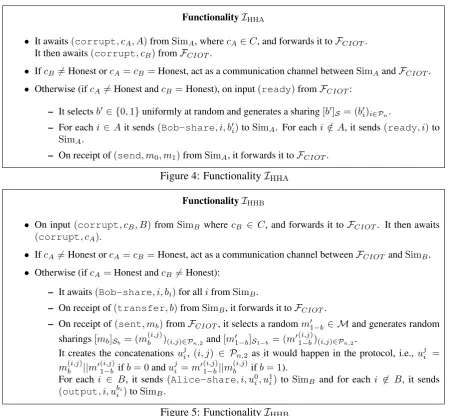
three ideal functionalities: one center box, denoted byFCIOT (Figure 6), and two outer-boxes, denoted by IHHA(Figure 4) and IHHB (Figure 5) respectively. The local simulatorSimAfor A(respectively SimBforB) will communicate withIHHA(respectivelyIHHB) only.
Each of the outer boxes will know the level of corruption of both players. IHHAwill learn the level of corruption of Alice directly from the local simulatorSimA, while it will learn the level of corruption
The goal of the outer boxes is to hide from the local simulators whether the other party is honest, semi-honest or malicious (we use the acronym HH to denote honesty-hiding). This is done because having a functionality which would reveal the corruption level of the simulator would be useless for constructing protocols. This means that the outer boxes must simulate the case of a semi-honest party when the party in question is honest. A case-by-case (according to the corruption levelscA andcB)
description ofFL
OT can be found in Appendix D.
FunctionalityIHHA
• It awaits(corrupt, cA, A)fromSimA, wherecA∈C, and forwards it toFCIOT. It then awaits(corrupt, cB)fromFCIOT.
• IfcB6=Honest orcA=cB=Honest, act as a communication channel betweenSimAandFCIOT.
• Otherwise (ifcA6=Honest andcB=Honest), on input(ready)fromFCIOT:
– It selectsb0 ∈ {0,1}uniformly at random and generates a sharing[b0]S = (b0i)i∈Pn.
– For eachi ∈Ait sends(Bob-share, i, b0i)toSimA. For eachi /∈A, it sends(ready, i)to
SimA.
– On receipt of(send, m0, m1)fromSimA, it forwards it toFCIOT.
Figure 4: FunctionalityIHHA
FunctionalityIHHB
• On input(corrupt, cB, B)fromSimB wherecB ∈ C, and forwards it toFCIOT. It then awaits
(corrupt, cA).
• IfcA6=Honest orcA=cB =Honest, act as a communication channel betweenFCIOT andSimB.
• Otherwise (ifcA=Honest andcB6=Honest):
– It awaits(Bob-share, i, bi)for allifromSimB.
– On receipt of(transfer, b)fromSimB, it forwards it toFCIOT.
– On receipt of(sent, mb)fromFCIOT, it selects a randomm01−b∈ Mand generates random
sharings[mb]Sb= (m
(i,j)
b )(i,j)∈Pn,2 and[m 0
1−b]S1−b = (m
0(i,j)
1−b)(i,j)∈Pn,2.
It creates the concatenationsuji,(i, j) ∈ Pn,2 as it would happen in the protocol, i.e.,uji = mb(i,j)||m01(i,j−b)ifb= 0anduij =m0(1i,j−b)||m(bi,j)ifb= 1).
For eachi ∈ B, it sends(Alice-share, i, u0
i, u1i) toSimB and for each i 6∈ B, it sends
(output, i, ubi
i )toSimB.
Figure 5: FunctionalityIHHB
We will now argue that this ideal functionality is indeed one that we want to implement securely. Consider first the usual scenario where one of the players is honest. If both are honest then the function-ality just implements OT as usual. If one of the players is honest and the other is not, the non-honest side obtains certains shares belonging to a sharing of some random element (and therefore not related to the inputs) plus, in the case where Alice is honest and Bob is semi-honest, part of a sharing of the output, but the output is already known by Bob.
Now we consider the case where none of the players are honest. In this case, our model forces us to communicate to the local simulators part of a “real” sharing of the actual inputs of the other player. This is because the information that the environment will receive from bothSimAandSimB has to be
FunctionalityFCIOT
• On input(corrupt, cA, A)fromIHHA, wherecA∈C:
The ideal functionality checks thatA∈ A. IfcA=Honest, it also checks thatA=∅. If some of these checks fails, then it ignores further commands.
Otherwise, it stores(cA, A).
• On input(corrupt, cB, B)fromIHHB, wherecB ∈C:
The ideal functionality checks thatB ∈ B. IfcB=Honest, it also checks thatB=∅. If some of these checks fails, then it ignores further commands.
Otherwise, it stores(cB, B).
• The ideal functionality sends(corrupt, cA)toIHHBand(corrupt, cB)toIHHA.
• On input (transfer,b) fromIHHB, send (ready) toIHHA.
On input(send, m0, m1)fromIHHA, if(transfer, b)has been received previously fromIHHB,
send(sent, mb)toIHHB.
• IfcA=Semi-honest:
On command(Bob-share, i, bi)fromIHHB: ifi∈Ait sends(Bob-share, i, bi)toIHHA; other-wise, it sends(ready, i)toIHHA.
• IfcB=Semi-honest:
On command(Alice-share, i, u0
i, u1i)fromIHHA: ifi∈B, it sends(Alice-share, i, u0i, u1i) toIHHB; otherwise, it sends(output, i, ubi
i )toIHHB.
• IfcA=Malicious:
Any command fromIHHAis directly forwarded toIHHB.
• IfcB=Malicious:
Any command fromIHHBis directly forwarded toIHHA.
Figure 6: FunctionalityFCIOT
THEOREM7.4 Let(A,B)be aR2pair of structures and assumeAadmits an ideal LSSS overF2. Then πOT LUC-implementsFOTL against the class of pairs(A,B)of adversaries whereAcorrupts Alice and
A∈ AandBcorrupts Bob andB∈ B.
We prove this Theorem in Appendix E. Here we give an intuition. The case where one of the players, say Alice, is honest reduces to the universal composability proof with a few differences. The inner functionalityFCIOT acts as the functionalityFOT in the UC case, except it sends some additional messages which are ignored byIHHAif Alice is honest. Furthermore we will define Bob’s simulator so that its composition withIHHB acts as the simulator for the UC case. If both Alice and Bob are corrupted, then we have the added complication that in the real world the environment will receive certain information fromAthat is consistent with the information received fromB. The simulation needs to guarantee this also happens in the ideal world, and for this we use the fact that the ideal functionality has the ability to transfer the appropriate parts of the information from one simulator to the other.
8
Acknowledgement
We are grateful to an anonymous reviewer of a previous version of this paper for insisting that we clarify the relation between our results and the single-adversary impossibility result in [FHM99], which helped us improved the presentation.
References
[Bla79] George Blakley. Safeguarding cryptographic keys. In Proceedings of the 1979 AFIPS National Computer Conference, volume 48, pages 313–317, June 1979.
[Can01] Ran Canetti. Universally composable security: A new paradigm for cryptographic proto-cols. InFoundations of Computer Science, 2001. Proceedings. 42nd IEEE Symposium on, pages 136–145. IEEE, 2001.
[CDM00] Ronald Cramer, Ivan Damg˚ard, and Ueli M. Maurer. General Secure Multi-party Com-putation from any Linear Secret-Sharing Scheme. In Bart Preneel, editor,EUROCRYPT, volume 1807 ofLecture Notes in Computer Science, pages 316–334. Springer, 2000.
[CV12] Ran Canetti and Margarita Vald. Universally Composable Security with Local Adversaries. InSCN, pages 281–301, 2012.
[DI05] Ivan Damg˚ard and Yuval Ishai. Constant-Round Multiparty Computation Using a Black-Box Pseudorandom Generator. In Victor Shoup, editor,Advances in Cryptology - CRYPTO 2005: 25th Annual International Cryptology Conference, Santa Barbara, California, USA, August 14-18, 2005, Proceedings, volume 3621 of Lecture Notes in Computer Science, pages 378–394. Springer, 2005.
[EGL82] Shimon Even, Oded Goldreich, and Abraham Lempel. A Randomized Protocol for Sign-ing Contracts. InAdvances in Cryptology: Proceedings of CRYPTO ’82, Santa Barbara, California, USA, August 23-25, 1982., pages 205–210, 1982.
[FHM99] Matthias Fitzi, Martin Hirt, and Ueli Maurer. General adversaries in unconditional multi-party computation. InAdvances in Cryptology-ASIACRYPT99, pages 232–246. Springer, 1999.
[HIKN08] Danny Harnik, Yuval Ishai, Eyal Kushilevitz, and Jesper Buus Nielsen. OT-combiners via secure computation. InTheory of Cryptography, pages 393–411. Springer, 2008.
[HKN+05] Danny Harnik, Joe Kilian, Moni Naor, Omer Reingold, and Alon Rosen. On robust com-biners for oblivious transfer and other primitives. InAdvances in Cryptology–EUROCRYPT 2005, pages 96–113. Springer, 2005.
[HM00] Martin Hirt and Ueli M. Maurer. Player Simulation and General Adversary Structures in Perfect Multiparty Computation.J. Cryptology, 13(1):31–60, 2000.
[IKO+11] Yuval Ishai, Eyal Kushilevitz, Rafail Ostrovsky, Manoj Prabhakaran, Amit Sahai, and J¨urg Wullschleger. Constant-Rate Oblivious Transfer from Noisy Channels. In Phillip Rog-away, editor, Advances in Cryptology - CRYPTO 2011 - 31st Annual Cryptology Confer-ence, Santa Barbara, CA, USA, August 14-18, 2011. Proceedings, volume 6841 ofLecture Notes in Computer Science, pages 667–684. Springer, 2011.
[ISN87] Mitsuru Ito, Akira Saito, and Takao Nishizeki. Secret sharing schemes realizing general access structures. InProc. IEEE GlobeCom ’87 Tokyo, pages 99–102, 1987.
[Kil88] Joe Kilian. Founding Cryptography on Oblivious Transfer. In Proceedings of the 20th Annual ACM Symposium on Theory of Computing, May 2-4, 1988, Chicago, Illinois, USA, pages 20–31, 1988.
[Rab81] Michael Rabin. How to Exchange Secrets with Oblivious Transfer. Technical report, Aiken Computation Lab, Harvard University, 1981.
[Sha79] Adi Shamir. How to share a secret.Communications of the ACM, 22:612–613, 1979.
A
Security Against Corruptions of Only Servers
As explained in the introduction, our model does not consider corruption of only servers, and our security proofs therefore do not directly guarantee any security in case the adversaries corrupt only a set of servers. Nevertheless, we can argue that some security properties are satisfied even in case of server-only corruption.
Let us first consider the case where Alice is honest and has inputxA, whileBis semi-honest and corrupts only a setS ∈ Bof servers. So Bob is also honest and has inputxB. If a protocolπ is secure
in our model, it is easy to see that it will compute the correct result f(xA, xB) also in this case and
thatB will learn nothing more than f(xA, xB), xB. This follows, since if Bhad also corrupted Bob semi-honestly, he would have learned at least as much and we can use security ofπ to conclude that in that case the correct result is computed andBlearns nothing more thanf(xA, xB), xB. In particular,
the view ofScan be simulated perfectly based onf(xA, xB), xB. A symmetric conclusion holds if we
switch the roles of Alice and Bob.
Now, consider the case where S ∈ A and S ∈ B. We can then conclude that the view of S can be simulated perfectly based onf(xA, xB), xB and also based on f(xA, xB), xA. But this must
mean that the distribution of this view depends only onf(xA, xB): assume for contradiction that there
existed xA, xB 6= x0B such that f(xA, xB) = f(xA, x0B) but the distribution of the view of S given
f(xA, xB), xB is different from the one givenf(xA, xB), x0B. Now compare the two cases where we
run the protocol on inputs(xA, xB)respectively(xA, x0B). Then the simulation based onf(xA, xB), xA
would output the same distribution in both cases, so it cannot be consistent with both the distribution resulting fromf(xA, xB), xBand fromf(xA, xB), x0B. So we have
PROPOSITIONA.1 If protocolπis perfectly secure in our model, it is also secure in the standard single adversary sense against semi-honest corruption of a set of servers that is in bothAandB, except that the simulation may not in general be efficient.
Let us now consider malicious corruption: Alice is honest andBis malicious and corrupts only a set S ∈ B of servers. (so Bob is also honest). Note that from Alice’s point of view, the situation is indistinguishable from a case whereBalso corrupts Bob but lets him play honestly. Security ofπnow implies thatBlearns nothing more thanf(xA, x0B)for some well defined inputx0Bthat is determined by
the behaviour of the malicious servers. Note that we are not guaranteed thatx0B is equal to the honest inputxB, even though Bob plays honestly. By symmetry we get that forS ∈ A,Awill learn nothing thanf(x0A, xB).
We observe that ifSis in bothAandB, then both the honest Alice and honest Bob are guaranteed privacy: By runningπ, I will give away only the function evaluated in my own input and some input from the other party. But Alice and Bob are not guaranteed to agree on the result, so we do not get security in the standard single adversary sense against malicious corruption ofS.
We can in fact argue that this cannot in general be achieved in our model, even if S is in both A
andB: Consider a case with 3 servers S1, S2, S3 and letA = {{S1},{S2}}andB = {{S2},{S3}}. This is clearlyR2, so our model applies. Now, it is easy to see that a secure protocolπin our sense will in this case also be semi-honestly secure against single-adversary corruption of{Alice, S1}, as well as
S2 has no inputs or outputs. This is precisely the case where the proof of Theorem 1 in [FHM99] says we cannot have general secure MPC.
B
Proof of Proposition 6.1
In this section, we show that we can indeed take the linear secret sharing schemesS0 andS1 that we have used in our constructions to be ideal, i.e., the size of every share will be the size of the secret. In our constructions, the secret is a bit-string of some fixed lengthm. However, clearly it is enough to show the result for the casem = 1since, given ideal linear secret sharing schemes for this case, we can use them to share each bit of the secret independently.
We in fact prove the following result. LetW ⊆ {0,1}`be an affine space, i.e.,W =b+V, where
b= (b1, . . . , b`)∈F`2 andV is a vector subspace ofF`2. Consider the setP`,2of2`players indexed by
P`,2={(i, j) :i= 1, . . . , `, j = 0,1}.
WriteΓW the access structure on these2`players whose minimally qualified sets are {(1, w1),(2, w2). . . ,(`, w`)} ⊆ P`,2,
with(w1, w2, . . . , w`)∈W.
We will show in Theorem B.1 below that there is an ideal LSSS over F2 with ΓW as its access
structure. Note first that this indeed yields our ideal LSSSS0andS1. The access structuresΓ0andΓ1 to be realized by these schemes are preciselyΓV0andΓV1, whereVbis the set of sharings ofbin another
LSSS S. By linearity ofS, V0 is a vector space. On the other handV1 is an affine space that can be described asV0+v1, wherev1 is some sharing of1according toS.
THEOREMB.1 The access structureΓW admits a linear ideal secret sharing scheme overF2.
PROOF. LetV⊥be the orthogonal space toV, i.e., V⊥={h∈F`
2 :hv,hi= 0for allv∈V}.
We define the following scheme. In order to share s ∈ F2, the dealer picks uniformly at random r1, . . . , r`−1 ∈F2and letr` =s−P`i=1−1ri. He also choosesh= (h1, h2, . . . , h`)uniformly at random
inV⊥.
The share of participant(i, j)is then
si,j =ri+ (bi−j)hi.
(Note that ifV⊥={0}, then we are just definingsi,j =ri).
The scheme is perfect because it is linear and ideal. Now we prove that this scheme realizesΓW,
that is, we show that its access structureΓcoincides withΓW.
First we show thatΓW ⊆Γ. LetA= {(1, w1), . . . ,(`, w`)}for somew ∈W, which is therefore
of the formw=v+bwithv∈V. The sum of all shares of participants inAis:
X
(i,j)∈A
si,j = `
X
i=1
(ri+ (bi−wi)hi) = `
X
i=1
ri− hv,hi= `
X
i=1
ri =s,
which shows the claim.
We now show thatΓ⊆ΓW. For this we prove that: 1) every minimally qualified set inΓhas to
con-tain exactly one player(i, yi)for everyi, and 2) if(y1, . . . , y`) ∈/ W, then{(1, y1),(2, y2), . . . ,(`, y`)}
Part 1 is shown as follows. Obviously, every qualified set has to contain at least one player(i, yi)for
eachi, since allri’s are needed to reconstructs. On the other hand, since the scheme is linear, a set of
playersAis qualified if there exists a linear functionρAsuch thatscan be recovered by applyingρAto
the shares inA, for every possible secret and choice of the randomness. But since we are working over the fieldF2 this just means thatA ∈Γif and only if there existsA0 ⊆A, such thats=P(i,j)∈A0si,j.
This means A is minimally qualified if and only if it coincides with this A0, i.e., the secret can be recovered as the sum of the shares inA. Now if both(i,0)and(i,1)are inA,ri appears twice in the
sum and will cancel out. Hence it can only be the case thatAcontains exactly one element of the form (i, yi)for eachi.
Now for the second part, we show that if A ={(1, y1),(2, y2), . . . ,(`, y`)}and(y1, . . . , y`) ∈/ W
then there is a valid sharing ofs= 1where every player inAhas0as share. Since this is also the case fors= 0, this will showA /∈Γ. Ify= (y1, . . . , y`)∈/W, that meansy−b∈/ V and there exists some
h0 ∈V⊥such thathy−b,h0i= 1. Now consider the following choice of the randomness:h=h0and ri = (yi−bi)hi fori= 1, . . . , `−1. Then ifs = 1is shared using this randomness, it is immediate
thatsi,yi = 0for everyi= 1, . . . , `−1, and we easily verify that
s`,y` = (s−
`−1 X
i=1
ri) + (b`−y`)h` = 1− hy−b,hi= 1−1 = 0
which finalizes the proof. 4
C
Protocol for general
A
We show the general version of the protocolπOT from Section 6, when the adversary structureA
cor-rupted byAis not necessarily the adversary structure of an ideal LSSS overF2. Note that many inter-esting access structures, for example most threshold structures, do not admit an ideal LSSS overF2.
Let S be a possibly non-ideal perfect secret sharing scheme with adversary structure A. For i = 1, . . . , n the i-th share of S belongs to some vector space Ui = F`2i for some integer `i ≥ 1. Let `=Pn
i=1`ibe the complexity ofS.
The idea of the generalization is simple. Basically Si is splitted in `i subservers, each of which
receives one bit from Bob and two shares of eachm0andm1from Alice and performs an OT as servers did in the protocol from Section 6 (we remark however that the adversaries corrupt full servers and not individual subservers).
More precisely, letV0, V1⊆U1× · · · ×Unthe sets of all possible sharings of0and1respectively.
We can think of the elements ofV0andV1ask-bit strings, and we index their coordinates by pairs(i, k) where the(i, k)-th coordinate of a sharing is thek-th bit of thei-th share.
As before we construct two perfect secret sharing schemes that we call S0 andS1. These are now secret sharing schemes with2`shares each and the set of shares will be indexed by
P`,2 :={(i, k, j) :i= 1, . . . , n, k= 1, . . . , `i, j= 0,1}.
We define the access structureΓ0ofS0 as follows. The minimally qualified sets are exactly the sets
{(1,1, v(1,1)),(1,2, v(1,2)). . . ,(n, kn, v(n,kn))} ⊆ P`,2,
with (v(1,1), v(1,2), . . . , v(n,kn)) ∈ V0. Similarly, the access structure Γ1 of S1 has as its family of minimally qualified sets
{(1,1, v(1,1)),(1,2, v(1,2)). . . ,(n, kn, v(n,kn))} ⊆ P`,2,
Again, we can construct ideal schemesS0,S1with the properties above from Theorem B.1.
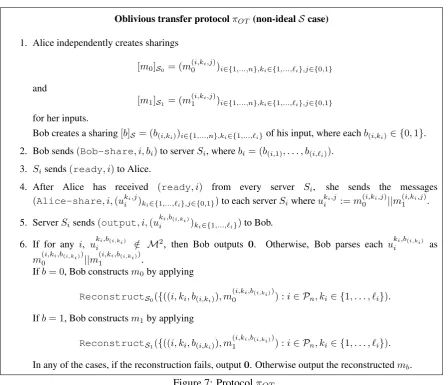
The general protocol is given in Figure 7. The security proofs work essentially as in the particular case presented in Sections 6 and 7.2.
Oblivious transfer protocolπOT (non-idealScase)
1. Alice independently creates sharings
[m0]S0 = (m
(i,ki,j)
0 )i∈{1,...,n},ki∈{1,...,`i},j∈{0,1}
and
[m1]S1 = (m
(i,ki,j)
1 )i∈{1,...,n},ki∈{1,...,`i},j∈{0,1} for her inputs.
Bob creates a sharing[b]S = (b(i,ki))i∈{1,...,n},ki∈{1,...,`i}of his input, where eachb(i,ki)∈ {0,1}.
2. Bob sends(Bob-share, i, bi)to serverSi, wherebi= (b(i,1), . . . , b(i,`i)).
3. Sisends(ready, i)to Alice.
4. After Alice has received (ready, i) from every server Si, she sends the messages
(Alice-share, i,(uki,j
i )ki∈{1,...,`i},j∈{0,1})to each serverSiwhereu ki,j i :=m
(i,ki,j)
0 ||m
(i,ki,j)
1 .
5. ServerSisends(output, i,(u ki,b(i,ki)
i )ki∈{1,...,`i})to Bob.
6. If for any i, ukii,b(i,ki) ∈ M/ 2, then Bob outputs 0. Otherwise, Bob parses each uki,b(i,ki)
i as
m(0i,ki,b(i,ki))||m1(i,ki,b(i,ki)).
Ifb= 0, Bob constructsm0by applying
ReconstructS0({((i, ki, b(i,ki)), m
(i,ki,b(i,ki))
0 ) :i∈ Pn, ki∈ {1, . . . , `i}).
Ifb= 1, Bob constructsm1by applying
ReconstructS1({((i, ki, b(i,ki)), m
(i,ki,b(i,ki))
1 ) :i∈ Pn, ki∈ {1, . . . , `i}).
In any of the cases, if the reconstruction fails, output0. Otherwise output the reconstructedmb.
Figure 7: ProtocolπOT
D
Description of
F
LOT
by cases
We describe the functionalityFL
OT (the composition ofIHHA,FCIOT andIHHB) case-by-case,
accord-ing to the level of corruption of Alice and Bob.
In every case, the functionality receives (corrupt, cA, A)and(corrupt, cB, B) from the local
simulators.
1. Case HH(cA=cB=Honest).
It works exactly asFOT.
2. Case HS(cA=Honest,cB=Semi-honest).
It awaits(Bob-share, i, bi)for alli∈ Pn.
On input(transfer, b)fromSimB, it sends (ready) toSimA.
On input(send, m0, m1)fromSimAthe functionality generates a random messagem01−b ∈ M
and random sharings[mb]Sb and[m 0
1−b]S1−b. It creates valuesu
j i = m
(i,j) 0 ||m0
(i,j)
It sends, toSimB, the messages(Alice-share, i, u0i, u1i)fori∈ B and(output, i, u bi
i )for
i /∈B.
3. Case SH(cA=Semi-honest,cB =Honest).
On input(transfer, b)fromSimB, it generates sharesb0ifor a random bitb0and sends toSimA
the messages(Bob-share, i, b0i)for alli∈Aand(ready, i)for alli /∈A. On input(send, m0, m1)fromSimA, it sends(sent, mb)toSimB.
4. Case SS(cA=Semi-honest,cB=Semi-honest).
The functionality awaits, for alli∈ Pn, the messages(Bob-share, i, bi)fromSimB.
It sends toSimAthe messages(Bob-share, i, bi)for alli∈Aand(ready, i)for alli /∈A.
The functionality awaits, for alli∈ Pn, the messages(Alice-share, i, u0i, u1i).
It sends, toSimB, the messages(Alice-share, i, u0i, u1i)fori∈ B and(output, i, u bi
i )for
i /∈B.
5. Case HM(cA=Honest,cB =Malicious).
The functionality acts exactly the same as in the HS case.
6. Case MH(cA=Malicious,cB =Honest).
The functionality acts exactly the same as in the SH case.
7. Case SM(cA=Semi-honest,cB=Malicious).
The functionality acts the same as in the SS case except thatallmessages received fromSimBare
sent toSimA.
8. Case MS(cA=Malicious,cB=Semi-honest).
The functionality acts the same as in the SS case except thatallmessages received fromSimAare
sent toSimB.
E
Proof of Theorem 7.4
We first describe how each of the local simulators works. Later on, we will show the indistinguishability between the real world and the ideal world with these simulators.
E.1 Simulators
E.1.1 Description ofSimA
• First, the simulator awaits (corrupt,cA,A) and forwards it toIHHA. It also takes note of this
tuple.
• IfcA= Honest, it awaits (ready) from the functionality and forwards it to the environment. It
then awaits(send, m0, m1) from the environment and sends it toIHHAand ignores any other message.
• IfcA = Semi-honest, on receiving a share bi or a message (ready, i) from IHHA, it forwards
them to the environment. It also forwards any other message fromIHHAthat contains an index iwithi∈Ato the environment4. It then awaits the message(send, m0, m1)from the environ-ment. It sends the message (send,m0,m1) toIHHA. It then generates the values{(u0i, u1i)}from 4
Note this captures the situation where a maliciousBsends arbitrary messages to servers withi∈A∩B, sinceAwill see
(m0, m1) as in the protocol. It sends these values to the environment and it sends the messages (Alice-share, i, u0
i, u1i)toIHHAfor alli.
• If cA = Malicious, during its whole interaction with the environment, on reception of
mes-sages from the environment it checks that they contain a unique index i corresponding to a server. For each message, if this does not happen or ifi /∈ A(unless for messages of the form (Alice-share, i, u0i, u1i)), the message is ignored. Otherwise, it is forwarded toIHHA5. On reception of messages fromIHHA, it forwards them to the environment.
On reception of the shares of bi for i ∈ A from IHHA, it also constructs sharings [0]S := (c1, . . . , cn), [1]S := (d1, . . . , dn)consistent with the receivedbi’s (i.e.,ci =di=bifori∈A).
On reception of the values{uji : (i, j)∈ Pn,2}from the environment, it also constructs
m0=ReconstructS0({((i, ci), m
(i,ci)
0 ) :i∈ Pn}) and
m1 =ReconstructS1({((i, di), m
(i,di)
1 ) :i∈ Pn}).
If the reconstruction ofm0 (respectivelym1) fails, Simsetsm0 = 0 (resp. m1 = 0). Now it sends the command (send,m0,m1) toIHHA.
Note that in the case that Bob is honest, the local simulatorSimBfor Bob will output the value that
was generated bySimA, otherwiseSimBwill reconstruct a message based on the shares received
viaFL OT.
E.1.2 Description ofSimB
• First, the simulator awaits (corrupt,cB,B), notes that value and forwards it toIHHB.
• IfcB =Honest, it sends (transfer,b) toIHHB and forwards the response(sent, mb)to the
environment.
• If cB = Semi-honest, it awaits input (transfer, b). It forwards it to IHHB. It then
se-lects a random sharing[b]S = (bi)i∈Pn. It sends thebi to the environment. It sends messages
(Bob-share, i, bi)toIHHBfor everyi. On receiving(Alice-share, i, u0i, u1i)fori∈Band
(output, i, ubi
i ) fori /∈ B fromIHHB it forwards these to the environment. It reconstructs a messagemb from the received shares as in the protocol. Finally it forwards this message to the
environment.
• If cB = Malicious, during the whole interaction with the environment, on reception of
mes-sages from the environment it checks that they contain a unique index i corresponding to a server. For each message, if this does not happen or ifi /∈ B (unless for messages of the form (Bob-share, i, bi)), the message is ignored. Otherwise, it is forwarded toIHHB. On reception
of messages fromIHHA, it forwards them to the environment. The simulator awaits that the en-vironment has sent(Bob-share, i, bi)to eachi∈B. On receiving(Alice-share, i, u0i, u1i)
fori ∈ B and(output, i, ubi
i ) fori /∈ B fromIHHB it forwards these to the environment. It
reconstructs a messagemb from the received shares as in the protocol. Finally it forwards this
message to the environment.
5
This captures the fact that in the real protocol, a maliciousAcan only deviate from the protocol by interacting with a
E.2 Indistinguishability
First we argue that the case where one of the players is honest reduces to the universal composability proof. Say Alice is honest. Then, the idea is that the functionalityFCIOT (the “inner” part ofFOTL ) is
basically the same as the functionalityFOT in Section 6, except that it sends some additional messages to the honest side. However, these messages are ignored byIHHA. Moreover, the composition ofSimB
andIHHBacts as the simulator for the UC proof in the case of an honest Alice. If Bob is honest, the same holds by swappingAandB.
As for the cases where both Alice and Bob are corrupted (respectively byAandB), as we have said, we are assuming thatAandBare not both malicious, and thus one of them is semi-honest. Say for the moment thatAis semi-honest. If we compare this with the situation where Alice is honest, and Bob has the same level of corruption, here we need to take into account that, in the real world,Zwill additionally receive fromAthe information of the serversSi withi∈A, and all information held by Alice, and all
this information is consistent with what it receives fromB. We need to show that this needs to be the case also in the simulation. However, note that by design, the ideal functionality transfers the appropiate parts of the sharings created bySimB to SimA. Moreover, if B is malicious it also sends any other potential information that goes through the servers corrupted byA.