Clustering Based Analysis for LTE-A Network
using Protocols with Underlay D2D
Communication
B.Parvathavarthini
1, C. Elakya
2PG Student, Dept. of ECE , M.A.M. College of Engineering, Trichy, Tamilnadu, India1
Assistant Professor , Dept. of ECE, M.A.M. College of Engineering, Trichy, Tamilnadu, India2
ABSTRACT : Mobile ad hoc network is a collection of mobile nodes communicating through wireless channels without any existing network infrastructure or centralized administration. The main objective of such an ad hoc network routing protocol is accurate and efficient route establishment between a pair of nodes so that messages may be delivered in a well-timed manner. Cluster analysis or clustering is the task of grouping a set of objects in such a way that objects in the same group are more similar to each other than to those in other groups. Clustering nodes into groups, so that nodes communicate information only to cluster heads and then the cluster heads communicate the aggregated information to the processing center, may save energy. In this paper we examines two routing protocols for mobile ad hoc networks– the Destination Sequenced Distance Vector (DSDV), the table- driven protocol and the Ad hoc On- Demand Distance Vector routing (AODV), an On –Demand protocol and evaluates both protocols with varying pause time, sources based on:-Average End-to-End Delay, Packet Delivery Ratio, Packet Drop Ratio, Throughput, Normalizing Routing Load. The performance comparison has been evaluated using widely recognized and improved network simulator NS-2 version 2.34.
KEYWORDS : AODV, DSDV, Routing Protocol, NS2, Performance Parameters.
I.INTRODUCTION
D2D Communication has been proposed to increase spectral efficiency of the network by allowing direct communication between two mobile users without traversing the Base Station (BS) or core network . In underlay D2D communication, the D2D users can reuse cellular spectrum, and communicate directly while remaining controlled by the BS. Note that both cellular users (CUs) and D2D users (DUs) share the same radio resources, and therefore it is essential to control the interference caused by CUs to DUs, and vice versa . Mobile ad hoc network are formed by collection of wireless nodes that can dynamically self-organize into an arbitrary and temporary topology to form a network without necessarily using any pre-existing infrastructure or centralized administration. In ad hoc networks, each node may communicate directly to with other nodes. In adhoc network nodes are not directly connected they communicate by forwarding their packets through intermediate nodes. Every ad hoc node acts as a router. Due to the mobility of the nodes, routes between the nodes may change. Therefore, it is not possible to establish fixed routing path between the networks. So, Because of this, routing is the most studied problem in adhoc networks and a variety of routing protocols have been proposed.
Once a route has been established, it is maintained by some form of route maintenance procedure until either the destination becomes inaccessible along every path from the source or until the route is no longer desired.
II.LITERATURE SURVEY
The author A. BoomiraniMaalny , V.R.SarmaDhulipaland , RM.Chandrasekaran (2009) proposed the performance of a variety of routing protocols such as AODV, Fisheye, DYMO,STAR,RIP, Bellman Ford, LANMAR,LAR results were graphically compared and analysis has been done on average end to end delay & throughput. The author Nilesh P. Bobade, Nitiket N. Mhala (2010) proposed the major method for evaluation of MANETs is simulation and it is subjected to evaluate the performance of DSDV, AODV through the performance metrics namely PDF, Average end-to-end delay, normalized routing load and throughput by varying network size up to 50 nodes . The author Patil V.P(2012) proposed the examination of two routing DSDV, AODV, evaluates both protocols based on packet delivery fraction ,average end to end delay, throughput and routing overhead while varying pause time using NS2. The author Jay Kumar Tiwari, Neha Bharadwa (2015) proposed the comparison of DSDV, AODV, DSR based on performance parameters such as throughput, average end to end delay, packet delivery ratio with fixed no of nodes using Ns2.
III.METHODOLOGY
Mobile ad hoc network is a set of mobile nodes communicating through wireless links without any existing network infrastructure or centralized administration. The main objective of such an ad hoc network routing protocol is accurate and efficient route establishment between a pair of nodes so that messages may be delivered in a appropriate manner. These paper examines two routing protocols for mobile ad hoc networks– the Destination Sequenced Distance Vector (DSDV), the table- driven protocol and the Ad hoc On- Demand Distance Vector routing (AODV), an On –Demand protocol.
3.1Destination Sequenced Distance Vector(DSDV)
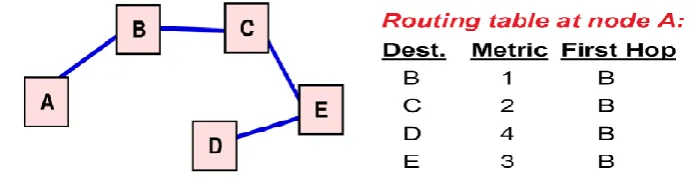
DSDV, an enhanced version of the distributed Bellman- Ford algorithm, belongs to the proactive or table driven family where a correct route to any node in the network is always maintained and updated .In DSDV, each node maintains a routing table that contains the shortest distance and the first node on the shortest path to every other node in the network. A sequence number created by the destination node tags each entry to prevent loops, to counter the count –to-infinity problem. At regular intervals the tables are exchanged between neighbours to keep an update of network topology and if a node discover an important change in local topology. This exchange of table imposes a large overhead on the whole network. To reduce these control overheads, routing updates are classified into two categories. The first is known as “full dump” which includes all available routing information. This type of updates should be used as infrequently as possible and only in the cases of complete topology change. In the cases of infrequent movements, smaller “incremental” updates are sent carrying only information about changes since the last full dump. Each of these updates are carried out in a single Network Protocol Data Unit (NPDU), and therefore considerably decreasing the amount of traffic. Table updates are initiated by a destination with a new sequence number which is always greater than the previous one. Upon receiving an updated table a node either updates its tables based on the received information or waits until receives the best metric from multiple versions of the same update from different neighbours. Routes availability to all destinations implies that much less delay is involved in the route setup process. The data broadcast by each node will contain its new sequence number, the destination’s address, the number of hops count.
3.2 Adhoc On- Demand(AODV)
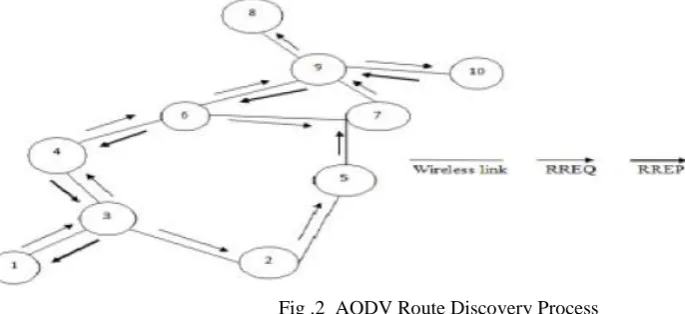
AODV is an improvement on the DSDV. AODV uses an on- demand approach for finding routes .As it is an on-demand algorithm, a route is established only when route discovery process initiated by a source node for transmitting data packets and it maintains these routes as long as they are needed by the source. AODV uses a destination sequence number, created by the destination, to determine an up to data path to the destination. Route information is updated by a node only if the destination sequence number of the current received packet is greater than the destination sequence number recorded at the node. It indicates the newness of the route accepted by the source. To prevent multiple broadcast of the same packet AODV uses broadcast identifier number that ensure loop freedom since the intermediate nodes only forward the first copy of the same packet and discard the duplicate copies. To find a path to the destination, the source a initiates Route Request (RREQ) packet across the network and it contains the source address, destination address, source sequence number, destination sequence number, the broadcast identifier and the time to live field. Nodes that receive RREQ either if they are the destination or if they have a fresh route to the destination, can respond to the RREQ by unicasting a Route Reply (RREP) back to the source node otherwise, the node rebroadcasts the RREQ. When a node forwards a RREQ packet to its neighbours, it also records in its routing table the node from which the first copy came and it is required by the node to construct the reverse path for the RREP packet. AODV uses only symmetric links because the route reply packet follows the reverse path of route request packet. Information about the preceding node from which the packet was received is recorded when a node receives a RREP packet, in turn to forward the data packets to this next node as the next hop toward the destination. Once the source node receives a RREP it can begin using the route to send data packets. The source node rebroadcasts the RREQ if it does not receive a RREP before the timer expires. If it does not discover a route after this maximum number of attempts, the session is aborted and the source moves to reinitiate route discovery to the destination. Hello message is broadcasted periodically among the nodes in order to detect link break and if the intermediate nodes moves or changes then this information send to its upstream neighbours and so on till it reaches the source upon which the source can
reinitiate route discovery if required.
Fig .2 AODV Route Discovery Process
3.3 .Simulation parameter and performance metrics
The simulation were performed using Network Simulator2 (NS-2) widespread popular in mobile networks. The traffic sources are CBR (continuous bit rate).The source-destination pairs are spread randomly over the network. The packet rate is 1 packet per second for 20, 30 & 40 nodes. The packet size is 1000bytes.The mobility model uses random waypoint model in the rectangular field of 500 m * 500m. In this mobility model, each node starts its journey from a random selected source to random selected destination. Once the destination is reached, another random destination is chosen after a pause time. The speed of nodes is varied between 0 to 20m/s and pause time is between 0 to 10 seconds. Different network scenario for different numbers of node & pause time. The propagation model is the Two-way ground model.
Packet delivery ratio: The ratio between the number of packets that are received and the number of packets sent.
Average End-to-End Delay: This delay includes processing and queuing delay in each intermediate node i.e. the time elapsed until a demanded route is available. Unsuccessful route establishments are ignored.
Throughput: Total no. of packets sends per unit time.
Packet Drop Ratio: Number of Packets drop during transmission.
Normalize Routing Load: The number of routing packets transmitted per data packet delivered at the destination.
Parameter Value
Simulation NS2
Protocols studied DSDV & AODV
Simulation area 500 m X 500 m
Simulation Time 300 s
Nodes Movement model Random way point
Speed 0-20 m/s
Traffic load CBR
Data payload 1000 bytes/packet
Packet Rate 1 packet/sec
Node pause time 0-10 in steps of 2s
Fig .3 Simulation Table
IV.SIMULATION RESULTS AND DISCUSSIONS
The simulation results are shown in the following section in the form of graphs. Graphs also show comparison between two protocols by varying different no. of sources on the basis of the above mentioned metrics as a function of pause time.
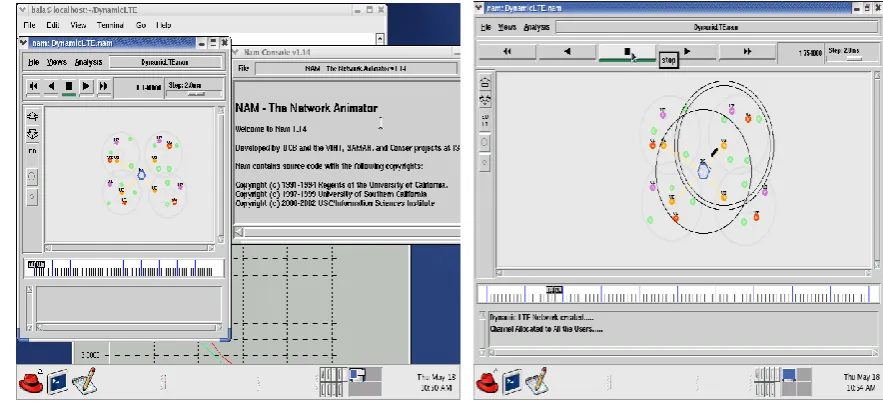
Fig .4 Creation of multiple nodes in NAM
Fig .5 Packet Delivery Ratio Vs number of users
Fig .5 shows a comparison between both the on-demand and proactive routing protocols on the basis of packet delivery ratio as the function of different number of traffic sources.
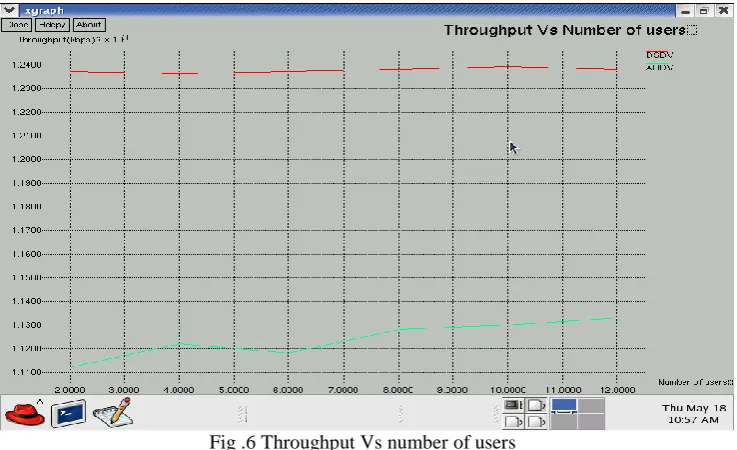
Fig .6 Throughput Vs number of users
Fig .7 Mean packet end to end delay Vs number of D2D users
Fig .7 shows the comparison of mean packet end to end delay between the two routing protocols, the delay in DSDV is less then AODV for given number of users. For increase in number of nodes ,the results varies.
V.CONCLUSION
In this research work we implemented DSDV and AODV routing protocols. Simulation results shows that protocols AODV deliver a greater percentage of the originated data packets. DSDV delivers a greater percentage of packet drop ratio as nodes increases than AODV. In DSDV, AODV as the number of nodes increases normal routing load increases but AODV provides a increased normalizing load than DSDV. Packet delivery ratio increases in AODV as compared to DSDV when no. of nodes increases.
REFERENCES
[1] K. Doppler et.al.,“Device-to-device communication as an underlay to LTE-advanced networks”, IEEE Communication Mag. , vol. 47, no. 12, pp. 42-49, 2009.
[2] C.-H. Yu et.al., “On the performance of device-to-device underlay communication with simple power control”, in Proc. VTC, pp. 1-5. 2009. [3] Yadav.Singh.Narendra ,Yadav.P.R ,“Performance Comparison and Analysis of Table-Driven and On-Demand Routing Protocols for Mobile
Ad-hoc Network”, Information Journal of InformationTechnology. Volume No.4, Issue No.2. 2008.
[4] Alia Asheralieva and Yoshikazu Miyanaga , “Dynamic Buffer Status based Control for LTE-A Network with Underlay D2D Communication”
, IEEE Transactions on Communications, 2016.
[5] Asheralieva, K. Mahata ,”Resource allocation for LTE-based cognitive radio network with queue stability and interference constraints”, Physical Communication., vol. 14, pp. 1 – 13. 2015.
[6] Snehal Goverdhan , Aakanksha Choubey , “Comparative Analysis and Implementationof DSDV and AODV Routing Protocol for MANET ”, International Journal of Computer Techniques – Volume 2 Issue 3, May - June 2015.
[7] Malany.Boomarani.A. Dhulipala . Sarma. Chandrasekaran.RM.V.R , “Throughput and Delay Comparison of MANET Routing Protocols“, Int. J. Open Problems Compt. Math. Volume No.2 , Issue No.3. 2009
[8] Patil.P.V , “Performance Evaluation of on demand and Table driven Protocol for Wireless Ad hoc Network”, International Journal of Computer Engineering Science. Volume No 2. Issue No 9. 2012
[9] Sharma.Aditi. Rana.Sonal. Kalia.Leena., “Performance Comparison of AODV and DSDV Routing Protocols in Mobile Ad Hoc Networks”, International Journal of Emerging Research in Management &Technology. Volume No.3, Issue No.7. 2014