Re-using Listed Buildings through
Conversion:
a process mapping approach
by
Esra Kurul
submitted for a Doctorate of Philosophy Degree
Bartlett School of Graduate Studies
University College London
ABSTRACT
Re-use is the fundamental means of sustaining and thus conserving modest architectural heritage (Grade II listed buildings). Currently, it remains a marginal activity within property development as the direct agents perceive the re-use process to be more complex, construction and project costs to be higher, and the project duration to be longer than new built projects. As a result, the risk of vacancy and obsolescence in architectural heritage Increases.
The author asserts that understanding the actual dynamics of the process, and identifying the factors that increase the chances of overcoming challenges associated with re-use, and thus achieving a successful outcome, would be Instrumental In firstly evaluating the validity of the above perceptions, which are widely published in the related literature, and then proposing a 'good practice re-use process' that can be adopted to similar projects. Hence, agents would become equipped with the know-how of carrying out re-use projects. Eventually, re-use would move towards the centre of the property development domain, and subsequently our capacity for sustaining architectural heritage would have increased.
Therefore, this thesis focuses on the process of re-using listed buidings. It adopts a process mapping approach m a case study context. The development processes of three re-use projects in London are mapped. The process mapping approach adopted is novel to the property development sector. Its novelty lies in two areas. Firstly, it maps the actual processes instead of proposing a normative process protocol. Secondly, it devises a methodOlogical approach, which is both flexible enough to allow data 'speak for itself, and systematic enough to allow for rigorous and consistent analysis of rich and extensive qualitative data. (Comparative analysis of the maps follow process mapping. Here, the aim is to assess process performances and project outcomes. Then a 'good practice guide for re-use process' is proposed. This is based on the findings of the comparative analysis.
The research has shown that the re-use process is complex, but is still possible to achieve success if the development team is competent in managing complexity, flexible and responsive, and adopts a holistic project perspective. Even if the development teams do not have these attributes, they can successfully complete a re-use project if the market is buoyant. The buoyancy of the market can thus counter-balance the drect agents' reluctance to get involved and increase the opportunities of re-using listed buildings. The challenge is to establish and sustain the attributes the development team needs to possess to achieve success in the development/construction industry where shorttermism still ovemdes. Until this is achieved, re -use is likely to continue to be a marginal activity dominated by a small number of development teams with expertise in the field at locations and times of market depression.
TABLE OF CONTENTS
CHAPTER1
INTRODUCTION ... I
1.1. THECONTEXT...I
1 .2. S GNIFIcANCE OF RE-USE IN CONSERVING BUILT HERITAGE...3
1 .3. THE CHALLENGES OF RE-USE...
5
1.4. RESEARcH
Focus...
71 .5. THE RESEARCH QUESTIONS & WORKING PROPOSITIONS...10
1
.6.
THE STRUCTURE OF THE THESIS...10CHAPTER 2 THE IDEOLOGICAL CONTEXT: EVOLUTION OF THE
CONSERVATIONMOVEMENT ... 13
2 .1. INTRODUCTION...13
2.2. FROM ANTIQUITY TO ThE NINETEENTh CENTURY...14
2 .3. NINETEENTH CENTURY...17
2.4. THE EARLY TWENTIETH CENTURY: PRE-SECOND WORLD WAR...21
2.4.1. Athens Charter: an intermediar,' document ...23
2 .5. THE SECOND WORLD WAR-
1960s...
242.6. 1960s-1 980s: THE PHYSICAL EXPANSION ...26
2
.7.
1980s -
PRESENT...302.8. EvoLlrrIoN OF RE-USE PRACTICE...33
2.9. CONCLUDING REMARKS ...34
CHAPTER3
THE IMPLEMENTATION CONTEXT...36
3 .1. INTRODUCTION: BALANCING THE DEMAND & SUPPLY...36
3.2. MACRO LEVEL INFLUENCES: THE STRUCTURE ...37
3.2.1. The Role & Transformation of the Regulatory Context ...37
3.2.Z Demand Characteristics ... 40
3.2.3. Supply Characteristics...41
3 .3. EXrENT OF CURRENT RE-USE AcTIvrrv... 42
3.4. THE RE-USE PROCESS: DEFINITIONS...43
3.4.1. Activities... 45
3.42 Agents... 46
3.4.3. Issues ... 47
3 .5. M CR0 LEVEL INFLUENCES ...49
3.5.1. Development Control... 49
3.52 Building Control...52
3.5.3. Meeting the Changing Demand Characteristics...53
3.5.4. Supply Characteristics...55
CHAPTER 4 LINKING IDEOLOGY AND IMPLEMENTATION: DYNAMICS OF
ADAPTIVERE-USE...58
4 .1. INTRoDucTIoN... 58
4.2. DEVELOPMENT TYPES: NEW BUILD & REFURBISHMENT/CONVERSIONIRE-USE ... 58
4.3. LISTED BUILDING AS PROPERTY AND AS ARTEFACT: THE TENSION ...62
4.3.1. Impact of Listing on Development Cost & End-product Value...64
4.4. BALANCING THE
SUPPLY &
DEMAND ... 684.4.1. Continuity & Change... 68
4.5. DRIvING FORCES OF ADAPTIVE RE-USE...71
4.6. DYNAMICS OF RE-USE: CONCLUSIVE REMARKS ...74
CHAPTER 5 DUKE OF YORK'S PROJECT (DOY): PILOT STUDY...77
5.1. INTRODUCTION ... 77
5.2. THE
SITE...78
5.3. THE PROJECT TIME-LINE ...80
5.4. ANALYSIS ..._81 5.4.1. Analysis Strategy...82
5.5. RESULTS ... 85
5.5.1. Issues & Activities...- 85
5.5.1.1.
Time- related issues...
855.5.1.2.
Economic Issues ...
895.5.1.3.
End Product Characteristics...
915.5.1.4.
Politics & ActMties ...
925.5.1.5.
Project Characteristics & Activities ...
935.5.1.6.
Building Characteristics & Activities ...
945.6. CONCLUSIVE REMARKS...97
CHAPTER6
RESEARCH METHODOLOGY...100
6.1. INTRODucTIoN...100
6 .2. METHODOLOGICAL IMPUCATIONS OF THE PILOT CASE STUDY...100
6.3. THE GENRE: QUANTITATIVE/QUALITATIVE ...101
6.4. OVERALL STRATEGY...103
6
.5.
SITE & POPULATION
SELECTION ... 1036.5.1. Heritage Caseload...105
6.5.1.1.
LBC Applications ... 106
6.6.
TACTICS ...
1086.7. DATA MANAGEMENT & ANALYS S METHoDs...110
6.7.1. Qualitative Data Analysis...110
6.7.1.1.
Qualitative Data Analysis Software ...
1126.7.1.3.
Cognitive Mapping .115
CHAPTER 7 APPLICATION OF THE RESEARCH METHODOLOGY...119
7.1.
INTRODUCTION...119
7
.2. DATA COLLECTION & PREPARATION FOR ANALYSIS...
1197.3.
DATAANALYSIS...121
7.3.1.1.1.
BuildingThe
Maps...123
7.3.1.2.
Analysing the Maps...1247.4. METHODOLOGICAL POTENTIAL
...127
CHAPTER8
552 KING'S ROAD PROJECT...128
8.1.
INTRODUCTION...128
8
.2.
AGENTS...130
8
.3.
ANALYsIS...131
8.3.1.
Initiation ...134
8.3.1.1.
PFI
Deal...134
8.3.1.2.
552 King's Road...135
8.3.2.
Initial Scheme...137
8. 3.3.
Pre-application Negotiations & Tendering...139
8.3.4.
Planning & Funding Applications, and Detailed Design...143
8.3.5.
Construction & Marketing...151
8
.4. RESULTS...152
8.4.1.
Process...152
8.4.2.
Activities...153
8.4.3.
Agents...154
8.4.4.
Issues...155
8.5.
CONCLUSIONS...158
CHAPTER9
NEW RIVER HEAD PROJECT...160
9.1.
INTRODUCTION...160
9
.2.
AGENTS...162
9.3.
ANALYSIS...163
9.3.1.
Project Initiation...164
9.3.1.1.
Planningfor
Real...164
9.3.1.2.
Initiation of the Current Project...1679.3.1.3.
JV
Negotiations...168
9.3.2.
Emergence of Initial Scheme...169
9.3.3.
Pre-Application Negotiations...170
9.3.4.
Planning Application...173
9.3.5.
Detailed Design & Tendenng...175
9.3.7. Project Gain. 183
9.4. RESULTS. 184
9.4.1. Process... 184
94.2. Activities... 184
9.4.3. Agents... 186
9.4.4. Issues... 187
a c I RQ CHAPTER10 ANCHOR TERRACE PROJECT ... 191
10.1. INTRODUCflON... 191
10.2. AGENTS... 193
10.3. ANALYsIs... .... 194
10.31. Project Initiation ...197
10.3.2. Initial Scheme & Project Costing...200
10.3.3. Pre-application Negotiations & Ground Investigations...203
10.3.4. Planning & SAM Applications & Consents...205
10.3.5. Design Detailing & Building Regulations ...207
10.3.6. Construction, Marketing & Sales...208
10.3.7. Project Gain...210
10.4. RESULTS...211
10.4.1. Process...211
10.4.2. ActWities...211
10.4.3 Agents...213
10.4.4. Issues...215
10.5. CoNcLusioNs... 217
CHAPTER11 COMPARATIVE RESULTS ... 220
11.1. INTRODUCTION... 220
11.2. COMPARISON OF PROJECT PROCESSES ... 221
11.2.1. Comparison Criteria...221
11.2.2. The Matrices...221
11.2.3. The Processes...224
11.2.3.1.
Initiation...
22511.2.3.2.
Emergence of Initial Scheme...
229112.3.3.
Pre-application Negotiations...
23211.2.3.4.
Planning Application ...
23711.2.3.5.
Detailed Design
&Tender...
241112.3.6.
Construction, Marketing & Sales...
24611.3.
SIGNIFICANT ATrRJBUTES OF THE RE-USE PROCESS...
24911.4.
PROJECT OUTCOMES ...25111.4.2. Evaluation . 252
11.5. PROCESS EVALUATION ...254
11.5.1. Evaluation Criteria...254
11.5.2. Process Evaluation Matrix...255
11.6. EPILOGUE ...256
CHAPTER 12 CONCLUSIONS & RECOMMENDATIONS ...257
12.1. INTRODUCTION ...257
12.2. RESEARCH QUESTiONS & PROPOSmONS RE-vlsi ED ...257
12.3. REvIEw OF THE RESEARCH OUTCOMES ...258
12.4. CoNcLusIoNs ...259
12.4.1. The Re-use Process: characteristics & influences...259
12.4.2. Managing Complexity & Achieving Success...261
12.4.3. Listed Building as Artefact versus Listed Building as Property...263
12.4.4. Methodological Implications & Potential...264
12.5. RECOMMENDATIONS ...266
12.5.1. Emergent Propositions & Recommendations for Further Research...266
12.5.2. Lessons for Indirect Agents...268
12.6. VALUE OF REsEARCH FOR ITS AUDIENCE
...
270BIBLIOGRAPHY ... 268
APPENDIX 1- Duke of York's Case Study Project Process...288
APPENDIX2- King's Road Project PFI Background...302
APPENDIX3- King's Road Project Cluster Maps...305
APPENDIX4- NRH Project Cluster Maps...337
APPENDIX5- Anchor Terrace Project Cluster Maps...360
LIST OF FIGURES
Figure1.1. Inherent conflict...6
Figure1.2. The Re-use Process...
8Figure3.1. Development Process: input & output ...
43Figure 3.2. Model of Planning in Institutional Structure of Society ...47
Figure3.3. Asset Performance Over Initial Design Life...53
Figure3.4. Functional Degeneration...54
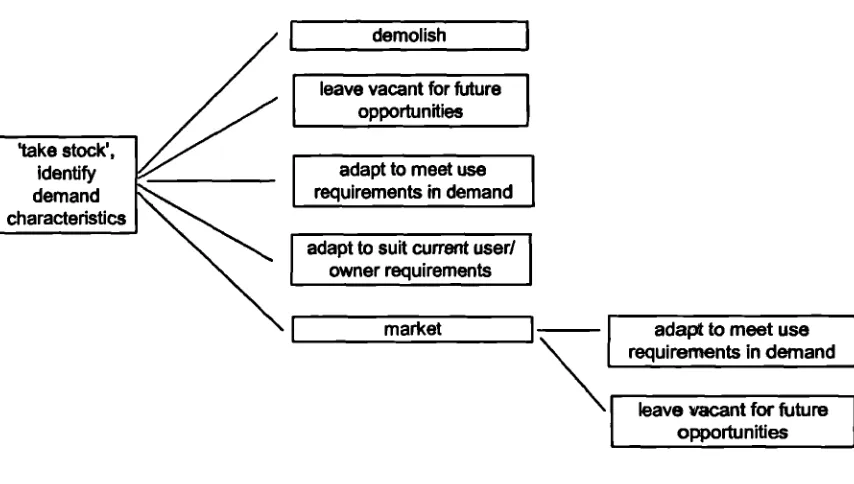
Figure3.5. Development Options ...55
Figure4.1. Socio-cultural values...63
Figure4.2. Technical Values...63
Figure4.3. Percepto-cognitional Values ...63
Figure4.4. Agents & incentives ...
72Figure4.5. Dimensions of Adaptive Re-use...
75Figure5.1. Duke of York's Site Map...78
Figure5.2. Listed Buildings on Site & Open Space...79
Figure5.3. Project Time-line...80
Figure 5.4. Artist Impression of DoY Square & Block A after Completion ...81
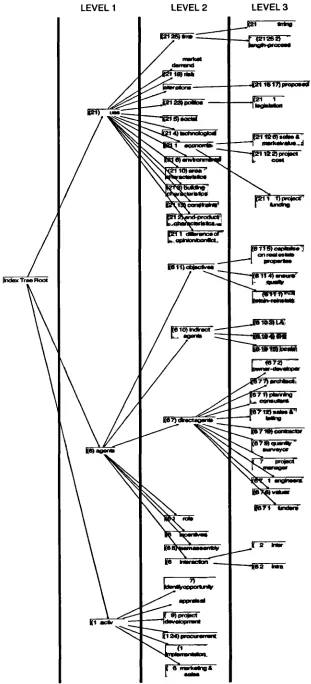
Figure5.5. D0Y Emergent Index Tree...83
Figure6.1. Grounded-theory-based qualitative data analysis ...111
Figure7.1. NUDIST screen showing text & coding ...122
Figure7.2. DE Map: concepts, links & memo card...124
Figure7.3. An Emergent Cluster in 552 King's Road Project...125
Figure7.4. An Emergent Matrix...126
Figure8.1. King's College Site Map...128
Figure8.2. Listed Buildings on Site...129
Figure8.3. Process Map: PFI Deal...134
Figure8.4. Process Map: Initiation...136
Figure8.5. Process Map: Initial Scheme ...137
Figure8.6. Process Map: Design Detailing & Tendering...140
Figure 8.8. Process Map: Design detailing & Planning application...144
Figure 8.9. Process Map: Northacre's Involvement & Design Detailing ...147
Figure8.10. Process Map: Design Detailing & Outcomes...149
Figure8.11. Process Map: Construction & Marketing ...151
Figure 9.1. NRH Site Map...160
Figure9.2. Buildings on Site ...161
Figure9.3. Process Map: Planning for Real Exercise ...166
Figure9.4. Process Map: Initiation Stage ...167
Figure9.5. Process Map: JV Negotiations...168
Figure9.6. Process Map: Initial Scheme ...169
Figure9.7. Process Map: Pre-application Negotiations...171
Figure 9.8. Process Map: Planning Application ...174
Figure9.9. Process Map: Design Detailing...176
Figure9.10. Tendering Chain of Argument...177
Figure9.11. Process Map: Construction & Marketing ...180
Figure10.1. Anchor Terrace Site & its Context ...191
Figure 10.2. Anchor Terrace & Globe Theatre Remains ...192
Figure10.3. Initiation Stage Map ...197
Figure10.4. initial Scheme Stage Map...202
Figure10.5. Pre-application Stage Map...204
Figure10.6. Planning Application Stage Map...205
Figure10.7. Design Detailing Stage Map ...207
FIgure 10.8. Construction, Marketing & Sales Stage Map ...208
Figure10.9. Project Gain ...210
Figure11.1. Stage Matrix...223
Figure 11.2. Process Maps: Initiation Stage ...227
Figure11.3. Initiation Stage Matrices...228
Figure11.4. Process Maps: Emergence of Initial Scheme...230
Figure11.5. Initial Scheme Matrices...231
Figure 11.7. Pre-application Negotiations Matrices . 235
Figure11.8. Process Maps: planning application stages...238
Figure11.9. Planning Application Matrices...239
Figure11.10. Process Maps: design detailing stages ...242
Figure
11.11. Design Detailing Matrices...244Figure11.12. Process Maps: construction & marketing stages...247
LIST OF TABLES
Table 1.1. Criteria for Indusion in The Buildings at Risk Register...5
Table2.1. Evolution of the Conservation Movement ...16
Table3.1. Agents in the Re-use Process...46
Table3.2. Issues in the Re-use Process ...48
Table 3.3. Significant Supply Characteristics for Adaptive Re-use...56
Table 4.1. Influence of Listing on Market Value (based on Scanlon, et. aI,1994)...66
Table5.1. Agents & Issues Matrix ...84
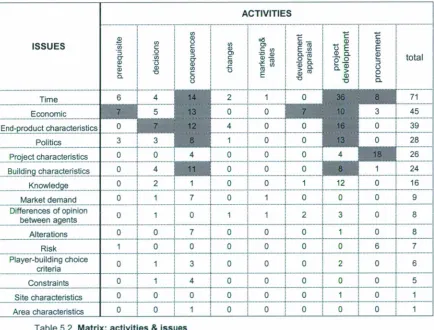
Table5.2. Matrix: activities & issues...85
Table5.3. Project development & Time...86
Table5.4. Matrix: time issues & top-3 activities...87
Table5.5. Matrix: economic issues & top-3 actMties ...89
Table5.6. Matrix: agents & objectives ...92
Table5.7. Matrix: agent attributes & issues...95
Table5.8. Perceptions & attitudes: issues...96
Table5.9. Disagreements on end-product...96
Table6.1. LBC applications as a ...107
Table6.2. LBC applications as a percentage of...107
Table7.1. The Interview Topic Guide ...120
Table 8.1. 552 King's Road Project Matrix Showing Strength of Links between Clusters...131
Table8.2. List of Clusters...132
Table8.3. 552 King's Road Project time-line...133
Table8.4. 552 King's Road Project Key Issues ...157
Table9.1. List of Clusters...163
Table 9.2. NRH Project: Matrix showing number of links between dusters ...164
Table9.3. NRH Project Time-line...165
Table9.4. NRH Project Key Issues...188
Table10.1. List of Clusters...194
Table 10.4. Anchor Terrace Project Key Issues . 216
Table
11.1.Planning Process Duration...240
Table11.2. Design Detailing Process Duration ...243
Table11.3. Project Duration versus Construction Duration...246
Table
11.4.Purchase to Sales Duration ...253
Table11.5. Process Evaluation Matrix...255
Table 12.1. Influences on Project Complexity & the Controlling Agents...260
CHAPTER 1 INTRODUCTION
'...
it is again no question of expediency or feeling whether we shall preserve the buildings of past times or not. We have no right whatever to touch them. They are not ours. They belongpartly to those who built them, and partly to all the generations of mankind who are to follow us...What we have ourselves built, we are at liberty to throw down; but what other men gave
their strength and wealth and life to accomplish, their right over ri does not pass away with their death: still less is the right to the use of what they have left vested in us only'.
John Ruskin, Seven Lamps of Architecture ((1880) 1989: 197)
'It is fundamental to the Government's policies for environmental stewardship that there should be effectWe protection for all aspects of the historic environment. The physical survWors of our past are to be valued and protected for their own sake, as a central part of our cultural heritage
and our sense of national identity...' Quoted in paragraph 1.1., PPG 15, DoE (1994a).
1.1. The Context
The 1990s have seen an Increase in the conversion of redundant buildings in inner city areas in the UK in general, and in particular in England. The fundamental reasons behind this increase include the economic restructuring of the early I 980s that succeeded the recession of the I 970s, technological developments that influenced the pace and means of data transfer, social transformations reflected in the demographic structure and an increased concern for environmental issues. As well as influencing the property development sector directly through increased demand for conversions, these factors were also influential on the Government's focusing on conversion as an alternative means of accommodating substantial growth in spatial demand (mainly residential), thus encouraging conversions through policy statements.
These factors triggered an increase in the re-use of listed buildings 1 by the private sector. This was a major shift from the situation in the late-I 980s when the majority of re-use projects were undertaken by agents 'who [had] little or no direct experience of property development' (DoE, I 987b: 6). The successful schemes in the UK and the North American, specifically in New York, experience of 'loft living' (Zukin, 1984) were instrumental in revealing the buoyant market potential for listed building conversions, resulting in a propensity to get involved in re-use schemes among direct agents2 who had not hitherto shown an interest in such schemes.
Although they were influential in a steady increase in the re-use activity over the past two decades, these developments did not bring a long-term, viable solution to the problem of re-using listed buildings. Neither were they instrumental in expanding to a wider group the market confidence that a limited number of developers had gained. Both statutory bodies and
See Section 3.4, page 43 for the definition of 'adaptive re-use'.
2 See Section 3.4.2, page 46 for the definitions of direct and indirect agents.
-developers share responsibility for failing to use this opportunity to establish a new framework to solve the problems associated with re-using listed buildings. The statutory bodies tried to solve long-standing problems and to overcome widespread prejudices against the re-use process and themselves by introducing temporary solutions (such as development corporations) instead of dealing with the actual causes of the problem, which lie in the statutory framework and complexity of the conversion process. In contrast, most developers adopted an opportunistic attitude by trying to exploit the contemporary market and then moving on to other markets or areas. As a result, the relationship between the two realms with which re-using modest listed buildings is associated, I.e. architectural conservation and property development and management, have remained separate. Their interface has been confined to the planning procedure, resulting in a high potential of conflict throughout the process.
As a result, most developers still regard re-use of listed buildings to be an unfavourable venture when compared to other types of development; hence, vacancy and dereliction of listed buildings continue to constitute problems for which the statutory bodies strive to find solutions. If schemes like Shad Thames3 in London are considered, it is possible to argue that conditions have started to change and re-use has become a favourable activity. However, it should be noted that this is a seemingly established market, confined to areas where development pressure is high or where the market forecast is such that demand will increase In the near future. This leads to a geographical disparity in the number of re-used listed buildings, resolving the problem only in certain areas. Reluctance towards re-use schemes continues to the detriment of listed buildings in areas with low market demand.
The discordance becomes even more problematic as the presumption in favour of conservation of all buildings of architectural or historic interest, which was seeded at the end of the nineteenth century in the writings of interested intellectuals such as Ruskin, has now become well-established, as the latter quote at the beginning of this introduction shows. This presumption does not make any concessions to the periodical or geographical variance of market conditions except to acknowledge the difficulty of finding a use for listed buildings in economically disadvantaged areas.
Conversely, there is dear evidence that market demand increases the chances of a non-monumental (Grade II) listed building being re-used and thus, conserved. This is because the upkeep and adaptation of a Grade H listed building depends on the availability of private sector funding, which is dependent on the utility a building would yield.
Thames spans west and east of Tower Bridge on the south bank of River Thames hi London. The area became available for a major re-use project as warehouses ni the area gradually became vacant (and some obsolete) by the caesurae of warehouse use in the early I 970s. A scheme was developed by a development consortium to convert the existing buildings on site to high-quality mixed-use spaces induding residential, shopping and offices. The development started hi 1985 and lasted until the mid-1990s. Although the consortium faced financial problems and went into receivership during the development process, the area had become well-established, with property prices comparable to the north of the Thames, by the end of the 1990s and it is now a highly sought after area by the people working rn
Facts and figures in the recently updated Buildings at Risk Register4 (English Heritage, 2002) provide evidence for the lack of public funding and Its inadequacy In overcoming the wide-scope, large-scale problems of conserving the built environment, and the resultant dependence on private sector investment. According to Kennedy (2002), 'the cost of restoring everything on the Register is estimated to be £400 million'. Given that English Heritage can afford to spend £5million on conservation grants annually, it would take 80 years to rescue all buildings at risk in England. This is provided that no building is added to the register in the meantime. Entries and removals from the 2002 Register show that the number of entries exceeded the number of removals by 20. This suggests that the number of buildings at risk will remain constant un the future unless funding levels are increased dramatically, and thus the problem of under-funding will continue.
It can be argued that grants available from Heritage Lottery Fund (HLF) can help resolve the problem. During the 2000-2001, HLF spent £188.7 million in grant aid (HLF, 2001). Only 30% (56.61 million) of the total grant is spent on historic buildings and sites. Even if all grants available for listed buildings are channelled towards the rescue of listed buildings at risk, the rescue operation for buildings currently included in the list would take seven years to complete. Given that both English Heritage and HLF grants have to be 'matched' by the recipient and the buildings at risk represent only a small part of the problem, it becomes apparent that private sector investment is necessary for the conservation of architectural heritage. As a result, the presumption in favour of purist conservation becomes artificial, thus problematic, especially in economically disadvantaged areas. Therefore, there is still the need to devise means of promoting re-use.
1.2. Significance of re-use in conserving built heritage
Buildings facilitate their occupants to perform an array of activities. They need to fufil their users' spatial, servicing, environmental and operational requirements in order to continue facilitating these activities and thus need to be occupied. As a result, occupation of a bulding is associated with the utility it yields to its occupants through use. The utility gained from the use of buildings which have a higher symbolic value than use value can be more abstract than simply fulfilling the spatial requirements of its users. The sense of (community) pride such buildings provide is an example of such abstract utility.
The array of uses and/or the user requirements (demand characteristics) change throughout the building life-cycle. The extent to which a building fulfils its user requirements throughout its life cycle is defined here as building performance. Building performance steadily decreases throughout the life of buildings. The decline starts almost as soon as the building is occupied
due to rapid changes in user requirements (CIRIA, 1994: 6). At the point where the building starts under-performing, it needs to be adapted to keep the building performance at levels acceptable to its current user requirements if the current occupants are to continue occupying the building. If this is not the case, then it need to be adapted for change of use for potential future occupants.
Unless this adaptation takes place and thus the buildings continue to be occupied, the buildings carry the risk of obsolescence and subsequent decay and neglect. This Is evident In English Heritage's criteria for inclusion in the Buildings at Risk Register. Table 1.1 shows the criteria and six possible building use capability, occupancy and condition scenarios. In all scenarios where buildings are unoccupied, the buildings are registered as being 'at risk' independent of their condition and beneficial use capability (Scenario 4). This suggests that occupancy Is a factor in safeguarding architectural heritage. Given the above arguments which assert that buildings are occupied if they yield utility to their occupants through use, re-using a listed building becomes a key factor in its conservation.
Refurbishment for change of use (adaptive re-use) is particularly necessary to avoid obsolescence of Grade II (non-monumental) listed buildings, the original use of which has become obsolete. The fundamental reasons behind this necessity are:
• the wide gap between contemporary spatial requirements and the ones the building was constructed to fulfil, resulting in very low performance levels;
• lack of maintenance leading to high levels of deterioration in original building materials.
vet bad
AT RISK poor
very bad
AT RISK poor
fair condition I AT RISK
fair condition AT RISK
fair condition, but Iackwg management arrangements
5 incapable
I
occupied VULNERABLEScenario Beneflclai Use I Occupancy Condition Registered as
I
2
3
4
vacant
incapable
partly occupied I abouttobevacatedas
I
a result of functionalvacant capable partly occupied
I about to be vacated as
I
a result of functionalvacant
incapable
partly occupied I about to be vacated as
I
a result of functionalvacant partly occupied capable
about to be vacated as a result of functional
6 capable
I
occupiedI
poor VULNERABLETable 1.1. CrIteria for Inclusion In The Buildings at Risk Register
Current planning law explicitly states the presumption against demolition of any listed building. For example, Planning Policy Guidance Note 15 (PPG 15) states that 'the Secretaries of State would not expect consent for demolition to be given simply because redevelopment is economically more attractive to the developer than repair and re-use of a historic building' (paragraph 3.17). If these buildIngs are to be instrumental in 'enhancing the familiar and cherished local scene' rather than becoming eye-sores due to lack of maintenance and resultant obsolescence, then there is the need to promote the re-use of listed buildings. Re-use of listed buildings can only be promoted if It can be shown that there is the potential to overcome challenges associated with re-use.
1.3. The challenges of re-use
schemes. The thesis carries the argument further by asserting that challenges associated with
re-use stem from:
• the statutory framework that is based on the presumption in favour of conservation;
• inconsistency and subjectivity associated with the planning process and related decisions;
• uncertainty associated with the building condition; and
• complexity of, and risks associated with, re-use projects.
Despite these challenges, conditions could not have been more favourable for re-use activity
since the late 1980s in the UK. Given the challenges of planning for the substantial growth
(mainly residential) in spatial demand within the urban context, public opinion in favour of
architectural and environmental conservations, and government support, the forecast is that
re-use activity will continue. Central locations of most listed buildings in the urban environment,
coupled with an increasing trend of living in city centres, provide further supportive evidence
that re-use of listed buildings will become much more common than at present. This is an
immense opportunity, utilisation of which can assist greatly in the creation of favourable
conditions for the conservation of listed buildings by transforming the ever-expanding
architectural heritage from an under-used stock to a sustainable resource. This transformation
can only be accomplished by re-establishing re-use as a routine activity in the construction
industry.
building 55 reSt estate PROPERTY DEVELOPMENT
business interests
41'
building as public property
interests of general public PLANNING as perceived by planners
building as cultural property CONSERVATION interests of conservation specialists
Figure 1.1. Inherent conflict
It can be argued that making
necessary changes in the statutory
framework is the means to this
re-establishment as it would
contribute to the reduction of
challenges associated with the
process. Although this would make
an immense contribution, such
changes would not be sufficient on
their own. This is because the
inherent conflict between
development control and planning
will continue as it would in any other development project. Despite being less intensive, the
potential for conflict would still be higher than a mainstream conversion project in the likely
event of the continuation of the marginalisation of heritage issues through the conflicting
development control mechanism they are subject to (Figure 1.1).
Furthermore, the complexity of any one project and the high risks associated with it will continue
to nurture the direct agents' reluctance in getting involved, independent of changes to the
statutory framework. The project will remain inter alia complex as the number of issues that
need to be taken into consideration will remain high. This is because individual agents involved
property' and 'real estate', and the project, I.e. profitability, and public benefit. The number of agents involved will remain high contributing to further complication of the project and management of the process.
In addition to the above stated complexities that emanate from the specific characteristics of listed buildings, re-use/conversion projects are distinguished by being more complex than new build projects due to their project and team-specific characteristics. The project specific characteristics that increase complexity can be listed as:
• uncertainty associated with building conditions; and thus, project duration and cost; • high risks that result from the above uncertainty;
• requirement for both higher flexibility in timing, cost and functionality of end-product; and allowances for reiterations/recursions between different stages in order to handle high levels of uncertainty.
Team specific characteristics include involvement of a high number of professionals operating in a project environment and the necessity of their early collaboration.
Understanding the challenges that stem from the statutory framework should be complemented by understanding those that stem from the project characteristics. This will enhance the understanding of the re-use process, which will assist in the identification of factors that would enhance process performance and project output. In the context of this research, these factors will be used as the basis of proposing a good practice re-use process. As the proposed good practice process is tested and refined through subsequent research, it will increase the chances of success In this thorny area of property development, helping to reduce the reluctance of direct agents to get involved.
1.4. Research Focus
This research focuses on gaining a detailed understanding of the process of re-using Grade II (non-monumental) listed buildings in Central London. This section concentrates on the justification of the research focus in terms of the choice of:
• process mapping as a means to understand the process; • Grade II listed buildings as the study population;
• Central London as the research location.
Hunt (1996: 2) defines a business process as 'a series of steps designed to produce a product or service'. It is possible to rely on 'the documentation and examination of the input-output of the process' in an attempt to analyse business processes. However, this leaves out the analysis of process through which the inputs are transformed to outputs. Given that between every input and output there is a process and that business improvements remain partial if the process is not analysed and understood, It becomes specifically important to concentrate on the structured analysis of that process. (Hunt, 1996)
'proven [to be a] methodology for identifying current "As-i? businesses and can be used to provide a "To-be road map"'(Hunt, 1996: 1). Also, the mapping approach has the potential to avoid over-simplifying this complex system. This approach is adopted for the purposes of the research.
The components of a re-use process are argued to be: the direct and indirect agents Involved, the activities they undertake, and the issues they take into consideration In making their decisions (Figure 1.2). The components of the process are pre-conditioned by contextual forces, which create or obliterate favourable conditions for certain types of development at certain locations. Fisher (1999: 221) defines these forces as the structure within which any given project is contained. Process components are inextricably linked with each other through the building throughout this development process. They also interact with the structure within which they are contained. These characteristics make the property development process a complex system to study.
S T R U C T U R E
Figure 1.2. The Re-use Process
Given the above definition of the re-use process and process mapping, the main areas of this study are:
• identification of the agents involved, and capturing a description of the process as perceived by them;
• identification of the issues they take Into consideration during the process. The issues include incentives for individual agents to get involved and the economic, social, cultural, technological, political and environmental factors that are contained in the structure; and
mapping the process by bringing together this information.
Having identified the main research areas and justified the choice 01 process mapping as the general research strategy, the focus of this section shifts to the justification of the sampling decisions that have been taken. These decisions specifically relate to choosing non-monumental listed buildings in Central London as the sampling population.
adaptive re-use is the absolute pre-requisite for the conservation of Grade II listed buildings specifically in the short-to-medium term. Although adaptive re-use will continue to enable the conservation of Grade II listed buildings in the long-term, making the essential changes to the listing mechanism will also help to ease the problem of obsolescence and dilapidation in these buildings.
Adoption of rigorous and consistent listing criteria which consider the long-term implications of enforcing the retention of buildings of modest architectural and historic significance is the most Important one of these changes. Such criteria should include the adaptability of these buildings for contemporary uses as well as their heritage value. This will allow the filtering of the buildings during the listing process and thus ensure that listing does not become an unrealistic enforcement for the retention of a building5. After all, 'any city can afford only a few unemployed buildings'6.
Moreover, 91.7% of listed buildings are listed Grade II (National Monuments Record- NMR) '. Thus, under-use of Grade II listed buildings would create larger scale problems associated with obsolescence and dilapidation in the built environment, as well as being highly un-sustainable. Because of these issues, Increasing the re-use opportunity of Grade II listed buildings should be given priority. Therefore, this research focuses on these buildings.
The reasons behind the choice of Central London are: the number of listed buildings; and
the frequency of re-use projects.
Greater London Authority (GLA) estimates that there are 37,000 listed buildings in London (GLA, 2002) and NMR states that there are 370,000 listed buildings in England. According to these figures, 10% of all listed buildings in England are in London. This makes London the city with the highest ratio of listed buildings per unit area in England, and thus a suitable area to study the research phenomena. Furthermore, the frequency of re-use projects is also high in London, mainly because of the buoyant property market. Given the arguments in Section 1.1 (see page 1), which asserted that there is the need to promote re-use in economically disadvantaged areas where the property market is by definition depressed, the decision to sample from London cases can be regarded as a contradiction. However, the need to study the phenomena in its context In an exploratory research such as this one requires the research to be carried out in a geographical area where there is an adequate number and variety of cases to sample from. The choice of London is justified on these grounds.
Here, ft should be fterated that although establishing rigorous listing criteria Is considered to be an
important achievement In enabling conservation, It Is not the focus of this thesis.
am thankful to Prof 6ev Null for the discussions which helped to enrich the theoretical framework of this thesis. This line was quoted dunng these discussions.
1.5. The Research Questions & Working Propositions
Given the main areas of study and the definition of re-use process within the context of this research, the research questions the author seeks to answer are:
1. What comprises the process of re-using listed buildings? - Who are the agents involved?
What activities do the agents undertake?
- Which issues do they take into consideration in performing these activities? 2. How are the components of the process, i.e. agents, activities, issues, related to
each other? What are the relationships between these components?
3. How complex are re-use projects? Does project complexity vary throughout the process? What Influences project complexity?
4. What influences process performance and project outcome? The working propositions, based on the above questions are:
• Agents who are not normally involved in a development process, e.g. conservation officers, will be involved.
• It is expected that the agents will undertake activities which they consider necessary in order to carry out the development. Probably, It will not be possible to have a definitive list of activities due to divergent project characteristics.
• The agents will take a wide range of social, technological, economic, environmental and political issues into consideration.
• Components of the process will be inextricably linked to each other. • The projects will be complex.
• Listed building control will have a strong bearing on the process. It may also influence the project complexity.
• It is probable that there will be local differences, even inconsistencies, in the 'interpretation' of national listing building control strategy by the local authorities. • Uncertainty associated with the process and the end-product is likely to have an
influence on project complexity.
• Because of the uncertainty, risks associated with the projects will be high. This might influence project complexity.
• It is likely that the direct agents will assess the project and its outcome against the 'golden triangle': cost of development, duration of project and quality of the product. • Indirect agents will pay due cognisance to their 'perceptions' of the quality of the
outcome.
1.6. The structure of the thesis
Chapter 2 reviews the evolution of the conservation movement in order to provide a background to the current situation in the field of architectural conservation with specific reference to re-use. This is followed in Chapter 3 by the placing of re-use within the realm of property development and management, and the life-cycle of a building.
development process. The analytical framework that is adopted to analyse the pilot study data, which is reported in Chapter 5 Is based on these components.
The pilot case study in Chapter 5 reports results of a live re-use project on the conversion of the Duke of York's Headquarters to a mixed-use development. The pilot study was undertaken to identify the agents involved in the project, and to capture their understanding of the re-use process through the description of the activities undertaken and the uncovering of the issues considered while undertaking these activities, including the ones related to conservation of the listed buildings. Furthermore, the case study was instrumental in identifying the requirement of the methodological approach for this research to yield rigorous results and the criteria for selecting appropriate analytical tools.
CHAPTER 2
The Ideological Context: Evolution of the
conservation movement
When William Blake called fmill towns) dark and satanic, nobody could have forecast how the
passage of histoiy would treat them. But yesterday three of the great mill complexes that were to turn the county Into the cradle of the Industrial Revolution and to change the life of the British working man forever were named as Worid Heritage Sites by Unesco.'
(The Daily Telegraph, 15 December 2001, p.15)
2.1.
introduction
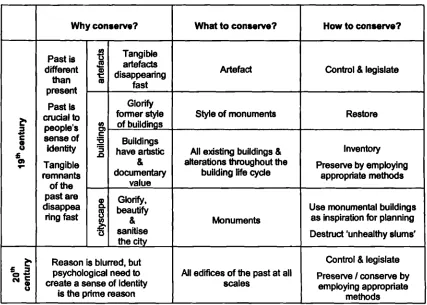
Scholars agree that the seeds of the conservation movement were laid in Italy during the Roman Era (Antiquity) (Erder, 1985: 72; Lowenthal, 1985:41). Since then, different societies have attempted to respond to the questions of 'why to conserve?' (justifications), 'what to conserve?' (definitions, perceptions) and 'how to conserve?' (legislation, conservation methods). These attempts were characterised by dichotomies and equivocation.
The transformation of (architectural) conservation from an ideal to a professional practice from Antiquity to the present is integral to understanding our current attitude towards architectural heritage. However, the nineteenth century is different from the other periods because it saw the distinction between the conservation of the artefact, the building and advances in integrating architectural heritage to urban planning. Moreover, systematic efforts to conserve heritage stock emerged during this century (Delafons, 1997; Ross, 1996; Lowenthal et.al, 1981).
The current mechanism of architectural conservation, specifically the present legislative system, has its roots in the nineteenth century. Therefore, this chapter concentrates on the evolution of the conservation movement from the nineteenth century onwards. It starts with a very brief overview of the significant pre-nineteenth century developments which had a principal influence on the contemporary discourse of architectural heritage. The developments after the nineteenth century are divided into the following phases:
• nineteenth century;
• eaily twentieth century pro- Second World War • the Second World War- 1960s;
• 1960s-1980s;and • 1980$-present.
the pace of change so dramatically that societies felt the need to adhere to their past more strongly.
The review concentrates on developments in Britain after the Second World War as developments such as the declaration of the Athens Charter had helped to elevate the conservation discourse to the international level. Thus, a common set of goals for individual countries had already been established by the early 1930s. As a result, the differences between different countries remained at a judicial level in the years to come. Judicial differences are not central to the fundamental argument of this chapter. Therefore, the review concentrates on developments in Britain, which the author believes are representative of developments in other Western European countries.
2.2. From Antiquity to the nineteenth century
The conservation concept has its roots in mankind's psychological need to associate himself with his forefathers to establish a sense of identity through 'knowing the past'. Lowenthal (1985) identifies memory, history and relics as 'sources' through which mankind 'knows' his past Ancient Romans were no exception. Built heritage was among these sources. These buildings not only reflected the tradition and history of the past (Lowenthal et.al , 1981 :17), but were also symbols of religion and power (Erder, 1985). Sustaining their symbolic value was of the utmost importance because they would 'remind the spectator of the power of the governors' (Jukilehto, 1999: 4). As long as their symbolic value was sustained, partial or wholesale renewal of built heritage was legitimate. Until the mid-fourteenth century, partial or wholesale renewal of built heritage was legitimate as long as symbolic value of the buildings was sustained (see Table 2.1).
Towards the middle of the fourteenth century, the realisation of the past's distinctiveness from the present resulted in '[thej self-conscious concern about the rival merits of old and new' (Lowenthal, 1985: 75). The arte fact became valuable as it encapsulated the past achievement. Thus, the material itself as well as its symbolic value was to be conserved and appreciated from the mid-fourteenth century onwards. The value associated with the material itself gradually increased throughout the next four centuries, peaking in the eighteenth century.
Why conserve? What to conserve? How to conserve?
Symbolic value Psychological need to
associate with the past Educational value ('knowing Sustain symbolic value through the past')
• Re-use constituents of old
buildings to build 'glorious'
0 Glorify Christianity Symbolic value buildings
5 Appreciate & appropriate
____ __________________ __________________ with Classicism
Concern about rival merits of
the past (FIRST TIME) Artefact Obeisance to Antiquity5
' Past had reached the ideal - C
50
Learn from the past In order Surpass past achievement Educational value
to Improve on it
Architectural quality, historic
Monument as artefact Use existing buildings as an c and educational value of
'- e u edifice lnspration contemporary
buildings development
Destruct & build new, re-Glorify Christianity Symbolic value use materials
C
a
U
5
Architectural quality, historic
'Monumenta'9 as artefact I
and educational value of Protection of 'monumenta'
edifice buildings
Use remains as sources of Inspiration for arts and . Glorify the existing buildings Symbolic value architecture
C __________________ __________________ Obeisance to Antiquity a
U
Concern about rival merits of
the PASt Artefad Obeisance to Antiquity
Past had reached the ideal
Collect original works of art
Regulate export
C
• Appreciation of Classical Artefact (given the highest
U
achievement value ever) Study the artefacts by
systematic & critical
___ ______________ _____________ recording
5 Th1S obeisance reached to such an extent that exact replication was legitimate as it was done in order to achieve the idealism antiquity had reached.
Why conserve? What to conserve? How to conserve?
Past is . 4! Tangibleartefacts
different disappearing Artefact Control & legislate
than fast
present- ___________ ________________________ _______________________
Past Glorify
crucial to former style Style of monuments Restore
people's of buildings _______________________ ______________________ c sense of Buildings
identity have artistic All existing buildings & Inventory Tangible & alterations throughout the Preserve by employing remnants documentary building life cyde appropriate methods
ofthe - value _______________________ ______________________ past are Glouify,
disappea Use monumental buildings
ring last " & Monuments as inspiration for planning
sanitise Destruct 'unhealthy slums'
_____ _______ - thecity ____________________ ___________________
Reason is blurred, but Control & legislate
¶ psychological need to All edifices of the past at all Preserve / conserve by create a sense of identity scales employing appropriate
is the prime reason methods
Table 2.1. EvolutIon of the Conservation Movement
The value of the artefact reached its highest level during the eighteenth century. The systematic and critical survey of the ancient artefact ('knowing') that reached perfection was considered to be the means for the then contemporary artists to achieve similar perfection (Jokilehto, 1999: 49, 63; Lowenthal, 1985: 252). Hence, disinterment and recording of the antiquities became important. As a result, the Grand Tours started at first to Italy, and then to the Eastern Mediterranean.
The most significant impact of the tours to Italy was the emergence of the Picturesque
movement in England. The Picturesque valued existing buildings because of their harmonious relationship within their context (Hunter, 1996: 4). Thus, the idea of place and its historic associations emerged as new concepts in appreciating the past.
heritage protection to existing buildings of lesser importance. Wllh the influence of Romanticism, a heightened nostalgia towards the past emerged. This resulted not only In the appreciation of medieval buildings but also a reaction against the neglect that many religious buildings had been subject to, especially In Britain (Hunter, 1996: 6). This is the fundamental reason behind the restoration of existing churches In Gothic style, a Style which was now considered supreme, in the nineteenth century. These restorations Stripped the religious buildings of their later additions. France and some Germanic countries followed Britain's footsteps in restoring their religious buildings to the glory of the Gothic. It should be noted that these restorations did not go without criticism from the likes of Ruskin and Moms.
2.3. Nineteenth Century
The systematic efforts to conserve architectural heritage which emerged during this century were the result of the wider social and cultural changes in society in individual countries. Such changes led to 'a three-fold awareness of the past: that it was unlike the present, that it [was] crucial to [people's] sense of identity, and that its tangible remnants (were] rapidly disappearing' (Lowenthal, et al, 1981:17). The awareness that tangible remnants were disappearing prompted the need to devise means to protect the remaining remnants of the past under the guise of
restoration. Legislation was considered to be an adequate provision and the conservation movement of the nineteenth century was dominated by attempts to establish legislation in Western European countries.
Countries like Italy, Sweden and France passed decrees that ordered the protection of antiquities, regulated their export, punished people who vandalised them and attempted to avoid the demolition of antique structures as early as the sixteenth century. It could, therefore, be argued that endeavours to legislate existing works of art and architecture started long before the nineteenth century. However, these decrees only entitled the adminiSbators to be reactive against destruction. They did not include measures to actively promote preservation of cultural heritage. The first law regarding active measures to be taken by the administrative bodies for the protection of cultural heritage came from France in 1785
Italy is one of these countries. The former Italian legislation was revised in a law passed in 1820. The aim was to organise the administration of works of art and architecture, achieve a unity in the way they were handled, and enforce existing legislation for the protection of cultural property1° more efficiently. It also included special measures for the export of works of art and antiquarian objects. In addition to this, the Papal administration supported new excavations in an attempt to discover new antiquities to replace the ones lost to France as well as sending artists to Paris in order to recover some of the treasures.
Apart from the passage of laws, which were based on the 1818 decree, in other European countries, there was not much legislative activity until the late nineteenth century. The decades following the 1820s were charactensed by debates on the ways to handle monuments and the extent of their alteration (Jokilehto, 1999: 149).
The decrees and the laws during this period show that the notion of safeguarding these buildings had already been established by the mid-nineteenth century. In most cases, attempts to safeguard monuments resulted in either extensive and unskilful alterations or neglect, which lead to extensive decay. So, the debate was not one of whether to conserve or not, but one of the extent and nature of adequate alterations to conserve. The fundamental question was whether to restore the building to its former style or to conserve it by keeping the later alterations. Supporters of both methods aimed at the conservation and protection of these buildings (Hunter, 1996).
The supporters of restoration included Viollet-le-Duc in France and G. Gilbert Scott in Britain. They argued that the buildings should be 'scientifically' restored in a way, which will strengthen the building and commemorate its original style (Erder, 1986). This required a very through understanding of the building; however, it led to the destruction of later additions to a building. Nineteenth century supporters of conservation, on the other hand, stated that the buildings should be preserved without stripping them of their later additions. They focused on the artistic and documentary values of the buildings as they were reflected in the original materials. John Ruskin, who was the leading figure of this school, argued that, independent of the period, all original features in these buildings were worthy of conservation as they were the features that distinguished these buildings as 'valuable'. Therefore, the original materials and features should be at the core of the attention (Hunter, 1996; Jokilehto, 1999).
In France, these debates were followed by the destruction of architectural heritage in the name of beautification and sanitation. For example, in Paris the destruction was caused by the implementation of Haussmann's plans, which were commissioned by Napoleon Bonaparte during the second half of the nineteenth century (Kostof, 1991; Hall, 1999: 719). These plans constituted opening large boulevards in the city and clearing the vicinity of monuments in order
to glorify them, which led to the destruction of medieval structures and some less important monuments.
By this time, the impact of the Industrial Revolution was reflected In the economy in Britain and European countries like France, leading to social and political changes In these countries (Urban Task Force, 1999:26). The pace of change had significantly increased by the advances of the Industrial Revolution. This brought a change in the norm of dealing with changes to functional requirements, which until then had been to adapt and reuse purely utilitarian buildings and/or their components to new uses when they ceased to fulfil the requirements of their original function.
In Britain, there were three fundamental reasons behind this change. The first was the relative ease and speed of construction. The second was the abundance of building materials. The last, and most important was the wealth brought by the Industrial Revolution, which provided the financial surplus that could be used for building activity (Beales, 1967; Harvey, 1972; Fisher,
1992). These changes led to an environment where discarding what was present became the norm to provide the necessary buildings for the quickly expanding population of Britain. Hence, it became more usual to demolish and build new (Cantacuzino, 1989: 8). Victorian Britain was 'earnestly reanimating' the features of its past even when it was replacing the old with the new, because change 'radically sundered the present from even the recent past ... land this] triggered a reactionary nostalgia', while the destruction of existing buildings in order to provide the much needed accommodation continued (Lowenthal, 1985: 96).
Moms' (1887) condemnation of 'stylistic restoration' and the destruction of medieval quarters in urbanising the cities to accommodate the immigrants in the industrialised cities can be interpreted as a reflection of this 'reactionary nostalgia' (Saint, 1996). Moms founded the Society for the Protection of Ancient Buildings (SPAB) in 1877 with a handful of early founders Including Sir John Lubbock, who introduced the National Monuments Preservation Bill to Parliament in 1873 (Hunter, 1996: 22). Morris' battle In favour of conservation and his condemnation of restoration remained confined to his reactions, sometimes ungrounded, against G. Gilbert Scott's proposals for church restorations. His basic contribution to the conservation debate was to try to establish the holistic approach to buildings with a view to commemorate all of their constituents, irrespective of style and period, to continue the debate in favour of authentic material, and to emphasise the importance of maintenance (Jokilehto, 1999:
185).
was that such restrictions were 'an insult to the spirit and enterprise of private citizens who inherited these ancient monuments' (Delafons, 1997: 25).
Here, it is important to note that Britain lagged half a century behind developments in Continental Europe in establishing the required legislation (Brown, 1905). Countries in Continental Europe had established an administrative system to handle their architectural heritage during the first half of the nineteenth century. Despite taking the lead in establishing the principles of a conservative attitude towards existing works of art and architecture through the concept of Picturesque at the end of the eighteenth century, Britain failed to Incorporate this discourse into her legislative system by setting up the necessary adminstrative system. Saint (1996) argues that this was due to Britain's 'historical reputation for fetishising the rights of private ownership'. This argument finds support in the reactions against the Bills proposed to legislate heritage matters.
The first attempt to take some Government action for the protection of architectural heritage in England came from the First Commissioner of Works in 1869. He asked for a list of 'Historical Tombs or Monuments existing in Cathedrals, Churches and other Public Places and buildings' to be compiled (Delafons, 1997:23). The Church objected to this strongly, probably because it considered the compilation of the list as a threat to ecclesiastical exemption. There was no progress until 1873, when Sir John Lubbock introduced his National Monuments Preservation Bill.
This Bill proposed a schedule of monuments that would exclude lihabited houses and ecclesiastical buildings, as well as any remains that were on private land; hence, the BiH applied to archaeological sites. Furthermore, it proposed to equip the, yet to be established, National Monuments Commission with the authority to take 'power of restraint' after notifying the owner of sites and buildings on the list and, under circumstances of insistence not to make necessary repairs by the owners, to compulsorily purchase the property under consideration. This meant that alterations to the site and/or building would be subject to the Commission's approval These proposals met with strong objection in Parliament as they were regarded as constraints to owners' rights (Delafons, 1997).
Mainly as a result of these objections, it took nine years for the Bill to be passed as an Act. The 1882 Act stripped the Commission of the 'power of restraint'. The State, however, 'could purchase an ancient monument and maintain it if the owner agreed; or, at the owner's instigation, could take it into guardianship'. The significance of the Act was that 'it was the first time that the national government was obliged to acknowledge any responsibility for conservation' (Detafons, 1997:25). Furthermore, it marked the beginning of 'scheduling monuments' in Britain (Sant, 1996: 116). The Act aimed to protect monuments from destruction, but the government did not have any responsibility to take further action to preserve such monuments.
1905: 132). This was led by some Italian States and was strongly objected to. The main thrust of the objectors' arguments was the restnction these powers would bring on the private owners' rights. it was only in 1902 that a law regarding the conservation of national monuments was passed in Italy (Jokilehto, 1999: 198).
In this respect, the law passed i 1887 in France, which was fundamentally influenced by the 1818 decree passed in Germany, warrants mention. This law was pioneering In the sense that it restricted private ownership rights In the interests of the public by giving the state the right to schedule a building and then take it under official protection. It established the administrative principles of conservation and defined the role of different administrative bodies, some of which had long been established 11 . It should be noted that It also stripped the local administrators of the power of decision-making by transferring such powers to central government. The main shortcoming of this law was its lack of addressing issues related to archaeological sites (Brown, 1905).
Developments in the nineteenth century shifted the focus of the conservation movement to establishing legislation to safeguard architectural heritage because Western society associated itself with its material heritage through these developments (Lowenthal, 1985: 385). The material heritage that man so fondly associated himself with was under constant threat as the pace of change increased so dramatically that he could experience the change within his life-time. Therefore, he was urged to 'conserve' what was left of his past. Legislation was considered as a means to achieve this aim; hence, it became the medium through which the conservation movement evolved through the twentieth century.
2.4. The Early Twentieth century: Pre-Second World War
The Historic Monuments Act of 1913 laid the foundations of contemporary heritage legislation in France. This Act introduced the listing of cultural heritage values In two categories: 'classification' and 'inclusion in the supplementary inventory of historic monuments'. It also gave the power to supervise proposed works to 'classified buildings'. 'A right of easement was established on buildings, private or public, within sight of a monument' (Erder, 1986: 143). This right was later defined as within 500 meters of a monument. With this Act, official organisations were given partial responsibility for the care of cultural heritage. As a result, the National Treasury of Historic Monuments was established in 1914. The main function of this organisation was to administer the funds allocated by the Government.
The first extensive revision of the principles set out by the Papal administration was made in 1902 in Italy (Brown, 1905:133). This Act was further revised in 1904. These Acts gave the administrative bodies the power to control new building activities within the vicinity of