Improvements of Algebraic Attacks Based on
Structured Gaussian Elimination
Satrajit Ghosh Abhijit Das
Department of Computer Science and Engineering Indian Institute of Technology Kharagpur, India
satrajit,[email protected]
Abstract. Algebraic attacks are studied as a potential cryptanalytic procedure for various types of ciphers. The XL SGE algorithm has been recently proposed to improve the complexity of the XL attack. XL SGE uses structured Gaussian elimination (SGE) during the expansion phase of XL. In this paper, we establish that XL SGE suffers from some serious drawbacks that impair the effectiveness of SGE-based reduction at all multiplication stages except the first. In order to avoid this problem, we propose several improvements of XL SGE. Our modifications are based upon partial monomial multiplication and handling of columns of weight two. Our modified algorithms have been experimentally verified to be substantially superior to XL SGE.
Keywords:Multivariate polynomial equation, algebraic attack, lineariza-tion, XL, sparse linear system, structured Gaussian elimination
1
Introduction
Algebraic attacks pertain to cryptanalyzing some types of cipher that can be rephrased in terms of multivariate quadratic equations in the bits of the plain-text, the ciphertext and the key. In general, solving such systems over finite fields is an NP-Complete problem. However, when the multivariate system is overde-fined, some algorithms faster than exponential-time are known. These algorithms can be broadly classified into three categories.
– Algorithms based on Gr¨obner basis computations: These includeF4 andF5
algorithms [1, 2].
– Algorithms based on linearization: Kipnis and Shamir’s relinearization [3], Courtois et al.’s eXtended Linearization (XL) [4], Courtois and Pieprzyk’s eXtended Sparse Linearization [5] and Ding et al.’s MutantXL [6].
– Algorithms based on SAT solvers: Bard et al.’s algorithm [7]
Although superficially different, these approaches are occasionally proved to be computationally equivalent. For example, see [8].
For example, Courtois and Pieprzyk [5] estimate an effort of nearly 2230 bit
operations to cryptanalyze 128-bit AES [13] using XSL. Consequently, it is of important research concern to propose practical improvements of known algo-rithms on algebraic attacks.
Our recent proposal XL SGE [14] uses a heuristic to improve the performance of the XL method by reducing the size of the final linearized system. It uses structured Gaussian elimination (SGE) [15] to reduce the growth of the number of variables during the expansion stage of XL. It also helps by decreasing the number of linearly dependent equations. There is an apparent resemblance of this proposal with WXL or its parallel version PWXL discussed in [16], but we argue that this resemblance is only superficial. Sparse system solvers are used in [16] as a faster alternative to Gaussian elimination, and may be used in conjunction with SGE as indicated in the conclusion of that paper. On the contrary, XL SGE uses SGE at every stage of monomial multiplication in order to curb the growth of the linearized system by setting aside some equations and preventing them to take further role in the expansion process. At each level, we can use, as WXL does, any sparse system solver to identify the solvability of the system.
XL SGE, however, suffers from a design flaw, and it is this flaw that we address in this paper. In many cases, the reduction in the system size obtained by XL SGE is not significant, as is evident from the experimental results presented in [14]. We identify some sources of ineffectiveness of XL SGE, and propose improvements to overcome these shortcomings of XL SGE. These improvements make use of two novel techniques. First, random monomial multiplications are used during the multiplication stage of XL SGE. Second, variables with column weight two are considered in the SGE stage of the algorithm. Experiments carried out on small systems and toy ciphers indicate that our new heuristic ideas bring down the complexity of XL SGE substantially. Indeed, the new proposals exploit more prudently the fact that an overdetermined system is expected to have the same solution space even if we throw away a sizeable fraction of the equations. This constrains the growth in the multiplication phase further (compared to XL SGE), hopefully without having significant detrimental effects on the rank profile.
Like XL SGE, these new proposals, although heuristically stronger and ex-perimentally validated on random systems and toy ciphers, lack ironclad theo-retical guarantees of effectiveness. Nevertheless, we believe that these proposals merit attention of the algebraic cryptanalysis community.
2
A Description of XL SGE
In what follows, we assume that we are given a systemAoverGF(2) of multivari-ate equations, some of which are quadratic and the rest of which are linear. Such systems are available from block ciphers like AES. We assume that the initial system is sparse and has (at least) one solution. We concentrate upon lineariz-ing the system followed by solvlineariz-ing the generated linear system uslineariz-ing well-known linear-algebra tools.
2.1 eXtended Linearization (XL)
The XL algorithm [4] is presented below as Algorithm 1. In addition to the initial systemA, a degree bound Dis also supplied as an input to XL.
Algorithm 1: Extended Linearization (XL) of multivariate systems 1. Multiply:Generate the new systemA0:
A0= [
0≤k≤D−dmax
XkA,
whereXk stands for the set of all monomials of degree k, anddmax is the maximum degree of the initial system of equations.
2. Linearize: Consider each monomial in the variables xi of degree ≤D as a new variable, and perform Gaussian elimination on the system A0. The ordering of the monomials must be such that all the terms containing single variables (likex1) are eliminated last.
3. Solve:Assume that Step 2 yields at least one univariate polynomial equation in some variablex1. Solve this equation over the underlying finite field using
a standard root-finding algorithm.
4. Repeat: Simplify the equations, and repeat the process to find the values of the other variables.
2.2 Structured Gaussian Elimination
Structured Gaussian Elimination (SGE) [15] is an algorithm that can substan-tially reduce the sizes of sparse linear systems. Its working is based upon clas-sifying columns as heavy-weight and light-weight. Algorithm 2 describes one iteration of SGE.
Algorithm 2: Structured Gaussian Elimination (SGE) 1. Delete columns of weight 0 and 1.
2. Delete rows of weight 0 and 1.
3. Delete rows of weight 1 in the light part. After Step 2 and Step 3, update column weights.
2.3 eXtended Linearization with Structured Gaussian Elimination (XL SGE)
Step 1 of XL multiplies the initial system by all available monomials in one shot so that the degrees of the freshly generated equations is no larger thanD. XL SGE replaces this by D−2 stages of multiplications by the initial set of variables. After every multiplication stage, the system is reduced by applying SGE. This reduction controls the growth of the system in the linearization pro-cess by eliminating some rows and columns and also by reducing the number of equations generated in each subsequent multiplication stage. XL SGE uses only the first three steps of SGE. Algorithm 3 describes the stages of XL SGE. The degree boundD is so adjusted that the final linearized system is of full (or nearly full) rank.
Algorithm 3: Extended Linearization with Structured Gaussian Elimination (XL SGE)
1. Expand the initial system of equations A up to degree d= 2 using XL to obtain a linearized systemA0.
2. Apply structured Gaussian elimination (SGE) on A0 to obtain a reduced system of equationsA00of degreed.
3. Multiply the reduced system A00 with monomials of degree 1, append the generated equations toA00, and rename this appended system asA0.A0 now contains equations of degrees up tod+ 1.
4. If the degree of the system of equationsA0isD, end the process. Otherwise, go to Step 2.
XL SGE [14] controls excessive reduction of intermediate systems due to avalanche effects by using a heuristic parameter K during the application of SGE. More specifically, the i-th row and thej-th column are eliminated if and only if the following three conditions are satisfied.
– Thej-th column has weight 1.
– The (i, j)-th entry is non-zero (1, to be precise). – The weight of thei-th row is at leastK.
In this paper, we use the parameterK exactly in the same way.
3
Analysis of XL SGE
XL SGE is designed to reduce the size of the final solvable system in comparison with XL. However, there are many instances where this size reduction is not substantial. There are even situations where an application of SGE increases (though only slightly) the number of equations compared to XL. Thus, the basic goal of arriving at reduced systems is often not achieved by XL SGE.
A0 to get a reduced system A00 of the same degree d. Then, A00 is multiplied
by monomials of degree 1 (variables) to get a system (renamed again as A0) of degreed+ 1. This is repeated until the degree of the equations in A0 reaches a predetermined boundD.
Our experiments reveal that SGE onA0 ford= 2 yields sizable reduction in the system size. Subsequently, ford≥3, SGE progressively loses effectiveness in bringing down the system size. From the column-weight distribution, we observe that for d= 2,A0 contains many columns of weight 1. Ford≥3, such columns are rare in A0, so Step 1 in Algorithm 2 is executed for only a few number of times.
These experimental observations can be justified intuitively. After the initial expansion for d = 2 using XL, A0 is expected to contain many variables with column weight one. After SGE reduces this system, all columns that remain are of weights at least two. The subsequent monomial-multiplication stage generates new variables each expected to be of column weight at least two. Consider a variable x in the system of equations after the last application of SGE. The column weight of xis at least two at this point, that is, xappears in at least two equations. Let y be a monomial of degree 1. If the system of equations is multiplied by the monomial y, then xis multiplied by y at least twice, so the column weight of the new variablexywill be at least two. There may, however, be some cancellation of terms (after algebraic simplification usinga2=afor any initial variable aand z+z= 0 for any linearized variablez). If there are many initial variables, this phenomenon does not occur frequently.
While applying SGE ford≥3, only Step 3 of Algorithm 2 can create new columns of weight 1 (or 0) by deleting certain rows. Since monomial multiplica-tion increases the size of the system, some previously heavy columns may turn light after monomial multiplication, potentially creating new avenues for row deletion in Step 3. Step 2 of Algorithm 2 is quite ineffective, since the previous round of SGE leaves no rows of weight 0 or 1, and monomial multiplication does not reduce row weights except in rather infrequent situations (like multiplication ofx1x2+x2 byx1 in an equation).
As an example, leta, b, c, d be GF(2)-valued variables. Suppose that an in-termediate application of SGE leaves us with the following linearized system of equations of algebraic degree three. The linearized variables in the system area,
b,d, abc, bc, and adeach with column weight at least two.
abc+bc +a = 0 (1)
abc+bc +b+d = 1 (2)
abc +ad +b = 1 (3)
ad+a +d = 0 (4)
and 14 variables. Eqn (8) is generated twice (Eqn (4)×aand Eqn(7)×a), but is shown only once.
a = 0 (5)
ab +ad +a = 0 (6)
abc +ab +ad +a = 0 (7)
abc +ab +bc = 0 (8)
abc +bc+bd = 0 (9)
abc+abd = 0 (10)
abd +ab +bd = 0 (11)
abc +ac +bc = 0 (12)
abc +cd +c = 0 (13)
abc +acd +bc +c = 0 (14)
acd +ac +cd = 0 (15)
abcd +bcd +ad = 0 (16)
abcd +bcd +bd = 0 (17)
abcd +ad +bd +d = 0 (18)
d = 0 (19)
The monomial abc appears thrice in the system (4)–(7). Multiplication of these equations bydgenerates three occurrences ofabcdin the expanded system (8)–(22). The monomial bd appears in the expanded system four times, twice from multiplying the termbin Eqns (5) and (6) byd, and twice from multiplying the termdin Eqns (5) and (7) byb. There is also a case of cancellation arising out of algebraic simplification. For example,adappears twice in the system (4)– (7). Multiplying Eqn (6) byd leaves the term ad, but multiplying Eqn (7) by
d removes this term. Unfortunately, however, the term ad appears from other sources too. For example, Eqn (4)×dand Eqn (5)×agive Eqns (19) and (9) respectively, each containing the non-zero termad.
To sum up, all the monomials appearing in the expanded system (8)–(22) happen to have column weights two or more. When SGE is applied to this expanded system, no variable and equation can be removed by Step 1 of SGE (Algorithm 2).
4
Improvements of XL SGE
To ensure reduction of system sizes by SGE for all degrees ofA0, two possibilities can be explored. First, we investigate how variables of column weight one may reappear in the system. Second, we look into modifying SGE to work even when all variables have column weights two or more.
the new equations. If one of these multiplications is skipped, the number of occurrences ofxy(that is, its column weight) reduces by one. For example, consider the expansion of the system (4)–(7) to generate the system (8)–(22). The termabdappears in both Eqns (13) and (14) upon multiplication ofad
in Eqns (6) and (7) byb. If we skip the second multiplication, we no longer generate Eqn (14), so abd occurs with column weight one. Similarly, if we avoid the multiplication of Eqn (7) byc(so that Eqn (18) is not generated), we reduce the column weights of both ac and cd. Note that ac occurs in Eqn (15) and (18) from the common terma in Eqns (4) and (7), whereas
cdoccurs in Eqns (16) and (18) from the common term din Eqns (5) and (7). Therefore, skipping a single multiplication leaves both ac and cd with column weight one. Finally, the variableadoccurs in four equations of the expanded system, so skipping only one of the four multiplications yielding this variable cannot bring down the column weight ofadto one.
The above discussion highlights that carefully skipping certain monomial multiplications has some benefits. First, fewer equations are generated, and second, SGE may again discover variables of column weight one. On the darker side, generation of fewer equations may adversely affect the rank pro-file of the expanded system. If, however, too many monomial multiplications are not skipped, we hope not to encounter a big trouble with the rank pro-file. Therefore, two important issues are of relevance in this context: which monomial multiplications would be skipped, and how many.
– Deletion of variables with weight more than one: Suppose that a variablezappears int≥2 equations in an expanded system. If we add one of these equations to the remaining t−1 equations, the column weight of
zreduces to one, so SGE (Algorithm 2) can remove this variable in Step 1. This, however, increases the weight of theset−1 equations. This increase in row weights may increase weights of certain columns. That is, an effort to forcibly eliminate z may stand in the way of the elimination of other variables. However, if t = 2, this processing of z followed by the removal of the only equation containingz does not increase the total weight of the system. Still, the density (average weight per row or column) of the system increases (since one equation and one variable are now removed), but the expanded systems, particularly if large, are expected to absorb this problem without sufficient degradation of the performance of XL SGE.
Our modifications of XL SGE following these two ideas are now elaborated.
4.1 XL SGE with Random Monomial Multiplication (XL SGE-2)
For the time being, we skip monomial multiplications randomly, and the amount of skipping is governed by a probabilityp∈(0,1]. More precisely, each equation is multiplied by each monomial of degree one with probability p(and skipped with probability 1−p). Ifp= 1, we have the original XL SGE algorithm. For
p <1, we expect more size reduction compared to XL SGE. Several choices ofp
The modified algorithm XL SGE-2 accepts as input the initial system of equations (both linear and quadratic)A(which has at least one solution), a de-gree boundD∈N, the avalanche-control parameterK∈N, and a multiplication probability p∈(0,1]. The steps of XL SGE-2 follow.
Algorithm 4: XL SGE with Random Monomial Multiplication (XL SGE-2) 1. Expand the initial system A up to degree d = 2 using XL to obtain a
linearized systemA0.
2. Apply structured Gaussian elimination (SGE) on A0 to obtain a reduced system of equationsA00of degreed. Here,Kis used to control the avalanche effect in SGE (see Section 2.3).
3. Multiply each equation inA00by each monomial of degree 1 with probability
p(that is, with probability 1−p, a multiplication is skipped). Append the generated equations toA00, and rename this appended system asA0 which now contains equations of degrees up tod+ 1.
4. If the degree of the system of equationsA0isD, end the process. Otherwise, go to Step 2.
If we get a full-rank system (or a close-to-full-rank system) for a particular
D, we solve that system. Otherwise, we increase the degree boundD, and run XL SGE-2 again to obtain a system with smaller rank deficit. This process is repeated until the rank deficit becomes zero or goes below a tolerable limit.
The multiplication probabilityphas been heuristically chosen in our experi-ments. We have worked with several fixed values ofpin different layers (degrees
dofA0). From our experimental experiences, we recommend values ofp≥0.5. A slight modification in the above algorithm for XL SGE-2 is also studied. In this variant, monomial multiplications are randomly skipped even in Step 1 (that is, since the very beginning of the expansion process).
Another possibility is to use different probabilities in different layers of multi-plication. We study two models for varyingpwith the degreedofA0. In the first model, we takep1= 1−d+11 , that is, the probability of monomial multiplication
gradually increases with the degree d of the expanded system. The motivation behind this choice is that we initially restrict the expansion of the system. If this initial restriction allows us to arrive at a solvable system quickly, we are done. If, on the other hand, the initial restriction leads to large rank deficits, we progressively remove the restriction on the growth of the system. Note that this model can be applied even to Step 1 of XL SGE-2 (that is, ford= 1).
In the second model, we take the gradually decreasing sequence of probabili-tiesp2=DD−−d+1d . Initially, the system size is small, so we can afford the system to
grow at this stage. Asdincreases,A0becomes increasingly large, and restricting the growth of the system gradually controls the eventual growth of the system. Note also that higher-degree monomials appear in the linearized system from a larger number of sources. For example, the lower-degree monomial y1y2y3 may
appear by multiplyingy2y3 withy1 or by multiplyingy1y3 withy2or by
may appear in the system in ten different ways: by multiplying y1y2· · ·y10/yi byyifori= 1,2, . . . ,10. Soy1y2· · ·y10having column weight one requires more
restriction at the expansion stage ford= 9 thany1y2y3requires at d= 2.
XL SGE fails to exploit Step 4 of the SGE algorithm. Our partial monomial strategy is a possible way to address this issue in the sense that deleting some rows is in effect equivalent to not generating the rows at all.
4.2 Column-weight Two Reduction
As discussed earlier, the original SGE procedure (Algorithm 2) can be modified so as to remove columns of weights two or more. In order that the rank profile of the expanded system does not deteriorate too much, we have experimented with deletion of columns of weight two only. The modified SGE algorithm is described below. The algorithm repeats Steps 1–4 until no further reduction is possible. Notice that this strategy is independent of the partial monomial multiplication strategy described above, and is applicable equally well to both XL SGE and XL SGE-2. Moreover, this can be viewed as another approach to effectively exploit Step 4 of the SGE algorithm.
Algorithm 5:Structured Gaussian Elimination with Column-weight Two Re-duction (SGE0)
1. Delete columns of weight 0 and 1.
2. Delete columns of weight 2: If a column has weight 2, delete one equation cor-responding to that variable. Substitute that equation in the other equation. Delete the corresponding column.
3. Delete rows of weight 0 and 1.
4. Delete rows of weight 1 in the light part. After Steps 2–4, update column weights.
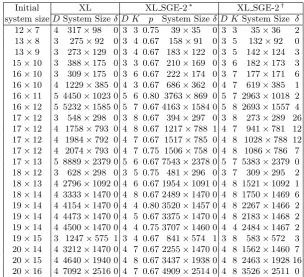
Table 1.Performance of XL SGE-2
(Random monomial multiplication done in Step 1 of Algorithm 4)
Initial XL XL SGE-2∗ XL SGE-2† system sizeDSystem Sizeδ D K p System Sizeδ D KSystem Size δ
12×7 4 317×98 0 3 3 0.75 39×35 0 3 3 35×36 2 13×8 3 275×92 0 3 4 0.67 158×91 0 3 5 132×92 0 13×9 3 273×129 0 3 4 0.67 183×122 0 3 5 142×124 3 15×10 3 388×175 0 3 3 0.67 210×169 0 3 6 182×173 3 16×10 3 309×175 0 3 6 0.67 222×174 0 3 7 177×171 6 16×10 4 1229×385 0 4 3 0.67 686×362 0 4 7 619×385 1 16×11 5 4450×1023 0 5 6 0.80 3763×869 0 5 7 2963×1018 2 16×12 5 5232×1585 0 5 7 0.67 4163×1584 0 5 8 2693×1557 4 17×12 3 548×298 0 3 8 0.67 394×297 0 3 8 273×289 26 17×12 4 1758×793 0 4 8 0.67 1217×788 1 4 7 941×781 12 17×12 4 1984×792 0 4 7 0.67 1517×785 0 4 8 1028×788 12 17×12 4 2074×793 0 4 7 0.75 1506×758 0 4 8 1086×786 7 17×13 5 8889×2379 0 5 6 0.67 7543×2378 0 5 7 5383×2379 0 18×12 3 628×298 0 3 5 0.75 481×296 0 3 7 309×295 2 18×13 4 2796×1092 0 4 6 0.67 1954×1091 0 4 8 1521×1092 1 18×14 4 3333×1470 0 4 8 0.67 2489×1470 0 4 8 1750×1469 6 19×14 4 4154×1470 0 4 4 0.80 3520×1457 0 4 8 2267×1466 2 19×14 4 4473×1470 0 4 5 0.67 3375×1470 0 4 8 2183×1468 2 19×14 4 4500×1470 0 4 4 0.75 3707×1460 0 4 4 2484×1467 2 19×15 3 1247×575 1 3 4 0.67 841×574 1 3 8 583×572 3 20×14 4 3212×1470 0 4 7 0.67 2255×1470 0 4 8 1562×1460 7 20×15 4 4640×1940 0 4 8 0.67 3437×1938 0 4 8 2463×1928 16 20×16 4 7092×2516 0 4 7 0.67 4909×2514 0 4 8 3526×2511 0
∗Smallest systems obtained among the choicesp= 0.67,0.75,0.80 are reported. †Fixed probabilityp= 0.50 is used.
5
Experimental Results and Discussion
We have experimented with XL SGE-2, the modified version of XL SGE, on small random sparse multivariate quadratic systems, and have found that the heuristic substantially improves the performance of the XL algorithm in terms of the size of the final linearized system. Indeed, XL SGE-2 performs consistently much better than XL SGE too. Even in those cases where XL SGE fails to improve upon XL, our modified algorithm XL SGE-2 produces positive results. In fact, XL SGE-2 has been found to significantly improve XL in almost all the experiments we have conducted. However, the column-weight two reduction strategy works well only in a limited set of experiments. In general, this strategy results in massive reductions in the system size, leading to failure in generating the final solvable system.
small-est system size obtained, where the minimum is taken over the three choices 0.67,0.75 and 0.80 of the monomial-multiplication probabilityp. In the table,δ
represents the rank deficit of the final system. In most of the cases, we get the smallest system forp= 0.67. However, the dependence of the final output onp
or on the structure of the initial system is not yet fully understood.
The results obtained for p = 0.50 are shown in the last four columns of Table 1. In the case ofp= 0.50, we usually get much smaller final systems than produced by larger probabilities (like 0.67). But at the same time, p = 0.50 yields final systems with some positive (albeit small) rank deficits, whereas the larger values of p leave no rank deficits in identical settings (like same values of D). These experiments demonstrate the expected tradeoff between system reduction and rank profile. If we use partial monomial multiplication since Step 1 of Algorithm 4,p= 0.67 appears to be the experimentally recommended choice. The size of the final system also depends on the random seed chosen during the execution of the algorithm. Different seeds correspond to different (random) choices of monomial multiplication. It has been observed that for the same initial system and the same p, different final systems can be obtained using different seeds. The variations of the final system size on different seeds are shown in Table 2 . Both the parts in the table correspond to the same initial system of size 16×10. For this system, XL gives a final solvable system of size 1229× 385 for D = 4. Table 2(a) shows the results obtained by XL SGE-2 for p = 0.67, and Table 2(b) shows the results obtained by XL SGE-2 for p = 0.50. For p = 0.67, the variation in the number of equations in the final system is observed to be within 50% of one another, whereas forp= 0.50, this variation is within 20% of one another. In all cases, however, we obtain noticeably smaller systems compared to XL. The rank deficit exhibits the same essential behavior as in Table 1, but the choice of monomial multiplications has some effect on this rank deficit for p= 0.50. It, however, appears assuring that the variation of the performance of XL SGE-2 on the seed is not annoyingly large, that is, our strategy of random monomial multiplication is experimentally validated to exhibit good performance in general.
Table 3 shows the results obtained by using random monomial multiplication only in Step 2 of Algorithm 4. In Step 1, all the multiplications are carried out. Here, we have experimented with four different values 0.50,0.67,0.75 and 0.80 of
p. The Table shows the smallest system size obtained among these four choices ofp. XL SGE-2 works very well in most (more than 90%) of the cases. Even in cases where XL works better than XL SGE, the modified XL SGE-2 outperforms XL. In a few (less than 10%) experiments, however, XL SGE-2 exhibits poorer behavior than XL in terms of the rank profile of the expanded systems.
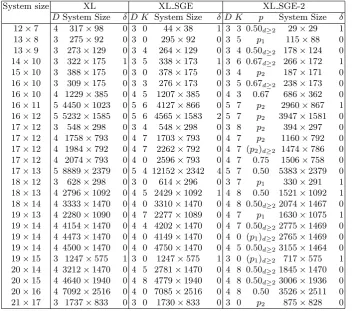
The performance of XL SGE-2 is compared with the performance of XL and XL SGE in Table 4. In the columns under XL SGE-2 in this table, we have re-ported the best results obtained by XL SGE-2. Here, the best is obtained among several choices ofp, including the fixed values 0.50, 0.67, 0.75 and 0.80, and also including the variable probability sequences p1 = 1− d+11 and p2 = DD−−d+1d . If
multi-Table 2.Variation of the final system size in XL SGE-2 for some seed values
Final system size D K Seed δ Final system size D K Seed δ 674×355 4 0 11056 0 518×373 4 6 8252 4 747×361 4 0 5356 0 518×378 4 6 8637 9 964×383 4 5 9065 0 536×375 4 7 11395 5 966×385 4 6 8517 0 543×383 4 6 7581 3 968×385 4 5 3438 0 583×384 4 7 4067 3 983×384 4 6 5120 0 619×385 4 7 2596 1
(a)p= 0.67 (b)p= 0.50
Table 3.Performance of XL SGE-2
(Random monomial multiplication not done in Step 1 of Algorithm 4)
Table 4.Comparison of performances of XL, XL SGE and XL SGE-2
System size XL XL SGE XL SGE-2
DSystem Size δ D K System Size δ D K p System Size δ 12×7 4 317×98 0 3 0 44×38 1 3 3 0.50d≥2 29×29 1
13×8 3 275×92 0 3 0 295×92 0 3 5 p1 115×88 0
13×9 3 273×129 0 3 4 264×129 0 3 4 0.50d≥2 178×124 0
14×10 3 322×175 1 3 5 338×173 1 3 6 0.67d≥2 266×172 1
15×10 3 388×175 0 3 0 378×175 0 3 4 p2 187×171 0
16×10 3 309×175 0 3 3 276×173 0 3 5 0.67d≥2 238×173 0
16×10 4 1229×385 0 4 5 1207×385 0 4 3 0.67 686×362 0 16×11 5 4450×1023 0 5 6 4127×866 0 5 7 p2 2960×867 1
16×12 5 5232×1585 0 5 6 4565×1583 2 5 7 p2 3947×1581 0
17×12 3 548×298 0 3 4 548×298 0 3 8 p2 394×297 0
17×12 4 1758×793 0 4 7 1703×793 0 4 7 p2 1160×792 0
17×12 4 1984×792 0 4 7 2262×792 0 4 7 (p2)d≥2 1474×786 0
17×12 4 2074×793 0 4 0 2596×793 0 4 7 0.75 1506×758 0 17×13 5 8889×2379 0 5 4 12152×2342 4 5 7 0.50 5383×2379 0 18×12 3 628×298 0 3 0 614×296 0 3 7 p1 330×291 1
18×13 4 2796×1092 0 4 5 2429×1092 1 4 8 0.50 1521×1092 1 18×14 4 3333×1470 0 4 0 3310×1470 0 4 8 0.50d≥22074×1467 0
19×13 4 2280×1090 0 4 7 2277×1089 0 4 7 p1 1630×1075 1
19×14 4 4154×1470 0 4 4 4202×1470 0 4 7 0.50d≥22775×1469 0
19×14 4 4473×1470 0 4 0 4149×1470 0 4 0 (p1)d≥22765×1469 0
19×14 4 4500×1470 0 4 0 4750×1470 0 4 5 0.50d≥23155×1464 0
19×15 3 1247×575 1 3 0 1247×575 1 3 0 (p1)d≥2 717×575 1
20×14 4 3212×1470 0 4 5 2781×1470 0 4 8 0.50d≥21845×1470 0
20×15 4 4640×1940 0 4 8 4779×1940 0 4 8 0.50d≥23006×1936 0
20×16 4 7092×2516 0 4 0 7085×2516 0 4 8 0.50 3526×2511 0 21×17 3 1737×833 0 3 0 1730×833 0 3 0 p2 875×828 0
Table 5.Performance of XL SGE0(XL SGE with column-weight 2 reduction)
plications are done in Step 1 of Algorithm 4), a suffixd≥2 is written against the probability. The general observation is that XL SGE performs slightly better than XL in most cases, whereas XL SGE-2 performs considerably better than the other two algorithms consistently in almost all cases.
Some positive results obtained by XL SGE with column-weight two reduc-tion (henceforth referred to as XL SGE0) are shown in Table 5. In some cases, XL SGE0 works very well. In Row 2 of Table 5, XL SGE0 shows 60% reduction in the number of equations and 51% reduction in the number of variables, in comparison with XL. For the same initial system, XL produces the final solvable system for D = 5, whereas XL SGE0 gives the solvable system for D = 4. In Row 5 of Table 5, XL SGE0shows 50% reduction in the number of equations and 44% reduction in the number of variables, in comparison with XL. More inter-estingly, XL produces a system forD= 6 with rank deficit 8, whereas XL SGE0 produces the final system forD= 5 with rank deficit 1 only. However, there are many instances (not shown in Table 5) where XL SGE0 does not work better than XL. In fact, in some of these cases, XL SGE0is even poorer than XL SGE. We have not studied XL 2 with column-weight two reduction (XL SGE-20). It is perhaps not the case that XL SGE-2 is incompatible with the column-weight two reduction strategy. However, the effectiveness of column-column-weight two reduction is expected to show up for relatively large values ofd. On the contrary, XL SGE-2 demonstrates superior performance compared to XL and XL SGE even for small values ofd. Since our experiments are typically restricted to the upper bound D ≤5 of the degree ofA0, our experiments miss the opportunity to study XL SGE-20 in a proper setting.
Table 6.Performances of XL and variants of XL SGE for four-round baby-Rijndael (D= 3). The initial system size is 890×208.
AlgorithmK p Final System Size Rank Deficit XL 0 1 2594060×1498713 96936 XL SGE 3 1 2571848×1476481 93172 XL SGE-2 0 0.75d≥22276971×1442363 89387
XL SGE0 0 1 2556116×1449153 81576
6
Conclusion
Controlling the sizes of the linearized systems in the XL algorithm has been studied by various researchers. The chief technical contribution of this paper is our efforts to improve upon the XL family of algebraic attacks. More pre-cisely, we suggest variants of a recent proposal called XL SGE. Our experiments establish the effectiveness of using our modifications in tandem with XL SGE. Like all other variants of the XL family, our proposals too are not feasible in cryptanalyzing most practical ciphers (like AES). We, however, believe that the improvements we have already achieved are worth reporting to the research com-munity.
While our proposals address some of the open problems associated with XL SGE, some other issues continue to remain unattended. Moreover, our study opens up some new avenues for research, some of which are stated below.
– The domains of applicability of XL SGE0 need to be experimentally and/or theoretically determined. Modifications of XL SGE0 may also be called for to make the column-weight two reduction strategy useful in a variety of situations.
– We have demonstrated how partial monomial multiplication may improve the performance of XL and XL SGE. So far, XL SGE-2 uses only random monomial multiplication. A more intelligent partial-multiplication strategy may exploit the structures of the intermediate linearized systems better than a random strategy can. Moreover, the dependence of the system size and rank profile on the seed (multiplication decisions)—a property inevitably associated with a randomized algorithm like XL SGE-2—should better be minimized, if not eliminated altogether.
– An optimal choice forp(fixed or varying with degreed) requires more ex-perimentation and theoretical analysis.
References
1. Faug`ere, J.C.: A new efficient algorithm for computing Gr¨obner basis (F4) (2000)
2. Faug`ere, J.C.: A new efficient algorithm for computing Gr¨obner basis without reduction to zero (F5). ISSAC ’02 (2002) 75–83
3. Kipnis, A., Shamir, A.: Cryptanalysis of the HFE public key cryptosystem by relinearization. In: CRYPTO. (1999) 19–30
4. Courtois, N., Klimov, A., Patarin, J., Shamir, A.: Efficient algorithms for solv-ing overdefined systems of multivariate polynomial equations. In: EUROCRYPT. (2000) 392–407
5. Courtois, N., Pieprzyk, J.: Cryptanalysis of block ciphers with overdefined systems of equations. In: ASIACRYPT. (2002) 267–287
6. Ding, J., Buchmann, J., Mohamed, M., Mohamed, W., Weinmann, R.: MutantXL. In: SCC. (2008) 16–22
8. Ars, G., Faug`ere, J.C., Imai, H., Kawazoe, M., Sugita, M.: Comparison between XL and Gr¨obner basis algorithms. In: ASIACRYPT. (2004) 338–353
9. Courtois, N., Bard, G.V.: Algebraic cryptanalysis of the Data Encryption Stan-dard. In: IMA Int. Conf. (2007) 152–169
10. Courtois, N., Bard, G.V., Wagner, D.: Algebraic and slide attacks on Keeloq. In: FSE. (2008) 97–115
11. Courtois, N., O’Neil, S., Quisquater, J.J.: Practical algebraic attacks on the Hitag2 stream cipher. In: ISC. (2009) 167–176
12. Courtois, N.T.: Algebraic complexity reduction and cryptanalysis of GOST. Cryp-tology ePrint Archive, Report 2011/626 (2011)http://eprint.iacr.org/. 13. Daemen, J., Rijmen, V.: Rijndael for AES. In: AES Candidate Conference. (2000)
343–348
14. Ghosh, S., Das, A.: An improvement of linearization-based algebraic attacks. In: InfoSecHiComNet. (2011) 157–167
15. LaMacchia, B., Odlyzko, A.: Solving large sparse linear systems over finite fields. In: CRYPTO. (1991) 109–133
16. Mohamed, W.S.A., Ding, J., Kleinjung, T., Bulygin, S., Buchmann, J.: PWXL: A parallel Wiedemann-XL algorithm for solving polynomial equations over GF(2). In: SCC. (2010) 89–100