Faster Secure Arithmetic Computation Using
Switchable Homomorphic Encryption
Hoon Wei Lim, Shruti Tople, Prateek Saxena, and Ee-Chien Chang
National University of Singapore
July 11, 2014
Abstract
Secure computation on encrypted data stored on untrusted clouds is an important goal. Existing secure arithmetic computation techniques, such as fully homomorphic encryption (FHE) and somewhat homomorphic encryption (SWH), have prohibitive performance and/or storage costs for the majority of practical applications. In this work, we investigate a new secure arithmetic computation primitive calledswitchable homomorphic encryption(or SHE) that securely switches between existing inexpensive partially homomorphic encryption techniques to evaluate arbitrary arithmetic circuits over integers. SHE is suited for use in a two-cloud model that is practical, but which makes stronger assumptions than the standard single-cloud server model. The security of our SHE solution relies on two non-colluding parties, in which security holds as long as one of them is honest. We benchmark SHE directly against existing secure arithmetic computation techniques—FHE and SWH—on real clouds (Amazon and Rackspace) using microbenchmarks involving fundamental operations utilized in many privacy-preserving computa-tion applicacomputa-tions. Experimentally, we find that SHE offers a new design point for computing on large data—it has reasonable ciphertext and key sizes, and is consistently faster by several (2–3) orders of magnitude compared to FHE and SWH on circuits involving long chain of multiplications. SHE exhibits slower performance only in certain cases, when batch (or parallel) homomorphic evaluation is possible, only against SWH schemes (which have limited expressiveness and potentially high ciphertext and key storage costs).
1
Introduction
Outsourcing of large-scale personal data from resource-constraint client devices, such as smartphones or laptops, to public clouds is prevalent from email to medical records management applications. In such services, users often want to utilize the cloud services for storage and computation without trusting it with the privacy of their data. Secure (or privacy-preserving) computation on encrypted cloud data has been a long-standing problem.
PHE techniques have been used in several practical research systems recently [57, 64]. Similarly, somewhat homomorphic encryption (or SWH) [53, 4] has received considerable attention for its better efficiency com-pared to FHE. However, it evaluates only low-degree polynomials on encrypted data, thereby having limited expressiveness.
In this paper, our goal is to develop an alternative primitive for secure arithmetic computation on
encrypted data. Specifically, we aim to develop a primitive that supports generalexpressiveness, supporting
arbitrary number of addition and multiplication over encrypted integers, with betterefficiencyfor practical
use. We aim to experimentally benchmark our primitive directly against existing primitives on the same
benchmarks under the real cloud settings. In order to explore alternative primitives, we consider atwo-cloud
model that is practical to achieve, but requires a stronger trust assumptions than the traditional single
server-setting. (We elaborate on this model and its practical feasibility in§2.1.)
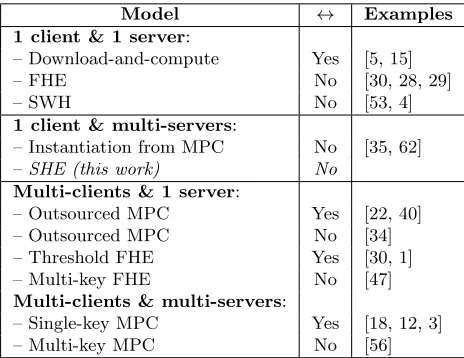
Two-Cloud Model. The majority of the existing cryptographic techniques for secure computation are designed for a client-server model. Table 1 gives a summary of different variants of client-server models,
ranging from one-client & one-server, e.g., a naive download-and-compute approach1 and FHE, to
multi-client & multi-server,e.g., general secure multi-party computation (MPC).
In this work, we consider a single-client and two non-colluding cloud model. We assume that the client
outsources its data to two cloud providers (e.g., Google, Microsoft, Amazon, and Rackspace), never revealing
the decryption keys to any of them, but making some realistic assumptions about them not colluding. Such a model (relying on two non-colluding parties or multiple parties with a subset of them being honest) has also been used in other contexts, for example, initially in secure two-party computation (2PC) [22, 36, 14, 8, 62] and multi-party computation (MPC) [20, 12, 40], and more recently in private information retrieval
(PIR) [2, 16, 4] and oblivious RAM (ORAM) [48, 61]. We consider anon-interactivemodel between a client
and two servers, in the sense that the client is “offline”,i.e., outsourced computation on encrypted data can
be performed without the client’s participation. We further discuss the differences between previous works
and ours in§6.
Model ↔ Examples
1 client & 1 server:
– Download-and-compute Yes [5, 15]
– FHE No [30, 28, 29]
– SWH No [53, 4]
1 client & multi-servers:
– Instantiation from MPC No [35, 62]
–SHE (this work) No
Multi-clients & 1 server:
– Outsourced MPC Yes [22, 40]
– Outsourced MPC No [34]
– Threshold FHE Yes [30, 1]
– Multi-key FHE No [47]
Multi-clients & multi-servers:
– Single-key MPC Yes [18, 12, 3]
– Multi-key MPC No [56]
Table 1: Models for secure computation. (Notation: ↔ denotes interactivity between the client and the
server during secure computation.)
Our Contributions. We demonstrate that there exist practical alternatives to FHE when working in the two-cloud model, which seems to be a promising, under-explored direction in the context of homomorphic
encryption. We realize this through a new cryptographic primitive calledswitchable homomorphic encryption (or SHE), which relies on two non-colluding clouds to jointly execute the client’s computation on encrypted data without any of them having access to the decryption key. While we focus on two clouds in this paper,
our approach can be generalized and extended to an-cloud setting (e.g., one server andn−1 proxies, where
at least one of them is honest) in a straightforward manner.
Informally, our concept of SHE builds upon existing PHE techniques, such that it is possible to transform ciphertexts associated with additively homomorphic encryption (or ADD) to ciphertexts associated with multiplicatively homomorphic encryption (or MUL), and vice versa, and thus achieving fully homomorphic encryption. Our construction of SHE makes use of the well-studied Paillier ADD scheme [54] and a variant of the ElGamal MUL scheme [21] as building blocks. A major challenge in designing SHE based on the ElGamal MUL scheme is that a ciphertext leaks information whenever a plaintext value is zero. In our scheme, we make use of a simple, but novel, technique to address the zero-plaintext problem. Our technique enables an ElGamal ciphertext to be “operated” within a Paillier ciphertext, such that the encryption of zero is indistinguishable from the encryption of any other value. (We give an overview of our solution in §2.4.)
We implement and benchmark our SHE scheme based on two real cloud settings: Amazon and Rackspace. To compare against existing known primitives for secure arithmetic computation, we also implement and benchmark SWH based on the HElib library [45], FHE based on the Scarab Library (FHE) [46], and GC based on FastGC [37]. Our benchmarks are based on two fundamental operations in privacy-preserving computation: matrix multiplication and polynomial evaluation. These operations are commonly used in applications such as, set intersection [24], regular expression matching [55], private information retrieval [4], and so on. Our experimental results show that for encrypted polynomial evaluation, especially in applications
with less data parallelism, our SHE scheme in the two-cloud model can be up to approximately 2,500 times
faster than SWH and FHE in the single-cloud setting; and roughly up to 35 times faster than FastGC. However, our scheme shows only slightly better performance as compared to SWH and GC approaches in the case of matrix multiplication. Thus, our scheme performs better than the existing solutions for applications
with deeper circuit sizes,i.e., many consecutive multiplications. When parallelization is used in SWH, our
scheme is considerably slower. The dominant overhead comes from the communication cost between the two clouds. However, public key and ciphertext sizes in SWH can expand quickly (with polynomial or polylog overhead) as the evaluated circuit gets deeper. On the other hand, our approach enjoys constant sizes in both the public key and the ciphertext, and thus, has lower storage cost. In summary, our contributions are twofold:
• We demonstrate that indeed it is feasible to efficiently and securely switch between PHE schemes in
the two-cloud model.
• We implement and evaluate secure arithmetic primitives on the same, real cloud platform (rarely done
in previous works).
2
Problem & Approach
In this work, we are interested in looking for an alternative that is as expressive as existing FHE schemes, but with better efficiency.
2.1
Problem Definition
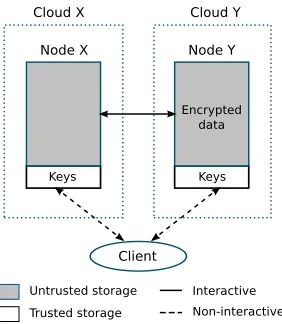
We consider the problem of secure computation of outsourced data generated by a client. In our setting,
as illustrated in Figure 1, there exist two entities: nodesX andY hosted by two separate cloud providers,
Keys Encrypted
data
Node X Node Y
Client
Cloud X Cloud Y
Keys
Untrusted storage Trusted storage
Interactive Non-interactive
Figure 1: Secure outsourced computation via two clouds,X andY.
provider and not able to collude outside of an organization. Our goal is then to protect dataconfidentiality
against both the clouds. We do not consider non-malleability and verifiability of data computation.
A client interacts with both clouds, say via a web service, through a privacy-assisting browser extension.
The client generates by itself some cryptographic keys, encrypts and stores its data on nodeY. The client
also shares some key material (different from the client’s private keys) with X and Y, such that the key
share at each side alone does not reveal any information about the encrypted data. Data computation is then performed within a virtual machine (VM) running on each cloud with the following constraints:
• Node Y is able to perform computation on the encrypted data on the client’s behalf by interacting
with node X over a high-speed network;
• The client can be offline during the computation, and upon completion, is able to retrieve the output
from Y;
• The VMs run on an untrusted environment; that is, they are susceptible to snooping by curious insiders
(c.f.[57]).
• Both X andY are required to store only a small amount (less than a few KB) of cryptographic keys
per user. All persistent ciphertext storage is accessible to service admins.
Adversarial Model. We assume that at least one of the two clouds is honest (i.e., the other cloud can behave maliciously by deviating arbitrarily from our scheme). Security holds as long as at least one party is honest. If the server and cloud overtly collude by sharing the cryptographic keys, or if both act maliciously, no security can be guaranteed. We consider this to be a practical assumption. In the public cloud scenario, it is possible for well-reputed public cloud providers to overtly collude across organizations, but it risks
their reputation. Our scheme can be extended to a n-cloud model where security holds as long as one
party is honest, thereby making collusion difficult. Our trust assumptions are comparable to those used in multi-cloud PIR [48, 16] and ORAM [61].
We also assume that both nodesX andY on the clouds are susceptible to malware installations by any
outsider at the software stack, including the OS and the applications running on it. These may result in leakage of the client’s encrypted data and key material, and any intermediate computation results stored on the VM. Hence, each cloud is assumed to further employ secure key distribution and storage mechanisms by
leveraging TPM-based solutions,e.g., KISS [69], to protect the key material. We assume that the client’s key
share never leaves a sealed storage component and it is accessible only via a trusted piece of software,e.g.,
content in the single-server setting, where the client’s (entire) decryption key is assumed to be securely stored on a hosting server. However, our model is stronger in the sense that the exposure of a key share does not reveal the plaintext corresponding to any encrypted data, unless the remaining key share is also known to the attacker.
Nevertheless, TPM-based solutions do not preclude all physical attacks, such as cold boot attacks. Hence, curious insiders, who have physical access to the node, may still learn the key material via a sophisticated
hardware attack.2 However, even if the insider gets the key material and has access to the encrypted data,
it still cannot learn anything. It needs the other key share.
Our model also slightly differs from that used in many existing works on two-party computation (2PC),
e.g., [14, 35, 62, 67]. Their model allows the client’s entire decryption key to be revealed to one of the
two parties; the other party without the key has access to the client’s encrypted data. That is, the model assumes that the encrypted data is never accessible to the party holding the decryption key. This seems to be a stronger assumption and may not be easy to realize in practice even with TPM-based solutions, since the ciphertext storage requirement could be large. Our model only assumes the protection of a small amount of key material on each node.
Note that it is not within our goal to prevent a malicious cloud provider from modifying ciphertexts stored on the cloud or launching a denial-of-service (DoS) attack to the other party. Also, we do not preserve the
privacy of any function that is to be evaluated by the server, i.e., it may infer some information about
the client’s encrypted input based on the function that it evaluates. Evaluating private functions [44, 42], verifying computation [25] and mitigating the impact of (DoS) attacks are orthogonal subjects of interest that are beyond the scope of this work.
2.2
A Simple but Inefficient Solution
Consider the following surprisingly simple known protocol [35, 62] that achieves the stated goal in the two-cloud model: store all the client’s data encrypted with an additive homomorphic encryption (ADD) scheme,
E+, on one cloud, Y, and store the corresponding decryption key on the other cloud,X. (Here, we require
an ADD scheme, e.g., the Paillier ADD scheme [54], that also allows multiplication of an encrypted value
by a constant.) This way,Y can perform any arbitrary number of homomorphic additions on the encrypted
data. To evaluate a multiplication operation on encrypted valuesE+(a) andE+(b),Y chooses two random
valuesr1 andr2and runs the following protocol withX:
Y →X:E+(a+r
1), E+(b+r2)
X →Y :E+((a+r
1)(b+r2)).
In the first step, Y simply homomorphically blinds the target ciphertexts E+(a) and E+(b) with random
valuesr1andr2, respectively. X then, using the corresponding decryption key, recovers (a+r1) and (b+r2),
performs the required multiplication, and returns the encryption of (a+r1)(b+r2) to Y. Now what Y
received fromX isE+(ab+ar
2+br1+r1r2). However, clearly,Y is able to homomorphically remove all the
“unneeded” terms (exceptab) from the ciphertext, since it knows random valuesr1 and r2, and the ADD
scheme allows multiplication ofE+(a) andE+(b) withr
2 andr1, respectively.
While the above simple solution works, it has two issues. First, X has the decryption key, and hence, if
given access to any ciphertexts generated by the client (e.g., those stored onY), it would be able to recover
the corresponding plaintexts. However, this is easy to fix. We can simply split the client’s decryption key and give each party only one part of the key. This way, neither party can individually decrypt any ciphertext.
Alternatively, we can “double-encrypt” the ciphertexts stored onY, such that Y can decrypt the “outer”
layer of encryption andX can decrypt the “inner” layer. (The outer-layer protects against curious insiders.)
The second issue is that the solution has poor efficiency. Each multiplication operation requires a “joint
computation” betweenX andY (which includes one encryption, two decryptions and roughly five modular
2There exist mechanisms for preventing hardware attacks, for example, by using a secure processor substrate and through
exponentiations if the Paillier ADD scheme is used). Therefore, the solution does not scale for applications requiring a large number of multiplications.
2.3
Challenges
Henceforth, we focus on using two partially homomorphic encryption (PHE) schemes (supporting addition and multiplication, respectively) as the building blocks in designing a practical FHE solution. There are numerous challenges in realizing this:
• Compatibility: To convert arbitrarily between ADD and MUL ciphertexts, we need a transformation
function that is bijective,i.e., one-to-one mapping between ADD and MUL ciphertexts. Moreover, such
transformation function must preserve the homomorphism property of the ciphertexts. A homomorphic and bijective function that maps elements from one group to elements of another group is known as a group isomorphism. This may not be easy to realize, for example, if we work with the well-known Paillier ADD and the standard ElGamal MUL schemes [21]. The former uses an additive group with composite modulus and the later works in a multiplicative group with prime order. There seems to be no known efficient inverse of an isomorphic function that maps elements from a multiplicative group to those in an additive group.
• Zero-Plaintext: A fundamental, inevitable property of known MUL schemes, such as ElGamal and RSA, is that encrypting zero results a zero in the ciphertext. One natural way to address such issue is to encode a message with some “noise” before encrypting it. However, this typically destroys the multiplicative homomorphism of the scheme, for example in the case of RSA-OAEP [52]. Moreover, removing the accumulated noise in an encrypted domain after a series of computations may not be trivial at all.
• Security: The cloud providers performing computation on a client’s encrypted data must not learn anything about the underlying plaintexts and the corresponding decryption keys. It is also critical to preserve the data confidentiality invariant before, during and after transformation of any ADD and MUL ciphertexts. We assume SHE switching logic runs in a TPM-protected environment.
• Efficiency: The overall computational and communication overhead incurred during transformation of ciphertexts should be reasonable for most real world application scenarios.
Why not instantiate with 2PC? To solve our outlined problem, one may consider using an existing 2PC protocol between the proxy and the server [37]. First, the communication complexity of generic 2PC is at least linear to the size of the garbled circuit, which in turn, is proportional to the size of the data (input wires). In contrast, our approach has communication complexity that is independent of the size of the encrypted data, but instead is linear to the number of ciphertext transformations between ADD and MUL schemes in the circuit. Second, many efficient solutions to 2PC, such as GC, require the circuit to be encrypted in advance by the client, unlike in our solution where the computed function can be dynamically picked by a third party. Finally, garbled circuits typically cannot be reused in order to preserve the secrecy of the relevant input and function. The client must reconstruct a new garbled circuit (proportional to the size of
the dataset) and upload it to the server each time the client wants to evaluate a function.3 This renders GC
to be unsuitable for privacy-preserving outsourced computation, particularly for large datasets. Although circuit construction can be outsourced to the server, the computational and storage costs incurred could still be high for large datasets and large numbers of clients. We experimentally benchmark the efficacy of one of the recent GC solutions using its off-the-shelf implementation and compare it against our scheme [37].
3While there exist recent, promising results on reusable garbled circuits using function encryption by Goldwasseret al.[32],
2.4
Solution Overview
For ease of exposition, let us now call nodeX theproxyand node Y theserver. In our solution, the client
encrypts its data using either the ADD or the MUL scheme and stores the resulting ciphertexts on the server. In our solution, the client stores integer or ASCII data encrypted under the MUL scheme. Circuits are in DNF form. They are constructed once and uploaded to the server, and can be reused on any subset of the data repeatedly. The client also provides the corresponding secret key shares to both the proxy and the server. Using our SHE schemes, the server can evaluate addition and multiplication operations on the encrypted data, and when necessary, switch between ADD and MUL ciphertexts. We now give some technical highlights of our approach.
Secret Key Shares. We split a user-chosen private (decryption) key into two parts. The proxy and the server each is given one part of the key, which in turn, can be used only to jointly decrypt a ciphertext during transformation of a ciphertext from ADD to MUL (and vice versa).
SHE. We work with a variant of the ElGamal MUL scheme that uses a composite modulus, such that it
is “compatible” with the Paillier ADD scheme. However, a fundamental limitation with the ElGamal MUL
scheme is that it does not handle a zero-plaintext.4 Our SHE scheme addresses such an issue. We perform
addition and multiplication of ElGamal ciphertexts in a homomorphic manner within an encrypted domain associated with the Paillier ADD scheme. Since the encryption of zero under the Paillier ADD scheme is indistinguishable from the encryption of a random plaintext under the same scheme, the ElGamal ciphertext will not leak any information even if the corresponding plaintext becomes zero. However, the catch is that all the client’s initial input has to be encrypted with the ElGamal MUL scheme and the input must not contain zeros. We do not see this as a glitch. As pointed out by Jakobsson and Juels [39], we can represent an
ElGamal encryption of zero with two ElGamal encryptions of two random valuesn1andn2, respectively, such
that n1−n2 = 0. Using our technique, therefore, we can perform homomorphic addition or multiplication
over any two ElGamal ciphertexts, or a Paillier ciphertext and an ElGamal ciphertext. It turns out that Boolean combinatorial circuits can be represented in DNFs (sum of products) [58]. This implies that we can evaluate arbitrary size disjuncts and sum up an arbitrary number of them. For certain applications, the
DNF size may grow larger, but our evaluation in§5 explains that many interesting applications directly build
on matrix multiplication and polynomial-arithmetic operations. Our scheme can also be used for statistical analysis applications such as, mean, covariance, and linear regression. These are well-suited for DNF.
Security. The security of our SHE solution is based on the assumptions that: (i) the underlying Paillier ADD and ElGamal MUL schemes are also secure, and (ii) the proxy and the server do not collude. We analyze the security of our SHE scheme under the scenario that either the proxy or the server is malicious, while the other remains honest. Our security proof is by reduction to the security of the Paillier ADD and ElGamal MUL schemes and the hardness of the Decisional Diffie-Hellman (DDH) problem. We show that our SHE scheme is CPA-secure [41] (in terms of indistinguishability of encryptions).
3
SHE with Two Clouds
In this section, we first give a definition of switchable homomorphic encryption (SHE). We also briefly recall two partially homomorphic encryption (PHE) schemes. We then present our SHE construction built upon the PHE schemes.
Notation. Henceforth, we use the operator◦ ∈ {+,×}to indicate if a parameter, an algorithm or a scheme
is associated with either additive (+) or multiplicative (×) homomorphic encryption,i.e., ADD or MUL.
4In fact, technically speaking, any messagem /∈
3.1
Definition
A switchable homomorphic encryption (SHE) scheme in the two-cloud setting comprises six algorithms defined as follows:
• KeyGen(1n): On input a security parameter 1n, the algorithm outputs a public and private key pair (pk◦, sk◦) for each operator◦ ∈ {+,×}.
• Enc(pk◦, m): The algorithm takes as input a public keypk◦ and a messagem. It outputs a ciphertext
c◦.
• Dec(sk◦, c◦): On input a private keysk◦ and a ciphertextc◦, the algorithm outputs a messagem.
• KeyShaGen(sk◦): The algorithm takes as input a private keysk◦and outputs a pair of secret key shares
(k◦0, k◦1). (Here secret key shares are key material used toblindlydecrypt5 a ciphertext.)
• AddToMul(k0+, k+1, c+, pk+, pk×): The algorithm takes as input the secret key shares (k+ 0, k
+
1) and an
ADD ciphertextc+. It outputs the corresponding MUL ciphertextc× under public keypk×.
• MulToAdd(k0×, k1×, c×, pk×, pk+): On input the secret key shares (k×
0, k
×
1) and an MUL ciphertextc×,
the algorithm outputs the corresponding ADD ciphertextc× under public key pk+.
The first four algorithms described above are run by the client. TheAddToMulandMulToAddalgorithms
can be loosely regarded as isomorphic transformation functions (discussed in§2.3), which are performed by
the proxy and the server to transform an ADD ciphertext to a MUL ciphertext, and vice versa.
3.2
PHE as Building Blocks
We work with the Paillier ADD scheme [54] and a variant of the ElGamal MUL scheme [21]. We choose to
work with an ElGamal encryption scheme that uses a composite modulus [50],i.e., N =pq where p, q are
large primes. Both the ADD and MUL schemes share the same modulus. (Note that this does not pose any security concern since the modulus is public information and a public-private key pair used in scheme has different structure and is independently chosen from that of the other scheme.) This is essential so that both schemes work on the same group structure, and thus, allowing ciphertexts to be transformed in a natural
way (i.e., such that bijective mapping exists.)
Paillier ADD. The Paillier encryption system, denoted by E+, is defined as follows:
• KeyGen(1n,+): On input a security parameter 1n, the algorithm outputs (N, p, q), where N = pq,
and p and q are n-bit primes. The public key is pk+ := N and the corresponding private key is
sk+:=hN, φ(N)i, whereφ(N) = (p−1)(q−1).
• Enc(pk+, m): The algorithm takes as input a public key N and a message m ∈
ZN. It chooses a
randomr∈Z∗
N and outputs the ciphertextc+ as
(1 +N)m·rN modN2.
• Dec(sk+, c+): On input a private keyhN, φ(N)iand a ciphertextc+, the algorithm outputs the message
mas
((c+)φ(N)modN2)−1
N ·φ(N)
−1modN.
(Recall that since|Z∗
N2|=φ(N2) =N φ(N), we have rN φ(N)= 1 modN2 for anyr∈Z∗N.)
Clearly, the scheme is additively homomorphic.
5We use the term “blind decryption” to denote a decryption that results in a “partially” decrypted ciphertext or a blinded
ElGamal MUL. The ElGamal encryption system, denoted byE×, is defined as follows:
• KeyGen(1n,×): On input a security parameter 1n, the algorithm chooses two large, safe primespand
q (as specified in [50]) and setN =pq. It also chooses a base g= 16 and a random odd6 number x,
and setsh:=gxmodN. The public key is thenpk× :=hN, g, hiand the corresponding private key is
sk×:=hN, g, xi.
• Enc(pk×, m): The algorithm takes as input a public keyhN, g, hiand a messagem∈Z∗
N. It chooses
a random r∈Z∗
N and outputs the ciphertextc×:=hc
×
1, c
×
2ias
hmhr, grmodNi.
• Dec(sk×, c×): On input a private keyhN, g, xiand a ciphertextc×, the algorithm outputs the message
mas
(c×1)/(c×2)xmodN.
It is easy to see that multiplicative homomorphism holds.
We discuss the security of the Paillier ADD and ElGamal MUL schemes in§4.
3.3
Our Scheme
We avoid the inherent zero-plaintext problem in the ElGamal scheme. Moreover, our scheme enables com-putation of arbitrary sum-of-subset expressions (and more) over encrypted integers, and thus is expressive as FHE. It is sufficient to show that such a scheme, in theory, evaluates arbitrary boolean combinatorial circuits, since any circuit can be represented in its DNF form (sum-of-subsets).
Intuition. Since the Paillier ADD scheme allows encryption of a zero-plaintext, but the ElGamal MUL
scheme does not, one natural question to ask is: can we manipulate ElGamal ciphertexts within the Paillier
ciphertext space? It turns out that we can, since both ElGamal and Paillier encryptions can operate within
the group ZN. One can simply treat an ElGamal ciphertext, which is an element of the group Z∗N, as
a “plaintext” in the Paillier encryption domain, where the message space is ZN. By slightly abusing the
notationE+ andE×, this can be visualized as
E+(E×(m)) = (1 +N)E×(m).rN
for a random r and where E×(m) = mhr0modN. (Note that strictly speaking, the above expression is
incorrect since an ElGamal ciphertext has two components hmhr0, gr0 modNi. However, for exposition
purpose, we simply assume for now thatE×(m) refers to the first ciphertext componentmhr0.) We observe
that, interestingly, even ifE×(m) is “encrypted” (as a Paillier ciphertext), the Paillier ADD scheme has the
property that allows anyone without knowledge of the Paillier decryption key to manipulate the ElGamal
ciphertext. That is, one can “decrypt”E×(m) by raising the encrypted ElGamal ciphertext to the power of
(hr0)−1(with knowledge of the ElGamal decryption key), or “re-encrypt”mby raisingE+(m) to the power
of hr1 for a randomly chosen r
1. This way, we can perform addition and multiplication on ElGamal and
Paillier ciphertexts. Henceforth, when we say “an encrypted MUL ciphertext”, we refer to encryption of the formE+(E×(m)).
Take for example, givenE+(m) andE×(m0) =mhr0, one can “homomorphically multiply” the ciphertexts
to getE+(mm0). This can be done simply as follows:
1. raiseE+(m) to the power of E×(m0) such that we have E+(mm0hr0)
2. remove the termhr0 fromE+(mm0hr0) by raising it to the power of (hr0)−1, assuming the decryption
E+ E×
E+ + +,×
E× +,× +,×
Table 2: Combination of ciphertexts and supported operations.
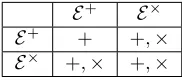
Table 2 summarizes possible combinations of ciphertexts and the corresponding supported arithmetic operations. Note that our scheme supports homomorphic addition and multiplication of any combination
of E+and E×ciphertexts, except that it does not allow homomorphic multiplication of two E+ciphertexts.
Circuits prepared in DNF form will have no need to switch back from ADD to MUL. In DNF form, multi-plications are performed first and followed by additions. If DNF form is not suitable for whatever reason,
we can always combine SHE with the basic interactive multiplication approach described in§2.2.
Construction. We are now ready to present ourSHEscheme, which is based on the Paillier ADD scheme,
E+, and the ElGamal MUL scheme,E×described in§3.2. We note that since we operate MUL ciphertexts in
an encrypted domain, the AddToMulalgorithm is used to transform a message encrypted underE+ into an
encrypted MUL ciphertext underE+; analogously, theMulToAdd algorithm transforms an encrypted MUL
ciphertext underE+ into a plaintext encrypted underE+. OurSHEscheme is specified as follows:
• KeyGen(1n): On input a security parameter 1n, the algorithm first chooses (N, p, q), where N =pq,
and p and q are n-bit primes. It then chooses two random odd numbersx0, x1 ∈ Z∗N, where |x0| ≈
|x1| < 12|N|, and the generator g = 16. It sets x = x0x1 and h = gx, and outputs the following
public-private key pairs
(pk+, sk+) := (N, hN, φ(N), p, qi) (pk×, sk×) := (hN, g, hi, hN, g, x0, x1i).
• Enc(pk◦, m): For◦:= +, the algorithm runs theEncalgorithm of E+; otherwise if◦:=×, it runs the
Enc algorithm ofE×.
• Dec(sk◦, c◦): Similarly, for◦:= +, the algorithm runs theDecalgorithm ofE+; otherwise if◦:=×, it
runs theDecalgorithm of E×.
• KeyShaGen(sk+): The algorithm sets both the secret key sharesk+ 0 andk
+
1 to null (since no decryption
ofE+(m) ciphertexts is required in our scheme).
• KeyShaGen(sk×): The algorithm sets the secret key shares to bek0×:=x0 andk×1 :=x1.
• AddToMul(c+, pk×): This algorithm is run locally by the server. Given an ADD ciphertext of the form
E+(m) := (1 +N)m·(r0)N modN2
and the MUL public key pk× :=hN, g, hi, the algorithm chooses a random r∈ Z∗
N and outputs an
encrypted MUL ciphertext
E+(E×(m)) :=h(1 +N)mhr
·(r0)N hr modN2, gri.
• MulToAdd(c+, k×
0, k
×
1): This algorithm is jointly run by the server and the proxy. On input an encrypted
MUL ciphertext of the form
E+(E×(m)) :=h(1 +N)mhr·(r0)N hr modN2, gri,
the server chooses a randoms∈Z∗N, computes
c0:= (gr+s)k1×, R:=gs
and forwardshc+, c0, Rito the proxy. (Here the random valuesis used to blind the ElGamal ciphertext
component gr. This is to prevent the proxy from learning the corresponding hr value using its key
share.)
The proxy then, using its key share k×0, computes (c0)k×0 = hr+s and its inverse (hr+s)−1. It also
computes and returns
c00:= ((1 +N)mhr·(r0)N hr)(hr+s)−1 modN2
:= (1 +N)mh−s·(r0)N h−s modN2
:=E+(mh−s)
andR0=Rk×0 to the server.
Finally, the server computes (R0)k×1 =hs and recovers the corresponding ADD ciphertext E+(m) by
homomorphically removing h−sfromc00.
We analyze the security of the above construction in Section 4.
3.3.1 Discussion
Assumptions. In ourSHEscheme, the client is required to generate and submitonlyElGamal ciphertexts
corresponding to non-zero plaintexts. As explained in Section 2.4, if encryption of zero is required in the
computation, the client can construct a circuit that represents zero in the form of
MulToAdd(E+(E×(n
1)))×MulToAdd(E+(E×(n2)))−1=E+(0)
for random n1, n2 and where n1−n2 = 0. This prevents encryption of a zero-plaintext under E× at any
point of the computation.
Moreover, we assume that: (i) at least either the proxy or the server does not reveal to any party its
secret key shares and any local states,e.g., random valuesused in a ciphertext transformation; (ii) at least
either the proxy or the server obediently executes the specified algorithms in the scheme.
Homomorphism. With the SHE scheme, it is trivial to evaluate homomorphic multiplication on two
encrypted messagesE×(m1) andE×(m2). To output the result inE+, the server simply encryptsE×(m1m2)
underE+and runsMulToAdd(E+(E×(m
1m2))). To homomorphically addE×(m1) toE+(m3), the server first
runs theMulToAdd(E+(E×(m
1))) =E+(m1) and then adds the result to E+(m3) to obtainE+(m1+m3).
The steps involved in performing multiplication between E×(m
1) and E+(m3) has been sketched before.
Lastly, homomorphic addition of two Paillier encrypted messages is done in the usual way.
Extending ton-cloud. Our scheme can be extending to work in then-cloud setting. For example, instead
of relying on one proxy, we can usen−1 non-colluding proxies to jointly perform the MulToAddalgorithm
with the server. Each proxy is given a secret key sharek0×,i for i∈ {1, . . . , n−1} and the server holds the
key share k0×,n such thatx=k×0,1· · ·k0×,n. This way, the confidentiality of the client’s data is protected so
long as at least one of thenparties is honest.
4
Security Analysis
with one arithmetic operation is transformed to one that supports another arithmetic operation. However, as with any existing homomorphic encryption schemes, our schemes do not guarantee data integrity or
correctness.7 Moreover, our schemes do not prevent information leakage through the function to which the
client’s input is fed.
4.1
CPA Model
We work with the standard chosen-plaintext attack (CPA) model [41]. As usual, security is defined through
simulating anindistinguishabilitysecurity game between an adversaryA(attack algorithm) and a challenger:
1. Aplays the role of either a malicious server or a malicious proxy (but not both).
2. At the start of the game, A is given the public keys and secret key shares that would have been
required by a real server or proxy to perform the Encalgorithms associated withE+ andE×, and the
AddToMul andMulToAddalgorithms for transformation of ciphertexts.
3. During the game,Ais given access to the following oracles:
• Encoracle—capability to choose arbitrary plaintexts to be encrypted and obtain the corresponding
ciphertexts;
• AddToMuloracle—capability to transformE+(m) to E+(E×(m));
• MulToAddoracle—capability to transformE+(E×(m)) toE+(m).
4. Ais also required to choose two messagesm0, m1with the restriction that|m0|=|m1|. It also chooses
what type of transformation (AddToMulor MulToAdd) on which it wishes to be challenged.
5. During the challenge phase, and given m0, m1, the challenger performs the following steps:
• pick a random bitb∈ {0,1};
• ifAwishes to be challenged onAddToMul, generateE+(m
b) and run theAddToMulalgorithm;
• otherwise, generateE+(E×(m
b)) and jointly run theMulToAddalgorithm withA;
• output both the ciphertexts before and after transformation as the challenge ciphertext;Ais also
given a copy of E×(m
b) (since all data is initially encrypted in such form in ourSHEscheme).
6. Acontinues to have access to the aforementioned oracles.
7. At the end of the game,Aoutputs a guessb0∈ {0,1} forb. Awins the game ifb=b0.
Note that sinceAhas access toE×(m
b), we impose the restriction ofm06=m16= 0 in the above game. (In
the actual scheme, as explained, this requirement can be easily met.) Moreover, for simplicity, we consider transformation of a single ciphertext that is directly computed from one of the messages chosen by the adversary. However, it is straightforward to extend the above CPA security game to allow the adversary to submit two sets of messagesM0={m10, m20, . . . , mt0} andM1={m11, m21, . . . , mt1}, with the restriction that
|mi
0|=|mi1|for all 1≤i≤t.
We say that the SHEscheme is CPA-secure if any probabilistic polynomial-time algorithmAattacking
the scheme has onlynegligible advantageof winning the CPA security game.
7Hence, we work in a model which is comparable to a semi-honest model typically used in the MPC setting [31], but
4.2
Security of PHE
The Paillier MUL scheme has been proven to have indistinguishable ciphertexts under the CPA model. The security proof is based on the assumption that the decisional composite residuosity problem is hard, relative
to the hardness of factoring a composite numberN that is the product of two primes [54].
On the other hand, McCurley [50] showed that, with careful selection of parameters, ElGamal encryption with a composite modulus can be secure against any adversary who could break Diffie-Hellman key exchange, or could factor the modulus, but not both. While there is no known proof of CPA-security, it is conjectured that the ElGamal MUL scheme over a composite modulus is semantically secure [23, 9].
4.3
Security of SHE
We now prove the security of ourSHEscheme under the CPA model defined in§4.1.
Theorem 1. The SHE scheme is secure in the CPA model against any probabilistic polynomial-time ad-versary if the underlying ADD and MUL schemes are CPA-secure, the Decisional Diffie-Hellman (DDH) problem is hard, and provided at least the proxy or the server is honest.
Proof of Theorem 1. Letshe be the advantage ofAin breaking theSHEscheme. We simulate a CPA secu-rity game and consider the following cases.
Case 1 (Honest Server): IfAis the proxy, it is given the public keypk× and the key sharek0× for the
MUL scheme. Moreover, ifAchooses to attack theAddToMulalgorithm, it has access to
hE×(mb),E+(mb),E+(E×(mb))i
as the challenge ciphertext. However, by the semantic security of the ADD scheme,Alearns no information
aboutmb from E+(mb) andE+(E×(mb)) without the corresponding private key sk+. Hence, it is sufficient
to analyze if any information aboutmb can be deduced from
hE×(mb) = (mbhr, gr), pk× = (N, g, h), k0×=x0i.
Lemma 1. Givenhg, h, x0, gr, mbhri, any probabilistic polynomial-time adversaryAhas negligible advantage
A1 in distinguishingE×(m0)fromE×(m1), assuming that the DDH problem is hard.
Proof of Lemma 1. By definition of the CPA-secure MUL scheme, m0hr is indistinguishable from m1hr.
This is because mbhr contains no information aboutmb for a randomly chosen r (i.e., the distribution of
the former is independent of that of the latter), sincehr is indistinguishable from a random group element
under the DDH assumption. However, given knowledge of the key sharek0×=x0,Ais able to compute the
valuesh1/x0 = (gx)1/x0=gx1 and (m
bhr)1/x0 =m
1/x0
b g
rx1, wherex
1is the other unknown key share. (Note
that here (mb)1/x0 is known toA.) Hence, we need to show that given (g, gr, gx1),Ais unable to distinguish
grx1 from a random group element with non-negligible advantage, since the capability in doing so implies
thatAis able to distinguishm1/x0
0 grx1 from m 1/x0
1 grx1 with non-negligible advantage.
Let consider ˜mb=m
1/x0
b as an encoded message ofmb. It is then straightforward to prove that ˜mbgrx1
leaks no information about ˜mb under the standard DDH assumption. Suppose there exists an adversaryA
which can break the CPA security of the MUL scheme with advantage at leastA1. We build an algorithmB
which can solve the DDH problem. LetBtake as input a DDH challenge (g, gv, gw, T) for randomv, w∈
Z∗N
and whereT is eithergvw or a random group element of
Z∗N. Bthen proceeds as follows. It picks a random
x0 and sets hg, h = gw, Ni as the public key of the MUL scheme and x0 as the secret key share k0× for
adversaryA. (This implicitly setsgw=gx1.) B also providesEncoracle access toAin the standard way.
During the challenge phase, A submits two messages m0, m1 of equal length. B chooses a random bit
b ∈ {0,1} and returns (m1/x0
b T, gv) as the challenge MUL ciphertext, which by definition, is a valid MUL
ciphertext since
(m1/x0
b T, g
where ˜mb can be treated as an encoded message based onx0, andgw=gx1 is given toAas the public key.
Afinally outputs a guess b0 ofb. If b0 =b, Boutputs 0 (indicating thatT =gvw); otherwise, it outputs
1 (indicating thatT is a random element ofZ∗
N). We see that if T is a random group element, thenBhas
probability 1
2 in outputtingb= 0. On the other hand, ifT =g
vw, Bhas advantage at least
A1 in solving
the DDH problem.
On the other hand, ifAwishes to attack theMulToAddalgorithm, it has access tohE×(m
b),E+(E×(mb)), c0, Ri instead during the challenge phase. Similarly, we turn our attention to analyzing what information can be deduced from non-ADD ciphertext components
hE×(mb) = (mbhr, gr), c0 = (gr+s)x1, R=gs, pk× = (N, g, h), k×0 =x0i.
From Lemma 1, we prove that the adversary does not learn anything aboutmb fromhE×(mb), pk×, k0×i.
Hence, it is sufficient to show that no information aboutmb is leaked throughc0 andR.
Lemma 2. Givenhg, h, x0, gs,(gr+s)x1, mbhri, any probabilistic polynomial-time adversaryAhas negligible advantageA2 in distinguishing E×(m0) fromE×(m1), assuming that the DDH problem is hard.
Proof of Lemma 2. Given (gr+s)x1 and x
0, Ais able to compute (gr+s)x1x0 = (gx)r+s =hr+s, from which
it can also computehr+s/(m
bhr) = (1/mb)hs. Hence, we need to show that it is infeasible for the adversary
to distinguish (1/m0)hsfrom (1/m1)hswith non-negligible advantage.
We can prove that (1/mb)hs leaks no information about mb using the same technique for proving
Lemma 1. That is, we run an adversary A with advantage at least A2 against the MUL scheme as a
subroutine within an algorithm B, which is used to solve the DDH problem. Given a DDH challenge
(g, gv, gw, T), we set gw=gx1 and embedgv in the challenge ciphertext of the form
((1/mb)1/x0T, gv) = ( ˜mbT, gv)
such thatT is either gvw =gsx1 or a random element of
Z∗N. Following the same reasoning, we can show
thatB has advantage at leastA2 in solving the DDH problem.
Case 2 (Honest Proxy): IfAis the server, it is given the public key pk× and the key sharek1× for the
MUL scheme. Similarly to Case 1, ifAwishes to attack the AddToMulalgorithm, it learns no information
aboutmb fromhE×(mb),E+(mb),E+(E×(mb))iby the security definition of the ADD scheme and Lemma 1.
However, if Aattacks the MulToAddalgorithm, it is given access to hE×(m
b),E+(E×(mb)), c00, R0i. We then focus on what can be inferred from non-ADD ciphertext components
hE×(m
b) = (mbhr, gr), R0=gsx0, k1×=x1i.
Lemma 3. Given hg, h, x1, s, gr, gsx0, mbhri, any probabilistic polynomial-time adversary A has negligible advantageA3 in distinguishing E×(m0) fromE×(m1), assuming that the DDH problem is hard.
Proof of Lemma 3. Given knowledge of sandx1, clearlyA can computegx0 and (mbhr)1/x1 =m
1/x1
b grx0,
wherex0is unknown toA. Using the same proof technique for Lemma 1, we can show that given (g, gr, gx0),
it is infeasible to distinguishgrx0 from a random group element under the DDH assumption. If there exists
an adversary A with advantage A3 in breaking the security of the MUL scheme, then we can build an
algorithmBto solve the DDH problem with advantage A3.
What remains is to analyze if Acan deduce any information about the MUL private key just from one
of the given key shares.
Proof of Lemma 4. Since k0× =x0 and k×1 = x1 are randomly and independently chosen, clearly the
dis-tribution for each key share is indistinguishable from A’s viewpoint. Even thoughAwith knowledge of x0
(resp.x1) can compute gx1 (resp.gx1), recovering the other unknown key sharex1 (resp.x0) is equivalent
to solving the discrete logarithm problem. Thus, given only one of the two key shares,Acan only perform
exhaustive search on the other key share, and thus, has only negligible probability A4 in recovering the
correct original decryption keyx=x0x1.
Combining Lemmas 1–4, we haveshe≥A1+A2+A3+A4. This completes the proof of Theorem 1.
5
Evaluation
5.1
Implementation
SHE. We implement ourSHEscheme using the GNU MP library version 5.1.3 in 1540 lines of Ccode. We
choose a modulus N of size 1024 bits for implementing the Paillier AHE and the ElGamal MHE schemes.
Our current implementation is unoptimized and does not use any parallelization techniques.
GC. We use FastGC [37], which is implemented in Java, and is one of the fastest available implementations
of the MPC framework that is based on GC. For benchmarking purposes, we construct circuits for 32-bit integer multiplication, matrix multiplication, and polynomial evaluation. We assume that the client sends all the inputs along with the circuit to the server, which in turn, evaluates the circuit and returns the results to the client. For every new input which has to be evaluated, a new garbled circuit has to be generated with new input labels, as the garbled circuits in FastGC can be used only once for secure computation. Hence our experiments take into account the time required for the circuit construction, garbling or any circuit upload while measuring the execution time using FastGC.
SWH. Our implementation of SWH is based on a recently released homomorphic encryption library called
HElib [45], which is written inC++. It implements the BGV homomorphic encryption scheme [6] and makes
use of Smart and Vercauteren’s packing techniques [60] allowing SIMD-like computation. The optimization
provides support for parallel computation onNSLOTSwith a single SIMD-like instruction. The HElib library
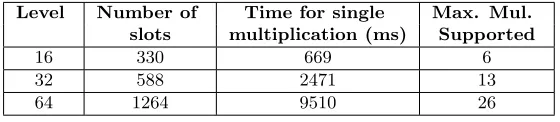
supports both bit and integer operations on encrypted data. Moreover, we choose the security parameter to be 80 bits, roughly equivalent to the 1024-bit security level achieved by our SHE scheme. The library, however, does not provide the bootstrapping function required for FHE, and thus imposing a limit on the depth of the evaluated circuit. The number of consecutive multiplication operations required in an application decides the depth of a circuit. The deeper the circuit, the slower is the performance of each multiplication operation. The maximal depth of the circuit that we could support is 26 multiplications. Table 4 shows different choices of levels, number of slots and their corresponding times required for multiplication and the maximal supported number of multiplications.
FHE. We also implement FHE based on the Scarab Library [46], which in turn, is based on the work of
Gentry [30], and Smart and Vercauteren [60]. The library implements the “re-encrypt” operation required for bootstrapping and refreshing a ciphertext, and it supports bitwise operations over encrypted bit inputs. In order to be used for our benchmarking, we modify the library such that it supports integer addition and
multiplication. There are other faster variants of FHE scheme, such as L´opez-Alt et al.’s scheme that is
based on NTRU encryption [47]. However, no open source implementation of these schemes is available
yet. Nevertheless, Doroz et al. [19] report that the NTRU-based scheme can be faster than using HElib
by a factor of 6. As we show next, our SHEscheme can be up to roughly 2,500 times faster (3 orders of
Level Number of Time for single Max. Mul.
slots multiplication (ms) Supported
16 330 669 6
32 588 2471 13
64 1264 9510 26
Table 4: Parameter choices for SWH.
5.2
Selection of Benchmarks
SHE is based on partially homomorphic encryption schemes that support limited but fast arithmetic
op-erations. Hence, we focus on benchmarks that operate on integer values as inputs and do not consider
applications using bitwise operations like AES. To evaluate the performance of SHE, we select polynomial
evaluation and matrix multiplication that are commonly used in privacy-preserving computation applications
as our benchmarks. We evaluate these benchmarks for various input sizes usingSHE and other primitives
described above. We limit the input sizes to a small numberi.e., 26 degree for polynomial and 10 for matrix
as the tools we compare to did not scale for larger values.
Polynomial Evaluation. Encrypted polynomial evaluation is a fundamental building block of many in-teresting privacy-preserving applications, for example, privacy-preserving set intersection [24], private infor-mation retrieval [4], and regular expression matching [55]. In our experiments, we measure the computational cost for polynomial evaluation using both the naive method and Horner’s rule. The naive way of evaluating a polynomial involves: (i) computing all the terms in the polynomial; and (ii) adding up all the terms. The input to this application is encrypted polynomial coefficients and a point at which the polynomial is to be evaluated. However, the degree of the polynomial is unencrypted. All the inputs are in the integer domain.
Matrix Multiplication. Our second benchmark is based on matrix multiplication, which is a core opera-tion used in various applicaopera-tions such as image transformaopera-tion, page rank algorithms, and machine learning algorithms []. We evaluate multiplication of two square matrices of different dimensions where the inputs are encrypted. Unlike polynomial evaluation which may have long chains of multiplications, matrix multiplica-tion requires only a small depth circuit. Thus our selected benchmarks allow us to evaluate the efficiency of
SHEon both small and larger depth circuits.
5.3
Evaluation
We perform our evaluation with the following goals:
• To examine the impact of the network latency between the two nodes, including on real clouds.
• To evaluate the efficiency of SHE for different depth of circuits which is indicated by the number of
continuous chain of multiplications.
• To compare the performance of SHE with publicly available implementations for secure arithmetic
computation on encrypted data.
Methodology. We measure the performance ofSHEfor three different setups: (i) between two clouds, (ii) within a LAN, and (iii) on the same machine.
For evaluating our scheme in the two-cloud model (i.e., between proxy and server), we use Amazon EC2
and Rackspace servers connected over a bandwidth of 251 Mbits/sec (measured usingiperf[63]). We set up
different regions to evaluate the communication overhead between these two clouds. Our proxy is hosted in US Northern Virginia, while the server is hosted in US West (Oregon).
For evaluation on a local area network (LAN), we use two machines connected over a bandwidth of 937 Mbits/sec. We use a Dell Latitude E6430s machine with 8 GB RAM and Intel(R) Core(TM) i7-3520M CPU at 2.90 GHz 4-core processor having cache size of 4096 KB as the proxy. On the other hand, we use a Dell Optiplex D990MT Desktop machine with 8 GB RAM and Intel(R) Core(TM) i7-2600M CPU at 3.40 GHz 8-core processor having cache size of 8192 KB as the server.
In the third setting, we run both the proxy and the server on the same machine. One can imagine this to be useful in a scenario where a machine contains two CPUs manufactured by different vendors and a possible threat arises from a hardware backdoor present in either of the CPUs [65]. The two CPUs can act
as the two nodes in ourSHE design and execute the proxy and server logic respectively. We use the Dell
Optiplex D990MT Desktop machine to measure the performance when proxy and server are hosted on the same machine.
Summary of Evaluation. The results of our evaluation can be summarized as follows:
• SHEis a new design point in the space of secure arithmetic computation in the two cloud model and
is expressive enough for applications of different circuit depths like matrix multiplication (depth = 1)
and polynomial evaluation (depth = 26)8.
• In applications with no data parallelism, our scheme demonstrates a stark improvement of 2500 time
speed up over FHE and SWH, and 35 times over GC for naive evaluation of a polynomial (deep circuit) and 1000 times speed up over FHE, 2 times over GC and almost comparable performance with SWH for matrix multiplication (low depth circuit).
• The dominant cost in the performance is due to the communication overhead between two clouds which
varies our speed up from 2500 to 7000 over FHE when moved from cloud setting to same machine setting that has zero network latency.
5.4
Results
Table 3 shows the results of our evaluation in the three experimental setups. It gives the time required, in milliseconds, to execute our benchmark applications for various sizes of input. It also shows the speed up of our scheme as compared to FHE, GC , SWH and SWH when the parallel functionality is used. We report on matrices of size 2, 5 and 10 since the FHE library did not scale for matrix size of 10 in our experiments. We evaluate the polynomial for a maximum of 26 degree as the SWH library could not scale for more than 26 degree because of its limited expressiveness.
Performance of SHE. Our scheme takes around 400 ms to evaluate a polynomial of degree 26 using the
naive method and 4.5 seconds using Horner’s method in the cloud setting. Both methods require conversions
from ElGamal ciphertexts to Paillier ciphertexts (MulToAdd) proportional to the degree of the polynomial. However in the naive way of evaluating a polynomial, all the multiplications are done together and sent to the proxy for conversion in a single request; whereas Horner’s method requires to make communication calls to the proxy that is equal to the degree of the polynomial. Thus, the communication overhead increases in the latter case. The time for evaluating a polynomial using both the naive method and Horner’s method are almost the same (101 ms and 115 ms resp.) when executed on the same machine (zero network latency). This confirms our observation that the dominant cost comes from the communication overhead between the
two clouds. Matrix multiplication makes N3 conversion calls for multiplying two matrices of size N ×N.
On the same machine setting, SHE takes 5 s for multiplying matrices of size 10. This shows that the
second dominant factor after network latency that effects the performance is the number of conversions from
ElGamal to Paillier ciphertexts. Thus,SHEis comparatively much more efficient for applications which have
longer chains of multiplications and fewer conversion calls.
KeyGen MulToAdd Pai. Mul AddToMul Pai. Add ElG. Mul
66 ms 11 ms 2 ms 5 ms 0.003 ms 0.002 ms
Table 5: Time required for individual operations onSHE(averaged over 10 runs).
Comparison with other schemes. The performance ofSHEis roughly 2500 and 7000 times better than FHE when evaluated on two-cloud servers and on the same machine, respectively, for applications with a high-depth circuit like polynomial evaluation. FHE involves the computationally expensive “re-encrypt” function after every multiplication operation in order to remove the noise from the ciphertext. This operation
increases the execution time for longer chain of multiplications. SHE scheme does not suffer from any
such costly computations, and thus, shows consistent speed up in the performance even for execution of deep circuits. However, the network latency between the proxy and the server effects the speed up in the
performance ofSHEwhen it is run in the cloud setting.
For non-parallel applications, our scheme is around 2500 times faster than SWH in the two cloud setting and 8500 times faster when executed on the same machine setting for high-depth polynomial evaluation. Our scheme shows comparable performance against SWH for matrix multiplication which has depth size of 1 (as the depth of circuit is only one, we set the level parameter as 2 in the SWH scheme for evaluating this particular application). This is due to the fact that SWH is faster for small chain of multiplications and slows down with increase in the circuit depth. After a certain number of multiplications, the ciphertext becomes noisy and cannot be used further. This limits the maximum multiplications that can be supported by SWH. Table 4 shows the maximal number of supported multiplications in the HElib library. For applications that can support highly parallel tasks, we show the comparison to our scheme by dividing the execution
time of SWH with the NSLOTS (the maximum parallelism possible) in Table 4. We observe that SHE is
considerably slow for matrix multiplication and Horner’s method, and is comparable to SWH for naive method of polynomial evaluation using batch processing offered by SWH. However, for dynamic queries,
e.g., private information retrieval, where client does not have enough input data available to leverage the
benefits of such batch processing in SWH,SHEis faster. Even with parallel processing,SHEperforms 2.64
to 6.76 times better than SWH for 26 degree polynomial. The benefits of SHEin terms of efficiency and
expressiveness are visible for deep chains of multiplication which SWH cannot support due to its limitations.
Our benchmarks execute around 35 times faster using SHE as compared to running with GC in the
cloud setting. The main performance overhead in GC comes from the circuit generation and circuit garbling
operations that are proportional to the size of the input. UnlikeSHEwhich can reuse the same application
to evaluate on different set of encrypted inputs, GC is limited to a one-time use of the circuit for a particular set of inputs.
Individual Operation costs. Table 5 shows the computation times required for various operations in the
SHEscheme. The key generation step is performed by the client and takes around 66 ms. Paillier
homomor-phic addition and ElGamal homomorhomomor-phic multiplication require only 0.003 ms and 0.002 ms, respectively.
Multiplying a Paillier ciphertext with a constant value and AddToMul both require on an average of less
than 5 ms. TheMulToAddcall call to the proxy takes around 10 ms (which includes the network latency).
All the timing measurements are averaged over 10 runs of each operation.
6
Related Work
Secure Arithmetic Operations. In the secure two-party or multi-party computation (2PC/MPC) set-ting, there has been an extensive amount of work in secure arithmetic operations, such as addition, multiplica-tion, division, exponentiation and modulo reduction over integers, see for example [26, 39, 17, 33, 35, 62, 67].
Typically, 2PC is performed over two input valuesaandbfrom each party such that both parties learn only
their respective input and the outputc=a◦b for some operator◦. The communication and computational
secret sharing takes a single round of communication and involves the exchange ofO(n2) elements from a
relevant finite field [26]. This is because each of thenplayers must perform Shamir secret sharing as part of
the protocol. In the garbled circuit setting, on the other hand, multiplication of twol-bit unsigned integers
requires a circuit of size approximately O(l1.6) with Karatsuba’s algorithm. The complexity can increase
drastically even for a slightly more advanced operation. For example, Yuet al.’s two-partyexponentiation
protocol takes 24 rounds and requires roughly 279l secure multiplications [67] forl-bit shares.
Outsourced MPC. Kamara et al. [40, 59] studied MPC in a server-aided setting, where the involved clients/parties, particularly those with limited computing power, are able to outsource expensive computation to an untrusted server with vast amount of computational resources. The server neither has any input to the computation nor receives any output from the computation. However, any secure computation would require
interaction between the involved parties and the server. On the other hand, Halevi et al. [34] proposed a
non-interactive MPC solution that allows outsourcing of computation to a web server. However, the server is allowed to learn the output of the computation.
Peteret al.[56] recently extended the above previous works to the multi-key setting, proposing an MPC
construction that allows input to be encrypted with multiple keys corresponding to different parties/clients. Their construction, as with our work, relies on two non-colluding servers and no interaction is required between the clients and the servers during secure computation. However, it makes use of traditional MPC protocols as building blocks, and thus, the resulting construction has relatively high computational
over-head. For example, one multiplication operation alone takes approximately 200 ms using the Bressonet al.
encryption scheme [7] with a 1536-bit modulus. Other work on secure polynomial evaluation in the multi-key setting can be found in [66].
Threshold FHE & Multi-key FHE. The notion of FHE typically assumes a semi-honest adversary model. As observed by Gentry [30], however, we can extend this to the fully malicious model using threshold
cryptography. Asharov et al. [1] proposed a threshold FHE (TFHE) scheme in which all clients share a
common public key and decryption requires a collaborative effort from all the clients. Using their TFHE scheme, one can derive simple MPC protocols secure against fully malicious attackers, while preserving relatively low communication complexity.
L´opez-Altet al.[47] proposed the concept of multi-key FHE (MFHE) that allows computation on data
encrypted under multiple unrelated public keys, analogous to multi-key MPC [56]. One major advantage of such approach is that dynamically chosen computation can be performed on data belonging to arbitrary sets of users on-the-fly and in a non-interactive manner. Nevertheless, it still relies on an interactive protocol during decryption of the computed results. The performance of the schemes is faster than FHE but still unsuitable for practical use.
Hybrid Approach. There also exist works on combining homomorphic encryption with 2PC/MPC proto-cols to support a wider range of operations, including both arithmetic and Boolean circuits, while achieving more optimal performance compared to using each primitive/protocol individually [35, 13, 68]. Our SHE scheme is orthogonal to the hybrid framework and can be used as a faster alternative to homomorphic en-cryption for supporting arithmetic operations. Algorithms for automated protocol selection among different types of secure computation protocols for optimal performance can be found in [43].
Others. Naehrig et al. [53] showed that SWH is sufficient for a number of real-world applications, par-ticularly in the medical, financial, and the advertising domains. Reasonable efficiency can be achieved by carefully performing application-specific optimization to an SWH scheme. The efficiency of our SHE scheme is comparable to that of an SWH scheme for a small number of homomorphic additions and multiplications. For a larger number of similar operations, our scheme outperforms the latter. We provide a more detailed
performance comparison against SWH in Section 5. In a recent independent work, Boneh et al.[4] showed
how private database conjunction queries can be performed using techniques from SWH. For a database