A Wireless BCI System for Control
Applications
Vandana Akshath Raj
Assistant Professor, Dept. of ECE, AJ Institute of Engineering and Technology, Mangalore, Karnataka, India
ABSTRACT: Brain–computer interfaces (BCIs) are used to translate brain activity signals into control signals for external devices. ELECTROENCEPHALOGRAM (EEG)-based brain computer interfaces (BCIs) have attracted a great deal of attention because they are non-invasive, relatively convenient, and affordable. The objective of the proposed project is to employ a wireless module for EEG signal transmission and using the motor imagery based mu rhythm and the P300 potential to control an application. It will provide the multiple independent control signals necessary for the multi-degree continuous control.
KEYWORDS: BCI system, EEG, P300, motor imagery.
I.INTRODUCTION
BCI systems provide a new communication channel to humans who use it. They measure neurophysiological signals of the human, electroencephalogram (EEG) in particular. EEG based BCI systems are designed to decode the intension of the human user and generate commands to control external devices or computer applications. The human can produce these commands by generating the neurophysiological signals intentionally. This process can become more successful – fast and accurate – through training and practice. This technology allows the users with new experiences which enable a direct communication between the human and the computers or external devices such as home appliances, and prosthetic devices.
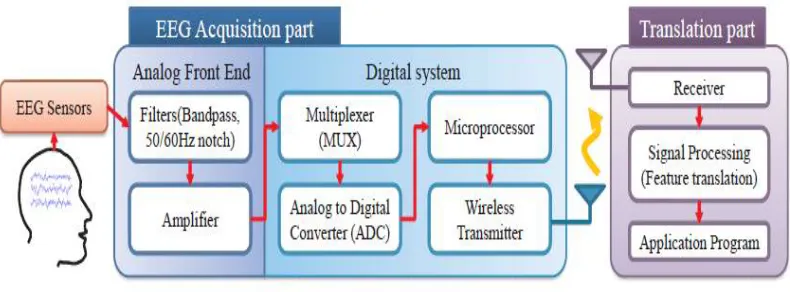
Fig. 1 A wireless BCI system
extraction and classification to convert the raw neurophysiological signals into computer readable messages. Depending on the type of connection between the two parts, BCI systems can be divided into two kinds, wired versus wireless BCI systems. Many conventional BCI systems are wired. With just three electrodes positioned at the occipital lobe, the acquisition part of wired BCI systems generally comes with bulky and heavy amplifiers and pre-processing units. Connection wiring is usually complicated with a large number of cables between the electrodes and the acquisition part. For these reasons, preparation time for measuring EEG signals is typically very long. In addition, user’s movement is limited due to cable constraints. Therefore, the application of BCI systems is difficult to escape from laboratory scale experiments. These restrictions make the types of applications for which BCI systems can be made useful be severely limited.
Wireless BCI systems are to eliminate the wire connection, between the signal acquisition and the translation part, with the use of a wireless transmission unit such as Bluetooth and Zigbee modules. Removing wire connections, portability of BCI systems is greatly improved. Postures and movements of users wearing the acquisition part of wireless BCI systems are also unimpeded. These desirable aspects of wireless BCI systems promote to go beyond a laboratory scale experiments and to develop everyday-life applications. BCIs are categorized based on the EEG brain activity patterns into four different types: event–related desynchronization/synchronization (ERD/ERS), steady state visual evoke potentials(SSVEP), P300 component of event related potentials (ERPs), and slow cortical potentials (SCPs).Compared to other modalities for BCI approaches, such as the P300-based and the SCP BCIs,SSVEP-based BCI system has the advantage of having higher accuracy and higher informationtransfer rate.
1.P300- based BCI: Event related potentials (ERPs) are the measurement of brain responses to specific cognitive, sensory or motor events. One of the main approaches towards BCI is based on ERPs. P300 is a major peak and one of the most used components of an ERP. The presentation of stimulus in an oddball paradigm can produce a positive peak in the EEG, 300 msec after onset of the stimulus. The stimulus can either be visual, auditory or somatosensory. This evoked response in EEG is called P300 component of ERP.
2. SSVEP BCI: Electrophysiological and neurophysiological studies have demonstrated increases in neural activity elicited by gazing at a stimulus. Visual evoked potentials are elicited by sudden visual stimuli and the repetitive visual stimuli would lead to stable voltage oscillations pattern in EEG that is called SSVEP. SSVEP is considered as a concept with two different definitions. According to which SSVEP is a direct response in the primary visual cortex. On the other hand, it is also assumed that the SSVEP includes indirect cortical responses via cortical-loops, from the peripheral retina, while a cognitive task is performed. Although the main mechanism of SSVEP still is unknown, generally SSVEP is considered as a continuous visual cortical response evoked by repetitive stimuli with a constant frequency on the central retina.
As a nearly sinusoidal oscillatory waveform, the SSVEP usually contains the same fundamental frequency as the stimulus and some harmonics of the fundamental frequency. For example, when the retina is excited by a visual stimulus at presentation rates ranging from 3.5 Hz to 75 Hz, the brain generates an electrical activity at the same and different frequency of the visual stimulus. The flickering stimulus of different frequency with a constant intensity can evoke the SSVEP in verity of amplitudes, ranging from (5-12Hz) as low frequencies, (12-25 Hz) as medium ones and (25-50 Hz) as high frequency bands. This type of stimulus is a powerful indicator in the diagnosis of visual pathway function, visual imperceptions in patients with cerebral lesions, loss of multifocal sensitivity in patients with multiple sclerosis, and neurological abnormalities in patients with schizophrenia and other clinical diagnoses. In addition to the usual clinical purpose of diagnosing visual pathway and brain mapping impairments, the SSVEP can serve as a basis for BCI. Recently, SSVEP BCI systems have gained a special place in the BCI paradigms continuum because of having a variety of different possibilities. SSVEP BCIs are useful in different applications, especially the ones that need some major requirements as follows:
• Large number of BCI commands is necessary (in SSVEP BCI limitations are mostly defined only by the design).
• High reliability of recognition is necessary (in SSVEP BCI, patterns are clearly distinguishable by frequency).
• No training (or just a short time training for classifier training) is allowed.
• Self-paced performance is required.
processing, and memory, proceed over time ranges in the order of tens of milliseconds. Whereas PET and MRI can localize regions of activation during a given mental task, ERPs can help in defining the time course of these activations. Amplitudes of ERP components are often much smaller than spontaneous EEG components, so they are not to be recognised from raw EEG trace. They are extracted from set of single recordings by digital averaging of epochs (recording periods) of EEG time-locked to repeated occurrences of sensory, cognitive, or motor events. The spontaneous background EEG fluctuations, which are random relatively to time point when the stimuli occurred, are averaged out, leaving the event-related brain potentials. These electrical signals reflect only that activity which is consistently associated with the stimulus processing in a time-locked way. The ERP thus reflects, with high temporal resolution, the patterns of neuronal activity evoked by a stimulus.
Sensory and cognitive processing and motor behavior result not only in an event-related potential (ERP), but also in a change in the ongoing EEG in form of an event-related desynchronization (ERD) or an event-related synchronization (ERS). The former represents a short-lasting and localized amplitude decrease of rhythmic activity, the latter an amplitude increase. These reactivities are highly frequency-band specific and nonphase locked to the event.
II. LITERATURE REVIEW
Over the past two decades, the study of the Brain Computer Interfaces (BCI) has grown dramatically. With portable wireless BCI systems, various real-life applications are underdevelopment now. In the early days of BCI researches, cursor control and speller applications were developed mainly targeted for helping the disabled people. Recently, with growing interest, wireless BCI systems have been applied in entertainments as well. For example, Emotiv and Neurosky companies have recently released their wireless BCI headsets for entertainment uses such as brain gaming and mind monitoring. Moreover, international research groups have applied wireless BCI systems for interesting new applications such as home automation system based on monitoring human physiological states, cellular phone dialing, and drowsiness detection for drivers.
Gert Pfurtscheller et all in [8] proposed hybrid brain–computer interface (BCI) composed of an imagery-based brain switch and a steady-state visual evoked potential (SSVEP)-based BCI. The brain switch (event related synchronization (ERS)-based BCI) was used to activate the four-step SSVEP-based orthosis (via gazing at a 8 Hz LED to open and gazing at a 13 Hz LED to close) only when needed for control, and to deactivate the LEDs during resting periods. Only two EEG channels were required, one over the motor cortex and one over the visual cortex. As a basis for comparison, the orthosis was also operated without using the brain switch. Six subjects participated in this study. This combination of two BCIs operated with different mental strategies is one example of a “hybrid” BCI and revealed a much lower rate of FPs per minute during resting periods or breaks compared to the SSVEP BCI alone. Four out of the six subjects succeeded in operating the self-paced hybrid BCI with a good performance.
Yuanqing Liet all in [7] proposed a new approach by combining two brain signals including Mu/Beta rhythm during motor imagery and P300 potential. In particular, a motor imagery detection mechanism and a P300 potential detection mechanism are devised and integrated such that the user is able to use the two signals to control, respectively, simultaneously, and independently, the horizontal and the vertical movements of the cursor in a specially designed graphic user interface. A real-time BCI system based on this approach is implemented and evaluated through an online experiment involving six subjects performing 2-D control tasks. The results attest to the efficacy of obtaining two independent control signals by the proposed approach. Furthermore, the results show that the system has merit compared with prior systems it allows cursor movement between arbitrary positions.
Dandan Huang et all in [9] proposed an effective and practical paradigm for a brain–computer interface (BCI)-based 2-D virtual wheelchair control. The paradigm was based on the multi-class discrimination of spatiotemporally distinguishable phenomenon of event-related desynchronization/synchronization (ERD/ERS) in electroencephalogram signals associated with motor execution/imagery of right/left hand movement. Comparing with traditional method using ERD only, where bilateral ERDs appear during left/right hand mental tasks, the 2-D control exhibited high accuracy within a short time, as incorporating ERS into the paradigm hypothetically enhanced the spatiotemoral feature contrast of ERS versus ERD.
average time to hit a target 10 m away was about 59 s, with 39 s for the best set. The superior control performance in subjects without intensive BCI training suggested a practical wheelchair control paradigm for BCI users.
Jinyi Long et all proposed in [6] a hybrid BCI that uses the motor imagery based mu rhythm and the P300 potential to control a brain-actuated simulated or real wheelchair. The objective of the hybrid BCI is to provide a greater number of commands with increased accuracy to the BCI user. This paradigm allowed the user to control the direction (left or right turn) of the simulated or real wheelchair using left- or right-hand imagery. Furthermore, a hybrid manner can be used to control speed. To decelerate, the user imagines foot movement while ignoring the flashing buttons on the graphical user interface (GUI). If the user wishes to accelerate, then he/she pays attention to a specific flashing button without performing any motor imagery.
Two experiments were conducted to assess the BCI control; both a simulated wheelchair in a virtual environment and a real wheelchair were tested. Subjects steered both the simulated and real wheelchairs effectively by controlling the direction and speed with our hybrid BCI system. Data analysis validated the use of our hybrid BCI system to control the direction and speed of a wheelchair.Multi-degree control is essential to operate a wheelchair. For instance, several control signals are required to control the direction (left and right) and speed (acceleration and deceleration) as well as to start and stop the motion. Furthermore, these control commands must be accurately and quickly generated. Multiple independent control signals based on BCIs have been discussed in several studies. McFarland et al. presented a BCI system that modulates various EEG rhythms, allowing continuous three-dimensional (3-D) cursor movement control. Also, BCI systems were used to control a virtual helicopter in 3-D space; motor imagery events including imagery of the left-hand, right-hand, tongue, foot and both hands, and the resting state generated several commands. A common characteristic of these BCI systems is the generation of control signals from a single modality of motor imagery. Hybrid BCIs that can combine different brain signals are appealing regarding their ability to simultaneously or sequentially provide multiple control commands. For example, Allison et al. demonstrated that combining multiple brain signals, such as motor imagery and SSVEP, can improve the accuracy of BCIs, especially that of the BCIs used by blind subjects. In the previous study, it has been presented a hybrid BCI that incorporates ERD/ERS and the P300 potential for continuous 2-D cursor control. Specifically, the horizontal and vertical cursor movements are separately and simultaneously controlled by motor imagery and the P300 potential, respectively. This system offers two advantages. First, there are two independent control signals generated from the type of motor imagery and the P300 potential. Second, the user can move the cursor from an arbitrary position to a randomly given target position.
A hybrid task-based approach that combined motor imagery and the P300 potential into a single hybrid feature was also proposed for target selection. This proposed a hybrid BCI paradigm to provide directional and speed control commands to a simulated or real wheelchair. The control of the wheelchair speed is useful to the disabled. Generally, a real wheelchair provides several gear speeds. For instance, when the wheelchair is moving in the correct direction and there is a large distance between the wheelchair and the destination, it is better for the user to choose a middle or high speed. By contrast, it is better to choose a low speed when the wheelchair is making a sharp turn or moving along a narrow road. In our system, the left and right direction commands are based on the user’s left- and right-hand imagery, respectively.
Furthermore, a hybrid paradigm is used to control speed. To decelerate, the user imagines a third motor event (e.g., movement of the foot) while ignoring any flashing buttons on the graphical user interface (GUI). If the user wishes to accelerate, then he/she pays attention to a specific flashing button without imagining any movement. The flashing buttons on the GUI are set to evoke P300 potentials. Two experiments were conducted in this study. First, a simulated wheelchair was driven in a virtual environment to assess the performance of our proposed hybrid BCI. Second, a real wheelchair was driven using the hybrid BCI. The experimental results and data analysis demonstrated the efficiency of this method.
III. PROBLEM FORMULATION
limited. Wireless BCI systems are to eliminate the wire connection, between the signal acquisition and the translation part, with the use of a wireless transmission unit such as Bluetooth and Zigbee modules. Removing wire connections, portability of BCI systems is greatly improved.
Compared to other modalities for BCI approaches, such as the P300-based and the SCP BCIs,SSVEP-based BCI system has the advantage of having higher accuracy and higher informationtransfer rate (ITR). In addition, short/no training time and fewer EEG channels are required. One important application of EEG-based BCIs is wheelchair control, which can improve the quality of life and increase the independence of a disabled user. Also by combining any two of the above potentials a hybrid BCI can be formed which is more suitable.Multi-degree control is essential to operate any application effectively. For instance, several control signals are required to control the direction (left and right) and speed (acceleration and deceleration) as well as to start and stop the motion. Hence efficient methods have to be used by considering all the above facts.
IV. PROPOSED SYSTEM METHODOLOGY
The proposed project is developing a BCI system which employs a wireless module for EEG signal transmission and using the motor imagery based mu rhythm and the P300 potential to control a brain-actuated simulated or real wheelchair. It provides the multiple independent control signals necessary for the multi-degree continuous control of a wheelchair.The first step in this proposed BCI systems is the data collection and filtering, the filters are designed in such a way not to introduce any change or distortion to the signals. High pass filters with a cut-off frequency of usually less than 0.5 Hz are used to remove the disturbing very low frequency components such as those of breathing. On the other hand, high-frequency noise is mitigated by using low pass filters with a cut-off frequency of approximately 40–70 Hz.
Fig. 2 Block diagram of the data signal processing unit
Next this signal is to be transmitted to the signal processing unit using Bluetooth modem. With EEG classification, an important problem is the huge number of features. It comes from the fact that (i) EEG signals are non-stationary, thus features must be computed in a time-varying manner and (ii) the number of EEG channels is large. The proposed project uses spectral analysis including the Fast Fourier Transform FFT, the Short Time Fourier Transform STFT and the space time-frequency analysis. For the classification process, a multilayer perceptron MLP neural network can be trained with the back propagation algorithm.
Fig. 2 illustrates the parts of the work. The EEG signals are collected and preprocessed using special filters, the EEG features are extracted using several methods and finally those features are classified depending on the mental task they represent. Finally the control signal obtained is transmitted to the application part.
REFERENCES
[1] Setare Amiri, Ahmed Rabbi, Leila Azinfar and Reza Fazel-Rezai “A Review of P300, SSVEP, and Hybrid P300/SSVEP Brain- Computer Interface Systems”
[2] J. Peter Rosenfeld, “Event-Related Potentials in Detection of Deception”, Department of Psychology Northwestern University Evanston, IL 60208.
[3] S. Bermúdez i Badia, A. García Morgade, H. Samaha, and P. F. M. J. Verschure, “Using a Hybrid Brain Computer Interface and Virtual Reality System to Monitor and Promote Cortical Reorganization through Motor Activity and Motor Imagery Training” IEEE transactions on neural systems and rehabilitation engineering, VOL. 21, NO. 2, March 2013
[5] G. Pfurtscheller, “Functional brain imaging based on ERD/ERS”, Department of Medical Informatics, Institute of Biomedical Engineering and Ludwig Boltzmann Institute for Medical Informatics and Neuroinformatics, Uni_ersity of Technology Graz, Inffeldgasse 16a/II, A-8010 Graz, Austria
[6] Jinyi Long, Yuanqing Li, Hongtao Wang, Tianyou Yu, Jiahui Pan, and Feng Li, “A Hybrid Brain Computer Interface to Control the Direction and Speed of a Simulated or Real Wheelchair”, IEEEtransactions on neural systems and rehabilitation engineering, vol. 20, no. 5, september 2012
[7] Yuanqing Li et al “An EEG-Based BCI System for 2-D Cursor Control by Combining Mu/Beta Rhythm and P300 Potential”, IEEEtransactions on biomedical engineering, vol. 57, no. 10, october 2010
[8] Gert Pfurtscheller, Member, IEEE, Teodoro Solis-Escalante, Student Member, IEEE, Rupert Ortner, Patricia Linortner, and Gernot R. Müller-Putz,” Self-Paced Operation of an SSVEP-Based Orthosis With and Without an Imagery-Based “Brain Switch:” A Feasibility Study Towards a Hybrid BCI”, IEEEtransactions on neural systems and rehabilitation engineering, vol. 18, no. 4, august 2010