(and a new very-efficient extractable-and-equivocable commitment scheme)
Luís T. A. N. Brandão∗
(Technical report – June 28, 2015)
Abstract. Secure two-party parallel coin-flippingis a cryptographic functionality that allows two mutually distrustful parties to agree on a common random bit-string of a certaintarget length. In coin-flippinginto-a-well, one party learns the bit-string and then decides whether to abort or to allow the other party to learn it. It is well known that this functionality can be securely achieved in the ideal/real sim-ulation paradigm, using commitment schemes that are simultaneouslyextractable
(X) andequivocable(Q). This paper presents two new constant-round simulatable coin-flipping protocols, based explicitly on one or a few X-commitments of short seeds and a Q-commitment of a short hash, independently of the large target length. Apseudo-random generatorand acollision-resistant hash functionare used to combine the separate X and Q properties (associated with short bit-strings) into a unified X&Q property amplified to the target length, thus amortizing the cost of the base commitments. In this way, the new protocols are significantly more efficient than an obvious batching or extension of coin-flippings designed (in the same security setting) for short bit-strings and based on inefficient X&Q commitments. The first protocol, simulatable with rewinding, deviates from the traditional coin-flipping template in order to improve simulatability in case of unknown adversarial probabilities of abort, without having to use a X&Q com-mitment scheme. The second protocol, one-pass simulatable, derives from a new construction of a universally composable X&Q commitment scheme for large bit-strings, achieving communication-rate asymptotically close to 1. Besides the base X and Q commitments, the new commitment scheme only requires corre-sponding collision-resistant hashing, pseudo-random generation and application of a threshold erasure code. Alternative constructions found in recent work with comparable communication complexity require explicit use of oblivious transfer and use different encodings of the committed value.
Keywords: coin-flipping, commitments, simulatability, extractability, equivoca-bility, rewinding, universal composaequivoca-bility, efficient protocols.
∗
Index
Abstract . . . 1
1 Introduction . . . 3
1.1 Coin-flipping and primitives . . . 3
1.2 Contributions . . . 5
1.3 Roadmap . . . 7
2 Related work . . . 7
2.1 Basic primitives . . . 7
2.2 Constant-round parallel coin-flipping (with rewinding) . . . 8
2.3 UC commitment schemes . 9 3 Preliminaries . . . 10
3.1 Ideal/real simulation paradigm . . . 10
3.2 Commitment schemes . . . . 11
3.3 Coin-flipping . . . 12
4 A new coin-flipping protocol simulatable-with-rewinding . . . . 12
4.1 Intuition . . . 12
4.2 Detailed description (protocol #1) . . . 13
4.3 Security analysis . . . 13
5 A new UC commitment scheme 16 5.1 Intuition . . . 16
5.2 Detailed description (protocol #2) . . . 21
5.3 Security analysis . . . 23
Acknowledgments . . . 23
References . . . 23
Appendix
. . . 28A Ideal functionalities . . . 28
A.1 Ideal/real paradigm . . . 28
A.2 X-and-Q bit-string commitments . . . 31
A.3 Parallel coin-flipping into a well . . . 33
A.4 A base protocol template . 34 B Ideal commitments with suppressed properties . . . 36
B.1 Motivation for simulation based security . 37 B.2 An initial attempt . . . 37
B.3 A nested hybrid model . . . 42
B.4 Different models of simulation . . . 43
C Coin-flipping with rewinding . . . 45
C.1 Coin-flipping into a well . . 45
C.2 (Non-)simulatability of the traditional template . . . 47
C.3 Proof of security of coin-flipping protocol #1 . 49 C.4 Bound on number of rewindings . . . 54
D Plain Model . . . 58
D.1 Based on DDH assumption 59 D.2 Interfering com-schemes . 61 D.3 X-com-scheme from regular BitComs . . . 64
D.4 Q-com-scheme from regular BitComs . . . 75
E Analysis of UC commitment scheme. . . 81
E.1 Simulation of protocol #2 . 82 E.2 Security of authenticators . 84 E.3 Concrete authenticator instantiation . . . 89
F Concrete comparisons . . . 91
F.1 Remarks on protocol variations. . . 91
F.2 Protocol variants . . . 92
F.3 Concrete parameters . . . 94
G Lists of Figures and Tables . . . . 97
List of Figures . . . 97
1
Introduction
Secure two-party parallel coin-flipping is a probabilistic functionality that allows two mutually distrustful parties to agree on a common random bit-string of a certaintarget
length. Leaving implicit the target length and other elements needed for possible setup conditions, e.g., a shortcommon reference string, both parties start with a nil input and then interact to obtain the same bit-string as output, uniformly random across different executions. It is intuitive that the output bit-string must be obtained as acombinationof independentcontributionsfrom both parties, in a way that any party is able to induce the necessary randomness, even if the other party is malicious. In particular, each party must prevent the other from distinguishing the final bit-string from one that would have been obtained from a uniform random selection.
In a further sophistication, a coin-flipping protocol is denotedsimulatableif it can be proven secure within the ideal/real simulation paradigm, showing that itemulates
a protocol in an ideal world where anideal functionalitywould provide the random bit-string directly to the two parties. Achieving simulatability is useful for the design of larger protocols, as it guarantees security under some type ofcompositionoperation, e.g., non-concurrent modular self-composition [Can00] (a.k.a. the stand-alone setting) oruniversal composability[Can01], depending on the type of achievable simulation, namelywith-rewindingorone-pass, respectively.
Motivation for this functionality can be found directly in the real-world usefulness of deciding a random bit, or bit-string, enabling parties to make fair decisions (e.g., “who gets the car” [Blu83]). A more-technical motivation is the security enhancement of larger cryptographic protocols. A fundamental application, requiring simulatability, may be the joint decision of a largecommon reference stringneeded as setup condition of one or several follow-up protocols [CR03]. Another general application, within larger constant-roundsecure two-party computation(S2PC) protocols, may be to decide random bit-strings that have an explicit representation or influence in the final (honest) output of an outer protocol. A practical example isS2PC with bit-commitments(e.g., [Bra13]), where both parties need to jointly decide as many random bits as the number of bit-commitments multiplied by the size of bit-commitments.
1.1 Coin-flipping and primitives
Commitment schemes and thetraditionalcoin-flipping template. A protocol for two-party coin-flipping (“by telephone”) was early proposed by Blum [Blu83]. It uses the fundamental notion of commitment scheme, allowing one party (say, PA) tocommither own contribution before knowing anything about the contribution of the other party (say, PB), buthidingit until the contribution of PBis revealed, andbindingPAto only being able toopenthe committed value. The solution, designed to emulate a coin-flipping into a well,1sets the basis for what is hereafter denoted as thetraditional template:
– Step 1.In acommitphase, PAcommits to her contribution, while hiding it from PB. – Step 2.PBselects and sends his random contribution to PA.
– Step 3.In anopenphase, PAreveals her contribution to PBin a convincing way. – Step 4.Each party computes the final output as a combination of both contributions.
The simulatability of a protocol within this template depends on the number of coins flipped in parallel, i.e., the length of the contributions, and the type of commitment scheme. When flipping a single coin, any hiding and binding commitment scheme is enough if rewinding is allowed in the simulation [Gol04, §7.4.3.1]. Conversely, when doing parallel flipping of coins in number at least linear in the security parameter, or when considering a setting without rewinding, simulatability is facilitated by using com-mitment schemes with special simulatability properties, such asextractability(X) and
equivocability(Q). In a X scheme [SCP00], asimulatoris able toextracta contribution that has been committed by another party, in apparent conflict with thehidingproperty. In a Q scheme [Bea96], asimulatoris able toequivocatethe opening to any contribution, namely to a value different from what had been committed, in apparent conflict with the
bindingproperty. The conflict is only apparent, as in comparison with a real party the simulator is endowed with extra power, such as capability to rewind the other party in the simulated execution, or knowledge of some secret information (a trapdoor) obtained from some specially selected setup.
Traditionally, achieving simultaneous X and Q (i.e., X&Q) is costly as a function of the target length. For example: in the plain model and when allowing rewinding, by requiring zero-knowledge (ZK) proofs (or ZK proofs of knowledge) about elements of size or in number linear with the target length [Lin03], or cut-and-choose techniques with high communication cost [PW09]; or, in a model with setup assumptions but not allowing rewinding, by requiring commitment schemes based on computationally expensive operations (e.g., exponentiations) associated with the target length [CF01, BCPV13]. The high cost noticed in traditional approaches serves as motivation in this paper to explore improvements, following two approaches: (i) deviate from the traditional template to find a new structure that requires less sophisticated commitments (i.e., not necessarily X&Q); (ii) devise a more efficient X&Q commitment scheme that can be directly used within the traditional template.
Very-efficient primitives(PRG and CR-Hash). This paper is interested in flipping ofmanycoins (e.g., a bit-string with target length larger than a million), in contrast with a number small enough (e.g., up to 256) to fit into a (relatively inefficient) X&Q commitment of a group-element of practical size. Thus, it is pertinent to ask how very-efficient primitives can be used to increase the computational throughput and reduce the communication cost of parallel flipping of many coins, improving the efficiency per flipped coin. The suggestive expressionmany coinsdenotes atarget lengthlarge enough to make relevant the communication and computational amortization of the expensive operations. Intuitively, a solution may involve applying the very-efficient primitives to strings with the large target length and leave other expensive operations (e.g, commitments with special simulatability properties) to only a few short strings.
and acollision-resistant hash function(CR-Hash) (naturally associated with compressing commitments). The underlying practical assumption is that there are constructions, directly assumed to be cryptographically secure, such that, for sufficiently large target length, the respectivegenerationandhashingare much more efficient than an available base of X&Q commitment scheme for bit-strings with similar length. Indeed, there are standardized highly-efficient PRGs [Nat14b] (e.g., based on block or stream ciphers) and CR-Hash functions [Nat14a], allowing a throughput in the order of gigabits per second using current commodity hardware and software.
The advantage of using these two primitives is hinted by the following initial intuition, here denotedexpand-mask-hash: theextractabilityof a large string can be reduced to theextractability(X) of one short seed, whose PRG-expansion is used to mask (with a one-time-pad) the large string; the equivocabilityof a large string can be reduced to theequivocability(Q) of a short hash of whatever large string (e.g., the mask) the simulator wants to equivocate. However, a simple concatenation of these elements (a X commitment of theseedof a mask, a masked message and a Q commitment of a
hashof the mask) would not produce a X&Q commitment (as it would not preserve equivocability). This paper devises two ways in which to very-efficiently combine the two properties within a coin-flipping protocol.
1.2 Contributions
This paper introduces a newexpand-mask-hash approach for parallel coin-flipping, harnessing the “power” of a PRG and a CR-Hash, to improve the throughput of flipping
many coins(i.e., bit-strings with a large target length). The approach relies on base commitment schemes with separate extractable (X) and equivocable (Q) properties, applied only to a few short strings independently of the polynomial target length. This shows that X and Q properties in separate and in a few short strings can be extended to enable a unified X&Q property (i.e., combining X and Q) in a very long string, while at the same time significantly amortizing the computational cost of the base commitments and asymptotically achieving optimal communication complexity. More specifically, two newconstant-round simulatableprotocols are devised fortwo-party parallel coin-flipping, in two different simulation settings:with rewindingandone-pass, respectively. The protocols are proven secure in astatic,activeandcomputationalmodel; i.e., at most one party is corrupted at the onset of the protocol execution, the corrupted party may deviate from the protocol specification, and both parties are limited to probabilistic polynomial time computations (in the first protocol, the simulator in the ideal world is allowed expected-polynomial time).
Protocol #1. The first protocol (§4) devised in this paper is designed to be simulatable-with-rewinding. It deviates from the traditional template, in order to avoid a simulatability difficulty (related with unknown adversarial probabilities of abort) found in Blum’s protocol [Blu83], due to the use of a Q-but-not-X commitment scheme, and at the same time avoid large complexity: it does not require explicit ZK proof/argument sub-protocols2about a committed long-contribution, as required in Lindell’s protocol
[Lin03]; it does not incur a high communication cost, as incurred in Pass and Wee protocol [PW09]. A key aspect of the new protocol is that it does not require augmenting the base commitment schemes to become full-fledged X&Q, and instead it achieves these properties (for the coin-flipping) based on a notion ofnon-local extraction and equivocation. Specifically, extraction of the contribution of PBand equivocation of the contribution of PAare possible via black-box rewinding of PBoutside of the respective
commitandopenphases. Asymptotically, the protocol requires communication of only
two bits per flipped coin. Computationally, each party has to commit and open a short value, and compute a PRG and a CR-Hash associated with the target length.
The protocol and its proof are defined in a hybrid model with access to separate ideal functionalities of a X commitment scheme and a Q commitment scheme. The Appendix shows a very-efficient concrete instantiation in the plain model, assuming intractability of the decision Diffie-Hellman problem (§D.1), requiring only five expo-nentiations per party in a setup phase, and four expoexpo-nentiations in the online phase (or six exponentiations, considering practical parameters where an exponent only fits half of a hash length). This is an improvement in comparison with protocols that require a linear number of exponentiations (or exponentiations in a group with elements of size at least as large as the target length). The exponentiations can be avoided altogether, using solely PRG-based commitments and achieving X and Q based on rewinding. This is exemplified with concrete instantiations of X and Q commitments based only on regular bit-commitments (§D.3 and §D.4), at the cost of extra communication rounds and larger concrete communication complexity – though still amortized as the target length grows.
Protocol #2. The second protocol (§5) devised in this paper is designed for one-pass simulatability. It follows the traditional template of coin-flipping, with a commitment used only for the contribution of PA. Here, the innovative technical contribution is a new X&Q UC commitment scheme for large strings. The new construction is based on a
cut-and-choosemethod, where the size of each instance in the cut-and-choose is reduced proportionally to the number of instances. This achieves communication rate as close as desired to 1, i.e., the number of bits transmitted in each phase (commitandopen) beingroughlythe same as (i.e., just slightly larger than) the number of committed bits – asymptotically, this meansthree bits per flipped coinin the traditional template.
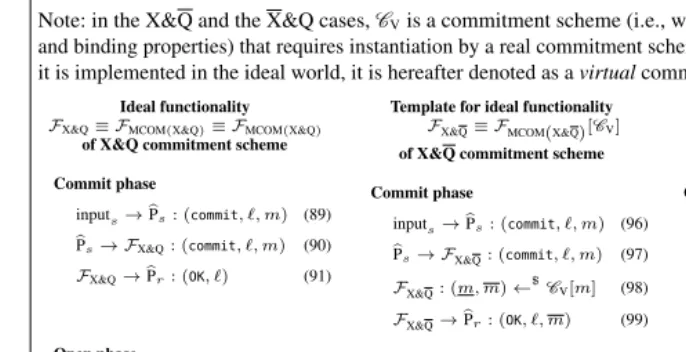
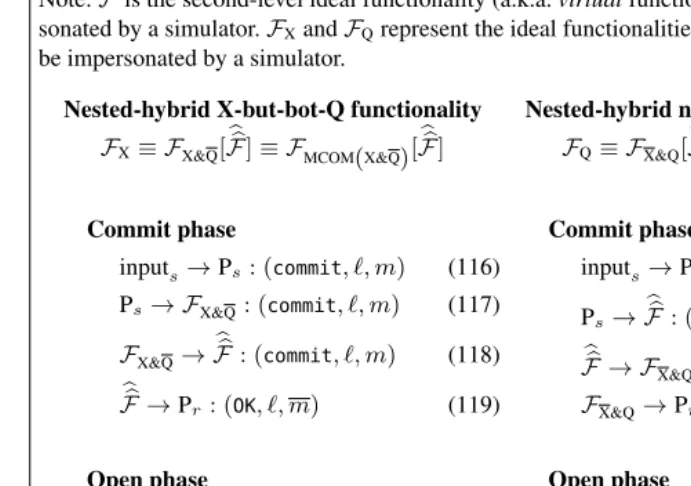
The scheme is defined in a hybrid model using separate ideal functionalities for a X commitment scheme and a Q commitment scheme. Even though UC commitments schemes are simultaneously X and Q, security can be proven with a simulator that, for each type of base commitment scheme (X or Q), does not use the complementary property (Q or X, respectively). This means that a X&Q UC commitment scheme for long bit-strings can be implemented based on commitment schemes for short strings and with suppressed properties, e.g., X&Q (X-but-not-Q) and X&Q (not-X-but-Q). Naturally, the protocol remains secure if the underlying schemes are indeed full-fledged X&Q – in such case the protocol represents a UC commitment extension, where a few (commit
andopen) calls to X&Q commitments for short bit-strings achieve a X&Q commitment
(commitandopen) for a string of independently larger polynomial size (and assuming the existence of a PRG and a CR-Hash).
In comparison, very recent and independently developed works [GIKW14, DDGN14, CDD+15], using a different approach, also focus on committing many bits in parallel, amortizing the cost to the throughput of a PRG and capable of achieving rate-1 asymptotic communication complexity. One noteworthy difference with the protocol devised in this paper is that they explicitly use oblivious transfer, instead of other base commitments and a CR-Hash.3 Also, [GIKW14, DDGN14] rely onsecret sharing schemes with error-correction or verifiability requirements ([CDD+15] works with any linar code), whereas this paper uses a simpler erasure code (i.e., aninformation dispersal scheme
where reconstruction only uses correct fragments). In addition, [GIKW14] considers selective openings and [DDGN14, CDD+15] considers homomorphic properties and verification of linear relations between committed values. [CDD+15] also achieves linear computational complexity, which may be comparable with this work.
Remark. While the main focus of the paper is achieving very-efficient protocols, the analysis is also relevant by the discovery of new approaches and relations between properties, such as: using a new coin-flipping template structure, different from the tradi-tional template; understanding the distinctive role of rewinding for some simulatability properties, clarified by the contrast made between definitions oflocalvs.non-localX and Q (in a rewinding setting); achieving a rate-1 UC commitment scheme, resolving the duality between X and Q via a cut-and-choose approach without explicit use of OT; exploring the concept of ideal commitment schemes with suppressed properties (X-but-not-Q and Q-but-not-X). While the direct applicability of commitment schemes might be broader than coin-flipping, this paper justifiably focuses on coin-flipping as an application that better contextualizes the sequence of contributions. In particular, the reflection is made in a sequence of simulation settings (firstwith-rewinding, then
one-pass), with the goal of reducing the need ofrewindingin simulation of coin-flipping.
1.3 Roadmap
The paper proceeds as follows: Section 2 reviews related work; Section 3 introduces preliminary definitions useful in the remainder of the paper; Section 4 describes the new protocol for coin-flipping simulatable-with-rewinding; Section 5 specifies the new UC commitment scheme (X&Q), directly usable forone-pass simulatablecoin-flipping; the Appendix includes formal definitions of the ideal functionalities of commitment schemes and coin-flipping (§A, §B), concrete instantiations for the coin-flipping protocol #1 (§C, §D), and further details about the new UC commitment scheme (§E, §F).
2
Related work
2.1 Basic primitives
One-way permutations or functions are enough in theory to achieve many useful cryptographic primitives, such as PRGs [HILL99, VZ12], one-way hash functions
[NY89, Rom90], some types of commitment schemes [Nao91, DCO99] and ZK proofs of knowledge (ZKPoK) [FS90]. Collision-resistant hash functions can also be built from other primitives [Sim98], such as claw-free sets of permutations [Dam88] or pseudo-permutations [Rus95]. Based on such primitives, coin-flipping can be achieved in ent ways, e.g., based solely one-way functions [Lin03, PW09] (with rewinding). In differ-ent simulatability settings, coin-flipping can be more directly based on higher level prim-itives, such as bit or multi-bit X&Q commitment schemes (e.g., [CF01, DN02, Cre03]) and even from coin-flipping protocols with weaker properties [HMQU06, LN11].
In practice, parallel flipping of a few coins (i.e., a short bit-string) can be achieved somewhat efficiently from commitment schemes based on specific algebraic instantia-tions of standard cryptographic assumpinstantia-tions, such as the intractability of thedecision Diffie-Hellmanproblem (e.g., [Lin11, BCPV13]). Naturally,flipping many coinscan be devised by batching several executions of a protocol for flipping a short bit-string (a
block), thus achieving a throughput linear in the total number of coins, but still inheriting the inefficiencies of the underlying repeated protocol. This is not satisfactory when the inefficiency of the base commitment scheme multiplied by the number ofblocksleads to a cost larger than what can be supported, namely computation proportional to a factor super-linear in the block size (e.g., from exponentiations with respective modulus size) and communication complexity with a constant multiplicative factor larger than one (e.g., from communicating several group elements for each flippedblock). In contrast, this paper devises a construction where the cost of base commitments is amortized.
In the computational model (the one considered in this paper), there are known theoretical feasibility results about coin-flipping, covering the stand-alone and the UC security settings. For example, in the UC setting, it is possible to achieve coin-flipping extension (assuming enhanced trapdoor permutations with dense public descriptions), i.e., coin-flip a large bit-string when having as basis a single invocation of an ideal functionality realizing coin-flipping of a shorter length [HMQU06]. This paper shares the concern of achieving properties in large strings based on functionalities associated with short strings, but focuses on a base of a few short commitments (not needing to be simultaneously X and Q) and has the motivation of improving efficiency. The paper does not delve into analyzing further implications between different primitives (e.g., see [DNO10] for relations between OT and commitments, under several setup assumptions).
2.2 Constant-round parallel coin-flipping (with rewinding)
When flipping many coins, the traditional template enables simulatability if the base commitment scheme is X&Q. Lindell achieved this (in two variant protocols [Lin03, §5.3 & §6])4by augmenting thecommitandopenphases with ZK sub-protocols that endow the phases with respective X and Q properties. In particular, a X-commitphase (step 1) can be achieved by a regular commitment followed by a ZK argument of knowledge of the committed value, from which the simulator in the role of receiver
can extract the value. Then, a Q-openphase (step 3) can be achieved by sending the intended (equivocated) contribution of PA(which on its own cannot be verified against the respective commitment) and giving afakeZK argument that it is a valid decommitment. This solution provides a feasibility result for constant-round simulatable parallel coin-flipping. However, for a general commitment scheme applied to a long bit-string, either a ZK proof/argument of knowledge forextractionor a ZK proof/argument forequivocation
is typically expensive, if not both.
A different approach, followed by Pass and Wee [PW09], is to use a cut-and-choose approach (in a rewinding setting) to achieve X and Q properties directly from a regular commitment scheme (or from one with only X or only Q properties). The goal of their construction is not efficiency, but rather showing that one-way functions are sufficient to achieve X&Q commitment schemes and consequently also coin-flipping (based on the traditional template protocol). In particular, their technique requires communication proportional to the target length multiplied by the statistical security parameter of the cut-and-choose approach.
In contrast with the two referred constructions in a simulation-with-rewinding setting, a main goal in this paper is to improve efficiency when flipping many coins. This is achieved by focusing on X and Q properties of short strings, and then using a PRG and hash functions to combine and expand them into a larger bit-string, thus amortizing the cost of the underlying commitment schemes.
2.3 UC commitment schemes
on specific assumptions, such as the Decision Diffie-Helman (DDH) intractability, e.g., [Lin11, FLM11, BCPV13] achieving alow(constant) number of group elements of communication and exponentiations to commit to a group element. Still, the trivial extension of these protocols for a large number of commitments would imply a linear increase in said number of asymmetric operations (modular exponentiations), without amortization. Some of the above-mentioned proposals achieve adaptive security (with erasures), whereas this paper is focused only on static security.
This paper is focused on achieving high efficiency when flipping (and committing) many coins, making use of base X or Q commitments and erasure codes – as already mentioned, three recent independent works [GIKW14, DDGN14, CDD+15] devise UC commitment schemes with comparable asymptotic rate-1 communication, but following different approaches (namely explicitly using oblivious transfer and encoding the com-mitted value in different ways). Future work may be useful to identify concrete tradeoffs between different techniques.
3
Preliminaries
3.1 Ideal/real simulation paradigm
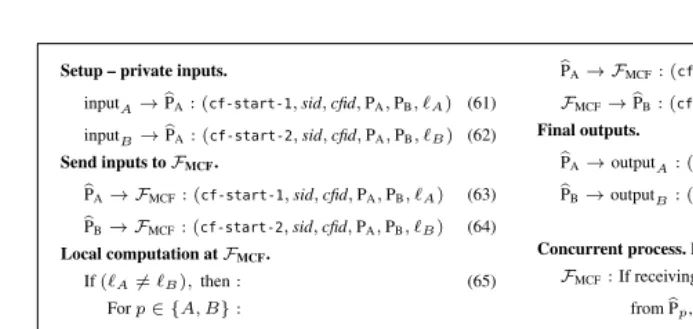
This paper considers the ideal/real simulation paradigm, as developed in the work of Canetti on composability of protocols [Can00, Can01]. A basis to understand the ideal functionalities of commitment schemes, namely in the UC framework, can also be found in the work of Canetti et al. [CF01, CLOS02]. A protocol in the real world is considered secure if itemulatesan intended ideal functionality defined in an ideal world. In the case of parallel coin-flipping (into a well), the ideal functionality5 FMCFdecides the random coin-flipping outcome (thetarget bit-string), then sends it to PAand only then (if PAallows it) to PB, as suggested by the traditional template. Formally, the concept of emulation is equivalent to the inability of an external observer (denoted environment
Z) to distinguish executions in the ideal world from those in the real world, when the adversary in the ideal world is replaced by a suitable simulatorSthat has black-box access to the adversaryAof the real world.
This paper considers astaticandactivecorruption model, where an adversary can corrupt at most one party (i.e., make itmalicious) only before the beginning of the protocol execution.6 The protocol is said to be simulatable if the proof of emulation can be carried out for each of the two possible corruptions. The protocols are proven secure in thecomputational model, with all parties being restricted to probabilistic polynomial time computations. In the protocol for simulatable-with-rewinding,S is allowed expected probabilistic polynomial time.
Security is proven by constructively defining a suitable simulatorS, who performs indeed a simulation in order to learn how the adversaryAin the real world would behave.
5
The notation "MCF" inFMCFdenotes "multiple coin-flipping", meaning that the functionality can be invoked multiple times, each time providing a random bit-string.
6
In the case of coin-flipping, the essential intuition is thatSneeds to be able to induce the final coin-flipping result of a simulated execution (as received byA) to be the value thatFMCF has decided in the ideal world (thetarget bit-string). This is necessary so thatScan learn whatAwould output (or possibly abort) when facing the perspective of obtaining such target bit-string as the result of a real protocol. This is the reason to require fromSthe ability to eitherextractorequivocatethe contribution of a party in a simulation. Furthermore, since an abort is also a possible outcome of a protocol,Smust also be able to emulate said probability in the ideal world, namely the case of early-abort, where PAaborts after learning the coin-flipping outcome but before PBlearns it.
Definition 1 (needed complementary contribution). When S has obtained in the ideal world thetarget bit-stringfromFMCF, and has already obtained in the simulated execution (possibly by means of extraction) the contribution of the malicious party, the
needed complementary contributiondenotes the contribution thatS, in the role of the other (honest) party in the simulated execution, must present (possibly by means of
equivocation) to the malicious party, so that the outcome of the simulated execution (in case there is no abort) is the same as the target bit-string decided byFMCF.
Definition 2(emulate an abort). Toemulate an abortmeans thatSaborts the execution in the ideal world (e.g., by sending anabortmessage toFMCF) and then outputs in the ideal world whatever the black-box adversary outputs in the simulated execution.
3.2 Commitment schemes
A commitment scheme is a two-phase protocol played between two parties, asender
and areceiver. In acommitphase, the parties interact in a way that the sender becomes
boundto a value, whilehidingit from the receiver. In anopenphase, the parties interact in a way that thereceiverlearns the committed value and becomes convinced that it is the correct value. A phase is called non-interactive if the communication consists on a single message from thesenderto thereceiver.
Definition 3 (extractability). Anextractable commitment schemeCX is one whose
commitphase allowsS in the role of receivertoextract(i.e., learn) the committed value, with probability equal to or larger than a value negligibly-close to the probability with which the (possibly malicious)senderis able to successfullyopenthe value in the respectiveopenphase.
Definition 4(equivocability). Anequivocablecommitment schemeCQis one whose
openphase allowsS in the role of sendertoequivocatethe opening to any desired value (in the domain of committable values), regardless of the value that had been committed, such that the view of the execution by the (possibly malicious) receiver
is indistinguishable from one where thecommitandopenphase had been honestly associated with such equivocated value.
scheme (CX) and the equivocable scheme (CQ), are replaced by ideal commitment functionalities from which the simulator does not take advantage of Q or X, respectively.7
3.3 Coin-flipping
For the purpose of a coin-flipping protocol simulatable-with-rewinding, extracting or equivocating the contribution of a party might be achievable (e.g., with the help of rewinding) even if commitment scheme(s) used as primitive(s) is(are) not on its own X or Q, respectively. Thus, it is useful to introduce a characterization (locality vs. non-locality), of the type of X and Q, in order to allow differentiating the context in which the respectiveextractionandequivocationcan be achieved. This characterization will facilitate conveying the intuition for the new structure of protocol #1, in comparison with the traditional template.
Definition 5(locality of X and Q). Within a protocol making use of commitments, namely including bothcommitandopenphases,extractionis characterized aslocalif the simulator can extract the committed value within the respectivecommitphase, i.e., without going beyond that phase in the protocol and without rewinding to a step before that phase.Local equivocationis defined analogously in relation to theopenphase. The properties are characterized asnon-localif they can be achieved but notlocally(i.e., involving rewinding beyond the respective phase).
4
A new coin-flipping protocol simulatable-with-rewinding
This section devises a new parallel coin-flipping protocol, simulatable-with-rewinding.4.1 Intuition
In the new (constant round) protocol, the malicious P∗Ais still the first party to learn the final bit-string. However, in fundamental contrast with Blum’s protocol (which uses a Q-but-not-X commitment scheme in the traditional template), in the new protocol a simu-lator in the role of PBin the simulated execution can extract the contribution of P∗Awhile still semantically-hiding from P∗A(even in the execution before anyexplicit rewinding) the contribution of PB. Intuitively, this prevents the probability of anunfair-abortof P∗A from depending on the contribution of PBand the final bit-string. Furthermore, in contrast with the protocols of Lindell [Lin03] and Pass and Wee [PW09], where PAcommits her contribution using a X&Q commitment, in the new protocol the extraction of the contribution of PBis achieved even though PAuses a Q-but-not-X commitment scheme. In particular, the new protocol achieves simulatability based onnon-local extractionof the contribution of one party (PB) andnon-local equivocationof the other (PA).
The protocol uses a new template that requires only one X-commitment of a short seed by PAand one Q-commitment of a hash by PB, plus a PRG (to expand the seed) and
7
a collision-resistant hash function (to compress the contribution of PB). Thus, as the target length grows the throughput is amortized to that of one PRG and one hash function. The devised solution corresponds to an augmentation of the traditional template, involving the combination of three key aspects: (1)extractionof the contribution of PAis obtained by extraction of a small seed, which once expanded serves as mask of the full contribution – this reduces the input size of the base X-commitment; (2)extractionof the contribution of PBis obtained non-locally (i.e., far away from the respectivecommitphase), but before PBlearns anything about the contribution of PAin any rewinding attempt – this bypasses the simulatability difficult found in Blum’s protocol; (3)equivocationof the contribution of PBis applied to the hash of the contribution, rather than to the full contribution – this reduces the input size of the base Q-commitment. Despite the simplicity of the new protocol, the proof of security is challenging for the case of corrupted P∗B.
4.2 Detailed description (protocol #1)
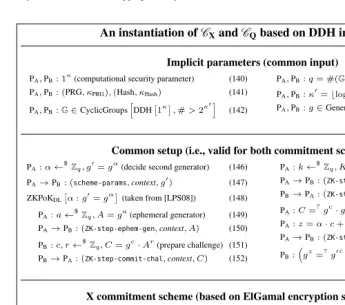
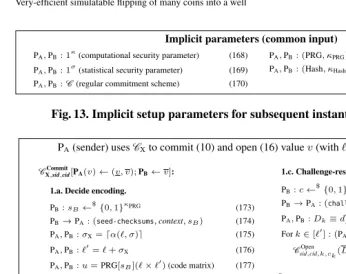
The protocol is specified using succinct notation in Fig. 1. As implicit parameters, the protocol depends on a computational security parameter (1) and a respectively secure PRG and CR-Hash function (2). The protocol is here defined and proven secure in a hybrid model where a X commitment scheme (CX) and a Q commitment scheme (CQ) (3) are replaced by respective ideal functionalitiesFXandFQwith respective X and Q properties. In theplainmodel (§D),CXandCQwould be agreed between the two parties in asetupphase, requiring thatCXisnon-malleable with respect to openingofCQ.
The execution starts when both parties are activated to initiate a coin-flipping of a certaintarget length, with the parties assuming asymmetric roles in the protocol, e.g., w.l.o.g., with PAbeing the first to learn the final outcome ((4)-(5)). After a possible implicit setup phase, PBselects his contribution (6), with the target length, andcommits to its hash (7) usingFQ(8). Then, PAselects a seed (9) andcommitsto it usingFX(10). PAalso selects a random bit-string (denotedmasked contribution) with the target length (11) and sends it to PB(12). Then, PBasksFQtoopento PAthe committed hash (13), and then PBsends his contribution to PA(14). PAchecks that the hash of the contribution of PBis equal to theopenedhash (15). Then, PAasksFXtoopento PBthe committed seed (16). Finally, each party proceeds concurrently with local computations: expanding the seed of PAinto a bit-string of the target length (17) (i.e., themask); computing the
bit-wise exclusive-OR(XOR) combination of themaskand themasked contribution, thus determining the contribution of PA(18); and locally computing the final outcome as the XOR of the two contributions (19), and deciding that as the final output (20)-(21).
Appendix D describes efficient concrete instantiations in the plain model. One requires an unitary number of exponentiations in a short group; the other does not need any exponentiation but it requires a slightly larger communication complexity (also amortizable) and one commitment scheme becomes explicitly interactive.
4.3 Security analysis
Implicit parameters.
Security parameters:1κ (1)
Primitives:(PRG, κPRG),CR-Hash (2)
Sub-protocols:(CX,CQ) (3)
0. Initial input.
inputA→PA: (start-1,sid,cfid,PA,PB, `) (4)
inputB→PB: (start-2,sid,cfid,PA,PB, `) (5)
1. Commit contribution of PB.
PB:χB←${0,1}`(select contribution of PB) (6)
PB:hB=CR-Hash(χB)(hash of contribution) (7) CCommit
Q,sid,cfid
PA←hB;PB(hB)← hB, hB
(8)
2. Commit contribution of PA.
PA:sA←${0,1}κPRG(seed) (9) CX-Commit
X,sid,cfid
PA(sA)← sA, sA
;PB←sA
(10)
PA:tA←${0,1}`(masked contribution) (11)
PA→PB: (masking-1,sid,cfid,PA,PB, tA) (12) 3. Reveal contribution of PB.
CQ-Open
Q,sid,cfid hB PA←hB;PB(hB, hB) (13)
PB→PA: (send-contrib-2,sid,cfid,PA,PB, χB) (14)
PA:If CR-Hash(χB)6=hBthenhalt (15) 4. Open contribution of PA.
COpen X,sid,cfid(sA)
PA(sA, sA);PB←sA
(16)
PA,PB:s 0
A=PRG[sA](`)(seed expansion≡mask) (17)
PA,PB:χA=tA⊕s0A(contribution of PA) (18)
5. Final output (locally combine contributions).
PA,PB:χ=χA⊕χB (19)
PA→outputA: (output-1,sid,cfid,PA,PB, χ) (20)
PB→outputB: (output-2,sid,cfid,PA,PB, χ) (21)
Fig. 1. Protocol #1 – Parallel coin-flipping.Legend:κ(cryptographic security parameter, e.g.,128≡1128); `(target length, i.e., number of bits to coin-flip in parallel, e.g.,106, satisfying` ∈ O(poly(κ)));χp(contribution of Pp, forp ∈ {A, B}); CR-Hash (compressive collision-resistant hash function); PRG[s](`)(expansion of seeds, using a pseudo-random generator, into a bit-string of length`);κPRG(input-seed length sufficient to guarantee security consistent with parameterκ);x(commitment ofx);x(randomness needed to decommitxfromx); X, Q, X&Q (ex-tractable, equivocable, extractable-and-equivocable – properties of commitment schemes, which may be present in some phases);Ctp(phasep(Commitor X-CommitorOpenor Q-Open) of a commitment scheme of typet(X or Q or X&Q);
Ctp(z) [PA(xa)←ya;PB(xb)←yb](execution of phaseCtp, between PAand PB, starting with common inputzand with respective private inputsxaandxb, and ending with respective private outputsyaandyb).
in a stand-alone setting and in the (FX,FQ)-hybrid model, in the presence of static and computationally activerewindableadversaries. Furthermore: for each (polynomially arbitrarily-long) bit-string coin-flipping execution, each phase (commitandopen) ofFX andFQis invoked only once for a short string; in the case of a malicious P∗A, simula-tion is possible without explicit rewinding; in the case of a malicious P∗B, simulation is possible with an expected number of explicit rewindings less than two.
Intuition for proof of security. Proving security (i.e., simulatability) amounts to show a simulator that, with an expected number of rewindings at most polynomial in the security parameter, is able to induce in the ideal world aglobaloutput whose distribution is indistinguishable from the one in the real world. Specifically, in the role of each party in a simulated execution,Smust be able (with overwhelming probability) to learn the contribution of the other possibly-malicious (black-box) party and still be in a position toopentheneeded complementary contributionas if it was honestly random and at the same time simulate the probability ofearly-abortof the malicious party.
The simulator (S) starts a simulation, with rewindable black-box access toA(who corrupts a party P∗pat the onset of the simulated execution).S relays toAthe input received fromZin the ideal world, and relays to the simulated P∗pthe input thatZsends tobPpin the ideal world.
One-pass simulation (i.e., without explicit8rewinding), for malicious P∗A. In the sim-ulated execution,Sin the role of PBcommits to a random hash value (8). The execution
proceeds withSreceiving the X-commitment of a seed from P∗A(10), and extracting the respective seed. Then, once receiving from P∗Aa masked contribution (12),Scombines it with the PRG-expansion of the seed in order to learn the contribution of P∗A((17)-(18)). Then, in the ideal world,Sin the role of the idealbP
∗
Areceives from the ideal coin-flipping functionalityFMCFthe random bit-string (i.e., the target outcome).Sdetermines what is theneeded complementary contributionfor PBin the simulated execution, namely the XOR between the target outcome and the contribution of P∗A.Scomputes the hash of this complementary contribution (7) and uses its power to equivocate such hash value from the respective Q-commitment (13). Finally,Salso sends the complementary contribution to P∗A(14). SinceCQisnon-malleable with respect to openingofCX, it follows that P∗A can only either open the contribution that has been extracted byS, or decide to abort without sending her contribution to PB(played byS) (16). In case of abort, then S
emulates an abort, otherwiseSletsFMCFcontinue the execution in the ideal world (i.e., send the bit-string to the idealbPB) andSoutputs in the ideal world what P∗Aoutputs in the simulation.
Simulation with rewinding, for malicious P∗B.
– First iteration.In the simulated execution,Sin the role of an honest PAproceeds the simulation until receiving the contribution of P∗Band verifying its hash against the respective opened commitment (15). If P∗Baborts until this step (including if it reveals a contribution inconsistent with the opened hash), thenSemulates an abort. Otherwise,Slearns the contribution of P∗B.
– Get target outcome.Sthen gets fromFMCFin the ideal world the target outcome and uses it to compute theneeded complementary contributionof PAin the simulated execution, namely the XOR between the target outcome and the contribution of P∗B. Then,Sdefines for the remainder of the simulation an appropriate exponential upper-bound (#rw-bound) of number of rewindings. There is a subtle issue related with probability of early abort: if there is no bound, then this simulator does not guarantee an expected polynomial number of rewindings; if the bound is polynomial, then there is an adversary for which the probability of early abort is distinguishable between the ideal and real worlds (namely if the probability is noticeable and noticeably-smaller than the inverse of#rw-bound). An appropriate bound is discussed in Appendix C.3.4
– Induce target outcome.Then,S rewinds until the step of selecting the seed of PA(9) and resumes the execution by selecting a new random seed and committing to it (10). In the next step of the protocol, instead of selecting a randommasked contribution(12),Scomputes the contribution of PAas the XOR combination of theneeded complementary contributionand the PRG-expansion of the seed. If P∗B does not abort before the step where it reveals her contribution, thenScontinues the simulation until the end and outputs in the ideal world whatever P∗Boutputs in the real world (even if P∗Baborts while PAis opening her seed (16)). Otherwise, if P∗B aborts before correctly revealing his contribution,Srewinds again until the step of selecting the seed of PAand replays the simulation procedure just described, again and again until receiving the contribution of P∗B(equal to the one already known by
5
A new UC commitment scheme
This section devises a new UC commitment scheme, i.e., one-pass-simulatable, thus with the X and Q properties being local. To flip many coins, it is then enough to use this scheme tocommitandopenthe contribution of PAin the traditional template. The section starts by conveying an intuition (§5.1), then gives a precise description using concise notation (§5.2), and then presents a security analysis (§5.3).
5.1 Intuition in a sequence of optimizations
Besides the primitives already discussed (X and Q commitments, PRG, CR-Hash), the new protocol embeds three main ingredients:
– acut-and-chooseapproach, where PAbuilds severalinstancesof short commitments and then PB checks the correctness of some (the checkinstances) to gain some confidence that a majority of the remaining (theevaluationinstances) are correct;
– authenticators, allowing the simulator to anticipate whether individualinstances
aregoodorbad, thus having better assurance about correct extraction;
– an information dispersal scheme (IDS), used to partition (i.e., split) the target message into smaller components (i.e.,fragments), and allowing a portion of those fragments to be combined into (i.e., torecover) the original message; the IDS enables the size of eachinstanceto be reduced proportionally to the number of instances.
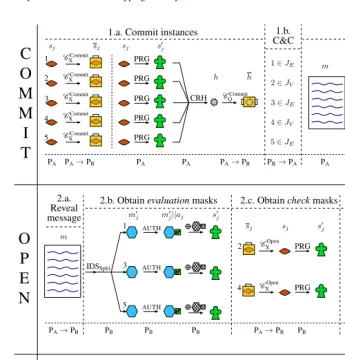
The combination of these elements is described below, in a sequence of progressive optimizations, and is complementary also sketched in Fig. 2.
5.1.1 Cut-and-choose warmup
A non-example. It is instructive to first look at a non-X or non-Q (and thus non-UC) scheme. Consider acommitphase as follows: i) PAX-commits to a seed; ii) calculates amaskas the PRG-expansion of the seed; iii) sends the respective messagemasking
to PB; iv) and Q-commits to the hash of themask. Then: if theopenphase involves opening the seed, then the scheme is X-but-not-Q, because each seed (which not even a simulator can equivocate) leads each masking to a unique message;9if, instead, theopen
phase involves revealing the message and opening the hash of the mask, but not opening the seed, then the scheme is not-X, because a malicious P∗Amay have (undetectably to PB) used a mask different from the seed-expansion. Conversely, suppose that in the latter case it would somehow be possible to ensure that the used mask was indeed the PRG-expansion of the committed-but-not-opened seed. Then the simulator would be able to extract the message – by extracting the seed and then use its PRG-expansion to unmask themasking. The method hereafter uses a cut-and-choose approach, based on several instances of commitments of seeds, to obtain the needed assurance in a statistical manner, namely ensuring an overwhelming probability of correct extraction.
A simple but not-efficient cut-and-choose based scheme:
– Commit phase.PAproduces several seeds, builds a X-commitment of each, and also builds a Q-commitment of a CR-Hash (hereafter denotedglobal hash) of the sequence of PRG-expansions of all seeds. Then, PBcutsthe set of instances of seed-commitments in two random complementary subsets, andchoosesone for a
checkoperation and the other for anevaluationoperation. For each instance selected forevaluation, PAuses the respective PRG-expansion to mask (using XOR) the
target message, and sends the respectivemessage maskingto PB.
– Open phase.PAreveals the message – this allows PBto compute all masks (i.e., the PRG-expansions) used with evaluation instances. Also, PA opens all check seeds, thus letting PBcompute the respective PRG-expansions. Finally, PAopens the commitment of the global hash, letting PBverify that it is equal to the one that can be obtained from all PRG-expansions. Otherwise, if the global hash verification fails, PArejects the opening of the target message.
This above solution has a high communication complexity: target length multiplied by number ofevaluationinstances. Nonetheless, it has the needed simulatability properties:
– Hiding.In thecommitphase, the message is hidden from PB, by a one-time-pad of PRG-expansions (the masks).
– Binding.In theopenphase, PAis bound to open a single message: by collision resistance of CR-Hash, PAcan only know one mask per evaluation instance that leads to the correct global hash; thus, PAcan only successfully open the message that for all evaluation instances is equal to the XOR of such mask and the respective previously sentmasking.
– Equivocation.In theopenphase, the equivocator-simulator (SQ) in the role of P
A can successfully open any desired fake message, by revealing the message, opening the correct seeds of check instances and thenequivocatingthe needed fake global hash (without revealing the respective seeds of evaluation instances).
– Extractability.In thecommitphase, the extractor-simulator (SX) in the role of P
B
extractsthe seed of each evaluation instance, then PRG-expands it and uses it as a tentative mask to unmask the masked message. This leadsSX to obtain several
unmaskings, all of which are tentative messages. If a majority of tentative messages is consistent (i.e., all of them are equal), thenSX chooses such message as the
correct one. OtherwiseSXguesses that P
Awill not be able to successfully open any message in the later open phase.
extracted seeds are correct. With adequate cut-and-choose parameters, this probability is overwhelming in the total numbernof instances, i.e., the commitment scheme is extractable. For fixedn, statistical security (the additive symmetric of the logarithm base 2 of the probability of failed extraction) is maximized with the optimal proportions of approximately three fifths forcheckand two fifths forevaluation[SS11, §A], leading to about 1 bit of statistical security per every three instances. For example, using 123 instances, 74 of which forcheckand 49 of which forevaluation[Bra13, Table 2], leads to approximately (slightly larger than) 40 bits of statistical security, i.e., the probability of wrong extraction is less that two to the minus 40.
5.1.2 Authenticator aid
Improving statistical security. In comparison with the above-described method, statis-tical security can be improved by including averifiability mechanismthat endowsSX
with the ability to verify which evaluation instances aregoodand which ones arebad, without comparison between instances. With such mechanism,SXextracts an incorrect
message only if allcheckinstances aregoodand allevaluationinstances arebad, i.e., only if a malicious P∗Aanticipates the exact cut-and-choose partition. For appropriate cut-and-choose parameters, the (un)likelihood of this guess corresponds to about one bit of statistical security per instance, thus reducing the number of instances about three-fold. For example, 40 bits of statistical security can be obtained with 41 or 76 instances, while respectively limiting the number ofevaluationinstances to be at most 20 or 10. The ratio-nale about probabilities is similar to that used in recent improvements obtained for more general secure two-party computation protocols based on a cut-and-choose of garbled-circuits approach, where the criterion for success changed from at least a majority to just at least a single correct evaluation garbled-circuit [Bra13, Lin13, HKE13].
Authenticators. The intended verifiability can be achieved by augmenting each evalu-ationinstance with anauthenticatorelement that allowsSX to verify whether or not
each extracted seed is consistent with each respective anticipated tentative message. Specifically, whenSX extracts a seed and uses its seed-expansion to unmask the
re-spective masked string received from PA, only two things should be possible: either (i)SX gets a correctlyauthenticated message, which must be the only one that P
A can later successfully open, i.e., this is agoodinstance; or (ii)SX gets an incorrectly authenticatedmessage, implying that a successfulopeningby a malicious P∗Awill have to use a mask different from the seed-expansion, i.e., this is abadinstance.
As a starting point, P∗A becomes bound to her choices, by committing her seeds and the global hash (which commits the masks), before even learning how to compute
C
O
M
M
I
T
PRG CCommit X PRG PRG PRG PRG CCommit X CCommit X CCommit X CCommit X 1 2 3 4 5 CRH 1 3 5 AUTH AUTH AUTH 1∈JE2∈JV
3∈JE
4∈JV
5∈JE
CCommit Q
sj s0j
h
m
m0
j tj
h
sj sj m0j||aj
IDSSplit
PA PA→PB PA PA PA→PB PB→PA PA PA PA PA→PB
1.a. Commit instances 1.b. 1.c. Message masking C&C
O
P
E
N
1 3 5 AUTH AUTH AUTH m m0j m0j||aj s0j
IDSSplit
PA→PB PB PB PB
COpen X 2 COpen X 4 PRG s0 j sj PRG CRH s0 j h h
PB PA→PB PA→PB PB
COpen Q 1 2 3 4 5
2.b. Obtainevaluationmasks 2.c. Obtaincheckmasks 2.d. Verify global hash
=? sj PB h ? ? 2.a. Reveal message
E
X
T
R
A
C
T
CCommit X CCommit X CCommit X CCommit X CCommit X 1 2 3 4 5 AUTH AUTH AUTH 1∈JE2∈JV
3∈JE
4∈JV
5∈JE
sj sj sj tj m0j||aj m0j m
PA PA→ SX SX SX
Extract seeds PRG PRG PRG s0 j sj SX IDSRecover SX = ? ? ? ? ? ? 6 = = m0 j SX Recover message Execute the X-Commit phase
Other values
Obtain tentative authenticated fragments
PA→ SX
Verify authenticators
aj aj
& & & & & SX
Fig. 2. Sketch of UC commitment scheme.Legend: (seedsj); (extractable commitmentsj– like a vault with a single opening); (seed expansions0j– like a tree growing from a seed); (global hash – like a smashed paper); (equivocable commitmenth– like a vault with several openings); (messagembeing committed – like a text file); (message fragmentm0
j– can be combined with other fragments to recover the initial message); (authenticatoraj – vouches for the correctness of the respective fragment); (maskingtj– the chess pattern represents something that is masked);AUTH(authenticator function); C&C (cut-and-choose);C(extractable commitment scheme);CX(extractableC);
CQ(equivocableC); CRH (collision-resistant hash); IDS (information dispersal scheme); PRG (pseudo-random generator);
SX(simulator with extraction goal). This sketch shows a toy example with a cut-and-choose withn= 5instances, of which
v= 2are selected forcheckande= 3are selected forevaluation. In theextractionexample, a malicious P∗Aconstructed onebadinstance (j= 3), selected for thechecksubset.SXdetects the bad instance and thus ignores it when using the IDS to reconstruct the message from onlyt= 2(the recovery threshold) fragments. Equivocation (not shown) is trivial, as it involves only revealing the equivocated message (2.a), then calculating the intermediate values as a receiver (PB) would (2.b, 2.c and 2.d), and then simply equivocate the global hash needed for a successful final verification (2.d).
The properties and concrete instantiations ofαare further analyzed in Appendix E.10 Onestrict-authenticatorfunction, proposed as an algebraic field-multiplication between the nonce and a CR-hash of the message, is proven secure based solely on a collision resistance of the hash. Oneloose-authenticatorfunction, proposed as the hash of the concatenation of the message and the nonce, is secure if it is assumed to be infeasible to find four pre-images whose respective hashes cancel out when XORed. In spite of the authenticator mechanism, equivocation is still possible by the simulatorSQin the role of
PAbecause the authenticator is also masked and the respective mask is also equivocable.
5.1.3 Communication reduction
Using an IDS. In the above method, thecommitphase still requires communicating bits in number proportional to the number ofevaluationinstances multiplied by the target length. This can be further reduced, by taking advantage of a thresholdinformation dis-persal scheme(IDS) [Rab89] tosplit(i.e., disperse) the message into as many fragments as the number ofevaluationinstances, each fragment with areduced length. Then, the original message can bereconstructedfrom proper subsets (of the set of fragments) with at least a certainthresholdnumber of elements.11In the improved method, the message is initially split into as many fragments as the number ofevaluationinstances. Then, the authenticator scheme is applied to every fragment, instead of only to the full message. Finally, PAsends to PB, in the commit phase, the authenticated masked fragments (each with areduced length) instead of several masked versions of the same message (where each would have the original target length). This makes the communication complexity become proportional to the number ofevaluationinstances divided by the IDSthreshold, instead of just proportional to the number ofevaluationinstances.
The new method also reduces the sum of all PRG-expansion lengths, as well as the length of the sequence of masks whose hash needs to be calculated, thus also obtaining a computational improvement in compensation to the new IDS split operation. Asymptotically, as the target length increases to infinite, the communication expansion-rate can be made as close to 1 as desired. The statistical security is again changed, with the new criterion for successful extraction requiring a number ofgoodevaluation instances at least as high as the recovery threshold. For example, with 119 instances, 46 of which for evaluation, and with an IDS threshold 23, the scheme achieves 40 bits of
10Another authenticator mechanism is considered there, based on a X&Q commitment scheme, providing a conceptually simple UC commitment extension; i.e., a protocol where a few UC commitments applied to short strings enable a X&Q commitment of a large string.
11
The IDS does not need to hide the original message, as would a full-fledged secret-sharing scheme [Sha79, Kra94], because the necessary hiding is already achieved with the (XOR) mask-ing. Also, the IDS does not need to support error-correction [RS60], because theauthenticator
mechanism givesSX
(in the role of PB) the ability to detect errors. Yet, the IDS needs to be anerasure code, in the sense that it can recover the original contribution from proper subsets of fragments, namely when omitting the fragments thatSX
statistical security and an asymptotic communication expansion-rate 2 in thecommit
phase. The communication in the open phase has rate 1, as only the committed message needs to be revealed (along with opening several short commitments). Other concrete parametrizations are mentioned in Appendix F (Tables 3 and 5).
5.2 Detailed description (protocol #2)
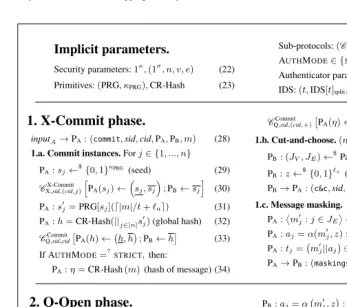
The protocol is described using succinct notation in Fig. 3. In a setup phase, the parties agree on the security parameters (computational and statistic) and consistently agree on remaining elements: the cut-and-choose parameters (including a fixed number ofcheck
andevaluationinstances) (22), a PRG and a CR-Hash function (23), a X commitment scheme (CX) and a Q commitment scheme (CQ) (24), a mode of authentication (STRICT
orLOOSE) (25) and respective function and parameters (26), and the IDS scheme and
respective parameters (27). The proof of security will be made in a hybrid model where theCXandCQare replaced by respective ideal functionalitiesFXandFQ.
5.2.1 X-commit phase (PAcommitting a message to PB)
– 1.a. Commit instances.PAselectsnrandom seeds (29) (e.g., 119) and commits individually to each of them using (the X-commitphase of)FX(30). PAuses the PRG to expand each seedsjinto a strings0jwith areduced-length(equal to the target
length`divided by the IDS recovery-thresholdt) extended by an authenticator-length`a(31). PAcalculates theglobal hashhas the CR-hash of the concatenation of all seed-expansions (32). PAthen usesFQto commit toh(33). If in theSTRICT mode, PAalso usesFQto commit to the hash of the target messagem(34)-(35). – 1.b. Cut-and-choose.PB decides a random cut-and-choose partition (36) (e.g.,
identifying 73 instances forcheckand 46 forevaluation) and a random noncez(37) of adequate length (`z) and sends them both to PA(38).
– 1.c. Message masking.PAuses the threshold IDS tosplither message into as many fragments as the number ofevaluationinstances (39), each with areduced length. Then, PAcomputes the authenticatoraj of each fragmentm0j as an appropriate
functionαof the fragment and the nonce (40); PAthen uses the extended masks0j
to compute the maskingtjof the fragment concatenated with the authenticator (41).
Finally, PAsends to PBthe maskings associated with allevaluationinstances (42).
5.2.2 Q-open phase (PAopening a message to PB)
– 2.a. Reveal message.PAsends the (previously committed) messagemto PB(44). If using theSTRICTauthenticator mode, then PAalso asksFQto open to PBthe hash of the message (45), and PBverifies that it is consistent with the hash of the received message (46).
– 2.b. Obtainevaluationmasks.The phase continues regardless of the authenticator mode beingSTRICTorLOOSE. PBuses the IDS to obtain the same fragments that an honest PAwould (47).12 PBcomputes the authenticator of the fragment in the
12The IDS can be probabilistic, as long as PAalso sends the random coins used in its previous
Implicit parameters.
Security parameters:1κ,(1σ, n, v, e) (22) Primitives:(PRG, κPRG),CR-Hash (23)
Sub-protocols:(CX,CQ) (24)
AUTHMODE∈ {STRICT,LOOSE} (25) Authenticator parameters:{α, `a=|α|, `z} (26) IDS:(t,IDS[t]split,IDS[t]recover) (27)
1. X-Commit phase.
inputA→PA: (commit,sid,cid,PA,PB, m) (28)
1.a. Commit instances.Forj∈ {1, ..., n} PA:sj←${0,1}κPRG(seed) (29)
CX-Commit X,sid,(cid,j)
h
PA(sj)←
sj, sj;PB←sj
i
(30) PA:s
0
j=PRG[sj](d|m|/t+`ae) (31) PA:h=CR-Hash(||j∈[n]s
0
j)(global hash) (32)
CCommit Q,sid,cid
PA(h)← h, h
;PB←h
(33) If AUTHMODE=?STRICT,then:
PA:η=CR-Hash(m)(hash of message) (34)
CCommit Q,sid,(cid,+)
PA(η)← η, η
;PB←η
(35)
1.b. Cut-and-choose.(n=e+v)
PB: (JV, JE)←$Partition[v, e](n) (36)
PB:z←${0,1}`z (nonce) (37)
PB→PA: (c&c,sid,cid,PB,PA,(JV, JE, z)) (38)
1.c. Message masking.
PA:
m0j:j∈JE
←IDS[t]split(m, JE) (39)
PA:aj=α(m0j, z) :j∈JE(authenticators) (40) PA:tj= m0j||aj
⊕s0j:j∈JE(maskings) (41) PA→PB: (maskings,sid,cid,PA,PB,||j∈JEtj) (42)
2. Q-Open phase.
inputA→PA: (open,sid,cid,PA,PB) (43)
2.a. Reveal message.
PA→PB: (open,sid,cid,PA,PB, m) (44)
If AUTHMODE=?
STRICT, then:
CQ-Open Q,sid,(cid,+)(η)
PA(η, η);PB←η
(45) PB:If CR-Hash(m)6=ηthen ABORT (46)
2.b. Obtain evaluation maskings.
PB:
m0j:j∈JE
←IDS[t]split(m, JE) (47)
PB:aj=α m0j, z
:j∈JE(authenticator) (48) PB:s0j=tj⊕ m
0 j||aj
:j∈JE(tentative masks) (49)
2.b. Obtain check maskings.
COpen X,sid,(cid,j)(sj)
h
PA
sj, sj;PB←sj
i
:j∈JV (50) PB:s
0
j=PRG[sj](d|m|/t+`ae) :j∈JV (51)
2.d. Verify global hash.
CQ-Open Q,sid,cid h
[PA(h, h) ;PB←h] (52)
PB:If CR-Hash(||j∈[n]s
0
j)6=hthenhalt (53) PB→outputB: (accept,sid,cid,PA,PB, m) (54)
Fig. 3. Protocol #2 – X&Q bit-string commitment scheme.Legend: legend of Fig. 1 also applies;σ
(statistical security parameter, e.g.,40≡140);n, v, e(number oftotalinstances, number ofcheckinstances, number of
evaluationinstances); Partition[v, e](n) (set of possible partitions of the set of the firstnpositive integers into a pair of complementary subsets, the first withvelements, and the second with the remaininge). IDS[t] (information dispersion schemewithrecovery thresholdoftfragments; it has sub-algorithmssplitandrecover); Ifeandvare fixed in a setup phase they must satisfy((s−b)!e!)/((e−b)w!s!)≤2−σ, whereb=e−t+ 1(the number of bad instances in an optimal attack);α(authenticator function);`z(length of nonce);`a(length of authenticator output, e.g., 256 bits).
same way that an honest PAwould have, based on the fragment and the nonce (48). Then, PBconcatenates the tentative fragment and the tentative authenticator, and computes the XOR combination of the resulting string with the extended masking, thus obtaining the tentative extended masks0j, supposedly used by PA(49). – 2.c. Obtaincheckmasks.PAasksFXtoopento PBthe seeds associated withcheck
instances (but not those ofevaluationinstances) (50). PBcomputes by himself the PRG-expansion (with the appropriate length) of eachcheckseed (51).
5.3 Security analysis
Theorem 2 (security of protocol #2). Assuming a cryptographically secure PRG and CR-Hash, the protocol defined in this section (using an adequate authenticator in
theSTRICTmode) UC-realizes the ideal functionality of longbit-string commitment
in the (FX,FQ)-hybrid model, in the presence of static and computationally active adversaries. Furthermore: for the combinedcommitmentandopeningof a bit-string, with polynomially arbitrarily-long target length, each phase ofFQis invoked for a short-string only once, and each phase ofFXis invoked for short strings only a number of times that is independent of the target length.
IfCXandCQare directly instantiated by an ideal UC commitment scheme (Fig. 4), respectively limited to messages of lengthκPRGandκHash, then this becomes a statement about UC commitment length extension (i.e., that a few X&Q-commitments of short strings can be extended to X&Q-commitments of long strings).
Intuition for proof of security. Proving security amounts to show that the new commit-ment scheme is X&Q; more specifically, that thecommitphase is extractable (X) and theopenphase is equivocable (Q). The analysis assumes that the PRG and CR-Hash are cryptographically secure and thatCXis extractable andCQis equivocable. More precisely, an hybrid model is considered, with the underlying commitment schemes (CX,
CQ) being replaced by ideal functionalities (FX,FQ) with respective X and Q properties, while suppressing the respectively complementary properties (Q and X). The proof of security is accomplished by defining respective simulators:
– For equivocation, in theopenphase the equivocator-simulator (SQ, in the role of P
A in the simulated execution) (i) reveals the intended equivocated message, then (ii) computes the masks that would need to have been used to unmask the previously sent masked fragments into the needed fragments, and finally (iii) equivocates the opening of the needed global hash. This procedure is always successful.
– For extractability, in thecommitphase the extractor-simulator (SX, in the role of
PBin the simulated execution) (i) extracts the seeds committed by PA, then (ii) uses their PRG-expansions to unmask the masked-fragments sent by PA, then (iii) uses theauthenticatormechanism to find which ones aregood, and then (iv) uses the IDS-recovery procedure to recover the committed message from a set of enough
good(i.e., authenticated) fragments. This procedure is also depicted in Fig. 2. For suitable cut-and-choose and IDS parameters, a wrongextractionbySXduring the commitphase can happen only with probability negligible in the statistical parameter – exemplified configurations are detailed in Appendix F (Table 5).
References
[BCPV13] O. Blazy, C. Chevalier, D. Pointcheval, and D. Vergnaud. Analysis and Improve-ment of Lindell’s UC-Secure CommitImprove-ment Schemes. In M. Jacobson, M. Locasto, P. Mohassel, and R. Safavi-Naini, editors,ACNS 2013, vol. 7954 ofLNCS, pages 534–551. Springer, Berlin Heidelberg, 2013. See also Cryptology ePrint Archive, Report 2013/123. (Cited on pages 4, 8, and 10.)
[Bea96] D. Beaver. Adaptive Zero Knowledge and Computational Equivocation (Extended Abstract). InSTOC 1996, pages 629–638. ACM, New York USA, 1996. (Cited on pages 4 and 31.)
[Blu83] M. Blum. Coin flipping by telephone – a protocol for solving impossible problems.
SIGACT News, 15:23–27, 1983. Appeared also at CRYPTO 1981. (Cited on pages 3, 5, 45, and 48.)
[BM81] M. Blum and S. Micali. Coin-Flipping into a Well. Unpublished, 1981. (Cited on page 3.)
[Bra13] L. T. A. N. Brandão. Secure Two-Party Computation with Reusable
Bit-Commitments, via a Cut-and-Choose with Forge-and-Lose Technique. In K. Sako and P. Sarkar, editors, ASIACRYPT 2013, vol. 8270 of LNCS, pages 441–463. Springer-Verlag, Berlin Heidelberg, 2013. See also Cryptology ePrint Archive, Report 2013/577. (Cited on pages 3 and 18.)
[Can00] R. Canetti. Security and Composition of Multiparty Cryptographic Protocols.
J. Cryptology, 13:143–202, 2000. See also Cryptology ePrint Archive, Report 1998/018. (Cited on pages 3, 10, and 28.)
[Can01] R. Canetti. Universally composable security: a new paradigm for cryptographic protocols. InFOCS 2001, pages 136–145, 2001. See also Cryptology ePrint Archive, Report 2000/067. (Cited on pages 3, 10, 28, and 82.)
[CDD+15] I. Cascudo, I. Damgård, B. David, I. Giacomelli, J. Nielsen, and R. Trifiletti. Ad-ditively Homomorphic UC Commitments with Optimal Amortized Overhead. In J. Katz, editor,Public-Key Cryptography – PKC 2015, vol. 9020 ofLNCS, pages 495–515. Springer Berlin Heidelberg, 2015. (Cited on pages 7 and 10.)
[CF01] R. Canetti and M. Fischlin. Universally Composable Commitments. In J. Kilian, editor,CRYPTO 2001, vol. 2139 ofLNCS, pages 19–40. Springer, Berlin Heidelberg, 2001. See also Cryptology ePrint Archive, Report 2001/055. (Cited on pages 4, 8, 9, 10, and 32.)
[Cle86] R. Cleve. Limits on the Security of Coin Flips when Half the Processors Are Faulty. InSTOC 1986, pages 364–369. ACM, New York USA, 1986. (Cited on page 47.) [CLOS02] R. Canetti, Y. Lindell, R. Ostrovsky, and A. Sahai. Universally composable
two-party and multi-two-party secure computation. InProc. STOC 2002, pages 494–503. ACM, New York USA, 2002. See also Cryptology ePrint Archive, Report 2002/140. (Cited on pages 9, 10, and 30.)
[CR03] R. Canetti and T. Rabin. Universal Composition with Joint State. In D. Boneh, editor,
CRYPTO 2003, vol. 2729 ofLNCS, pages 265–281. Springer, Berlin Heidelberg, 2003. See also Cryptology ePrint Archive, Report 2002/047. (Cited on pages 3 and 9.)
[Cre03] G. D. Crescenzo. Equivocable and Extractable Commitment Schemes. In S. Cimato, G. Persiano, and C. Galdi, editors,SCN 2002, vol. 2576 ofLNCS, pages 74–87. Springer, Berlin Heidelberg, 2003. (Cited on pages 8 and 9.)
 (expansion of seed s,using a pseudo-random generator, into a bit-string of length ℓ); κPRG (input-seed length sufficient to guarantee securityconsistent with parameter κ); x (commitment of x); x (randomness needed to decommit x from x); X, Q, X&Q (ex- Ctp (phase p (Commit or X-Commit or Open or Q-Open) of a commitment scheme of type t (X or Q or X&Q);tp(z) [PA(xa) ← ya; PB(xb) ← yb] (execution of phase Ctp, between PA and PB, starting with common input z and xa and xb, and ending with respective private outputs ya and yb).](https://thumb-us.123doks.com/thumbv2/123dok_us/7930834.1316880/14.595.43.393.56.208/inputsctractable-equivocable-extractable-cryptographic-contributionof-compressive-sufcient-securityconsistent.webp)