Improved Bootstrapping for Approximate
Homomorphic Encryption
Hao Chen1, Ilaria Chillotti1, and Yongsoo Song2
1
Microsoft Research 2 University fo California, San Diego
October 28, 2018
Abstract. Since Cheon et al. introduced a homomorphic encryption scheme for approximate arithmetic (Asiacrypt ’17), it has been recog-nized as suitable for important real-life usecases of homomorphic en-cryption, including training of machine learning models over encrypted data. A follow up work by Cheon et al. (Eurocrypt ’18) described an approximate bootstrapping procedure for the scheme. In this work, we improve upon the previous bootstrapping result. We improve the amor-tized bootstrapping time per plaintext slot by two orders of magnitude, from ∼ 1 second to ∼ 0.01 second. To achieve this result, we adopt a smart level-collapsing technique for evaluating DFT-like linear trans-forms on a ciphertext. Also, we replace the Taylor approximation of the sine function with a more accurate and numerically stable Chebyshev ap-proximation, and design a modified version of the Paterson-Stockmeyer algorithm for fast evaluation of Chebyshev polynomials over encrypted data.
Keywords.Fully homomorphic encryption, bootstrapping
1
Introduction
Homomorphic Encryption (HE) refers to a specific class of encryption schemes which allows computing directly on encrypted data without having to decrypt. Due to this special property, it has numerous potential applications in data-heavy industries, where one challenge is to gain meaningful insights from data while keeping the data itself private. Since the first construction of HE by Gentry [23], the field has witnessed a lot of growth: more efficient schemes (e.g. [8, 9, 7, 22, 20, 17, 18]) have been proposed, and there has been various design and implementations (e.g. [25, 4, 12, 10, 19, 6]) of confidential computing applications using HE.
Since the plaintext space is finite, after a certain number of multiplications, it is impossible to recover the actual number. So, we need to perform “scale down and truncate” operation on encrypted data. However, it is an expensive operation since the available HE schemes only support addition and multiplication.
The second issue is ciphertext growth. Following Gentry’s blueprint, a fresh encryption contains a small amount of “noise”, and the noise level grows as operations are done on the ciphertext. It is necessary that the noise does not overwhelm the actual data within a ciphertext. To achieve this, one could use the Somewhat Homomorphic Encryption (SHE) approach, where the parameters are scaled up with the level of the circuit to be evaluated so that noise overflow is unlikely. Using SHE, both the ciphertext size and the performance overhead of HE will grow at least linearly with the circuit level, hence this approach has scaling issues. The other option is the Fully Homomorphic Encryption (FHE) approach, which uses Gentry’sbootstrappingtechnique to refresh the noise in a ciphertext, so that circuit of arbitrary level can be evaluated on a fixed set of parameters. The FHE approach solves the ciphertext growth problem, with the caveat being that bootstrapping is expensive in practice despite the continuous effort in optimizations.
In 2017, Cheon et al. [16] proposed a HE scheme (denoted by CKKS scheme from now) which performs approximate arithmetic on encrypted data, by intro-ducing a novel encoding technique and a fast “scaling down” operation, which effectively controls the growth of plaintext. Due to the nice properties, the CKKS scheme performs well at tasks such as training a logistic regression over encrypted data on a medium-sized data set with around 1000 samples [30]. Recently, a bootstrapping algorithm for the CKKS scheme was proposed in [14]. Using the bootstrapping procedure, one could train a logistic regression model over data sets with more than 4×10⁵ samples in around 17 hours [29].
1.1 Previous Bootstrapping Method for CKKS
In the CKKS scheme, the cipehrtext modulus qdecreases after each homomor-phic multiplication, and decryption is correct if and only if the norm of the message is smaller thanq. Hence, one can only perform a certain number of se-quential multiplications beforeqgets too low for the next multiplication. Hence, bootstrapping amounts to the following function: giving a ciphertext ct with modulusq encrypted under the secretsksuch that
[hct,ski]q =m,
bootstrapping outputs a ciphertextct0 in a larger modulusQ > q such that
[hct0,ski]Q≈m,
Note that we do not hope to have exact equality, due to the approximate nature of CKKS.
then for a larger modulus Q q, the same ciphertext decrypts to t(X) =
m(X) +q·I(X) for a polynomial I(X) with small coefficients. The next step approximately evaluates the modulo q function on coefficients to recover the coefficientsmi = [ti]q of the input plaintext. It is done by first taking thed-th
Taylor polynomial of the scaled exponential function exp(2πit/(2r·q)), raising
the polynomial to power 2r through repeated squaring, and finally take the
imaginary part and scale byq/(2π). In other words, we have an approximation polynomial indexed bydandr:
Kd,r(t) =
q
2π
" d
X
k=0 1
k! 2πit
2r·q
k#2
r
,
whose imaginary part approximates values of (q/2π)·sin(2πt/q)≈ [t]q, as
de-sired. One issue remaining is that homomorphic operations are not performed on coefficients but on plaintext slots. Before and after the evaluation of an ex-ponential function, we have to shift the coefficients into the plaintext slots, and vice versa. It can be done by evaluating the encoding and decoding algorithms which are linear transformations on plaintext vectors.
Why the previous method does not scale well.There have remained some efficiency issues in the previous work. First, the parameters ofKd,r(t) were
cho-sen byd=O(1) andr=O(logq) to guarantee the accuracy of approximation. It requires only O(logq) homomorphic operations to evaluate the exponential function, but the depthO(logq) is somewhat large. Meanwhile, the linear trans-formations require only one level, but their complexity grows linearly with the number of plaintext slots. As a result, the previous solution was not scalable when a ciphertext is densely-packed, and it was not optimal with respect to the level consumption.
1.2 Our Contributions
In this paper, we suggest two improvements upon the bootstrapping algorithm in [14].
Sine approximation Then, we used a Chebyshev interpolant to approximate the scaled sine function, which not only consumes less levels but also is more accurate than the original method. Our results indicate that in order to achieve the same level of approximation error, our method only requires max{logK+ 2,log logq}levels, whereas the previous solution requiresO(log(Kq)) levels. Here
q is closely related to the plaintext size before bootstrapping, andK=O(λ) is a small constant related to the security parameter.
In order to evaluate a Chebyshev interpolant of formPn
k=0ckTk(x) efficiently on encrypted inputs, we proposed a modified Paterson-Stockmeyer algorithm which works for polynomials represented in Chebyshev base. As a result, our approach requires O(pmax{4K,logq}) ciphertext multiplications to evaluate the sine approximation, which is asymptotically better compared toO(log(Kq)) in the previous work.
1.3 Related Works
There has been a few works which focus on improving the performance of boot-strapping. In terms of throughput, the works [24, 28, 11] designed optimized bootstrapping algorithms for BGV/BFV schemes. In terms of latency, the line of work [20, 17, 18] designed a specific RLWE-based HE scheme suitable for bootstrapping, and through extensive optimizations brought the bootstrapping time down to 13 ms. However, the scheme encrypts every bit separately, and bootstrapping needs to be performed after every single binary gate. Hence the overhead is still quite large for it to be practical in large scale applications.
Our major point of comparison is [14], bootstrapping for the CKKS approx-imate homomorphic encryption scheme. It is based on a novel idea of using a scaled sine function 21πsin(2πt/q) to approximate the modulus reduction func-tion [t]q.
1.4 Road map
In Section 2, we recall the constructions and properties of the CKKS scheme and its bootstrapping algorithm. In Section 3, we describe our optimization of the linear transforms. In Section 4, we discuss our optimization of the sine evalua-tion step in CKKS bootstrapping using Chebyshev interpolants. We analyze our improved bootstrapping algorithm and present performance results in Section 5. Finally, we conclude in Section 6 with future research directions.
2
Background
2.1 The CKKS Scheme
We restate the CKKS scheme [16] below. For a power-of-two integer N, we denote R =Z[X]/(XN + 1) be the ring of integers of the (2N)-th cyclotomic
entries. To be precise, let ζ = exp(πi/2`) be a (4`)-th primitive root of unity for a power-of-two integer 1 ≤` ≤ N/2. The decoding algorithm takes as the input an element m(Y) of the cyclotomic ring R[Y]/(Y2`+ 1) and returns a
vector Decode(m) = (m(ζ), m(ζ5), . . . , m(ζ4`−3)). Note that Decode is a ring isomorphism between R[Y]/(Y2`+ 1) and C`/2. If we identify m(Y) with the vectorm= (m0, . . . , m2`−1) of its coefficients, then the decoding algorithm can
be viewed a linear transformation whose matrix representation is given by
M`=
1 ζ ζ2 . . . ζ2`−1 1 ζ5 ζ5·2 . . . ζ5(2`−1) ..
. ... ... . .. ... 1ζ4`−3ζ(4`−3)·5. . . ζ(4`−3)(2`−1)
,
i.e., Decode(m) = M`·m. The encoding algorithm is defined by its inverse.
When we implement the decoding function, we first define the special Fourier transformation matrix
SF`=
1 ζ . . . ζ`−1 1 ζ5 · · · ζ5(`−1) ..
. ... . .. ... 1ζ4`−3. . . ζ(4`−3)(`−1)
,
which is an`×`square matrix satisfyingM`= [SF`|i·SF`]. Then, the decoding
and encoding algorithms can be represented using the multiplication withSF`,
its inverse and some conjugations.
We embed plaintext polynomials inR[Y]/(Y2`+ 1) intoR[X]/(XN + 1) by
Y 7→ XN/2`. We say that a plaintext is fully packed (full-slot) when `=N/2. An encoded polynomial should be rounded to the closest integral polynomial in
R to be encrypted.
• Setup(1λ).Given the security parameter λ, choose a power-of-two integerN.
Set the distributions χkey, χerr, χenc onR for the secret, error, and encryption,
respectively. For a base integer p and the number of levelsL, set the chain of ciphertext moduliq`=p` for 1≤`≤L. Choose an integerP.
• Keygen(). Sample s ← χkey and set the secret key as sk ← (1, s). Sample
a ← U(RqL) and e ← χerr, and set the public key as pk ← (b, a) ∈ R
2
qL for b=−as+e (mod qL). Samplea0 ←RP·qL, e
0 ←χ
errand set evaluation key as
evk←(b0, a0)∈R2
P·qL forb
0=−a0s+e0+P s2 (mod P·q
L).
• Encpk(m). Sample r ← χenc and e0, e1 ← χerr. Output the ciphertext ct =
r·pk+ (m+e0, e1) (modqL). Note that hct,ski (modqL) is approximately
equal tom.
• Decsk(ct). For an input ciphertext of level`, compute and outputm=hct,ski
We remark that the encryption procedure of CKKS introduces an error so its decrypted value is not exactly same as the input value. We describe homomor-phic operations (addition, multiplication, scalar multiplication, and rescaling) as follows.
• Add(ct,ct0). For ciphertextsct,ct0 in the same level `, outputctadd=ct+ct0
(mod q`).
• CMultevk(a,ct). For a constant a ∈ R and a ciphertext ct of level `, output
ctcmult= (d0, d1) +bP−1·d2·evke (mod q`).
•Multevk(ct,ct0). Forct= (c0, c1),ct0 = (c00, c01)∈R2q`, let (d0, d1, d2) = (c0c 0
0, c0c01+
c00c1, c1c01) (modq`). Outputctmult= (d0, d1) +bP−1·d2·evke (modq`).
• Rescale`→`0(ct). For an input ciphertext of level`, outputct0 =bp` 0−`
·cte ∈
(mod q`0).
We note that {1,5, . . . ,2`−3} is a cyclic subgroup of the multiplicative group Z×2` generated by the integer 5. One can rotate or take the conjugate of an encrypted plaintext by evaluating the maps Y 7→Y5 or Y 7→Y−1 based on the key-switching technique. The rotation keyrkand conjugation keyckshould be published to perform these algorithms (see [14] for details).
• Rotaterk(ct;k). For an input encryption of m(Y), return an encryption of
m(Y5k
) in the same level. The encrypted plaintext vector is shifted byk slots.
• Conjugateck(ct). For an input encryption of m(Y), return an encryption of
m(Y−1) in the same level. It takes the conjugation of the encrypted plaintext.
In applications of CKKS, we usually multiply ascaling factor to plaintexts to maintain the precision of computations. The rescaling algorithm can divide an encrypted plaintext by a power ofpand preserve the size of scaling factors during homomorphic arithmetic.
2.2 Previous Bootstrapping for CKKS
Cheon et al. [14] showed how to refresh a ciphertext of the CKKS scheme. In this section, we briefly explain the previous solution.
Suppose that we have a low-level ciphertext ct ∈ R2q encrypting m(Y) ∈
Z[Y]/(Y2`+1)⊆R, i.e.,hct,ski (modq)≈m(Y). Recall thatm(Y) can be iden-tified with an`-dimensional complex vectorz=Decode(m). The goal of boost-rapping is to generate ahigh-level ciphertextct0 satisfyinghct0,ski (mod Q)≈ m(Y) by evaluating the decryption circuit homomorphically.
The first step raises up the modulus of an input ciphertext. We have that [hct,ski]Q0 ≈q·I(X) +m(Y) for someQ0> q and I(X)∈R. The coefficients
of I(X) is bounded by a constant K which depends on the secret distribution
χkey. Then, we perform thesubsum procedure which generates a ciphertext ct0
I(2`−1)N/2`·YN−1 and t(Y) =q·J(Y) +m(Y).3 The constant (N/2`) can be
canceled by the rescaling process.
Thecoefficients to slots step, denoted by coeffToSlot, is to generate an en-cryption of the coefficients oft(Y) =q·J(Y) +m(Y), i.e., a ciphertextct00which satisfies that
[hct00,ski]Q1 ≈Encode(t)
for some Q1. This step can be done by homomorphically evaluating the en-coding algorithm which is a variance of complex Fourier transformation. We point out that the resulting ciphertext should encrypt an (2`)-dimensional vec-tor (t0, . . . , t2`−1) compared to the input ciphertext with ` plaintext slots, so
we need to generate two ciphertexts encrypting halves of coefficients when the full-slot case`=N/2.
Now we have one or two ciphertexts which encryptti=q·Ji+mi for 0≤i <
2`in their plaintext slots. The goal of next step (evalExp) is to homomorphically evaluate the reduction moduloqfunction and return ciphertexts encryptingmi=
[ti]q in plaintext slots. Since the modulo reduction is not a polynomial function,
the previous work used the following approximation by a trigonometric function which has a good accuracy under the condition that |m| q:
[t]q =m≈
q
2πsin
2πt
q
.
For the evaluation of this sine function, we first evaluate the polynomial
P−r(t) = d
X
k=0 1
k! 2πt
2r·q
k
≈exp 2πit
2r·q
for some integers r and d, which is the d-th Taylor polynomial of complex exponential function. Then, we can recursively perform the squaring r times
Pi+1(x) =Pi(x)2to get an encryption of
P0(t) = [P−r(t)]2
r
≈exp(2πit/q)
whose imaginary part is sin(2πit/q) as desired. The output of evalExpis one or two ciphertexts which contains approximate values of [ti]q=miin their plaintext
slots.
During the evalExpstep, one needs to multiply a scaling factor δ·q to en-crypted values for an appropriate constant δ to keep the precision of compu-tation. A larger scaling factor will consume more ciphertext modulus while a small scaling factor makes the result less accurate. Table 1 summarizes the con-sumption of modulus bits and relative error from approximation based on the parameter Set-I which uses the initial polynomial of degree d = 7 and r = 6 iterations.
3
Params logδ Mod bit consumption Relative error
Set-I
4 337 0.00083
3 327 0.002
2 317 0.003
Table 1.Comparison of different log T and log I values
Finally, theslots to coefficients (slotToCoeff) stage is exactly the inverse of coeffToSlot. It homomorphically evaluates the decoding algorithm to get a ci-phertext such that [hct000,ski]Q2 ≈m(Y) for someQ2. We stress again thatct
000
has` plaintext slots, the same as the input ciphertext ct. TheslotToCoeff step merges two output ciphertexts ofevalExpand returns a fully packed ciphertext in the full-slot case. Otherwise, the number of plaintext slots is reduced from 2`
to` during the evaluation.
3
Improved Linear Transforms from Level-Collapsing
In this section, we present a method to improve the performance of linear trans-formations coeffToSlotandslotToCoeff.
3.1 FFT-like Algorithms for coeffToSlot and slotToCoeff
The coeffToSlot and slotToCoeff steps in the original bootstrapping algorithm amounts to two linear transforms that are mutually inverses to each other. More precisely, slotToCoeff includes the computation z 7→ SF`·z where SF` is the
special Fourier transformation matrix defined in the previous section. Meanwhile, coeffToSlotis equivalent to computing the mapSF−`1on the plaintext vector. In order to evaluate these transforms on a ciphertext encrypting the vectorz, the previous work [14] adopted the diagonal method combined with a babystep-giantstep trick.
We begin by noting that similar to the Cooley-Tukey butterfly algorithm for DFT, the linear transform SF` can be expressed as a sequence of “butterfly”
operations. The following algorithm is taken from theHEAANBOOTlibrary [13]. In the beginning of Algorithm 1, a bit-reversal is performed, which effec-tively permutes the input vector. Then, the algorithm performs log` layers of transforms. Similarly, we can invert the above algorithm to obtain an FFT-like algorithm to compute SF−`1, which starts with ` levels of transforms, followed by a bit-reversal.
3.2 Our Solution
Algorithm 1: FFT-like algorithm for evaluatingSF`
Input:` >1 a power of 2 integer;z∈C`, and a precomputed tableΨ of
complex 4`-roots of unities Ψ[j] = exp(πij/2`), 0≤j <4`.
Output: w=SF`·z
1 w=z
2 bitReverse(w, `)
3 for (m= 2; m≤`; m= 2m) { 4 for (i= 0; i < `; i=i+m) { 5 for (j= 0; j < m/2; j=j+ 1){ 6 k= (5j mod 4m)·`/m
7 U =w[i+j] 8 V =w[i+j+m/2] 9 V =V ·Ψ[k] 10 w[i+j] =U+V 11 w[i+j+m/2] =U−V 12 }
13 }
14 }
15 return w
a permutation of order 2, and the sine evaluation is a SIMD (single instruction multiple data) operation, i.e., the same operation is performed independently on each slot. Hence, bit-reversals right before and after the sine evaluation will can-cel themselves out. Therefore, we only need to perform the butterfly transforms homomorphically. For ease of notations, we still use SF` to denote the linear
transform in lines 3-15 of Algorithm 1.
Next, we note that each layer of Algorithm 1 can be implemented using two slot rotations and three SIMD plaintext multiplications. More precisely, thei-th iteration in Algorithm 1 can be represented as
w:=a[i]w+b[i](w2i−1) +c[i](w2i−1),
where w j (resp. w j) denotes rotating the vector w to the left (resp. right) by j slots, and denotes the component-wise multiplication between vectors. The vectorsa[i],b[i],c[i]∈C`can be precomputed. This gives us a direct algorithm to evaluate linear transform SF` on an encrypted vector in CKKS
scheme using log` levels and O(log`) operations. In contrast, the approach in [14] requires one level andO(`) operations to evaluateSF`.
3.3 Optimal Level-Collapsing from Dynamical Programming
First we recall the idea of Halevi and Shoup [27]. The task is to apply a sequence of linear transformsL1◦ · · · ◦L` on some input, and each evaluation consumes
one “level”. One is allowed to collapse some levels by merging some adjacent transforms into one. For example, for n = 4 we could merge into two levels by lettingM1 =L1◦L2 and M2=L3◦L4. Assuming there is a cost function associated to every linear transform, it is an optimization problem to find the best level collapsing strategy that minimizes the cost. More precisely, let Cost(a, b) denote the cost of evaluating La◦ · · · ◦Lb−1 and let `0 ≤`be an upper bound on the level. Then we wish to solve the following optimization problem:
min
a0=1<a1<...<ak<ak+1=`+1,
k+1≤`0
k
X
i=0
Cost(ai−1, ai).
To solve for an optimal solution, we recall the idea outlined in [27] as follows. LetOpt(d, `0) be the optimal cost to evaluate the firstdlinear transforms using
`0 levels. Then
Opt(d, `0) = min
1≤d0≤dCost(d−d
0, d+ 1) +Opt(d−d0, `0−1).
We can then use a dynamic programming algorithm to compute the optimal strategy as a list of splitting points (a1, . . . , ak). Given this optimal level
col-lapsing strategy, we can generate the collapsed levels by merging the individual layers.
Applying level-collapsing to our case First, we give an example of how levels can be merged. Recall that thei-th level of Algorithm 1
w:=a[i]w+b[i](w2i−1) +c[i](w2i−1).
Suppose we merge the layers iandi+ 1. Then the new linear transform is
w:= a[i+ 1] a[i]w+b[i](w2i−1) +c[i](w2i−1)
+b[i+ 1] a[i]w+b[i](w2i−1) +c[i](w2i−1))2i +c[i+ 1] a[i]w+b[i](w2i−1) +c[i](w2i−1)
2i = Aw+B(w2i−1) +C(w2i−1) +D(w2i)
+E(w2i) +F(w3·2i−1) +G(w3·2i−1)
for some vectorsA, B, . . . , G. Overall, this merged layer requires 6 rotations and 7 plaintext multiplications. In general, if we merge some layers together, then we end up with a merged layer which looks like
w:=
k
X
i=1
0 1 2 3 4 5 6 0
20 40 60 80 100 120 140 160 180 200
Consumed Level Complexity
log`= 7 log`= 8 log`= 10 log`= 12 log`= 14
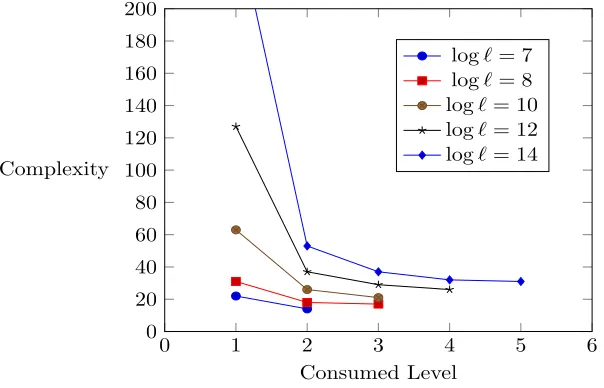
Fig. 1.Optimal complexity (number of rotations) of FFT-like algorithm with respect to the depth and number of slots
for some precomputable vectorsp[i] and integersti, and requires (k−1) rotations
and k plaintext multiplications to evaluate. To further reduce the complexity, we can utilize a babystep-giantstep method to reduce the number of rotations to about 2√k. Note that in a new version of the implementation of the CKKS scheme [1], plaintext multiplication takes much more time than rotation. There-fore, we define the cost of the merged layer as 2√k. In the following Figure 1, we present the optimal costs for different`and level upper bounds.
4
Improved Sine Evaluation from Chebyshev
Approximations
4.1 Background: Chebyshev Polynomials and Chebyshev Interpolants
Recall that the Chebyshev polynomials is a family of polynomials {Tn(x)}n≥0 defined by the recurrence relation:
T0(x) = 1
T1(x) =x
T2n(x) = 2Tn(x)2−1
T2n+1(x) = 2Tn(x)·Tn+1(x)−x.
Given a Lipschitz continuous functionf defined on the interval [−1,1], the
n-thChebyshev interpolantoff is defined as
pchebn (x) =
n
X
k=0
ckTk(x)
where the coefficients ck are uniquely determined such thatpchebn (xj) = f(xj)
for
xj= cos(jπ/n), for 0≤j≤n.
Letp∗n denote the minimaxpolynomial of degree ≤n which minimizes the
infinity normkf−p∗nk∞. It would be optimal to usep∗nas a polynomial
approx-imation to f. However, computing such polynomials is not trivial in practice. On the other hand, Chebyshev interpolants are not only easy to compute, but also almost as good as the minimax approximation. More precisely, we have the following formula from [21]:
kf −pchebn k∞≤
2
πlogn+ 2
· kf−p∗nk∞. (2)
4.2 Chebyshev Interpolants of Sine Function
Recall that in the bootstrapping procedure, we need to homomorphically evalu-ate
q
2πsin
2πt
q
.
witht∈[−Kq, Kq]. After a change of variables, we see that it suffices to evaluate
g(x) := 1
2πsin(2πKx)
with x∈[−1,1]. Our goal is to find a polynomialp(x) with small degree such that kg−pk∞ is small. How good can the approximation be? For the scaled sine function g, it has been shown (see e.g. [26]) that the minimax error n =
kg−p∗nk∞satisfies
lim sup
n→∞
n1n/n= eK
2 . (3)
Therefore, n decreases like eK2n
n
as n → ∞, i.e., the approximation error decreases super-exponentially as a function of the degree n. So, the logn loss factor from replacing the minimax approximation with Chebyshev interpolant is almost negligible compared to the decreasing speed ofn. Hence, Chebyshev
in-terpolants provide a decent approximation the sine function in our bootstrapping algorithm.
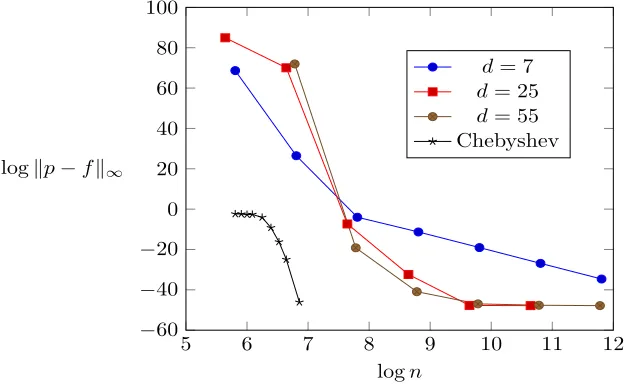
to approximate it. Then, it performs r repeated squaring operations to obtain an approximation of exp(2πiKx). Finally, g(x) is equal to 1/(2π) times the imaginary part of exp(2πiKx). In Figure 2 below, we present the log-log plot of approximation error versus polynomial degree for different values ofd.
From the plot, we see that the Chebyshev interpolant achieves small error quickly for degree less than 128. On the other hand, the [14] apporoach requires a much larger degree to reach the same error whend= 7. For a largerd= 55, the difference between the approaches becomes smaller. However, since the Taylor coefficients of exp(2πKix/2r) decrease super-exponentially, evaluating such a
large degree Taylor approximation is likely to result in large numerical errors. Therefore, we decided to use Chebyshev interpolants for approximating the sine function.
5 6 7 8 9 10 11 12
−60
−40
−20 0 20 40 60 80 100
logn
logkp−fk∞
d= 7
d= 25
d= 55 Chebyshev
Fig. 2.Polynomial approximation errors to 1
2πsin(2πKx) (K= 12).
4.3 Computing Chebyshev Polynomials in FHE
The Chebyshev coefficientsck of the scaled sine functiong can be precomputed
and stored. Next, our task is to evaluatePn
k=0ckTk(x) homomorphically. There
are several choices:
Since eachTk(x) is a polynomial inx, we could rewritepchebn (x) as
Pn
k=0c
0
kx k,
and use any existing method for homomorphic evaluation of polynomials in one variable in the literature. However, the transition matrix between the ck and
orders of magnitude. Therefore, the evaluation is likely to generate large numer-ical errors, even over unencrypted input.
A better method is to use the recurrence relation (1) to evaluateTk(x) for 0≤
k≤n, and then computePc
kTk(x) using scalar multiplications and additions.
This method yields smaller numerical errors in practice. However, the efficiency is sub-optimal: we still needO(n) homomorphic multiplications in order to evaluate a degree-nChebyshev interpolant.
Paterson-Stockmeyer for Chebyshev Our next idea is to use the Paterson-Stockmeyer algorithm [31], which requires onlyO(√n) non-scalar multiplications to evaluate a polynomial of degreeninx. However, we could not directly apply this algorithm since it requires the polynomial to be presented in thepower base 1, x, . . . , xn. Of course, one could rewrite the Chebyshev interpolant in power base first, and then execute the Paterson-Stockmeyer algorithm. But as we dis-cussed above, such method is subject to large numerical errors, hence it is not a desirable solution.
Instead, we propose a new approach by modifying the Paterson-Stockmeyer algorithm to directly evaluate Chebyshev interpolants. As a result, we can eval-uate a Chebyshev interpolant of degree nwith√2n+O(logn) non-scalar mul-tiplications. In order to describe our algorithm, we first recall the Paterson-Stockmeyer algorithm in [31]:
Algorithm 2: The original Paterson-Stockmeyer algorithm
Input: (a0, a1, . . . , an), u
Output: f(u) =P
iaiui
1 Find positive integersk, msuch thatk≈pn/2 andk(2m−1)> n 2 f˜(x) =f(x) +xk(2
m−1)
3 Compute powersbs= (u, u2, uk),gs= (uk, u2k, u4k, . . . , u2
m−1k
)
4 Using long division, write ˜f(x) =xk2
m−1
q(x) +r(x)
5 Set ˜r(x) =r(x)−xk(2
m−1−1)
6 Using long division, write ˜r(x) =c(x)q(x) +s(x) 7 Evaluatec(x) atuusing the precomputed powers
8 Set ˜s(x) =s(x) +xk(2
m−1−1)
9 Recursively evaluateq(x) and ˜s(x) at u(with lines 1-3 skipped)
10 Compute ˜f(u) = (uk(2
m−1)
+c(u))q(u) + ˜s(u).
11 Computeuk(2
m−1)
by multiplying all values ings
12 returnf(u) = ˜f(u)−uk(2
m−1)
Now suppose we wish to use the Chebyshev basis {Tk(x)}k instead of the
power base in Algorithm 2. We can start by replacing every occurrence of xi
which can be done ink+m operations using the recurrence formula (1). Thus we only need an algorithm for long division of polynomials in Chebyshev base. That is, given Chebyshev coefficients of polynomialsf andg, output Chebyshev coefficients of the quotient and remainder polynomialsqandrsuch that degq= degf−degg, degr <degg andf =qg+r. A first attempt is to convertf and
g to the power base, perform long division as usual, and convert the resultingq
and rback to Chebyshev base. Again, this approach is likely to generate a lot of numerical errors since the transform matrices are ill-conditioned. To resolve this issue, we present a direct algorithm.
Long Division for polynomials in Chebyshev base
Lemma 1 (Long Division). Given two polynomialsf andg with positive de-greesnandkgiven by their Chebyshev coefficients, there exists an algorithm with
O(k(n−k))operations to compute the Chebyshev coefficients of polynomialsq(x) andr(x), such that degq= degf −degg,degr <degg, and
f(x) =g(x)q(x) +r(x).
Proof. For simplicity, we assume bothf andg are monic, meaning their highest Chebyshev coefficient is 1. We do it with induction on n= degf. Ifn≤degg
then we are done. Now supposen > k= degg andk≥1. Let
r0(x) =Tn(x)−2g(x)Tn−k(x).
Using the formula
Tm(x) = 2Ti(x)Tm−i(x)−T|m−2i|(x),
we see that deg(r0) < n, and we may compute the Chebyshev coefficients of
r0(x). Now we could recursively perform the divisionr0 bygto finish the algo-rithm. The correctness is easy to verify, and since computing r0 requires O(k) operations, the algorithm requiresO(k(n−k)) operations. This finishes the proof.
Given the above lemma, we can modify Algorithm 2 to directly perform long division of polynomials in Chebyshev base. We omit the detailed description of the modified algorithm since it is straightforward. As a result, we have
Theorem 1. There exists an algorithm to evaluate a polynomial of degree n
given in Chebyshev base with √2n+O(logn) non-scalar multiplications and
O(n)scalar multiplications.
5
Putting it together
5.1 Asymptotic analysis
Linear Transforms The subSum step remains unchanged from [14], which requiresO(N/2`) rotations. For the two transformscoeffToSlotandslotToCoeff, recall that [14] takes O(√`) rotations and` plaintext multiplications, whereas our algorithm provides a spectrum of trade-offs between level consumption and operation counts. For example, if we fix the level budget to be`0= 2, then both thecoeffToSlot andslotToCoeff requires O(`1/4) rotations andO(√`) plaintext multiplications.
Sine evaluation The approach of [14] to evaluate the sine approximation re-quires a polynomial of degreed·2randO(d+r) ciphertext multiplications. They
took d=O(1) andr=O(log(Kq)) in order to achieve an approximation error ofO(1) for the function (q/2π) sin(2πt/q). Thus, both the required level and the number of operations areO(log(Kq)).
In our case, we used a Chebyshev interpolant to approximate the sine func-tion. From the results in Section 4, we see that it suffices to take degree n ≤
max{4K,logq} to achieve 1/qapproximation error from (2) and (3). Therefore, our approach consumes only logn≤max{logK+ 2,log logq}levels. In terms of the number of operations, by using the modified Paterson-Stockmeyer algorithm, we can evaluate the Chebyshev interpolant inO(√n) ciphertext multiplications.
5.2 Implementation and performance
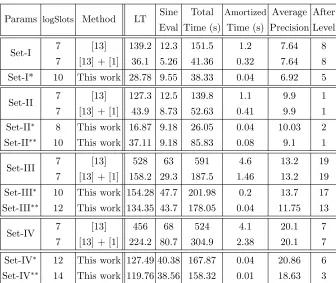
Recently, the authors of [16] published a improved version [1] of the implemen-tation of the CKKS scheme with faster operations. We implemented our boot-strapping algorithm on top of the new version. In order to separate the causes of speedups, we also experimented with the original bootstrapping algorithm with the new library. We summarize our findings in Table 4.
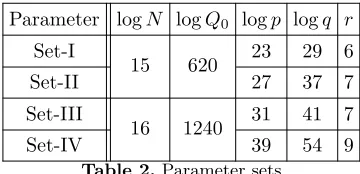
Parameter Choices To benchmark the original bootstrapping algorithm, we used the same parameter sets (Table 2) from [14]. We modified these parameters slightly for our new bootstrapping algorithm. The modified parameters are pre-sented in Table 3. We note that these modifications do not involve logN,logQ
or the initial noise in the ciphertexts, hence the security level remains the same as previous work.
Parameter logN logQ0 logp logq r
Set-I
15 620 23 29 6
Set-II 27 37 7
Set-III
16 1240 31 41 7
Set-IV 39 54 9
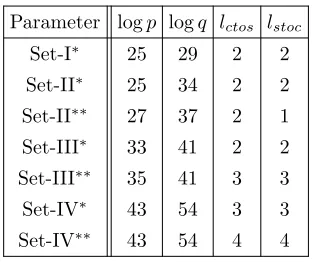
Parameter logp logq lctos lstoc
Set-I∗ 25 29 2 2
Set-II∗ 25 34 2 2
Set-II∗∗ 27 37 2 1
Set-III∗ 33 41 2 2
Set-III∗∗ 35 41 3 3
Set-IV∗ 43 54 3 3
Set-IV∗∗ 43 54 4 4
Table 3.New Parameter sets
In Table 3, the columns labeledlctos andlstoc denote the level consumption
forcoeffToSlotandslotToCoeff, respectively. Note that larger levels result in less operations. For the sine evaluation, we fixedK= 12 and a Chebyshev interpolant of degreen= 119 based on experimental results. All experiments are performed on a laptop with 2.8GHz Intel Core i7 Processor and 16GB memory, running on a single thread.
5.3 Comparison
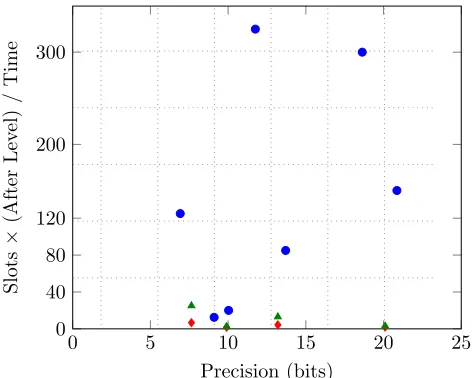
In order to make a meaningful comparison of the efficiency of the different boot-strapping methods/implementations, we need to provide a common measure, and one such measure is the number of slots times the number of levels allowed after bootstrapping, divided by the bootstrapping time. We argue that this definition makes sense, since in the process of evaluating a typical circuit homomorphically, the frequency of bootstrapping should be inverse proportional to the after level. Also, since the complexity of bootstrapping depends on the bit precision of the output, we plot the utility versus precision in the following Figure 3.
From Figure 3, we see that our new algorithms can improve the utility of bootstrapping by two orders of magnitude. For example, [14] could bootstrap numbers with around 20 bits of precision with a utility of 2.94 (Level×Slot / Second). With a slightly larger precision, we achieved a utility of 150, yielding a 50x improvement.
6
Conclusion and Future Work
In this work, we showed that algorithmic improvements to the linear transforms and sine evaluation steps could boost the efficiency of bootstrapping for the CKKS approximate homomorphic encryption scheme by two orders of magni-tude.
Params logSlots Method LT Sine Total Amortized Average After Eval Time (s) Time (s) Precision Level
Set-I 7 [13] 139.2 12.3 151.5 1.2 7.64 8
7 [13] + [1] 36.1 5.26 41.36 0.32 7.64 8
Set-I* 10 This work 28.78 9.55 38.33 0.04 6.92 5
Set-II 7 [13] 127.3 12.5 139.8 1.1 9.9 1
7 [13] + [1] 43.9 8.73 52.63 0.41 9.9 1
Set-II∗ 8 This work 16.87 9.18 26.05 0.04 10.03 2
Set-II∗∗ 10 This work 37.11 9.18 85.83 0.08 9.1 1
Set-III 7 [13] 528 63 591 4.6 13.2 19
7 [13] + [1] 158.2 29.3 187.5 1.46 13.2 19
Set-III∗ 10 This work 154.28 47.7 201.98 0.2 13.7 17
Set-III∗∗ 12 This work 134.35 43.7 178.05 0.04 11.75 13
Set-IV 7 [13] 456 68 524 4.1 20.1 7
7 [13] + [1] 224.2 80.7 304.9 2.38 20.1 7
Set-IV∗ 12 This work 127.49 40.38 167.87 0.04 20.86 6
Set-IV∗∗ 14 This work 119.76 38.56 158.32 0.01 18.63 3 Table 4.Performance comparisons for bootstrapping: LT (linear transformations) tim-ing is the sum of the timtim-ings for subSum, coeffToSlot and slotToCoeff. Precision is averaged among all slots.
to evaluate the sigmoid function or the RELU function, which is interesting from the point of view of doing machine learning over encrypted data. Also, this idea can be applied to the absolute value function, which may expedite evaluation of a sorting network over encrypted data.
The improved linear transform technique for the CKKS scheme can be used to provide a fast evaluation of discrete Fourier transform (DFT) over encrypted data, which might be of independent interest. Also, we could utilize our algo-rithm to provide an efficient implementation of the conversion between CKKS ciphertexts and ciphertexts from TFHE or BFV/BGV schemes, outlined in a recent work [5].
0 5 10 15 20 25 0
40 80 120 200 300
Precision (bits)
Slots
×
(After
Lev
el)
/
Time
[13] [13] + [1] This work
Fig. 3.Bootstrapping utility comparisons
References
1. HEAAN with Faster Multiplication. https://github.com/snucrypto/HEAAN/ releases/tag/2.1, 2018.
2. J.-C. Bajard, J. Eynard, M. A. Hasan, and V. Zucca. A full RNS variant of FV like somewhat homomorphic encryption schemes. InInternational Conference on Selected Areas in Cryptography, pages 423–442. Springer, 2016.
3. B. Beckermann. On the numerical condition of polynomial bases: estimates for the condition number of Vandermonde, Krylov and Hankel matrices. PhD thesis, Verlag nicht ermittelbar, 1997.
4. C. Bonte, C. Bootland, J. W. Bos, W. Castryck, I. Iliashenko, and F. Vercauteren. Faster homomorphic function evaluation using non-integral base encoding. In In-ternational Conference on Cryptographic Hardware and Embedded Systems, pages 579–600. Springer, 2017.
5. C. Boura, N. Gama, and M. Georgieva. Chimera: a unified framework for b/fv, tfhe and heaan fully homomorphic encryption and predictions for deep learning. Cryptology ePrint Archive, Report 2018/758, 2018. https://eprint.iacr.org/ 2018/758.
6. F. Bourse, M. Minelli, M. Minihold, and P. Paillier. Fast homomorphic evaluation of deep discretized neural networks. In Annual International Cryptology Confer-ence, pages 483–512. Springer, 2018.
9. Z. Brakerski and V. Vaikuntanathan. Fully homomorphic encryption from Ring-LWE and security for key dependent messages. In Advances in Cryptology– CRYPTO 2011, pages 505–524. Springer, 2011.
10. H. Chen, R. Gilad-Bachrach, K. Han, Z. Huang, A. Jalali, K. Laine, and K. Lauter. Logistic regression over encrypted data from fully homomorphic encryption. Cryp-tology ePrint Archive, Report 2018/462, 2018. https://eprint.iacr.org/2018/ 462.
11. H. Chen and K. Han. Homomorphic lower digits removal and improved fhe boot-strapping. InAnnual International Conference on the Theory and Applications of Cryptographic Techniques, pages 315–337. Springer, 2018.
12. H. Chen, K. Laine, and P. Rindal. Fast private set intersection from homomorphic encryption. In Proceedings of the 2017 ACM SIGSAC Conference on Computer and Communications Security, pages 1243–1255. ACM, 2017.
13. J. H. Cheon, K. Han, A. Kim, M. Kim, and Y. Song. Implementation of boostrap-ping for HEAAN, 2017. https://github.com/kimandrik/HEAANBOOT.
14. J. H. Cheon, K. Han, A. Kim, M. Kim, and Y. Song. Bootstrapping for approximate homomorphic encryption. InAdvanced in Cryptology–EUROCRYPT 2018, pages 360–384. Springer, 2018.
15. J. H. Cheon, K. Han, A. Kim, M. Kim, and Y. Song. A full rns variant of ap-proximate homomorphic encryption. Cryptology ePrint Archive, Report 2018/931, 2018. https://eprint.iacr.org/2018/931.
16. J. H. Cheon, A. Kim, M. Kim, and Y. Song. Homomorphic encryption for arith-metic of approximate numbers. In Advances in Cryptology–ASIACRYPT 2017, pages 409–437. Springer, 2017.
17. I. Chillotti, N. Gama, M. Georgieva, and M. Izabach`ene. Faster fully homomorphic encryption: Bootstrapping in less than 0.1 seconds. InAdvances in Cryptology– ASIACRYPT 2016: 22nd International Conference on the Theory and Application of Cryptology and Information Security, pages 3–33. Springer, 2016.
18. I. Chillotti, N. Gama, M. Georgieva, and M. Izabach`ene. Faster packed homo-morphic operations and efficient circuit bootstrapping for tfhe. In Advances in Cryptology–ASIACRYPT 2017: 23rd International Conference on the Theory and Application of Cryptology and Information Security, pages 377–408. Springer, 2017. 19. J. L. Crawford, C. Gentry, S. Halevi, D. Platt, and V. Shoup. Doing real work with fhe: The case of logistic regression. Cryptology ePrint Archive, Report 2018/202, 2018. https://eprint.iacr.org/2018/202.
20. L. Ducas and D. Micciancio. FHEW: Bootstrapping homomorphic encryption in less than a second. InAdvances in Cryptology–EUROCRYPT 2015, pages 617–640. Springer, 2015.
21. H. Ehlich and K. Zeller. Auswertung der normen von interpolationsoperatoren. Mathematische Annalen, 164(2):105–112, 1966.
22. J. Fan and F. Vercauteren. Somewhat practical fully homomorphic encryption. IACR Cryptology ePrint Archive, 2012:144, 2012.
23. C. Gentry. Fully homomorphic encryption using ideal lattices. InIn Proc. STOC, pages 169–178, 2009.
24. C. Gentry, S. Halevi, and N. P. Smart. Better bootstrapping in fully homomorphic encryption. InPublic Key Cryptography–PKC 2012, pages 1–16. Springer, 2012. 25. R. Gilad-Bachrach, N. Dowlin, K. Laine, K. Lauter, M. Naehrig, and J. Wernsing.
26. A. Giroux. Approximation of entire functions over bounded domains. Journal of Approximation Theory, 28(1):45–53, 1980.
27. S. Halevi and V. Shoup. Algorithms in HElib. InAdvances in Cryptology–CRYPTO 2014, pages 554–571. Springer, 2014.
28. S. Halevi and V. Shoup. Bootstrapping for HElib. In Advances in Cryptology– EUROCRYPT 2015, pages 641–670. Springer, 2015.
29. K. Han, S. Hong, J. H. Cheon, and D. Park. Efficient logistic regression on large encrypted data. Cryptology ePrint Archive, Report 2018/662, 2018. https:// eprint.iacr.org/2018/662.
30. A. Kim, Y. Song, M. Kim, K. Lee, and J. H. Cheon. Logistic regression model training based on the approximate homomorphic encryption. Cryptology ePrint Archive, Report 2018/254, 2018. https://eprint.iacr.org/2018/254.