General State Channel Networks
Stefan Dziembowski1,?, Sebastian Faust2,??, and Kristina Host´akov´a3,?? 1
[email protected]; University of Warsaw, Poland
2 [email protected]; Technische Universit¨at Darmstadt, Germany 3
[email protected]; Technische Universit¨at Darmstadt, Germany
Abstract. One of the fundamental challenges that hinder further adaption of decentralized cryptocur-rencies is scalability. Because current cryptocurcryptocur-rencies require that all transactions are processed and stored on a distributed ledger – the so-called blockchain – transaction throughput is inherently limited. An important proposal to significantly improve scalability areoff-chain protocols, where the massive amount of transactions is executed without requiring the costly interaction with the blockchain. Ex-amples of off-chain protocols include payment channels and networks, which are currently deployed by popular cryptocurrencies such as Bitcoin and Ethereum. A further extension of payment networks envisioned for cryptocurrencies are so-calledstate channel networks. In contrast to payment networks that only support off-chain payments between users, state channel networks allow execution of arbitrary complex smart contracts. The main contribution of this work is to give the first full specification for general state channel networks. Moreover, we provide formal security definitions and prove the security of our construction against powerful adversaries. An additional benefit of our construction is the use of channel virtualization, which further reduces latency and costs in complex channel networks.
1
Introduction
In recent years we have witnessed a growing popularity of distributed cryptocurrencies such as Bitcoin [23] or Ethereum [33]. The underlying main innovation of these currencies is a consensus mechanism that allows their users to maintain the so-calledblockchain (orledger). One of the most interesting potential applications of such currencies are themicrotransactions[32, 28, 21, 26], i.e., transactions of very small values (typically less than 1 cent) that are executed instantaneously. Once implemented, they could enable many novel business models, e.g., fair sharing of WiFi connection, or devices paying to each other in the “Internet of Things”.
Unfortunately, blockchain-based systems face inherent challenges that make it very hard, if not impossible, to use them directly for microtransactions. Firstly, each transaction that is processed via the network has to be stored on the blockchain. Moreover, consensus on the blockchain requires significant time to confirm transactions, e.g., in Bitcoin confirmation takes at least around 10 minutes. This imposes a fundamental limit on how many transactions can be processed per second (for instance, the Bitcoin network is currently limited to process up to 7 transactions per second [6]). Finally, the miners that process transactions, ask for fees. Once these fees surpass the actual value assigned to a transaction, micropayments become much less attractive.
A prominent tool for addressing the above challenges areoff-chain channels [5, 27, 18, 4, 19, 29, 17] that allow two users to rapidly exchange money between each other without sending transactions to the blockchain. Channels are implemented using so-called smart contracts, which allow to transfer money according to complex program rules. Below we will first briefly describe this concept, and then give a short introduction to the state of the art in off-chain channels.
Smart contracts. Informally speaking, smart contracts (or simply: “contracts”) are programmable money, described in form of self-enforcing programs that are published on the ledger. Technically, the term “smart contract” can have two meanings: (1) a contract code which is a static object written is some program-ming language, and (2) a contract instance (a dynamic object that executes this code and is running on a
?Supported by the NCN grant 2014/13/B/ST6/03540. ??
blockchain, or inside of a state channel, see below). In the sequel we will often use this distinction (which is similar to the distinction between “programs” and “processes” in operating systems). One can think of a smart contract instance as a trusted third party to which users can send coins, and that can distribute coins between the parties, according to conditions written in its code. Probably the best known currency that supports contracts of an arbitrary complexity isEthereum [33], and its most popular contract language isSolidity. In this system, a contract instance never acts by itself, and its actions have to be triggered by the users (who pay the so-called fees for every contract execution). The users communicate with the contract instances usingfunctions calls(from the contract code). An instance is deployed on the ledger by a call from a special function calledconstructor. For more details on smart contracts and their formal modeling we refer to Sec. 3.
Payment channels. Payment channels are one of the most promising proposals for addressing the scalability challenges in cryptocurrencies. The main idea behind this technology is to keep the massive bulk of trans-actions off-chain. To this end, the parties that want toopen a channel deploy a special “channel contract” on the blockchain and lock a certain amount of coins in it. Afterwards they can freely update the channel’s balance without touching the ledger. The blockchain is contacted only when parties involved in the payment channel want toclose the channel, or if they disagree, in which case the channel contract handles fair settle-ment. In the normal case, when the two parties involved in the payment channel play honestly and off-chain transactions never hit the blockchain before the channel is closed, payment channels significantly improve on the shortcomings of standard blockchain-based payments mentioned above: they limit the load put on the blockchain, allow for instantaneous payments, and reduce transaction fees.
The idea of payment channels has been extended in several directions. One of the most important exten-sions are the so-called payment networks, which enable users to route transactions via intermediary hubs. To illustrate this concept, suppose that P1 has a payment channel withP2, and P2 has a payment channel with P3. A channel network allows P1 to route payments to P3 via the intermediary P2 without the need for P1 and P3 to open a channel between each other on the ledger. This reduces the on-chain transaction load even further. The most well known example of such a system is the Ligthning network that has been designed and implemented by Poon and Dryja over Bitcoin [27]. It is based on a technique calledhash-locked transactions, in which each transaction that is sent fromP1toP3is routed explicitly viaP2– meaning that P2confirms that this transaction can be carried out betweenP1 andP3. For further details on hash-locked transactions, we refer the reader to, e.g., the description of the Lightning network [27] and to Appx. A.
Virtual payment channels. An alternative technique for connecting channels has recently been proposed in [11] under the name “channel virtualization”. Using this technique two parties can open a virtual channel over two “extended payment channels” running on the ledger.4 Consider the example already mentioned above, where P1 and P3 are not connected by a payment channel, but each of them has an extended payment channel with an intermediary called P2. In contrast to connecting payment channels via hash-locked transactions, virtual payment channels have the advantage that the intermediaryP2 does not need to confirm each transaction routed via him. As argued in [11], virtual channels can further reduce latency and fees, while at the same time improving availability.5 To distinguish the standard channels from the virtual ones, the former ones are also calledledger channels. In [11] the authors present only a construction of virtual payment channels over a single intermediary hub, leaving the general construction as an open research problem. Addressing this shortcoming is one important contribution of our work.
State channels. A further generalization of payment channels arestate channels [1], which radically enrich the functionality of payment channels. Concretely, the users of a state channel can, besides payments, execute complex smart contracts in an off-chain way. Alice and Bob who established a state channel between each
4
Concretely, the contract representing the extended payment channel offers additional functionality to support connecting two payment channels.
other can maintain a “simulated ledger for contracts” and perform the execution of contracts on it “without registering them on the real blockchain”. This happens as long as the parties do not enter into a conflict. The security of this solution comes from the fact that at any time parties can “register” the current off-chain state of the channel on the real blockchain, and let the channel contract fairly finish the execution of the contract. Examples of use cases for state channels are manifold and include contracts for digital content distribution, online gaming or fast decentralized token exchanges.
In contrast to payment channels, there has been only little work on general state channels.6One prominent project whose final goal is to implement general state channels over Ethereum is called Raiden [31], but currently it only supports simple payments, and a specification of protocols for full state channel networks has not been provided yet. The concept of an off-chain state maintained by parties was formalized in the work of Miller et al. [22], where it is used as a main building block for the payment channel construction. In contrast to [22], our general state channel construction allows two parties to have a virtual state channel whose opening does not require any interaction with the blockchain. This significantly improves the time complexity and the cost of a state channel creation. To our best knowledge, the only work considering longer general state channels is [9] recently published by Coleman et al. and developed independently from our work. The work of [9] lacks formal definitions and security proofs. On the other hand, it includes several features useful for practical implementation. We are in contact with the authors of [9] and planing collaboration to further improve our construction and move provably secure state channel networks closer to practice.
1.1 Our contribution
As described above, until now there has not been any satisfactory formal construction or security definition of general state channel networks. The main contribution of this work is to address this shortcoming by providing the first construction for building state channel networks of arbitrary complexity together with a formal definition and security analysis. Our construction (i) allows users to run arbitrary complex smart contracts off-chain, and (ii) permits to build channels over any number of intermediaries. Below we describe our core ideas in more detail.
Constructing state channel networks. In order to construct the general state channel networks, we follow a modular recursive approach where virtual state channels are built recursively on top of ledger or other – already constructed – virtual state channels. For a high-level description of our recursive approach see Sec. 2 (and Fig. 1 therein). As long as everybody is honest, the intermediaries in the virtual channel are contacted only when the channel is opened and when it is closed (and the ledger is never contacted). On the other hand, let us stress that no intermediary can lose its coins even if all other parties are dishonest and every user of a virtual state channel has the guarantee that he can execute a contract created in a virtual state channel even if all other parties collude.
Modeling state channel networks and security proofs. In addition to designing the first protocols for state channel networks, we develop a UC-style model for “state channel networks” – inspired by the universal composability framework introduced in the seminal work of Canetti [7]. To this end, similarly to [11], we model money via a global ledger ideal functionality Lb and describe a novel ideal functionality for state channel networks that provide an ideal specification of our protocols. Using our model, we formally prove that our protocols satisfy this ideal specification. Key challenges of our analysis are (i) a careful study of timings that are imposed by the processing of the ledger, and (ii) the need to guarantee that honest parties cannot be forced to lose money by the fact that the contracts are executed off-chain even if all other parties collude and are fully malicious.
We emphasize that in the context of cryptocurrencies, a sound security analysis is of particular importance because security flaws have a direct monetary value and hence, unlike in many other settings, are guaranteed
6
to be exploited. The later is, e.g., illustrated by the infamous attacks on the DAO [30]. Thus, we believe that before complex off-chain protocols are massively deployed and used by potentially millions of users, their specification must be analyzed using formal methods as done in our work using UC-style proofs.
Optimistic vs. pessimistic execution times. While constructing our protocols we will provide the “optimistic” and “pessimistic” execution times. The “optimistic” ones refer to the standard case when all parties behave honestly. In the optimistic case all our protocols allow for instantaneous off-chain contract execution, and a possible delay depends only on the latency of the network over which parties communicate. The “pessimistic” case corresponds to the situation when the corrupt parties try to delay the execution as much as they can by forcing contract execution on the blockchain. In our solution the pessimistic execution times grow linearly with the number of intermediaries`involved. Notice that these pessimistic times can in reality happen only in the unlikely case when all but one party are corrupt. Since the main goal of this paper is to introduce the general framework, and not to fine-tune the parameters, we leave it as an important direction for future work to improve our construction and optimize these timings, possibly using the techniques of [22].
Further related work One of the first proposals for building payment channels is due to Decker [10], who in particular also introduced a construction for duplex payment channels. An alternative proposal for payment channel networks has been given by Miller et al. [22]. In this work, the authors show how to reduce the pessimistic timings to constant time (i.e., independent of the length of the channel path). It is an interesting question for future work to combine the techniques from [22] with the channel virtualization. Several works focus on privacy in channel networks, path finding or money re-balancing in payment channels [19, 29, 17]. In particular, [22, 19, 11] also provide a UC-based security analysis of their constructions. Channel constructions based on the sequence number maturity (that we also use in this paper) have been mentioned already in [27], and recently described in more detail (as “stateful duplex off-chain micropayment channels”) by Bentov et al. in [4]. Another challenge in building and maintaining complex channel networks is the fact that parties have to continuously watch what happens on the blockchain regarding the state of their channels. This problem can be addressed using so-called watchtowers [25, 20], to which users can outsource the task of watching the blockchain.
1.2 Organization of the paper
We begin with an informal description of our state channel construction in Sec. 2, where we explain how state channels are created and how they can be used. The ideal specification of our construction is presented in Sec. 4 and the full description of the state channel protocols is given in Sec. 6 (for ledger state channels) and in Sec. 7 (for virtual state channels). We introduce the necessary formalism and present security and efficiency properties required from a general state channel in Sec. 3. Our modular approach of building state channels is discussed in Sec. 5. Finally, we conclude in Sec. 8.
2
State channel construction
P1 P2 P3 P4 P5 P6
γ1
γ3
γ4
γ2
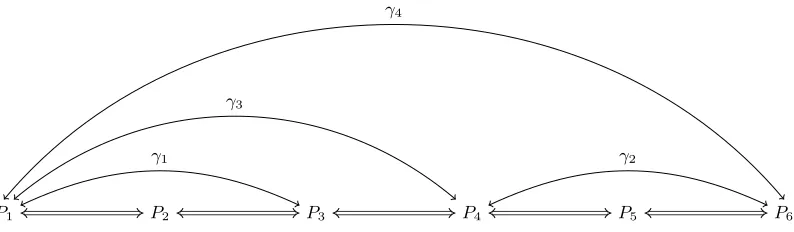
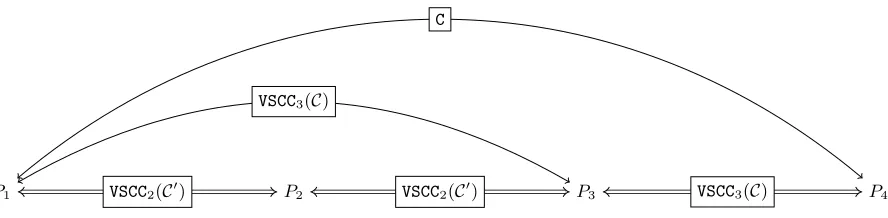
Fig. 1: Example of a recursive construction of a virtual state channelγ4 (of length 5) betweenP1andP6.
Ledger state channels – an overview. The terminology for ledger state channels is given in Sec. 3. and their construction can be found in Sec. 6. Below we explain only the main idea of the ledger state channel construction. A ledger state channel δbetween Alice and Bob allows them to execute off-chain instances of some contract code C. An example could be a lottery game contract Clot, where each user deposits 1 coin and then one user is randomly chosen to receive 2 coins. Technically, this is implemented using the standard cryptographic method based on commitment schemes (see, e.g., [2]), where the execution of the contract happens in the following steps: first the parties deposit their coins in the contract instance (call the resulting initial state of the gameG0)7, then Alice sends to the contract her commitment to a random bitrA∈ {0,1} (which results in state G1), afterwards Bob sends his random bit rB ∈ {0,1} to the contract (denote the resulting stateG2). Then, Alice opens her commitment, the final stateG3is computed, and 2 coins are given to Alice if rA⊕rB = 0, or to Bob (otherwise). Finally, the contract instance terminates. Technically, the previous steps are implemented via function calls. For example: sending a bitrB by Bob can be implemented as function callReveal(rB) (whereRevealis a function available inClotthat storesrB in the storage of the contract).
As described in Sec. 1, two parties create a ledger state channel by deploying a state channel contract, (SCC), in which each party locks some amount of coins. Once the ledger state channelδis established, parties can open instances of the contract codeCin the channel and execute them. For example the parties can open a channel in which each of them locks 10 coins and then run several instances of the lottery contractClot in this channel. Every contract instance locks 1 coin of each party (from the coins that are locked in channel δ). A locked coin cannot be used for any other contract instance inδ. Once the contract instance terminates, the coins are unlocked and distributed back to the channelδaccording to the rules ofC. The state channel contract on the blockchain guarantees that if something goes wrong during the off-chain execution (parties disagree on a state of some contract instance, one of the parties stops communicating, etc.), they can always fairly resolve their disagreement and continue the execution via the state channel contract on the blockchain.
Off-chain contract execution in the ledger state channels. Let us now take a closer look how the off-chain contract execution is done via the ledger state channel. Let C be a contract code, and let G denote the (dynamically changing) instance ofCthat is executed inδ. To deployGboth parties agree on the initial state G0ofG. The parties then exchanging signatures on (G0,0). The rest of the execution is done by exchanging signatures on further states of G together with indices w that denote the version numbers. Assume that Alice wants to call a functionf (with some parametersm) in the contract instance. Let (Gw, w) be the last state of the contract instance G on which the parties exchanged their signatures. She then (1) computes locally the new value Gw+1 of the state, by calling f(m) onGw, and then (2) sends signed (Gw+1, w+ 1)
7
together withf andmto Bob. Bob checks if Alice’s computation was correct, and if yes then he replies with his signature on (Gw+1, w+ 1). When the instanceGterminates, the coins resulting from this execution are distributed between the parties according to the outcome of the game.
For example if Gis an instance of the lottery contractClot described above then the states of the game are G0, G1, G2 and G3. Since the first move of the game is done by Alice, she locally computes the new stateG1and sends it to Bob together with her commitment to rA and her signature on (G1,1). Then Bob replies with his signature on (G1,1). Thereafter, Bob makes his move, i.e., he computes G2, sends signed (G2,2) together with his random bit rB to Alice, and so on. Note that the interaction of the parties with the contract instance is always “local”, i.e., the parties themselves compute the new states of Gand then just exchange signatures.
As long as both Alice and Bob are honest, everything is done without any interaction with the blockchain. If, however, one party cheats (e.g. by refusing to communicate), the other party can always ask the SCC contract to finish the game. The version numberwis used to make sure thatSCCgets always the latest state of the game. More concretely: the contract is constructed in such a way that if a malicious party submits an old state, then the other party can always “overwrite” this state by providing a signed state of the contract instance with a higher version number. Once the SCCcontract learns the latest stateGw, the game can be finished (starting fromGw) on-chain via SCC.
Virtual state channels – an overview. As described above, the virtual state channels are constructed recur-sively “on top” of the ledger state channels. Suppose that Alice and Bob want to run some contract codeC (e.g. the lottery game) in an off-chain way in γ. This time, however, they do not have an open ledger state channel between each other. Instead, both Alice and Bob have a channel with a third party, which we call Ingrid. Denote these channelsαandβrespectively. With the help of Ingrid but without interacting with the blockchain, Alice and Bob can open a virtual state channel γ that has the same functionality and provides the same guarantees as if it would be a ledger state channel between them. In particular, Alice and Bob are allowed to create a contract instance ofCin their channelγand execute it just by communicating with each other (i.e. play their game without talking to any third party or the blockchain).
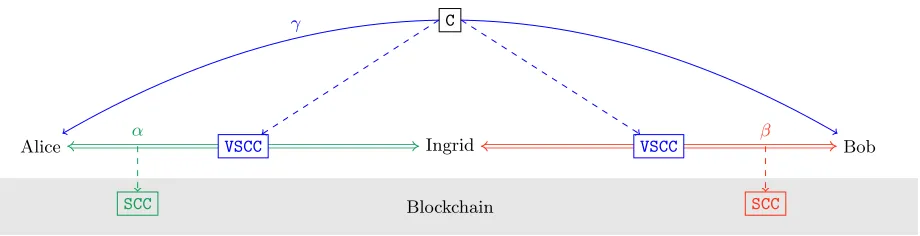
Recall that in case of the ledger state channels every dispute between Alice and Bob is resolved by the state channel contract,SCC. For the virtual state channelγ the role of such a “judge” is played by Ingrid. The main difference from the previous case is that, unlikeSCC(that is executed on the ledger),Ingrid cannot be trusted, and in particular, she may even collude with a corrupt Alice or Bob. In order to prevent parties from cheating, we create special contracts in each of the ledger state channels αandβ. Their code will be called “virtual state channel contract” (VSCC) and their instances will be denoted να andνβ, respectively. The instancesναprovides security guarantees for Alice, andνβ for Bob. In addition, both contract instances together provide guarantees for Ingrid. The contract codeVSCC has to depend on the code Csince it needs to interpret the codeCin case the parties enter into a dispute (see below). Note thatSCCdepends onVSCC, and hence, indirectly, onC. This dependence is summarized in Fig. 2.
Creating the virtual state channel. Let us explain the virtual state channel creation in more detail. In the first step Alice and Bob inform Ingrid about their intention to use her as anintermediary for their virtual state channelγ. Alice does so by proposing to open an instanceνα ofVSCC in the channelα. This instance will contain all information about the virtual state channelγ(for example: how many coins each party wants to lock in the channel). In some senseνα can be viewed as a “copy” of the virtual state channelγ in which Ingrid plays the role of Bob — for example, if the initial balance inγis 1 coin for Alice and 5 coins for Bob, then Alice would lock 1 coin and Ingrid 5 coins inνα. Symmetrically, Bob proposes a new instance νβ of VSCC in the ledger state channelβ that can be viewed as a “copy” of the virtual state channelγ in which Ingrid plays the role of Alice. In the example above, Ingrid would lock 1 coin and Bob 5 coins inνβ. If Ingrid receives both proposals and she agrees to be the intermediary of the virtual state channel γ, she confirms both requests.
“Off-Alice Ingrid Bob
Blockchain
α
VSCC
β VSCC
γ C
SCC SCC
Fig. 2: Construction of a virtual state channelγ1 of length 2 in which a contract instance ofCis created.
chain contract execution in the ledger state channels” above). That is, as long as both Alice and Bob are honest, they execute a contract instance G by exchanging signatures on new versions of the game states without talking to Ingrid at all, and without updating να and νβ. The case when Alice and Bob disagree needs to be handled differently, since the parties cannot contact the blockchain contract, but have to resolve this situation using the channelsαand β that they have with Ingrid. Consider, for example, the situation when, in the scenario described above, Bob is malicious and stops communicating with Alice, i.e. he does not send back his signature on (Gw+1, w+ 1). In this situation, Alice has to make her move “forcefully” by using the channel α she has with Ingrid. More concretely, she will execute the contract instance να. It is very important to stress that the virtual state channel construction uses this instance in a black-box way, i.e., when describing the protocols for virtual state channel execution this protocol uses the execution ofνα in a black-box way via the interface of the underlying channel. Internally, of course this is done by a protocol between Alice and Ingrid realizing the off-chain execution ofνα (as long as Alice and Ingrid are honest).
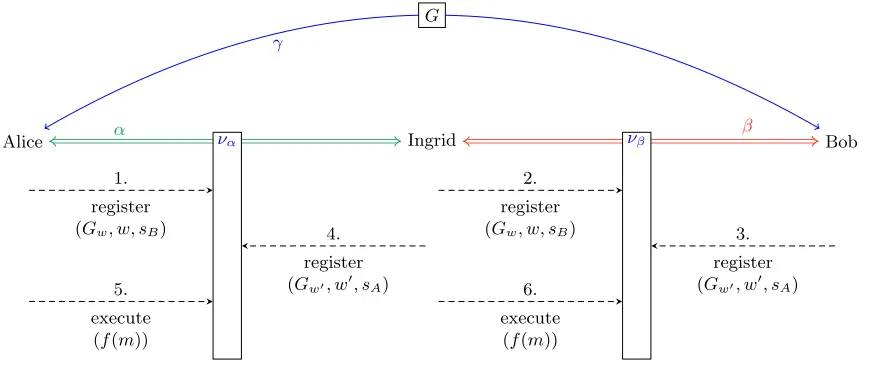
First, Alice starts the “state registration procedure”. The goal is to letναknow that she has a disagree-ment with Bob, and to convinceνα thatGw is the latest state of the contract instanceG. To this end, she sends toνα the state (Gw, w, sB), wheresB is Bob’s signature on (Gw, w). She does it by calling a function “register” (see Step 1 on Fig. 3). Of courseναhas no reason to believe Alice that this is really the latest state ofG. Thereforeναforwards this message to Ingrid8, that, in turn, calls a function “register(Gw, w, sB)” of the contract instanceνβ in channelβ(see Step 2). Bob now replies (in Step 3) toνβwith his latest version of the contract instance (i.e. he calls “register(Gw0, w0, sA)”, wheresA is Alice’s signature). When Ingrid learns about Bob’s version from νβ, she forwards this information toνα (see Step 4). Suppose that w > w0, i.e., Alice is honest, and Bob is cheating by submitting and old version of the instance (the other case is handled analogously). Then, bothναandνβ decide that (Gw, w) is the latest version ofG(i.e. they “registerGw”). From the point of view of Ingrid, the most important security feature of this procedure is that there is a consensus among να and νβ about the latest state ofG (even if Alice and Bob are both dishonest and playing against her). This consensus will be maintained during the entire execution ofGin instancesναand νβ. This is important, as otherwise she could lose coins.9 This invariant will be maintained throughout the rest of the “forced execution procedure”.
After the state registration is over, Alice calls (in Step 5, Fig. 3) a function “execute(f(m))” of να, “asking” να to executef(m) on the contract instance Gstarting from the registered state (Gw, w). Since we want to maintain the “consensus invariant” mentioned above, we cannot simply let να perform this execution immediately after it receives this call. This is because some contracts may allow both parties to
8
Recall again that this execution is realized by a protocol between Alice and Ingrid.
9 Imagine, e.g, that the final state ofGinνα is that Alice gets all the coins locked inG, and the final state ofGin
call functions at the same time10, and Bob could simultaneously call some other function execute(f0(m0)) of νβ. This situation is especially subtle because function execution is generally not commutative, i.e., executing f(m) and thenf0(m0) can produce a different result than doing it in the different order. Consequently, this
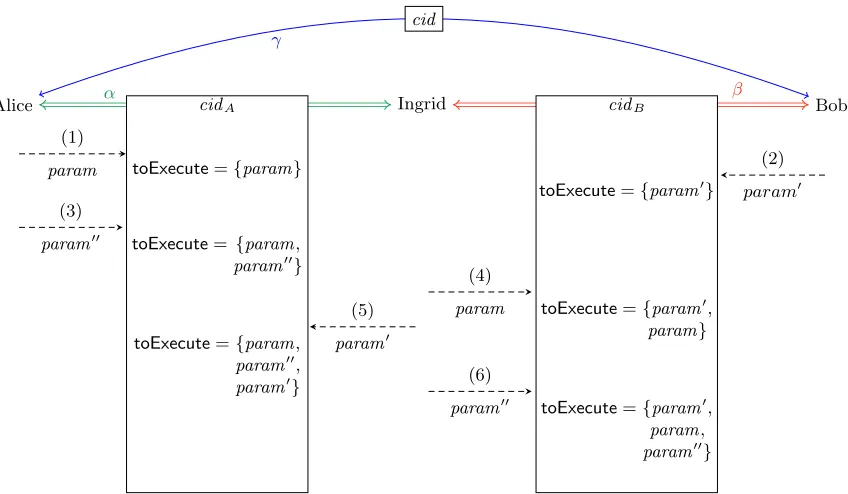
could result inναandνβ having different states of their local copies ofγ. We solve this problem by delaying the execution of f(m) until it is clear that no other function can be executed beforef(m). More precisely, the contract code VSCC is defined in such a way that f(m) is only stored in the storage of the contract instanceνA, resp.νB together with a time stamp of storage. The internal execution off(m) inνA, resp.νB, is performed only when the contract instance is being terminated (which happens when then virtual state channelγ is being closed).
Let us emphasize that the purpose of the description above is to explain the concepts and main ideas of our construction. The final protocol, however, works slightly differently due to several optimizations. For example, in order to decrease the pessimistic time complexity, the registration phase and the force execution phase for virtual state channels are run in parallel (i.e. Step 1 and Step 5 are happening in the same round). We refer the reader to Sec. 7 for the full description of our protocol.
Alice α Ingrid β Bob
γ
G
να νβ
1. register (Gw, w, sB)
2. register
(Gw, w, sB) 3.
register (Gw0, w0, sA) 4.
register (Gw0, w0, sA) 5.
execute (f(m))
6. execute (f(m))
Fig. 3: Illustration of the forced execution process from our example in which Alice and Bob have a virtual state channelγ in which they opened a contract instance. Only the function calls are shown (the messages sent by the contracts are omitted).
Applying recursion. As already highlighted earlier, longer virtual state channels are constructed recursively. The key observation that enables this recursion is that the state channelsαand β that are used to buildγ are accessed in a “black-box” way. In other words, the only property ofαandβneeded in the construction of γis that one can execute off-chain contracts in them. This “black-box” property guarantees that our virtual state channel construction works also if the channelsαandβarevirtual (not ledger), or in case one of them is virtual, and the other one is ledger.
Let us illustrate this by taking a look again at the situation depicted in Fig. 1. Consider first the virtual state channel γ3 – a virtual state channel of length 3 build on top of a virtual state channelγ1 of length 2 and the ledger state channelP3 ⇔P4. Assume that Cis the contract code whose instances can be opened in γ3. Following the construction described earlier in this section, γ3 can be created if both the underlying 10Note that it isnot the case of the
Clot contract, since there its always clear which party is expected to “make a
state channelsγ1 andP3⇔P4support contract instances of the virtual state channel contract VSCCwhich depends on C. This, in particular, implies that the ledger state channelsP1⇔ P2 and P2⇔P3, on top of which the virtual state channelγ1 is created, must support contract instances of the virtual state channel contractVSCC0 which depends onVSCC (thus indirectly also onC).
This reasoning can be repeated for longer channels. For example, ifCis a contract code whose instances can be opened in the virtual state channelγ4, then contract instances ofVSCC must be supported by both γ2 andγ3, contract instances ofVSCC0 must be supported by γ1,P3 ⇔P4, P4⇔P5 and P5 ⇔P6. Finally, contract instances of the virtual state channel contractVSCC00, which depends onVSCC0, must be supported by the ledger state channels P1 ⇔ P2, P2 ⇔ P3. More details of this recursion, including the analysis of pessimistic and optimistic timing, are provided in further sections. Let us just mention here that in order to achieve linear pessimistic time complexity (in the channel length), our construction assumes that virtual state channels are built in a balanced way as in Fig. 1 (i.e. the two state channels used to build a virtual state channel have approximately the same length).
The notion of time In the description above we ignored the notion of time. This was done to simplify this informal description. We define this notion in the technical part of the paper (see Sec. 3.3). In our construction parties are always aware of the current time, and they pass the time information to the contract functions in the state channels. Time is modeled as a natural number, and the time unit is called around (think of it as 1 second, say).
Key features of our construction. An important property of our construction and our model is that we support full concurrency. That is, we allow several virtual state channels to be created simultaneously over the same ledger state channels, and allow parties to be involved in several concurrent executions of (possibly complex) contracts. This is possible because our ledger state channels can store and execute several contracts “independently” (i.e., these are multi-contract state channels).
Another important feature of our modular construction is that it naturally allows for building channels via multiple (possible incompatible) cryptocurrencies as long as they have a sufficiently complex scripting language (in particular, they allow to deploy a state channel contract). For illustration, consider Alice having a ledger state channel with Ingrid in cryptocurrency called “A-coin”, and Bob having a ledger state channel with Ingrid in cryptocurrency called “B-coin”. Now, Alice and Bob can build a virtual state channel over Ingrid, where Alice (resp. Bob) is oblivious of the details of B-coin (resp. A-coin). This makes sense as long as the exchange rate between the currencies does not change too much during the lifetime of the virtual channel. Note that, since the virtual channel opening and closing does not require interacting with the ledger, the lifetime of a virtual state channel can be made very short (minutes or hours). In addition, virtual state channels also improve on privacy. This is the case because channel updates are fully P2P and do not require involvement of intermediaries.
Finally, we point out that our concept of higher-level channel virtualization has the key feature that it adds further “layers of defense” against malicious parties before honest users need to communicate with the blockchain. Consider, for example, the situation shown in Fig. 1. Even ifP6 and the intermediaryP4 in the virtual state channelγ4 are corrupt, thenP1can resolve possible conflicts via the intermediaryP3using the virtual state channelγ1, i.e.P1 does not need to communicate with the ledger.
3
Definitions and Security model
In the sequel, following [11], we present tuples of values using the following convention. The individual values in a tupleT are identified using keywords calledattributes:attr1,attr2, . . .. Strictly speaking anattribute tuple is a function from its set of attributes to{0,1}∗. Thevalue of an attribute attrin a tupleT (i.e.T(attr)) will
3.1 Definitions of contracts and channels
We now present our syntax for describing contracts and channels. The notation presented in this section can be viewed as an extension of the one used in [11]. In the rest of this paper we assume that the set
P ={P1, . . . , Pn} of parties that use the system is fixed.
Contracts We consider only contracts executed between two parties. Acontract storage is an attribute tuple σthat contains at least the following attributes: (1) σ.userL, σ.userR ∈ P that denote the users involved in the contract, (2)σ.locked∈R≥0that denotes the total amount of coins that is locked in the contract and (3) σ.cash:{σ.userL, σ.userR} →Rthat denotes the amount of coins that the users have freely available. It must
hold thatσ.locked≥σ.cash(σ.userL) +σ.cash(σ.userR). Let us explain the difference between locked coins and freely available coins as well as the above inequality on a concrete example. Assume that parties are playing a game where each party initially invests 5 coins. During the game, parties make a bet, where each party puts 1 coin in the “pot”. Now the amount of coinslocked in the game did not change, it is still equal to 10 coins; however, the amount offreely available coins decreased (each party has only 4 freely available coins). In addition to the attributes mentioned above, a contract storage may contain other application-specific data.
We will now define formally the notion ofcontract code that was already described informally in Sec. 1. Formally a contract code consists of some functions (in Ethereum they are written in Solidity) that operate on contract storage. The set of possible contract storages is usually restricted (e.g. the functions expect that it has certain attributes defined). We call the set of restricted storages theadmissible contract storages and typically denote itΛ.
Formally, we define a contract code as a tupleC= (Λ, g1, . . . , gr, f1, . . . , fs), where Λare the admissible contract storages andg1, . . . , gr are functions calledcontract constructors, andf1, . . . , fs are calledcontract functions. Each contract constructorgi is function that takes as input a tuple (P, τ, z), with P ∈ P, τ ∈N,
and z∈ {0,1}∗, and produces as output an admissible contract storageσ or a special symbol⊥(in which
case we say that the contract construction failed). The meaning of these parameters is as follows: P is the identity of the party that called the function,τis the current round (see Sec. 3.3 for more on how we model time and rounds), and zis used to pass additional parameters to gi. The constructors are used to create a new instance of the contract. If the contract construction did not fail, thengi(P, τ, z) is the initial storage of a new contract instance.
Each contract function fi takes as input a tuple (σ, P, τ, z), with σ ∈ Λ being an admissible contract storage, P ∈ {σ.userL, σ.userR}, τ ∈ N and z ∈ {0,1}∗ (the meaning of this parameters is as before). It
outputs a tuple (˜σ,addL,addR, m), where ˜σ is the new contract storage (that replaces contract storageσ in the contract instance), values addL,addR ∈R≥0 correspond to the amount of coins that wereunlocked from the contract storage to each user (as a result of the execution of fi), and m ∈ {0,1}∗ ∪ {⊥} is an output message. If the output message is⊥, we say that the executionfailed (we assume that the execution always fails if a function is executed on input that does not satisfy the constraints described above, e.g., it is applied toσthat is not admissible). If the output messagem6=⊥, then we require that ˜σis an admissible contract storage and the attributesuserL anduserRin ˜σare identical to those inσ. In addition, it must hold thataddL+addR=σ.locked−σ.˜locked. Intuitively, this condition guarantees that executions of a contract functions can never result in unlocking more coins than what was originally locked in the contract storage.
As described in Sec. 1 a contract instance represents an instantiation of a contract code. Formally, a contract instance is an attribute tuple ν with a contract storage and code, where ν.code = (Λ, g1, . . . , gr, f1, . . . , fs) is a contract code, andν.storage∈Λis a contract storage.
Ledger state channel. We next present our terminology for ledger state channels, which is inspired by the notation for payment channels used in [11]. Formally, a ledger state channelγis defined as an attribute tuple γ:= (γ.id, γ.Alice, γ.Bob, γ.cash, γ.cspace).We call the attributeγ.id∈ {0,1}∗the identifier of the ledger state
channel. Attributesγ.Alice ∈ P andγ.Bob ∈ P are the identities of parties using the ledger state channel γ. For convenience, we also define the set γ.end–users := {γ.Alice, γ.Bob} and the function γ.other–party
mapping the setγ.end–userstoR≥0such thatγ.cash(T) is the amount of coins the partyT ∈γ.end–usershas locked in the ledger state channelγ. Finally, the attributeγ.cspaceis a partial function that is used to describe the set of all contract instances that are currently open in this channel. It takes as input acontract instance identifier cid ∈ {0,1}∗ and outputs a contract instance ν such that {ν.storage.userL, ν.storage.userR} = γ.end–users. We will refer to γ.cspace(cid) as the contract instance with identifier cid in the ledger state channelγ.
Virtual state channel. Formally, a virtual state channel γ is a tuple γ := (γ.id, γ.Alice, γ.Bob, γ.Ingrid, γ.subchan, γ.cash, γ.cspace, γ.length, γ.validity). The attributes γ.id, γ.Alice, γ.Bob,γ.cash and γ.cspace, are defined as in the case of a ledger state channel. The same holds for the set γ.end–users and the function
γ.other–party. The new attribute γ.Ingrid∈ P denotes the identity of the intermediary of the virtual state
channel. For technical reasons (see Sec. 7.2 on Page 31), we restrict γ.cspacefor virtual state channels to contain only a single contract instance. We emphasize that this is not a restrictions of the functionality since ledger state channels support an arbitrary number of contract instances, and hence we can build any number of virtual state channels.
The attributeγ.subchanis a function mapping the setγ.end–usersto{0,1}∗. The value ofγ.subchan(γ.Alice)
equals the identifier of the ledger/virtual state channel betweenγ.Aliceandγ.Ingrid. Analogously for the value
of γ.subchan(γ.Bob). We often call these channels the subchannels of the virtual state channel γ. The
at-tributeγ.validity denotes the round in which the virtual state channelγwill be closed (see Sec. 3.3 for more on the notion of rounds). The reason to have this parameter is to ensure that the channelγwill not remained open forever. Otherwise γ.Ingrid could have her money blocked forever, as (unlike γ.Alice and γ.Bob) she cannot herself request the channel closing. Finally, the attributeγ.length∈N>1 refers to the length of the virtual state channel, i.e., the number of ledger state channels over which it is built. For example in Fig. 1 (see Page 5) we have: γ1.length = 2, γ2.length = 2, γ3.length = 3, γ4.length = 5. Sometimes it will be convenient to say that ledger state channels have length one.
3.2 Security and efficiency goals
Before presenting our formal security model in Sec. 3.3, let us start by listing some security guarantees that are desirable for a state channel network. In the following description, if it is not important whether γ is ledger state channel or a virtual state channel, and hence we will refer toγ as astate channel.
(1) Consensus on creation:A state channelγ can be successfully created only if all users ofγagree with its creation.
(2) Consensus on updates: A contract instance in a state channel γ can be successfully updated (this
includes also creation of the contract instance) only if both end-users ofγ agree with the update.
(3) Guarantee of execution: An honest end-user of a ledger state channel γ can execute a contract
functionf of a created contract instance in any roundτ0 on input valuez even if the other end-user of γ is corrupt. This property holds also for virtual state channels with the restriction thatτ0< γ.validity. (4) Balance security:The intermediary of a virtual state channelγnever loses coins even if both end-users
ofγ are corrupt.
While property (4) provides a strong monetary security guarantee to the intermediary of a virtual state channel, the guarantees for the end-users given by properties (2) and (3) only ensure that party can not be forced to create a contract instance and that contract instances can be executed at any time. We emphasize that this is similar to what is guaranteed by the ledger to on-chain contracts. Concretely, this means that if the contract rules allow that a certain end-user may lose money (e.g., by losing the lottery as described in the example from Sec. 2), then this is not in violation with the security properties guaranteed by a state channel network.
(1) Constant round optimistic update/execute:In the optimistic case when both end-users of a state channel γ are honest, they can update/execute a contract instance in γ within a constant number of rounds.
(2) Constant round virtual state channel creation: Successful creation of a virtual state channel γ
takes a constant number of rounds.
3.3 Our model
To formally model the security of our construction, we use a UC-style model following the works of [3, 11] that consider protocols that operate with coins.11 In particular, our model uses a synchronous version of the global UC framework (GUC) [8] which extends the standard UC framework [7] by allowing for a global setup.
Protocols and adversarial model. We consider ann-party protocol πthat runs between parties from the set
P ={P1, . . . , Pn} which are connected by authentic communication channels. A protocol is executed in the presence of an adversary Adv that takes as input a security parameter 1λ (with λ∈
N) and an auxiliary
inputz ∈ {0,1}∗, and who can corrupt any partyP
i at the beginning of the protocol execution (so-called static corruption). By corruption we mean thatAdvtakes full control overPi including learning its internal state. Parties and the adversaryAdvreceive their inputs from a special party – called theenvironment Z – which represents anything “external” to the current protocol execution. The environment also observes all outputs returned by the parties of the protocol. In addition to the above entities, the parties can have access to ideal functionalities G1, . . . ,Gm. In this case we say that the protocol works in the (G1, . . . ,Gm)-hybrid model.
Modeling communication and time. We assume a synchronous communication network, which means that the execution of the protocol happens in rounds. Let us emphasize that the notion of rounds is just an abstraction which simplifies our model (see, e.g, [13, 14, 24, 16] for a formalization of this model and its relation to the model with real time). Whenever we say that some operation (e.g. sending a message or simply staying in idle state)takes at most τ ∈N∪ {∞}rounds we mean that it is up to the adversary to
decide how long this operation takes (as long as it takes at mostτrounds). Let us now discuss the amount of time it takes for different entities to communicate with each other. The communication between two parties Pi takes exactly one round. All other communication – for example, between the adversary Adv and the environment Z – takes zero rounds. For simplicity we assume that any computation made by any entity takes zerorounds as well.
Handling coins. We follow [11] and model the money mechanics offered by crypotcurrencies such as Bitcoin or Ethereum via a global ideal functionalityLbusing theglobal UC (GUC) model [8]. The state of the ideal functionality Lbis public and can be accessed by all parties of the protocol π, the adversary Adv and the environment Z. It keeps track on how much money the parties have in their accounts by maintaining a vector of non-negative (finite precision) real numbers (x1, . . . , xn), where eachxiis the amount of coins that Pi owns.12
The functionalityLbis initiated by the environmentZthat can also freely add and remove money in user’s accounts, via the operationsadd and remove. While parties P1, . . . , Pn cannot directly perform operations onLb, the ideal functionalities can carry outaddandremoveoperations on theLb(and hence, indirectly,Pi’s can also modify Lb, in a way that is “controlled” by the functionalities). Every time an ideal functionality issues anaddorremovecommand, this command is sent toLbwithin∆rounds, for some parameter∆∈N. The exact round when the command is sent is determined by the adversaryAdv. The parameter∆ models the fact that in cryptocurrencies updates on the ledger are not immediate. We denote a ledger functionality
b
L with maximal delay∆ by Lb(∆) and an ideal functionality G with access to Lb(∆) by GLb(∆). The ledger functionalityLbis formally defined in Fig. 4.
11Throughout this work, the wordcoin refers to a monetary unit. 12
FunctionalityLb
FunctionalityLb, running with partiesP1, . . . , Pnand the environmentZ, gets as input (x1, . . . , xn)∈Rn≥0(where R≥0 are finite-precision non-negative reals). It stores the vector (x1, . . . , xn) and accepts queries of following types:
Adding money
Upon receiving a message (add,sid, Pi, y) fromZ (fory∈R≥0) setxi:=xi+y. We say thatycoins are added toPi’s account inLb.
Removing money Upon receiving a message remove,sid,{(Pij, yij)}
t j=1
(for somet∈ {1, . . . , n}) andyij ∈R≥0):
– Check iffor every j∈ {1, . . . , t}we have thatxij ≥yij; if not then reply with a message (nofunds,sid) and stop.
– Otherwise for j ∈ {1, . . . , t} let xij := xij −yij. We say that yi1, . . . , yit coins were removed from the
accounts ofPi1, . . . , Pit (resp.) inLb.
Fig. 4: The ledger functionalityLb.
The GUC-security definition. Letπbe a protocol working in the G-hybrid model with access to the global ledgerLb(∆). The output of an environment Z interacting with a protocolπand an adversaryAdvon input 1λ and auxiliary inputzis denoted as
execLπ,b(∆),Adv,GZ(λ, z).Ifπis a trivial protocol in which the parties simply
forward their inputs to an ideal functionality F, then we call the parties dummy parties, the adversary a simulator Sim, and we denote the above output asidealLFb(∆),Sim,Z(λ, z).
To simplify the description of our protocols and the ideal functionalities, we consider a class of restricted environments which we denoteEres. These restrictions typically disallow the environment to carry out certain actions, e.g., we forbidZto instruct one party to start a protocol without instructing the other party to start the protocol as well.13We emphasize that these restrictions can easily be eliminated by integrating additional checks into the protocols and functionalities. The restrictions definingEres are informally introduced in Sec. 4 and their complete list can be found in Appx. B. We are now ready to state our main security definition.
Definition 1. LetE be some set of restricted environments. We say that a protocolπworking in aG-hybrid model emulates an ideal functionality F with respect to a global ledger Lb(∆) against environments from class E if for every adversary Adv there exists a simulator Sim such that for every environment Z ∈ E we have
n
execLπ,b(∆),Adv,GZ(λ, z)
o λ∈N, z∈{0,1}∗
c
≈nidealLFb(∆),Sim,Z(λ, z)
o λ∈N, z∈{0,1}∗
(where “≈c” denotes computational indistinguishability of distribution ensembles, see, e.g., [12]).
Informally, the above definition says that any attack that can be carried out against the real-world protocol πcan also be carried out against the ideal functionalityF. Since the ideal functionality is secure by design (see Sec. 4.2 and Appx. C), also the protocol offers the same level of security. In Sec. 5 we will discuss in more detail the roles ofF andG.
13
Simplifying assumptions To simplify exposition, we omit the session identifiers sid and the sub-session identifiersssid. Instead, we will use expressions like “messagemis a reply to messagem0”. We believe that this approach improves readability. Another simplifying assumption we make is that before the protocol starts the following public-key infrastructure is setup by some trusted party: (1) For everyi = 1, . . . , nlet (pkP
i,skPi)←$KGen(1
λ), (2) For every i = 1, . . . , n send the message (sk
Pi,(pkP1, . . . ,pkPn)) to Pi. We
emphasize that the use of a PKI is only an abstraction, and can easily be realized using the blockchain.
4
State channels ideal functionality
In this section, we describe the ideal functionality that defines how ledger state channels and virtual state channels are created, maintained and closed. Before we do so, let us establish several conventions which simplify the description of the ideal functionality.
4.1 Abbreviated notation
When it is clear from the context which state channel γ we are talking about, we will denote the parties
of γ as A :=γ.Alice, B := γ.Bob and I := γ.Ingrid. We also introduce symbolic notation for sending and
receiving messages. Instead of the instruction “Send the messagemsgto partyP in roundτ”, we writemsg τ
,−→P. Instead of the instruction “Send the message msg to all parties in the set γ.end–users in roundτ”, we writemsg ,−→τ γ.end–users. By msg ←−τ- P we mean that an entity ( i.e. the ideal functionality) receives a message msg from party P in round τ, and we usemsg ←−−−τ≤τ1- P when an entity receives msg from party P latest in round τ1. In the description of the ideal functionality we use two “timing functions”: TimeExe Req(i) that represents the maximal number of rounds it takes to inform a party that execution of a contract instance in a state channel of lengthi >0 was requested by the other party, and TimeExe(i) that represents the maximal number of rounds it takes to execute of a contract instance in a state channel of lengthi >0. Both of these functions are of the order O(∆·i) (see Sec. 7.3 for formal definition of these function and their relationship).
Each entity stores and maintains a set of all state channels it is aware of. Following [11] this set will be calledchannel space and denotedΓ. Sometimes we will abuse notation and interpret the channel space as a function which on inputid ∈ {0,1}∗returns a state channel with identifieridif such state channel exist and
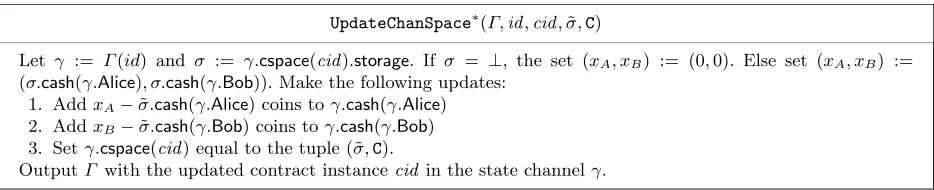
otherwise⊥. Every time a new contract instance in some of the state channels stored in Γ is successfully created (or an existing one is executed), the channels spaceΓ must be updated accordingly. To this end we define an auxiliary procedureUpdateChanSpace. The procedure takes as input a channel spaceΓ, a channel identifier id, a contract instance identifier cid, a new contract instance ν and two values addA and addB representing the required change in the cash values of the state channel with identifierid. The procedure sets Γ(id).cspace(cid) :=ν, addsaddA coins toΓ(id).cash(A) and addsaddB coins toΓ(id).cash(B). Finally, it outputs the updated channel spaceΓ. In Fig. 5 we define the procedure formally.
UpdateChanSpace(Γ,id,cid,˜σ,C,addA,addB)
Letγ:=Γ(id) andσ:=γ.cspace(cid).storage. Make the following updates: 1. AddaddAcoins toγ.cash(γ.Alice)
2. AddaddB coins toγ.cash(γ.Bob)
3. Setγ.cspace(cid) equal to the tuple (˜σ,C).
OutputΓ with the updated contract instancecid in the state channelγ.
4.2 The ideal functionality
We denote the state channel ideal functionality byFLb(∆)
ch (i,C), wherei∈Nis the maximal length of a state channel that can be opened via the functionality, and C denotes the set of contract codes whose instances can be created in the state channels. The ideal functionalityFLb(∆)
ch (i,C) communicates with parties from the setP, and has access to the global ideal functionalityLb(the ledger).F
b L(∆)
ch (i,C) maintains a channel space Γ containing all the open state channels. The set Γ is initially empty.
Since inputs of parties and the messages they send to the ideal functionality do not contain any private information, we implicitly assume that the ideal functionality forwards all messages it receives to the simulator
Sim. More precisely, upon receiving the messagemfrom partyP the ideal functionality sends the message (P, m) to the simulator. The task of the simulator is to instruct the ideal functionality to make changes on the ledger and to output messages to the parties in the correct round (both depends on the choice made by the adversary Adv in the real world). In the description of the ideal functionality, we do not explicitly mention these instructions of Sim, but instead use the following abbreviation. By saying “wait for at most ∆rounds to remove/addxcoins fromP’s account on the ledger” we mean that the ideal functionality waits until it is instructed by the simulator, which will happen within at most∆rounds, and then request changes ofP’s account on the ledger. Let us emphasize this abbreviated notation does not affect the reactive nature of the ideal functionality (meaning that every action of the functionality has to be triggered by some other entity).
We present the formal definition of the FLb(∆)
ch (i,C) functionality in Fig. 6 (the constants that appear in the formal description follow from the technical details of our protocols, see Sec. 6.3 and Sec. 7.2. Here we provide some intuitions behind this definition, informally introduce the restrictions on the environment (see Sec. 3.3) whose full list is given in Appx. B, and argue why the ideal functionality satisfies all the security and efficiency properties stated in Sec. 3.2.
State channel creation The FLb(∆)
ch (i,C) functionality consists of two “state channel creation” procedures: one for ledger and one for virtual state channels. The ledger state channel creation procedure starts with a “create” message fromA(without loss of generality we assume thatAalways initiates the creation process). The functionality removes the coins thatAwants to deposit in the ledger state channel fromA’s account on the ledger, and waits forBto declare that he wants to create the ledger state channel as well. If this happens within∆rounds, thenB’s coins are removed from the ledger and the ledger state channel is created which is communicated to the parties with the “created” message. OtherwiseAcan get her money back by sending a “refund” message. Since both parties have to send the message “create”, theconsensus on creation security property is clearly satisfied for ledger state channels.
The creation procedure for a virtual state channelγ works slightly differently since its effects are visible on the subchannels of γ. The intention to create γ is expressed by P ∈ γ.end–users∪ {I} by sending a “create” message to the functionality. Once such a message is received fromP, the coins that are needed to create γ are locked immediately in the corresponding subchannel of γ (ifP =I, then coins are locked in both subchannels ofγ). If the functionality receives the “create” messages from all three parties within three rounds, then the virtual state channel is created, which is communicated to γ.end–users by the “created” message.14Thus, theconsensus on creation security property is satisfied also for virtual state channels and since the successful creation takes three rounds, theconstant round virtual state channel creation holds as well.
After the virtual state channel is created, γ.end–userscan use it until roundγ.validity. When this round comes, the parties initiate the closing procedure. The functionality then distributes the coins of γ back to its subchannels according to the balance inγ’s last version. In case there existscid such thatγ.cspace(cid) is a contract instance with locked coins, then all of these coins go back to I inboth subchannels ofγ. This 14
FunctionalityFLb(∆)
ch (i,C)
This functionality accepts messages from parties inP. We use the abbreviated notation defined in Sec. 4.1. Ledger state channel creation
Upon (create, γ)←−τ0- Awhereγ is a ledger state channel:
1. Within∆rounds removeγ.cash(A) coins fromA’s account onLb.
2. If (create, γ) ←−−−−−−τ1≤τ0+∆- B, remove within 2∆roundsγ.cash(B) coins fromB’s account onLband then setΓ(γ.id) :=γ, send (created, γ),−→γ.end–usersand stop.
3. Otherwise upon (refund, γ)←−−−−−>τ0+2∆- A, within∆rounds addγ.cash(A) coins toA’s account onLb.
Virtual state channel creation
1. Upon (create, γ)←−- P, whereP ∈γ.end–users∪ {I}, record the message and proceed as follows:
– IfP ∈ γ.end–usersproceed as follows: If you have not yet received (create, γ) fromI, then removeγ.cash(P) coins fromP’s balance inγ.subchan(P) andγ.cash(γ.other-party(P)) coins fromI’s balance inγ.subchan(P).
– If P =I, then for both P ∈ γ.end–users proceed as follows: If you have not yet received (create, γ) from P then remove γ.cash(P) coins from P’s balance in γ.subchan(P), and γ.cash(γ.other-party(P)) coins from I’s balance in
γ.subchan(P).
2. If within 3 rounds you record (create, γ) from all users inγ.end–users∪{γ.Ingrid}, then defineΓ(γ.id) :=γ, send (created, γ)
,−→ γ.end–users and wait for channel closing in Step 4 (in the meanwhile accepting the update and execute messages concerningγ).
3. Otherwise wait until roundγ.validity. Then within 2·(TimeExeReq(dj/2e) + TimeExe(dj/2e)) rounds, wherej:=γ.length, refund the coins that you removed from the subchannels in Step 1.
Automatic closure of virtual state channelγwhen roundγ.validitycomes:
4. Let j := γ.length. Within 2·(TimeExeReq(dj/2e) + TimeExe(dj/2e)) rounds proceed as follows. Let ˆγ be the current version of the virtual state channel, i.e. ˆγ:=Γ(γ.id), and let ˆcA:= ˆγ.cash(A) and ˆcB:= ˆγ.cash(B).
5. Add ˆcA coins toA’s balance and ˆcB coins toI’s balance inγ.subchan(A). Add ˆcAcoins toI’s balance and ˆcB coins toB’s balance inγ.subchan(B). If there existscid∈ {0,1}∗
such thatσcid:= ˆγ.cspace(cid).storage6=⊥and ˆc:=σcid.locked>0,
then add ˆccoins toI’s balance in bothγ.subchan(A) andγ.subchan(B). Erase ˆγ fromΓ and (closed, γ.id),−→γ.end–users. Contract instance update
Upon (update,id,cid,σ,˜ C)←−τ0- P, letγ:=Γ(id),j=γ.length. IfP6∈γ.end–usersthen stop. Else proceed as follows:
1. Send (update–requested, id,cid,σ,˜ C),−−−→τ0+1 γ.other–party(P) and set T :=τ0+ 1 in optimistic case when both parties in
γ.end–usersare honest. Else ifj= 1, setT :=τ0+ 3∆+ 1 and ifj >1, setT :=τ0+ 4·TimeExeReq(dj/2e) + 1. 2. If (update–reply,ok,id,cid)←−−−τ1≤T- γ.other–party(P), then set Γ :=UpdateChanSpace(Γ,id,cid,˜σ,C,addA,addB), where
addA :=−˜σ.cash(A) ifγ.cspace(cid) =⊥and addA :=σ.cash(A)−σ.˜cash(A) otherwise forσ:=γ.cspace(cid).storage.
The valueaddB is defined analogously. Then send (updated,id,cid),−−−→τ1+1 γ.end–usersand stop.
Contract instance execution
Upon (execute,id,cid, f, z)←−τ0- P, letγ:=Γ(id) andj=γ.length. IfP6∈γ.end–usersthen stop. Else setT1 andT2 as: – In the optimistic case when both parties inγ.end–usersare honest, setT1:=τ0+ 4 andT2:=τ0+ 5.
– In the pessimistic case when at least one party in γ.end–users is corrupt, set T1, T2 :=τ0 + 4∆+ 5 if j = 1 and set
T1 :=τ0+ 2·TimeExeReq(dj/2e) + 5,T2:=τ0+ 4·TimeExeReq(dj/2e) + 5 ifj >1. 1. In roundτ1≤T1, send (execute–requested,id,cid, f, z)
τ1
,−→γ.other–party(P).
2. In round τ2 ≤T2, letγ :=Γ(id), ν:=γ.cspace(cid), σ:=ν.storage, and τ :=τ0 ifP is honest and elseτ is set by the simulator. Compute (˜σ,addL,addR, m) :=f(σ, P, τ, z). Ifm=⊥, then stop. Else setΓ :=UpdateChanSpace(Γ,id,cid,˜σ, ν.code,addL,addR) and send (executed,id,cid,σ,˜ addL,addR, m)
τ3
,−→γ.end–users.
Ledger state channel closure
Upon (close, id)←−τ0- P, letγ=Γ(id). IfP6∈γ.end–usersthen stop. Else wait at most 7∆rounds and distinguish the following two cases:
1. If there existscid∈ {0,1}∗ such thatσcid:=γ.cspace(cid).storage6=⊥andσcid.locked6= 0, then stop.
2. Otherwise wait up to∆rounds to addγ.cash(A) coins to A’s account andγ.cash(B) coins to B’s account on the ledger
L. Then setΓ(id) :=⊥, send (closed, id),−−−−−−−→τ2≤τ0+8∆ γ.end–usersand stop.
is to guarantee thatI never loses coins even if end-users of γdo not terminate their contract instance inγ beforeγ.validity. See Appx. C for a formal proof of thebalance security property.
In both cases (“ledger” and “virtual”) we assume that all the honest parties involved in channel creation initiate the procedure in the same round and that they have enough funds for the new state channel. In case of a virtual state channel, we additionally assume that the length of its two subchannels differ at most by one.15
Contract instance update The procedure for updating a contract instance is identical for ledger and virtual state channels (this procedure is also used for creating new contract instances). It is initiated by a party
P ∈γ.end–usersthat sends an “update” message to the ideal functionality. This message has parametersid
andcid that identify a state channelγand a contract instance in this state channel (respectively). The other parameters, ˜σ and C, denote the new storage and code of the contract instance. The party Q :=γ.other–
party(P) is asked to confirm the update via an “update-requested” message. If Qreplies with an
“update-reply” message within 1 round if both parties are honest and within T rounds otherwise (where T is a function of state channel length, see Step 2), the contract instance with identifiercid inγgets replaced with a contract instance determined by the tuple (˜σ,C). In the next round, both parties inγ.end–usersget notified via an “updated” message. Note thatQalways has to confirm the update which implies the consensus on update security property. The constant round optimistic update efficiency property holds as well since the update takes exactly 2 rounds if both parties are honest.
We assume that the environment never asks the parties to do obviously illegal things, like updating a contract instance in a state channel that does not exits, or creating a contract instance when there are not enough coins in the subchannels. Moreover, we assume that the environment never asks to update a contract instance when it is already being updated or executed.16
Contract instance execution The procedure for executing a contract instance is initiated by one of the parties
P ∈γ.end–users that sends an “execute” message to the ideal functionality in round τ0. This message has
parameters id and cid whose meaning is as in the update procedure. Other parameters are: f denoting the contract function to be executed, andz which is an additional input parameter to the functionf. The execution results in updating the contract instance with identifiercid according to the result of computing f(σ, P, τ, z), where σ is the current storage of the contract instance and τ := τ0 in case P is honest and determined by the simulator otherwise. The other party of the state channel is notified about the execution request before roundτ0+ 5 in the optimistic case and before roundτ0+T1otherwise. Both parties from the setγ.end–userslearn the result of the execution before roundτ0+ 5 in the optimistic case (which implies the constant round optimistic execute) and before roundτ0+T2otherwise. The valuesT1andT2are functions of state channel length, see the formal description in Fig. 6. Observe that contract instance execution initiated by partyP doesnotrequire approval of the other party of the channel (although the other party is informed about the execution request). This implies that theguarantee of execution security property is satisfied.
We would like to emphasize that if two different execute messages are received by the ideal functionality at the same time (or not too many rounds from each other), then it is up to the adversary to decide which function is executed first.17 Designers of contract codes and users of the protocols should be aware of this possible asynchronicity.
Ledger state channel closure The procedure for closing a ledger state channelγstarts when a partyP ∈γ.end–
userssends to the ideal functionality a message (close, id), where id is the identifier of ledger state channel
γ to be closed. The functionality checks (in Step 1) if there are no contract instances that are open over γ. If not, then in Step 2 the functionality distributes the coins fromγto the ledger accounts of the parties 15
As discussed in Sec. 2, we make this assumption to achieve pessimistic time complexity which is linear in the state channel length.
16
Although we forbid parallel updates of thesame contract instance, we do not make any restrictions about parallel updates of two different contract instances even if they are in the same ledger state channel. This in particular means that we allow concurrent creation of virtual state channels.
17
according to γ’s latest balance, and notifies the parties about a successful closure. The restrictions on the environment in case of the contract instance execution and ledger state channel closure are straightforward (see Appx. B).
4.3 Using the state channel ideal functionality
Let us now demonstrate how to use our ideal functionality for generalized state channel networks in practice. We do it on a concrete example of the two party lottery (already discussed in Sec. 2). The first step is to define a contract code Clot(i) which allows two parties to play the lottery in a state channel of length at mosti. A contract storageσ ofClot(i) has, in addition to the mandatory attributesσ.userL, σ.userR, σ.cash
and σ.locked (see Sec. 4.1), the attribute σ.start ∈ N, whose purpose it to store the construction round,
the attribute σ.com ∈ {0,1}∗, to store the commit value when submitted by σ.user
L, and the attribute σ.bit∈ {0,1} to store the secret bit when provided byσ.userR.
The contract code has one constructor Initlot which generates the initial contract storageσsuch that both σ.cash(σ.userL) andσ.cash(σ.userR) are equal to 1 (each user deposits 1 coin). The contract functions are: (i) Comwhich, if executed by σ.userL on inputc, storesc in σ.com, (ii) Reveal which, if executed by σ.userR on input rB, stores rB in σ.bit, (iii)Open which allowsσ.userL to open the commitment stored in σ.com and pays out 2 coins to the winner, and (iv) Punish which allows a party to unlock coins from the contract instance in case the other party misbehaves. See Appx. D for a formal definition ofClot(i).
Assume now that parties Alice and Bob have a virtual state channelγcreated via the ideal functionality
FLb(∆)
ch (i,C), whereClot(i)∈ C. If Alice wants to play the lottery usingγ, she first locally executes the construc-torInitlotto obtain the initial contract storageσ. Then she sends the message (update, γ.id,cid, σ,Clot(i)) toFLb(∆)
ch (i,C) for some contact instance identifiercid never used before. The ideal functionality informs Bob about Alice’s intention to play by sending the message (update–requested, γ.id,cid, σ,Clot(i)) to him. If Bob agrees with playing the game, he sends the reply (update–reply,ok, γ.id,cid). Alice and Bob can now start playing in a way we describe below (letτ0be the current round).
1. Commit: In roundτ0 Alice locally chooses a random bitrA∈ {0,1} and a random strings∈ {0,1}λ, where λis the security parameter, locally computes the commit value c using the randomnesss. Then she submitscby sending the message (execute, γ.id,cid,Com, c) to the ideal functionality.
2. Reveal:If before roundτ0+ TimeExe(i) Bob receives a message from the ideal functionality that Alice committed to her secret bit, Bob locally chooses a random bit rB ∈ {0,1} which he submits by sending the message (execute, γ.id,cid,Reveal, rB) to the ideal functionality. Otherwise, in round τ0 + Time Exe(i), he sends the message (execute, γ.id,cid,Punish,⊥) to the ideal functionality to unlock all coins from the lottery contract by which he punishes Alice for her misbehavior.
3. Open: If before round τ0+ 2·TimeExe(i) Alice receives a message from the ideal functionality that Bob reveled his secret bit rB, she opens her commitment by sending (execute, γ.id,cid,Open,(rA, s)). Otherwise, in roundτ0+ 2·TimeExe(i), she sends the message (execute, γ.id,cid,Punish,⊥) to unlock all coins from the lottery contract by which she punishes Bob for his misbehavior.
4. Finalize: If until roundτ0+ 3·TimeExe(i) Bob did not receive a message from the ideal functionality that Alice opened her commitment, Bob sends the message (execute, γ.id,cid,Punish,⊥) to the ideal functionality to unlock all coins from the lottery contract and finalize the game.
5
An overview of our approach
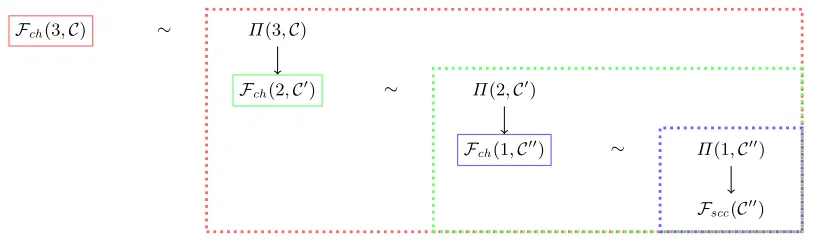
In this section we provide a high level idea of the modular design of our protocol realizing the state channel ideal functionalityFLb(∆)
ch (i,C) (the main ideas behind our construction were already presented in Sec. 2). Ledger state channels Our first step is to define an ideal functionalityFLb(∆)