ISSN(Online): 2320-9801 ISSN (Print): 2320-9798
I
nternational
J
ournal of
I
nnovative
R
esearch in
C
omputer
and
C
ommunication
E
ngineering
(An ISO 3297: 2007 Certified Organization)
Vol. 3, Issue 5, May 2015
3-Dimensional Face Recognition Using Pose
and Illumination Compensation
K.Rajakumari
1, C. Nalini
21Research Scholar &Asst Professor, Dept. of CSE, Bharath University, Chennai, Tamil Nadu, India
2Associate Professor, Dept. of CSE, Bharath University, Chennai, Tamil Nadu, India
ABSTRACT: The 3D Face recognition is one of the most challenging applications in the image processing concepts. The face recognition system using a combination of pose, color, position, illumination, size, shape of a person's nose,
eyes, jaw and cheekbones, and depth images. The cope with illumination and pose variations 3D information is used
for the normalization of the input images. The proposed pose compensation algorithm is based on a robust 3D face detection and pose estimation technique, while illumination compensation exploits depth data to recover the
illumination of the scene and relight the image under frontal lighting. One of the impediments to developing improved
face recognition is the lack of data. The Face Recognition challenge problems include sufficient data to overcome this
impediment. When normalized images, depicting upright orientation and frontal lighting, are used for classification
significantly high recognition rates are achieved, as established on a face database with more than 2000 images.
KEYWORDS: Eigen Face, Embedded Hidden Markov Model algorithm, Robust Algorithms, 3-Dimensional Pose & illumination, Support Vector Machines.
1. INTRODUCTION
The most recent evaluation of commercial face recognition systems shows the level of performance for face verification of the best systems to be on par with fingerprint recognizers for frontal, uniformly illuminated faces. Recognizing faces reliably across changes in pose and illumination has proved to be a much harder problem [10, 13]. While the majority of research has so far focused on frontal face recognition, there is a sizable body of work on pose invariant face recognition and illumination invariant face recognition. However, face recognition across pose and illumination has received very little attention.
The paper describes and evaluates a complete face identification system using a combination of 2D color and 3D range images captured in real-time. We present several novel techniques which are capable, taking as input a pair of 2D and 3D images, to produce a pair of normalized images depicting frontal pose and illumination. The efficiency and robustness of the proposed system is demonstrated on a data set of significant size and compared with state-of-the-art compensation techniques.
Although the 3D structure of the human face conveys important discriminatory information only a few techniques have been proposed employing range images. This is mainly due to the high cost of available 3D digitizers and the fact that they do not operate in real time (e.g. time of flight laser scanners) or produce inaccurate depth information (e.g. stereo vision). The work presented in this paper is partly motivated by the recent development of novel low cost 3D of low-cost sensors that are capable of real-time 3D acquisition [1]. A common approach adopted towards 3D face recognition is based on the extraction of 3D facial features by means of differential geometry techniques [2–4]. A few techniques [5,6] also employ grayscale images but mainly for augmenting the detection of features such as the eyes that are harder to detect on the range image. Although feature-based techniques are robust to pose variations they rely on accurate 3D maps of faces, usually extracted by expensive off-line 3D scanners. Thus their applicability to real-world applications with highly noisy data is questionable.
ISSN(Online): 2320-9801 ISSN (Print): 2320-9798
I
nternational
J
ournal of
I
nnovative
R
esearch in
C
omputer
and
C
ommunication
E
ngineering
(An ISO 3297: 2007 Certified Organization)
Vol. 3, Issue 5, May 2015
persons) containing both grayscale and range images, and produced comparative results of face identification using eigen faces for 2D, 3D and their combination and for varying image quality. This test however considered only frontal images captured under constant illumination conditions. For this work we have recorded a face database containing several appearance variations. These variations are compensated before reaching the classifier, thus leading to high recognition rates. The main drawbacks to face recognition are its current relatively low accuracy(compared to the proven performance of fingerprint and iris recognition)[4].
Handling of such variability inevitably leads to failures in recognition. These include:
Physical changes: facial expression change; aging; personal appearance (make-up, glasses, facial hair, hairstyle, disguise).
Acquisition geometry changes: change in scale, location and in-plane rotation of the face (facing the camera) as well as rotation in depth (facing the camera obliquely, or presentation of a profile, not full-frontal face).
Imaging changes: lighting variation; camera variations; channel characteristics (especially in broadcast, or compressed images).
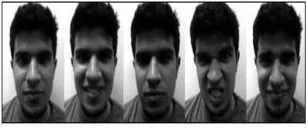
Fig 1 : Face image of a single subject with 5 different facial Images
II. ACQUISITION OF 3D DATA
The proposed system is based on real-time quasi-synchronous color and 3D image acquisition based on the color structured light approach [1]. The sensor is based on low cost devices, an off-the-shelf CCTV-color camera and a standard slide projector. The average depth accuracy of the system optimized for an access control application is about
0:5mm. The spatial resolution of the range images is approximately equal to the color camera resolution.
Using the above setup a face database was recorded. For each subject several images depicting different appearance variations were acquired: three facial expressions, three types of illumination (left/right side spot lights and overhead light), two pose variations (§20 degrees), two images with and without glasses, and three frontal images. The database
contains 20 persons and 2 recordings with time lapse between each recording session about 10 days (2200 image pairs).
III. POSE COMPENSATION
The aim of the pose compensation algorithm described in this section is to generate, given a pair of color and depth images, novel corresponding color and depth images depicting a frontal, upright face orientation. Also the center of the face on the input image is aligned with the center of the face in the gallery images of the same person with pixel accuracy.
The proposed technique uses the range image only for face detection and pose estimation and therefore is robust especially under varying pose and illumination conditions, as demonstrated by the experimental results.
ISSN(Online): 2320-9801 ISSN (Print): 2320-9798
I
nternational
J
ournal of
I
nnovative
R
esearch in
C
omputer
and
C
ommunication
E
ngineering
(An ISO 3297: 2007 Certified Organization)
Vol. 3, Issue 5, May 2015
The estimation of 3D head pose, performed next is based on the detection of the nose [9]. After the tip of the nose is localized a 3D line is fitted on the 3D coordinates of pixels on the ridge of the nose. This 3D line defines two of the three degrees of freedom of the face orientation. The third degree of freedom, that is the rotation angle around the nose axis, is then estimated by finding the 3D plane that cuts the face into two bilateral symmetric parts. The error of the above pose estimation algorithm tested on more than 2000 images is less than 2 degrees.
Once the tip of the nose and the pose of the face have been estimated, a 3D coordinate frame aligned with the face is defined centered on the tip of the nose. A warping procedure is subsequently applied on the input depth image to align this local coordinate frame with a reference coordinate frame, which is defined during the training faces using the gallery images, bringing the face in up-right orientation. The transformation between the local and reference coordinate frames is further refined to pixel accuracy by applying the ICP [9] surface registration algorithm between the warped and a reference (gallery) depth image corresponding to claimed person ID.
The rectified depth image contains missing pixel values that are interpolated using a series of steps. Some of the missing values are determined simply by copying corresponding symmetric pixel values from the other side of the face. Remaining missing pixel values are linearly interpolated from neighboring points. The interpolated depth map is subsequently used to rectify the associated color image also using 3D warping (fig. 2).
(a) (b)
(c) (d) (e) (f)
Fig. 2. Pose compensation example. (a) Original color image, (b) original depth image showing detected head blob and estimated local coordinate system fixed on the nose, (c) rectified depth image, (d) symmetry-based interpolation, (e) final linear interpolated depth image, (f) rectified color image.
The proposed pose compensation algorithm is very ac-curate as will be demonstrated in 5 but also computationally efficient, with total running time is less than 1 sec on a Pentium III 1 Ghz computer.
IV. ILLUMINATION COMPENSATION
In this section an algorithm is described that compensates illumination by generating from the input image a novel image relight from a frontal direction. Our approach is inspired by recent work on image-based scene relighting used for rendering realistic images. Image relighting relies on inverting the rendering equation, i.e. the equation that relates the image brightness with the object material and geometry and the illumination of the scene. Given several images of the scene under different conditions this equation may be solved (although an ill-posed problem) to recover the illumination distribution and then use this to re-render the scene under novel illumination.
ISSN(Online): 2320-9801 ISSN (Print): 2320-9798
I
nternational
J
ournal of
I
nnovative
R
esearch in
C
omputer
and
C
ommunication
E
ngineering
(An ISO 3297: 2007 Certified Organization)
Vol. 3, Issue 5, May 2015
face illuminated from different directions. The set of light source directions is uniformly sampled from a section of the positive hemisphere. To decrease the dimensionality of the problem, from each rendered image a feature vector is extracted containing locally weighted averages of image brightness over M preselected image locations (M= 30 in
our experiments). The sample locations are chosen so as to include face areas with similar albedo (i.e. the skin). Feature vectors xi; i= 1; : : : ; N extracted from all the images, normalized to have zero mean and unit variance, are then used
as samples of the M-dimensional illuminant direction function.
An approximation of this function ~
L = G(x) G using the samples is a regression problem that may be efficiently solved using Support Vector Machines (SV M) [10]. Assume now that we want to compute the similarity between a pose compensated probe image and gallery images of a person j in the gallery. A feature vector x is computed from the
probe image as described previously. Then an estimate of the light source direction is given
by ~j i.e. the G (x)
SVM regression function computed for the person j during the training phase.
Given the estimate of the light source direction L re-lighting the input image with frontal illumination L0 is
straight-forward. Let I C , I D be respectively the input pose compensated color and depth images and ~C the illumination
compensated image. Then the image irradiance for each pixel u is approximated by,
~
IC(u) = A(u)R(ID; L; u); IC(u) = A(u)R(ID; L0; u)
(1) where A is the unknown face albedo or texture function (geometry independent component) and R is a rendering of
the surface with constant albedo. Equation 1 is written
R(ID; L; u)
~
IC (u) = IC (u)R(ID; L0; u)
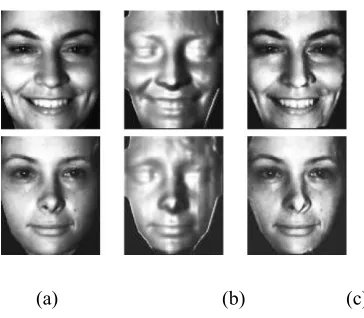
i.e. the illumination compensated image is given by multi-plication of the input image with a ratio image.
(a) (b) (c)
Fig. 3. Illumination compensation example. (a) Originalimage, (b) R(ID;L;u), (c) frontally illuminated image
ISSN(Online): 2320-9801 ISSN (Print): 2320-9798
I
nternational
J
ournal of
I
nnovative
R
esearch in
C
omputer
and
C
ommunication
E
ngineering
(An ISO 3297: 2007 Certified Organization)
Vol. 3, Issue 5, May 2015
The same relighting procedure is also applied on training images. Then it is expected that illumination compensated probe and gallery images of the same person will only differ up to a scale factor since the intensity of the light source may not be recovered. This scale factor is cancelled by taking the logarithm of the images (that makes the factor additive instead of multiplicative) and subsequently subtracting the mean value.
Although the description of above relighting technique considers a single channel image, color images may be handled equally well by applying the same procedure (illuminant estimation and relighting) separately for each channel.
An important advantage of the previously described algorithm is the flexibility in coping with complex illumination conditions by adaptation of the rendering function R above. For example, accounting for attached shadows may be simply achieved by activating shadowing in the render-ing engine. On the other hand, from our experience with different rendering models, good results may be also ob-tained with relatively simple renderings.
V. EXPERIMENTAL RESULTS
The focus of the experimental evaluation was to investigate the improvement achieved by incorporating the proposed pose and illumination schemes into state-of-the-art 2D face recognition algorithms. We have therefore used the Embedded Hidden Markov Model algorithm [11] as a baseline classification algorithm. Two such classifiers are used, one for color images (for practical reason only the red component of the color images was used) and one for depth images. The results of each classifier is a similarity measure for every person in the database. Using the similarity measures associated with color and depth images respectively a combined similarity measure is obtained using the product rule [12].
We have performed several experiments using images of the recorded face database. Training of the classifier was performed using images from the first recording session. On average 3 images per subject depicting different facial ex-pressions were used for training. Testing was performed using all images of the second recording session.
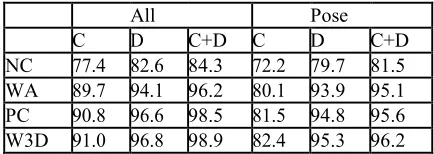
Table 1 Demonstrates the recognition rates achieved with the proposed compensation scheme. This is compared with the case that no compensation is performed (the face detection algorithm in [11] was applied in this case), and with manual pose normalization i.e. three points over the eyes and mouth were selected by a human operator and used to rectify the images. Rectification in this case is performed either by 2D affine warping of the images or by 3D warping using depth information as described in section 3.As shown in table 1 the proposed scheme results in significant im-provements in the recognition accuracy and its very close to the accuracy achieved by manual image normalization.
All Pose
C D C+D C D C+D
NC 77.4 82.6 84.3 72.2 79.7 81.5
WA 89.7 94.1 96.2 80.1 93.9 95.1
PC 90.8 96.6 98.5 81.5 94.8 95.6
W3D 91.0 96.8 98.9 82.4 95.3 96.2
Table 1. Recognition rates for pose compensation schemes (Color images: C, depth images: D, color + depth: C+D), NC: no compensation, WA: affine warping with manually selected feature points, PC: proposed pose compensation al-Algorithm, W3D: 3D warping with manually selected feature points. The first three columns correspond to all images in the database and the rest three columns correspond to im-ages with large face orientation angle[14][15].
VI. CONCLUSION
The above is a walkthrough some of the researches in the face recognition methods. we have proposed a new approach
for 3D face recognition based on automatic image normalization algorithms exploiting the availability of 3D
ISSN(Online): 2320-9801 ISSN (Print): 2320-9798
I
nternational
J
ournal of
I
nnovative
R
esearch in
C
omputer
and
C
ommunication
E
ngineering
(An ISO 3297: 2007 Certified Organization)
Vol. 3, Issue 5, May 2015
has limitation to total number of persons it can remember. The advancement of computing field has urged a strong
desire for automated recognition methods and hence this is still a continual process.We hope in further improvement of
these results in the future using model-based image warping for pose compensation and also by the investigation of efficient reflectance estimation techniques to further enhance illumination compensation.
REFERENCES
[1] F. Forster, P. Rummel, M. Lang, and B. Radig, “The hiscore camera: a real time three dimensional and color camera,” in Proc. Int. Conf. Image Processing, Oct. 2001, vol. 2, pp. 598–601.
[2] Udayakumar R., Khanaa V., Saravanan T., "Chromatic dispersion compensation in optical fiber communication system and its simulation", Indian Journal of Science and Technology, ISSN : 0974-6846, 6(S6) (2013) pp. 4762-4766.
[3] G.G. Gordon, “Face recognition based on depth and curvature features,” in Proc. of IEEE Computer Society Conf. on Computer Vision and Pattern Recogni-tion, CVPR ’92, 1992, pp. 808–810.
[4] Kumar S., Das M.P., Jeyanthi Rebecca L., Sharmila S., "Isolation and identification of LDPE degrading fungi from municipal solid waste", Journal of Chemical and Pharmaceutical Research, ISSN : 0975 – 7384 5(3) (2013) pp.78-81.
[5] H. T. Tanaka, M. Ikeda, and H. Chiaki, “Curvature-based face surface recognition using spherical corre-lation. principal directions for curved object recogni-tion,” in Proc. 3rd IEEE Int. Conf. on Automatic Faceand Gesture Recognition, 1998, pp. 372–377.
[6] Udayakumar R., Khanaa V., Saravanan T., "Analysis of polarization mode dispersion in fibers and its mitigation using an optical compensation technique", Indian Journal of Science and Technology, ISSN : 0974-6846, 6(S6) (2013) pp. 4767-4771.
[7] C.-S. Chua, F. Han, and Y.-K. Ho, “3d human face recognition using point signature,” in Proc. 4th IEEEInt. Conf. on Automatic Face and Gesture Recognition,2000, pp. 233–238.
[8] Sundar Raj M., Arkin V.H., Adalarasu, Jagannath M., "Nanocomposites based on polymer and hydroxyapatite for drug delivery application", Indian Journal of Science and Technology, ISSN : 0974-6846, 6(S5) (2013) pp.4653-4658.
[9] Y. Wang, C.-S. Chua, Y.-K. Ho, and Y. Ren, “In-tegrated 2d and 3d images for face recognition,” in Proc. 11th Int. Conf. on Image Analysis and Process-ing, 2001, pp. 48–53.
[10] Udayakumar, R., Khanaa, V., Saravanan, T., "Synthesis and structural characterization of thin films of sno2 prepared by spray pyrolysis technique", Indian Journal of Science and Technology, ISSN : 0974-6846, 6(S6) (2013) pp.4754-4757.
[11] S. Tsutsumi, S. Kikuchi, and M. Nakajima, “Face identification using a 3d gray-scale image-a method for lessening restrictions on facial directions,” in Proc.3rd IEEE Int. Conf. on Automatic Face and Gesture Recognition, 1998, pp. 306–311.
[12] K. Chang, K. Bowyer, and P. Flynn, “Face recog-nition using 2d and 3d facial data,” in Proc. Multi-modal User Authentication Workshop, Santa Barbara,December 2003, to appear.
[13] B.Vamsi Krishna, Significance of TSC on Reactive power Compensation, International Journal of Advanced Research in Electrical, Electronics and Instrumentation Engineering, ISSN (Online): 2278 – 8875,pp 7067-7078, Vol. 3, Issue 2, Febuary 2014
[14] B.Vamsi Krishna, Realization of AC-AC Converter Using Matrix Converter, International Journal of Advanced Research in Electrical, Electronics and Instrumentation Engineering, ISSN (Online): 2278 – 8875,pp 6505-6512, Vol. 3, Issue 1, January 2014
[15] D.Sridhar raja, Comparison of UWB Band pass filter and EBG embedded UWB Band pass filter, International Journal of Advanced Research in Electrical, Electronics and Instrumentation Engineering, ISSN 2278 – 8875,pp 253-257 ,Vol. 1, Issue 4, October 2012
[16] D.Sridhar raja, Performances of Asymmetric Electromagnetic Band Gap Structure in UWB Band pass notch filter, International Journal of Advanced Research in Electrical, Electronics and Instrumentation Engineering, ISSN (Online): 2278 – 8875,pp 5492-5496, Vol. 2, Issue 11, November 2013
[17] Dr.S.Senthil kumar, Geothermal Power Plant Design using PLC and SCADA, International Journal of Advanced Research in Electrical, Electronics and Instrumentation Engineering, ISSN 2278 – 8875,pp 30-34, Vol. 1, Issue 1, July 2012
[18] S. Malassiotis and M. G. Strintzis, “Real-time head tracking and 3d pose estimation from range data,” inProc. Int. Conf. Image Processing, Barcelona, Spain,September 2003.
[19] P. J. Besl and N. D. McKay, “A method for registration of 3-d shapes,” IEEE Trans. Pattern Anal. and Mach.Intell., vol. 14, no. 2, pp. 239– 256, February 1992.