Content-Based Image Retrieval Based on Late
Fusion of Binary and Local Descriptors
Nouman Ali
1,2,*, Danish Ali Mazhar
2, Zeshan Iqbal
2, Rehan Ashraf
1,
Jawad Ahmed
3and Farrukh Zeeshan Khan
21
Department of Computer Science, National Textile University, Faisalabad,
Pakistan; [email protected]
2
Faculty of Telecommunication & Information Engineering, University of
Engineering & Technology, Taxila, Pakistan;
[email protected] (D.A.M.); [email protected] (Z.I.);
[email protected] (F.Z.K.)
3
Department of Basic Sciences, University of Engineering & Technology, Taxila,
Pakistan; [email protected]
* Correspondence: [email protected]
Abstract
One of the challenges in Content-Based Image Retrieval (CBIR) is to reduce the semantic gaps
between low-level features and high-level semantic concepts. In CBIR, the images are represented in
the feature space and the performance of CBIR depends on the type of selected feature representation.
Late fusion also known as visual words integration is applied to enhance the performance of image
retrieval. The recent advances in image retrieval diverted the focus of research towards the use of binary
descriptors as they are reported computationally efficient. In this paper, we aim to investigate the late
fusion of Fast Retina Keypoint (FREAK) and Scale Invariant Feature Transform (SIFT). The late fusion
of binary and local descriptor is selected because among binary descriptors, FREAK has shown good
results in classification-based problems while SIFT is robust to translation, scaling, rotation and small
distortions. The late fusion of FREAK and SIFT integrates the performance of both feature descriptors
for an effective image retrieval. Experimental results and comparisons show that the proposed late fusion
enhances the performances of image retrieval.
I. INTRODUCTION
In image classification and retrieval-based problems, the extraction of a meaningful image
descriptor is an open research problem [1]. Due to an increase in the number of image archives, it
is necessary to design an effective system for image search [1], [2]. The conventional
annotations-based approach for image retrieval relies on text and keywords-annotations-based image search [1], [3], [4].
Human manual efforts and difference in the visual perception make the conventional approach
less effective [1], [2]. The modern image search systems retrieve the images on the basis of
image visual contents and this is referred as CBIR [1]. Image retrieval has vast applications
in many domains like image analysis, search of image over internet, medical image retrieval,
remote sensing and video surveillance [1]. The recent research is carried out to enhance the
performance of image retrieval by retrieving the images that are similar to the query image
[1], [5], [6]. In recent few years, different types of image representations are proposed that are
associated with different application domains [1], [2], [7], [8], [9], [10]. In this paper, we are
interested to explore a novel image representation based on the late fusion of binary and local
features. The proposed framework can describe the visual contents in a meaningful way and the
main focus of this research is image retrieval.
In CBIR, the commonly used image representations are mainly based on global and local
features [1], [2], [11]. The global feature representations are based on color, texture and shape
[1]. Color is one of the fundamental image feature and it is not dependent on size, direction
and angle [2]. Color features lack spatial distribution and perceptual meaning [1], [2]. Texture
features are divided into two main classes and texture is extracted to capture the spatial attributes
in the group of pixels [2], [5]. The main limitation of spatial texture techniques is their sensitivity
to noise and distortion [2], [5]. The spectral texture techniques are dependant on shape and have
shown good performance in-case of square regions [5]. The sensitivity to noise and computational
complexity limits the use of texture features in many application domains [2], [5]. According
to Zhang et al. [12], region-based and contour-based are the two main approaches that are
commonly applied to extract shape features. The sensitivity to scaling, translation and rotation
are the main limitations of shape-based image representations [2], [5].
The local feature descriptors like Scale Invariant Feature Transform (SIFT) [13], Speeded-Up
good performance in various applications of image retrieval [7], [16]. Local feature descriptors
are robust to translations, scaling, rotation, and small distortions and are applied in various image
matching applications [7]. According to the recent literature [7], the classification and retrieval
performance of local features is better than global features.
The recent advances in computer vision turned the attention of research to the use of binary
descriptors [7], [17]. Binary Robust Invariant Scalable Keypoints (BRISK) [18], Fast Retina
Keypoint (FREAK) [19], Binary Robust Independent Elementary Features (BRIEF)[20] and
Features from Accelerated Segment Test (FAST) [21] are the examples of binary descriptors.
Local and binary descriptors are used to describe the image information in a high-dimensional
feature space by using keypoints [7]. The late fusion (also known as visual word integration)
based on proper features selection improves the effectiveness of image retrieval. [5], [22], [23].
The performance of FREAK is reported efficient for classification-based problems [7], [17] while
SIFT is robust to translation, scaling, rotation, and small distortions [24].
Due to these facts, in this paper, we investigated the late fusion/visual word integration of
FREAK and SIFT. Binary and local features are extracted from training images. A quanization
algorithm such as k-means is applied to cluster two codebooks (visual vocabularies), that are
based on descriptors of FREAK and SIFT, respectively. The codebooks of binary and local
features are combined to represent an image in a dimension that is twice the size of constructed
vocabulary. The main contributions of the proposed research is the CBIR based on the late fusion
of FREAK (binary descriptor) and SIFT (local descriptor).
The remaining paper is organized as follow: Section II describes the related work. Section III
provides an overview about the proposed research methodology. Section IV presents evaluation
measures and results obtained on three image benchmarks while Section V concludes our work
and points towards the future directions in the research.
II. RELATEDWORK
CBIR is used to search the images that are visually similar to the query image [1], [10],
[25]. Wang et al. [26] proposed Spatial Weighting BOF (SWBOF) by extracting the spatial
information from different sub-blocks of the images. Adjacent block distance, local entropy and
variance are used for the extraction of spatial information. The spatial weighting is achieved
[23] proposed image retrieval by using integration SIFT and Local Binary Pattern (LBP). The
combination of SIFT-LBP is selected to enhance the performance of image retrieval in-case of
noisy background and ambiguous objects. Yu et al. [22] proposed two new image representations
based on early features fusion for an effective image retrieval. The clusters are constructed by
applying a weighted scheme to maintain a balance between two features. The two new feature
integrations are image-based SIFT-LBP and patch-based HOG-LBP. The image-based integration
of SIFT-LBP outperforms the state-of-the-art approaches [22]. Zhang et al. [27] proposed a
rotation invariant image matching system by using combination of SIFT and LBP. The regions
of LBP descriptors are calculated by using SIFT detector. Kabbai et al. [28] proposed a new
approach to extract invariant features from the regions of interest. The uniform pattern is applied
to the LBP and Center Symmetric Local Binary Pattern (CSLBP) for a robust image matching
application.
According to [6], the spatial information can be extracted by dividing an image into Level 1
and Level 2 triangles. Dense SIFT is used for feature extraction and three different classifiers are
applied to determine the best retrieval performance. Zeng et al. [29] proposed an image
repre-sentation that is based on generalized histogram of quantized colors. Gaussian Mixture Models
(GMMs) is applied for quantization and Expectation-Maximization (EM) algorithm is used for
training. Bayesian Information Criterion (BIC) is applied for determination of quantized color
bins. Images are retrieved on the basis of similarity between the respective spatiograms. Walia et
al. [30] proposed a fusion framework for color-based image retrieval. The color and texture are
extracted by applying Color Difference Histogram (CDH) and Angular Radial Transform (ART)
and modification in CDH algorithm is proposed to make it more effective. Dubey et al. [31]
proposed a rotation and scale invariant hybrid image descriptor for an efficient image retrieval.
The color features are extracted by quantizing RGB color space while texture is extracted by
structuring the patterns that are generated from locally structured elements. Color and textural
are integrated to construct the inherently Rotation and Scale-invariant Hybrid image Descriptor
(RSHD). Montazer et al. [32] proposed a new learning method for RBFNNs (Radial Basis
Function Neural Networks). Particle Swarm Optimization (PSO) is applied to initialize the radial
basis function units in more accurate way. The spatial information of the data and non-linearity
of the function are approximated to determine the widths of RBFNNs. According to Wan et al.
can reduce the semantic gaps. CNN model pre-trained on large dataset can be used for feature
extraction and the optimized feature extraction techniques based on deep learning outperforms
conventional features. In our previous work [34], we proposed the visual words integration
(late fusion) of two local features. Different Weighed Averages (WA) of local features are also
calculated to sort out the second best performance for image retrieval. The research presented
in this paper is different from our previous work [34] as in this paper, we replaced SURF
with FREAK to evaluate the late fusion (visual words integration) of SIFT (local descriptor)
with FREAK (binary descriptor). The experimental results demonstrates the dominant effect of
FREAK when used with the late fusion SIFT descriptor.
III. BAG OFFEATURESREPRESENTATION
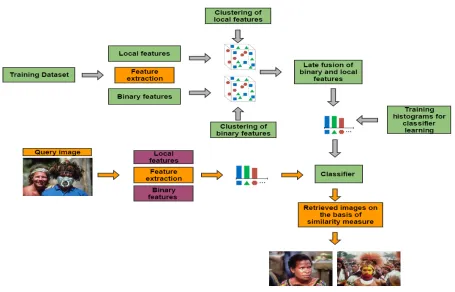
Fig. 1 represents the block diagram of the proposed image representation that is based on
late fusion of binary and local features. The proposed research is based on BoVW image
representation model [35]. The detail about features extraction using FREAK, SIFT and late
fusion of FREAK and SIFT is mentioned in the following sub-sections.
A. Fast Retina Keypoint (FREAK)
FREAK is a binary descriptor that is computed on the basis of brightness comparison tests
around the keypoints and is inspired from the human visual system [19]. In the first step, a
circular sampling grid is applied to generate retinal sampling pattern with higher density of
points near the center . One-bit Difference of Gaussian (DoG) is applied to compute a binary
descriptor. The feature are calculated by applying a saccadic search. In the last step, the sum of
local gradients over selected pairs are used to compute the rotation of keypoints [19].
B. Scale Invariant Feature Transform (SIFT)
There are four main steps that are involved to compute SIFT descriptors [13]. The first step
involves the computation of interest points, for this purpose the Difference of Gaussian (DoG)
is used to produce several Gaussian blurred images. The neighborhood image are compared for
the calculation of DoG. The second step involves the calculation of extrema to find out the
stable keypoints and low contrast and pints along the edges are removed by apply Taylor series.
Fig. 1: Proposed framework based on late fusion of FREAK and SIFT.
achieve rotation invariance, the principal orientation is calculated for the keypoints. The last step
involves the computation of SIFT descriptor. For each keypoint, a set of orientations histograms
are created on 4x4 pixel neighborhoods, with 8 orientation bins [13].
C. Proposed Late Fusion Based on Binary and Local Descriptors
1) In BoVW model, a raw image I is represented as:
I = (ar,s) (1)
where r,s are the pixels of image.
2) Binary and local features (FREAK and SIFT) are extracted from a set of training images
and an image I is represented as:
3) A quantization algorithm such as k-means is applied to construct the codebook (visual
vocabulary) consisting of Z words, represented as CB:
CB ={w1, w2, ...., wZ} (3) where CB is the codebook consisting of wZ visual words, separate codebooks are
con-structed for FREAK and SIFT by extracting the respective features.
4) The features are extracted from the image and quantized in the feature space. Mapping of
each visual word is done over the image areas and the nearest words are assigned to the
quantized descriptors according to the following equation:
w(dm) =argmin w ε CB
Dist(w, dm) (4)
where w(dm) is representing the visual word assigned to the mth descriptor dm while
Dist(w,dm) is the distance between the descriptor dm and visual word w. Each image is
represented as a collection of patches and each patch is represented by a visual word
(visual words of FREAK are mapped on the images by using the codebook of FREAK
while visual words of SIFT are mapped on the images by the using the codebook of SIFT).
5) The histograms consisting of the visual words of FREAK and SIFT are combined and
an image is represented in a dimension that is twice the size of constructed codebook.
Consider Z as the number of visual words of the codebook. Let Fi be the set of the
descriptors that are mapped to the visual word wi then the ith bin of the histogram of
visual words bi, is the cardinality of the set Di.
bi =Card(Fi) and Fi ={dm, m∈(1, ...., Z)|w(dm) = wi} (5) IV. EXPERIMENTAL PARAMETERS AND RESULTS
The proposed late fusion is evaluated by using three image dataset [36], [37], [38]. We used
the image classification parameters as mentioned in [34]. 70% of the images from each class
are selected for training and 30% for testing. Keeping in view, the unsupervised nature of
randomly selected for training and testing. The set of selected images for training are used for
the construction of codebook and image retrieval performance is reported by using the images
from test dataset. The images are retrieved by calculating the closeness among the classifier
score values within the same class.
The size of the codebook affects image retrieval performance [39], [40]. An increase in the
the size of the codebook increases the retrieval precision. The larger size codebook decreases the
retrieval precision due to over-fitting [39], [40]. We constructed different sizes of codebook from
randomly set of selected training images to sort out the best retrieval performance. The codebook
is constructed by a random selection of 25 %, 50 % and 75 % of features (both for FREAK and
SIFT) per image (from the training dataset). Additional experiments are performed to evaluate the
performance of FREAK and SIFT separately with the same experimental parameters to represent
the dominant affect of late fusion on image retrieval performance.
A. Evaluation Measures
We selected precision and recall to determine the performance of our proposed late fusion
[2]. Precision determines the number of correctly retrieved images.
P recision= Kr
Xr (6)
where Kr represents the number of relevant images similar to the query and Xr indicates the
number of images retrieved by the system in response to the query.
Recall= Kr
Xc (7)
where Xc is total number of images of that class in the database.
B. Performance Evaluation using Corel-1000
There are 10 classes in Corel-1000 image dataset and each class contains 100 images. Fig. 2
represents a sample of randomly selected images from each class of the Corel-1000. We selected
Corel-1000 for the evaluation of proposed framework as it has been recently used to evaluate
the performance CBIR research [22], [26], [34], [32], [41]. We varied the codebook size to sort
Fig. 2: Randomly selected images from each class of Corel-1000 image dataset [36].
Mean Average Precision (MAP) obtained from the proposed framework for top 20 retrievals.
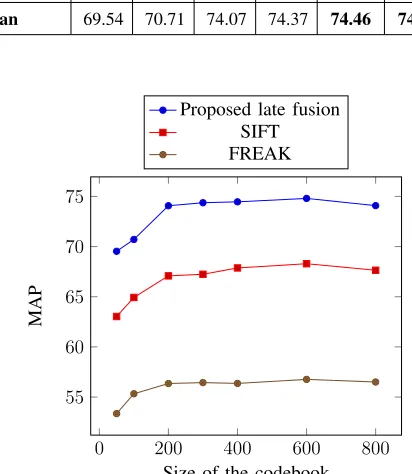
Fig. 3 presents a comparison of MAP as a function of codebook size using different evaluation
parameters.
TABLE I: MAP as a function of codebook size (late fusion of FREAK and SIFT)
.
Codebook size
and features %
used
50 100 200 300 400 600 800
25 % 68.85 70.45 74.36 74.52 74.68 74.58 73.99
50 % 69.31 70.56 73.86 74.91 74.16 74.96 74.01
75 % 70.45 71.13 73.99 73.69 74.55 74.87 74.25
Mean 69.54 70.71 74.07 74.37 74.46 74.80 74.08
0 200 400 600 800
55 60 65 70 75
Size of the codebook
MAP
Proposed late fusion SIFT FREAK
The results and comparisons presented in Table I and Fig. 3 indicate that the best MAP is
obtained from the proposed last fusion on a codebook of size 600 with a value of 74.80 %. The
best MAP obtained by using SIFT and FREAK on a codebook with a size of 600 is 68.29%
and 56.76%, respectively. The MAP on codebook of each size by using the proposed late fusion
is higher than that of SIFT and FREAK. To present a sustainable performance, the best MAP
obtained from the proposed late fusion is compared with existing research [22], [26], [34], [32],
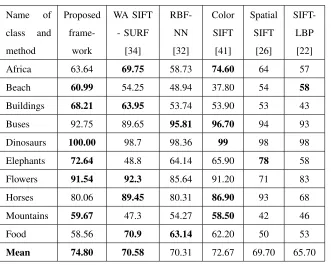
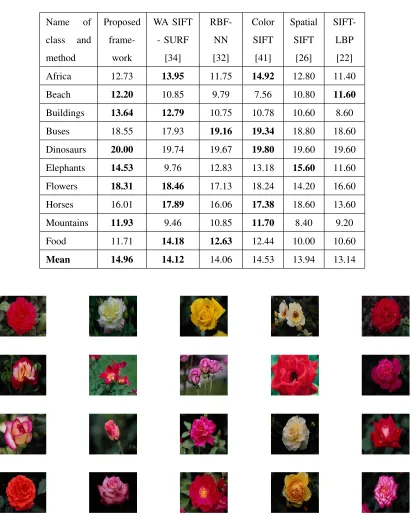
[41]. Table II and Table III presents the comparison of precision and recall for top 20 retrievals
( as the research selected for comparison is also reported for top 20 retrievals).
TABLE II: Comparison of retrieval precision.
Name of class and method Proposed frame-work WA SIFT - SURF [34] RBF-NN [32] Color SIFT [41] Spatial SIFT [26] SIFT-LBP [22]
Africa 63.64 69.75 58.73 74.60 64 57
Beach 60.99 54.25 48.94 37.80 54 58
Buildings 68.21 63.95 53.74 53.90 53 43
Buses 92.75 89.65 95.81 96.70 94 93
Dinosaurs 100.00 98.7 98.36 99 98 98
Elephants 72.64 48.8 64.14 65.90 78 58
Flowers 91.54 92.3 85.64 91.20 71 83
Horses 80.06 89.45 80.31 86.90 93 68
Mountains 59.67 47.3 54.27 58.50 42 46
Food 58.56 70.9 63.14 62.20 50 53
Mean 74.80 70.58 70.31 72.67 69.70 65.70
The best values of precision and recall are mentioned as bold in Table II and Table III. The
MAP of proposed late fusion outperforms state-of-the-art research [22], [26], [34], [32], [41]. Fig.
4 and Fig. 5 represents the image retrieval results obtained on the basis of similarity measures
for the semantic class ”Flowers” and ”Buses”, respectively. The classifier output label determines
the class of the image while the images are retrieved on the basis of closeness among classifier
TABLE III: Comparison of recall.
Name of
class and
method
Proposed
frame-work
WA SIFT
- SURF
[34]
RBF-NN
[32]
Color
SIFT
[41]
Spatial
SIFT
[26]
SIFT-LBP
[22]
Africa 12.73 13.95 11.75 14.92 12.80 11.40
Beach 12.20 10.85 9.79 7.56 10.80 11.60
Buildings 13.64 12.79 10.75 10.78 10.60 8.60
Buses 18.55 17.93 19.16 19.34 18.80 18.60
Dinosaurs 20.00 19.74 19.67 19.80 19.60 19.60
Elephants 14.53 9.76 12.83 13.18 15.60 11.60
Flowers 18.31 18.46 17.13 18.24 14.20 16.60
Horses 16.01 17.89 16.06 17.38 18.60 13.60
Mountains 11.93 9.46 10.85 11.70 8.40 9.20
Food 11.71 14.18 12.63 12.44 10.00 10.60
Mean 14.96 14.12 14.06 14.53 13.94 13.14
Fig. 5: Retrieval result on the basis of similarity measures for the semantic class ”Buses”
Fig. 6: Randomly selected images from each class of Corel-1500 image dataset [37].
C. Performance Evaluation Using Corel-1500
There are 15 classes in the Corel-1500 [37] image benchmark and each class contains 100
images [37]. Fig. 6 represents a sample of randomly selected images from each class of the
Corel-1500. We evaluated the proposed framework on Corel-1500 and compared the results with
state-of-the-art CBIR methods [29], [34]. Fig. 3 presents a comparison of MAP as a function of
0 200 400 600 800 50
60 70
Size of the codebook
Mean
av
erage
precision
Proposed late fusion SIFT
FREAK
Fig. 7: MAP as a function of codebook size (Corel-1500).
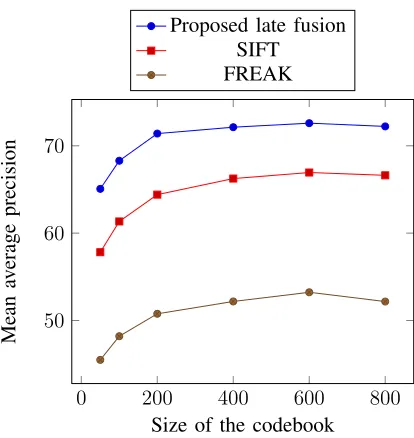
The comparison results results presented in Fig. 3 indicate that the best MAP is obtained from the
proposed last fusion on a codebook of size 600 with a value of 72.59 %. The best MAP obtained
by SIFT and FREAK is 66.94 % and 53.23 %, respectively. Table IV presents a comparison of
precision and recall values.
TABLE IV: Comparison of precision and recall.
Image retrieval
performance
Proposed late
fusion
WA SIFT-SURF
[34]
SQ +
Spatiogram [29]
Precision 72.60 68.05 63.95
Recall 14.52 13.61 12.79
The proposed framework based on late fusion of FREAK and SIFT provides a better retrieval
performance with higher values of precision and recall than the existing research [29], [34].
D. Performance Evaluation using Oliva and Torralba (OT-Scene)
There are 08 classes in OT-Scene image dataset that contains a total of 2688 images. Fig. 8
Fig. 8: Randomly selected images from each class of OT-Scene image dataset [38].
We evaluated the proposed framework using OT-Scene benchmark and compared the results
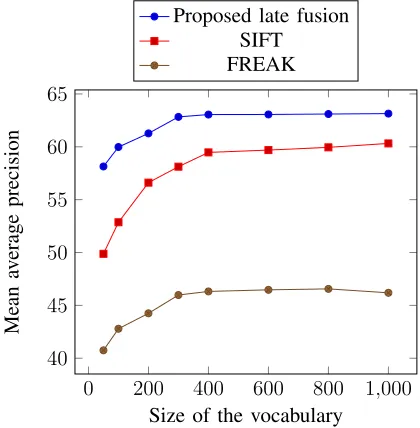
with state-of-the-art CBIR methods [30], [42]. Fig. 9 presents a comparison of mean precision
as a function of codebook size using different evaluation parameters. Table V represents the
comparison of MAP values.
0 200 400 600 800 1,000
40 45 50 55 60 65
Size of the vocabulary
Mean
av
erage
precision
Proposed late fusion SIFT FREAK
Fig. 9: MAP as a function of codebook size (OT-Scene).
TABLE V: Mean precision comparison.
Image retrieval
performance
Proposed late
fusion
Morphology
based IR [42]
Min Max
Fusion [30]
The results and comparisons presented in Fig. 9 and Table V indicate that the proposed late
fusion of FREAK and SIFT provides a better retrieval performance than existing research [30],
[42].
V. CONCLUSION ANDFUTURE DIRECTIONS
The research scope of this paper is based on the late fusion/visual word integration of binary
and local descriptor for an effective image retrieval. Keeping in view, the good recognition ability
and efficient computation time, we selected FREAK as the binary descriptor. SIFT is selected as
the local feature as it is robust to change in translation, scaling, rotation, and small distortions.
The image is represented in the form of late fusion of FREAK and SIFT. The proposed research
is based on the BoVW framework and classification is performed by using SVM. Testing is
performed by varying the size of codebook, to sort out the best image retrieval precision. The
results obtained from the proposed research are compared with state-of-the-art CBIR research.
The late fusion of FREAK and SIFT outperforms several CBIR methods. In future, we will
evaluate our proposed work on real world retrieval problem by using a pre-trained CNN model.
ACKNOWLEDGMENTS
The authors would like to thank Professor James Z. Wang, Pennsylvania State University, USA
for sharing Corel image benchmark that is used for the evaluation of the proposed research.
REFERENCES
[1] T. Dharani and I. L. Aroquiaraj, “A survey on content based image retrieval,” inPattern Recognition, Informatics and
Mobile Engineering (PRIME), 2013 International Conference on. IEEE, 2013, pp. 485–490.
[2] A. Alzubi, A. Amira, and N. Ramzan, “Semantic content-based image retrieval: A comprehensive study,”Journal of Visual
Communication and Image Representation, vol. 32, pp. 20–54, 2015.
[3] A. Kumar, J. Kim, W. Cai, M. Fulham, and D. Feng, “Content-based medical image retrieval: a survey of applications to
multidimensional and multimodality data,”Journal of digital imaging, vol. 26, no. 6, pp. 1025–1039, 2013.
[4] E. Rashedi, H. Nezamabadi-Pour, and S. Saryazdi, “A simultaneous feature adaptation and feature selection method for
content-based image retrieval systems,”Knowledge-Based Systems, vol. 39, pp. 85–94, 2013.
[5] D. Zhang, M. M. Islam, and G. Lu, “A review on automatic image annotation techniques,”Pattern Recognition, vol. 45,
no. 1, pp. 346–362, 2012.
[6] N. Ali, K. B. Bajwa, R. Sablatnig, and Z. Mehmood, “Image retrieval by addition of spatial information based on histograms
[7] D. Mukherjee, Q. J. Wu, and G. Wang, “A comparative experimental study of image feature detectors and descriptors,”
Machine Vision and Applications, vol. 26, no. 4, pp. 443–466, 2015.
[8] R. Ashraf, T. Mahmood, A. Irtaza, and K. Bajwa, “A novel approach for the gender classification through trained neural
networks,”J. Basic Appl. Sci. Res, vol. 4, pp. 136–144, 2014.
[9] R. Ashraf, K. Bashir, A. Irtaza, and M. T. Mahmood, “Content based image retrieval using embedded neural networks
with bandletized regions,”Entropy, vol. 17, no. 6, pp. 3552–3580, 2015.
[10] R. Ashraf, K. Bashir, and T. Mahmood, “Content-based image retrieval by exploring bandletized regions through support
vector machines,”Journal of Information Science and Engineering, vol. 32, no. 2, pp. 245–269, 2016.
[11] Z. Mehmood, S. M. Anwar, N. Ali, H. A. Habib, and M. Rashid, “A novel image retrieval based on a combination of
local and global histograms of visual words,”Mathematical Problems in Engineering, vol. 2016, 2016.
[12] D. Zhang and G. Lu, “Review of shape representation and description techniques,”Pattern recognition, vol. 37, no. 1, pp.
1–19, 2004.
[13] D. G. Lowe, “Distinctive image features from scale-invariant keypoints,”International journal of computer vision, vol. 60,
no. 2, pp. 91–110, 2004.
[14] H. Bay, T. Tuytelaars, and L. Van Gool, “Surf: Speeded up robust features,” inComputer vision–ECCV 2006. Springer,
2006, pp. 404–417.
[15] N. Dalal and B. Triggs, “Histograms of oriented gradients for human detection,” in Computer Vision and Pattern
Recognition, 2005. CVPR 2005. IEEE Computer Society Conference on, vol. 1. IEEE, 2005, pp. 886–893.
[16] T. Krajnik, P. Crist´oforis, M. Nitsche, K. Kusumam, and T. Duckett, “Image features and seasons revisited,” in Mobile
Robots (ECMR), 2015 European Conference on. IEEE, 2015, pp. 1–7.
[17] J. Figat, T. Kornuta, and W. Kasprzak, “Performance evaluation of binary descriptors of local features,” inComputer Vision
and Graphics. Springer, 2014, pp. 187–194.
[18] S. Leutenegger, M. Chli, and R. Y. Siegwart, “Brisk: Binary robust invariant scalable keypoints,” in Computer Vision
(ICCV), 2011 IEEE International Conference on. IEEE, 2011, pp. 2548–2555.
[19] A. Alahi, R. Ortiz, and P. Vandergheynst, “Freak: Fast retina keypoint,” in Computer Vision and Pattern Recognition
(CVPR), 2012 IEEE Conference on. Ieee, 2012, pp. 510–517.
[20] M. Calonder, V. Lepetit, C. Strecha, and P. Fua, “Brief: Binary robust independent elementary features,”Computer Vision–
ECCV 2010, pp. 778–792, 2010.
[21] D. G. Viswanathan, “Features from accelerated segment test (fast),” 2009.
[22] J. Yu, Z. Qin, T. Wan, and X. Zhang, “Feature integration analysis of bag-of-features model for image retrieval,”
Neurocomputing, vol. 120, pp. 355–364, 2013.
[23] X. Yuan, J. Yu, Z. Qin, and T. Wan, “A sift-lbp image retrieval model based on bag of features,” inIEEE International
Conference on Image Processing, 2011.
[24] C. Valgren and A. J. Lilienthal, “Sift, surf & seasons: Appearance-based long-term localization in outdoor environments,”
Robotics and Autonomous Systems, vol. 58, no. 2, pp. 149–156, 2010.
[25] Z. Mehmood, S. M. Anwar, M. Altaf, and N. Ali, “A novel image retrieval based on rectangular spatial histograms of
visual words,”Kuwait Journal of Science, 2017.
[26] C. Wang, B. Zhang, Z. Qin, and J. Xiong, “Spatial weighting for bag-of-features based image retrieval,” in Integrated
[27] Y.-b. Zheng, X.-s. Huang, and S.-j. Feng, “An image matching algorithm based on combination of sift and the rotation
invariant lbp,”Journal of computer-aided design & computer graphics, vol. 22, no. 2, pp. 286–292, 2010.
[28] L. Kabbai, A. Azaza, M. Abdellaoui, and A. Douik, “Image matching based on lbp and sift descriptor,” inSystems, Signals
& Devices (SSD), 2015 12th International Multi-Conference on. IEEE, 2015, pp. 1–6.
[29] S. Zeng, R. Huang, H. Wang, and Z. Kang, “Image retrieval using spatiograms of colors quantized by gaussian mixture
models,”Neurocomputing, vol. 171, pp. 673–684, 2016.
[30] E. Walia and A. Pal, “Fusion framework for effective color image retrieval,”Journal of Visual Communication and Image
Representation, vol. 25, no. 6, pp. 1335–1348, 2014.
[31] S. R. Dubey, S. K. Singh, and R. K. Singh, “Rotation and scale invariant hybrid image descriptor and retrieval,”Computers
& Electrical Engineering, vol. 46, pp. 288–302, 2015.
[32] G. A. Montazer and D. Giveki, “An improved radial basis function neural network for object image retrieval,”
Neurocomputing, vol. 168, pp. 221–233, 2015.
[33] J. Wan, D. Wang, S. C. H. Hoi, P. Wu, J. Zhu, Y. Zhang, and J. Li, “Deep learning for content-based image retrieval: A
comprehensive study,” in Proceedings of the ACM International Conference on Multimedia. ACM, 2014, pp. 157–166.
[34] N. Ali, K. B. Bajwa, R. Sablatnig, S. A. Chatzichristofis, Z. Iqbal, M. Rashid, and H. A. Habib, “A novel image retrieval
based on visual words integration of sift and surf,”PloS one, vol. 11, no. 6, p. e0157428, 2016.
[35] J. Sivic and A. Zisserman, “Video google: A text retrieval approach to object matching in videos,” inComputer Vision,
2003. Proceedings. Ninth IEEE International Conference on. IEEE, 2003, pp. 1470–1477.
[36] J. Z. Wang, J. Li, and G. Wiederhold, “Simplicity: Semantics-sensitive integrated matching for picture libraries,”Pattern
Analysis and Machine Intelligence, IEEE Transactions on, vol. 23, no. 9, pp. 947–963, 2001.
[37] J. Li and J. Z. Wang, “Real-time computerized annotation of pictures,”Pattern Analysis and Machine Intelligence, IEEE
Transactions on, vol. 30, no. 6, pp. 985–1002, 2008.
[38] A. Oliva and A. Torralba, “Modeling the shape of the scene: A holistic representation of the spatial envelope,”International
journal of computer vision, vol. 42, no. 3, pp. 145–175, 2001.
[39] E. Nowak, F. Jurie, and B. Triggs, “Sampling strategies for bag-of-features image classification,” inComputer Vision–ECCV
2006. Springer, 2006, pp. 490–503.
[40] G. Csurka, C. Dance, L. Fan, J. Willamowski, and C. Bray, “Visual categorization with bags of keypoints,” inWorkshop
on statistical learning in computer vision, ECCV, vol. 1, no. 1-22. Prague, 2004, pp. 1–2.
[41] X. Tian, L. Jiao, X. Liu, and X. Zhang, “Feature integration of eodh and color-sift: Application to image retrieval based
on codebook,”Signal Processing: Image Communication, vol. 29, no. 4, pp. 530–545, 2014.
[42] R. Das, S. Thepade, and S. Ghosh, “Multi technique amalgamation for enhanced information identification with content
based image data,”SpringerPlus, vol. 4, no. 1, pp. 1–26, 2015.
c
2017bytheauthors.LicenseePreprints,Basel,Switzerland.Thisarticleisanopenaccess articledistributedunderthetermsandconditionsoftheCreativeCommonsAttribution