President’s
Message:
A Year
without
Equal
PETER V. JACKSON
I believe that I can say without question that this was a year without equal in my life. What was to be a happy experience with the pleasure of seeing many of my most dreamed of projects become reality, came crashing down in April with the untimely passing of Francis Colbert, our first and a most successful full-time executive secretary. Francis and I had a special relationship, which I will hold dear for the remainder of my life. What that relationship was is hard to explain. Perhaps it was the fact that we were both dreamers and gamblers, for we had planned of many things, of cabbages and kings, with shining eyes and excited words. I suppose if all the ideas we considered had come true the United Nations building would be small compared to facilities we would have needed for our headquarters. Perhaps I am telling tales out of school, but if we as a society are to fulfill the role expected and available to us, we must think big; and with people as large as Francis, these projects are possible and well within reach.
Decisions in the Crisis
Quite often a crisis brings out the best in people, and ours was no exception. When word came to me that Francis was no longer with us, I found our staff and Board already in action. A conference call had been arranged in order that I could get the good judgment of the members of our Board. This action alone indicated to me that our people in the headquarters in Denver had been well-trained and disciplined-instead of frantic calls and expensive trips, the wise judgment to use modern communications had our Board in action in less than 24 hours with basic decisions made and plans laid.
I must take the responsibility for the actions taken following our misfortune, be they right or wrong. I am proud that our Board had the faith in me to allow my proposals to be tried. It was my personal conclusion that two things were evident. First it would be wrong to appoint a temporary executive secretary while a permanent replacement was found; for in my judgment anything temporary has a tendency to continue and we could easily go for a long period of time putting off decisions with built-in excuses and generally going into a state of doldrum, while the major actions of the Society stood waiting. Second, the staff and Board wanted to be a part of the action. No one wondered what to do. They quickly volunteered to do extra duty to keep the activities of the Society moving as usual. In plain words, everyone was willing to sacrifice.
Address given at the 28th Annual Meeting of the Society Management in Mexico City, Mexico, in February, 1975.
for Range
With these two situations in mind, I felt certain that our best approach toward the fastest recovery and keeping our momentum was personal involvement and not turning over our troubles. to someone else for solution. That is the reasoning behind the use of an Executive Committee rather than a temporary executive secretary.
Thanks to Many
It’s rather ridiculous to try to thank the members of the Executive Committee and staff for all the hard work and personal sacrifice that was given, but rather keep foremost in your minds that the continued smooth-running of the Society and the many goals and accomplishments that have been achieved this year can be directly related to their efforts. I for one can only say a simple, heart-felt thank-you to people who knew their job and did it well for all our benefit.
Accomplishments of 1974
I was taught at a very young age to never brag, but let’s just take a modest look at last year with all its handicaps and sad moments. Perhaps we can look with well-deserved pride at a point or two.
Membership
First, with memberships under the able leadership of Nick Cozakos, our numbers have exceeded 5,400 members. The momentum of the drive for membership has continued to increase the percentage of new members in recent years, the greatest being 1974. I personally predict that this will continue, and I hope for even greater highs in the very near future.
Governors Conference
A new world opened up for us this year. For the first time Range Management was a major topic at a Governors Conference on Agriculture held in Salt Lake City, Utah. The high interest and large participation by the conferees resulted in decisions whereby Range Development Committees and action groups are being formulated all over the western United States; and almost invariably the SRM or members of the Society have shown leadership in these events. From what I have been able to surmise, we have only scratched the surface in this area and great things will be coming in short order. Please, if you have the opportunity to become a part of this movement, by all means do so, not only for the sake of the Society but for the betterment of the resource.
Red Meat Symposium
Results of an unprecedented scope have come from the Red
Meat Symposium generated by Past President Martin
Gonzalez. During the past year a landmark document has been developed by the United States Department of Agriculture on the Red Meat Production from the Western rangelands.
Truly,
the Society can be proud of this accomplishment, and future ones of an even greater nature should result from this conference and the return participation of the foremost agricultural leaders of Canada, Mexico, and the United States. Frankly, I envy the future officers of our organization, for exciting and fruitful results are sure to happen if only we do our part and cope with the challenges given us by these great and powerful men. They are deeply serious, and we must rise to their desires.Rancher Participation
Being a rancher by profession, I am extremely proud of the advancements this year of our rancher membership and their increased participation. Not to my surprise I have discovered that they are the largest single segment of our Society and are becoming increasingly active. An example was the Ranchers Liaison Committee Meeting held in Alberta, Canada, last July. A large crowd of ranchers gathered to identify areas of concern and high priority in the activities of the organization. I sincerely hope that this interest continues to grow, not just for an independent group but in all facets of the Society and at all levels.
New Journal
Perhaps one of the major projects of this year’s program,
Rangeman’s Journal,
will guarantee rancher involvement even more.Rangemun’s Journal
was a great step forward, especially for this year with its period of transition. But with the pressure of the Advisory Council at our backs and the intense involvement of the Board, we felt the time was now. All this coupled with the genius of Jeff Powell, our publications chairman, brought the first issue off the press in mid-fall. I for one was gratified with the results, and my feelings are not alone. I have heard more favorable comment on this endeavor than on any other we have ever attempted.This publication will require work by everyone. We need practical articles and lots of them. So please, get them written and in. A success with this journal will bring in needed membership in larger numbers than any other effort that I can imagine.
There is a direct relationship between the Rangeman’s
Journal
and the dues increase. A publication of this caliber is more expensive than the former Rangeman’s News, but it is well worth it. I am proud to announce that in spite of the increased cost of membership and the recession and inflation being felt by everyone, the dues for 1975 are coming in in excellent shape, which again bears evidence to me that an active program and the newJournal
has our Society in a very healthy condition.New Executive Secretary
After an exhaustive search, a new executive secretary was engaged and took office on October 1. I was amazed at the
qualifications that were necessary to fill this position. But when you give the situation due consideration, it certainly shouldn’t have been any surprise. Really, how often does a person walk down the streets looking for a new career with the qualifications we require-being bilingual, an expert writer, an office manager, a public relations expert, a politician, a financial genius, and an expert in foreign affairs. These are only a sample of what is required. Frankly, it takes a real man to qualify-and we searched far and wide. But like the acre of diamonds, he was literally under my own feet. When all the smoke had cleared, Mr. David Smith still stood there and had met the qualifications.
I would like to say a word or two about Dave, for I have known him for several years. He is a humble man, a devoted Christian family man, and yet he sees deeply into problems we face and is very willing to go after the impossible. Things will not be dull or status quo with Dave at the helm-action is his middle name.
Increased Attention on Rangelands
I feel that this year, rangelands have come into their true importance. Perhaps the world is yet to become aware of this. But with the energy and food crisis, which has been so graphically emphasized this year by the World Food Congress in Rome, the important responsibility of the rangelands to produce net energy protein as grass fat meat cannot be under estimated. I feel that we have a solemn responsibility to see that these lands produce their maximum of goods and services, while making doubly sure they are not desecrated in the process. To me it is frightening to see groups of people dealing in food products, making obligations on resources, and really not knowing the consequences that may be coming. We are duty bound as an int.ernational organization to make sure that decision makers are armed with the facts. To deal in food involves tremendous strength, but the results can easily be disastrous.
Exciting Future
Therefore, I recommend that the highest priorities be placed on the food situation and our maximum involvement given, for no longer can any one organization or nation stand alone doling out or withholding her products at the whim of the people in power at the moment. Again I say that total involvement, whatever the price, is our only course.
In conclusion, I am proud of the activities of the Society during my tenure as president. Our membership has made a healthy growth, our committees have been very active with excellent progress, and financially we are sound. Our scope has widened into new areas both at the international and national level. The meetings reflect this growing scope with the participation of national and world leaders.
It appears to me that it is strictly up to us where we go from here, and I predict it will be to greater things. Again I say that I look with envy at the upcoming officers-what an exciting future they have in front of them. Gentlemen, at all costs look well to the future; its size is up to you.
Now let me close by saying “thank you” to everyone who did so much. It was an honor and a privilege to have been your president.
A Rangeman’s
Critique
of the
World
Food Conference
GERALD W. THOMAS
Highlight: The World Food Conference held in Rome, Italy, November 5 to 16, 1974 was considered an important first step to confront the most important issue facing mankind-world hunger. The principal focus on the need for increased production at any cost to meet the needs of present populations, and about 76 million additional people each year, will result in an all-out effort to expand the cultivated area and maximize’ production from areas already under cultivation. Emphasis was mainly on grain production with little positive attention given to the possibilities of animal production and the great potential role of rangelands in meeting world food requirements. In spite of these deficiencies, positive steps included I) setting up a World Food Council; 2) agreeing to establish a grain reserve; 3) approving the establishment of an international fund for agricultural development; 4) instituting a world-wide system of food information; 5) developing a systematic approach to world-wide fertilizer production and distribution; and 6) intensifying agricultural and weather research.
While much of the publicity
resulting from the World Food
Conference has been somewhat
negative, it is my feeling that, on the positive side, an important ‘first step” was taken in Rome to confront the most important issue facing man kind-world hunger. This challenge-perhaps new to an apathetic majority of the world’s people-is not a new issue for biological scientists, who for years have been warning of the impending food disaster associated with unlimited population growth. What is
new, and one of the major
accomplishments of the World Food
Conference, is an “increased
world-wide awareness”-a necessary first step to the solution. Perhaps peoples and governments will now follow up with the necessary action programs.
The United Nations Food and
Agriculture Organization (FAO)
prepared some excellent background materials for the 130 nation delegation to the Conference and proposed an
Gerald W. Thomas is president of New
Mexico State University, Las Cruces. He
served as press representative of the Journal
of Range Management and several other scientific publications at the World Food Conference in Rome, Italy, November S-16, 1974.
86
approach to the problem within two time frames:
(1) Serious attention must be given to the immediate food crisis. Conservative estimates indicate that 460 million people are now suffering from hunger and severe malnutrition.
(2) Over the long term, the challenge is to increase food production for a rap idly expanding world population. An annual gain of 70 to 80 million people poses the continuing threat of global famine far in excess of that previously experienced in the history of mankind.
The Immediate Food Crisis The present food crisis is more serious and widespread than the world has experienced since the forties. In 1972, grain stocks declined sharply and adverse weather affected production in
several parts of the world
simultaneously-USSR, China, India, Australia, S ahelian Africa, and southeast Asia. Although the 1973 harvests were reasonably good, they were insufficient to meet trade and aid requirements, and 1974 has failed to bring about the needed replenishment of stocks. At the same time, fish yields
have fallen in several ocean
areas-probably because of
JOURNAL OF
over-exploitation.
Recently, two other problems have complicated the situation-the energy crisis and inflation-causing shortages of fertilizers and petrochemicals and increasing the cost of food production. The immediate need is for 8 to 10 million tons of grain for developing countries. Unless production is increased dramatically, the United Nations estimates that the annual deficit could reach 85 to 100 millions tons of grain by 1985. Other food needs for balanced human nutrition, particularly proteins, will also be in short supply.
The only solution to the immediate hunger problem is increased food aid. Who will provide this food aid and how it will be provided was the subject of much debate. Those countries where
people are presently starving
(particularly the African Sahel and Bangladesh) do not have the purchasing power to obtain the food. Before the
conclusion of the conference,
commitments for additional food aid were made by several countries, including Canada, Sweden, Australia, and the United States. The member countries of the European Economic Community (EEC) will probably not increase immediate food aid, but will add funds to compensate for inflation. Perhaps altogether, both the direct donations and all forms of indirect help, may reach one-third of the estimated goal of 10 million metric tons of grain this year.
Food and International Politics Secretary of State Kissinger, in an eloquent address to the plenary session, challenged the country delegates to “confront the problem and not each other.” Secretary Kissinger was firm in his position that the responsibility for financing food imports to the hungry
Unless production is increased dramatically, the United Nations estimates that the annual deficit could reach 85 to 100 millions tons of grain by 1985. Other food needs for balanced human nutrition, particularly proteins, will also be in short supply.
areas cannot rest solely with the food exporters alone. The new oil-rich countries of the world must bear part of
the burden by assisting with
investments and contributions, as well as by keeping the cost of energy within reasonable limits. He stated: “The continuing massive transfer of wealth and the resulting impetus of world-wide inflation have shattered the ability of the developing countries to purchase food, fertilizer, and other goods.”
The concern over energy and
inflationary costs was expressed by many delegates. However, Algerian President Boumedienne charged that the food problem resulted from “a policy of domination” of developed nations-along with “world inflation,
caused and maintained by
industrialized countries” rather than the price of oil. Iran placed “much blame on the West” because of its “past food policy” which “created the present food shortage.” The Cuban representative stated that the world had a “satisfactory” and well-balanced agriculture “prior to the advent of colonialism and imperialism and that the US and not the new oil-rich
countries caused the present
inflationary spiral.” Algeria proposed that the “concept of production for market purposes” must be replaced with “production for humanitarian purposes.” The Minister of Agriculture for Libya labelled as “absolutely false allegations” any suggestions that oil was responsible for causing the food crisis. “The excessively luxurious life led by the USA and its allies,” he said, “aswell as its deliberation to raise the prices of agricultural production inputs such as machinery, fertilizers and chemical pesticides-all these combined have
contributed to the shortage of
foodstuffs now suffered by the
countries of Asia and Africa.”
The Chinese spokesman stated that China was “ready to join in common efforts to solve the world food problem,” which was “due to the developed countries which practice
plunder, control, and ruthless
enslavement .” He urged the developing nations not to be misled by statements from the West “which place the blame
on climate, prices, oil, or
overpopulation” and said that “the emphasis on population control was
being spread for ulterior motives.” “China developed” he stated, “because we severed ties with the imperialist countries,” and “established rural peoples in communes.”
Many other countries supported the Chinese and Russian concepts of revolution and economic reform to insure adequate food supplies. Mexico’s President Echeverria, facing a very sympathetic audience, proposed a “World Food and Agricultural Research Bank” and a “World Food Plan for Development .” He declared : “The present chaotic condition of markets, prices, and raw materials has been
brought about by the great
industrialized nations.” Dr. Philip Potter, General Secretary of the World Council of Churches, stated: “. . . it is being said that what is needed is population control, and this will enable development aid and the transfer of grain to the needy to be more effective. But experience has shown that it is precisely socio-economic development which reduces income inequality, and this is a precondition for a decrease in the rate of population growth. Moreover, such evidence as we have indicates that where there is a
determined effort to promote
participatory self-reliance and an economic policy aimed at social justice, as in China, the most populous nation,
the problems of hunger can be
satisfactorily tackled.” Dr. Lester Brown tried to set the record straight by citing that China had also been receiving substantial food imports and the claim of self-sufficiency was not valid.
The “population” problem was not confronted directly by most delegates. F. T. Sai, representing the International
Planned Parenthood Federation,
reaffirmed the belief that “family
JOURNAL OF RANGE MANAGEMENT 28(2), March 1975
planning is a human right” and “in
today’s marginal economies,
satisfactory feeding of the people cannot be assured if fertility regulation programmes do not go hand-in-hand with programmes for nutritional improvement .” Pope Paul VI invited the participants in the World Food Conference to the Vatican where he emphasized that, “the threat of hunger and the burden of malnutrition are not an inevitable destiny.” He reaffirmed the stand of the Catholic Church on birth control, stating: “In times gone by, nations used to make war to seize their neighbors’ riches. But, is it not a new form of warfare to impose a restrictive demographic control on nations to insure they will not claim Russian delegate indicated little concern for population control by stating that the world could easily support 40-50 billion people. This high estimate was shocking to most of us who have been worrying about 5-6 billion.
The preceding statements are cited only as examples of the interplay among nations and special interest groups. It was the actions of the US delegation, however, that attracted the most attention (and criticism), not only from country delegates, but from the large group of Non-governmental
Organizations (NGO’s) given
credentials to the Conference. Secretary of Agriculture Earl Butz kept
reminding the delegates that
governments, bureaucracies, and even food conferences, do not produce food, “only farmers produce food, and they must have the incentive to produce.” He cited with pride America’s history of sending food to poorer lands. The US has contributed 46% of all the foodaid given to developing countries since
1962. Butz emphasized that the top priority for the conference must be to “stimulate additional production in the developing countries.”
This approach by Secretary Butz was not satisfactory for many conferees concerned with the immediate hunger problem. Due to this pressure and
concern, part of the American
Congressional delegation, including Senators Hubert Humphrey, George McGovern, and Richard Clark, insisted that the White House be contacted to obtain an immediate commitment to increase US food aid from 1 million to 2 million tons of grain this year. Dick Gregory flew into Rome to start a fast
The heavy reliance of modern agriculture on petroleum products (depletable resources) was acknowledged, but no one talked about the possibility that fossil fuel will, someday, become exhausted. The time frame here was much too short-sighted, in my opinion, being aimed primarily at the next two decades. What happens beyond the year 2000 was only dimly visualized. Perhaps, the specter of hungry people today obscured the vision for the long-term future.
(joined by Rene Dumont, French
environmentalist) to stimulate
additional interest in doubling US food aid, and the NGO’s passed a resolution to support the drive. President Ford turned down the request and Anne Armstrong, one of the ranking members of the US delegation, reported the reasons: “The American housewife is having a tough enough time meeting her own budget,” and increased emergency food aid would add to the already inflated prices at home. Mrs. Armstrong cited the financial problems now confronting farmers and ranchers in the US. Most delegates had little sympathy for, or understanding of, the US position. (It should be noted that the US has budgeted $675 million this year for nutritional programs and technical
assistance, and Secretary Butz
committed an additional $50 million to food aid through Public Law 480 sales.)
The Long-Term Challenge to Increase Food Supplies
The major thrust of the conference was toward the medium-term objective to increase food production and to establish a world-wide system of food security. Discussions and action proposals for these topics were not as heavily involved in politics.
The principal focus on the need for “increased production at any cost” in both the developed and developing nations raises some questions. How can we meet the needs of about 76 million additional people each year without some sacrifice to the resource base? India alone will require an additional 2.5 million metric tons of grain each year to cope with their expanding population. And Bangladesh, as one reporter stated recently, is “. . . sliding irretrievably toward mass starvation and social breakdown.” Bangladesh, equal in size to the State of Wisconsin, now has 75 million people, compared with the 4.4 million in Wisconsin, and the population of Bangladesh will
88
double in 23 years! Under these population pressures little attention will likely be given to resource conservation. It appears that an all-out effort will be made to expand the number of cultivated acres and to maximize the production on those areas now under the plow. This poses the threat of over-expansion into marginal lands and increased pressure on range areas.
While a few delegates and observers raised questions about environmental
deterioration, most people in
attendance had little understanding of natural ecosystems or the impact of more intensive agricultural technology or environmental stability. The heavy reliance of modern agriculture on
petroleum products (depletable
resources) was acknowledged, but no one talked about the possibility that fossil fuel will, someday, become exhausted. The time frame here was much too short-sighted, in my opinion, being aimed primarily at the next two decades. What happens beyond the year 2000 was only dimly visualized. Perhaps, the specter of hungry people today obscured the vision for the long-term future.
Animal agriculture came under constant attack from some participants with the simplistic assumption that all animals were produced at a cost of 4 to 10 pounds of grain that could go directly into human food channels. Certainly, much grain can go directly into human consumption. However, the important contribution of the ruminant animal as a converter of roughage, the
importance of range livestock
production, the role of animals in the utilization of low-quality grains and grains bred specifically as “feed grains” and not “food grains” was neglected. The American livestock producers present at the conference were very
concerned about this
“misunderstanding.” Also, several reporters noted that, while delegates on the floor were condemning livestock production and the excessive eating habits of affluent societies, most of these same persons consistently ordered beef steak or lamb for dinner in the evening.
Some background material on the role of rangelands in world food production and in balanced agricultural ecosystems was submitted to the conference planners but was not used in the final documents by FAO. Failure to recognize these values of uncultivated lands is not a new phenomenon for members of the Society for Range Management. Even in the US, we have difficulty obtaining recognition or adequate support for much-needed research on range vegetation and range livestock production. And, while world grain supplies is always cited as the most important single indicator of the world food situation, this statistic cannot be properly evaluated without looking at other food sources for balanced nutrition.
In spite of these deficiences in the data base and in spite of the variability in backgrounds, ideologies, and political interests of delegates, some positive and encouraging actions were taken:
(1) A World Food Council is to be established under the United Nations to coordinate the global war on hunger. The new group will be based in Rome, sharing facilities with FAO. It will include various committees on food aid, food security, fertilizer, and research and technical assistance for agriculture.
(2) Major grain producers and governmental representatives agreed to
Even in the US, we have difficulty obtaining recognition or adequate support for much-needed research on range vegetation and range livestock production. And, while world grain supplies is always cited as the most important single indicator of the world food situation, this statistic cannot be properly evaluated without looking at other food sources for balanced nutrition.
establish agrain resente. It remains to be seen whether this will be handled on an individual country basis or by the United Nations. The individual country
approach was favored by most
delegates. American farm interests at the Food Conference were insistent that such a reserve be established in a way that will not compete with the seasonal markets for farmers and livestock producers. The target for this reserve will be 10 million tons of grain to be used for emergency food aid only. (3) The Conference approved the establishment of an international fund for agricultural development to help developing countries move toward se 1 f-sufficiency. The new oil-rich countries will help support this fund.
(4) A world-wide system of food informu ‘ion-an early warning system to avoid food disasters-will be instituted. At every turn, delegates were faced with inadequate information on which to make decisions It was minted
out repeatedly that no world-wide information system can work without free and open cooperation from Russia and China.
(5 ) A systematic approach to world-wide fertilizer production and distribution will be developed
Observers cited the fact that the Arab countries are flaming more natural gas than is now required annually for nitrogen production.
(6) Agricultural and weather research will be intensified. The present international centers, such as the rice institute in the Philippines and the cereal center in Mexico City, will be strengthened, and all countries will be encouraged to add support to their agricultural research efforts. (Note: At the recent annual meeting of the State Universities and Land-Grant Colleges, a
strong resolution was passed
emphasizing the important role the Land-Grant Colleges and State TJnivprGtipy mn nnd rnljrt tiwlrno in
fighting world hunger. Scientific manpower in these US universities represent the world’s largest single source of expertise in agriculture and related fields.)
Cattle
Diets on Semidesert
Grassland:
Botanical
Composition
R. E. ROSIERE, R. F. BECK, AND J. D. WALLACE
Highlight: Botanical composition of cattle diets on semidesert rangeland was
studied by microhistological techniques. Cattle consumed 56% of all species available. Dietary portions of grasses, forbs, shrubs, and unidentifiable plants averaged 45, 32, 19, and 6%, respectively. Composition of diets changed with seasons. Grass contents of diets were highest in summer and lowest in spring. Mesa dropseed was the most common species in diets. Perennial grasses represented dependable sources of forage, but never comprised more than 50% of the steers’ diets in any season, and should not be used as the sole criterion for estimating forage production or determining stocking rates. Shrub portions were highest in spring when soaptree yucca was grazed almost exclusively. Forb fractions of diets varied little among seasons but were highest in winter. Forbs and shrubs comprised over one-half of the diets in certain seasons and should be grazed in these seasons if full benefit is to be derived from them. Preference ranking of forage plants evaluated selectivity and palatability but preference trends were inconsistent and most affected by species availability.
Semidesert grassland occupies 36 million ha in the Southwest (Campbell and Craft, 1939) with most ranges being grazed by livestock. These ranges are usually grazed yearlong, but
This report is Journal Article 517 from
the Agricultural Experiment Station, New Valentine (1967) proposed a seasonal Mexico State University. suitability grazing system to restore
deteriorated pastures. Cattle diets
Manuscript received May 31, 1974.
JOURNAL OF RANGE MANAGEMENT 28(2), March 1975
from this system are compared to those under continuous grazing.
Effective range management
depends upon identification of plants which are palatable and nutritious to livestock. Most plants on desert grassland contribute more to cattle diets than is usually believed (Galt et al., 1969). The investigation reported here was initiated to examine species composition of cattle diets further and to compare forage under continuous vs seasonal suitability systems.
Experimental Procedure
Study pastures were on the New
Mexico State University Ranch, 38 km north of Las Cruces, where the climate is arid and the frost-free period averages 200 days. Average annual precipitation for a 57-year period was 23 cm, 51% of which fell during the major growing season in July, August, and September (Table 1). Rainfall from July through September was 32%
above average in 1972 but 45% below average in 1973.
Data were collected from one continuously grazed pasture (No. 15 which contained 1348 ha) and three
pastures within a seasonal suitability
system (Nos. 3N, 3S, and 3W, which
contained 45 1, 526, and 668 ha,
respectively). Vegetation was
semidesert grassland varying from homogenous stands of black grama (see Table 2 for scientific names) to
sand dune areas dominated by
mesquite. Botanical compositions of pastures (Table 2) were derived while measuring plant density in circular plots of variable size (Rosiere, 1973). Herbage available (kg/ha) on each
pasture duirng each season was
calculated by multiplying the average weight of a species times the density of that species in a hectare. Density estimates for pastures by seasons were obtained from 100 randomly located plots.
Forage samples were collected from four esophageal fistulated Hereford steers during 1 O-day periods in August and October of 1972 and in January, May, and July-August of 1973. Steers grazed study pastures for 2 to 3 weeks prior to sampling periods, except in October, 1972. Pastures were sampled once a day at sunrise after steers had been penned overnight. The year-long use pasture and one pasture in the seasonal suitability system were sampled on alternate days each 1 O-day period. Steers were driven to different plant communities (i.e., black grama - dropseed grassland, mesquite sand dunes, annual grass-forb sites, etc.)
within each pasture and then
Table 1. Average long term monthly pre- cipitation and monthly precipitation for 1972 and 1973 on study pastures.
Precipitation (cm)
Jornada Exp. Range College Ranch2 Months long term average’ 1972 1973
January 1.4 0.6 1.8
February 1.1 0.0 3.8
March 0.7 0.0 0.7
April 0.6 0.0 0.0
May 0.7 1.7 4.1
June 1.4 4.1 1.2
July 4.1 4.3 3.6
August 4.3 9.5 3.4
September 3.7 2.4 0.2
October 2.3 5.6 0.0
November 0.9 0.0 0.0
December 1.4 3.8 0.2
Average 22.6 32.0 19.0
1 Average since 1915 at US Weather Report-
ing Station on Jornada Experimental Range, 15 km NE of study pastures (US Corn - merce Dep., 1972).
2Data are average of 7 rain gauges on or
near study pastures.
90
permitted to graze at will until approximately 1 kg of plant material was obtained. Collected forage was dried at 55” C for 24 hr in a forced-air oven and then ground through a 1 mm screen in a Wiley mill.
Species composition of cattle diets was determined by a microscopic technique modified from Sparks and
Malechek (1968). Microscope
reference slides of plant species growing in study pastures and slides of fistulae-collected forage were prepared
by covering ground herbaceous
material with synthetic resin mounting media and cover slips. Plant particles in slides from diet samples were identified by comparing with species reference slides. Identification was by histological characteristics as reported by Free et al. (197 1).
(Table 4). Significant changes were also found in the forage available in standing crop among seasons (Table 3). Similar trends were observed on pinyon-juniper grassland (Thetford et al., 1971) and shortgrass plains (Beck, 1969). Grass content did not differ significantly in the two summer diets or between fall and summer diets. Shrub content was highest in spring when large quantities of soaptree yucca were consumed. Inconsistent seasonal variability existed in forb portions of diets.
Statistical evaluation was by split plot analysis of variance with Tukey’s procedure used to test differences among means (Steel and Torrie, 1960). Preference “ranks” developed from preference indicies (Van Dyne and Heady, 1965) were used to evaluate species preference by cattle.
Preference ranks (Table 3) helped explain differences in selectivity. A rank of “c” (P.I. = 0.7 - 1.3) indicated that the percentage of a species in the diets was the same as in available herbage (i.e., no selectivity). Preference higher or lower than “c” demonstrated selection for or against species, respectively. Preference alone
did not always account for
proportions of species in diets, because availability was also a major factor influencing dietary composition. Results and Discussion
Of the 52 plant species found on the year-long pasture and the 50 species on the seasonal suitability pastures, 28 species were identified in the diets, plus a small number of unidentified species. Twenty species were found to comprise 84%-95% of the steers’ diets in all seasons (Table 3). Some species which were observed being grazed were not found in slides of forage. Some plant particles could not be identified due to absence of unique histological features and were often a process of elimination.
Proportions of grasses, forbs, and shrubs in diets changed among seasons
Preference trends were usually inconsistent. For a given species,
preference ranks might differ
considerably between pastures within season, but in another season ranks for that species might be similar. This, also, indicated that availability affected preference. Studies have shown that preference changed as grazing intensity increased. Leigh and MuIham (1966) found that 56% of sheep diets were comprised of a species that formed only 1% of herbage but that portions in diets decreased as availability decreased. Thus, high preferences lasted only short periods. In this study similar results were noted when the amount
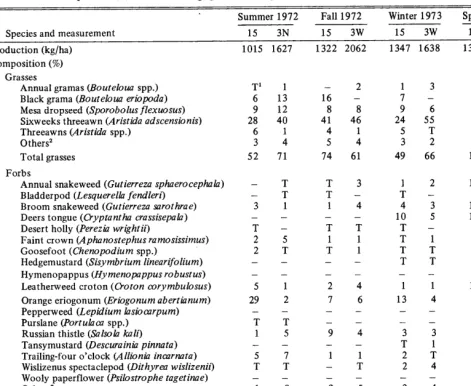
Table 2. Plant composition ($6) and total herbage production (kg/ha) on year long (15) and seasonal suitability (3N, 3S, 3W) pastures. Summer 1972 Fall 1972 Winter 1973 Spring 1973 Summer 1973
Snecies and measurement 15 3N 15 3w 15 3w 15 3N 15 3s
Production (kg/ha) Composition (%)
Grasses
Annual gramas (Bouteloua spp.) Black grama (Bouteloua eriopoda) Mesa dropseed (Sporobolus flexuosus)
Sixweeks threeawn (Aristida adscensionis) Threeawns (Aristida spp.)
Others’ Total grasses Forbs
Annual snakeweed (Gutierreza sphaerocephala) Bladderpod (Lesquerella fendleri)
Broom snakeweed (Gutierreza sarothrae)
Deers tongue (Ckyptantha crassisepala) Desert holly (Perez& wrightii)
Faint crown (Aphanostephus ramosissimus)
Goosefoot (Chenopodium spp.)
Hedgemustard (Sisymbrium linearifolium)
Hymenopappus (Hymenopappus robustus)
Leatherweed croton (0oton corymbulosus)
Orange eriogonum (Eriogonum abertianum)
Pepperweed (Lepidium Iasiocarpum) Purslane (Portulaca spp.)
Russian thistle (Salsola kali)
Tansymustard (Descurainti pinnata)
Trailing-four o’clock (Allionti incarnata)
Wislizenus spectaclepod (Dithyrea wislizenii) Wooly paperflower (Psilostrophe tagetinae) 0 thers’
Total forbs Shrubs
Mesquite (Prosopis juliflora)
Soaptree yucca (Yucca ekta)
Torrey ephedra (Ephedra torreyana)
Total shrubs
1015 1627 1322 2062 1347 1638 1320 1591 1669 2143
T’ 6 9 28 6 3 52 - - 3 - T 2 2 - - 5 29 - T 1 - 5 T - 1 48 - - - - 1 13 12 40 1 4 71 T T 1 - - 5 T - - 1 2 - T 5 - 7 T 8 29 - - - -
- 2 1 3 1 2 T T
16 - 7 - 8 6 9 5
8 8 9 6 4 8 19 18
41 46 24 55 2 T 1 2
4 1 5 T 2 2 1 1
5 4 3 2 1 1 2 1
74 61 49 66 18 19 32 27
T T 1 - T 1 T - - 2 7 - 9 - 1 - - 3 24 10 1 17 13 T 5 T
2 T
T 5
21 41
8 4
T T
6 3
T T
- 4 6 - - 4 - 1 T - 5 29 5 - 5 10 1 T 4 10 T T T T - 1 13 - 3 T 2 2 3 39 4 7 1 12 2 - 3 5 - 1 T T - 1 4 - - 3 1 T 4 - 4 28 - T 10 1 9 T 1 T T 2 1 1 71 z - 2
- 8
2 3
4 -
6 11
4 14 28 9 T 9 - - 1 2 1 T - 1 T T 1 1 - 71 2 5 3 10 - -
1 2
8 6
T T
3 T
T -
1 1
T T
T 2
3 1
1 1
7 6
61 71
1 1 -
2 ’ T = 0.4% or less.
2 “Others” includes those plant species which either comprised less than 2% of the available herbage or were unimportant in the steers’ diets.
of flower stalks of soaptree yucca in
the steers’ diets changed from
approximately 70% of spring diets while comprising less than 4% of available herbage to less than 10% of
summer diets when availability
dropped to less than 2%.
The high preference for certain
species greatly exceeded those
reported for any species growing on shortgrass pastures (Beck, 1969) and sandhill ranges (Scales, 1972). Wallace et al. (1972) noted that on certain sandhill ranges, herbage quantity was sufficient to allow cattle to select their total diets from any one of several species. Similar conditions seldom exist on depleted semidesert ranges having mixed plant communities and this might account for high preference values of certain desert plants. Van Dyne and Heady (1965) concluded that less abundant species usually were either highly selected or rejected, while abundant ones furnished the
bulk of diets and appeared to be neither preferred nor avoided.
Observations that cattle graze primarily grass (Cook et al., 1967) were substantiated during certain seasons. Cattle preferences for grasses,
however, were often low and
quantities of grass consumed depended upon season and on palatability of forbs and shrubs. Grass contents of diets varied from as high as 78% in summer to as low as 14% in spring. Herbel and Nelson (1966) reported similar trends.
Mesa dropseed was the most
important forage plant, and comprised larger, more consistent portions of diets than any other species. There were not significant season or pasture differences in dietary proportions of dropseed. Cattle grazed less selectively on dead and live dropseed herbage than on any other grass.
Palatability of black grama did not appear as great as reported by early
JOURNAL OF RANGE MANAGEMENT 28(2), March 1975 91
workers (Campbell and Crafts, 1939). Preference for black grama was about average when compared to preferences for other species. Lowest preference occurred in spring while highest preference occurred in winter. Watkins (1955) noted that winter growth activity of black grama increased palatability. This observation was confirmed by highest preference for black grama in the year-long use pasture during winter. Black grama was scarce in pasture 3W, so winter preference could not be evaluated in the seasonal suitability system. Strong preference was also shown for black grama in pasture 3s during summer 1973 when quantities of green forage were limited by drought. Similar findings were reported for cattle diets on semidesert ranges in Arizona (Galt et al., 1969).
Table 3. Botanical composition (%) and preference rank’ of plant species in steer diets on year long (15) and seasonal suitability (3N, 3S, 3W) pastures
Species
Summer 1972 Fall 1972 Winter 197 3 Spring 197 3 Summer 197 3
15 3N 15 3w 15 3w 15 3N 15 3s
Grasses (%) Black grama Mesa dropseed Sixweeks threeawn Threeawns 0 thers2 Total grasses Forbs (%)
Bladderpod Deers tongue Desert holly Goosefoot Hedgemustard Hymenopappus Leatherweed croton Pepperweed Purslane Russian thistle Tansymustard
Wislizenus spectaclepod Wooly paperflower Others2
Total forbs Shrubs (%)
Mesquite Soaptree yucca Torrey ephedra Total shrubs Unidentified (%)
6c 16c 33a 29a 17d 3Oc
6c 3a
- -
62 c 78 c
- 2a
- -
ia Ib
- -
- -
3d lc
- -
9a 3a 4a 5c
- -
la -
6 3
29d 15d
- -
- -
3a la 3a la
7 7
2oc - lib -
1Oc 27a 16b lib
19d 28d 7d 15d
2d 5a 2d la
- - - -
51~ 6Oc 36 c 27 d
- -
6a ia
- lc
- -
-2c 5b
- -
31a 16a -
- -
- la
- -
1 1
40b 27 c
SC 5c la -
- -
14a 13a
- -
lc lb
- -
- -
12a 14a lla 22a 5a 6c
- -
- -
53b 61a
- -
2c la 2a 8b 4b 9c
7 6
- -
2d - 2b 4c 4d 4d
8 8
5c 4c 9b 12b
- ld
- -
- -
14c 17c
2a 6d
- -
- -
- -
- 2a 3a le Id le -
- -
- -
- -
4b lc
- -
- 1
10e 12e
- -
72a 67a
- -
72a 67a
5 5
12c 8b 26b 27b 2b Id 3a 4a
1 1
44 c 41 b
la lob
- -
- -
- -
ia ?a 3d 2d 5b Tc3
- -
2a -
- -
5b - 9a 8a
9 5
40c 32d
Id 10a 8a lla
- -
9c 21a
6 8
’ Preference rank and meanings are derived from the following preference indices:
Preference Index Preference Rank Meaning
2.1 or greater definite preference
1.4 - 2.0 : some preference
0.7 - 1.3 same in diet as available
0.3-0.6 : some avoidance
0.2 or less e avoidance.
2 “Others” include plant species which never comprised more than 4% of the diets for any pasture or lo-day period in the study. 3T = 0.04% or less.-
highest in summer 1973 when
preferences for mesa dropseed were lowest. Annual grasses, primarily
sixweeks threeawn, contributed
substantially to cattle diets especially in late summer and fall after perennial
grasses had matured and before
decomposition of smaller plants became pronounced.
Tansymustard and a hedgemustard
were unusually abundant during.
winter and were the most preferred species during that season. Cattle on other parts of the ranch were observed grazing these forbs persistently. Several cows developed symptoms of tansymustard toxicity, and death of a
heifer was attributed to it.
The most dramatic example of selective grazing was soaptree yucca utilization. Steers became adept at locating and cropping developing flower stalks. They spent most of their grazing time searching for yucca plants and would often run to them from
Forb content in diets varied from 61% in winter to 10% in spring and averaged nearly 3 1% for all seasons. However, most species of forbs were only eaten at certain seasons. Russian thistle was the most dominant forb in diets, particularly in fall when it
composed 31% of diets under
year-long use conditions. Though not always identified histologically, Russian thistle was observed being grazed in every pasture and at every season. Leatherweed trot on and Wislizenus spectaclepod consistently made up small portions of diets.
Table 4. Seasonal proportions ($6) of grasses, forb, and shrubs in standing crop and steer diets.
Year and season
Grass Standing Steer
crop ’ diets’
Forb Standing Steer
crop ’ diets’
Shrub Unident. Standing Steer Steer
crop’ diets’ diets’ 1972 Summer Fall 1973 Winter Spring Summer
61a 70a 39ab 21b T* 2b 7
68a 55a 27c 33ab 6a 6b 6
58a 32b 33bc 57a 9a 4b 8
18b 15b 71a llb 11a 69a 5
30ab 42ab 66ab 36a 5a 15b 7
Average 47 43 47 32 6 19 6
’ Means in the same column with different superscripts are significantly different (p < .05). *T = 0.5% or less.
distances of 10 to 15 m. Other cattle in the pastures exhibited similar behavior and rancher observations support these findings.
Mesquite was utilized only in
summer 1973 when numerous
seedpods were produced. Seedpods constituted most of the consumed material, but small quantities of leaves were also eaten. Higher consumption and preference for mesquite in pasture 3s were attributed to availability of seedpods. Cows had grazed pasture 3s only 2 weeks prior to the collection period and this may have been the reason for more beans being available.
Conclusions
1) Perennial grasses, while
representing dependable sources of forage, never comprised more than 50% of the steer diets in any season and should not be used as the sole
criterion for estimating forage
production or quality.
2) Shrubs and ephemeral grasses and forbs comprised over one-half of the steers’ diets in certain seasons, and must be utilized when available if any benefit is to be derived from them.
3) Cattle grazing desert grassland utilize a wide variety of plants when availab le.
Literature Cited
Beck, R. F. 1969. Diets of steers in southeastern Colorado. PhD Diss. Colorado State Univ., Fort Collins. 55 p. Campbell, R. S., and E. C. Crafts. 1939. How to keep and increase black grama on southwestern ranges. U.S. Dep. Agr. Leaflet 180. 8-p.
Cook, C. W., L. E. Harris, and M. C. Young. 1967. Botanical and nutritive content of diets of cattle and sheep under single and common use on mountain range. J. Anim. Sci. 26:1169-l 174.
Free, J. C., P. L. Sims, and R. M. Hansen. 1971. Methods of estimating dry-weight composition in diets of steers. J. Anim. Sci. 32:1003-1007.
Galt, H. D., B. Theurer, J. H. Ehrenreich, W. H. Hale, and S. C. Martin. 1969. Botanical composition of diet of steers
grazing a desert grassland range. J. Range Manage. 22:14-19.
Herbel, C. H., and A. B. Nelson. 1966. Species preferences of Hereford and Santa Gertrudis cattle on a southern New Mexico range. J. Range Manage. 19:177-181.
Leigh, J. H., and W. E. Mulham. 1966.
Selection of diet by sheep grazing semi-arid pastures on the Riverine Plain. I. A bladder saltbush (Atriplex vesicania), cotton bush (Kochia aphylla)
community. Australian J. Exp. Agr. and Anim. Husb. 6 :460-467.
Rosiere, R. E. 1973. Cattle diets on semidesert grassland. MS Thesis. New Mexico State Univ., Las Cruces. 139 p.
Scales, G. H. 1972. Nutritive value and consumption of sandhill range forage by grazing cattle. PhD Diss. Colorado State Univ., Fort Collins. 259 p.
Sparks, D. R., and J. C. Malecheck. 1968. Estimating percentage dry-weight in diets using a microscopic technique. J. Range Manage. 21:264-265.
Steel, R. G. D., and J. H. Torrie. 1960. Principles and procedures of statistics. McGraw-Hill Book Co., Inc., New York. 481 p.
Thetford, F. O., R. D. Pieper, and A. B.
Nelson. 1971. Botanical and chemical composition of cattle and sheep diets on pinyon-juniper grassland range. J. Range Manage. 24 :425-43 1.
U. S. Department of Commerce. 1972.
Annual summer climatological data, New Mexico. National Oceanic & Atmos- pheric Administration. Environmental Data Service. Vol. 76(13):215-228. Valentine, K. A. 1967. Seasonal suitability,
a grazing system for ranges of diverse vegetation types and condition classes. J. Range Manage. 20:395-397.
WaIlace, J. D., J. C Free, and A. H. Denham. 1972. Seasonal changes in herbage and cattle diets on sandhill grassland. J. Range Manage. 25 : 100-l 04. Watkins, W. E. 1955. Digestibility of range grasses and grass-legume mixtures. New Mexico Agr. Exp. Sta. Bull. 400. 22 p.
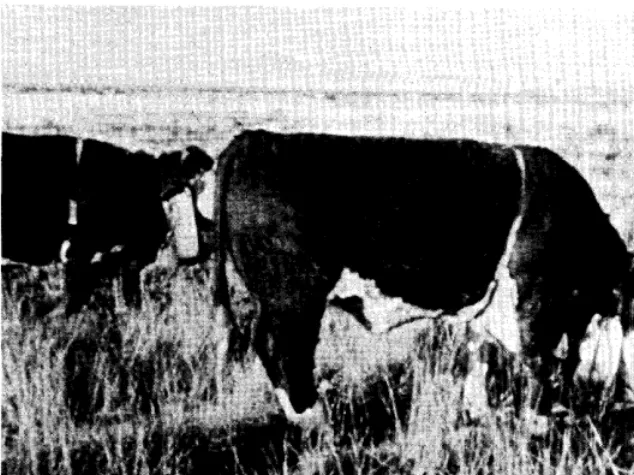
Esophageal fistulated steers fitted with forage collection bags grazing mixed semidesert grassland.
Cattle
Diets on Semidesert
Grassland:
Nutritive
Content
R. E. ROSIERE, J. D. WALLACE, AND R. F. BECK Experimental Procedure
Highlight: A study of chemical composition and organic Four esophageal fistwlated Hereford steers were used to matter digestibility of cattle diets was conducted on sample diets from a southern New Mexico semidesert range. semidesert grassland in southern New Mexico during different Diets were sampled during lo-day periods at five different seasons. Forage quality was highest in the spring. Fall diets seasons. Steers grazed study pastures 14 to 21 days prior to were lower in digestibility, contained less crude protein and collection periods for all but October collections. During each the least estimated digestible energy. Level of protein in fall period forage was collected from a continuously grazed diets was greater than requirements for dry co& but was
iess
than recommended levels for lactating cows or growing calves. Table 1. Average chemical composition, in vitro organic matter di- A stepwise regression equation showed that protein accounted gestl%ility, and estimated digestible energy in cattle diets.’
for more variation in in vitro digestibility than did other
components. Year and season
1972 1973
More than a million cattle graze semidesert grassland throughout the Southwest. Ranch enterprises are vital to the economy of this region, but cattlemen are finding it increasingly difficult to obtain a profit from range operations. Ranchers can remain in business only by increasing production and efficiency. Beef production can be increased by nutritive evaluation of cattle diets but such information is limited. This investigation was conducted to study the nutritive value of diets selected by cattle on semidesert rangeland.
Authors are graduate research assistant, range nutritionist, and range ecologist, respectively, Department of Animal, Range and Wildlife Sciences, New Mexico State University, Las Cruces.
This report is Journal Article 5 19 from the Agricultural Experiment Station, New Mexico State University.
Manuscript received May 31, 1974.
Item Summer FaII Winter Spring Summer
Organic matter (OM) (%)
Composition of OM:-
Protein (%)
Fiber (%) Lignin (%)
80.8b2 86.8a 80.5b 86.0ab 87.6a
12.7a 7.3b 13.0a 13.7a
53.8’
1 1.5a
52.913 63.3a 46.8’ 52.4bC
12.0ab 12.5ab 13.ga 7.gc 10.5h In vitro OM
digestibility (%) Estimated di- gestible energy3
(McaIk) 2.2a 1.4c 1.8b 2.4” 1.8b
’ Each value represents the mean of all steers over both grazing systems. 2Means on the same line with different superscripts are significantly
different (P < .05).
‘Predicted according to Rittenhouse et al. (197 1).
Table 2. Average seasonal composition (%) of grasses, forbs, and shrubs Table 3. Composition of available herbage and cattle diets during
in steer diets on semidesert ranges. 1 spring and summer of 1973.
Year and season
Item Organic matter @Ml (%I
Composition of OM: Protein (%) Fiber (%) Lignin (%)
Season
Spring Summer
Herbage Diet Herbage Diet
86.4 86.0 89.2 87.6
9.5 13.7 10.0 11.5
48.2 46.8 46.8 52.4
9.7 7.9 10.0 10.5
Forage class
1972 1973
Summer Fall Winter Spring; Summer
Grasses 70 55 32 15 42
Forbs 21 33 57 11 36
Shrubs 2 6 4 69 15
Unidentified 7 6 7 5 7
1 Values represent averages over both grazing systems.
pasture and from one of three pastures within a seasonal suitability grazing system. The two pastures were sampled on alternate days and forage collections were made once daily at daybreak after steers had been penned overnight. Steers were hazed to preselected areas and allowed to graze freely until about 1 kg of grazed forage was acquired. Collected forage was spread evenly over plastic trays and dried for 24 hours at 55’C in a forced-air oven. After drying it was ground through a
l-mm screen in a Wiley mill.
Dry matter, ash, and Kjeldahl nitrogen were determined according to Ass. Offic. Agr. Chem. (1965) procedures. Fiber and lignin were analyzed by acid detergent techniques (Van Soest, 1963) while organic matter digestibility was estimated by the method of Tilley ‘and Terry (1963). Digestible energy values were predicted from organic matter digestibility using a regression equation developed by Rittenhouse et al. (1971). Details of experimental pastures and climate were reported by
Rosiere (1973) and Rosiere et al. (1975). Statistical methods used were those described by Steel and Torrie (1960).
Results and Discussion
There were seasonal differences (P < 0.01) in nutrient components and in vitro organic matter digestibility (Table 1). Grazing systems had no significant effect on these factors nor were there significant differences among diets of individual steers (Rosiere, 1973), thus, data presented in Table 1 are averages of all steers and both grazing systems. Digestibility of summer diets was lower in 1973 than in 1972 even though there were differences only in forb portions of these diets (Table 2).
Fall diets were lower in protein and organic matter digestibility than were those during other seasons (Table 1). Nutrient content of fall herbage was not evaluated, but it was noted that there was less green plant material at this season than during any other. Lowest protein level coupled with lowest digestibility indicated that fall was the most critical
nutritive period and that the most benefit from
supplementation would have been expected during this period. It was impossible to determine accurately whether protein in fall diets was adequate to meet cattle requirements because
forage intake was unknown. Review of beef cattle
requirements (National Res. Count., 1970) showed that the crude protein level in fall diets (7.3%) exceeds the 5.9% recommended for dry, pregnant cows but it is lower than the 9.2% and 11 .l% suggested for lactating cows and 200-kg heifers gaining 0.5 kg per day, respectively. Protein supplementation might have been beneficial for lactating cows and young, growing cattle but not for dry cows. Dry cows grazing the study pastures were unsupplemented and produced an 88% calf crop in spring of 1973. During fall seasons, most cattle herds on semidesert ranges contain a mixture of lactating and dry cows as well as replacement heifers. In some
In vitro OM
digestibility (%) 49.3 63.7
Estimated digestible
energy’ (Meal/kg) 1.8 2.4
’ Predicted according to Rittenhouse et al. (197 1).
44.6 48.9
1.6 1.8
cases, weaned calves are wintered on these same pastures. Consequently, supplementation programs would vary with individual ranches.
There were no significant differences in protein levels of diets among seasons other than fall (Table 1). Increase in protein content from fall to winter was due to growth of highly palatable forbs. Herbel and Nelson (1966) found that cattle grazed various forbs and shrubs during winter and felt that this maintained adequate protein and carotene in diets. Winter protein supplementation of dry, pregnant cows is probably unnecessary on ranges where forbs are plentiful. Winter forb growth is dependent upon adequate precipitation and, consequently, does not always occur. Under such conditions winter and spring may be more critical than fall.
Frequent drought may make supplementation or even
“dry-lotting” necessary in summer. Cattle diets on desert grassland are dynamic and no fixed seasonal trend can be established to fit all years.
Moir (1961) reported a high correlation (i = 0.98) between digestible energy and dry matter digestibility of numerous roughages fed to ruminants. Rittenhouse et al. (1971) developed a regression equation to predict digestible energy (DE) from organic matter (OM) digestibility of forage grazed by cattle on Great Plains grasslands:
DE, Meal/kg OM = 0.039 (%OM digestibility) - 0.10. This equation is similar to that derived by Moir (1961) and its application to desert grassland diets should indicate seasonal trends in DE. Estimated DE values were highest in the spring and lowest in the fall (Table 1). These values may be compared to the requirements (National Res. Count., 1970) by converting metabolizable energy (ME) values to DE using the
Table 4. Numbers of steers required for sampling nutritive components and in vitro organic matter digestrbility within 10% of the mean with 95% confidence during each collection period.’
Year and season
Item
1972 1973
Summer FaII Winter Spring Summer
In vitro OM
digestibility 2 26 8 2 7
Protein 5 84 5 8 3
Fiber 3 3 10 7 1
Lignin 24 25 28 12 24
‘Each value retxesents an average of the number of steers required under both grazing systems.