Automatically Verified Mechanized Proof of
One-Encryption Key Exchange
Bruno Blanchet
INRIA, ´Ecole Normale Sup´erieure, CNRS Paris, France
Abstract—We present a mechanized proof of the password-based protocol One-Encryption Key Exchange (OEKE) using the computationally-sound protocol prover CryptoVerif. OEKE is a non-trivial protocol, and thus mechanizing its proof provides additional confidence that it is correct. This case study was also an opportunity to implement several important extensions of CryptoVerif, useful for proving many other protocols. We have indeed extended CryptoVerif to support the computational Diffie-Hellman assumption. We have also added support for proofs that rely on Shoup’s lemma and additional game transformations. In particular, it is now possible to insert case distinctions manually and to merge cases that no longer need to be distinguished. Eventually, some improvements have been added on the computation of the probability bounds for attacks, providing better reductions. In particular, we improve over the standard computation of probabilities when Shoup’s lemma is used, which allows us to improve the bound given in a previous manual proof of OEKE, and to show that the adversary can test at most one password per session of the protocol. In this paper, we present these extensions, with their application to the proof of OEKE. All steps of the proof, both automatic and manually guided, are verified by CryptoVerif.
Keywords-Automatic proofs, Formal methods, Provable se-curity, Protocols, Password-based authentication
I. INTRODUCTION
Since the beginning of public-key cryptography, more and more complex security notions have been defined, with protocols getting also more intricate. Initially, a long time without attack was a good argument in favor of the security of a scheme. But some schemes took a long time before being broken. A famous example is the Chor-Rivest cryptosystem [1], [2], which took more than 10 years to be totally broken [3]. Nowadays, the lack of attacks is no longer considered as a security validation, and provable security is a requirement for any new proposal.
The basic idea of provable security consists in reducing a well-known hard problem to an attack, in the complexity theory framework. Such a reduction guarantees that an efficient adversary against the cryptosystem could be con-verted into an efficient algorithm against the hard problem. First security proofs were essentially theoretical, providing polynomial reductions only. But “exact security” [4] or “concrete security” [5] asked for more efficient reductions.
Unfortunately, a security result should be considered with care. As explained above, it consists of a theorem which states that under a precise intractability assumption a spe-cific security model (goals and means of the adversary) is satisfied. The reduction constitutes the proof of the theorem. Weaknesses can appear at several steps: the intractability assumption can be too strong, or even wrong; the security model might not correspond to the expected security level; the reduction may not be tight; and the proof can be erro-neous. Because of more and more complex security models and proofs, most of them are never (double)-checked.
A famous example is the OAEP construction [6] that has been proven to achieve chosen-ciphertext security. But because of ambiguous security models in the early 90s, there was no real difference between the so-called IND-CCA1 and IND-CCA2 security levels. As a consequence, the proof was believed to achieve the IND-CCA2 level, until Shoup [7] exhibited a counter-example. Fortunately, a complete proof for IND-CCA2 has quickly been provided [8]. A machine-checked proof has later been provided [9].
As suggested by Halevi [10], computers could help in verifying proofs. This paper follows this path, with computationally-sound computer-aided proof and verifica-tion of cryptographic protocols.
Related Work: Various methods have been proposed for reaching Halevi’s goal. Following the seminal paper by Abadi and Rogaway [11], many results show the soundness of the Dolev-Yao model with respect to the computational model, which makes it possible to use Dolev-Yao provers in order to prove protocols in the computational model (see, e.g., [12], [13], [14], [15], [16] and the survey [17]). However, these results have limitations, in particular in terms of allowed cryptographic primitives (they must satisfy strong security properties so that they correspond to Dolev-Yao style primitives), and they require some restrictions on protocols (such as the absence of key cycles). A tool [18] was developed based on [12] to obtain computational proofs using the formal verifier AVISPA, for protocols that rely on public-key encryption and signatures.
and showed its soundness with respect to computational primitives, under arbitrary active attacks. This framework has been used for a computationally-sound machine-checked proof of the Needham-Schroeder-Lowe protocol [21], [22]. Canetti [23] introduced the notion of universal composabil-ity. With Herzog [24], they show how a Dolev-Yao-style symbolic analysis can be used to prove security properties of protocols within the framework of universal compos-ability, for a restricted class of protocols using public-key encryption as only cryptographic primitive. Then, they use the automatic Dolev-Yao verification tool ProVerif [25] for verifying protocols in this framework. Process calculi have been designed for representing cryptographic games, such as the probabilistic polynomial-time calculus of [26] and the cryptographic lambda-calculus of [27]. Logics have also been designed for proving security protocols in the computational model, such as the computational variant of PCL (Protocol Composition Logic) [28], [29] and CIL (Computational Indistinguishability Logic) [30]. Canetti et al. [31] use the framework of time-bounded task-PIOAs (Probabilistic Input/Output Automata) to prove security pro-tocols in the computational model. This framework makes it possible to combine probabilistic and non-deterministic behaviors. These frameworks can be used to prove security properties of protocols in the computational sense, but except for [24] which relies on a Dolev-Yao prover, they have not been automated up to now, as far as we know.
Several techniques have been used for directly mechaniz-ing proofs in the computational model. Type systems [32], [33], [34], [35] provide computational security guarantees. For instance, [32] handles shared-key and public-key en-cryption, with an unbounded number of sessions, by relying on the Backes-Pfitzmann-Waidner library. A type inference algorithm is given in [36]. In another line of research, a spe-cialized Hoare logic was designed for proving asymmetric encryption schemes in the random oracle model [37], [38]. The tool CertiCrypt [39], [40], [41], [42], [9] enables the machine-checked construction and verification of cryp-tographic proofs by sequences of games [43], [44]. It relies on the general-purpose proof assistant Coq, which is widely believed to be correct. EasyCrypt [45] generates CertiCrypt proofs from proof sketches that formally represent the se-quence of games and hints, which makes the tool easier to use. Nowak et al.[46], [47], [48] follow a similar idea by providing Coq proofs for several cryptographic primitives.
Independently, we have built the tool CryptoVerif [49] to help cryptographers, not only for the verification, but also by generating the proofs by sequences of games [43], [44], automatically or with little user interaction. The games are formalized in a probabilistic polynomial-time process calculus. CryptoVerif provides a generic method for speci-fying security properties of many cryptographic primitives. It proves secrecy and authentication properties. It also provides a bound on the probability of success of an attack. It has
already been used to prove several cryptographic protocols, and also primitives [50]. This tool extends considerably early work by Laud [51], [52] which was limited either to passive adversaries or to a single session of the protocol. More recently, Tˇsahhirov and Laud [53], [54] developed a tool similar to CryptoVerif but that represents games by dependency graphs. It handles public-key and shared-key encryption and proves secrecy properties; it does not provide bounds on the probability of success of an attack.
Contributions: In this paper, we use the tool CryptoVerif in order to prove the password-based key exchange protocol One-Encryption Key-Exchange (OEKE) [55], a variant of Encrypted Key Exchange (EKE) [56]. This is a non-trivial case study, since EKE was not proved correct before 2003, 10 years after its publication. This mechanized proof pro-vides additional confidence that the protocol OEKE is se-cure. More precisely, we have shown that OEKE guarantees the secrecy of the session key and the authentication of the client to the server. The proof combines manually-guided and automatic steps, as detailed in Section IV. With the manual proof indications included in the CryptoVerif input file, the runtime of CryptoVerif version 1.14 for this proof was 3 s on an Intel Core i5 2.67 GHz (4 cores).
This case study was also an opportunity for implementing several extensions of CryptoVerif, useful for proving many other protocols. Here are these extensions:
• CryptoVerif’s specification mechanism for assumptions on primitives did not support the computational Diffie-Hellman (CDH) assumption, needed for proving OEKE and many important protocols. We have extended it to support CDH (Section III-D). This extension also allowed us to prove a signed Diffie-Hellman protocol, in a fully automatic way.
• We have extended CryptoVerif to be able to apply Shoup’s lemma [43], by introducing events and later bounding their probability. We improve over the stan-dard computation of probabilities, for applications of Shoup’s lemma, by avoiding to count several times probabilities that in fact correspond to the same runs. This allows us to obtain better probability bounds than [55] and to show that the adversary can test at most one password per session of the client or the server, which is the optimal result. This improvement applies both to CryptoVerif proofs and to manual proofs, and it is not specific to the OEKE protocol (Section IV-A). • Additional game transformations were also needed for manually introducing case distinctions or for merg-ing cases. We have implemented these transformations (Sections IV-A and IV-C).
Outline: We recall the protocol OEKE in the next section. Section III presents the CryptoVerif model of the protocol, and Section IV presents its proof. We conclude in Section V. The appendices give background on CryptoVerif and addi-tional details. The tool CryptoVerif and the input and output files can be found at http://www.cryptoverif.ens.fr/OEKE/.
Notations: |S| denotes the cardinal of the set S. #O denotes the number of calls to oracleO.
II. THEOEKE PROTOCOL
Password-authenticated key exchange protocols allow two parties that share a low-entropy common secret (a password) to agree on a common high-entropy secret key thereafter used with symmetric primitives, such as symmetric encryp-tion for privacy and message authenticaencryp-tion codes for au-thentication. The goal of such a protocol is to guarantee the secrecy of the resulting common key between the two partic-ipating players. Furthermore, the protocol should succeed if and only if the two players actually share the same password, which guarantees the identity of the partner to both of them. Because of the low-entropy, an active adversary will succeed in impersonating a party to the other one with non-negligible probability by successive password guesses. Such an on-line dictionary attack is unavoidable. However, one should guarantee that this is the best attack: one active attack allows the adversary to test and thus eliminate at most one password, and not more. Namely, passive attacks should not (computationally) leak any information about the password. One definitely wants to prevent off-line dictionary attacks, where after a few active attacks and possibly many passive ones the collected information is enough to eliminate many passwords, and thus accelerate impersonation from the on-line dictionary attack.
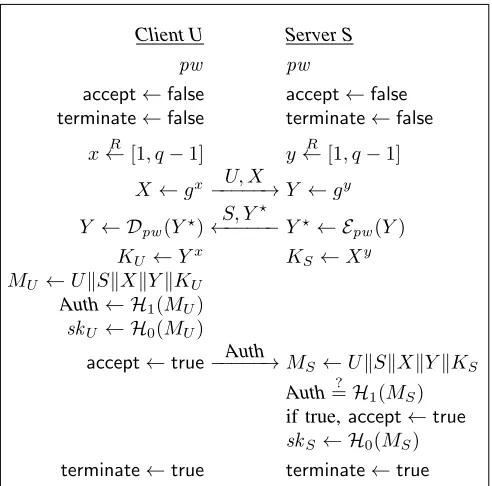
The first password-authenticated key exchange protocol has been proposed by Bellovin and Merritt [56], the En-crypted Key Exchange (EKE). This is basically a Diffie-Hellman key exchange where the two flows are encrypted with a symmetric encryption scheme, using the password as secret key. Several variants have thereafter been proposed, such as AuthA [57]. The One-Encryption Key Exchange protocol (OEKE) studied in [55] is the particular variant where the second flow only is encrypted under the password, and the first player proves his knowledge of the password with an additional key confirmation flow. Figure 1 provides a description of this OEKE protocol, which guarantees client authentication and key secrecy, under the assumptions that H0andH1are random oracles, thatEandDare respectively
the encryption and decryption of an ideal cipher, and that G is a finite group of prime order q, with generator g, in which the computational Diffie-Hellman problem is hard (see the definition in Section III-D), as proven in [55]. If the password pw is chosen among a finite dictionary passwd of size N equipped with the uniform distribution, their proof shows that the probability for any adversary,
Client U Server S
pw pw
accept←false accept←false terminate←false terminate←false
x←R [1, q−1] y←R [1, q−1]
X←gx−−−−−→U, X Y ←gy
Y ← Dpw(Y?)
S, Y?
←−−−−−Y?← E pw(Y)
KU ←Yx KS←Xy
MU ←UkSkXkYkKU
Auth← H1(MU)
skU ← H0(MU)
accept←true−−−−−→Auth MS ←UkSkXkYkKS
Auth=? H1(MS)
if true,accept←true
skS ← H0(MS)
terminate←true terminate←true
Figure 1. An execution ofOEKE, run by clientU and server S. The session key issk=H0(UkSkXkYkYx) =H0(UkSkXkYkXy).
within time t, and with less than NU sessions with a
client, NS sessions with a server (active attacks) and NP
passive eavesdroppings (passive attacks), and, asking qh
hash-queries and qeencryption/decryption queries, to make
a server instance accept with no terminating client partner is bounded by
NU + 2NS
N + 3qh×Succ
cdh G (t
0) +p
coll
withpcoll =
(2qe+ 2NU+ 3NS+ 3NP)2
2(q−1) +
q2 h+ 4Ns
2`1+1
where`1is the length of the output ofH1andt0 ≤t+(NU+
Ns+NP+qe+ 1)·τexp, withτexpdenoting the computation
time for an exponentiation inG.1 Furthermore, SucccdhG (t) denotes the maximal success probability an adversary can gain within time tagainst the computational Diffie-Hellman problem in G. Similarly, no adversary can distinguish the session key from a random key with advantage greater than
2NU + 4NS
N + 8qh×Succ
cdh G (t
0) + 2p
coll.
The proofs basically show that the unique way for the ad-versary to gain something (against both client authentication and secrecy of the session key) is to correctly guess the password, by either sending aY?that is really an encryption
under the correct password, or using the correct password to 1In [55], they use as parameter the numberq
decryptY? and compute the authenticatorAuth. One could hope to prove that the former event, denoted Encrypt, is bounded by NU/N and the latter event, denoted Auth, is bounded by NS/N. But, because of the way probabilities are computed when one uses Shoup’s lemma [43], some factor appears to the(NU +NS)/N main term.
III. MODELINGOEKEINCRYPTOVERIF
In this section, we present the model of the protocol given as input to CryptoVerif. We first recall some basic ideas behind CryptoVerif, and then present the model itself: the security assumptions on the primitives, the model of the protocol, and the security properties that we want to prove. The complete CryptoVerif model, and the reusable library that provides the definitions of cryptographic primitives, can be found at http://www.cryptoverif.ens.fr/OEKE/.
A. Review of CryptoVerif
CryptoVerif builds proofs by sequences of games [43], [44]. It starts from the initial game given as input, which represents the protocol to prove in interaction with an adversary. Then, it transforms this game step by step using a set of predefined game transformations, such that each game is indistinguishable from the previous one.
More formally, a game G interacts with an adversary represented by a context C, and we denote by C[G] the combination of C and G. During execution, C[G] may execute events, collected in a sequenceE, and finally returns a resulta, either a bitstring or the special valueabortwhen the game has been aborted. These events and result can be used to distinguish games, so we introduce an additional algorithm, adistinguisherDthat takes as input the sequence of events E and the result a, and returns true or false. An example of distinguisher isDe defined byDe(E, a) =true
if and only ife∈ E: this distinguisher detects the execution of evente. We will denote the distinguisherDesimply bye.
More generally, distinguishers can detect various properties of the sequence of events E executed by the game and of its result a. We denote by D∨D0, D∧D0, and ¬D the distinguishers such that(D∨D0)(E, a) =D(E, a)∨D0(E, a), (D∧D0)(E, a) = D(E, a)∧D0(E, a), and (¬D)(E, a) =
¬D(E, a), where∨is the logical disjunction, ∧the logical conjunction, and ¬ the logical negation. We denote by Pr[C[G] :D]the probability thatC[G]executes a sequence of eventsE and returns a resulta, such thatD(E, a) =true. A context C is acceptable for G with public variables V when it can read directly the variables of G that are in V, and it makes no other access to variables of G. (This is more formally defined in Appendix A.) We define indistinguishability as an equivalence G≈V
p G0:
Definition 1 (Indistinguishability) We write G ≈V
p G0
when, for all contextsCacceptable forGandG0with public
variablesV and all distinguishersDthat run in time at most tD,|Pr[C[G] :D]−Pr[C[G0] :D]| ≤p(C, tD).
This definition formalizes that the probability that algorithms C and D distinguish the games G and G0 is at most p(C, tD). The probabilityptypically depends on the runtime
ofCandD, but may also depend on other parameters, such as the number of queries to each oracle made by C. That is why p takes as arguments the whole algorithm C and the runtime of D. When V is empty, we write G ≈p G0.
Therefore, we obtain a sequence of indistinguishable games G0 ≈Vp1 G1 ≈
V
p2 G2. . . Gn−1 ≈ V
pn Gn, which implies G0≈Vp1+...+pnGn. In the last gameGn, the desired security property is proved by direct inspection of the game, without using any computational assumption. For example, to bound the probability that an event e is executed, event e does not occur at all in the last game, so Pr[C[Gn] : e] = 0,
hence the probability of executing e in the initial game is Pr[C[G0] :e]≤(p1+· · ·+pn)(C, e).
The game transformations used by CryptoVerif can be split into two categories:
• syntactic transformations, which are used by Cryp-toVerif to simplify games and to prepare cryptographic transformations. These transformations do not rely on any security assumption on primitives.
• cryptographic transformations, which rely on a security assumption on a primitive. These security assumptions are themselves formalized as indistinguishability prop-ertiesL≈pR, which are given as input to CryptoVerif
and need to be proved manually. They are proved once for each primitive and can then be reused in many protocols. We present such equivalences for the primitives used in OEKE below.
CryptoVerif uses these equivalences to perform proofs by reduction automatically. It detects that a gameGcan be written as a contextC that calls the oracles of L, that is,G≈V
0 C[L]by purely syntactic transformations,
and builds a gameG0 such thatC[R]≈V
0 G0by purely
syntactic transformations. C is the simulator usually defined for reductions. FromL≈pR, we can infer that
C[L]≈V
p0 C[R]whereV is a subset of the variables of
C and p0(C0, tD) = p(C0[C[ ]], tD). Indeed, if C0 is
the adversary against C[L] ≈V
p0 C[R], the adversary
against L≈p R isC0[C[ ]]. Therefore, G ≈Vp0 G0 and
CryptoVerif can transformGinto G0. B. The Random Oracle Model
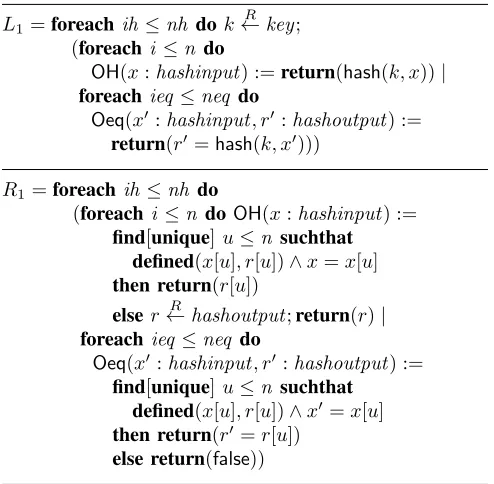
The random oracle model was introduced in [58] to model hash functions. It was encoded in CryptoVerif in [50]. We improve this model by using the equivalence L1≈#Oeq/|hashoutput| R1 whereL1 andR1 are defined in
L1=foreach ih≤nh dok R
←key; (foreachi ≤n do
OH(x:hashinput) :=return(hash(k, x))|
foreachieq≤neq do
Oeq(x0 :hashinput, r0:hashoutput) := return(r0=hash(k, x0)))
R1=foreach ih≤nh do
(foreachi ≤n doOH(x:hashinput) := find[unique]u≤n suchthat
defined(x[u], r[u])∧x=x[u] then return(r[u])
elser←R hashoutput;return(r)|
foreachieq≤neq do
Oeq(x0:hashinput, r0:hashoutput) := find[unique]u≤n suchthat
defined(x[u], r[u])∧x0=x[u]
then return(r0 =r[u]) else return(false))
Figure 2. Random oracle model
type hashoutput. The key models the choice of the hash function. The key must be chosen once and for all at the beginning of the game for each hash function, and the game must include a hash oracle, which allows the adversary to compute hashes. For each hash function indexed byih ≤nh, the gamesL1 andR1 define two oracles, OHandOeq:
• In L1, OH(x) returns the image of x by hash(k,·).
This oracle can be called at most n times for each hash function, and its calls are indexed byi∈[1,n], as defined byforeachi≤ndo. We can replace this oracle with a random oracle, that is, an oracle that returns a fresh random number when it is called with a new argument, and the previously returned result when it is called with the same argument as in a previous call. Such a random oracle is implemented inR1as follows.
Like all variables defined underforeachi ≤n,xis in fact an array indexed by i, so thatx[u] represents the value of x in theu-th call to OH. The find construct looks for an indexusuch thatx[u]andr[u]are defined, andx=x[u], that is, the current argument ofOHis the same as the argument in the u-th call, and if we find one, then we return the result of the u-th call, r[u]. Otherwise, we return a fresh random number r. • The oracle Oeq aims to optimize the treatment of
comparisons with the result of the hash function, an operation that appears frequently. In L1, the oracle Oeq(x0, r0) compares r0 with hash(k, x0). In R1, this
comparison is replaced with a lookup in previous calls to the hash function. If x0 was already given as argument to hash(k,·), in the u-th call (x0 = x[u]), then hash(k, x0)isr[u], so we compare r0 with
r[u]. Otherwise, x0 was never given as argument to
hash(k,·), so hash(k, x0) is a fresh random number, and it is equal to r0 with probability 1/|hashoutput|. We eliminate this case in R1, so the result of the
comparison r0 = hash(k, x0) is replaced with false
and the probability of distinguishing L1 from R1 is
at most#Oeq/|hashoutput|, where#Oeqdenotes the total number of calls toOeq.
We can notice that there exists at most oneuthat can satisfy the condition of find in OH in R1. Indeed, suppose that
u1 6=u2 are such that x[u1], r[u1], x[u2], r[u2] are defined
and x = x[u1] = x[u2]. Suppose that the queryOH with
i =u1 is called before OH with i = u2. (The other case
is symmetric.) Thus, when executing the query OH with i = u2, x[u1] and r[u1] are defined and x[u2] = x[u1],
so the find succeeds with u = u1, so r[u2] will not be
defined (since r is defined only in the else branch of the find). Contradiction. Therefore, u is unique. Following a similar reasoning, u is also unique in Oeq in R1. That is
why the finds in R1 are marked [unique]. Formally, the
modifier[unique]means that, in case several choices satisfy the condition of find, an event NonUnique occurs and the game is aborted. As we have shown, the event NonUnique
never occurs inR1, so the modifier [unique] does not alter
the equivalence L1 ≈#Oeq/|hashoutput| R1. The modifier [unique]allows additional transformations offind, which are correct only when there never exist several choices that make the condition of thefindsucceed. These transformations are detailed in Appendix E-B.
The novelties with respect to [50] are the use of keyed hash functions, the oracle Oeq, and the modifier [unique]. We believe that using keyed hash functions leads to a better modeling of random oracles, for several reasons:
• In the random oracle model, the adversary cannot evaluate the hash function by himself, without calling the random oracle. With the key, this is natural, since the adversary does not have the key, whereas in the absence of key, this is counterintuitive: the adversary should be able to reproduce the algorithm ofh. • In the absence of key, the transformation ofL1intoR1
above replaces a deterministic functionhwith a prob-abilistic one, since the results are chosen randomly in the right-hand side. The key removes this discrepancy: with the key, the hash oracle is also probabilistic in the left-hand side thanks to the choice of the key.
• The transformation ofL1 intoR1above is correct only
when it is applied to all occurrences of h simultane-ously. In the absence of key, this has to be enforced by an additional constraint on the transformation. With the key, this is naturally enforced, since all occurrences of the key need to be encoded as calls to the oracles of L1 for the transformation to be performed.
mod-L2=foreach ick ≤nck dock R
←cipherkey;
(foreachie ≤ne doOenc(me :blocksize,ke:key) :=return(enc(ck,me,ke))|
foreachid ≤nd doOdec(md:blocksize,kd:key) :=return(dec(ck,md,kd)))
R2=foreach ick ≤nck do
(foreachie ≤ne doOenc(me :blocksize,ke:key) :=
find[unique]j ≤ne suchthat defined(me[j],ke[j],re[j])∧me=me[j]∧ke=ke[j]then return(re[j])
⊕k≤ne suchthat defined(rd[k],md[k],kd[k])∧me =rd[k]∧ke=kd[k]then return(md[k]) elsere ←R blocksize;return(re)|
foreachid ≤nd doOdec(md:blocksize,kd :key) :=
find[unique]j ≤ne suchthat defined(me[j],ke[j],re[j])∧md=re[j]∧kd=ke[j]then return(me[j])
⊕k≤nd suchthat defined(rd[k],md[k],kd[k])∧md=md[k]∧kd =kd[k]then return(rd[k])
elserd ←R blocksize;return(rd))
Figure 3. Ideal cipher model
eling of other assumptions on hash functions, such as collision resistance. By always using keyed hash functions, we can easily change the assumption on the hash function without changing its interface.
Designing CryptoVerif specifications of primitives requires some expertise. That is why the specifications for most common cryptographic primitives are grouped in a reusable library. Therefore, CryptoVerif users generally do not have to design such specifications.
C. The Ideal Cipher Model
The ideal cipher model [59] models block ciphers by saying that encryption and decryption are two random permutations, inverse of each other. This can be encoded in CryptoVerif similarly to the random oracle model: we replace encryption and decryption with lookups in previous encryption/decryption queries; if a previous query matches, we return the previous result; otherwise, we return a fresh random number. This is modeled by the equivalenceL2≈p2 R2 where L2 and R2 are defined in Figure 3 and p2 = (#Oenc+ #Odec)(#Oenc+ #Odec−1)/|blocksize|. The encryption and decryption functions map bitstrings of type blocksize to bitstrings of typeblocksize; they take two keys as additional arguments: the standard encryption/decryption key of typekey, but also a key of typecipherkeythat models the choice of the scheme itself (like the key of the hash function in Section III-B). The games L2 and R2 define
two oracles Oenc and Odec, respectively the encryption and decryption oracles. In L2, they call the encryption and
decryption functions. InR2, they are replaced with lookups
in previous encryption/decryption queries. For instance, for oracle Oenc, we look for a previous encryption query of the same cleartext (me = me[j]) under the same key (ke = ke[j]) and, if we find one, we return the same ciphertext re[j]. We also look for a previous decryption query that has returned as cleartext the cleartext to encrypt
(me = rd[k]) using the same key (ke = kd[k]) and, if we find one, we return the corresponding ciphertextmd[k]. Otherwise, we return a fresh random ciphertext re. This definition does not yield random permutations, because the random choices of re and rd may collide with each other and with previous values of me and md. Let us consider a game R02 obtained fromR2 by excluding such collisions.
By adapting the reasoning used for the random oracle model in Section III-B, we can show that, in R02, there never exist several choices ofj/kthat satisfy the conditions of thefinds in Oenc andOdec, so these finds can be marked [unique] without modifying their behavior. The gameL2is perfectly
indistinguishable from R20, and R02 can be distinguished fromR2 with probability at most p2 (the probability of the
collisions excluded inR02), so the adversary can distinguish
L2 fromR2 with probability at mostp2.
D. The Computational Diffie-Hellman Assumption
A classical intractability assumption in asymmetric cryp-tography is the hardness of the Diffie-Hellman problem: let us be given a group G of prime orderq, with a generator g, and two random elements A = ga and B = gb with a, b ∈ [1, q−1], compute CDHg(A, B) = gab. The
Computational Diffie-Hellman (CDH) assumption claims that for any polynomial-time adversary A, SucccdhG (A) = Pr[A(G, g, A, B) =CDHg(A, B)]is negligible. More
gen-erally, we noteSucccdhG (t)the maximal success probability for any adversaryAwithin timet.
This assumption can be written in CryptoVerif as follows: foreach i≤ndoa←R Z;b←R Z;
(OA() :=exp(g, a)|OB() :=exp(g, b)|
foreach i0 ≤n0 doODDH(z:G) := z=exp(g,mult(a, b)))
≈#ODDH×Succcdh
L3=foreach ia≤na doa R
←Z; ( OA() :=return(exp(g, a))|
Oa() :=return(a)|
foreachiaDDH ≤naDDH do ODDHa(m:G, j≤nb) :=
return(m=exp(g,mult(b[j], a))))|
foreach ib≤nb dob←R Z; ( OB() :=return(exp(g, b))|
Ob() :=return(b)|
foreachibDDH ≤nbDDH do ODDHb(m:G, j≤na) :=
return(m=exp(g,mult(a[j], b))))
R3=foreach ia≤na doa R
←Z; ( OA() :=return(exp(g, a))|
Oa() :=letka:bitstring=markin return(a)|
foreach iaDDH ≤naDDH do ODDHa(m:G, j≤nb) :=
findu≤nb suchthat defined(kb[u], b[u])
∧b[j] =b[u]then
return(m=exp(g,mult(b[j], a))) else if defined(ka)then
return(m=exp(g,mult(b[j], a))) else return(false))|
foreach ib≤nb dob←R Z; ( OB() :=return(exp(g, b))|
Ob() :=letkb:bitstring =mark in return(b)|
foreach ibDDH ≤nbDDH do ODDHb(m:G, j≤na) :=
(symmetric ofODDHa)
Figure 4. Computational Diffie-Hellman assumption
(OA() :=exp(g, a)|OB() :=exp(g, b)|
foreach i0≤n0 doODDH(z:G) :=false)
The typeZ represents[1, q−1], that is, the groupZ∗q;mult
is the product in that group; G represents the group G without its neutral element; and exp is the exponentiation G×Z → G. These two games define three oracles: OA
andOBreturn the exponentialsga andgb respectively, and
the oracle ODDH checks whether its argument z is equal togab in the left-hand side while it always returns falsein
the right-hand side. The adversary can distinguish these two games if and only if it can provide azsuch thatz=gab, that
is, it breaks the CDH assumption. However, in CryptoVerif, this model requires that a and b be chosen one after the other under the same foreach: while this is true in some cryptographic schemes such as ElGamal, this is not true for most protocols: as in OEKE,aandbare chosen by different protocol participants that can each execute several sessions. Therefore, we need a more general model, which is given
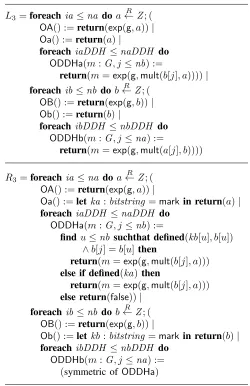
by the indistinguishability between the two games presented in Figure 4. In these two games, one generatesna exponents a,nbexponentsband the adversary (any context) has access to various oracles:OAandOBthat return the group elements associated toa, resp.b;OaandObthat return the exponents a and b themselves; and Diffie-Hellman decisions oracles
ODDHa and ODDHb that check whether the adversary correctly solved a Diffie-Hellman problem with the above generated elements. Basically, the difference between the two games is in the answers of the decision oracles: in the first game they answer correctly, while in the second game, they answer false if the adversary did not ask for any of the two exponents. Unless the adversary can break the Hellman problem, and then ask correct Diffie-Hellman decision queries, the two executions are perfectly indistinguishable. In more detail, in R3, the variable ka
is defined if and only if the oracle Oa has been called and thus the exponent a has been asked by the adversary. All variables and oracles defined under foreach ia ≤ na are implicitly indexed by ia, so that ka[ia] is defined if and only if a[ia] has been asked by the adversary. The variable kb plays the same role for b. The oracle ODDHa
computes the equality test m = ga[ia]b[j] when b[j] has
been asked by the adversary, i.e., kb[j]is defined, or a[ia] has been asked by the adversary, i.e. ka[ia] (abbreviated ka) is defined. Otherwise, it returns false. The condition “kb[j] is defined” is encoded as “kb[u] is defined for some usuch thatb[u] =b[j]” (defined(kb[u], b[u])∧b[j] =b[u]), because CryptoVerif allows to reference a variable x[˜u] in definedconditions in the right-hand side of an equivalence only when its indices u˜ are a prefix of the indices looked up by find, so a reference tokb[j] would not be allowed. We can refer to b[j] without including it in a defined condition because it also occurs in the left-hand side of the equivalence, so CryptoVerif knows that it must be defined. That is why the condition defined(kb[u], b[u])∧b[j] =b[u] is accepted by CryptoVerif.
In Appendix B-A, we formally prove that L3 ≈p3 R3, that is, no adversary can distinguish the two gamesL3and
R3, within timet, with advantage greater than
p3= (#ODDHa+ #ODDHb)
×max(1,7.4#Oa)×max(1,7.4#Ob)
×SucccdhG (t+ (na+nb+ #ODDHa+ #ODDHb)τexp).
The proof technique consists in guessing the two elementsa andb that will be involved in the critical decisional Diffie-Hellman query (but with Coron’s improvement [60]), and then to guess the critical query, hence the factor#ODDHa+ #ODDHb.
For this equivalence to be supported by CryptoVerif, we had to implement two extensions:
• In typical usages of the CDH assumption in proto-cols, gab is often an argument of a hash function
in the random oracle model. The transformation that comes from the random oracle model, presented in Section III-B, transformshash(. . . gab. . .)into lookups
that compare gab with previous arguments of hash.
These comparisonsm=gab, which occur in conditions
offind, are themselves transformed intofindusing the CDH assumption. We therefore end up with a find inside the condition of afind, which was not supported. In addition to the modeling of the CDH assumption itself, our model of Diffie-Hellman key agreements includes further properties, such as commutativity and injectivity of several functions. They are formally defined in Appendix B-B. We stress that our above modeling is not specific to the OEKE protocol. We have also used it to prove a signed Diffie-Hellman key exchange, and we believe that it can be used for proving many other protocols.
E. The Protocol Itself
If we consider a general configuration with several clients and servers, each client-server pair shares a different pass-word, and there is no other secret shared initially. Therefore, different client-server pairs have no common secret, so we can encode a single clientU and a single serverSthat wish to talk to each other; the other clients and servers, which may be corrupted, and the interactions of U and S with other clients and servers are included in the adversary. This model supports static corruptions; dynamic corruptions and forward secrecy properties are left for future work.
The protocol model first chooses random keys hk0 and hk1 to model the choice of the hash functionsh0 (i.e.H0)
and h1 (i.e. H1) respectively and a key ck to model the
choice of the ideal cipher scheme. It also randomly chooses a passwordpwin the typepasswd. Then, it makes available hash oracles for h0 and h1, encryption and decryption oracles, as well as oracles that represent the client and the server. As an example, we detail the code for the client: foreach iU ≤NU do
OC1() :=x←R Z;X ←exp(g, x);return(U, X);
OC2(=S,Ystar u:G) :=Y u ←dec(ck,Ystar u,pw); K u←exp(Y u, x);
auth u←h1(hk1,concat(U,S, X,Y u,K u)); sk u:hash0 ←h0(hk0,concat(U,S, X,Y u,K u)); return(auth u)
This code models NU sessions of the client, indexed by iU. Each session defines two oracles OC1 and OC2.OC1
takes no argument and returns the first message of the protocol U, X computed as specified in Figure 1. OC2
takes as argument the second message of the protocol
S,Ystar u received by the client and returns the third one auth u. It also computes the shared key sk u. In this code, concat(U,S, X,Y u,K u)is the concatenation
UkSkXkY ukK u. These oracles are implicitly indexed by iU, so that they can be written OC1[iU], OC2[iU]. (This index is omitted in CryptoVerif code for readability.) The adversary can call the oracles with any index it likes in the order it likes, except that, obviously,OC2[iU]can be called only ifOC1[iU] has been called before with the same iU. This gives the adversary full control over the network.
We represent NS sessions of the server in a similar way. The NU sessions of the client and the NS sessions of the server model active attacks. Additionally, we represent NP sessions of the protocol in which the adversary just eavesdrops messages without altering them. In order to represent such sessions, we simply compute and output their transcript. They model passive attacks. Since we are con-sidering dictionary attacks against a password-authenticated key exchange protocol, it is important to distinguish passive sessions/attacks from active ones against the honest players.
F. Security Properties
Our goal is to prove that OEKE is a secure key exchange that provides unilateral (explicit) authentication. (OEKE guarantees client authentication but not server authentica-tion.) To do that, we follow the ideas of [61, Section 7.2]: instead of proving semantic security of the key and au-thentication, we prove secrecy of the key on the client side and a slightly stronger authentication property. This technique avoids the burden of considering partnering when proving secrecy of the key and still implies authenticated key exchange [61, Proposition 4]: intuitively, authentication guarantees that a key of the server is also a key of a client. Authentication is modeled by correspondence properties [62] of the form “if some event occurs, then some other event oc-curred”. There are still two differences with respect to [61]: • [61] considers mutual authentication, while we consider unilateral authentication, so we remove the correspon-dence that guaranteed authentication of the server. • In [61], each protocol participant may interact with
hon-est participants (U andS here) but also with dishonest participants, and in the latter situation, the exchanged key is published when the participant accepts. As mentioned in Section III-E, in OEKE, we need not code explicitly forU andSinteracting with other clients and servers, so the output of the exchanged key disappears. Taking into account these points, we add events to record that the participants accept or terminate:
• eventacceptU(U,X,S,Ystar u,auth u,sk u)when the client accepts (line “accept ← true” of the client in Figure 1, that is, before the last line in the code of Section III-E).
and we prove that the resulting process preserves the secrecy of sk u and satisfies the correspondences
inj-event(termS(U, X, S,Ystar, a, k))⇒
inj-event(acceptU(U, X, S,Ystar, a, k)) (1) event(termS(U, X, S,Ystar, a, k))∧
event(acceptU(U, X, S,Ystar, a, k0))⇒k=k0 (2) with public variables {sk u}. A variant of [61, Proposi-tion 4] allows us to conclude one-way authenticated key exchange. Next, we define secrecy and correspondences.
Intuitively, the secrecy of sk u means that the keys sk u of all sessions of the client are indistinguishable from independent random keys. Formally, secrecy is defined as follows:
Definition 2 (Secrecy) Assume that the variable xof type T is defined inGunder a singleforeachi≤n. The gameG preserves the secrecy of xup to probability pwhen, for all contextsC acceptable for G| Rx without public variables
that do not containS andS,Pr[C[G|Rx] :S]−Pr[C[G|
Rx] :S]≤p(C)where
Rx=O0() :=b R
←bool;return;
(foreachi0 ≤n0 doO(u: [1, n]) := if defined(x[u])then
ifb then return(x[u])else
findu0 ≤n0 suchthat defined(y[u0], u[u0])∧ u[u0] =uthen return(y[u0])else
y←R T;return(y)
|O0(b0 :bool) :=ifb=b0 then eventS;abort else event S;abort)
O0, O, O0,b, b0, u, u0, y,S, andS do not occur inG.
We define the secrecy ofxwith the Real-or-Random model of [63]: in Rx, we choose a random bitb, and provide the
oracleO that the adversary can use to perform several test queries onx[u]: ifb= 1, the test query returnsx[u]; ifb= 0, it returns a random valuey(the same value if the same query x[u]is asked twice). Finally, the adversary should guess the bit b: it calls oracle O0 with its guess b0 and, if the guess is correct, then eventS is executed, and otherwise, eventS
is executed. The probability of getting some information on the secret is the difference between the probability ofSand the probability of S. (When the game always runs oracle O0, we have Pr[C[G| Rx] : S] = 1−Pr[C[G| Rx] :S],
so the advantage of the adversary is Pr[C[G| Rx] : S]− Pr[C[G | Rx] : S] = 2 Pr[C[G | Rx] : S]−1, which is
a more standard formula.) As shown in [63], the Real-or-Random model is stronger than the Find-Then-Guess model used in [55], which allows a single test query and several reveal queries. (Reveal queries always return the realx[u].) The correspondence (1) means that each execution of event termS(U, X, S,Ystar, a, k) corresponds to a dis-tinct execution of event acceptU(U, X, S,Ystar, a, k); in
other words, each session of the server that accepts with transcript U, X, S,Ystar, a and shared key k corresponds to a distinct session of the client that accepts with the same transcript and same key. It corresponds to the au-thentication of the client. The keyword inj-event is used in CryptoVerif to require injective correspondences, that is, acceptU has been executed at least as many times as termS, and not only once. The correspondence (2) means that when events termS(U, X, S,Ystar, a, k) and
acceptU(U, X, S,Ystar, a, k0)have been executed, k=k0, that is, if a client and a server have the same transcript, then they share the same key. These correspondences are proved “with public variables {sk u}”, that is, they hold even when the adversary is allowed to accesssk u directly. Formally, we writeE `ψ⇒ϕwhen the sequence of events E satisfies the correspondence ψ ⇒ ϕ. (This is formally defined in [61].) For instance,E `inj-event(termS(U, X, S, Ystar, a, k))⇒inj-event(acceptU(U, X, S,Ystar, a, k))if and only if, for each event acceptU(. . .) in E, there is a distinct eventtermS(. . .) inE with the same arguments as the eventacceptU(. . .).
Definition 3 (Correspondence) The game G satisfies the correspondence ψ ⇒ ϕ with public variables V up to probability p if and only if, for all contexts C acceptable for G with public variables V that do not contain events, Pr[C[Q] :D]≤p(C), whereD(E, a) = (E 6`ψ⇒ϕ).
IV. PROVINGOEKEINCRYPTOVERIF
In the previous section, we have presented the formal-ization of the protocol given as input to CryptoVerif. In this section, we explain how CryptoVerif proceeds with the proof. Some parts of the proof are automatic, some are guided by the user. The commands for guiding CryptoVerif can be given interactively, which allows one to see the current game and understand what should be done next, or in aproof{. . .}declaration in the CryptoVerif input file, so that CryptoVerif can then run on its own. The input file pre-sented at http://www.cryptoverif.ens.fr/OEKE/ includes such a declaration. We stress that, even with manual guidance, all game transformations are verified by CryptoVerif, so that one cannot perform an incorrect proof.
A. Applying Shoup’s Lemma
The first step of the proof is to introduce the events
AuthandEncrypt, which correspond to cases in which the adversary succeeds in testing a password and were also used in the manual proof of [55].
Hence,Pr[C[G] :D]≤Pr[C[G0] :e] + Pr[C[G0] :D]. We improve over this computation of probabilities by consider-ing e andD simultaneously instead of making the sum of the two probabilities:Pr[C[G] :D]≤Pr[C[G0] :D∨e].
Lemma 1 LetCbe a context acceptable forGandG0 with public variablesV.
1) If G0 differs from G only when G0 executes event e, thenPr[C[G] :D]≤Pr[C[G0] :D∨e].
2) If G differs from G0 only when G executes event
NonUniqueandD= (D0∧¬NonUnique)∨e1∨. . .∨en
where we abort just after executing eventse1, . . . , en,
thenPr[C[G] :D]≤Pr[C[G0] :D]. 3) If G ≈V
p G0, then Pr[C[G] : D] ≤ p(C, tD) + Pr[C[G0] :D].
4) Pr[C[G] :D∨D0]≤Pr[C[G] :D] + Pr[C[G] :D0].
This lemma, and Lemma 2 below, are proved in Ap-pendix C. In order to bound the probability that a distin-guisher D0 returns true for some game G0, we consider
any context C acceptable for G0 with public variables V
and that does not contain events, and bound Pr[C[G0] :
D0 ∧ ¬NonUnique] which is equal to Pr[C[G0] : D0]
because no find[unique] occurs in the initial game. For each game transformation, we assume that the introduced variables are fresh, so that C remains acceptable for all games of the sequence. We can then apply Lemma 1 for each game transformation. Points 1, 2, and 3 of this lemma allow us to handle several events simultaneously, as long as the proof uses the same sequence of games to bound their probabilities. Point 2 is useful for transformations that rely on the uniqueness of the values that satisfy the conditions of find, detailed in Appendix E-B: these transformations preserve the behavior of the game whenGdoes not execute event NonUnique. The distinguisher D is always of the desired form(D0∧ ¬NonUnique)∨e1∨. . .∨enbecause we
start fromD0∧ ¬NonUnique and add events introduced by
Shoup’s lemma using point 1; we abort immediately after these events. When the proof uses different sequences of games to bound the probabilities of events, we use point 4 of the lemma to bound each probability separately and compute the sum. The standard computation of probabilities corresponds to always applying point 4.
For example, suppose that we want to bound the proba-bility of evente0inG0,G1differs fromG0only whenG1
executes evente,G1≈pG2, andG2executes neithere0nor
e. Suppose for simplicity that nofind[unique]occurs, so that
NonUniquenever occurs. Lemma 1 yieldsPr[C[G0] :e0]≤ Pr[C[G1] : e0∨e] ≤p(C, te0∨e) + Pr[C[G2] : e0∨e] = p(C, te0∨e). The standard computation of probabilities yields Pr[C[G0] : e0] ≤ Pr[C[G1] : e0] + Pr[C[G1] : e] ≤
p(C, te0) +p(C, te). The runtimetD ofD is essentially the same for e0, e, and e0∨e, so Pr[C[G0] : e0] ≤ p(C, tD)
by Lemma 1, while Pr[C[G0] : e0] ≤ 2p(C, tD) by the
standard computation, so we have gained a factor 2. For secrecy, the advantage Pr[C[G|Rx] :S]−Pr[C[G|
Rx] :S]introduces a factor 2 in the probability: ifG≈
{x}
p
G0, thenPr[C[G|Rx] :S]−Pr[C[G|Rx] :S]≤2p(C[[ ]|
Rx], tS) + (Pr[C[G0|Rx] :S]−Pr[C[G0 |Rx] :S]), since
tS=tS. The next lemma avoids this factor 2 for probabilities
of events:
Lemma 2 Let C be a context acceptable for G and G0 with public variables V. Let the distinguishers D, D0 be disjunctions of eventse1∨. . .∨en such that we abort just
after executing each ei. Let AdvSecrecyG (C, D) = Pr[C[G |
Rx] :S∨D]−Pr[C[G|Rx] :S∨NonUnique].
1) If G0 differs from G only when G0 executes event e and we abort just after executing e, then
AdvSecrecyG (C, D)≤AdvSecrecyG0 (C, D∨e).
2) IfGdiffers fromG0only whenGexecutesNonUnique, thenAdvSecrecyG (C, D)≤AdvSecrecyG0 (C, D).
3) If G ≈V
p G0, then Adv Secrecy
G (C, D) ≤ 2p(C[[ ] |
Rx], t) + Adv Secrecy
G0 (C, D) where t = max(tS∨D,
tS∨NonUnique).
4) AdvSecrecyG (C, D∨D0)≤AdvSecrecyG (C, D) + Pr[C[G| Rx] :D0].
5) If CryptoVerif proves the secrecy of x in game G, then Pr[C[G | Rx] : S] = Pr[C[G | Rx] : S], so AdvSecrecyG (C, D)≤Pr[C[G|Rx] :D].
In order to prove secrecy of x in the initial game G0,
we bound Pr[C[G0 | Rx] : S] − Pr[C[G0 | Rx] : S] = AdvSecrecyG
0 (C,false), by applying Lemma 2 for each game transformation. When we apply points 4 and 5 of this lemma, we use bounds on the probabilities of events, Pr[C[G | Rx] : D0] and Pr[C[G | Rx] : D] respectively,
which can be established using Lemma 1. (They can be writtenPr[C[G|Rx] : (false∧ ¬NonUnique)∨D], so they
are of the form required by point 2 of Lemma 1.) These probabilities are not multiplied by 2, so we improve over the standard computation of probabilities for secrecy.
These improvements are implemented in CryptoVerif but also apply to manual proofs. For instance, by applying this result to the manual proof of OEKE [55], we obtain that the probability for any adversary to make a server instance accept with no terminating client partner is bounded by
NU +NS
N +qhSucc
cdh G (t
0) +p0
coll
withp0coll = (2qe+ 2NU+ 3NS+ 3NP) 2
2(q−1) +
qh2+ 2NS 2l1+1
and that no adversary can distinguish the session key from a random key with advantage greater than
NU +NS
N +qhSucc
cdh G (t
0) + 2p0
with the notations of Section II. (The detailed computation is in Appendix D.) For both properties, the first term of the probability NU+NS
N shows that the adversary can
test at most one password for each interaction with the client or the server, which is the optimal result, while the standard evaluation of probabilities given in Section II yields
NU+2NS
N for the first property and
2NU+4NS
N for the second
one. Similar improvements could also be obtained for the AuthA protocol [55, Section 4.1] and for the forward secrecy property [55, Appendix D].
1) Inserting events: In order to introduce events, we have implemented a new game transformation in CryptoVerif:
insert evente oinsertsevente;abortat program pointo. The program pointois an integer, which can be determined using the commandshow game occ: this command displays the current game with the corresponding label {o} at each program point. The command show game occ also allows one to inspect the game, for instance to know the names of fresh variables created by CryptoVerif during previous transformations. Program points and variable names may depend on the version of CryptoVerif; this paper uses CryptoVerif 1.14. CryptoVerif cannot guess where events should be introduced, so the commandinsert eventmust be manually given to the tool.
We have also defined a command insert o ins which adds instructionins at the program point o. The instruction ins can for instance be a test, in which case all branches of the test will be copies of the code that follows program pointo(so that the semantics of the game is unchanged). It can also be an assignment or a random generation of a fresh variable. In all cases, CryptoVerif checks that this instruction preserves the semantics of the game, and rejects it with an error message if it does not.
2) Transformations forh1: At the beginning of the proof, we transform the game using the random oracle assumption for h1. This transformation helps us make a program point appear at which we will next insert an event. Before actually performing this transformation, we first introduce a case distinction that leads to a simpler game after applying the random oracle assumption:
• By command insert 261“letconcat(x1,x2,x3,x4, x5) =h1x in”, we introduce aletin the hash oracle for
h1. As the result, this hash oracle becomesOH1(h1x : bitstring) :=letconcat(x1,x2,x3,x4,x5) =h1x in return(h1(hk1,h1x)) else return(h1(hk1,h1x)): the meaning of this let construct is that, if h1x is of the form concat(x1,x2,x3,x4,x5), then the in branch is taken with x1,x2,x3,x4,x5 bound to their value (which is uniquely determined because the length of the fields of the concatenation is fixed); otherwise, theelse branch is taken. Thus, we distinguish cases depending on whether h1x is of the form concat(. . .) or not. In the next transformation, which applies the random oracle assumption toh1, we are going to replace calls
toh1 with lookups in the previous queries to h1. All queries to h1in the protocol have an argument of the form concat(x10,x20,x30,x40,x50). When comparing this query to a query in the hash oracle, the compari-sonh1x =concat(x10,x20,x30,x40,x50) can then be simplified as follows:
– If h1(h1x) was computed in the in branch of the introduced let, the comparison becomes
concat(x1,x2,x3,x4,x5) = concat(x10,x20, x30,x40,x50), that is,x1 =x10∧. . .∧x5 =x50. – Ifh1(h1x)was computed in theelsebranch of this let, the comparison becomes false, because h1x cannot be of the form concat(. . .), since the in branch would have been taken in that case. • cryptorom(h1)applies the equivalenceL1≈p1R1of
Figure 2, designated byromfor Random Oracle Model, to the hash functionh1: it transforms calls to h1 into lookups in the previous queries to h1, as outlined in Section III-B.
3) Event Auth: Next, we introduce event Auth: This event corresponds to the case in which the group element X received by the server (denoted X s) does not come from the client, the authenticatorAuthreceived by the server (denotedauth s) comes from a hash query by the adversary, and authentication still succeeds. To be able to introduce this event, we first make the program point appear, at which this event will be inserted:
• insert 179“findj≤NU suchthat defined(X[j])∧ X[j] = X s then” inserts a test after receiving the authenticator in the server, to distinguish the case in which X s comes from the client (X s = X[j] for somej).
• insert 341“findjh ≤qH1 suchthat defined(x1[jh], x2[jh],x3[jh],x4[jh],hash1[jh])∧(U=x1[jh])∧(S=
x2[jh])∧(X s =x3[jh])∧(Y =x4[jh])∧(auth s= hash1[jh])then” inserts a test, in theelsebranch of the
previous one, to detect when authentication succeeds with an authenticatorauth s that comes from a hash query made by the adversary. The result of that hash query2 is hash
1[jh] and its arguments arex1[jh], . . . ,
x5[jh]. We purposely do not test that the 5-th argument of the hash query is the expected one. This avoids computing an exponentiationexp(X s, y) whereX s comes from the adversary andy is a secret exponent, thus removing a query toObin the CDH equivalence. • insert eventAuth384inserts the event itself in the
thenbranch of the previous test.
• Finally, simplify cleans up the obtained game. The elsebranch of thefindjhinserted above is removed: in that branch, authentication always fails so the protocol executes nothing.
2In CryptoVerif 1.14, the variablehash
1is in fact named@11 r 134.
4) EventEncrypt: Next, we introduce the eventEncrypt: This event corresponds to the case in which the value Y? received by the client (denoted Ystar u) comes from
an encryption query of the adversary under the correct password. As above, we have to prepare this insertion:
• crypto icm(enc) applies the equivalence that repre-sents the Ideal Cipher Model, designated by icm, to the encryption schemeenc: it replaces calls to encryp-tion/decryption with lookups in previous queries, as outlined in Section III-C.
• insert eventEncrypt 633inserts the event Encrypt
when the lookup in previous encryption/decryption queries that comes from the decryption of Ystar u succeeds with an encryption query of the adversary. 5) Transformations for h0: We proceed for h0similarly to what we did forh1at the beginning of the proof:
• insert 1251“letconcat(x01,x02,x03,x04,x05) = h0x in” distinguishes cases depending on whether the argumenth0x of the hash oracle forh0is of the form
concat(. . .)or not.
• cryptorom(h0)applies the random oracle assumption toh0(Section III-B).
B. Automatic Steps
After distinguishing cases forh0 andh1 and introducing events, we can use the automatic proof strategy of Cryp-toVerif, by commandauto. Basically, this strategy consists in applying all possible cryptographic transformations (com-ing from equivalences L ≈p R) and simplifying the game
after each such transformation. When the transformations fail, they advise syntactic transformations that could make them succeed; these transformations are executed and the cryptographic transformation is then retried [49, Section 5]. More precisely, in our case, CryptoVerif renames several variables and simplifies terms, in order to be able to apply the CDH assumption (Section III-D). Details are provided in Appendix F. After these transformations, no automatic step can be performed, so the automatic proof stops.
C. Reorganizing Random Number Generations
We end up in a situation in which random values forY are generated, but are used only in comparisons with previous queries. We would like to delay or remove these random number generations. This situation occurs at three places:
• When Y u (the value of Y in the client) is a fresh random group element,auth uandK uare also fresh random values, independently of the value of Y u, so Y u is used only in comparisons with previous encryption/decryption queries.
• The value of Y in the passive eavesdroppings, Yp, is a fresh random group element; the encryption Y?
of Y is thus also a fresh random group element by the ideal cipher model, and the hash queries return a
random value independently of the value of Yp, so Yp is also used only in comparisons with previous encryption/decryption queries.
• The value of Y in the server is also a fresh random group element; it is used in the test that decides whether to execute eventAuthand in comparisons with previous encryption/decryption queries.
We have implemented new game transformations in Cryp-toVerif, detailed in Appendix E, to handle this situation:
• move arrayXdelays the generation of a random value X until the point at which it is first used.
• merge arraysx11. . . x1n, . . . , xm1. . . xmnmerges
the variablesxj1, . . . , xjninto a single variablexj1for
each j ≤ m. Each variable xjk must have a single
definition. For each j ≤ n, the variables xj1, . . . ,
xjn must have the same type and indices of the same
type. They must not be defined for the same value of their indices (that is,xjk andxjk0 must be defined in
different branches ofif or findwhen k 6=k0), so that they can be merged into a single array.
• merge branchesmerges branches ofifandfindwhen they execute the same code.
Using these transformations, we can eliminate the random number generations for Y as outlined at the beginning of this section. We consider the three generations ofY in turn. For each of these generations, we first apply move array
to the corresponding variable, to delay its generation. For OEKE, this has the effect of generating it in the decryption oracle available to the adversary. So, in this oracle, we end up with two possibilities of generating a fresh result, the one that comes from the delayed generation of Y, say Y0, and the one that corresponds to the situation in which the query is really a fresh decryption query, say Yd. We would like
to merge these two cases by merge branches. However,
merge branchesdoes not succeed directly: we first need to merge the two variablesYd andY0 into a single variable by merge arraysYdY0, then we can applymerge branches.
In the case of the value of Y in the server, we additionally need to rewrite the condition that triggers the event Auth
for merge branches to succeed. This is done by a few manual commands, checked correct by CryptoVerif. In this process, the eventAuthis renamed intoAuth2. These steps are detailed in Appendix F.
D. The Final Computation of Probabilities
In the obtained game, the events Auth2 andEncrypt are guarded by the following conditions (variables have been renamed for readability):
(foreach iU ≤NU do. . .
find[unique]je ≤qE suchthat defined(re[je],ke[je])∧ Ystar u =re[je]∧pw=ke[je] then eventEncrypt. . .)
|(foreachiS ≤NS do. . .
x2[jh0],x3[jh0],x4[jh0],hash1[jh0],m[jd],kd[jd],
rd[jd])∧m[jd] =Y star ∧U=x1[jh0]∧
S=x2[jh0]∧X s =x3[jh0]∧rd[jd] =x4[jh0]∧ auth s=hash1[jh0]∧kd[jd] =pw then
eventAuth2. . .)|. . .
So, in order to bound the probabilities of these events, we just have to eliminate collisions between the password pw and the encryption and decryption keys, ke[je]and kd[jd]. This is done by the command simplify coll elim pw. The collisions on pw are not eliminated automatically by CryptoVerif because the type passwd of pw is declared with annotation password. This annotation allows manual elimination of collisions but prevents automatic elimination of collisions. For passwords, whose set is not very large, the automatic elimination of collisions would yield a too large probability bound.
We have to evaluate the probability of these collisions. A naive evaluation considers that one makes at mostNU×qE comparisons pw = ke[je] (there are NU sessions of the client and the condition of find is evaluated at most qE times) and similarly at mostNS×qH1×qD comparisons kd[jd] = pw, which yields the probability (NU ×qE + NS×qH1×qD)/|passwd|. A slightly more clever way is to notice thatpw =ke[je] contains as only indexje ≤qE, so at most qE distinct comparisons are performed (there are at most qE distinct encryption keys), and similarly at most qD distinct comparisons kd[jd] = pw, which yields the probability(qE+qD)/|passwd|. This is not satisfactory yet, because the encryption and decryption queries can be performed by the adversary without interacting with the protocol, soqE andqD can be large. So we have extended CryptoVerif to improve this probability bound. We start from the most naive evaluation NU ×qE and try to eliminate each factor. We can eliminate NU as shown above, but we can also eliminate qE: for each session of the client, Ystar u is fixed; since Ystar u = re[je], re[je] is also fixed. By eliminating collisions onre, there is a unique je that can make the comparison Ystar u = re[je] succeed, so a unique je for which the comparison pw = ke[je] is performed. Similarly, the comparison kd[jd] = pw is performed at most once for each session of the server. Thus we obtain the probability (NU +NS)/|passwd|. To know which factors we should preferably eliminate, we annotate qE and qD with noninteractive, which means that the adversary can perform the corresponding queries without interacting with the protocol, so qE and qD will typically be larger than other bounds. Therefore, the bound (NU +NS)/|passwd| is better than(qE +qD)/|passwd|, so CryptoVerif returns the former.
CryptoVerif then concludes that the events Encrypt and
Auth2 can be executed with probability at most (NU + NS)/|passwd|in the last game. Finally, CryptoVerif shows
that OEKE preserves the secrecy of sk u up to probability NS+NU
|passwd| + (2qH0+ 3qH1)Succ
cdh G (t
0) + 2p00
coll
and satisfies the correspondences (1) and (2) with public variables{sk u} up to probability
NS+NU
|passwd| + (4qH0+ 6qH1)Succ
cdh G (t
0) +p00
coll
wheret0 =t+(2qH0+3qH1+qD+2NU+2NP+NS)τexp
and the terms in p00coll come from elimination of collisions between hashes and between group elements:p00coll ≤(NS+ NU+qH1×NU +qH12)/|hash1|+ (qD×NU ×NP+ NU2×NP+qD×NU×NS+NU2×NS+ 2qH1×NP+ 4qE×NP+ 4qE×NS+ 4NP2+ 3NS2+ 2.5qD2+ 9NP× NU + 9NU ×NS + 7NS×qD + 6NP ×qD + 10NS× NP+ 12.5NU2+ 2qD×qE+qH1×NU+ 2qH0×NU+ 4NU×qD+3NU×qE+1.5qE2+6NS+10NU)/|G|. The main term in this probability is(NS+NU)/|passwd|: the adversary can test at most one password per session with the client or the server (active attack), which is the best bound we can hope. In contrast, [55] yields a bound of at most 4 passwords per session. In Section IV-A, by applying our im-provement of the computation of probabilities to the manual proof of [55], we obtained the same first term as CryptoVerif, and even better second and third terms. CryptoVerif obtains a second term larger than in Section IV-A because it counts several Diffie-Hellman queries, which in fact correspond to the same query, and because the CDH assumption does not benefit from the improvement of Lemma 2, points 4 and 5: the probability of breaking CDH is taken into account using Lemma 2, point 3, so it is multiplied by 2.
V. CONCLUSION
REFERENCES
[1] B. Chor and R. L. Rivest, “A Knapsack type public key cryp-tosystem based on arithmetic in finite fields,” inCRYPTO’84, ser. LNCS, vol. 196. Springer, 1985, pp. 54–65.
[2] H. W. Lenstra Jr., “On the Chor-Rivest knapsack cryptosys-tem,”Journal of Cryptology, vol. 3, no. 3, pp. 149–155, 1991.
[3] S. Vaudenay, “Cryptanalysis of the Chor-Rivest cryptosys-tem,” inCRYPTO’98, ser. LNCS, vol. 1462. Springer, 1998, pp. 243–256.
[4] M. Bellare and P. Rogaway, “The exact security of digital signatures: How to sign with RSA and Rabin,” in EURO-CRYPT’96, ser. LNCS, vol. 1070. Springer, 1996, pp. 399– 416.
[5] K. Ohta and T. Okamoto, “On concrete security treatment of signatures derived from identification,” inCRYPTO’98, ser. LNCS, vol. 1462. Springer, 1998, pp. 354–369.
[6] M. Bellare and P. Rogaway, “Optimal asymmetric encryp-tion,” in EUROCRYPT’94, ser. LNCS, vol. 950. Springer, 1994, pp. 92–111.
[7] V. Shoup, “OAEP reconsidered,” Journal of Cryptology, vol. 15, no. 4, pp. 223–249, 2002.
[8] E. Fujisaki, T. Okamoto, D. Pointcheval, and J. Stern, “RSA-OAEP is secure under the RSA assumption,” Journal of Cryptology, vol. 17, no. 2, pp. 81–104, 2004.
[9] G. Barthe, B. Gr´egoire, S. Z. B´eguelin, and Y. Lakhnech, “Beyond provable security. Verifiable IND-CCA security of OAEP,” inCT-RSA 2011, ser. LNCS, vol. 6558. Springer, 2011, pp. 180–196.
[10] S. Halevi, “A plausible approach to computer-aided crypto-graphic proofs,” Cryptology ePrint Archive, Report 2005/181, 2005, http://eprint.iacr.org/.
[11] M. Abadi and P. Rogaway, “Reconciling two views of cryp-tography (the computational soundness of formal encryp-tion),” Journal of Cryptology, vol. 15, no. 2, pp. 103–127, 2002.
[12] V. Cortier and B. Warinschi, “Computationally sound, auto-mated proofs for security protocols,” inESOP’05, ser. LNCS, vol. 3444. Springer, 2005, pp. 157–171.
[13] R. Janvier, Y. Lakhnech, and L. Mazar´e, “Completing the picture: Soundness of formal encryption in the presence of active adversaries,” in ESOP’05, ser. LNCS, vol. 3444. Springer, 2005, pp. 172–185.
[14] H. Comon-Lundh and V. Cortier, “Computational soundness of observational equivalence,” inCCS’08. ACM, 2008, pp. 109–118.
[15] M. Backes, D. Hofheinz, and D. Unruh, “CoSP: A general framework for computational soundness proofs,” inCCS’09. ACM, 2009, pp. 66–78.
[16] V. Cortier and B. Warinschi, “A composable computational soundness notion,” inCCS’11. ACM, 2011, pp. 63–74.
[17] V. Cortier, S. Kremer, and B. Warinschi, “A survey of symbolic methods in computational analysis of cryptographic systems,”Journal of Automated Reasoning, vol. 46, no. 3–4, pp. 225–259, 2011.
[18] V. Cortier, H. H¨ordegen, and B. Warinschi, “Explicit random-ness is not necessary when modeling probabilistic encryp-tion,” in ICS 2006, ser. ENTCS, vol. 186. Elsevier, 2006, pp. 49–65.
[19] M. Backes, B. Pfitzmann, and M. Waidner, “A composable cryptographic library with nested operations,” in CCS’03. ACM, 2003, pp. 220–230.
[20] M. Backes and B. Pfitzmann, “Symmetric encryption in a sim-ulatable Dolev-Yao style cryptographic library,” inCSFW’04. IEEE, 2004, pp. 204–218.
[21] C. Sprenger, M. Backes, D. Basin, B. Pfitzmann, and M. Waidner, “Cryptographically sound theorem proving,” in
CSFW’06. IEEE, 2006, pp. 153–166.
[22] C. Sprenger and D. Basin, “Cryptographically-sound protocol-model abstractions,” in LICS’08. IEEE, 2008, pp. 3–17.
[23] R. Canetti, “Universally composable security: A new paradigm for cryptographic protocols,” inFOCS’01. IEEE, 2001, pp. 136–145.
[24] R. Canetti and J. Herzog, “Universally composable symbolic analysis of cryptographic protocols (the case of encryption-based mutual authentication and key exchange),” Cryptology ePrint Archive, Report 2004/334, 2004, available at http:// eprint.iacr.org/2004/334.
[25] B. Blanchet, “Automatic proof of strong secrecy for security protocols,” in IEEE Symposium on Security and Privacy, 2004, pp. 86–100.
[26] J. C. Mitchell, A. Ramanathan, A. Scedrov, and V. Teague, “A probabilistic polynomial-time calculus for the analysis of cryptographic protocols,”Theoretical Computer Science, vol. 353, no. 1–3, pp. 118–164, 2006.
[27] D. Nowak and Y. Zhang, “A calculus for game-based security proofs,” in ProvSec 2010, ser. LNCS, vol. 6402. Springer, 2010, pp. 35–52.
[28] A. Datta, A. Derek, J. C. Mitchell, V. Shmatikov, and M. Tu-ruani, “Probabilistic polynomial-time semantics for a protocol security logic,” inICALP’05, ser. LNCS, vol. 3580. Springer, 2005, pp. 16–29.
[29] A. Datta, A. Derek, J. C. Mitchell, and B. Warinschi, “Com-putationally sound compositional logic for key exchange protocols,” inCSFW’06. IEEE, 2006, pp. 321–334.
[30] G. Barthe, M. Daubignard, B. Kapron, and Y. Lakhnech, “Computational indistinguishability logic,” inCCS’10. ACM Press, 2010, pp. 375–386.