ISSN(Online): 2320-9801
ISSN (Print): 2320-9798
International Journal of Innovative Research in Computer
and Communication Engineering
(An ISO 3297: 2007 Certified Organization)
Vol. 3, Issue 8, August 2015
Performance Evaluation of Turbo Decoding
Methods
Steffi A Pereira
M.Tech, Department of ECE, New Horizon College of Engineering, Marathahalli, Bengaluru, India
ABSTRACT: Turbo codes offer better performance when compared to convolutional codes at moderate BER and large block length. It works on the principle of efficient iterative decoding method. Turbo-codes were introduced to decrease the complexity of iterative turbo decoding while the performance of the system is close to Shannon capacity. Repeat Accumulate, Irregular Repeat Accumulate and Accumulate Repeat Accumulate codes are some of the recently invented turbo-like code. Turbo codes are used in many important wireless protocols from deep-space communications to mobile communications.
The objective of this project is to study the two prime candidates for decoding turbo codes, namely SOVA and Log-MAP decoding algorithms. Simulations are carried out using MATLAB software. BER performance evaluation of both Log-Map and SOVA turbo decoding algorithms are done. While doing this project, investigation was carried out on how various system parameters such as frame length, number of iterations, code rates etc. affects the performance of turbo codes using Log-Map and SOVA decoding algorithm.
KEYWORDS: Decoding Algorithms; turbo codes; SOVA; Log-Map; Viterbi Algorithm;
I. INTRODUCTION
Turbo code actually consists of two recursive systematic convolutional codes that are connected in parallel called parallel concatenation. The main dissimilarity between both the convolutional and turbo codes is that convolution codes shows higher production for larger constraint length, the turbo codes has a low constraint length, which maintain as a constant value in most of application. However, it achieves a substantial coding improvement at low coding rates. An important factor for gaining this increment is due to making use of the soft input soft output to produce the soft decisions using decoder algorithm.
The iterative style of the different turbo decoding algorithms has very high complexity when compared to classical forward error correction decoding techniques. The most important of the iterating decoder algorithms are, soft output Viterbi algorithm and maximum a posteriori probability algorithm. They need complex operations at the decoder end with many decoding iterative cycles. By lowering the complication of decoding of turbo codes in real time where as improving bit error rate is a significant design factor. Log MAP algorithm requires large number iterations to obtain a relatively better BER at low Signal to Noise Ratio. This results in excessive time delay and also increases computational complexity. So another turbo decoding algorithm such as SOVA was proposed. It is based on classical Viterbi Algorithm, which produces soft output rather than hard output. This algorithm provides best-suited path arrangement along with reliability rate of all of the received bits, which is the soft estimated output. When compared to Log MAP, SOVA reduces the system complexity as well as time delay. However the character performance of logmap is a bit excelling than SOVA.
II. RELATED WORK
ISSN(Online): 2320-9801
ISSN (Print): 2320-9798
International Journal of Innovative Research in Computer
and Communication Engineering
(An ISO 3297: 2007 Certified Organization)
Vol. 3, Issue 8, August 2015
used in an iterating turbo decoders. This is followed with an example of sova. Finally, the study of various system parameters that affect the performance of the decoder was made.
[2]This paper explains the role of parallel Turbo Decoding in the upcoming digital communication applications as it can achieve high throughput and less latency. It studies the parallelism techniques with Viterbi and MAP algorithm in convolutional Turbo Decoder by discussing the parallelism of turbo and SISO decoders. In next level, the analysis was based on a test such as efficiency on the basis of parallelism as they are the parameter that can act as a trade-off between the parallelism degree that can be achieved and the area overhead. Also, the map,log map, sova algorithms are discussed along with their design consideration. This is followed by a comparison of two techniques i.e.logmap and sova and algorithms for viterbi based encoder and decoder have been discussed.
[3] In this paper, the SISO algorithm which estimates the A-posteriori probabilities for each transmitted bit is executed. In the decoding process, the soft output from the first stage are fed as input to the second decoder which could also be an outer decoder that also process information sequence in an iterative manner. When compared to Viterbi algorithm, the proposed algorithm has an increased complexity of upto 4 times when compared to the Viterbi.
[4]In this paper, the Viterbi Algorithm is enhanced to provide the best path likelihood sequence in a finite state markov chain and is designed to produce the APP value for every bit or a confidence information. Considering the confidence indicator, the altered Viterbi Algorithm generates soft decisions which could be secondhanded for decoding the external codes. The inside sova takes in and gives out the soft test values hence could be used for improving SNR. Comparisons showing the gain over conventional hard deciding Viterbi Algorithm is shown including concatenated convolutional codes,block codes, trellis coded modulation having convolutioned error correcting codes in forward direction and also coded viterbi equilization. This paper also analyse the difficult symbol-by-symbol MAP algorithm which convert the probability value into soft outputs.
[5] This paper provides an overview of how parallel concatenated turbo codes are made using RSC codes.Two convolutional RSC codes are considered for the design and also feed back is considered using decoding rule.
III. DECODINGOFTURBOCODES
ISSN(Online): 2320-9801
ISSN (Print): 2320-9798
International Journal of Innovative Research in Computer
and Communication Engineering
(An ISO 3297: 2007 Certified Organization)
Vol. 3, Issue 8, August 2015
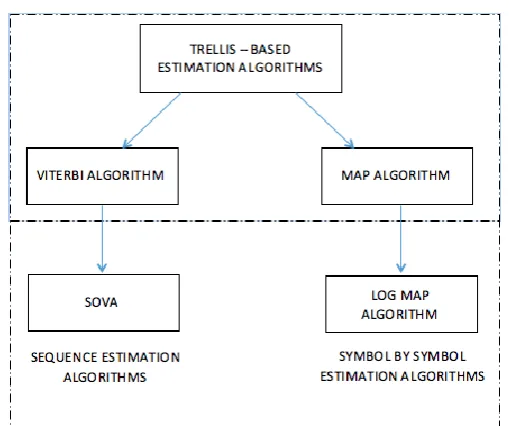
Figure 3.1 illustrates the different decoding algorithms that are used in this paper for purpose of decrypting the Turbo Codes. These algorithms functions on the basis of trellis structure estimating technique. There are two types of estimation techniques,they are:
a. sequence wise estimation technique. b. symbol wise estimation techniques.
Both viterbi algorithm and sova are sequence estimation algorithms while map algorithm, max log map and the log map algorithm are symbol estimation algorithms.On a comparison over these two algorithm shows symbol estimation is tough such as execution takes lots of time than sequence based. However their bit error rate characteristics is much more better than the other. All algorithms i.e. Sova, Map,logmap,maxlogmap gives soft decisions.But viterbi algorithm however generates hard decisions as the output. SOVA is the algorithm that generates soft output.
IV. STRUCTURE OF TURBO CODES
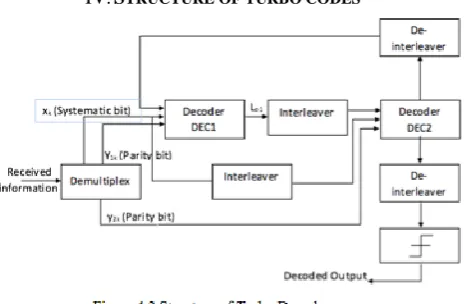
Xkand Ykare the punctured encoder outputs Xkand Ykcorrupted by two different noises with the same variation and
this forms the input to the decoder. The demultiplexer chooses Y1kwhen the transmitted sequence is Y1kand the decoder
chooses Y2k when the transmitted sequence is Y2k and sets it to zero if there is no transmission. DEC2 uses the output of
DEC1 to change the self-reliance levels and hence it can get more correct assessment of the message being transmitted. Interleaver is used to de–correlate the error bursts, which is the same as before. The o/p of DEC2 is transmitted back toDEC1 and the cycle is repeated many times based up on the BER rate needed for the application.After suitable iteration a threshold operation will be performed at the second decoder to obtain the hard output which is same as the input bit.
The logliklihood ratio consist of three terms such as:
𝐿(𝑑𝑘) = 𝐿𝑎𝑝𝑟𝑖 (𝑑𝑘) + 𝐿𝑐 (𝑥𝑘) +𝐿𝑒 (𝑑𝑘)
𝐿𝑐=4∗ 𝑎∗(𝐸𝑠/𝑁0)
Where, a=AWGN channel fading amplitude Lapri(dk) =a priori information of dk
Lc (xk) =the channel measurement
Le(dk) is the extrinsic information exchanged between the constituent decoders.
ISSN(Online): 2320-9801
ISSN (Print): 2320-9798
International Journal of Innovative Research in Computer
and Communication Engineering
(An ISO 3297: 2007 Certified Organization)
Vol. 3, Issue 8, August 2015
next forward (or reverse) state metric. This change will make intuitive sense. In Viterbi algorithm the best path can be found by finding the most likely path sequences therefore there is a continuous compare and select process.
In MAP algorithm, we find a soft output from the metrics of all available transitions at a particular time interval. For each correct bit that decoded this algorithm gives likelihood values and correct bit sequence. They were required for the turbo codes which uses the principle of iterative decoding .Where as, the SOVA decoding algorithm have the similar operation as Viterbi mentioned above with addition and storage of another real value Hence the SOVA can be implemented by reversing the VA. SOVA and VA differ by the parameter such as the reliability indicator with the hard decision output for each of the bit information added. The sova algorithm has two conventional changes over classical Viterbi Algorithm. Firstly metric values along path are modified by taking a-priori information while choosing maximum likelihood (ML) path. Secondly it provides a soft output for bits which are decoded Hence both the hard decision output as well as the reliability indicator combine together and form the „soft output‟.
V. SIMULATION RESULTS
Simulations were carried out in MATLAB, to understand the effect of various parameters like Frame size, code rate and number of iterations on SOVA and Log-Map Turbo decoding algorithms. The performance of Log-MAP and
SOVA algorithm have been simulated using generator polynomial (7oct,5oct) with constraint length K=3.
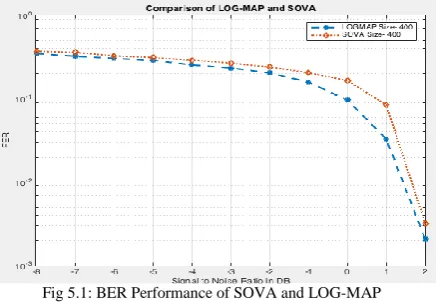
Fig 5.1: BER Performance of SOVA and LOG-MAP
Figure 5.1 shows the BER performance of SOVA and Log MAP decoder. It can be noted that Log MAP outperforms SOVA. The computational time of Log MAP is 14.047 seconds while of SOVA is 7.115 seconds.
ISSN(Online): 2320-9801
ISSN (Print): 2320-9798
International Journal of Innovative Research in Computer
and Communication Engineering
(An ISO 3297: 2007 Certified Organization)
Vol. 3, Issue 8, August 2015
Figure 5.2 and 5.3 shows the effect of various iterations. We used iterations of 1 and 5 here. It can be noted that better BER performance is obtained as we increase the number of iterations.
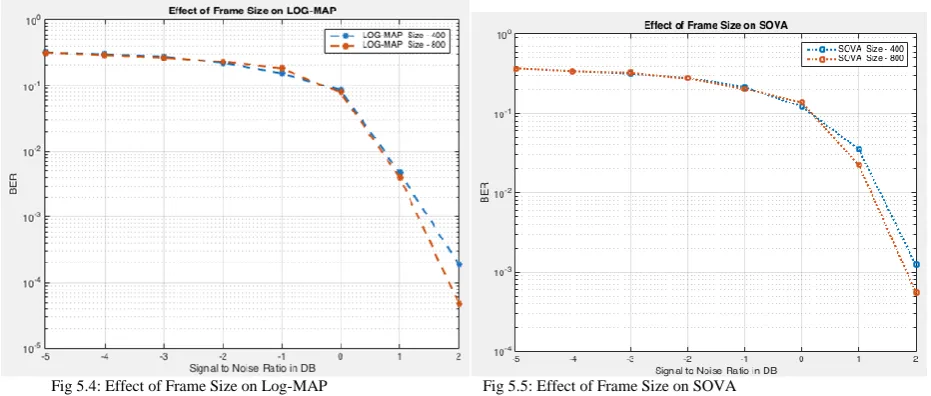
Fig 5.4: Effect of Frame Size on Log-MAP Fig 5.5: Effect of Frame Size on SOVA
Figure 5.4 and 5.5 shows the effect of various frame sizes on the decoding algorithms. We have used frame size of 400 and 800 in this simulation. The results obtained show that as 800-frame size performs better than 400.
Fig 5.6: Effect of Code Rate on Log-MAP Fig 5.7: Effect of Code Rate on SOVA
Figure 5.6 and 5.7 shows the effects of code rate such as ½ and 1/3. It can be observed that 1/3 code rate performs better compared to rate ½ punctured code sequence.
VI. CONCLUSION
ISSN(Online): 2320-9801
ISSN (Print): 2320-9798
International Journal of Innovative Research in Computer
and Communication Engineering
(An ISO 3297: 2007 Certified Organization)
Vol. 3, Issue 8, August 2015
achieved in a turbo coding system compared with the lower size of frame. Also as we increments the number of iterations for the operation of iterative turbo decoder it shows considerable improvement in performance in terms of bit error rates. The effect of code rate shows turbo code performs much better with decrease in code rate.
REFERENCES
1. Jason P.Woodard and LajosHanzo “Comparative Study Of Turbo Decoding Techniques:An Overview”, IEEE TRANSACTION ON
VEHICULAR TECHNOLOGY,VOL.49.NOVEMBER 2000.
2. RupinderKaur,SarpreetSing,”Techniques For Turbo Decoding Using Parallel Processing”,Vol 3,Issue 4,International Journal of Advanced
Research in Computer Science and Software Engineering 3(4),April - 2013, pp. 161-167.
3. StevenS. Pietrobon and Adrian S. Barbulescu, “A Simplification of the Modified Bahl Decoding Algorithm for Systematic Convolutional
Codes “, Australian Space Centre for Signal Processing University of South Australia The Levels SA 5095.
4. J. Hagenauer, P. Hoeher, “A Viterbi Algorithm with Soft Decision Outputs and its Applications”, Proc. IEEE CLOEECOM „89, Dallas,Nov.
1989, pp. 1680-1686.
5. C.Berrou,A.Glavieux and P.Thitimajshima, "Near Shannon Limit Error Correcting Coding and Decoding:Turbo Codes" Proceeding of IEEE