Suburbanized Access Control with Unsinged
Affirmation of Data Stored In Cloud
Raghvendra V.Kulakarani
1, Prof. Sachin Chavan
2PG Scholar, Department of Computer Engineering, MGM’s College of Engineering & Technology, Kamothe,
Navi Mumbai,India
Assistant Professor, Department of Computer Engineering, MGM’s College of Engineering & Technology, Kamothe,
Navi Mumbai,India
ABSTRACT: Cloud computing is one of the fast growing area in the computer field. The cloud must be secure because it may have sensitive data. There are some traditional techniques available but these are not sufficient. To enhance the security of the cloud we are proposing this scheme. In this proposed system the data i.e. cloud is decentralized and can support the unsigned affirmation of data stored in cloud. In this cloud does not need to authenticate the user before storing the data but to decrypt the data one should authenticate by cloud. This scheme provides protection from reply attacks and may allow creating, modifying and reading the data from cloud. Although access control and authentication is decentralized, the communication and storage is likely be centralized.
KEYWORDS: Cloud; Access control; Affirmation; suburbanized; attribute based encryption.
I. INTRODUCTION
Initially clouds were used to store the data only and considered as replacement for the storage devices hard disks, DVD,CD). But the researchers proved that it’s not only for the storage but we can do much more with the cloud. by using the cloud one can deploy computation and storage by using internet. Cloud also provides many types of services (eg. Google Apps)
At most of the times the data stored in cloud is hyper sensitive for example health care records, business documents, personal records, student’s record. As its sensitive data there should be a strong security otherwise one can hack the data and can be misused. One aspect is that the user must be authenticate before accessing the data on cloud and another aspect is that cloud should be trusted means cloud does not damage the data. User privacy is also important here, other user do not know the identity of the user.
The main purpose of the proposed system is to provide security to the cloud [1]. There are three types to access the cloud one is user based access. In this only users can access the cloud. Another type is role based access. In this type specific roles means specific users with assigned roles can access the cloud. And the last is attribute based access in which valid set of attributes decides the access control policy.
II. RELATED WORK
ISSN(Online): 2320-9801
ISSN (Print): 2320-9798
International Journal of Innovative Research in Computer
and Communication Engineering
(An ISO 3297: 2007 Certified Organization)
Vol. 3, Issue 10, october 2015
secure cloud storage using decentralized access control with anonymous authentication in 2013. He used policy based file access using attribute based encryption (ABE) with RSA key public private key combination. Markulf kohlweiss, ueli Maurer, cristinaOnete, Bjorn Tackmann, Daniele Venturi[4] introduced anonymity Preserving public keys Encryption: A constructive Approach where public key cryptosystem with enchanced security properties have been proposed. It investigates constructions as well as limitations for preserving receiver anonymity when using public key encryption. S Divy Bharathy and T Ramesh[5] introduced the concept of privacy preserving access control scheme for data storage, which supports anonymous authentication and perform decentralized key management in Securing Data Stored in Clouds Using Privacy Preserving Authenticated Access Control in April 2014. In this scheme, the cloud allows an access control policy and attributes hiding strategy to enhance security. This provides secure and efficient dynamic operation on data blocks, and performs data update, creation, modification and reading data stored in the cloud. Sushmita Ruj, Milos Stojmenovic, Amiya Nayak introduces Decentralized Access Control with Anonymous Authentication of Data Stored in Clouds in 2014. Its a new decentralized access control system for secure data storage in clouds that allows anonymous authentication. In the proposed scheme, the cloud verifies the authenticity of the series without knowing the user’s identity before storing data. Our scheme also has the feature of access control in which only valid users are able to decrypt the stored information.
III.PROPOSED SYSTEM A. Assumptions:
The cloud is trusted i.e. cloud doesn’t damage the data.
User can read or write or read and write the data.
All communications are secured.
B. System Design:
In the proposed system there are following keys used
Public Key: It’s a random generated key. It’s binary in nature & maintained by key manager. It’s used for encryption or decryption.
Private Key: It’s the combination of user credentials (User name, password, security Question). It is also used for encryption and decryption.
Access Key: This key is based on the policy. Private access key is maintained by the user. Access key generated on attributed based encryption.
C. Description of proposed system:
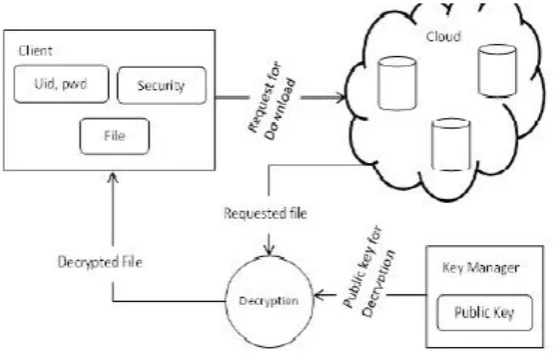
According to proposed system user can create and store a file in the cloud. This scheme uses the ABE protocol and RSA algorithm. Let discuss the scheme in detail. Fig 1 shows the actual working mechanism. In figure there are 3
Figure 1: System Modules
File Upload :
To upload a file initially user requests to the key manager for the public key. This key will be generated according to the policy associated with the file. For the different polices public key may differ and vice versa. Then user generates the private key by using user credentials. After that file is encrypted with the help of public and private key.
Figure 2: File uploading
File Download :
ISSN(Online): 2320-9801
ISSN (Print): 2320-9798
International Journal of Innovative Research in Computer
and Communication Engineering
(An ISO 3297: 2007 Certified Organization)
Vol. 3, Issue 10, october 2015
Figure 3: File download
IV.RESULTS
Cloud is the virtual storage where user can store the data or information. This data may be sensitive so user must ensure about the security of the cloud. For this user must sure that only authorized users can access the data. Security of data and privacy of the users must be preserved by the cloud. User may permit access to another user by granting access permission according to the choice. Result analysis can be done according to the authentication scheme, access permission and decentralized environment.
Scheme Authentication
Attribute based Data sharing with Attribute revocation
No Authentication
Decentralizing Attribute based encryption
No Authentication
Securing Personal health records in cloud computing
No Authentication
Realizing Fine-Grained and Flexible Access Control to Outsourced Data with Attribute-
Based Cryptosystems
Authentication
Proposed scheme Authentication
Table 1: Comparison between different systems
Users Read Read / Write
Velansiya 05 07
Shreeyash 15 03
Snehal 00 23
Dhanashree 09 21
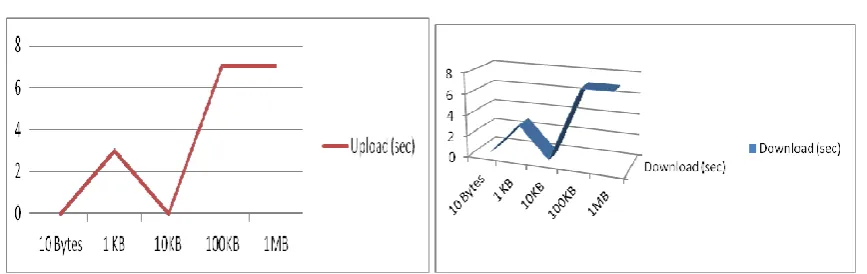
Figure 4: Graph showing time required time for the uploading and downloading the file on cloud
V. CONCLUSION AND FUTURE WORK
We have presented Suburbanized Access Control with Unsinged Affirmation of Data Stored in Cloud, which provides user revocation and prevents reply attacks. More security is assured while uploading and downloading the file to the cloud s it uses the standard Encryption / Decryption techniques. The cloud does not know the identity of the user but verifies the user credentials. Key distribution is in decentralized way. The cloud knows the access polices this can be a limitation in future work can be done to hide attributes and access policies of the users.
REFERENCES
1. S. Ruj, M. Stojmenovic, and A. Nayak, “Privacy Preserving Access Control with Authentication for Securing Data in Clouds,”
Proc.IEEE/ACM Int’l Symp. Cluster, Cloud and Grid Computing, pp. 556- 563, 2012
2. V. Goyal, O. Pandey, A. Sahai, and B. Waters, “Attribute-Based Encryption for Fine-Grained Access Control of Encrypted Data,” Proc.
ACM Conf. Computer and Comm. Security, pp. 89-98, 2006.
3. S. Ruj, A. Nayak, and I. Stojmenovic, “DACC: Distributed Access Control in Clouds,” Proc. IEEE 10th Int’l Conf. Trust, Security and
Privacy in Computing and Communications (TrustCom), 2011.
4. R. Lu, X. Lin, X. Liang, and X. Shen, “Secure Provenance: The Essential of Bread and Butter of Data Forensics in Cloud Computing,”
Proc. Fifth ACM Symp. Information, Computer and Comm. Security (ASIACCS), pp. 282-292, 2010.
5. G. Wang, Q. Liu, and J. Wu, “Hierarchical Attribute-Based Encryption for Fine-Grained Access Control in Cloud Storage Services,”
Proc. 17th ACM Conf. Computer and Comm. Security (CCS), pp. 735-737, 2010.
6. H.K. Maji, M. Prabhakaran, and M. Rosulek, “Attribute-Based Signatures: Achieving Attribute-Privacy and Collusion-Resistance,” IACR
Cryptology ePrint Archive, 2008
7. Pooja R. Vyawhare et al, / (IJCSIT) International Journal of Computer Science and Information Technologies, Vol. 6 (3) , 2015,
2441-2447
8. C. Wang, Q. Wang, K. Ren, N. Cao, and W. Lou, “Toward Secure and Dependable Storage Services in Cloud Computing,” IEEE Trans.
Services Computing, vol. 5, no. 2, pp. 220-232, Apr.- June 2012.
9. J. Li, Q. Wang, C. Wang, N. Cao, K. Ren, and W. Lou, “Fuzzy Keyword Search Over Encrypted Data in Cloud Computing,” Proc. IEEE
INFOCOM, pp. 441-445, 2010
BIOGRAPHY
Raghvendra V. Kulakarani is pursing Master of Engineering in Computer Engineering from MGM’s College of Engineering & Technology, Kamothe, Navi Mumbai, India. He received Bachelor of Engineering in Information & Technology degree in 2013 from Sant Gadage Baba Amravati University, Amravati, MS, India. His research interests are computer networks, cloud computing etc.