University of Windsor University of Windsor
Scholarship at UWindsor
Scholarship at UWindsor
Electronic Theses and Dissertations Theses, Dissertations, and Major Papers
2009
Reliability Consideration in the Design of Cellular Manufacturing
Reliability Consideration in the Design of Cellular Manufacturing
Systems using Genetic Algorithm
Systems using Genetic Algorithm
Xiao WangUniversity of Windsor
Follow this and additional works at: https://scholar.uwindsor.ca/etd
Recommended Citation Recommended Citation
Wang, Xiao, "Reliability Consideration in the Design of Cellular Manufacturing Systems using Genetic Algorithm" (2009). Electronic Theses and Dissertations. 215.
https://scholar.uwindsor.ca/etd/215
This online database contains the full-text of PhD dissertations and Masters’ theses of University of Windsor students from 1954 forward. These documents are made available for personal study and research purposes only, in accordance with the Canadian Copyright Act and the Creative Commons license—CC BY-NC-ND (Attribution, Non-Commercial, No Derivative Works). Under this license, works must always be attributed to the copyright holder (original author), cannot be used for any commercial purposes, and may not be altered. Any other use would require the permission of the copyright holder. Students may inquire about withdrawing their dissertation and/or thesis from this database. For additional inquiries, please contact the repository administrator via email
Reliability Consideration in the Design of Cellular Manufacturing
Systems using Genetic Algorithm
By
Xiao Wang
A Thesis
Submitted to the Faculty of Graduate Studies
through Industrial and Manufacturing Systems Engineering
in Partial Fulfillment of the Requirements for
the Degree of Master of Applied Science at the
University of Windsor
Windsor, Ontario, Canada
2009
Reliability Consideration in the Design of Cellular Manufacturing Systems using
Genetic Algorithm
By
Xiao Wang
APPROVED BY:
R. Bowers
Department of Mechanical, Automotive, and Materials Engineering
M. Wang
Department of Industrial and Manufacturing Systems Engineering
R. Lashkari, Advisor
Department of Industrial and Manufacturing Systems Engineering
H. ElMaraghy, Chair of Defense
Department of Industrial and Manufacturing Systems Engineering
iii
AUTHOR’S DECLARATION OF ORIGINALITY
I hereby certify that I am the sole author of this thesis and that no part of this
thesis has been published or submitted for publication.
I certify that, to the best of my knowledge, my thesis does not infringe upon
anyone’s copyright nor violate any proprietary rights and that any ideas, techniques,
quotations, or any other material from the work of other people included in my thesis,
published or otherwise, are fully acknowledged in accordance with the standard
referencing practices. Furthermore, to the extent that I have included copyrighted
material that surpasses the bounds of fair dealing within the meaning of the Canada
Copyright Act, I certify that I have obtained a written permission from the copyright
owner(s) to include such material(s) in my thesis and have included copies of such
copyright clearances to my appendix.
I declare that this is a true copy of my thesis, including any final revisions, as
approved by my thesis committee and the Graduate Studies office, and that this thesis
iv
ABSTRACT
This thesis proposes a multi-objective, mixed integer, non-linear programming model
of cellular manufacturing systems (CMS) design to maximize the system reliability
and minimize the total system cost simultaneously. The model involves multiple
machine types, multiple machines for each machine type, multiple part types, and
alternative process routes for each part type. Each process route consists of a sequence
of operations. System reliability associated with machines along process routes can be
improved by increasing the number of parallel machines subject to acceptable cost.
Assuming machine reliability to follow a lognormal distribution, the CMS design
problem is to optimally decide the number of each machine type, assign machines to
cells, and select, for each part type, the process route with the highest overall system
reliability while minimizing the total cost. The total cost consists of the variable cost
of manufacturing operations, the inter-cell material handling cost, the penalty cost of
machine under-utilization, and machine annuity cost. Genetic algorithm (GA) is
proposed as the solution procedure, and is applied to solve this practical-sized CMS
design problem. It is shown that, with its characteristics of random selection,
crossover, and mutation, GA is capable of finding a heuristic solution within a
v
ACKNOWLEDGEMENTS
I deeply appreciate my supervisor, Professor R.S. Lashkari. His valuable advice,
patience and support helped me in all the time of research for and writing of this
thesis.
I would like to express my sincere thanks to Dr. M. Wang and Dr. R. Bowers for their
constructive comments and advice for improving the quality of this thesis.
I gratefully acknowledge the financial support provided by Dr. Lashkari and the
Department of Industrial and Manufacturing Systems Engineering in the University of
Windsor for giving me the financial support in terms of a graduate assistantship.
I would like to express my gratitude to Ms. Jacquire Mummery and Mr. Dave
McKenzie for their help and kindness during my two years of master studies.
I would like to thank my sister Yang Wang’s continuous support during the entire
vi
LIST OF CONTENTS
AUTHOR’S DECLARATION OF ORIGINALITY iii
ABSTRACT iv
ACKNOWLEDGEMENTS v
CHAPTER 1 INTRODUCTION 1
CHAPTER 2 LITERATURE SURVEY 2
2.1 Literature Review 2
2.2 Motivation 6
2.3 Objectives 8
CHAPTER 3 MACHINE RELIABILITY ANALYSIS 10
3.1 Machine Availability Consideration 10
3.2 Machine Reliability Consideration 12
3.2.1 The reliability function 12
3.2.2 Failure Distribution Function 12
3.2.3 Reliability Function for Lognormal Distribution 13
3.2.4 Machine Reliability Consideration in a Part-type
Process-plan Route
14
vii
CHAPTER 4 MATHEMATICAL MODEL 18
4.1 Notations 18
4.2 Objective Functions 20
4.3 Constraints 23
4.4 Model Summary 25
CHAPTER 5 A HEURISTIC METHOD BASED ON
GENETIC ALGORITHM
27
CHAPTER 6 A NUMERICAL EXAMPLE 30
CHAPTER 7 RESULTS 36
CHAPTER 8 DISDUSSIONS AND CONCLUSIONS 49
8.1 Discussions 49
8.2 Contributions 50
REFERENCES 51
APPENDICES MATLAB FILES 55
A.1 Matlab programs to solve the numerical model
with 14 machine types and 24 part types
55
1
CHAPTER 1
INTRODUCTION
In a cellular manufacturing system (CMS), machines are grouped into a limited
number of cells. Compared with conventional manufacturing systems (job shops, flow
shops, etc.), the techniques of part family and machine cell formation of CMS is
advantageous in reducing set up times, throughput times and material handling cost,
as well as enhancing production efficiency (Wemmerlov and Hyer, 1989;
Wemmerlov and Johnson, 1997; Askin and Estrada, 1999) because each machine is
capable of handling different operations for different parts. However, most research
on CMS design in the past 30 years is subject to the assumption that machines are
100% reliable. System reliability is one of the major factors influencing the
performance of CMS. Machine breakdowns result in higher production costs, longer
production period (if the failed machine cannot be repaired/maintained within an
expected time), and other manufacturing problems. Moreover, machine rerouting of
parts to address the machine failure issue is not as easy in CMS as in job shops, even
though each part may be processed using different machine routes. Unlike the parallel
configuration of job shops, the series configuration of CMS requires intercellular
transportation arrangement for rerouting. Therefore, system reliability is more
important in the evaluation of CMS performance.
To overcome the challenges of machine breakdowns, Das et al. (2006) proposed an
effective CMS design approach, which considers system reliability in the allocation of
2
addition to routing flexibility, the optimal number of machines allocated to increase
the system reliability. More machines improve reliability; however, they increase the
system cost as well. A CMS design study is thus developed in terms of both efficiency
and cost-effectiveness.
The thesis proposes a multi-objective, mixed integer, non-linear programming model
of CMS design to maximize the system reliability and minimize the total system cost.
Different process plans are available for each part type. Each process plan consists of
a sequence of operations, and each operation can be performed by different machines,
which are configured as a series structure. Accordingly, the level of reliability for
each process route is decided by the reliability of the machines along the route as well
as the number of redundant machines.
It is known that reliability can be enhanced by increasing the number of parallel
machines. However, this also increases the probability of incurring high penalty costs
associated with machine under-utilization, as well as the associated annuity costs. In
addition, different machines are assigned to different cells, so the inter-cell movement
of parts between operations affects the cost performance. Using the concept of
alternative process routes, reducing the inter-cell movements among the parts is
another way to reduce the cost. The machine availability is taken into account to
estimate the effective capacities of machines by allocating operations to machines.
The CMS design problem is thus how to optimally decide the number of each
machine type, assign machines to cells, and select, for each part type, the process
3
In this thesis, genetic algorithm (GA) is proposed as the heuristic solution method to
solve the model, and is applied to solve a practical-sized CMS design problem. With
its characteristics of random selection, crossover and mutation, GA is capable of
finding a heuristic optimal solution within a reasonable amount of computational time.
The thesis is organized as follows. Chapter 2 contains a review of the related literature,
and provides the motivation of the thesis, and the extensions that are made compared
to the model put forward by Das et al. (2006). In Chapter 3, machine availability is
described. Assuming that machine reliability follows a lognormal distribution, the
integration of the machine reliability into system objectives is developed in Chapter 3.
The extended CMS model is described in detail in Chapter 4. The model is proposed
to both maximize the system’s reliability and minimize the total cost. The total cost
consists of the variable cost of manufacturing operations, the inter-cell material
handling cost, the penalty cost of machine under-utilization, and the machine annuity
cost. The genetic algorithm used in the optimal search to solve this large
practical-sized problem is described in Chapter 5. A numerical example with 24 part types, 14
machines, and 3 cells is given in Chapter 6 to demonstrate the application of the
model and the genetic algorithm. Chapter 7 lists the result of the numerical example
solved by the genetic algorithm. Based on the detailed data about system reliability
and system’s overall cost, the CMS performance is analyzed under various scenarios
depending on the weights assigned to each objective. Chapter 8 gives the discussion
4
CHAPTER 2
LITERATURE REVIEW
2.1 Literature Survey
Machine reliability is an important factor influencing the expected output of the CMS.
In the design of an effective CMS, two aspects of reliability planning are considered.
First, parts are allocated to machine routes with the highest possible system reliability
among the available machine routes. Second, in case of machine breakdown, parts can
be rerouted flexibly to reduce the impact of machine failures. The enhancement of the
performance in terms of reliability is often accompanied by an increase in the system
cost. So, an effective CMS design needs to consider reliability and cost
simultaneously.
In the past 30 years, effective CMS design models were developed by considering
various costs and constraints (Wemmerlov and Hyer, 1986; Joines et al., 1996; Selim
et al., 1998; Mansouri et al., 2000). However, since machine rerouting of parts to deal
with machine failures is not as easy in CMS as in job shops, only a limited number of
researchers have considered the effect of machine reliability in their design
approaches. Although some CMS design models (Wicks and Reasor, 1999; Caux et
al., 2000) used alternative machines routes to reduce costs and balance part flows,
they did not take machine failure into account.
The importance of appropriate reliability planning on CMS output performance has
been studied by a number of researchers. Logendran and Talkington (1997) compared
both mean work in-process and mean throughput time in CMS and job shops
5
throughput time was better in CMS only when preventive maintenance was performed.
So it was concluded that reliability is an important design factor in CMS. Seifoddini
and Djassemi (2001) compared the performances of CMS and job shops considering
different configurations. They pointed out that, compared with the parallel
configuration of a job shop, the series configuration of CMS limits the flexibility of
rerouting to handle machine failure. Their study demonstrated that the effect of
machine reliability on system performance is more noticeable in CMS. Neither study
developed a reliability-related design model.
In their work on cellular manufacturing systems, Jeon et al. (1998) focused on
developing a cell configuration which works through alternative routes to deal with
the problems caused by machine breakdowns. The proposed model minimized the
inventory handling cost, penalty cost, and waiting cost. However, the research work
did not take reliability into consideration explicitly. Diallo et al. (2001) pointed out
the fact that machines are unreliable and attempted to develop a cell formation model
to deal with machine breakdowns through alternative process plans. Moreover, the
reduction of intercell interactions and the non-availability of machines were also
discussed in their paper.
Recently, Das et al. (2006) focused on reliability considerations as well as the entire
system cost when dealing with a CMS design model. Moreover, a reroute process
plan was proposed to enhance system’s efficiency. Simulated annealing (SA) and
genetic algorithm (GA) were combined as a heuristic method to search the local
optimal solution of the proposed model. Regarding the reliability consideration, both
exponential distribution and Weibull distribution were used to model machine
reliabilities, and the model results were compared under the both conditions (Das,
6
maintenance planning with manufacturing system cost and machine system reliability
in the CMS design model. The model also included an algorithm to determine
effective preventive maintenance intervals for the CMS machines and minimize the
maintenance costs subject to acceptable machine reliability. The results demonstrated
that, compared to a CMS model without preventive maintenance planning, preventive
maintenance improves the system reliability and decreases the total cost significantly.
2.2 Motivation
The CMS design research proposed in this thesis extends the work of Das et al. (2006)
in four ways:
First, in the model of Das et al. (2006), only one unit of each machine type was
assigned. If the machine fails, all the parts that are planned to be processed on this
machine either have to be rerouted, or have to wait for the machine to be repaired if
there is no option to reroute. In the proposed model, more than one unit of each
machine type is available to assign. Multiple machines improve the availability and
reliability of the machine type in question; however, the total cost increases as the
number of machines increases. Therefore an optimal number of machines needs to be
determined.
Second, in addition to the operating and refixturing costs, the objective function also
includes the purchase cost recovery component of the machine, i.e., the annuity cost
charged to recover the initial purchase cost, which is often a significant part of the
7
Third, machine failures are assumed to follow a lognormal distribution, whereas Das
et al. (2006) considered the failure distributions to be either exponential or Weibull.
In this thesis, the system reliability is computed assuming the machines failure times
are independent and identically distributed as lognormal. Like the hazard rate of a
Weibull distribution, the hazard rate of a lognormal distribution is not always constant
over time. Lognormal distributions can take on a variety of shapes with different
shape and location parameters. It is also often observed that data fitting a Weibull
distribution will also fit a lognormal distribution (Ebeling, 1997). Additionally, a
lognormal distribution can deal with both increasing and decreasing failure rates.
Further discussion in support of the use of a lognormal distribution is found in Section
3.2.5.
Fourth, the CMS design problem proposed in this thesis is expected to be a large,
combinatorial model and difficult to solve exactly. Therefore, a Genetic Algorithm
(GA)-based heuristic procedure is applied to solve the model. One of the advantages
of GA is that it can avoid potentially wrong search directions that may lead the final
solution far away from its optimum location. In each iteration, a set of chromosomes
act to inherit advantageous characteristics in order to generate new chromosomes. The
action of crossover tracks the search tendency and leads each generation of
chromosome to be closer to the optimal solution. The action of mutation maintains the
versatility of the chromosome to keep the final solution from being trapped in a local
optimal area. Another advantage of GA is that, compared with traditional methods
such as tabu searches and simulated annealing algorithms, it searches the final
heurstic optimal solutions with a set of candidate solutions in parallel in each search
8
through candidate solutions one by one (Mitsuo and Cheng., 1997). Therefore GA
requires fewer iterations to search for an optimal solution. Also, GA does not require
derivative information or other auxiliary knowledge; only objective functions,
constraints, and the corresponding fitness levels influence the search direction of a
GA. GA uses probabilistic transition rules, not deterministic ones. It works on an
encoding of the parameter set rather than the parameter set itself, except where
real-valued individuals are used (Zalzala and Fleming., 1997). Moreover, GA is easily
extended and combined with other methodologies. In general, it tends to be
particularly effective at exploring various parts of the feasible region and gradually
evolving toward the best feasible solutions (Hillier and Lieberman, 2005).
2.3 Objectives
The objectives of the thesis are summarized as follows:
1. To develop a mathematic model of the CMS considering the reliability of
machines, and considering the possibility of using more than one unit of a
machine type. That is, the model involves multiple machine types, multiple
machines for each machine type, multiple part types, and alternative process
routes for each part type.
2. To investigate the application of lognormal distribution in the design of CMS.
With different shape parameter, lognormal distributions can take on a variety
9
3. To develop a GA solution for the model. Due to the non-linear nature of the
proposed model, the genetic algorithm is applied as a solution procedure to
CHAPTER 3
MACHINE RELIABILITY ANALYSIS
3.1 Machine availability consideration
In practice, no machine can be considered 100% reliable. A machine either performs
functions when it is up, or waits for repair when it breaks down. “Availability is the
probability that a machine performs its function at a given point in the time or over a
stated period of time when the machine is operated or maintained in a prescribed
manner.” (Ebeling, 1997). The point availability and interval availability expressions
can be obtained as follows (Ebeling, 1997):
The point availability A(t), i.e. the instantaneous availability at time , is the
probability of machine functioning at time t.
0 t≥
The interval availability between t1 and t2, can be expressed as
2
2 1
1 2 1
1
( )
t
t t
t
A A t dt
t t
− = −
∫
(3-1)In addition, the steady state availability, A=limT→∞ A( )T , can be defined as inherent
availability
lim ( )
inh T
MTTF
A A T
MTTF MTTR →∞
= =
+ (3-2)
where MTTF is the mean time to failure and MTTR is the mean time to repair.
In this thesis, machine interval availability, computed using a lognormal distribution,
is taken into account to estimate the effective machine capacity. Because inherent
availability is based on both failure time and repair time distribution, a lognormal
distribution was used to estimate machine availability.
Thus, availability of each machine type can be estimated from the following function:
j j
j j
MTTF A
MTTF MTTR =
+ (3-3)
where Aj is the availability of machine type j, MTTFj and MTTRjare the mean time to
failure and repair for machine type j, respectively.
The assumptions made are listed below.
1. For each machine type, the failure mode and repair mode are independent.
2. The information about MTTF and MTTR for each machine type is available
from the maintenance files.
3. Machine breakdowns occur independently according to a lognormal
distribution.
4. MTTF and MTTR do not change during the planning period.
5. Preventive maintenance is not considered.
3.2 Machine reliability consideration
3.2.1 The reliability function
The machine reliability function r(t) can be defined as the probability that the
machine will perform its function over a given time period t. The reliability function
is represented by:
r t( )=Pr{t≤T} (3-4)
where T is the continuous random variable representing the time to failure of the
machine, T≥0 , r t( )≥0, r(0) 1= , and limt→∞r t( )=0. For a given value of t, is
the probability that the time to failure is greater than or equal to t.
( )
r t
3.2.2 Failure Distribution Function
If it is defined that
( ) 1 ( ) Pr{ }
F t = −r t = T <t (3-5)
where F(0)=0 and , then F(t) is the probability that a machine failure
occurs before a given time t, and F(t) is defined as the cumulative distribution
function (CDF) of the failure times for machines. The probability density function
(PDF) for the failure distribution is defined by: ( ) 1
t
lim→∞F t =
( ) ( )
( ) dF t dr t
f t
dt dt
= = − (3-6)
where f t( )≥0 and 0
( ) 1
f t dt ∞
=
∫
.3.2.3 Reliability Function for Lognormal Distribution
The hazard rate of a lognormal distribution is not constant over time. Lognormal
distributions may be used to model increasing, decreasing and even constant failure
rates. The machine reliability function in the lognormal distribution is represented by
the following equation:
1
( ) 1 ( ln )
med
t r t
s t
= − Φ (3-7)
where s is the shape parameter and the location parameter tmed is the median time to
failure.
The mean time to failure MTTF of the lognormal distribution is given by:
2 exp( / 2)
med
MTTF =t s (3-8)
Because it is time-dependent, the hazard rate of the lognormal distribution cannot be
analyzed analytically but can be numerically calculated. The hazard rate of a
lognormal distribution shows a pattern that increases to a maximum and then
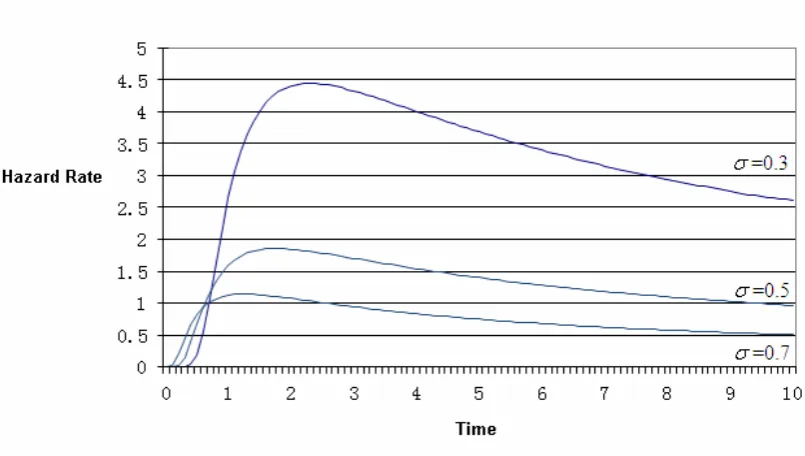
decreases to zero as time approaches infinity (Gupta and Lvin, 2005). Figure 3.1
shows the lognormal hazard rate at standard deviations σ=0.3, 0.5, 0.7 (Sweet, 1990).
Figure 3.1 Hazard rate of lognormal distribution (Sweet, 1990)
3.2.4 Machine Reliability Consideration in a Part-type Process-plan Route
To show how to correspond the machine reliability function to a part-type
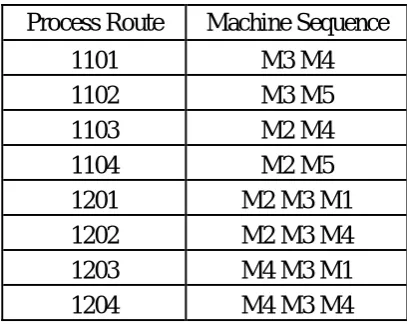
process-plan route, a small numerical example was developed as shown in Table 3.1. Each
part type may be processed under two process plans. In each process plan, there are
three operations which may be performed by different machines along different
process routes. For example, part type 1 may be processed in any of the eight process
routes shown in Table 3.2. Each route is represented by a 4-digit number where the
first digit represents the part type, the second digit represents the process plan, and the
Table 3.1 A sample route for 4 part types and 5 machines
Process Plan 1 Process Plan 2
Part Type
Operation 1 Operation 2 Operation 3 Operation 1 Operation 2 Operation 3
1 M3 M2 M4 M5 M2 M4 M3 M1 M4
2 M2 M4 M5 M3 M1 M3 M2 M5
3 M1 M4 M3 M2 M2 M4 M5 M2 M4 M1 M3
4 M1 M3 M2 M4 M5 M4 M5 M1 M4
Table 3.2 Process routes for part type 1
Process Route Machine Sequence
1101 M3 M4
1102 M3 M5
1103 M2 M4
1104 M2 M5
1201 M2 M3 M1
1202 M2 M3 M4
1203 M4 M3 M1
1204 M4 M3 M4
last two represent the route. For example, 1201 represents part type 1, process plan 2
and process route 01, which corresponds to the machine sequence M2-M3-M1 with a
system’s reliability:
1201( )t R t R t R t1( ) 2( ) 3( )
ℜ = (3-9)
The machines of the same type in a cell are in parallel, with the corresponding
machine reliability at time t given by:
( ) 1 [1 ( )]mj
j j
R t = − −r t
(3-10)
where r tj( ) is the reliability of a machine type j at time t, and mj is the number of
machines of type j.
The reliability of each machine type j follows the lognormal distribution:
1
( ) 1 ( ln )
j
j med j
t r t
s t
= − Φ
(3-11)
Then, system reliability along process route 1201 can be written as:
3
1 2
1201
1 1 2 2 3 3
1 1 1
( ) [1 ( ln ) ][1m ( ln ) ][1m ( ln ) ]m
med med med
t t
t
s t s t s t
ℜ = − Φ − Φ − Φ t
(3-12) or, 1201 1,2,3 1
( ) [1 ( ln ) ]mj
j j medj
t t s t = ℜ =
∑
− Φ (3-13)where we use to define system reliability corresponding to machine types 1,
2 and 3 for process (1201). The system reliability for other process routes is computed
in the same way. Maximizing the reliability of each process route for parts by
choosing appropriate process plans, machine types, and numbers leads to an optimal
performance of the entire CMS system with the respect to reliability and cost. 1201( )t
ℜ
3.2.5 Lognormal distribution in reliability studies
With different shape parameters,σ , and location parameters tmed, the lognormal
distribution can take on a variety of shapes. With such characteristics, lognormal
distributions are used for many types of life data, for example, semiconductor life,
electrical insulation life, crack propagation, and metal fatigue (Ireson et al., 1996).
Jia et al. (1993) studied the fatigue design of machine tools by considering
probabilistic reliability. In their model, machine tool fatigue lives are assumed to be
lognormally distributed. They proposed a theoretical formula to calculate the
equivalent fatigue load for reliability.
Because it is essential to collect and analyze field failure data for the purpose of
assessing and improving the reliability of computerized numerical control (CNC)
17
lathes, Wang et al. (1999) studied field failure data collection and collation. They
analyzed the data by applying a lognormal distribution to calculate the time between
successive failures (TBF) and by using the Kolmogorov-Smirnov test to verify the
goodness of the fit of the data to a lognormal distribution.
Enginarlar et al. (2005) analyzed lean buffering in serial production lines with
machine up-and-down time. Based on the consideration of Weibull, gamma, and
lognormal distributions, they provided a method to select and study the lean level of
buffering (LLB). They found that LLB mainly depended on the coefficients of the
variation in machine up-and-down time distribution, and was sensitive to CVdown
rather than CVup.
It is pointed out by Mullen (1998) that the distribution of an event rate is lognormal
because of the multiplicative processes in software systems; a lognormal distribution
fits the empirical failure rates well. He proposed a model to analyze two series of
failure data and the likelihood of data arising from lognormal based model and
Log-Poisson based model. The results demonstrated that the lognormal based model fits a
wide variety of reliability growth patterns.
Gokhale and Mullen (2008) gave an overview of the lognormal distribution. They
discussed the emerging applications for lognormal distributions and summarized the
evidence to confirm that it can be successfully applied to analyze problems in
CHAPTER 4
MATHEMATICAL MODEL
The following details are to describe the multi-objective model for cellular
manufacturing systems.
4.1 Notations
Indices:
{1, 2,.., }
k∈ K Cells
{1, 2,.., }
j∈ J Machine types
{1, 2,.., }
i∈ n Part types
{1, 2,.., ( )}
p∈ P i Process plans for part type i
(ip) A combination of part type and process plan
{1, 2,.., ( )}
o∈ O ip
J
Operations of (ip)
{1, 2,.., }
ipo
J ∈ Set of machine types that can perform operation o of (ip)
Parameters:
j
A Availability of machine type j
j
AN Annuity cost of machine type j
j
b Available capacity of machines type j cluster
( )
oj
C ip Operation and refixturing cost corresponding to operation o of
(ip) on machine j
j
cp Penalty cost of non- utilization of machine type j
i
d Demand of part type i
ijk j k
H ∧ ∧ Inter-cell transportation cost of moving part type i from machine
j in cell k to machine in cell to perform the next operation ˆj kˆ
N Number of years to recover the machine purchase cost
j
P Present cost of machine type j
q Interest rate per year
( )
j
r t Reliability of machine type j at time t
( )
j
R t Reliability of machine type j cluster at time t
j
s Shape parameter of log normal distribution for machine type j
medj
t Median time to failure of machine type j
( )
oj
TF ip Time to refixture for operation o of (ip) on machines type j
( )
oj
TO ip Time to perform operation o of (ip) on machines type j
UM Maximum number of machines in a cell
Decision Variables:
j
m Number of units of machine type j in the cluster
jk
M =1 if machine type j cluster is assigned to cell k,
=0 otherwise
( )
ojk
X ip =1 if operation o of (ip) is assigned to machine type j cluster in
cell k,
=0 otherwise
( )
Z ip =1 if part type i is processed under process plan p,
=0 otherwise
4.2 Objective Functions
We assume that there is a set of machines types j∈{1, 2,.., }J to process a set of part
types i∈{1, 2,.., }n with corresponding demands di during the planning time. A part
type may be processed under any of the process plans p∈{1, 2,.., ( )}P i . A
combination of part type and process plan is expressed as (ip), and
is the set of operations performed to process the (ip) combination.
The machines that can perform operation o of (ip) is represented by the set
. {1, 2,.., ( )}
o∈ O ip
{1, 2,.., }
ipo
J ∈ J
There are two objective functions in this model. The first objective function, defined
as objective function 1, calculates the overall system reliability through all part-type
process-plan routes:
Maximize objective function 1 = ( ) 1 1 P i n ip i p R = =
∏∏
(4-1) where ( ) 1 1 ( ) ( ) ipoO ip K
ip j ojk
j J k
o
R R t X ip
∈ =
=
=
∏
∑
∑
∀i p, (4-2)Equation (4-2) generates a composite expression by adding up the machine reliability
along all the feasible process routes for each (ip) combination. During the
optimization process, the operation allocation variable Xojk(ip) is compelled to assign
only one machine to each operation of the (ip) in order to comply with constraints
(4-9) and (4-10), which are noted in Section 4.3. Consequently, for each (ip)
combination, the solution will include the reliabilities of the machines for only one
selected process route.
The first objective function is searched to select the appropriate sets of part-type
process-plan routes and machine types with its numbers to maximize the entire
reliability of the system.
The second objective function, defined as objective function 2, computes the total
system cost, which consists of the variable cost of manufacturing operations (VCM),
the inter-cell material handling cost (MHC), the penalty cost of machine
under-utilization (MNC) and machine annuity cost (MAC).
Minimize objective function 2 = VCM +MHC+MNC+MAC (4-3)
The various components of this objective function are computed as follows.
The variable cost of manufacturing operations VCM computes the operation and
refixturing costs Coj( )ip :
22
ojk
( ) ( )
1 1 1 1
( ) ( )
ipo
P i O ip
n K
i oj
i p o j J k
VCM d C ip X ip
= = = ∈ = =
∑ ∑ ∑ ∑
∑
(4-4) ( ) ojkX ip is a binary variable which is equal to 1 when operation o of (ip) is performed
on a machine of type j in cell k, and zero otherwise. di is the demand of part type i.
The inter-cell material handling cost MHC computes the total inter-cell transportation
cost of the parts as they move from machine j in cell k to machine in cell to
perform the next operations (o+1):
ˆj kˆ
∑
∑ ∑ ∑ ∑ ∑
(4-5)= − = ∈ ∈ ≤ ≤ + = + = () 1 1 ) (
1 1 ,
) 1 (
1 ( 1)
) ( ) ( i P p ip O
o j J j J kk K
k j o ojk k j ijk n i i
ipo ipo
ip X ip X H d MHC ) ) )) ))
ijk j k
H ∧ ∧ is the cost of moving a unit of part type i from machine j in cell k to machine
in cell to perform the next operations (o+1).
ˆj
ˆ k
The penalty cost of machine under-utilization MNC computes a penalty on the portion
of a machine’s capacity that is not utilized:
( ) ( )
1 1 1 1 1
( ) ( )
1 (
[1 (1 ) ]j
P i O ip
J n K
oj oj
j i m ojk
j i p o j j k
TO ip TF ip
)
MNC cp d X ip
A b = = = = = ⎡ + ⎤ = ⎢ − ⎥ − − ⋅ ⎢ ⎥ ⎣ ⎦
∑
∑ ∑ ∑
∑
(4-6)where is the penalty cost of non- utilization of machine type j. is the
Time to perform operation o of (ip) on machines type j and is the time to
j
cp TO ipoj( )
( )
oj
refixture for operation o of (ip) on machines type j. Aj is the availability of machines
type j, and is the available capacity of machine type j. The expression
is the effective capacity of machine type j cluster.
j
b
[1 (1 ) ]mj
j
A
− − ⋅bj
Finally, the machine annuity cost MAC computes the annualized cost of recovering
the machine purchase cost:
1
J
j j
j
MAC AN m =
=
∑
(4-7)
where (1 )
(1 ) 1
N
j j N
q q AN P
q + =
+ − (4-8)
j
AN is the annuity cost of machine type j, mj is the number of machines of type j,
is the present cost of machine type j, q is the interest rate, and N is the number of
years to recover the machine purchase cost.
j
P
The second objective function is searched to select the appropriate sets of part-type
process-plan routes and machine types with its numbers to minimize the overall cost
of the system.
4.3 Constraints
( )
1
( ) 1
P i
p
Z ip =
=
∑
∀i (4-9)This constraint ensures that a part type i is processed under a single process plan.
( )
Z ip equals to 1 if part type i is processed under process plan p, and zero otherwise.
1
( ) ( )
ipo
K
ojk
j J k
X ip Z ip
∈ =
=
∑ ∑
∀i p o, , (4-10)This constraint establishes a correspondence between the selections of a process plan
for a part type i, and assigns the operations of that part to machines in cells where they
have been allocated.
1 1 K jk k M = =
∑
∀j (4-11)This constraint ensures that machine type j is allocated to cell k. It is pointed out that
‘machine type j’ infers a machine cluster which consists of mj units in parallel. Mjk
equals to 1 if machine type j cluster is assigned to cell k, and zero otherwise.
1 J jk j M UM = ≤
∑
∀k (4-12)The above constraint limits the total number of machines of each type in a cell.
( ) ( )
1 1 1
( )
P i O ip n
ojk jk
i p o
X ip M = = =
≥
∑∑ ∑
∀j k, (4-13)This constraint ensures that, before assigning operations to a machine type j, it has to
be placed in a cell k.
( ) ( )
1 1 1
[ ( ) ( )] ( ) [1 (1 ) ]j
P i O ip n
m
i oj oj ojk j jk
i p o
d TO ip TF ip X ip b M A = = =
+ ≤ −
∑ ∑ ∑
− j ∀j k, (4-14)This constraint ensures that the capacity of a machine cluster is not exceeded while
allocating operations to it.
( ), ( ),
ojk jk
X ip Z ip M are binary variables ∀i p o j k, , , ,
Finally, this constraint identifies the variables as 0-1 integer.
4.4 Model Summary
Maximize objective function 1 = ( ) 1 1 P i n ip i p R = =
∏∏
(4-1) where ( ) 1 1 ( ) ( ) ipoO ip K
ip j ojk
j J k
o
R R t X ip
∈ =
=
=
∏
∑
∑
∀i p, . (4-2)Minimize objective function 2 = VCM +MHC+MNC+MAC (4-3)
where
( ) ( )
1 1 1 1
( ) ( )
ipo
P i O ip
n K
i oj
i p o j J k
VCM d C ip X ip
= = = ∈ =
=
∑ ∑ ∑ ∑
∑
ojk(4-4)
∑ ∑ ∑ ∑ ∑
∑
= − = ∈ ∈ ≤ ≤ + = + = () 1 1 ) (1 1 ,
) 1 (
1 ( 1)
) ( ) ( i P p ip O
o j J j J kk K
k j o ojk k j ijk n i i
ipo ipo
ip X ip X H d MHC ) ) )) )) (4-5) ( ) ( )
1 1 1 1 1
( ) ( )
1 (
[1 (1 ) ]j
P i O ip
J n K
oj oj
j i m ojk
j i p o j j k
TO ip TF ip
)
MNC cp d X ip
A b = = = = = ⎡ + ⎤ = ⎢ − ⎥ − − ⋅ ⎢ ⎥ ⎣ ⎦
∑
∑ ∑ ∑
∑
(4-6) 1 J j j jMAC AN m =
=
∑
(4-7)
where (1 )
(1 ) 1
N
j j N
q q AN P
q + =
+ − (4-8)
Subject to constrains as follows:
( )
1
( ) 1
P i
p
Z ip =
=
∑
∀i (6-9)1
( ) ( ) ipo
K
ojk
j J k
X ip Z ip
∈ =
=
∑ ∑
∀i p o, , (6-10)1 1 K jk k M = =
∑
∀j (4-11)1 J jk j M UM = ≤
∑
∀k (4-12)( ) ( )
1 1 1
( )
P i O ip n
ojk jk
i p o
X ip M = = =
≥
∑∑ ∑
∀j k, (4-13)( ) ( )
1 1 1
[ ( ) ( )] ( ) [1 (1 ) ]j
P i O ip n
m
i oj oj ojk j jk
i p o
d TO ip TF ip X ip b M A = = =
+ ≤ −
∑ ∑ ∑
− j ∀j k, (4-14)( ), ( ),
ojk jk
X ip Z ip M are binary variables ∀i p o j k, , , ,
27
CHAPTER 5
A HEURISTIC SOLUTION METHOD BASES ON GENETIC
ALGORITHM
The idea of a genetic algorithm (GA) emanates from the biological theory of
evolution which was proposed by Charles Darwin in the middle of 1800s. Being a
stochastic global search method, GA begins with a population of random trial
solutions. In each generation, it evaluates the “fitness” of each chromosome as a
candidate solution, select better chromosomes to randomly modify and combine,
generates new chromosomes, and then proceeds to next iteration. In this thesis, the
“fitness” is measured by the objective functions (4-1) and (4-3). In addition,
occasional mutation is used to help the genetic algorithm explore perhaps better
chromosomes than previously explored. Lastly, iteration is terminated when the
stopping criterion is satisfied, e.g., a given number of iterations or a given tolerance is
reached. Then the chromosome with the fittest value is closest to the optimal solution.
Given the example presented in Table 3.1, a chromosome sample is represented by 14
genes. Genes 1 to 5 represent the optimal numbers of machines of each type. Genes 6
to 10 denote the cell number, to which the machine group of a given type is allocated.
The Genes 11 to 14 represent the process routes assigned to part types. Consider the
example, S=(2 1 2 2 2) (1 2 2 1 2) (1201 2201 3102 4101). It identifies that 2
machines of type 1, one machine of type 2, and 2 machines of type 3, 4 and 5,
respectively, are chosen; two machines of type 1 and two machines of type 4 are
28
part type 1 is processed in process route 01 under process plan 2, part type 2 is
processed in process route 01 under process plan 2, and so on.
The first step of genetic algorithm is to generate a set of chromosomes randomly.
Then GA evaluates these chromosomes by a fitness function. In this thesis, evaluation
is performed by ranking the chromosomes in terms of their values of the objective
function. After evaluation, the chromosomes with a higher ranking are selected to
perform the crossover and mutation operations. The new chromosomes generated by
the crossover operation inherit the ‘excellent’ features of the old chromosomes; the
mutation operation induces a new chromosome with new features that are not
inherited from the old chromosomes.
To illustrate how crossover and mutation work, we consider an example with two
chromosomes (initial solutions).
(1 2 1 2 2):(1 2 2 1 2):(1201,2201,3101,:4201)
(2 2 1 1 2):(2 1 2 2 1):(1101,2102,3202,:4101)
The interchange between the two chromosomes occurs around the crossover point and
generates a new chromosome with potentially better solutions.
(2 2 1 1 2):(1 2 2 1 2):(1101,2102,3202,:4201)
(1 2 1 2 2):(2 1 2 2 1):(1201,2201,3101,:4101)
On the other hand, mutation changes one or more genes in one chromosome to result
in a new chromosome.
29
(1 2 1 2 2):(1 2 1 1 1):(1201,2102,3101,:4201) (after mutation)
In this case, the crossover point and mutation point are chosen randomly. After a
series of extensive experiments by setting different probability values, it was found
that the genetic algorithm corresponding to this model converges well when the
probability of crossover and the probability of mutation are set at 0.9 and 0.01,
respectively.
After crossover and mutation, a new population is generated. Again, the newly-born
chromosomes are evaluated and ranked by fitness function, and selected to be the
candidate chromosomes for processing crossover and mutation to generate the next,
new population. In each iteration, the process of candidate chromosomes follows the
steps: evaluation, selection, crossover and mutation. Iterations continue until a
heuristic optimal solution is reached based on the defined stopping criterion. In this
30
CHAPTER 6
A NUMERICAL EXAMPLE
A numerical example with 14 machine types is employed to show how the model
works. There are 2 units of each machine type available to be allocated to 3 cells.
There are 24 part types, each having more than one operation that may be performed
on 2 or 3 alternative machines. For example, as Table 6.1 indicates, part type 1 can be
processed under either process plan 1 or process plan 2. Process plan 1 will perform 3
operations, while process plan 2 will perform 2 operations. In process plan 1,
operation 1 can be performed by machine type 4, operation 2 can be performed by
machine type 1 or type 5, and operation 3 can be performed by machine type 7. Thus,
the machine sequence for part type 1 through process plan 1 is M1-M7 or
M4-M5-M7. Similarly, it is evident that each part type has several process routes to
execute the corresponding operations. The number of cells is 3 and the maximum
number of machine types in each cell is assumed to be 5.
For each machine type, the MTTF and MTTR is generated randomly following the
uniform distributions U(160,360) and U(8,48), respectively, to satisfy the requirement
that the machine availability may fluctuate between 80% and 95% (Askin et al., 1997).
The parameter Tmed must be selected to be less than MTTF due to the definite positive
characteristics of the lognormal distribution.
Transportation cost among the machines within a cell is assumed to be $1 per unit.
31
hours. It is expected that the machine costs will be recovered in three years at an
interest rate of 10% per year.
Table 6.1 indicates part demands, processing times and costs of operations for the
given parts performed by given machines, and the alternative process routes for the
numerical example with 14 machine types and 24 parts.
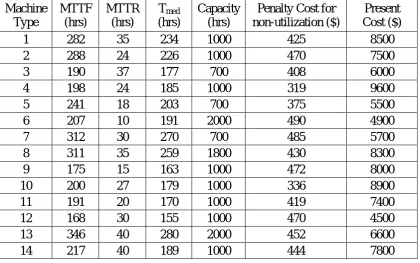
Information regarding the parameters of each machine type is shown in Table 6.2,
including MTTF, MTTR, Tmed, penalty costs for machine non-utilization, machine
capacities, and present costs.
The input data in both Table 6.1 and Table 6.2 are the same as the data used by Das et
al. (2006). Due to the following two reasons, however, the results in this thesis cannot
be compared to Das’s results. First, the results obtained in this thesis are based on the
lognormal distribution, whereas in Das et al. (2006), the Weibull distribution is used
to represent machine reliability. Second, the model developed in this thesis is
nonlinear; that is, the objective function includes a non-linear term, and one constraint
(Equation 4-14) is also non-linear. The model in Das et al. (2006) is a linear integer
Table 6.1 Demand, operation time, cost and process routes for part types
Process Plan 1 Process Plan 2
Part Type Demand Data
Operation 1 Operation 2 Operation 3 Operation 4 Operation 1 Operation 2 Operation 3
Machine M4 M1 M5 M7 M1 M7 M13
Time (hrs) 5 6 8 4 3 6 5
1 20
Cost ($) 9 7 7 8 8 4 6
Machine M4 M5 M6 M7 M1 M4 M5 M12 M13
Time (hrs) 7 8 6 7 9 7 4 8 6
2 10
Cost ($) 8 7 8 9 8 9 8 5 9
Machine M2 M3 M10 M2 M3 M3 M11 M13
Time (hrs) 8 3 6 6 7 10 9 7
3 30
Cost ($) 6 4 8 2 3 9 8 7
Machine M2 M3 M5 M11 M13 M2 M10 M12 M5 M11
Time (hrs) 9 5 6 11 9 6 7 6 7 8
4 40
Cost ($) 5 4 7 7 4 8 4 4 9 4
Machine M8 M9 M11 M6 M12 M9 M11 M14
Time (hrs) 4 7 5 8 9 5 4 7
5 10
Cost ($) 9 7 7 6 12 9 9 6
Machine M1 M13 M4 M7 M5 M9 M12
Time (hrs) 6 6 7 8 5 6 7
6 50
Cost ($) 5 5 5 4 8 7 4
Machine M3 M7 M10 M12 M13 M3 M4 M5 M11 M12
Time (hrs) 3 6 7 5 5 7 6 8 9 8
7 20
Cost ($) 6 6 6 4 5 9 6 7 9 6
Machine M12 M13 M4 M5 M7 M8
Time (hrs) 5 7 9 10 4 4
8 30
Cost ($) 6 8 7 8 6 4
Table 6.1 Cont’d
Process Plan 1 Process Plan 2
Part Type Demand Data
Operation 1 Operation 2 Operation 3 Operation 4 Operation 1 Operation 2 Operation 3
Machine M6 M8 M8 M9 M11 M13 M14 M2 M8 M11 M14
Time (hrs) 5 7 4 8 6 6 5 5 5 4 7
9 40
Cost ($) 5 5 6 6 7 8 8 5 9 6 6
Machine M6 M10 M9 M9 M9 M12 M14
Time (hrs) 4 5 7 6 9 7 6
10 10
Cost ($) 5 7 6 7 7 6 6
Machine M6 M9 M12 M12 M14 M7 M9 M10 M14
Time (hrs) 5 6 6 6 4 5 6 7 6
11 20
Cost ($) 6 7 8 7 6 7 5 6 7
Machine M6 M8 M12 M9 M14 M8 M12 M10 M14
Time (hrs) 6 7 5 5 6 8 4 7 6
12 10
Cost ($) 6 9 9 5 4 6 8 4 6
Machine M9 M12 M13 M14 M6 M10 M8 M13
Time (hrs) 9 7 7 8 7 8 6 5
13 10
Cost ($) 5 5 9 7 9 4 9 8
Machine M6 M8 M9 M13 M9 M12 M13 M14
Time (hrs) 6 5 8 9 6 7 6 5
14 50
Cost ($) 8 5 5 4 6 8 7 5
Machine M6 M10 M8 M9 M13 M1 M3 M14 M8 M10 M14
Time (hrs) 5 6 9 4 3 9 7 4 8 7 6
15 30
Cost ($) 6 4 7 8 7 7 4 8 6 8 5
Machine M6 M9 M8 M13 M9 M12 M5 M14
Time (hrs) 8 6 7 8 6 5 6 7
16 50
Cost ($) 4 9 7 4 9 8 4 8
34
Table 6.1 Cont’d
Process Plan 1 Process Plan 2
Part Type Demand Data
Operation 1 Operation 2 Operation 3 Operation 4 Operation 1 Operation 2 Operation 3
Machine M1 M4 M5 M8 M7 M13 M1 M10 M12 M13 M14
Time (hrs) 6 4 5 4 5 6 3 6 7 8 9
17 20
Cost ($) 9 4 4 5 3 8 8 7 9 7 9
Machine M4 M13 M12 M14 M1 M13 M6 M10
Time (hrs) 4 8 6 5 5 7 4 6
18 30
Cost ($) 9 7 6 6 5 8 6 7
Machine M4 M7 M1 M13 M5 M9
Time (hrs) 7 6 9 8 6 7
19 40
Cost ($) 4 7 7 5 7 7
Machine M4 M7 M5 M9 M7 M1 M4 M12 M14 M9 M13
Time (hrs) 6 5 3 4 3 5 6 5 6 3 4
20 10
Cost ($) 3 5 4 5 3 6 8 7 6 3 5
Machine M3 M7 M11 M14 M2 M6 M10 M12
Time (hrs) 7 6 8 7 7 6 7 5
21 20
Cost ($) 7 5 5 7 7 7 8 6
Machine M6 M10 M8 M13 M9 M13 M5 M14
Time (hrs) 6 5 6 7 6 7 6 8
22 30
Cost ($) 3 7 9 4 7 7 7 8
Machine M4 M13 M5 M11 M13 M1 M6 M9 M11 M13
Time (hrs) 7 7 5 8 9 8 4 5 6 7
23 50
Cost ($) 9 9 5 5 6 8 5 7 5 6
Machine M10 M13 M11 M12 M2 M10 M3 M13
Time (hrs) 5 6 7 8 7 8 5 6
24 10
35
Table 6.2 Machine data for numerical example
Machine Type
MTTF (hrs)
MTTR (hrs)
Tmed
(hrs)
Capacity (hrs)
Penalty Cost for non-utilization ($)
Present Cost ($)
1 282 35 234 1000 425 8500
2 288 24 226 1000 470 7500
3 190 37 177 700 408 6000
4 198 24 185 1000 319 9600
5 241 18 203 700 375 5500
6 207 10 191 2000 490 4900
7 312 30 270 700 485 5700
8 311 35 259 1800 430 8300
9 175 15 163 1000 472 8000
10 200 27 179 1000 336 8900
11 191 20 170 1000 419 7400
12 168 30 155 1000 470 4500
13 346 40 280 2000 452 6600
36
CHAPTER 7
RESULTS
The algorithm is coded in MATLAB 7.1 and run on a PC (1.6GHZ, 1 GB of RAM) to
solve the numerical example with 14 machine types, 3 cells and 24 part types. The
heuristic optimal solutions provide the best options for the number of units of each
machine type, the machine-cell assignments and the selected process routes.
The solutions are obtained using the genetic algorithm which optimizes the following
composite objective function:
Max ObjV=W1*Obj1-W2*Obj2 (7-1)
subject to the constraints described in section 6. Obj1 represents objective function 1
(system reliability as considered in equation(4-2)), and Obj2 represents objective
function 2 (the total cost as considered in equation(4-3)). W1 and W2 are the weights
assigned to objective functions 1 and 2, respectively. The weights are specifically
chosen so as to reflect the relative importance of Obj1 and Obj2 in the composite
objective ObjV. The model is solved using various combinations of W1 and W2.
The model is first used to solve two extreme cases: (W1:W2)=(1:0) and
(W1:W2)=(0:1). In the case of (W1:W2)=(1:0), only the reliability function (Obj1) is
maximized, regardless of the cost, to obtain the highest reliability associated with the
heuristic solution; that is, an upper bound is determined on the reliability function. In
contrast, in the case of (W1:W2)=(0:1), only the total cost function (Obj2) is
37
regardless of the reliability, to obtain the lowest total cost achievable, i.e., a lower
bound on the total cost function is determined. Next, gradually increasing weights are
assigned to the reliability function, ranging from W1=100 to W1=1,000,000, (while
keeping W2 =1), representing a total of 16 test cases. The model is solved in each
case, and the results are summarized in Tables 7.1-7.4.
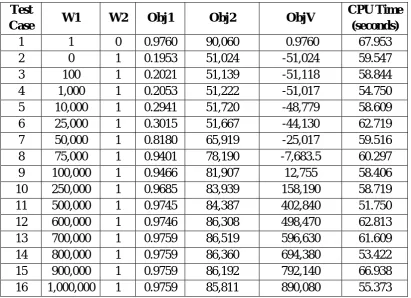
Table 7.1 summarizes the objective function values for the 16 test cases, and Table
7.2 lists the corresponding cell assignments. The first case corresponds to (W1:W2)
=(1:0). Here, the algorithm starts with 10 randomly selected chromosomes as a set of
initial solutions, which results in the highest reliability function value of only 0.5432,
and the corresponding chromosome:
(2 2 1 1 1 1 2 2 2 2 2 2 1 2) (1 3 1 1 2 2 2 3 2 3 3 1 3 1) (1201 2202 3205 4202 5202 6204 7201 8204 9103 10201 11102 12101 13202 14101 15206 16203 17105 18201 19201 20203 21102 22103 23103 24103)
The chromosome consists of three parts. The first part has 14 genes, each representing
the number of units of each machine type. The second part has 14 genes which show
the assignment of machines to cells. The last part has 24 genes denoting the process
route for each part type.
After 1000 iterations, the genetic algorithm reached the following heuristic solution:
(2 2 2 2 1 2 2 2 2 2 2 1 2 2) (3 3 2 2 1 1 1 3 2 3 3 1 1 2) (1201 2102 3204 4102 5201 6101 7101 8201 9101 10102 11201 12101 13201 14101 15101 16101 17107 18204 19101 20102 21203 22101 23202 24203)
with a composite objective function (ObjV) value of 0.9760, which is derived from
ObjV= W1*Obj1 - W2*Obj2
=1*0.9760 - 0*90,060
38
Test
Case W1 W2 Obj1 Obj2 ObjV
CPU Time (seconds)
1 1 0 0.9760 90,060 0.9760 67.953
2 0 1 0.1953 51,024 -51,024 59.547
3 100 1 0.2021 51,139 -51,118 58.844
4 1,000 1 0.2053 51,222 -51,017 54.750
5 10,000 1 0.2941 51,720 -48,779 58.609
6 25,000 1 0.3015 51,667 -44,130 62.719
7 50,000 1 0.8180 65,919 -25,017 59.516
8 75,000 1 0.9401 78,190 -7,683.5 60.297
9 100,000 1 0.9466 81,907 12,755 58.406
10 250,000 1 0.9685 83,939 158,190 58.719
11 500,000 1 0.9745 84,387 402,840 51.750
12 600,000 1 0.9746 86,308 498,470 62.813
13 700,000 1 0.9759 86,519 596,630 61.609
14 800,000 1 0.9759 86,360 694,380 53.422
15 900,000 1 0.9759 86,192 792,140 66.938
16 1,000,000 1 0.9759 85,811 890,080 55.373
39
Table 7.2 Machines assignments to cells
Test
Case Cell1 Cell2 Cell3
1 M5+2 M6+2 M7+M12+2 M13 2 M3+2 M4+2 M9+2 M14 2 M1+2 M2+2 M8+2 M10+2 M11
2 M1+M6+M7+M8+M13 M2+M9+M11+M12+M14 M3+M4+M5+M10
3 M4+M5+M7+M12+M13 M3+M9+M10+M14 M1+M2+M6+M8+M11
4 M1+M2+M3+M5+M11 M4+M6+M8+M12 M7+M9+M10+M13+M14
5 M1+M2+M3+M6+M13 M4+M5+M8+M9+M12 M7+M10+M11+M14
6 M1+M2+M6+M7+M11 M4+M5+M12+M14 M3+M8+M9+M10+M13
7 M1+M4+M10+M11 2 M2+2 M5+2 M12+2 M13+2 M14 M3+M6+M7+M8+M9
8 2 M2+M8+2 M10+M11+2 M12 2 M1+M3+M4+M6 2 M5+2 M7+2 M9+2 M13+2 M14
9 M6+2 M7+2 M9+M11+2 M13 2 M1+2 M2+2 M5+2 M12 M3+M4+2 M8+2 M10+2 M14
10 M4+2 M5+2 M8+2 M9+M11 2 M1+2 M2+2 M3+2 M6+2 M13 2 M7+2 M10+M12+2 M14
11 2 M1+M5+2 M7+M10 2 M2+2 M3+2 M6+2 M8+2 M13 2 M4+2 M9+M11+2 M12+2 M14
12 2 M1+2 M2+2 M7+2 M14 2 M3+2 M4+M5+2 M9 2 M6+2 M8+2 M10+M12+2 M13
13 2 M1+2 M8+2 M9+2 M4 2 M2+M5+2 M6+M11+M12 2 M3+2 M4+2 M7+ 2M10+2 M3
14 2 M2+2 M3+2 M4+M5+M11 2 M6+2 M7+2 M8+2 M10+M12 2 M1+2 M9+2 M3+2 M4
15 2 M3+2 M10+M12+2 M13 2 M4+2 M6+2 M8+2 M9+M11 2 M1+2 M2+2 M5+2 M7+2 M14
40
This value indicates that the reliability function has improved from 0.5432 to 0.9760.
The cell assignments in this case are shown in Table 7.2, and are as follows:
Cell 1: M5, 2 of M6, 2 of M7, M12, 2 of M13
Cell 2: 2 of M3, 2 of M4, 2 of M9, 2 of M14
Cell 3: 2 of M1, 2 of M2, 2 of M8, 2 of M10, 2 of M11
In the second test case, when only the total cost function is considered, i.e., when
W1:W2 =0:1, the heuristic solution is:
(1 1 1 1 1 1 1 1 1 1 1 1 1 1) (1 2 3 3 3 1 1 1 2 3 2 2 1 2) (1201 2104 3201 4102 5204 6101 7202 8204 9202 10101 11204 12202 13102 14104 15204 16102 17105 18201 19101 20101 21103 22202 23201 24201)
with a composite objective function (ObjV) value of -51,024, which is derived from
ObjV=W1*Objective function 1+W2* objective function 2
=W1*Obj1-W2*Obj2
=0*(0.9760) - 1*(-51,024)
= -51,024.
Because the emphasis in this case is on minimizing the total cost regardless of the
reliability, the model assigns only one unit of each machine type to the cells, as shown
in the following cell assignment (table 7.2):
Cell 1: M1, M6, M7, M8, M13
Cell 2: M2, M9, M11, M12, M14
41
It may be of interest to note that system reliability in this case is only 0.1953. The first
two cases, therefore, establish an upper bound on reliability of 0.9765, and a lower
bound on the total cost of 51,024.
In a similar manner, the other test cases corresponding to various weight
combinations (W1 and W2) are evaluated as shown in Tables 7.1 and 7.2. The
optimization process in essence generates a set of Pareto ‘optimal’ solutions, striking
a balance between the two objectives depending on the importance attached to each;
as the weight assigned to the reliability objective (Obj1) increases, the model attempts
to generate solutions with higher system reliabilities, which is possible by increasing
the number of parallel machines in each cluster, thus increasing the total costs.
In test cases 3 to 13, the weight of objective function 2 remains as 1 (W2=1), but the
weight of objective function 1 gradually varies from 100 to 700,000. As a result, the
objective function 1 value is increased from 0.2021 to 0.9759, whereas, the
importance of the total cost (objective function 2) diminishes correspondingly; the
value of objective function 2 increases from 51,139 to 86,519.
In test cases 14 to 16, as the weight of objective function 1 increases to 1,000,000, the
value of the objective function 1 remains unchanged at 0.9759, the upper bound on
system reliability. On the other hand, the performance of the total cost function
improves; the value of objective function 2 decreases from 86,360 to 85,811.
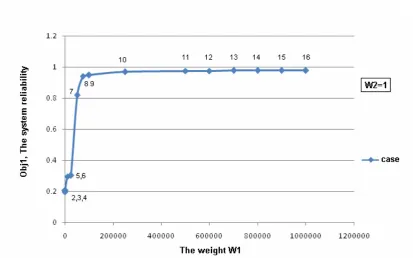
The performance values of the reliability function (Obj1) and the total cost function
(Obj2) are illustrated in Figures 7.1 and 7.2, respectively. It is observed that the
reliability function (Obj1) improves dramatically when the weights (W1:W2) change
Figure 7.1 System reliability corresponding to test cases 2-16
Figure 7.2 Total cost corresponding to test cases 2-16