NOTE
Highly Ef
fi
cient Genome Modi
fi
cations Mediated by
CRISPR/Cas9 in
Drosophila
Zhongsheng Yu,*,†,1Mengda Ren,‡,1Zhanxiang Wang,§Bo Zhang,§Yikang S. Rong,** Renjie Jiao,*,2
and Guanjun Gao‡,2 *State Key Laboratory of Brain and Cognitive Science, Institute of Biophysics, Chinese Academy of Sciences, Datun Road 15, Beijing 100101, China,‡School of Life Sciences, Tsinghua University, Beijing 100084, China,§Key Laboratory of Cell Proliferation and Differentiation of the Ministry of Education, College of Life Sciences, Peking University, Beijing 100871, China,†University of Chinese Academy of Sciences, Beijing 100080, China, and **Laboratory of Biochemistry and Molecular Biology, National Cancer Institute, National Institutes of Health, Bethesda, Maryland 20892
ABSTRACT We report that Cas9/gRNA mediates efficient genetic modifications in Drosophila. Through targeting seven loci, we achieved a germline efficiency of up to 100%. Genes in both heterochromatin and euchromatin can be modified efficiently. Thus the Cas9/gRNA system is an attractive tool for rapid disruption of essentially any gene inDrosophila.
D
ROSOPHILA is considered as one of the best animal models due to its amenability to a wide repertoire of genetic tools including gene targeting by homologous re-combination (Rong and Golic 2000; Gong and Golic 2003). However, the traditional gene-targeting method can be considered labor intensive if one’s goal is to simply generate knock-out mutations. Alternatively, designer nu-cleases (ZFN and TALEN) have been introduced into Dro-sophila to direct site-specific DNA double-strand breaks (DSBs) in the coding region of a target gene (Carroll 2011; Liuet al.2012). During nonhomologous end joining (NHEJ) repair of the DSBs, mutations at the cut site lead to disruption of the target gene. For both ZFN and TALEN, each chromosomal target site requires the construction of a pair of genes encoding the nuclease, which can be a signif-icant investment if one’s goal is to knock out multiple genes. Recently, the type II prokaryotic CRISPR (clustered regularly interspaced short palindromic repeats) system from bacteria has been introduced into several heterologous systems for the purpose of generating targeted mutations (Chang et al.2013; Conget al.2013; Hwanget al.2013; Maliet al.2013; Shenet al.2013; Wei et al.2013). The CRISPR-associated nuclease Cas9 is guided to its target cut site by a small RNA molecule (gRNA), which shares a region of about 20-nt ho-mology to its target DNA. Therefore, the same Cas9 protein can be directed to multiple chromosome sites depending solely on the sequence of the guide RNA. Here we targeted multiple genes with different gRNAs and achieved remark-able efficiency of targeted mutagenesis, including hetero-chromatic genes.
Results
Cas9 induced mutations at yellow
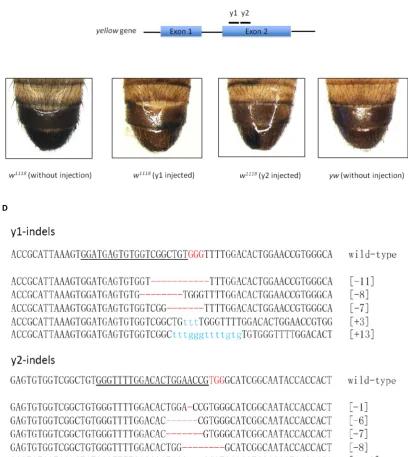
As a proof of principle for the functionality of the Cas9/ gRNA system in Drosophila, we chose the yellow locus to conduct our first target mutagenesis. We designed gRNAs to target two different sites in theyellowcoding region (y1-gRNA and y2-(y1-gRNA; Supporting Information, Figure S1). The gRNA along within vitrotranscribed Cas9 mRNA were injected into y+w1118embryos. The results from targeting
yellow were summarized in Table 1.
For y1-gRNA, 80% of the injected F0males showed so-matic yellow mosaicism suggesting that Cas9/y1-gRNA in-duced yellow mutations in somatic cells (Figure S1C). We crossed F0adults toy wflies to recover Cas9 inducedyellow mutations in the germline. For y1-gRNA, between 30 and 67% of the F0yield at least one yellow offspring; 7–13% of
Copyright © 2013 by the Genetics Society of America doi: 10.1534/genetics.113.153825
Manuscript received May 31, 2013; accepted for publication June 28, 2013 Supporting information is available online athttp://www.genetics.org/lookup/suppl/ doi:10.1534/genetics.113.153825/-/DC1.
1These authors contributed equally to this work.
2Corresponding authors: Institute of Biophysics, Chinese Academy of Sciences,
Datun Road 15, Beijing 100101, China. E-mail: [email protected]; School of Life Sciences, Tsinghua University, Yuanmingyuan Road 1, Beijing 100084, China. E-mail: [email protected]
the fertileflies inherited the Cas9-cut chromosome appear-ing as yellow mutants. For y2-gRNA, 36% of the F0 were mosaic for yellow; 59–68% of them yield yellow offspring and 7–9% of the total progeny were yellow mutants. Se-quencing identified small insertions and/or deletions (indels) at y1 or y2 in these individuals that bear signatures of nonhomologous end joining (NHEJ) repair (Figure S1D). Therefore, Cas9 can efficiently induce indel mutations at yellowin both the male and female germline.
Cas9 induced mutations at other euchromatic loci
To further demonstrate the functionality of the Cas9 system inDrosophila, we selected three additional euchromatic loci. Mutations of the ms(3)k81 locus cause male sterility (Fuyama 1986). No mutation has been characterized for eitherCG3708orCG9652. Results for this series of targeted mutagenesis are reported in Table 2.
Forms(3)k81, we designed a gRNA that would result in Cas9 cutting at an RsaI restriction site. We reasoned that indels at this site would destroy the cut site and render a PCR fragment across this site resistant toRsaI digestion. Interestingly, all 17 F0males were sterile. Some of the ste-rility must be an artifact from the micro-injection as 12 of the 20 females were also sterile. However, another possibil-ity is that some of the male sterilpossibil-ity could be due to simul-taneous disruption of bothms(3)k81copies on homologous chromosomes in the germinal nuclei, which are determined to develop into germ cells. We subjected these sterile males
along with several randomly selected F0female to PCR am-plification followed by RsaI digestion (Figure S2A). While the PCR fragment from uninjected controls could be fully digested withRsaI, the PCR from F0flies showed no sign of digestion, suggesting that in most, if not all, of the PCR fragments, theRsaI site had been mutated due to Cas9 cut-ting. Our proposition was supported when we assayed the mutation frequency in the female germline. Of all the 88 progeny randomly selected from 8 fertile F0 females, 87 were mutant for ms(3)k81 as assayed by RsaI digestion, DNA sequencing, and complementation with an existing ms(3)k81mutation (Figure S3).
ForCG3708, we designed a gRNA to direct Cas9 cutting at a BpmI site (Figure S2B). About 35% of the randomly selected progeny carried an indel at theBpmI site as assayed by bothBpmI digestion of PCR fragments and DNA sequenc-ing (Figure S4). For CG9652, we recovered two germline events with an indel out of 94 events sequenced (Figure S5). This frequency seemed rather low when compared to those from targeting the other loci. The underlying cause requires further investigations. In summary, we successfully targeted three different euchromatic loci using Cas9/gRNA. The germline frequency ranged from about 2% to essentially 100%.
Cas9 induced mutations at heterochromatic loci
The heterochromatic portion of the genome is generally considered inert. Yet it contains functional genes, some of Table 1 NHEJ mutagenesis at theyellowlocus by Cas9/gRNA
Target locus Parents
No. of F0
(crossed)
No. of F0
(fertile)
Indel yielding F0/total
fertile F0n/n, (%)
Mosaic F0/ total F0
examinedn/n, (%)
Detected mutants/total F1progenyn/n, (%)
y1 Female 22 17 5/17 (29.4) — 26/352 (7.4)
Male 38 30 20/30 (66.7) 24/30 (80%) 60/475 (12.6)a
y2 Female 52 41 24/41 (58.5) — 94/1111 (8.5)
Male 29 22 15/22 (68.2) 10/28 (35.7%) 30/418 (7.2)a
aThe female progeny of F
1was counted as total progeny.
Table 2 Mutation frequencies induced by Cas9/gRNA at six genomic loci inDrosophila
Target
Locus Location Chromatin
Embryos injected
Larvae hatched
Number of adult F0(crossed)
Number of adult F0(fertile)
Indel-yielding F0/ total
F0examined
(n/n)
Fraction of mutant F1
(detected/ examined)
Possible phenotype
of F0
Female Male Female Male
CG14251 3R Eu. 373 111 20 17 8 0a 100% (24/24) 98.9% Male sterile
(K81) (87/88)
CG3708 X Eu. 350 160 40 18 35 17 81.8% (36/44) 34.8% — (54/155)
CG9652 3R Eu. 380 165 37 43 36 27 — 2.1% — (2/94)
CG17629 Y Het. 420 134 37 29 33 0a 100% (29/29) — Male sterile (kl-3)
CG18028 2L Het. 445 128 39 38 30 33 — 18% —
(light) (9/50)
CG17420 3L Het. 800 114 0b 0b — — — — Early larva
(RpL15) Lethal
aAll males are sterile. b
No adults, embryonic (orfirst instar) lethal.
which are essential for viability or fertility. We selected three different heterochromatic loci for targeted mutagenesis: the kl-3 fertility factor on the Y chromosome, the light, and RpL15loci on autosomes.
Forkl-3, all of the 29 F0males were sterile, yet only 4 of 37 F0females were sterile (Table 2), suggesting that in all of the F0males, most if not all of the germ cells carried a non-functional kl-3 locus, possibly due to Cas9-induced indel mutations. To provide support for this proposition, we PCR amplified the Cas9 targeted region inkl-3 from individ-ual F0 males. DNA sequencing revealed multiple peaks around the Cas9 cut site, consistent with the PCR products being a mixture carrying different indels ofkl-3(Figure S2D andFigure S7).
For the RpL15 locus, we observed something similar to that observed when targeting ms(3)k81, which might have been frequent alteration of both gene copies in addition to a possible off-target effects. Of the 800 embryos injected, none developed beyond the first-instar stage. This lethal phase matches that of existing RpL15 mutations (Schulze et al. 2001), suggesting that both RpL15 copies had been disrupted in the injected individuals. Consistently, PCR prod-ucts of the Cas9-targeted region amplified from dying F0 larvae could not be digested with theNspI enzyme, although in wild-type DNA they could (Figure S2C). DNA sequencing of PCR products from F0animals revealed the presence of indels (Figure S8).
For the light gene, DNA sequencing of 50 randomly se-lected F1adults identified 9 indel events representing a fre-quency of 18% (Figure S6)
Discussion
As this article was being prepared, Gratz et al. (2013) reported the successful application of Cas9 to induce germ-line mutations in theyellowgene ofDrosophila. In addition, they were able to use the yellow phenotype to recover dele-tions ofyellow, along with an insertion of a 50bpattP attach-ment for phiC31. The frequencies reported by Gratz and colleagues were generally lower than the frequencies that we were able to achieve. One likely cause for this difference is the fact that both the mRNA for Cas9 and the gRNA were in vitrotranscribed in our study so that a large amount can be injected into the embryos. Remarkably, we were able to achieve germline targeting ofms(3)k81at essentially 100% efficiency. To avoid any negative effects of too high effi -ciency, one may consider injecting less of gRNAs and/or injecting only gRNAs into flies that stably express a low amount of Cas9 protein. The results from targeting kl-3 and RpL15 suggest that such efficiency is achievable even for heterochromatic loci. (SeeFile S1,Table S1,Table S2, andTable S3.)
Acknowledgments
We thank Dr. Jingwei Xiong for providing the plasmid of pMD19-T gRNA scaffold vector, Wei Wei and Wenyuan Li for technical assistance in DNA sequencing and constructing the pSP6-2sNLS-spcas9 plasmid, and Dr. Hui Wang for providing the bacterium strain of S. pyogenes that contains theCas9 gene. This work was supported by the grants from the Na-tional Natural Science Foundation of China, NSFC (31171278, 31271542). R.J. is supported by the grants from the 973 program (2009CB918702 and 2012CB825504) and the NSFC (31071087 and 31271573). Research in Y.S.R.’s laboratory is supported by the intramural program of Na-tional Cancer Institute.
LITERATURE CITED
Carroll, D., 2011 Genome engineering with zinc-finger nucleases. Genetics 188: 773–782.
Chang, N. N., C. H. Sun, L. Gao, D. Zhu, X. F. Xu et al., 2013 Genome editing with RNA-guided Cas9 nuclease in Ze-brafish embryos. Cell Res. 23: 465–472.
Cong, L., F. A. Ran, D. Cox, S. L. Lin, R. Barretto et al., 2013 Multiplex genome engineering using CRISPR/Cas sys-tems. Science 339: 819–823.
Fuyama, Y., 1986 Genetics of parthenogenesis inDrosophila mel-anogaster. I. The modes of diploidization in the gynogenesis induced by a male-sterile mutant, ms(3)K81. Genetics 112: 237–248.
Gong, W. J., and K. G. Golic, 2003 Ends-out, or replacement, gene targeting in Drosophila. Proc. Natl. Acad. Sci. USA 100: 2556– 2561.
Gratz, S. J., A. M. Cummings, J. N. Nguyen, D. C. Hamm, L. K. Donohueet al., 2013 Genome engineering ofDrosophilawith the CRISPR RNA-guided Cas9 nuclease. Genetics 194:1029-1035.
Hwang, W. Y., Y. F. Fu, D. Reyon, M. L. Maeder, S. Q. Tsaiet al., 2013 Efficient genome editing in zebrafish using a CRISPR-Cas system. Nat. Biotechnol. 31: 227–229.
Liu, J. Y., C. Q. Li, Z. S. Yu, P. Huang, H. G. Wu et al., 2012 Efficient and specific modifications of the Drosophila ge-nome by means of an easy TALEN strategy. J. Genet. Genomics 39: 209–215.
Mali, P., L. H. Yang, K. M. Esvelt, J. Aach, M. Guell et al., 2013 RNA-guided human genome engineering via Cas9. Sci-ence 339: 823–826.
Rong, Y. S., and K. G. Golic, 2000 Gene targeting by homologous recombination in Drosophila. Science 288: 2013–2018. Schulze, S., D. A. Sinclair, E. Silva, K. A. Fitzpatrick, M. Singhet al.,
2001 Essential genes in proximal 3L heterochromatin of Dro-sophila melanogaster. Mol. Gen. Genet. 264: 782–789.
Shen, B., J. Zhang, H. Wu, J. Wang, K. Maet al., 2013 Generation of gene-modified mice via Cas9/RNA-mediated gene targeting. Cell Res. 23: 720–723.
Wei, C., J. Liu, Z. Yu, B. Zhang, G. Gao et al., 2013 TALEN or Cas9–Rapid, efficient and specific choices for genome modifi ca-tions. J. Genet. Genomics 40: 281–289.
Communicating editor: D. A. Barbash
GENETICS
Supporting Information
http://www.genetics.org/lookup/suppl/doi:10.1534/genetics.113.153825/-/DC1
Highly Ef
fi
cient Genome Modi
fi
cations Mediated by
CRISPR/Cas9 in
Drosophila
Zhongsheng Yu, Mengda Ren, Zhanxiang Wang, Bo Zhang, Yikang S. Rong, Renjie Jiao, and Guanjun Gao
2 SI Z. Yu et al.
A
3 SI Z. Yu et al.
C
D
Fig S1 Targeted indel mutations mediated by Cas9/gRNA at the yellow locus. (A) Schematic illustration of Cas9/gRNA system used in our study. The transcription of Cas9 flanked by two NLS is driven by the SP6 promoter, whereas the transcription of gRNA is driven by the T7 promoter. gRNA is designed to target the genome sequence of the standard form of 5’-GG(G/A)-N17/18-NGG-3’ at the 5’ of PAM (NGG). (B) The physical map of the
pSP6-2sNLS-spcas9 plasmid used in our study. (C) Images showing the mosaic yellow phenotype at the abdomen of Cas9/gRNA-induced yellow mutants. y1: y1-gRNA; y2: y2-gRNA. (D) Representative DNA sequencing results of the PCR products from F0 individual flies showing indel mutations induced by Cas9/gRNA at the targeted yellow
4 SI Z. Yu et al.
A
5 SI Z. Yu et al.
C
D
Fig S2 Mutations induced by Cas9/gRNA at K81 (A), CG3708 (B), RpL15 (C), and kl-3 (D) loci in Drosophila. Pictures on the top left corner of each panel show targeting site and DNA sequences of each locus. Enzyme cutting sites chosen for identification of mutations are underlined. Pictures on each top right corner show the enzyme digestion results of PCR products of wild-type and Cas9/gRNA-induced F0 mutants. Lower sequence
graphics in each panel report representative DNA sequencing results of the PCR products from F0 flies showing
6 SI Z. Yu et al.
Fig S3 Targeted indel mutations induced by Ca9/gRNA at the CG14251 (K81) locus in Drosophila (F1)
Fig S4 Targeted indel mutations induced by Cas9/gRNA at the CG3708 locus in Drosophila (F1)
7 SI Z. Yu et al.
Fig S6 Targeted indel mutations induced by Cas9/gRNA at the CG18028 (light) locus in Drosophila (F1)
8 SI Z. Yu et al.
9 SI Z. Yu et al.
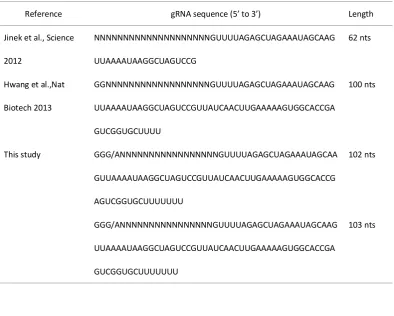
Table S1 Sequences of gRNA used in previously published in vitro studies and this in vivo work
Reference gRNA sequence (5’ to 3’) Length
Jinek et al., Science
2012
NNNNNNNNNNNNNNNNNNNNGUUUUAGAGCUAGAAAUAGCAAG
UUAAAAUAAGGCUAGUCCG
62 nts
Hwang et al.,Nat
Biotech 2013
GGNNNNNNNNNNNNNNNNNNGUUUUAGAGCUAGAAAUAGCAAG
UUAAAAUAAGGCUAGUCCGUUAUCAACUUGAAAAAGUGGCACCGA
GUCGGUGCUUUU
100 nts
This study GGG/ANNNNNNNNNNNNNNNNNGUUUUAGAGCUAGAAAUAGCAA
GUUAAAAUAAGGCUAGUCCGUUAUCAACUUGAAAAAGUGGCACCG
AGUCGGUGCUUUUUUU
102 nts
GGG/ANNNNNNNNNNNNNNNNGUUUUAGAGCUAGAAAUAGCAAG
UUAAAAUAAGGCUAGUCCGUUAUCAACUUGAAAAAGUGGCACCGA
GUCGGUGCUUUUUUU
10 SI Z. Yu et al.
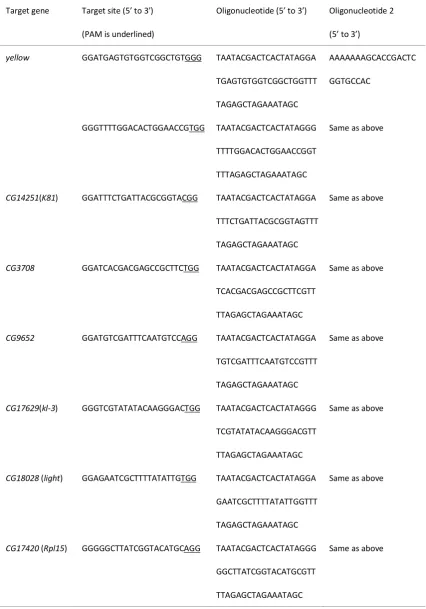
Table S2 Seven Drosophila loci with 8 targeting sites chosen for this study and oligonucleotides used to
generate the associated gRNA transcription
Target gene Target site (5’ to 3’)
(PAM is underlined)
Oligonucleotide (5’ to 3’) Oligonucleotide 2
(5’ to 3’)
yellow GGATGAGTGTGGTCGGCTGTGGG TAATACGACTCACTATAGGA
TGAGTGTGGTCGGCTGGTTT
TAGAGCTAGAAATAGC
AAAAAAAGCACCGACTC
GGTGCCAC
GGGTTTTGGACACTGGAACCGTGG TAATACGACTCACTATAGGG
TTTTGGACACTGGAACCGGT
TTTAGAGCTAGAAATAGC
Same as above
CG14251(K81) GGATTTCTGATTACGCGGTACGG TAATACGACTCACTATAGGA
TTTCTGATTACGCGGTAGTTT
TAGAGCTAGAAATAGC
Same as above
CG3708 GGATCACGACGAGCCGCTTCTGG TAATACGACTCACTATAGGA
TCACGACGAGCCGCTTCGTT
TTAGAGCTAGAAATAGC
Same as above
CG9652 GGATGTCGATTTCAATGTCCAGG TAATACGACTCACTATAGGA
TGTCGATTTCAATGTCCGTTT
TAGAGCTAGAAATAGC
Same as above
CG17629(kl-3) GGGTCGTATATACAAGGGACTGG TAATACGACTCACTATAGGG
TCGTATATACAAGGGACGTT
TTAGAGCTAGAAATAGC
Same as above
CG18028 (light) GGAGAATCGCTTTTATATTGTGG TAATACGACTCACTATAGGA
GAATCGCTTTTATATTGGTTT
TAGAGCTAGAAATAGC
Same as above
CG17420 (Rpl15) GGGGGCTTATCGGTACATGCAGG TAATACGACTCACTATAGGG
GGCTTATCGGTACATGCGTT
TTAGAGCTAGAAATAGC
11 SI Z. Yu et al.
Table S3 List of primers for PCR examination for allelic mutations used in this study and restriction enzyme used
for each locus
Target gene Primer name Primer sequence (5’ – 3’) Forward and Reserse Restriction enzyme
yellow yellow-F CGGAGCTAATTCCGTATCCA
yellow-R CGCCAGGTAGCTCGTATCTC
CG14251 (K81) CG14251-F GAGATTTCTCACTACTGCTCCTCG RsaI
CG14251-R ACACGAATTGGATATGCGATAGC
CG3708 CG3708-F GATATTTTGGAGGGTTCGGTGG BpmI
CG3708-R GTGCTCTGTTCCTTCGCCTGCT
CG9652 CG9652-F GCATTTTACGAGCTGCACATTG BstNI
CG9652-R ACCCATTTGGTTTCCTAATCATCC
CG17629(kl-3) CG17628-F CGATGTCATAGTTGGGATAACTGATG BsrI
CG17629-R ATTATTATTGTTTACTTACTATATTTGTTGAGCAGCC
ACAGACAGTTCTGGTAGCTCAATGCGATTAAATTC
CG18028 (light) CG18028-F GTATGTGGGCTTGCACCATTATC Sau96I
CG18028-R CCACGGAGTACGGTGATGAATG
CG17420 (Rpl15) CG17420-F GGATATCTGACGGATGTTATGTTCG NspI
12 SI Z. Yu et al.
File S1
Materials and methods
Fly stocks
w1118 and yw flies were used in this study, and all flies were cultured at 25°C.
Cas9/gRNA design
For the construction of pSP6-2sNLS-spcas9 (Figure S1B), genomic DNA of Cas9 was amplified by standard PCR
protocol from S. pyogenes genome, and then inserted into pMD18-T vector. An N-terminal XhoI restriction
enzyme site and C-terminal NLS sequence were included in the above PCR product. The N-terminal
CMV-SP6-NLS-3xFLAG fragment was cut from TALEN expressing vector (HUANG et al. 2011) by SalI and XhoI and
inserted into the XhoI site described above. Target DNA binding sequence of customized gRNA was selected
according to the previous studies in Zebrafish (CHANG et al. 2013; HWANG et al. 2013). To simplify the gRNA design
and the following in vitro transcription procedure, we follow the target sequence principle:
5’GGA/G-N17/18-NGG-3’. For the convenience of molecular identification of indel mutations in our interested loci
except for yellow, a restriction enzyme site was chosen around the cutting site of the target sequence. The
sequences of gRNAs are listed in Table S2.
In vitro synthesis and microinjection of Cas9-coding mRNA and gRNA
For Cas9 mRNA in vitro transcription, pSP6-2sNLS-spcas9 plasmids were linearized by XbaI and recovered as
corresponding templates. Transcription was carried out following the instructions of the Sp6 mMESSAGE
mMACHINE Kit (Ambion, USA). The poly(A) signals were added to the 3’ of capped mRNAs by E. coli Poly(A)
polymerase Kit (New England BioLabs, USA). For customized gRNA in vitro transcription, the DNA templates were
obtained from the pMD19-T gRNA scaffold vector (kindly provided by Dr. J. XIONG, peking university) by PCR. The
13 SI Z. Yu et al.
purified Cas9-coding mRNA and gRNA were mixed to a final concentration of 1ug/ul and 50ng/ul respectively,
followed by injection into w1118 embryos according to the standard procedure. The sequences of all primers for
different genes are listed in Table S2.
Cas9/gRNA-mediated mutation screens and statistical analyses
For the case of the yellow locus, the mosaic yellow phenotype in F0 (injected animals) and indel yielders in F1
were assessed according to the previous described methods (LIU et al. 2012). For detection of F0 mutants of the
other 6 loci, targeted genomic region was amplified by PCR from single F0 fly genome using primers designed to
anneal at approximately 100 to 300 base pairs upstream and downstream from the expected DSB site. The
corresponding PCR products were sequenced and/or digested by coresponding enzymes (Table S3). For detection
of F1 mutants, single F1 fly (5-10 flies randomly picked from each fertile F0 cross) genomic DNA were amplified
using primers described above. The resulting PCR products were sequenced. Mutated alleles were identified by
comparison with the wild-type sequence. For kl-3 and RpL15, targeted PCR products from an individual F0 animal
(kl-3) or pooled genomic DNA isolated from ten dying larvae (RpL15) were cloned into the pEASY-T vector for
DNA sequencing. The genomic DNA sequences with modifications mediated by Cas9/gRNA were scored as indel
14 SI Z. Yu et al.
CHANG,N.N., C.H.SUN, L.GAO, D.ZHU, X.F.XU et al., 2013 Genome editing with RNA-guided Cas9 nuclease in
Zebrafish embryos. Cell Research 23: 465-472.
HUANG,P., A.XIAO, M.G.ZHOU, Z.Y.ZHU, S.LIN et al., 2011 Heritable gene targeting in zebrafish using customized
TALENs. Nature Biotechnology 29: 699-700.
HWANG,W.Y., Y.F.FU, D.REYON, M.L.MAEDER, S.Q.TSAI et al., 2013 Efficient genome editing in zebrafish using a