Western University Western University
Scholarship@Western
Scholarship@Western
Electronic Thesis and Dissertation Repository
6-5-2015 12:00 AM
Hardware Implementations for Symmetric Key Cryptosystems
Hardware Implementations for Symmetric Key Cryptosystems
Hayssam El-Razouk
The University of Western Ontario
Supervisor
Arash Reyhani-Masoleh
The University of Western Ontario
Graduate Program in Electrical and Computer Engineering
A thesis submitted in partial fulfillment of the requirements for the degree in Doctor of Philosophy
© Hayssam El-Razouk 2015
Follow this and additional works at: https://ir.lib.uwo.ca/etd
Part of the VLSI and Circuits, Embedded and Hardware Systems Commons
Recommended Citation Recommended Citation
El-Razouk, Hayssam, "Hardware Implementations for Symmetric Key Cryptosystems" (2015). Electronic Thesis and Dissertation Repository. 2927.
https://ir.lib.uwo.ca/etd/2927
HARDWARE IMPLEMENTATIONS FOR SYMMETRIC KEY
CRYPTOSYSTEMS
(Thesis format: Monograph)
by
Hayssam El-Razouk
Graduate Program in Electrical and Computer Engineering
A thesis submitted in partial fulfillment
of the requirements for the degree of
Doctor of Philosophy
The School of Graduate and Postdoctoral Studies
The University of Western Ontario
London, Ontario, Canada
c
Abstract
The utilization of global communications network for supporting new electronic
applica-tions is growing. Many applicaapplica-tions provided over the global communicaapplica-tions network involve
exchange of security-sensitive information between different entities. Often, communicating
entities are located at different locations around the globe. This demands deployment of
cer-tain mechanisms for providing secure communications channels between these entities. For
this purpose, cryptographic algorithms are used by many of today’s electronic applications to
maintain security. Cryptographic algorithms provide set of primitives for achieving different
security goals such as: confidentiality, data integrity, authenticity, and non-repudiation. In
gen-eral, two main categories of cryptographic algorithms can be used to accomplish any of these
security goals, namely, asymmetric key algorithms and symmetric key algorithms. The
secu-rity of asymmetric key algorithms is based on the hardness of the underlying computational
problems, which usually require large overhead of space and time complexities. On the other
hand, the security of symmetric key algorithms is based on non-linear transformations and
permutations, which provide efficient implementations compared to the asymmetric key ones.
Therefore, it is common to use asymmetric key algorithms for key exchange, while symmetric
key counterparts are deployed in securing the communications sessions. This thesis focuses on
finding efficient hardware implementations for symmetric key cryptosystems targeting mobile
communications and resource constrained applications.
First, efficient lightweight hardware implementations of two members of the Welch-Gong
(WG) family of stream ciphers, the WG(29,11) and WG-16, are considered for the mobile communications domain. Optimizations in the WG(29,11) stream cipher are considered when theGF(229)elements are represented in either the Optimal normal basis type-II (ONB-II) or
the Polynomial basis (PB). For WG-16, optimizations are considered only for PB
representa-tions of theGF(216)elements. In this regard, optimizations for both ciphers are accomplished
mainly at the arithmetic level through reducing the number of field multipliers, based on novel
trace properties. In addition, other optimization techniques such as serialization and pipelining,
are also considered.
After this, the thesis explores efficient hardware implementations for digit-level
multipli-cation over binary extension fields GF(2m). Efficient digit-levelGF(2m) multiplications are
advantageous for ultra-lightweight implementations, not only in symmetric key algorithms,
but also in asymmetric key algorithms. The thesis introduces new architectures for digit-level
GF(2m) multipliers considering the Gaussian normal basis (GNB) and PB representations of
the field elements. The new digit-levelGF(2m) single multipliers do not require loading of the
multiplication in resource constrained applications with limited capacity of input data-paths.
The new digit-levelGF(2m) single multipliers are considered for both the GNB and PB. In addition, for the GNB representation, new architectures for digit-levelGF(2m) hybrid-double and hybrid-triple multipliers are introduced. The new digit-levelGF(2m) hybrid-double and
hybrid-triple GNB multipliers, respectively, accomplish the multiplication of three and four
field elements using the latency required for multiplying two field elements. Furthermore, a
new hardware architecture for the eight-ary exponentiation scheme is proposed by utilizing the
new digit-levelGF(2m) hybrid-triple GNB multipliers.
Keywords: Digit-Level Multipliers, Finite Fields, Finite Field Exponentiation, Gaussian
Normal Basis, Hybrid-Double Multiplication, Linear Feedback Shift Registers, Normal Basis,
Optimal Normal Basis, Polynomial Basis, Pseudo Random Key Generators, Serial
Co-Authorship
I would like to thank Dr. Guang Gong, from the electrical and computer engineering
depart-ment at the University of Waterloo, for her constructive inputs during the different discussions
and throughout the writing/revision phases of the published/accepted versions of chapters 3
Dedications
Acknowledgements
First of all, all praise and thanks are due to my Lord.
I would like to thank my parents, my wife Shaima, my beautiful daughter Quds, and my
sisters for all their support, and prayers.
I would like to thank my supervisor, Dr. Arash Reyhani-Masoleh, for his continuous and
non-stopping support and guidance throughout the course of my PhD studies.
I would also like to thank the examiners, Dr. Anestis Dounavis, Dr. Abdelkader Ouda, Dr.
Marc Moreno Maza, and Dr. Majid Ahmadi, for putting the time and effort to read my PhD
thesis and provide their constructive comments.
Last but not least, I would like to thank my colleges, Behdad Husseini, Depanwita
Gan-gopadhyay, Ebrahim Hassan, and Sasan Khoshroo, for all the constructive and fruitful
Contents
Abstract ii
Co-Authorship iv
Dedications v
Acknowledgements vi
List of Figures xii
List of Tables xiv
Nomenclature xvi
1 Introduction 1
1.1 Objectives . . . 2
1.2 Motivations and Significance . . . 2
1.3 Thesis Outline . . . 4
2 Background onGF(2m)and WG Stream Ciphers 5 2.1 Preliminaries on Algebraic Structures . . . 5
2.2 Finite Fields . . . 7
2.2.1 Fields . . . 7
2.2.2 Finite Fields . . . 7
2.3 Modular Arithmetic . . . 7
2.4 Polynomial Rings . . . 9
2.5 Binary Extension FieldsGF(2m) . . . 11
2.6 Polynomial Basis (PB) Representation . . . 11
2.7 Gaussian Normal Basis (GNB) Representation . . . 11
2.8 Addition overGF(2m) . . . 12
2.9.1 GF(2m) Multiplication in the PB Representation . . . 13
2.9.1.1 Multiplication of Two Arbitrary GF(2m) Elements Repre-sented in the PB . . . 13
2.9.1.2 Efficient Multiplication of aGF(2m) Element Represented in the PB byαq . . . 15
2.9.1.3 Previous Work on PB Multiplication . . . 15
2.9.2 GF(2m) Multiplication in the GNB Representation . . . 17
2.9.2.1 Formulation for the BL-PISOGF(2m) Multiplication in the GNB Representation . . . 17
2.9.2.2 Multiplication by the Normal Elementβ . . . 18
2.9.2.3 Previous Work on GNB Multiplication . . . 18
2.10 Exponentiation and Inverse overGF(2m) . . . 19
2.11 Trace Mapping . . . 20
2.12 Welch-Gong (WG) Stream Ciphers . . . 21
2.12.1 Stream Ciphers . . . 21
2.12.2 WG Stream Ciphers . . . 22
2.12.2.1 A General Block Diagram . . . 22
2.12.2.2 Phases of Operation . . . 23
2.12.2.3 WG(29,11) and WG-16 . . . 23
2.12.2.4 Parameters of the WG(29,11) . . . 24
2.12.2.5 Parameters of the WG-16 . . . 25
3 Implementations of the WG Stream Ciphers Using ONB-II 26 3.1 Optimized Hardware Design of the MOWG(29,11,17) Cipher . . . 27
3.1.1 Reducing the Hardware Complexity of the MOWG Transformation . . 27
3.1.2 Improving the Critical Path of the MOWG Transform . . . 28
3.1.2.1 Formulation . . . 29
3.1.2.2 Modified KIA Algorithm . . . 30
3.1.3 Architecture . . . 30
3.1.4 The Finite State Machine . . . 32
3.1.5 Space and Time Complexities . . . 33
3.1.5.1 Space Complexity . . . 33
3.1.5.2 Time Complexity . . . 35
3.2 Low Complexity WG Cipher . . . 36
3.2.1 Properties of the Trace Function for Type-II ONB . . . 36
3.2.3 Serializing the Computation of the Initial Feedback Signal . . . 39
3.2.3.1 Architecture and Operation of the Modified FSM . . . 40
3.2.3.2 Architecture and Operation of the Serialized Key Initializa-tion Module . . . 42
3.2.4 Space and Time Complexities . . . 44
3.2.4.1 Space Complexity . . . 44
3.2.4.2 Time Complexity . . . 46
3.3 Results and Comparisons . . . 46
3.3.1 Results from FPGA and ASIC Implementations . . . 46
3.3.2 Discussion . . . 49
3.4 Conclusion . . . 51
4 Implementations of the WG Stream Ciphers Using PB 52 4.1 Architectures of the WG(29,11) Stream Cipher . . . 54
4.1.1 Formulation ofWGT29 . . . 54
4.1.2 Design Parameters . . . 54
4.1.2.1 Field Polynomial and Squaring Matrices . . . 55
4.1.2.2 Characteristic Polynomial of the LFSR . . . 55
4.1.2.3 Trace Vector . . . 57
4.1.2.4 Trace of Multiplication of Two Field Elements . . . 57
4.1.3 Architecture and FSM . . . 59
4.1.3.1 Architecture of the WG(29,11) Cipher . . . 59
4.1.3.2 The Finite State Machine (FSM) . . . 62
4.1.4 Serialized Implementation of the PB Based WG(29,11) . . . 62
4.1.4.1 Architecture of the Serialized WG(29,11) . . . 62
4.1.4.2 FSM for the Serialized PB based WG(29,11) . . . 64
4.1.5 Pipelined Implementation of the PB Based WG(29,11) . . . 66
4.1.5.1 Architecture of the Pipelined PB Based WG(29,11) . . . 66
4.1.5.2 FSM for the Pipelined PB Based WG(29,11) . . . 67
4.2 Architectures of the WG-16 Stream Cipher . . . 68
4.2.1 Formulations ofWGP16 andWGT16 . . . 69
4.2.2 Squaring Matrices and Trace Vector . . . 70
4.2.2.1 Squaring Matrices . . . 70
4.2.2.2 Trace Vector . . . 71
4.2.4 Architecture and FSM . . . 71
4.2.4.1 Architecture of the WG-16 Cipher . . . 71
4.2.4.2 The Finite State Machine . . . 74
4.2.5 Serialized Implementation of the PB Based WG-16 . . . 74
4.2.5.1 Architecture of the Serialized WG-16 . . . 74
4.2.5.2 FSM for the Serialized WG-16 . . . 75
4.2.6 Pipelined Implementation of the PB Based WG-16 . . . 77
4.2.6.1 Architecture . . . 77
4.2.6.2 FSM for the Pipelined WG-16 . . . 78
4.3 Implementation Results and Comparisons . . . 78
4.3.1 ASIC Implementations . . . 79
4.3.2 Results and Comparisons . . . 79
4.4 Conclusion . . . 81
5 Digit-Level Architectures forGF(2m)Multiplication in the GNB 83 5.1 Proposed DL-FSIPO Single GNB Multipliers . . . 86
5.1.1 Proposed MSD DL-FSIPO Single GNB Multiplier . . . 86
5.1.1.1 Formulations . . . 86
5.1.1.2 Architecture . . . 89
5.1.1.3 Space and Time Complexities . . . 90
5.1.1.4 Bit-Level Case . . . 92
5.1.2 Proposed LSD DL-FSIPO Single GNB Multiplier . . . 93
5.1.2.1 Formulations . . . 93
5.1.2.2 Architecture . . . 96
5.1.2.3 Space and Time Complexities . . . 97
5.2 Proposed DL-PISO Single GNB Multiplier . . . 98
5.2.1 Architecture . . . 98
5.2.2 Space and Time Complexities . . . 100
5.3 Proposed Digit-Level Hybrid-Double and Hybrid-Triple GNB Multipliers . . . 101
5.3.1 Proposed MSD DL-SIPO Hybrid-Double GNB Multiplier . . . 101
5.3.2 Proposed DL-PIPO Hybrid-Triple GNB Multiplier . . . 103
5.3.3 Space and Time Complexity Analysis . . . 105
5.3.4 Hybrid Versus Single Digit-Level GNB Multipliers . . . 106
5.4 Proposed Architecture for Field Exponentiation . . . 107
6 Digit-Level Architectures forGF(2m)Multiplication in the PB 110
6.1 Proposed MSD DL-FSIPO PB Multiplier . . . 111
6.1.1 Formulations . . . 111
6.1.2 Architecture . . . 114
6.1.3 Space and Time Complexities . . . 116
6.2 Proposed LSD DL-FSIPO PB Multiplier . . . 118
6.2.1 Formulations . . . 119
6.2.2 Architecture . . . 124
6.2.3 Space and Time Complexities . . . 126
6.3 Comparisons . . . 131
6.4 Conclusion . . . 136
7 Summary and Future Work 137 7.1 Summary of Contributions . . . 137
7.2 Future Work . . . 138
Bibliography 139
List of Figures
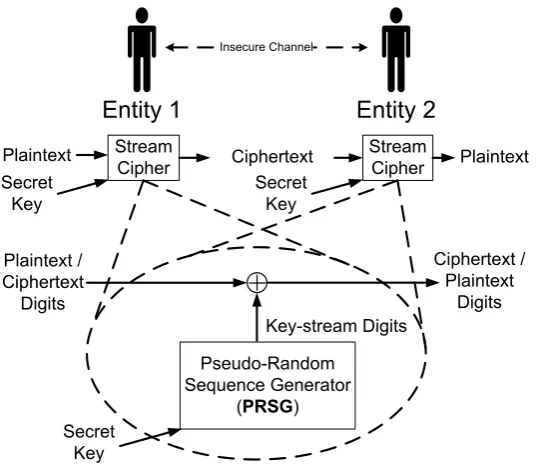
2.1 A stream cipher is used for providing privacy over an insecure channel between
two communicating entities. . . 21
2.2 A general block diagram of a WG stream cipher. . . 22
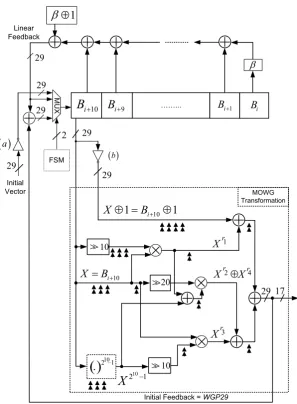
3.1 Proposed MOWG transformation. . . 28
3.2 Proposed design of the MOWG(29,11,17) cipher. . . 31
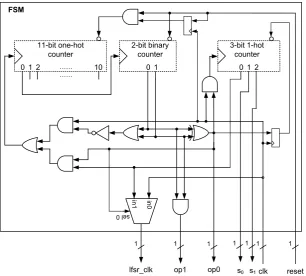
3.3 FSM of the MOWG. . . 32
3.4 The proposed design of the WG transformation. . . 39
3.5 Modified FSM after adding the new 3-bit one-hot counter. . . 41
3.6 Block diagram of the SKIM module. . . 42
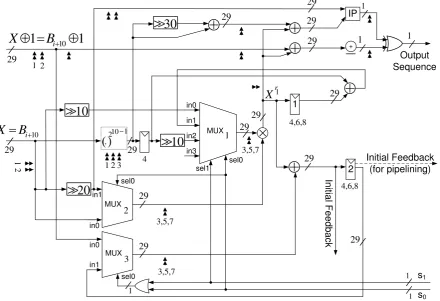
3.7 The proposed WG transformation after integration with the SKIM module. . . . 43
3.8 Serial Implementation of MOWG/WG Stream Ciphers. . . 49
4.1 Contributions of this work. . . 53
4.2 The matrixSfor WG(29,11). . . 56
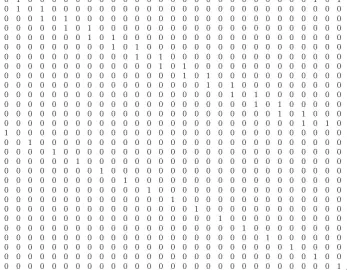
4.3 Architecture of the WG(29,11) stream cipher. . . 60
4.4 Architecture of the 210−1 module. . . 61
4.5 FSM for the PB based implementation of the WG(29,11) stream cipher. . . 62
4.6 Architecture of the serialWGP29/WGT29 implementation. . . 64
4.7 a) Architecture of the FSM for the serialized implementation of the WG(29,11). b) Generating the Clock Enable Control Signals and the Multiplexers’ Selectors. 65 4.8 Pipelined version of theWGT29. . . 66
4.9 Architecture of the FSM for the pipelined version of the WG(29,11). . . 67
4.10 Clock enable control signals for the pipelined version of the WG(29,11). . . 68
4.11 The matrixSfor WG-16. . . 70
4.12 a) Architecture of the WG-16. b) Generation of the signal Ys(s = 25−1). c) Generation of the signal (Ai+31)1057. . . 72
4.15 Pipelined version of the WG-16 transform. . . 77
4.16 Generating the clock enable signals and, ctrl0 and ctrl1 signals for the pipelined
version of the WG-16. . . 79
5.1 Summary of contributions. . . 84
5.2 (a) Architecture of the proposed MSD DL-FSIPO single GNB multiplier. (b)
Architecture of∇j. (c) Architecture ofβj. . . 89
5.3 Architecture of the proposed LSD DL-FSIPO single GNB multiplier. . . 96
5.4 (a) The proposed architecture of the MSD DL-PISO single GNB multiplier. . . 99
5.5 Architectures of the proposed MSD DL-SIPO hybrid-double GNB multiplier.
(a) Low area design. (b) High speed design. . . 102
5.6 Architectures of the proposed MSD DL-PIPO hybrid-triple GNB multiplier.
(a) Low area design. (b) High speed design. . . 104
5.7 Architecture of the proposed eight-ary field exponentiation scheme. . . 108
6.1 (a) Architecture of the proposed MSD DL-FSIPO PB multiplier. (b) Detailed
architecture of△j. (c) Architecture of⊗module. . . 115
6.2 The state of the correspondingGF(23)MSD DL-FSIPO PB multiplier for Ex-ample 6.1.3, throughout the different iterations of the computation. (a) initial
state. i = 0. (b) state after first clock cycle. i = 1. (c) state after second clock cycle.i= 2. (d) state after third clock cycle. . . 117 6.3 (a) Architecture of the proposed LSD DL-FSIPO PB multiplier. (b) Detailed
architecture of△′j ati-th iteration. . . 125 6.4 The state of the correspondingGF(23)LSB BL-FSIPO PB multiplier for
Ex-ample 6.2.3, throughout the different iterations of the computation. (a) initial
state. i = 0. (b) state after first clock cycle. i = 1. (c) state after second clock cycle.i= 2. (d) state after third clock cycle. . . 126 6.5 Multiplying an arbitrary GF(2m) element by the constant α−q wherep(x) =
xm+∑iω=−12xti+1 is the field’s generating irreducible polynomial withωnonzero terms andq≤ t1(condition of (6.11)). . . 129
6.6 Normalized throughput as a function of the digit size for the serial inputs
load-ing case. . . 132
6.7 Normalized throughput as a function of the digit size for the parallel inputs
List of Tables
1.1 Comparison of strength of AES, RSA, DSA, and ECDSA [18]. . . 1
2.1 Addition overGF(5). . . 9
2.2 Subtraction overGF(5). . . 9
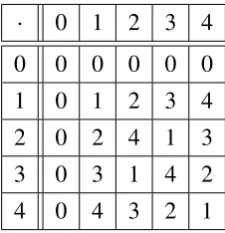
2.3 Multiplication overGF(5). . . 10
3.1 Phase of operation in the proposed MOWG as a function of the state of the 2-bit binary counter. . . 33
3.2 Count of 1-bit registers and logic gates in the different components of the pro-posed MOWG design. . . 34
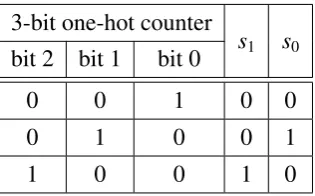
3.3 Signalss0ands1 as a function of the output of the 3-bit one-hot counter. . . 42
3.4 Multiplexers outputs and next states of Register 1 and Register 2 as a function ofs0ands1. . . 44
3.5 Count of 1-bit registers and logic gates in the components of the proposed WG(29,11). . . 45
3.6 Results obtained from ASIC implementations. . . 47
3.7 Results obtained from FPGA implementations. . . 47
4.1 The space and time complexities of the different squaring matrices used in the WG(29,11). . . 57
4.2 Computation of theIF = WGP29 signal over 3 clock cycles during the initial-ization phase. . . 61
4.3 Phase of operation in the proposed PB based WG designs as a function of the state of the 2-bit binary counter. . . 63
4.4 Steps for computing theWGP29 andWGT29 in the serial implementation of the WG(29,11) design. . . 63
4.5 Space and propagation delay complexities of the different squaring matrices used in the WG-16. . . 70
4.6 Computation of theWGP16 signal over 3 clock cycles. . . 73
4.8 Results obtained for area and speed from the ASIC implementations. . . 82
5.1 Steps for multiplication of the twoGF(23)elementsA= B= β22 =(0,0,1). . . 88 5.2 Space complexity of digit-level single GNB multipliers. . . 91
5.3 Time complexity of digit-level single GNB multipliers. . . 91
5.4 Space and time complexity readings for the case of type-4 GNB ofGF(2163)
digit-level single multipliers. . . 92
5.5 Steps for multiplication of the twoGF(23)elementsA= B= β22 =(0,0,1). . . 95
5.6 Space complexity of the digit-level hybrid-double and hybrid-triple GNB
mul-tipliers. . . 105
5.7 Time complexity of the digit-level hybrid-double and hybrid-triple GNB
mul-tipliers. . . 105
6.1 Example 6.1.3 for multiplying the twoGF(23)elementsA= α= (0,1,0) and
B=α2 =(1,0,0) using (6.1) and (6.2). . . 114 6.2 Example 6.2.3 for multiplying the twoGF(23)elementsA= α= (0,1,0) and
B=α2 =(1,0,0) using (6.6) and (6.7). . . 122 6.3 Space and time complexities of the different digit-levelGF(2m) PB multipliers. 131 6.4 Space and time complexities for the NIST recommended field GF(2233)
de-fined by the irreducible trinomialx233+xt1+1, wheret
1 =74 and the digit size
isd =1. . . 134 6.5 Space and time complexity estimates for the multipliers which are listed in
Nomenclature
3GPP The 3rd generation partnership project
4G Fourth generation mobile communications domain
AES Advanced encryption standard
ASIC Application specific integrated circuits
CMOS Complementary metal-oxide-semiconductor technology
DL Digit-level
Double field multiplication Multiplication of three field elements
DSA Digital signature algorithm
DSS Digital signature standard
ECDSA Elliptic curve digital signature algorithm
FF Flip-Flop
FLT Fermat’s Little Theorem
FPGA Field programmable gate array
FSIPO Fully-serial-in-parallel-out
FSM Finite state machine
GF(2) The binary finite field with elements 0 and 1
GF(2m) Galois Field with 2melements
i.e. That is
IP Inner product
IP-networks Internet protocol networks
LFSR Linear feedback shift register
LSB Least significant bit first
LSD Least significant digit first
LTE Long term evolution
m-sequence Maximal length sequence
MOWG Multiple output-bits version of the WG stream cipher
MPD Maximum propagation delay
MSB Most significant bit first
MSD Most significant digit first
MUX Multiplexer
NB Normal Basis
NIST National institute of standards and technology
ONB-II Optimal normal basis of type 2
PB Polynomial Basis
PD Propagation delay
PIPO Parallel-in-parallel-out
PISO Parallel-in-serial-out
PRSG Psuedo random sequence generator
RFID Radio frequency identification
ROM Read-only memory
SIPO Serial-in-parallel-out
SNOW 3G The stream cipher SNOW 3G, which is included in the 4G
net-work domain’s cipher suite
SSL Secure sockets layer
TLS Transport layer security
TP Throughput: number of output bits per second
Tr(A) The trace of a field elementA, which is a mapping fromGF(2m) to either 0 or 1
Triple field multiplication Multiplication of four field elements
w.r.t With respect to
WEP Wired equivalent privacy
WG Welch-Gong
WG Stream Cipher Welch-Gong transform based Stream Cipher
WG(29,11) WG stream cipher with an LFSR of length 11 overGF(229)
WG(m,l) WG stream cipher with an LFSR of lengthloverGF(2m)
WGP Welch-Gong (WG) permutation
WGT Welch-Gong (WG) transform
WPA Wi-Fi protected access
XOR Logical binary exclusive OR operation
XST Xilinx synthesis tool
ZUC The stream cipher ZUC, which is included in the 4G network
Chapter 1
Introduction
Cryptographic algorithms play essential role in communications systems security. In general,
the different deployed cryptosystems are divided into two categories of asymmetric key and
symmetric key [82]. Schemes from the former category require relatively high space and time
complexities for their hardware implementations. Hence, asymmetric key cryptosystems are
usually deployed in key set-up mechanisms. On the other hand, schemes from the latter
cat-egory offer hardware implementations which require relatively lower complexities in terms of
space and time. Hence, symmetric key cryptosystems are usually used for providing security
services during communications sessions. The lower implementation cost of symmetric key
systems is due to the simpler underlying mathematical constructs, in addition to the smaller
key sizes required by these cryptosystems to achieve certain security levels compared to the
asymmetric key ones. Table 1.1 presents a comparison of key sizes required by AES, RSA,
DSA, and ECDSA in order to achieve some security levels (in terms of bits of security). In
this table, kindicates the key size for AES, while it refers to the size of the modulus in RSA.
l andn, respectively, indicate the size of public and private keys for DSA. For ECDSA, f is considered to be the key size.
Bits of Security AES RSA DSA ECDSA
128 k= 128 k =3072 l= 3072, n=256 256≤ f ≤383 192 k= 192 k =7680 l= 7680, n=384 384≤ f ≤511 256 k= 256 k= 15360 l=15360, n=512 f ≥512 Table 1.1: Comparison of strength of AES, RSA, DSA, and ECDSA [18].
Efficient hardware implementations of the deployed cryptosystems are necessary for their
practical use. In other words, the implementation of a given cryptosystem should comply
research focuses on finding efficient hardware implementations for symmetric key
cryptosys-tems, targeting mobile and resource constrained applications, as it is stated in the following
section.
1.1
Objectives
The goal of this research is to introduce efficient hardware implementations for symmetric key
cryptosystems targeting the mobile communications domain and resource constrained
applica-tions, as follows.
First, this research aims for lightweight hardware implementations for the two classes
of the Welch-Gong (WG) family of stream ciphers, WG(29,11) and WG-16. The targeted lightweight implementations will provide trade-offs between space and time complexities for a
set of lightweight applications. Specifically, the WG-16 implementations are intended for the
Long term evaluation (LTE) 4G mobile communications domain.
After this, the research focuses on finding new finite field constructs for higher throughput
in resource constrained applications. New architectures for higher throughput digit-level field
multiplications will be investigated for resource constrained applications. The issue of reduced
throughput in digit-levelGF(2m) multiplication of two elements (single multiplication), due to inputs preloading in applications where the input data-path has limited capacity and the value
of m(dimension of the binary extension field) is large, will be addressed. This issue will be considered for both GNB and PB representations. Furthermore, new architectures for higher
throughput concurrent multiplications of three double multiplication) and four
(hybrid-triple multiplication) field elements will also be explored for the GNB representations. New
field exponentiation architectures based on the eight-ary scheme [42] will be considered as a
practical application of the hybrid-triple multipliers.
The following section highlights the motivations and significance of the research.
1.2
Motivations and Significance
This section states the importance and significance of the underlying research.
Stream ciphers are symmetric key cryptosystems which are attractive for protecting the
wireless communications domain [24]. This is because stream ciphers prevent error
propaga-tion at the receiving end. In this context, a stream cipher is required to provide the desired
security, generate key-stream sequences with good randomness properties, and show efficient
for other algorithms (for example, generating random numbers for the Digital signature
stan-dard ”DSS” [12]). In this type of applications, the randomness of the generated key sequences
is very critical. This thesis considers the two classes of WG(29,11) and WG-16 stream ciphers. In addition of resistance to all known attacks, to the best of the author knowledge, these two
ci-phers provide a set of desired randomness properties which can not be offered by other existing
ciphers [40, 68]. Therefore, new lightweight hardware implementations of the WG(29,11) and WG-16 stream ciphers are introduced. The new designs provide trade-offbetween randomness
properties and performance for a selection of cryptosystems. In particular, the new hardware
implementations of the WG-16 cipher provide different space options while complying with
the throughput requirements of the 4G domain. This, makes the WG-16 cipher an interesting
candidate for securing the 4G mobile domain.
The thesis then considers efficient digit-levelGF(2m) multipliers. Digit-level field multi-pliers trade-offspace complexity with lower throughput. Hence, digit-level field multipliers
are important for resource constrained applications. Any improvement in such operation is
considered of great value to a wide range of applications, such as: symmetric and
asymmet-ric crypto algorithms, error coding, random number generation, and digital signal processing.
In this context, this research proposes new architectures for single (multiply two elements),
hybrid-double (multiply three elements), and hybrid-triple (multiply four elements) digit-level
GF(2m) multipliers, as follows.
New GNB and PB single multipliers are introduced, targeting higher throughput for
digit-level field multiplications in resource constrained applications. In particular, for cases where
the input data-path has limited capacity, higher throughput is achieved through removing the
requirement for inputs preloading.
In addition, new hybrid-double and hybrid-triple GNB multipliers are introduced. The new
hybrid architectures improve the throughput of concurrent multiplications where three and four
field elements are multiplied at the same time. Also, these hybrid multiplier architectures are
advantageous for improving throughput of the important operations of field inversion [51]. It
is noted that, the hybrid-triple multiplier is proposed for the first time in the literature.
As another practical application for the hybrid-triple multipliers, field exponentiation is
an essential operation in asymmetric key cryptography (such as Diffie-Hellman key exchange
algorithm [29]) and symmetric key cryptography (WG for example). The proposed
hybrid-triple GNB multipliers are utilized in constructing new eight-ary exponentiation schemes. This
results in hardware exponentiation architectures which run at same latencies as the existing
eight-ary designs, however, without requiring any initial phase for precomputations, or any
storage of intermediate variables.
1.3
Thesis Outline
The thesis is outlined as follows. Chapter 1 highlights the objectives, motivations, and
sig-nificance, and, outlines the remaining chapters. Chapter 2 presents a brief overview about
binary extension fields and WG stream ciphers, as it suffices for understanding the rest of this
thesis. Chapter 3 introduces efficient hardware implementations for the WG(29,11) stream cipher based on the Optimal Normal Basis Type-II (ONB-II) representation of the feild
ele-ments. Chapter 4 introduces efficient hardware implementations for the WG(29,11) and WG-16 stream ciphers based on the Polynomial Basis (PB) representation of the feild elements.
Chapter 5 proposes new architectures for digit-level single, hybrid-double, and hybrid-triple
field multiplications and exponentiation based on the Gaussian Normal Basis (GNB)
represen-tation. Chapter 6 proposes new architectures for digit-level single field multiplications based
on the Polynomial Basis (PB) representation. Chapter 7 highlights the contributions of this
Chapter 2
Background on
GF
(
2
m
)
and WG Stream
Ciphers
This chapter starts by a brief introduction on binary extension fields and Welch-Gong (WG)
stream ciphers.
Arithmetic operations over binary extension fields are extensively encountered in the next
four chapters. This chapter presents necessary background about binary extension fields, as it
suffices for the purpose of clarifying contents of the remaining chapters. Other references can
be consulted for more reading about finite fields, for example, [82, 59]. For the purpose of this
work, in the following sections, some preliminary definitions are first given. This is followed
by introducing finite fields, modular arithmetic, polynomial rings, and binary extension fields.
After this, the two representations of Polynomial basis (PB) and Gaussian normal basis (GNB)
of binary extension fields elements are discussed. Then, field operations over binary extension
fields are reviewed. At the end of the sections which are dedicated for reviewingGF(2m), from
this chapter, the trace mapping is presented. It is noted that, the material presented throughout
the above-mentioned sections is a summary based on reviews done over [82, 59, 5].
After introducingGF(2m), the chapter introduces WG Stream Ciphers. First, a brief
intro-duction to stream ciphers is given. This is followed by an overview on WG stream ciphers,
where the chapter talks about general WG stream ciphers block diagrams and phases of
opera-tion, after which the two classes of WG(29,11) and WG-16 are discussed.
2.1
Preliminaries on Algebraic Structures
Before starting the presentation about finite fields, the following definitions are required.
opera-tion⋆is said to be a semigroup if:
• ⋆is closed over G, that is: for any g1,g2 ∈G, then, g1⋆g2 ∈G.
• ⋆is associative over G, that is: for any g1,g2,g3 ∈G, then,(g1⋆g2)⋆g3 =g1⋆(g2⋆g3).
Definition 2.1.2 The algebraic structure(G, ⋆)forms a group if it is a semigroup, and:
• G contains an identity element e with respect to⋆, where: for any g1 ∈G, then, g1⋆e=
e⋆g1 =g1.
• For each element g1∈G, there exists an inverse element g2 ∈G with respect to⋆, where:
g1⋆g2= g2⋆g1 =e.
Definition 2.1.3 The algebraic structure(G, ⋆)is called an abelian group if it is a group, and:
• ⋆is commutative over G, that is: for any g1,g2 ∈G, then, g1⋆g2= g2⋆g1.
Definition 2.1.4 The algebraic structure(R,+,·)which consists of a set R and the two binary operations+(additive) and·(multiplicative) is called a ring if:
• (R,+)is an abelian group. The additive identity element is usually denoted by 0. The additive inverse of any element r1∈R is denoted by−r1.
• (R,·)is a semigroup.
• ·is distributive over+, that is: for any r1,r2,r3 ∈R, then, r1·(r2+r3)= r1·r2+r1·r3,
and,(r2+r3)·r1 =r2·r1+r3·r1.
Definition 2.1.5 A homomorphism is a map between two algebraic structures (such as groups, rings, and so on) through which the operations are preserved. For example, for the two
groups (G, ⋆) and (H,△), the mappingϕ : G → H is a homomorphism if ∀g1,g2 ∈ G =⇒
ϕ(g1⋆g2) = ϕ(g1)△ϕ(g2). If in addition,ϕis surjective1(onto) and one-to-one, then ϕis an
isomorphism.
The following section introduces finite fields.
2.2
Finite Fields
2.2.1
Fields
An algebraic structure (F,+,·), constructed from a setF and the two binary operations+and· forms a field if:
• (F,+) is an abelian group.
• (F− {0},·) is an abelian group. The multiplicative identity element is usually denoted by 1. The multiplicative inverse of any element f1 ∈Fis denoted by f1−1.
• Multiplication is distributive over addition.
• There exist no zero divisors overF, that is, for any f1, f2 ∈ F, if f1· f2 = 0, then, either
f1= 0 or f2 =0.
2.2.2
Finite Fields
A finite field, known asGalois Field, and denoted byGF(q) (orFq), is a field
(
Fq,+,·
)
, where
Fq is a set with finitelyqelements. The order ofGF(q), that is the number of field elements q, is a positive integer which is either a prime or a power of a prime (including powers of 2). InGF(q), there is a zero element, while the remainingq−1 elements form the multiplicative group of the field (all elements which have multiplicative inverses). For a given orderq, there might be more than one representation of the corresponding finite fieldGF(q). However, all finite fields of a given order are isomorphic (have same structure).
In simple words, a finite field is a set with finitely many elements over which one can
perform the operations of addition, subtraction, multiplication, and division, while staying in
the same set.
The following section introduces modular arithmetic and highlights the relation between
the algebraic structure(Zp,+,·
)
and finite fields of the formGF(p), whereZdenotes the set of integers, pis a prime number, andZpis the set of positive integers less than p(including 0).
2.3
Modular Arithmetic
This section gives a brief presentation about modular arithmetic. Modular addition and
mul-tiplication are carried out as they are done over the set of integers Z, however, followed by
Applying the ”modulom” operator to a given integer v ∈ Z, written asvmodm, returns the remainder out of dividingv by m(long division). For example, let v = 7 and m = 3. Then, 7 mod 3 = 1, since 7 = 2×3+1. If there exists av′ ∈ Zsuch thatvmodm = v′ modm, one can also writev≡v′ (modm). The latter expression is read as:vis equivalent (or is congruent) tov′, modulom. In this expression, ≡ is known as the equivalence (or congruence) operator. Ifv≡ 0 (modm), that is,vmodm = 0, then,mdividesv, which is simply written asm |v. If
v ≡ w (modm), that is, vmodm = wmodm, then, m | |v−w|, where|·|denotes the absolute value operator. The following are some properties of congruences modulo an integerm>0:
• ∀v∈Z,v≡v(modm).
• ∀v,w∈Z,v≡ w(modm) =⇒ w≡v(modm).
• ∀v,w,x∈Z, ifv≡w(modm) andw≡ x(modm), thenv≡ x(modm).
• ∀v,w,x,y∈Z, ifv≡w(modm) and x≡y(modm), thenv±w≡ x±y(modm).
• If n is a non-zero positive integer such that n | m, therefore ∀v,w ∈ Z where v ≡ w(modm), thenv≡ w(modn).
• Letnbe a non-zero positive integer such that the greatest common divisor ofmandnis 1, that is, gcd (m,n) = 1. Therefore, ∀v,w ∈ Z, if v ≡ w(modm) and v ≡ w(modn), thenv≡ w(modmn).
Now, denote by Zm the set of residue classes modulo m. That is, Zm = {0, . . . ,m−1}
consists of integers modulom. In general, not all elements ofZmhave multiplicative inverses.
This is the reason why (Zm,+,·) forms a commutative ring and not a finite field. Only elements
of Zm which are relatively prime tom have multiplicative inverses. Therefore, if m = pis a
prime, then, multiplicative inverses exist for all non-zero elements inZp. In this case,Zpis an
abelian group under multiplication, and hence,(Zp,+,·
)
forms a finite field (since(Zp,+
)
is also
an abelian group,·is distributive over+, and there are no zero divisors inZp). Operations over
the finite field(Zp,+,·
)
are isomorphic to those overGF(p). The following is an illustrative example for arithmetic operations overGF(5). After this, next section introduces polynomial rings.
+ 0 1 2 3 4 0 0 1 2 3 4
1 1 2 3 4 0
2 2 3 4 0 1
3 3 4 0 1 2
4 4 0 1 2 3
Table 2.1: Addition overGF(5).
− 0 1 2 3 4 0 0 4 3 2 1
1 1 0 4 3 2
2 2 1 0 4 3
3 3 2 1 0 4
4 4 3 2 1 0
Table 2.2: Subtraction overGF(5).
2.4
Polynomial Rings
The algebraic structure (R,+,·) forms a ring if (R,+) is an abelian group, (R,·) is a semigroup, and multiplication is distributive over addition. A polynomial ring is a structure (R[x],+,·) such thatR[x]= {∑ni=0rixi |n≥ 0,ri ∈R
}
represents the set of all polynomials in the variant x
with coefficients fromR, where addition and multiplication, respectively, are defined as follows
n′
∑
i=0
ri′xi+ n”
∑
i=0
ri”xi =
max(n′,n”)
∑
i=0
(
r′i +ri”)xi,
and
n′
∑
i=0
r′ixi
·
n”
∑
i=0
ri”xi
=
n∑′+n”
i=0
∑
j+k=i r′j·r”k
xi.
Notice that, while exact division applies to fields, only long division is applicable to rings.
This is because field elements have inverses, while this is not the case for elements of a ring.
Therefore, in order to have long division in a polynomial ring, coefficients need to be from a
field and not a ring. Otherwise, long division might not be possible over a polynomial ring.
The following is an example showing operations done over elements of the polynomial ring
· 0 1 2 3 4 0 0 0 0 0 0
1 0 1 2 3 4
2 0 2 4 1 3
3 0 3 1 4 2
4 0 4 3 2 1
Table 2.3: Multiplication overGF(5).
Example 2.4.1 Let f (x)= x4+1and g(x)= x3+x+1be two elements from the polynomial ring
(GF(2) [x],+,·). GF(2)is the binary finite field with elements0and1, which is isomorphic to (Z2,+,·). Notice that, over GF(2): 1+ 1 = 0+ 0 = 0 and 0 + 1 = 1+ 0 = 1, while
0·0= 0·1=1·0= 0and1·1=1. Then, one conducts addition, multiplication, and division over these two elements as follows:
1) Addition:
f(x)+g(x)=(x4+1)+(x3+x+1)
=x4+ x3+ x.
2) Multiplication:
f (x)·g(x)=(x4+1)·(x3+x+1)
=x7+x5+x4+x3+x+1.
3) Division (long division):
x4+1=(x3+x+1)·(x)+(x2+x+1),
where q(x)= x is the quotient of f(x)/g(x)and r(x)= x2+ x+1is its remainder.
Notice that in the latter operation, the degree of r(x) is less than that of g(x), written as
deg (r(x)) < deg (g(x)). In general, 0 ≤ deg (r(x)) < deg (g(x)). If there exists a g(x)such that r(x)=0, then, in this case g(x)| f (x), and hence, f (x)is reducible over GF(2). If there is no such g(x)which divides f (x), then, f (x)is an irreducible polynomial over GF(2).
The following section introduces binary extension fields GF(2m) and shows how
2.5
Binary Extension Fields
GF
(2
m)
An extension field over the finite fieldGF(p) is referred to asGF(pm). GF(p) is denoted as
the ground field. Specifically, for p=2,GF(2m) is denoted as the binary extension field (over GF(2)). A GF(2m) can be viewed as a vector space overGF(2) of dimensionm. Hence, a GF(2m) is isomorphic toZ2[x]/p(x)under polynomial addition and multiplication, whereZ2[x]/p(x) denotes the set of polynomials in variant x with coefficients from Z2 taken modulo an
irre-ducible polynomial p(x) of degreem. There are 2m elements inGF(2m). Each one of these elements is uniquely represented bymbits (elements ofGF(2) with value 0 or 1) with respect to a basis. A basis is a set ofmlinearly-independent elementsΓ = {γi ∈GF(2m)|0≤ i<m}
[59]. Then, an element A ∈GF(2m) is represented with respect toΓas A = ∑m−1
i=0 aiγi, where ai ∈GF(2) for 0≤ i < mare the binary coordinates ofAw.r.tΓ. The following two sections
introduce two of the most common representations of the elements ofGF(2m).
2.6
Polynomial Basis (PB) Representation
The most straight forward representation for the elements of GF(2m) is obtained from the isomorphism ofGF(2m) toZ2[x]/p(x). Here, p(x) is an irreducible polynomial of degreemover
Z2. That is, coefficients of the terms of p(x) are either 0 or 1. Therefore, following this
construction, elements ofGF(2m) include the binary representations of all polynomials inxof
degree less than or equal tom−1.
A PB follows the form{αm−1, . . . , α,1}and is constructed by finding a rootα∈GF(2m) of
an irreducible polynomial p(x) of degreemoverGF(2) [72]. Then, using this PB, an element
AinGF(2m) is represented asA= ∑m−1
i=0 aiαi, whereai is either 0 or 1 for 0≤i< m. In vector
representation, the elementAcan also be refered to asA=(am−1, . . . ,a0) [5].
2.7
Gaussian Normal Basis (GNB) Representation
On the other hand, a Normal basis (NB) is constructed by finding an elementβ∈GF(2m) such
that themelementsβ20throughβ2m−1are linearly-independent [59]. Then, the set{β20, . . . , β2m−1}
forms a NB where β is called a normal element. In the NB, an element A is represented as
A= ∑mi=−01aiβ2 i
, withai ∈ {0,1}representing thei-th coordinate ofAwith respect to the NB, for
0≤i< m. In vector representation, the elementAcan also be represented asA=(a0, . . . ,am−1)
[5].
Gaussian normal bases (GNBs) is a special subset of NBs which offer field operations with
GNB exists for allGF(2m) which satisfy the following conditions [15, 52, 70]:
1. mis not divisible by 8, and
2. there exists a prime integer p= T m+1, withT > 0 is an integer, such that gcd(T mk ,m) =
1, andkis the order of 2 modulo-p(that is 2k ≡1 (modp)).
and hence,Tis called the type of the GNB. It is noted that for odd values ofmthe typeT should be even (since p is an odd prime). It is also noted that, smaller values of T results in more
efficient hardware implementations of field multiplications. Similar to the NB representation,
any elementA∈GF(2m) can be represented w.r.t the GNB asA= ∑m−1
i=0 aiβ2 i
= (a0, . . . ,am−1),
whereai ∈ {0,1}.
Common GF(2m) arithmetic operations include addition, multiplication, exponentiation, and inversion. The following three sections present more details about arithmetic operations
overGF(2m) considering the two cases of PB and GNB representations.
2.8
Addition over
GF
(2
m)
Field addition of two arbitraryGF(2m) elements, sayAand B, is accomplished by a bit-wise
Exclusive-OR (XOR) operation on the corresponding coordinates of the added elements,
re-gardless whether a PB or a GNB representation is used. That is:
A+B= m−1
∑
i=0
(ai +bi)γi,
where ai and bi are the binary coordinates of A and B with respect to a given basis Γ =
{γ0, . . . , γm−1}.
2.9
Multiplication over
GF
(2
m)
On the other hand, the field multiplication of two arbitraryGF(2m) elements A and Bis ac-complished as follows:
AB= m−1
∑
i=0
m−1
∑
j=0
aibjγiγj,
which is more expensive than field addition, and its complexity depends on the underlying
rep-resentationΓ = {γ0, . . . , γm−1}. It is known that the PB representation offers efficient hardware
implementations of field multiplications, compared to the NB/GNB representation [71]. The
following two sections give brief literature reviews of GF(2m) multiplications in the PB and
2.9.1
GF
(2
m)
Multiplication in the PB Representation
Two popular schemes for the multiplication of twoGF(2m) elements in the PB representation are: the two-step classic multiplication scheme and the Matrix-vector scheme [28]. The first
scheme starts by performing polynomial multiplication of the two input field elements, then,
the result is reduced modulo the irreducible defining field polynomial [89]. The following is
an example illustrating this multiplication scheme.
Example 2.9.1 This example constructs the field GF(23) using the irreducible polynomial
p(x) = x3 + x + 1 over GF(2). Denote by α the root of p(x) over GF(23). By using α,
the polynomial basis {α2, α,1} is constructed. Based on this polynomial basis, any element
A from the 23 = 8 elements of GF(23) is defined by a unique set of 3 binary coordinates as A = a2α2 +a1α+ a0. For example, by considering the GF
(
23) elements α2 + α+1 and α, then, one has (α2+α+1) ×(α) = α3+ α2 +α = α2 +1 over GF(23). The latter result is obtained after reducing x3+x2+ x by p(x) = x3+x+1(also, it can be obtained by noticing that p(α)= 0, which results inα3 =α+1).
In the second scheme, known as the Mastrovito multiplier [62, 84, 44, 72], one performs
the field multiplication in terms of vector by matrix multiplication, in which both steps of
the former scheme are combined into a single step. In the following, the multiplication of two
arbitraryGF(2m) elements represented in the PB, based on the vector by matrix method, is first
briefly reviewed. This is followed by reviewing efficient ways for the hardware realizations of
the fixed multiplication of an arbitrary GF(2m) element by αq, where q is a positive integer.
After this, a quick review over previous work on PB multiplication is presented.
2.9.1.1 Multiplication of Two ArbitraryGF(2m)Elements Represented in the PB
This section, reviews the multiplication of two arbitraryGF(2m) elements represented in the
PB based on the vector by matrix method. The formulations presented in this section are
utilized in Section 6.2.1 to accomplish the multiplication of an arbitraryGF(2m) element by
the constantαm−1. Here,αis a root of the irreducible polynomialp(x)= xm+∑ωi=−12xti+1 which generates the fieldGF(2m). ω = H(p(x)) is the Hamming weight of the field polynomial, denoting the number of nonzero terms in p(x). First, the following notations are defined.
Definition 2.9.2 Definev[↑i]andv[↓i] to be the operations of up and down i-bit shifts, re-spectively, of a given m-bit vertical vectorv=[ v0 . . . vm−1
]T
, where the emptied positions are filled with zeros (T denotes vector transposition). That is,
v[↓i]=[ 0 . . . 0 v0 . . . vm−i−1
and
v[↑i]=[ vi . . . vm−1 0 . . . 0
]T
.
Let C = (cm−1, . . . ,c0) denotes the result of multiplying two arbitrary GF(2m) elements
A = (am−1, . . . ,a0) and B = (bm−1, . . . ,b0), represented in the PB. Therefore, the m binary
coordinates ofC = ABmodp(α), represented by the verticalm-bit vectorc=[c0 . . . cm−1
]T
,
are obtained as follows [75]
c=d+
ω−2
∑
j=0
e′[↓tj
] , (2.1) where d=
a0 0 . . . 0
a1 a0 . . . 0
... ... ... ...
am−1 am−2 . . . a0
b0 b1 ...
bm−1
, (2.2)
e′ = n−1
∑
i=0
e[↑li],
and e=
0 am−1 . . . a2 a1
0 0 . . . a3 a2
... ... ... ... ...
0 0 . . . 0 am−1
0 0 . . . 0 0
b0 b1 ...
bm−2
bm−1
. (2.3)
Here, t0 = 0, n is the number of nonzero entries in column zero of the (m−1)× m binary
reduction matrixQ[72], andlidenotes the row location of thei-th nonzero entry in this column,
0≤i< n. The following are some remarks on the values ofnandli. Remark 2.9.3 Let p(x)= xm+∑ω−2
i=1 xti+1be the generator irreducible polynomial of GF(2m)
withωnonzero elements, then [33, 75]:
• l0 =0regardless of the structure of p(x).
• If p(x)is a trinomial of the form xm+x+1, then: n =1and l
0= 0.
• If p(x)is a trinomial of the form xm+ xt1 +1with1< t
1 ≤ m+21, then: n= 2with l0 = 0
and l1 =m−t1.
• If p(x)is a general irreducible polynomial with tω−2 ≤ m2+1, then: n=ω−1−
⌊1
t1
⌋
, l0 = 0,
and li = m−ti for1≤i≤ ω−2−
⌊1
t1
⌋
2.9.1.2 Efficient Multiplication of aGF(2m)Element Represented in the PB byαq
It is noted that, one can obtain a general formulation for the multiplication of an arbitrary
elementA=(am−1, . . . ,a0)∈GF(2m), represented in the PB, byαq, using (2.1), (2.2), and (2.3)
(see Section 6.2.1). However, this section lists some conditions, originally presented in [81]
and [57], for the efficient hardware realization of such constant field multiplication. Here,qis a positive integer andαis the root of the field’s irreducible polynomialp(x)= xm+∑ω−2
i=1 xti+1
withωnonzero terms.
Theorem 2.9.4 [81] Assume p(x)= xm+∑iω=−12xti+1is the field irreducible polynomial which defines GF(2m). Letαdenotes the root of p(x). Therefore, for q<m−tω−2, the coordinates of
αm+qare obtained as follows
αm+q
mod p(α)=
ω−2
∑
i=1
αti +1
αq. (2.4)
Theorem 2.9.5 [57] Assume p(x)= xm+∑ω−2
i=1 xti+1is the field irreducible polynomial which
defines GF(2m). Denote byαthe root of p(x). Let A= (a
m−1, . . . ,a0)be an arbitrary GF(2m)
element represented in the PB. Therefore, for q ≤ m−tω−2, the coordinates of Aαqmod p(α)
are obtained in a single step using q(ω−2) two-inputs XOR gates with a propagation delay equivalent to⌈log2(q+1)⌉XOR gate delays, as follows:
Aαqmod p(α)=
m−1
∑
i=0
aiαi+q mod p(α)
= m∑−q−1
i=0
aiαi+q+
m−1
∑
i=m−q ai
ω−2
∑
j=1
αtj +1
αi−(m−q).
(2.5)
2.9.1.3 Previous Work on PB Multiplication
In general, the different proposed designs for implementing PB multiplication fall under one
of the two categories of parallel and serial computations. For achieving high throughput, the
parallel implementation is used where all the output bits of the multiplication are generated in
a single clock cycle [19, 62, 84, 44, 72, 27, 22]. For achieving low space complexity,
digit-level serial computations are considered. In digit-digit-level serial multiplication schemes, the space
complexity is reduced at the expense of increasing the number of clock cycles required for
In a digit-level serial implementation, the multiplication input / output bits are entered /
generated either in parallel, or serially in the order of one digit per a clock cycle. For example,
digit-level serial-in-parallel-out (DL-SIPO) multipliers generate the output bits in parallel after
k clock cycles [20]. In this DL-SIPO scheme, one input is loaded in parallel (in advance to computations), while the other input enters serially one digit per a clock cycle during
compu-tations. The serial input of the DL-SIPO multiplier enters in either a most-significant-digit first
(MSD) or least-significant-digit first (LSD) order. Parallel-in-serial-out is another digit-level
multiplication scheme (DL-PISO), in which both inputs are preloaded in parallel in advance to
computations [75]. After this, the output digits of the DL-PISO multiplier are generated overk
clock cycles, one digit per a clock cycle. A third digit-level multiplication scheme is known as
parallel-in-parallel-out (PIPO) requires preloading of both inputs in advance to computations.
The output of the PIPO multiplier is generated in parallel after a number of clock cycles from
inputs preloading. For example, the PIPO PB multiplication architecture presented in [50] has
a latency of 2tω−2+1 clock cycles to generate themoutput bits in parallel, wheretω−2denotes
the second highest nonzero term of the field irreducible polynomial p(x) = xm+∑iω=−12xti +1 withωnonzero terms. The authors of [50] show that their serial PIPO PB multiplier offers the lowest latency for cases wherem≥2tω−2−1, however, the corresponding space complexity is
quadratic inm.
In addition, serial-serial finite field multipliers with two serially-entered inputs and serial
output have also been proposed. For example, in 1992, the authors of [46] presented a
bit-level most-significan-bit-first (MSB) serial-serial PB multiplier which generates themoutput
bits serially over 2m clock cycles. In [46], the inputs to the multiplier enter serially bit-by-bit, starting with the MSB, over the first m clock cycles. After reading the serial inputs, the
moutput bits are then generated serially, one bit per a clock cycle, starting with the MSB. In 2009, the authors of [14] proposed a generic serial-serial multiplication/reduction architecture
forGF(q), whereqcan be a prime p, a power of a prime pm, and where it is possible to have
p = 2. For the case ofGF(2m), which is the focus of this thesis, the serial-serial
multipli-cation/reduction scheme proposed in [14] reads both of its multiplication inputs serially, one
digit at a time, in either least or most-significant first order. The final result is generated
digit-by-digit without using any dedicated parallel-in-serial-out register, starting with the (k+1)-th clock cycle, where an additional correction step is required in case of the least-significant first
input order. Then, using the scheme in [14], all the moutput bits are produced serially, after a total of 2kclock cycles. It is noted that, the serial-serial multiplier in [14] is not a dedicated
multiplication scheme in the sense that it works for any irreducible polynomial by reading it as
one of its inputs. In order to allow for scalability, and to make the field multiplication generic,
in addition to a number of control signals.
2.9.2
GF
(2
m)
Multiplication in the GNB Representation
Although multiplication is realized more efficiently in hardware based on the PB
representa-tion [71]; however, NBs are considered advantageous for use in the hardware designs of binary
extension fields’ arithmetic [71] due to the free cost of squaring operations, which are
imple-mented as cyclic shifts [5]. In particular, the special subset of Gaussian normal bases (GNBs)
offer field operations with smaller area and time overhead compared to the general NB. Hence,
GNBs are often used for efficient hardware implementations of field multiplication, for
exam-ple see the IEEE standard [5] and the National institute of standards and technology (NIST)
standard [12].
The original multiplication scheme under the NB representation has been proposed by
Massey and Omura [61]. In this scheme, all the output bits of the product are computed,
one bit at a time, through applying some function to different cyclic shifts of the two input
elements. This scheme is referred to as bit-level (BL) parallel-in-serial-out (PISO)
multiplica-tion. This section, briefly reviews formulations for the BL-PISO multiplication of twoGF(2m)
elements represented in the GNB. Also, this section shows how the multiplication of a field
element by the normal elementβis accomplished. In addition, a brief summary about existing GNB multiplication is given.
The following, starts by reviewing formulations for the BL-PISO GNB multiplication of
two arbitraryGF(2m) elements.
2.9.2.1 Formulation for the BL-PISOGF(2m)Multiplication in the GNB Representation
Here, the formulations for accomplishing bit-level PISO multiplication of two GF(2m) ele-ments represented in the GNB are presented. As mentioned earlier, by finding an element
β ∈GF(2m) such that N = {β20, . . . , β2m−1}is a basis, then,N is a NB andβis a normal
ele-ment. For anym > 1 not divisible by 8, if there exists a prime number p = mT +1 such that gcd (mT/k,m) = 1 where 2k ≡ 1 (modp), then,N is a Gaussian normal basis (GNB) of typeT,
whereT is an even integer ifmis odd. Any element A ∈GF(2m) can be represented w.r.t the
GNB asA= ∑mi=−01aiβ2 i
=(a0, . . . ,am−1), whereai ∈ {0,1}.
LetPA(V)= AV = (p0, . . . ,pm−1) denotes the result of multiplyingAbyV = (v0, . . . ,vm−1).