Scholarship@Western
Scholarship@Western
Electronic Thesis and Dissertation Repository
7-19-2016 12:00 AM
The Effect of Speech-to-Text Software on Learning a New Writing
The Effect of Speech-to-Text Software on Learning a New Writing
Strategy
Strategy
Katrina N. Haug
The University of Western Ontario
Supervisor Dr. Perry Klein
The University of Western Ontario
Graduate Program in Education
A thesis submitted in partial fulfillment of the requirements for the degree in Master of Arts © Katrina N. Haug 2016
Follow this and additional works at: https://ir.lib.uwo.ca/etd
Part of the Curriculum and Instruction Commons, and the Educational Methods Commons
Recommended Citation Recommended Citation
Haug, Katrina N., "The Effect of Speech-to-Text Software on Learning a New Writing Strategy" (2016). Electronic Thesis and Dissertation Repository. 4089.
https://ir.lib.uwo.ca/etd/4089
This Dissertation/Thesis is brought to you for free and open access by Scholarship@Western. It has been accepted for inclusion in Electronic Thesis and Dissertation Repository by an authorized administrator of
i
Abstract
Handwriting and spelling present elementary students with significant sources of load on working memory as the various writing processes compete for cognitive resources (Kellogg, Whiteford, Turner, Cahill & Mertens, 2013). Several studies have shown that speech-to-text (STT) software can improve students' writing on a specific text (Higgins & Raskind, 1997; MacArthur & Cavalier, 2004; Quinlan, 2004); however, the question of whether STT can be used to teach writing strategies has been neglected. This pretest-post-test between groups study experimentally tested the effects of composition modality on learning a persuasive writing strategy. First, all students (N=45) completed a pretest of persuasive writing. They then, received instruction in Dragon NaturallySpeaking (version 11). Next, students were randomly assigned to participate in four lessons that emphasized dialectical elements of persuasive writing, in one of two modalities: STT or handwriting. Finally, all students completed post-tests of persuasive writing in both modalities (STT and handwriting). Writing samples were evaluated for word count, number of types of rhetorical moves, surface errors, and word errors. Students also completed measures of cognitive load for the pretest, each writing activity, and post-test. Both training conditions resulted in large, statistically significant, pre-to-post-test gains on word count, holistic quality and rhetorical moves. Students in the STT condition reported more effort
ii
Keywords
writing skills; assistive technology; strategy instruction; speech-to-text; persuasive writing; cognitive load.
Dedication
This thesis is dedicated to my family and friends for their continued love and support.
Acknowledgments
iii
Table of Contents
Abstract ...ii
Acknowledgments...iii
Table of Contents...iv
List of Tables...vi
List of Appendices...vii
1. Chapter 1: Introduction and Literature Review...1
1.1 Introduction...1
1.2 The Cognitive Psychology of Writing...2
1.3 Dictation and Speech-to-Text Technology Facilitate Composition...4
1.4 Possible Application of STT to Strategy Instruction...8
1.5 The Present Study…...10
2. Chapter 2: Method...11
2.1 Design Overview...11
2.2 Validity...11
2.3 Participant Characteristics...12
2.4 Confidentiality...14
2.5 Procedure...14
2.6 Measures...18
3. Chapter 3: Results...21
3.1 Data Analysis…...21
4. Chapter 4: Discussion...43
4.1 General...43
4.2 Discussion of Research Hypotheses…...43
iv
4.4 Cognitive Load (Effort and Difficulty)...48
4.5 Educational Implications...49
4.6 Limitations...50
4.7 Future Research...51
4.8 Conclusion...51
References...53
v
List of Tables
Table 1: Fluency (Word Count) at Pretest, Written Post-test and Speech-to-Text
Post-test...24
Table 2: Repeated Measures Summary Table for Fluency...25
Table 3: Tests of Within-Subjects Contrasts for Fluency...26
Table 4: Surface Errors at Pretest, Written Post-test and Speech-to-Text Post- test...27
Table 5: Repeated Measures Summary Table for Surface Errors………...28
Table 6: Tests of Within-Subjects Contrasts for Surface Errors………...29
Table 7: Word Errors at Pretest, Written Post-test and Speech-to-Text Post-test...30
Table 8: Repeated Measures Summary Table for Word Errors...30
Table 9: Tests of Within-Subjects Contrasts for Word Errors...32
Table 10: Rhetorical Moves at Pretest, Written Post-test and Speech-to-Text Post- test...33
Table 11: Repeated Measures Summary Table for Rhetorical Moves...33
Table 12: Tests of Within-Subjects Contrasts for Rhetorical Moves…...35
Table 13: Holistic Quality at Pretest, Written Post-test and Speech-to-Text...36
Table 14: Repeated Measures Summary Table for Holistic Quality...37
Table 15: Tests of Within-Subjects Contrasts for Holistic Quality...38
Table 16: Cognitive Load at Pretest, Written Post-test and Speech-to-Text Post- test...40
Table 17: Repeated Measures Summary Table for Cognitive Load...41
vi
List of Appendices
Appendix A: Letter of Information...57
Appendix B: Assent Letter...61
Appendix C: Introduction to Dragon NaturallySpeaking...63
Appendix D: Pretest and Post-Test Questions...74
Appendix E: Lesson 1: Developing Reasons...80
Appendix F: Lesson 2: Different Opinion...86
Appendix G: Lesson 3: Rebutting the Other Side…...93
Appendix H: Lesson 4: Conclusion...100
Appendix I: Student Workbook...113
Appendix J: Cognitive Load Measure...140
Appendix K : Rating Writing Mechanics and Overall Persuasiveness...141
Appendix L: Teacher Letter of Information...146
1
Chapter 1: Introduction and Literature Review Introduction
Writing is a form of communication that is important not only in an educational setting, but for communication in everyday life. Students who find writing to be difficult are often struggling with the mechanics of their writing. This focus on the mechanics interferes with the composing process by consuming students' available working memory and, in turn, affects the overall quality and quantity of students' writing (Bourdin & Fayol, 1994; McCutchen, 2011). Technological advances have made it possible for many computer software programs to support students' writing (Barrera, Rule & Diemart, 2001). It is possible that this support is a result of the technology relieving the burden imposed by writing on the working memory.
Speech-to-text software (STT), which is the focus of the present study, has been around for some time; however, recent advances have made it possible for students to use STT software at school and at home as a tool to improve their writing (Nuance Communications, 2014). Although research has confirmed that this technology aids students in writing a particular text (Garrett, Heller, Fowler, Alberto, Fredrick & O'Rourke, 2011; Millar, McNaughton, & Light, 2005), researchers have not yet investigated the effects of using STT technology to facilitate learning a new writing genre. In particular, STT technology is recommended to help students write but its effects on learning to write are unknown. The present study sought to examine if the use of STT software, specifically Dragon NaturallySpeaking Version 11, would facilitate
learning persuasive writing, in comparison to the traditional handwritten method of composition. It also investigated whether this strategy transferred learned skills between the STT and
2
The Cognitive Psychology of Writing
Writing is a demanding task due to the many cognitive processes involved, such as planning, translating and reviewing. Because these processes are not automated in every writer, they demand a great deal of attention (Flower & Hayes, 1981). The role of working memory in sub-processes of writing is explained using the cognitive process model. This model includes three main components: (a) the task environment that describes the rhetorical problem and the text to be produced; (b) the writing processes that include planning, translating and reviewing; and (c) the long term memory, which is comprised of the writer's knowledge (Flower & Hayes, 1981; Hayes, 2012). The three writing processes (planning, translating and reviewing) are not discrete; that is, they are always interrupting each other. The present study addressed the planning and translation phases of the writing process with the use of prompts and the STT software, Dragon NaturallySpeaking.
The Flower and Hayes (1981) cognitive process model was updated by Berninger and colleagues (Cartwright, Yates, Swanson & Abbott), to include children and beginning writers. Another addition to the cognitive process model was transcription, which they defined as spelling and handwriting processes. The beginning writer's transcription is not automatic, so it competes for cognitive resources with higher order processes during the planning, revising, and text generation phases of composition (Berninger, Cartwright, Yates, Swanson & Abbott, 1994; Berninger, Vaughn, Abbott, Rogan, Brooks, Reed & Graham, 1997; Koutsoftas & Gray, 2013).
3
are low level and some are high level. The goal was to automize handwriting, which is a low-level process. This automaticity would allow for greater working memory capacity. The results indicated that there was transfer from handwriting to compositional fluency and thus from transcription to text generation. This provided evidence that transcription plays a causal role in constraining composition.
Each of the processes involved in writing draws from working memory and competes for cognitive resources in both adults and children (Kellogg et al., 2013; McCutchen, 2011). For children, it has been shown that they typically have difficulty with writing, partially because the processes involved are not yet automatized. However, these difficulties could extend to adults as well. Transcription is typically more fluent for adults, and it has been theorized that as
transcription becomes more fluent it decreases working memory demands; this results in texts that are of better quality (McCutchen, 2011). Working memory also effects text generation; this is defined by Flower and Hayes (1981) in the cognitive process model as translation, which is the way in which a writer thinks about the linguistic message they want to convey. Working memory constraints during text generation can become more challenging when students are trying to negotiate semantics necessary for composing. All of these sources of knowledge are coordinated and used simultaneously but they are all limited by the working memory's capacity.
4
results indicated that the central executive (a process within working memory) was related to the skills used for idea generation and translation in writing. Similarly, Vanderberg and Swanson (2007) conducted an empirical study that looked to measure planning, text production (i.e., transcription and translation) and revision separately. Their findings suggested that available working memory predicts the translation and transcription components of writing. When instructional practices are aimed at improving transcription for beginner or unskilled writers it could transfer to improved texts (Berninger et al., 1997; Graham, Harris & Fink, 2000;
Vanderberg & Swanson, 2007). In conclusion, planning and transcription compete for working memory resources. The present study extended this research through use of STT technology as the method to accommodate for the demands of transcription on working memory; this was to allow the student to devote more resources to planning.
Based on the information that is known about the writing process, particularly the competition of transcription with idea generation and genre structuration for working memory resources, it was hypothesized that STT software would assist students in learning to write a new genre and reduce the cognitive load that arises from handwriting and spelling. For the present study it was theorized that this additional available working memory would assist with learning the new genre.
Dictation and Speech-to-text Technology Facilitate Composition
Given the rationale that for children and struggling writers, oral composition through STT may reduce cognitive load, it is imperative to discuss research on dictation as a mode of composition. Dictation to a scribe is analogous to STT software and is still used within
5
identified as having a learning or physical disability. Dictation allows thinking to unfold in a natural and uninterrupted way. It is thought that this process alleviates the burden that
transcription places on working memory and allows the student to focus on the content of their composition, increasing students' rate of writing and text length (De La Paz & Graham, 1997; Hayes & Berninger, 2009; MacArthur & Cavalier, 2004; MacArthur & Graham, 1987). Dictation to a scribe also has its limitations; it is time consuming and costly to have a human transcriber on hand. Additionally, dictation to a scribe does not allow the student freedom or independence to work on their own.
In a research study by De La Paz and Graham (1997), the effects of dictation versus handwriting combined with instruction strategies for advanced planning on student's persuasive essays was examined. All students were identified has having learning disabilities or difficulty writing. Students were assigned to one of two groups. The first group was taught a strategy for advanced planning; and the second was a comparison group that was not taught the strategy for advanced planning. These groups were then each divided in half. Half of the students used dictation and the others wrote with pen and paper. The students using dictation were required to dictate both their plan and their final text. It was found that dictation alone improved the quality ratings of those students who originally had the lowest quality essays at the pretest. A
6
Speech-to-text technology (STT), also known as voice recognition software or speech recognition software, is a type of computer program that allows a user to compose written text through dictation to a computer or other device (De La Paz, 1999; Nuance Communications, 2014). Originally, STT programs were only able to use discrete speech recognition; this required the user to say one word at a time to the computer. This process was lengthy and frustrating. Fortunately, the software has since evolved to use continuous speech recognition (Higgins & Raskind, 2000). With continuous speech recognition, users can speak as if they are having a natural conversation, much like dictation to a scribe. In addition, the use of the technology (instead of the human scribe) allows the writer independence and the ability to see and revise their text as it is composed (Higgins & Raskind, 2000; MacArthur & Cavalier, 2004). STT technology was chosen as the focus of this research over other assistive technologies in writing because the replacement of handwriting and spelling with dictation is hypothesized to offload the demands of the writing process on working memory.
A study conducted by Higgins and Raskind (1997) investigated the effects of STT with children with learning disabilities. At the time, they were using the very first version of Dragon NaturallySpeaking (v. 1). Students were randomly assigned to the STT condition, and results were measured using a pretest-post-test design. Students were taught how to use Dragon
7
has come a long way in improving its software through continuous speech recognition and improved accuracy (Nuance Communications, 2014).
MacArthur and Cavalier (2004) investigated the use of dictation as an accommodation using two modalities: dictation to a scribe and dictation to STT (Dragon NaturallySpeaking Version 4). Participants included 31 high school students with and without learning disabilities. The students were provided with a series of writing prompts in all conditions. In the dictation condition, the scribe simulated STT software by writing out the text so that it was visible to the student. For students without learning disabilities, the quality of their essays remained constant across the three conditions (handwriting, scribe and technology). However, it was found that both dictation to a scribe and dictation to Dragon NaturallySpeaking helped students with learning disabilities to produce better quality essays. In an interview conducted after the study, MacArthur and Cavalier reported the following reasons that students did not like using the software: Mistakes in word recognition, difficulty in correcting errors and difficulty initially training the system. Since this study was conducted, Dragon NaturallySpeaking has grown to version 11 (at the outset of the current study) and version 13 (at the time of publication). It is possible that students in MacArthur and Cavalier's (2004) research had difficulty using this earlier version of the software and the updated accuracy of later software could produce different results. This research, while important, aimed at facilitating a specific piece of writing. The present study differed in that it focused on learning a new writing strategy with the support of STT technology.
8
NaturallySpeaking (Version 5). Participants were students aged 11 through 14 who met criteria as either fluent or less fluent writers. The less fluent writers demonstrated a discrepancy between their oral and written language. It was found that fluent writers composed longer texts and that the effect of writing mode was significant for less fluent writers only; their STT narratives were significantly longer (Quinlan, 2004). In addition, for less fluent writers narratives composed with STT had significantly fewer surface errors. In general, students who saw the most improvement when using STT were those with learning or physical disabilities who were identified as less fluent writers (Quinlan, 2004). The authors explained the results by proposing that STT
technology freed working memory resources by reducing transcription related interference, but they did not collect empirical data on this variable.
Possible Application of STT to Strategy Instruction
The majority of research that has examined writing and technology, specifically STT, has only examined short-term benefits for student's compositions. That is, most research has looked at performance on the specific piece of writing being composed (Higgins & Raskind, 1995; MacArthur & Cavalier, 2004; Quinlan, 2004). However, a further question is how it might play a role in learning to write. Transcription and learning to write both draw on working memory (Kellogg et al., 2013; McCutchen, 2011). This suggests that if STT could be used to reduce the work of transcribing, then it could facilitate learning to compose.
9
instruction was found to be used mostly in teaching genre specific writing strategies such as persuasive or argument writing. All of the studies in the meta-analysis found that strategy instruction enhanced the quality of written compositions; they all had a positive effect with a statistically significant average (Graham et al., 2012). The present study used strategy instruction to introduce participants to persuasive writing.
The goal of a persuasive piece is to change the opinion of the reader or cause them to rethink an issue (Barone, 2011; Nippold, Ward-Lonergan, & Fanning, 2005). For children, this writing strategy can be especially difficult because they have to think about many different components. In order to write a persuasive text correctly, students must include the following elements: support a particular point of view, provide reasons and evidence for those reasons, and consider the opposing position, reasons for that position, a rebuttal and conclusion (Barone, 2011; Nippold et al., 2005). Persuasive writing was chosen for the present study due to its difficult nature and importance in the curriculum. In addition, developing an argument for both sides of an issue can increase critical thinking and learning about a topic (Klein & Rose, 2010).
Students, who are competent or exceptional writers, as well as low-achieving writers, often struggle with this genre. As a result, students tend to write one-sided arguments (Ferretti, Lewis & Weckerly, 2009; Nippold et al., 2005). Ferretti, Lewis and
Andrews-Weckerly (2009) investigated whether genre specific sub-goals and a general goal to persuade the reader would affect the structure and strategies used by students in their argument writing. There were two groups, the control group, which was given the general goal, and the
experimental group, which was provided with a prompt that reminded students of the
10
opinions. However, the arguments for the alternative opinions were not as well developed as the arguments for their own opinions. Despite this, the overall conclusion was that students of all ages and abilities would benefit from sub-goals for persuasive writing.
The Present Study
The present study was developed based on the theory that STT, in this case Dragon NaturallySpeaking, could be used to replace transcription. In effect, this would remove the burden that transcription places on working memory, and allow students to focus attention on learning a new writing strategy. Additionally, in using the STT technology for composition it was hypothesized students would have fewer spelling errors, more types of argument moves and a higher text quality.
The study was a pretest-post-test randomized experiment. First, all students completed a pretest of argument writing. They were randomly assigned to STT or handwriting condition. All participants had the opportunity to learn how to use the STT software. They were then taught a series of lessons on persuasive writing. Each lesson focused on a sub-goal of persuasive writing. Following completion of the lessons, students were given two post-tests, one handwritten and one using STT.
This research addressed the question: Does the use of STT technology facilitate learning of persuasive writing when compared to handwriting. It was hypothesized that (1) both
11
Chapter 2: Method
Design Overview
The study was a between-subjects, randomized pretest-post-test experiment. It
investigated the effect of mode of text production on Grade 5 students' learning of a strategy for a new text genre. The two levels of the independent variable, mode of production, were STT software (Dragon NaturallySpeaking) versus handwriting. The dependent variables were
cognitive load, text quality, number of persuasive elements in text, and number of writing errors (word errors and surface errors). There were 45 Grade 5 students from two classrooms in
different schools within the Thames Valley District School Board. Every student received a series of lessons on using Dragon NaturallySpeaking, which was available on school computers. Following that, all students participated in four lessons on persuasive writing. At the end of each lesson, students composed a persuasive text. Students randomly selected for the experimental condition completed all writing using Dragon NaturallySpeaking, while students in the control group completed the writing activities using pen and paper. Cognitive load was measured using a checklist at the end of each writing assignment, and at the end of the pre and post-tests. One week after the lessons, all students completed two post-tests in both the STT and handwritten mode.
Validity
The present study was designed to meet the nine quality indicators as described by Graham and Perin (2007) in their meta-analysis of experimental research on writing instruction. The first quality indicator is random assignment of participants to conditions. Second, is
12
across both conditions. The third indicator is no ceiling or floor effects at the post-test; this means that the mean scores for each dependent variable at the post-test will be at least one standard deviation away from the lowest and highest possible scores on the scale. The fourth indicator is pretest equivalence; this is achieved if students are randomly assigned to conditions, or if pretest performance is measured and found to be equivalent. Instructor training is the fifth quality indicator and is defined as having a description for the teachers of how to administer the treatments effectively. The sixth quality indicator is the type of control condition; this means that there is an alternative treatment that is clearly described as the control condition or alternative treatment. Avoidance of the Hawthorne effect is the seventh quality indicator and is described as ensuring that there is an alternative treatment for the control group that also provides them with attention and time. Finally, the last quality indicators are treatment fidelity and controlled teacher effects. Treatment fidelity is described as evidence that indicates that the treatments were
administered as intended. Indication of how each of these nine quality indicators were met in the present study are described throughout the procedure (Graham and Perin, 2007).
Participant Characteristics
13
experience and are at an appropriate age to benefit from additional instruction in persuasive writing, as it is a part of the Grade 5 curriculum in this province.
The researcher distributed a Parent Consent form (see Appendix A) and a Child Assent letter (see Appendix B) and students had approximately one week to return the signed consent forms to their classroom teacher if they wanted to participate in the study. The consent form specified that in agreeing to participate in the study students' work would be collected for research purposes only and would not affect their classroom grade (see Appendix A and B). In signing the consent form, parents and students agreed to the release of their most recent writing grade provided by the classroom teacher. To introduce the study and handout consent forms the researcher explained the following to students in each class:
"I am Ms. Haug from Western University and I am here to talk to you about a study that I want to do. (Handout consent form and letter of information). Soon, your class will be learning about persuasive writing. I want to understand how students learn about a new writing style like persuasive writing. Please read this letter of information with your parents and if you choose to be a part of this study then you and your parents can sign these forms. The work that we do during the study will not affect your grade; it will only be used for my study. If you choose not to participate then you will still learn the same lessons as your classmates and do the same work but I will not collect your work. This letter has more information for you and your parents. Please return it to your teacher by the end of next week. Thank you for listening! I will take a few minutes to answer questions. Does anyone have any questions?"
14
time participants could choose to remove themselves from the study; the number of participants who choose to remove themselves from the study was zero; this fulfilled the criterion of
mortality equivalence between the experimental and control group (Graham & Perin, 2007).
Confidentiality
Students' full names were recorded in a spreadsheet with a corresponding number. The number was written on the students' compositions and their original name was blacked out in order to match pretest, treatment condition persuasive writing samples and post-tests. Access to this information was shared between the primary researcher (Katrina Haug) and the supervisor (Dr. Perry Klein) of this research study. The spreadsheet that connects students' names and subject numbers was stored separately from the student compositions and SPSS statistics file to ensure confidentiality.
Procedure
15
argument move. This allowed the researcher to break down the learning into manageable steps for students and to track student progress. The fact that all students in the classroom received the same instruction and there is no group that is left out, eliminated the Hawthorne effect (Graham & Perin, 2007). The instructional periods were structured as follows:
Period 1a-d: Introduction to Dragon NaturallySpeaking. All students received four sessions (approximately 30-45 minutes for each session) of instruction in the STT software, before being randomly assigned to the control or experimental condition (see Appendix C for lesson plan and activities). Students were also given a "Dragon Tip Sheet" in their workbook to assist them in using the software throughout the duration of the experiment (see Appendix I). In the initial session, students completed the training program included with the software, as developed by Nuance Communications. In the following three sessions, students practiced using the software to achieve better accuracy. These three sessions were approximately 40 minutes each. By the end of the four sessions, all students completed the training with 80% or above voice recognition accuracy. Only students randomly assigned to the experimental group
continued to use the software for the four remaining instructional periods. Students in the control group switched to handwriting for the subsequent four instructional periods.
16
Period 2: Lesson on Developing Reasons. This lesson focused on teaching students to identify their opinion and to provide supporting reasons for their opinion. It required
approximately 40-50 minutes. All lessons included the following: Information on one-step of the strategy; studying a model text; an activity to promote peer discussion; and writing a practice text. The instructor followed the lesson plan (see Appendix E) and students were given the worksheets required for the lesson in their workbook (see Appendix I). Following the lesson, students either handwrote or orally dictated to Dragon depending on the condition to which they had been assigned. They then responded to two Likert scale questions regarding the cognitive load of the writing task (see Appendix J). In addition, students in both the control and
experimental group checked that they were including the correct persuasive elements of the strategy, by comparing their text to the checklist of argument elements found at the top of their worksheet. They were given an explanation and example of how to use this checklist as part of the lesson. The researcher collected students' compositions and responses to the cognitive load measure (only of those who consented).
17
researcher, for the purpose of this study, collected the responses (only for students who consented).
Period 4: Lesson on Writing a Rebuttal. In this lesson, students learned how to use a rebuttal to defend their opinion against the other viewpoint. The rebuttal is a contrary argument to undermine the evidence for the other side. This lesson required approximately 40-50 minutes. The instructor followed the lesson plan as attached in Appendix G and students found the worksheets required for the lesson in their workbook (see Appendix I). Following the lesson, students handwrote or orally dictated (depending on their condition) a persuasive piece with the elements they had learned thus far. Students monitored whether they were including these elements with the checklist found at the top of their worksheet. In addition, they responded to two cognitive load questions concerning the writing task. The researcher, for the purpose of this study, collected the responses (only for students who consented).
Period 5: Lesson on Writing a Conclusion. In this final lesson, students were taught to write a concluding statement. The goal of the concluding statement is to wrap up their thoughts by restating their opinion from the beginning of the paper, to summarize their argument, and to give a call to action. This lesson required approximately 40-50 minutes. The instructor followed the lesson plan as attached in Appendix H and students found the worksheets required for the lesson in their workbook (see Appendix I). Following the lesson, students handwrote or orally dictated (depending on their condition) a persuasive piece with the elements they had learned thus far. Students monitored whether they were including these elements with the checklist found at the top of their worksheet. In addition, they responded to two cognitive load questions
18
Period 6 and 7: Post-Test(s) of Persuasive Writing. Students completed two post-tests, which were approximately one week following the last lesson. All students completed post-tests in both the STT and written modes. Students were randomly assigned to STT or written
composition mode for their first post-test. Because the STT post-test took place in the computer lab, students were taken in groups of eight to complete the oral post-test. This was to ensure that students could sit far enough apart that they could not listen to each other for ideas or influence. While the students were working on the STT post-test, other students were working on the written post-test in their classroom. Students rotated over two days until everyone had completed both. The researcher collected these texts from the students who consented for the purposes of this study. See Appendix D for post-test questions and format.
Measures
Several measures were used in the collection of data:
19
them. Write at least one page about what you think the school should do about uniforms. (2) Imagine you are transported 100 years into the future; do you think that the world would be a better or worse place? Try to write at least one page.
Before scoring, the texts were transcribed to conceal the conditions in which they were composed (MacArthur and Cavalier, 2004). Each handwritten text was transcribed into a word document by the primary researcher two times. The first time they were transcribed exactly as they were written, with errors preserved. The second time they were transcribed free from spelling errors. By removing spelling errors, it allowed the rater to judge the text based on
persuasiveness alone. Two raters coded each feature of the text, independently, with the modality condition masked.
Cognitive load measures. The purpose of the cognitive load measure was to evaluate the working memory load of the writing conditions (Dragon NaturallySpeaking or handwriting) on the students working memory. The cognitive load measure was comprised of two Likert-scale survey questions and was attached to each writing assignment. Previous research shows that a self-report of effort and perceived difficulty comprise valid measures of working memory load (Sweller et al., 2001). See Appendix J for a copy of the Cognitive Load Measure.
Surface errors. The count of surface errors included punctuation and capitalization errors which were recorded by their frequency in the text. Raters were instructed to code
20
correlation between raters was high, ranging from r = .87, p < .001 to r = .90, p < .001 on pretests and post-tests. See Appendix K.
Word errors. The count of word errors included spelling errors, homophones, missing words, double words, pronoun errors, and misplaced words. Initially, raters were counting each apparent word error at each point in a sentence; this caused problems with agreement because it was subjective. For example the sentence: I walk to the park after school to with my friends. There are obvious missing words between "to" and "with" however, the missing words could range. For example, the sentence could be missing "play" which is only one word error or "play hide and go seek" which would have been five word errors. To avoid this inconsistency, raters were instructed to code for only one word error at every point even if they believed there to be more words missing, like the example of hide and go seek. For word errors, the source of the text was masked, and interrater reliability was very high, r = .98, p < .001 for pretest and written post-test and r = .99, p < .001 for STT post-test.
21
evolve from one-sided arguments toward more dialogical arguments (Nippold et al., 2005). Inter-rater reliability for rhetorical complexity was high, r (125) = .92, p < .001.
Holistic Quality. The purpose of this variable was to measure the students’ learning about argument writing. The rating was based on the criterion, “How good is this text as an example of persuasive writing?” This purely holistic rating was used to avoid biasing raters to look specifically for the elements taught during strategy instruction. According to Graham and Perin (2007), holistic measures are the most useful for evaluating the quality of students writing. The first rater sorted the texts into seven levels, ranging from (1) very low quality to (7) very high quality, and then selected one text as the most typical example of each level. The first rater then reread and evaluated the texts at each level, to ensure intra-rater reliability. The second rater, using the same criterion question plus the index texts, rated all texts a second time (MacArthur & Cavalier, 2004). Inter-rater reliability was generally high, and ranged from r = .75, p < .001 to r = .94, p < .001.
Word count. The purpose of this measure was to represent the fluency of students’ composition. The total number of words was counted electronically using the word count function of Microsoft Word.
Chapter 3: Results
Data Analysis
22
levels (pretest, written post-test, and STT post-test). The sequence of the two post-tests was counter-balanced, so the within-subjects variable is not, strictly speaking, time, but that convention for naming is followed here. The analysis included seven dependent variables: holistic text quality; word count (fluency); variety of rhetorical moves; surface errors; word errors, and two measures of cognitive load (perceived difficulty; effort).
Inter-rater reliability was assessed by examining the agreement of ratings by two graduate students who rated all students' texts. Raters were given training to ensure that they accurately used the analysis form, which is attached in Appendix K and Appendix M. Inter-rater agreement for continuous variables, was analyzed using Pearson's r. Continuous variables for the pretest and both post-tests included: word errors and surface errors. Inter-rater agreement for the continuous variables was generally high, ranging from (r = .78 to r = .99) Inter-rater reliability for categorical variables was expressed as exact agreement. On the various types of argument moves (claim, other opinion, reasons for other opinion, rebuttal and conclusion), exact agreement between raters was also high, ranging from 82.2% to 100%; these were later combined to form the variable "variety of argument moves".
Data was screened to confirm that it met the assumptions of repeated measures analysis of variance. All dependent variables showed approximate univariate normality, except for
individual types of argument moves. Most of the types of argument moves (claim, other opinion, reasons for other opinion, rebuttal and conclusion) were Poisson distributed. Consequently, the variable “variety of argument moves” was created as described above; it was normally
23
finding that the epsilon statistic for some dependent variables was greater than .75, the Huynh-Feldt correction was applied.
The within subjects main effect, time, represents differences among the pretest, written post-test and STT post-test, collapsed across instructional conditions. Planned contrasts based on time were used to test the difference between the pretest and the written post-test. This planned contrast corresponds to the first set of hypotheses: that both modes of instruction (collapsed together) would result in significant learning, that is, pretest to written post-test gains on measures of writing. Follow-up t-tests were conducted to locate whether significant gains occurred for both instructional conditions.
The second hypothesis was that both instructional modalities would contribute to learning, as operationalized by pretest to post-test gains on the STT post-test. Planned contrasts were used to test the difference between the STT post-test and the pretest. Follow-up t-tests were used to locate whether significant gains occurred for both instructional conditions.
The within-subjects time by treatment interaction represented the relative gains (slopes) of the two instructional groups across the pretest, written post-test, and STT post-test. The third set of hypotheses, that STT instruction, relative to written instruction, would result in greater learning, was represented by this interaction.
24
lack of treatment by post-test modality interaction. In itself, a null finding cannot be used to support a hypothesis; however the transfer hypothesis would be further supported if, as per hypothesis 1 above, significant pretest to post-test gains, for a given instructional modality, were to occur inboth post-test modalities.
Fluency (Word Count)
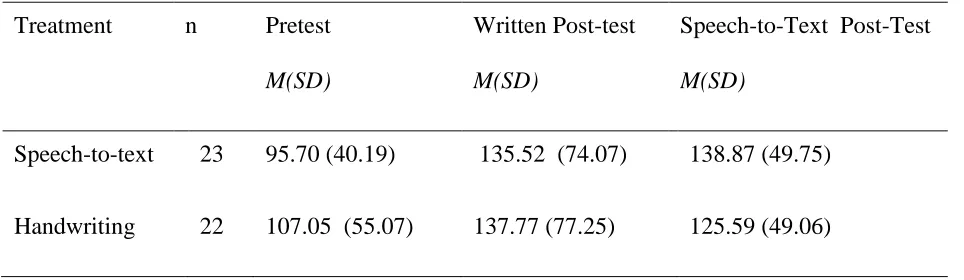
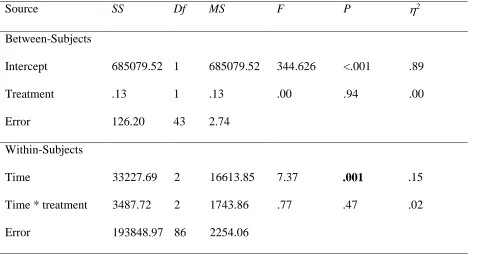
As mentioned above, word count was recorded by the researcher using the Microsoft word count function. The repeated-measures analysis showed that the between-subjects independent variable, instructional modality, did not have a significant effect (Table 1 and 2). Recall that this term collapses across the three testing times, so it does not correspond to any of the hypotheses.
Table 1.
Fluency (Word Count) at Pretest, Written Post-test and Speech-to-Text Post-test By Treatment Condition
Treatment n Pretest M(SD)
Written Post-test M(SD)
Speech-to-Text Post-Test M(SD)
Speech-to-text 23 95.70 (40.19) 135.52 (74.07) 138.87 (49.75)
25 Table 2.
Repeated Measures Summary Table for Fluency†
Source SS Df MS F P 2
Between-Subjects
Intercept 685079.52 1 685079.52 344.626 <.001 .89
Treatment .13 1 .13 .00 .94 .00
Error 126.20 43 2.74
Within-Subjects
Time 33227.69 2 16613.85 7.37 .001 .15
Time * treatment 3487.72 2 1743.86 .77 .47 .02 Error 193848.97 86 2254.06
† Huynh-Feldt correction
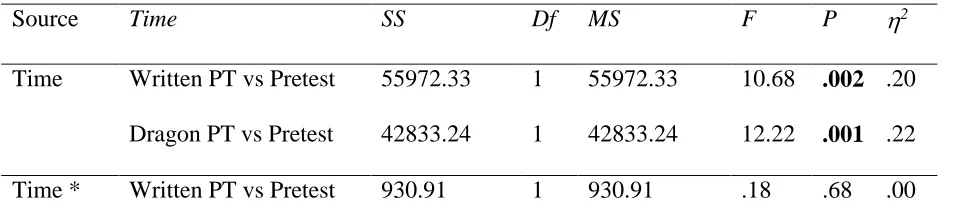
With respect to the first hypothesis, that both modalities of instruction would lead to significant gains from pretest to written post-test, the within-subjects effect (time) was
statistically significant and large in size (Table 3). In a planned contrast, the word count on the written post-test showed a large, statistically significant difference from the pretest (Table 4). Follow-up t-tests showed that the gain from pretest to STT post-test was significant for the STT instruction condition, t(22) = -2.47, p = .01; this gain was also significant for the written
instruction condition, t(21) = -2.16, p = .02.
26
that this gain was significant for the STT instruction condition t(22) = -3.47, p = .001; however, gains were not significant for the written instruction condition, t(21) = -1.48, p = .08.
With respect to the third hypothesis, that STT instruction would have a greater effect than written instruction, the test for a within-subjects time by treatment interaction was not
statistically significant (Table 3). Similarly, planned contrasts showed that the two instructional groups did not differ significantly in the gains that they made from pretest to written post-test; nor did they differ in the gains that they made from pretest to STT post-test (Table 4).
With respect to the fourth hypothesis, there was an absence of a significant instructional condition by time interaction, F(1, 43) = .57, p = .46, partial η2 = .01. This is consistent with the t-tests reported above, in which the STT instructional condition produced significant effects on word count in both post-test modalities. The lack of a treatment condition by post-test modality interaction is somewhat inconsistent with the lack of significant gains that students in the writing condition made as measured by the STT post-test. That is, the written instruction modality results were somewhat “between” transfer and modality specific learning; transfer was clear from STT training to the handwritten post-test; it was less clear from instruction through handwriting to the STT post-test.
Table 3.
Tests of Within-Subjects Contrasts for Fluency
Source Time SS Df MS F P 2
27
treatment Dragon PT vs Pretest 6820.44 1 6820.44 1.95 .17 .04 Error Written PT vs Pretest 225321.67 43 5240.04
(time) Dragon PT vs Pretest 150782.76 43 3506.58 Written PT = written post-test; Dragon PT = Dragon post-test
Surface Errors
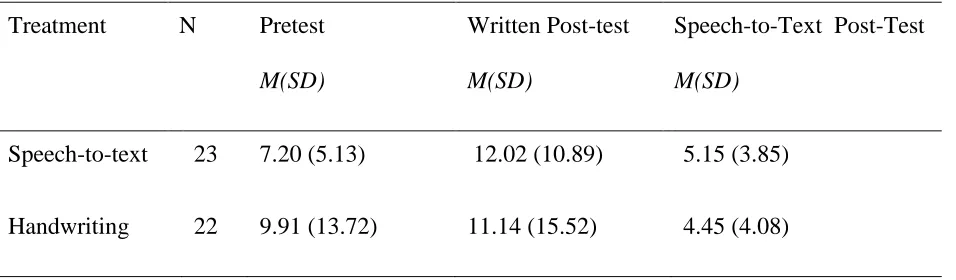
The variable surface errors consisted of capitalization errors and punctuation errors. Recall that the error measures were not considered measures of strategy learning, while the other text measures (text quality, word count, variety of rhetorical moves) were. The
repeated-measures analysis showed that the between-subjects independent variable, instructional modality, did not have a significant effect (Table 4 and 5).
Table 4.
Surface Errors at Pretest, Written Post-test and Speech-to-Text Post-test By Treatment Condition
Treatment N Pretest M(SD)
Written Post-test M(SD)
Speech-to-Text Post-Test M(SD)
Speech-to-text 23 7.20 (5.13) 12.02 (10.89) 5.15 (3.85)
Handwriting 22 9.91 (13.72) 11.14 (15.52) 4.45 (4.08)
28
written post-test showed a large, statistically significant difference from the pretest (Table 6). Follow-up t-tests showed that the increase in surface errors from pretest to written post-test was significant for the STT instruction condition, t(22) = -2.17, p = .04; however, was not significant for the written instruction condition, t(21) = 1.38, p = .18.
With respect to the second hypothesis, that both modalities of instruction would lead to a significant difference from pretest to STT post-test the within-subjects effect (time) was
statistically significant and large in size (Table 5). Planned contrasts showed that there was a statistically significant difference with large effect from the pretest to STT post-test (Table 6). Follow-up t-tests showed that this decrease in surface errors was significant for the written instruction condition t(21) = 1.82, p = .001; however, there was no significance for the STT instruction condition, t(22) = 1.63, p = .12.
In regards to the third hypothesis, that STT instruction would have a greater effect than written instruction, the test for a within-subjects time by treatment interaction was not
statistically significant (Table 5). Similarly, planned contrasts showed that the two instructional groups did not differ significantly in the number of surface errors from pretest to written post-test; nor did they differ in the number of surface errors from pretest to STT post-test (Table 6).
Table 5.
Repeated Measures Summary Table for Surface Errors†
Source SS Df MS F P 2
Between-Subjects
29
Treatment 4.80 1 4.80 .03 .87 .00
Error 7976.54 43 185.50
Within-Subjects
Time 1036.38 1.73 600.49 9.10 .001 .18
Time * treatment 92.29 1.73 53.47 .81 .43 .02 Error 4897.15 74.21 65.99
† Huynh-Feldt correction
With respect to the fourth hypothesis, investigating the interaction between modality of instruction and modality of learning, the absence of a significant instructional group by time interaction was again reflected in the fact that an additional planned contrast showed no
interaction between instructional condition and post-test modality, F (1.7) = .81, p = .43, partial η2 = .02. This is somewhat consistent with the t-tests reported above, in which the STT
instructional condition produced significant effects on the written post-test, while the written instructional condition produced significant effects on the STT post-test. The lack of a treatment condition by post-test modality interaction is somewhat inconsistent with significant
relationships that were found between modality and post-test. That is, the results somewhat supported transfer of learning as significance was found for the post-test modality that was opposite to students' instructional modality.
Table 6.
Tests of Within-Subjects Contrasts for Surface Errors
Source Time SS df MS F P 2
30
Dragon PT vs Pretest 632.17 1 632.17 5.52 .02 .11 Time * Written PT vs Pretest 145.63 1 145.63 2.18 .15 .05 Treatment Dragon PT vs Pretest 130.83 1 130.83 1.14 .29 .03 Error Written PT vs Pretest 2866.67 43 66.67
(time) Dragon PT vs Pretest 4924.41 43 114.52 Written PT = written post-test; Dragon PT = Dragon post-test
Word Errors
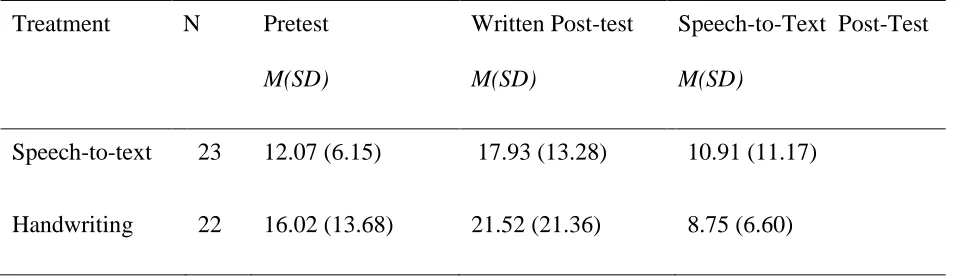
The variable word errors represented the total number of misspelled words, misplaced words, wrong word choice, missing words and double words. The repeated-measures analysis showed that the between-subjects variable, instructional modality did not have a significant effect (Table 7 and 8).
Table 7.
Word Errors at Pretest, Written Post-test and Speech-to-Text Post-test By Treatment Condition
Treatment N Pretest M(SD)
Written Post-test M(SD)
Speech-to-Text Post-Test M(SD)
Speech-to-text 23 12.07 (6.15) 17.93 (13.28) 10.91 (11.17)
Handwriting 22 16.02 (13.68) 21.52 (21.36) 8.75 (6.60)
Table 8.
Repeated Measures Summary Table for Word Errors†
31 Between-Subjects
Intercept 9501.96 1 9501.96 94.31 <.001 .69
Treatment 36.20 1 36.20 .36 .55 .00
Error 4332.41 43 100.75
Within-Subjects
Time 2219.15 1.75 1270.58 10.74 .001 .20
Time * treatment 264.88 1.75 151.66 1.28 .28 .03 Error 8884.26 43.00 206.611
† Huynh-Feldt correction
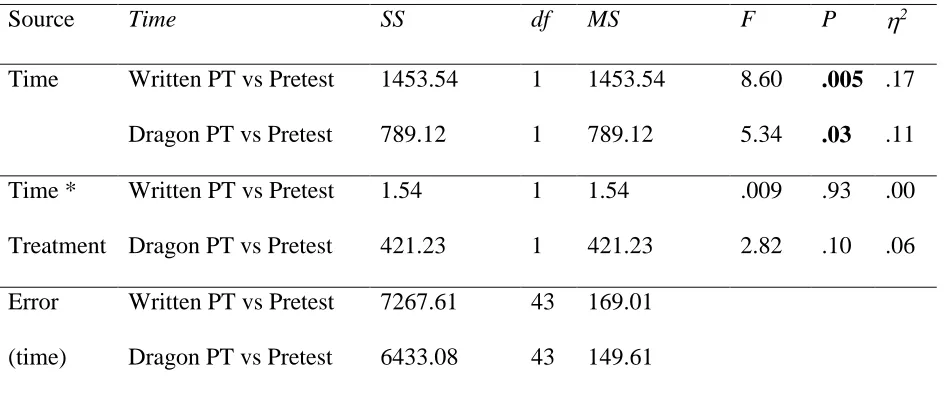
With respect to the first hypothesis, that both modalities of instruction would lead to a significant difference from pretest to written post-test, the within subjects effect (time) was statistically significant and large in size (Table 8). In a planned contrast, the number of word errors showed a large, statistically significant difference between pretest and post-test. Follow-up t-tests showed that the difference in word errors was significant for the STT instruction, t(22) = -2.28, p = .03 condition, but was not significant for the written instruction condition (Table 9).
32
With respect to the third hypothesis, that STT instruction would have a greater effect then written instruction, the test for a within-subjects time by treatment interaction was not
statistically significant (Table 8).
Table 9.
Tests of Within-Subjects Contrasts for Word Errors
Source Time SS df MS F P 2
Time Written PT vs Pretest 1453.54 1 1453.54 8.60 .005 .17 Dragon PT vs Pretest 789.12 1 789.12 5.34 .03 .11 Time * Written PT vs Pretest 1.54 1 1.54 .009 .93 .00 Treatment Dragon PT vs Pretest 421.23 1 421.23 2.82 .10 .06 Error Written PT vs Pretest 7267.61 43 169.01
(time) Dragon PT vs Pretest 6433.08 43 149.61 Written PT = written post-test; Dragon PT = Dragon post-test
In regards to the fourth hypothesis, that there would be modality specific learning or transfer of learning, the absence of a significant instructional group by time interaction was also reflected in planned contrasts which showed no interaction between instructional modality and post-tests, F (1.75) = 1.28, p = .28, partial η2 = .03. This is inconsistent with the t-tests reported above, in which the STT instructional condition produced a significant difference between pretest and written post-test while the written condition produced a significant difference between pretest and STT post-test. The lack of a treatment condition by post-test modality interaction is
33
suggest transfer of learning although results were somewhat “between” transfer and modality specific learning.
Rhetorical Moves
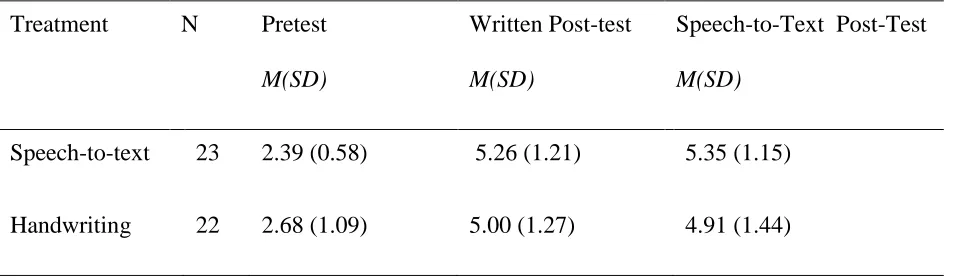
The variable rhetorical moves represents the number of types of argument moves that the student included in the text. As a reminder, rhetorical moves included: claim, reasons, other opinion, reasons for other opinion, rebuttal and conclusion and students could score a maximum of six if they included all the elements. The repeated-measures analysis showed that the between-subjects independent variable, instructional modality, did not have a significant effect (Table 10 and 11).
Table 10.
Rhetorical Moves at Pretest, Written Post-test and Speech-to-Text Post-test By Treatment Condition
Treatment N Pretest M(SD)
Written Post-test M(SD)
Speech-to-Text Post-Test M(SD)
Speech-to-text 23 2.39 (0.58) 5.26 (1.21) 5.35 (1.15)
Handwriting 22 2.68 (1.09) 5.00 (1.27) 4.91 (1.44)
Table 11.
Repeated Measures Summary Table for Rhetorical Moves†
Source SS Df MS F P 2
34
Intercept 818.21 1 818.21 1117.64 .000 .96
Treatment .209 1 .209 .29 .60 .01
Error 31.48 43 .73
Within-Subjects
Time 201.59 2 100.80 112.17 .000 .72
Time * treatment 3.25 2 1.63 1.81 .17 .04
Error 77.28 86 .90
† Sphericity Assumed
With respect to the first hypothesis, that both modalities of instruction would lead to significant gains from pretest to written post-test, the within-subjects effect (time) was statistically significant and large in size (Table 11). In a planned contrast, the number of rhetorical elements on the written post-test showed a large, statistically significant difference from the pretest (Table 12). Follow-up t-tests showed that the gain from pretest to written post-test was significant for STT instruction condition, t(22) = -10.97, p = .00, and for the written instruction condition, t(21) = -6.86, p = .00.
35
With respect to the third hypothesis, that STT would have a greater effect then written instruction, the test for within-subjects effect time by treatment was not statistically significant (Table 12).
Table 12.
Tests of Within-Subjects Contrasts for Rhetorical Moves
Source Time SS df MS F p 2
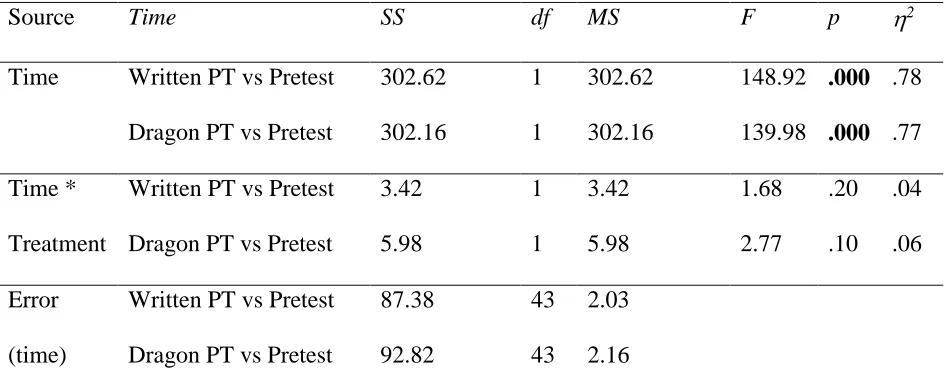
Time Written PT vs Pretest 302.62 1 302.62 148.92 .000 .78 Dragon PT vs Pretest 302.16 1 302.16 139.98 .000 .77 Time * Written PT vs Pretest 3.42 1 3.42 1.68 .20 .04 Treatment Dragon PT vs Pretest 5.98 1 5.98 2.77 .10 .06 Error Written PT vs Pretest 87.38 43 2.03
(time) Dragon PT vs Pretest 92.82 43 2.16 Written PT = written post-test; Dragon PT = Dragon post-test
As for the fourth hypothesis, that there would be modality specific learning or transfer of learning, the absence of a significant instructional group by time interaction was again reflected in the fact that an additional planned contrast showed no interaction between instructional
condition and post-test modality, F (2) = 1.81, p = .17, partial η2 = .04. This is consistent with the t-tests reported above, in which the STT instructional condition and the written instruction
condition both produced significant effects for rhetorical moves on both the written post-test and the STT post-test, which supports transfer of learning from one modality to the other.
36
The variable holistic quality represents the overall persuasiveness of the texts. As previously mentioned, texts were scored based on a 7-point scale by two raters. The repeated-measures analysis showed that the between-subjects independent variable, instructional modality, did not have a significant effect (Table 13 and 14).
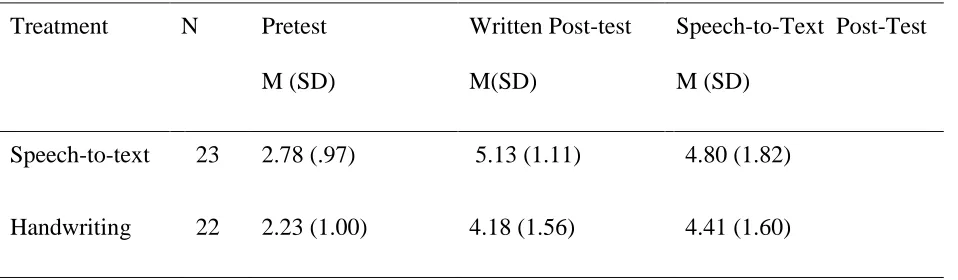
Table 13.
Holistic Quality at Pretest, Written Post-test and Speech-to-Text Post-test By Treatment Condition
Treatment N Pretest M (SD)
Written Post-test M(SD)
Speech-to-Text Post-Test M (SD)
Speech-to-text 23 2.78 (.97) 5.13 (1.11) 4.80 (1.82)
Handwriting 22 2.23 (1.00) 4.18 (1.56) 4.41 (1.60)
With respect to the first hypothesis, that both modalities of instruction would lead to significant gains from pretest to written post-test, the within-subjects effect (time) was
statistically significant and large in size (Table 14). In a planned contrast, the holistic quality on the written post-test showed a large, statistically significant difference from the pretest to the written test (Table 15). Follow-up t-tests showed that the gain from pretest to written post-test was significant for the STT instruction condition, t(22) = -11.75, p = .00; and was also significant for the written instruction condition, t(21) = -5.02, p =.00.
37
significant gain in holistic quality from the pretest to STT post-test (Table 15). Follow-up t-tests showed that this gain was significant for the written instruction condition t(21) = -5.83, p = .00; as well as significant for the STT instruction condition, t(22) = -5.67, p = .00.
Table 14.
Repeated Measures Summary Table for Holistic Quality†
Source SS Df MS F P 2
Between-Subjects
Intercept 2076.19 1 2076.19 590.34 .000 .93
Treatment 13.52 1 4.80 .03 .87 .00
Error 151.23 43 3.52
Within-Subjects
Time 135.65 1.87 72.74 61.00 .000 .59
Time * treatment 1.82 1.87 .98 .82 .44 .02
Error 95.62 80.19 1.19
† Huynh-Feldt Correction
With respect to the third hypothesis, that STT instruction would have a greater effect than written instruction, the test for a within-subjects time by treatment interaction was not
38 Table 15.
Tests of Within-Subjects Contrasts for Holistic Quality
Source Time SS df MS F p 2
Time Written PT vs Pretest 208.14 1 208.14 99.26 .000 .70 Dragon PT vs Pretest 198.69 1 198.69 66.22 .000 .61 Time * Written PT vs Pretest 1.74 1 1.74 .83 .37 .02 Treatment Dragon PT vs Pretest .29 1 .29 .10 .76 .00 Error Written PT vs Pretest 90.17 43 2.10
(time) Dragon PT vs Pretest 129.01 43 3.00 Written PT = written post-test; Dragon PT = Dragon post-test
In regards to the fourth hypothesis, that there would be modality specific learning or transfer of learning, the absence of a significant instructional group by time interaction was again reflected in the fact that an additional planned contrast showed no interaction between
instructional condition and post-test modality, F (1.87) = .82, p = .44, partial η2 = .02. This is inconsistent with the t-tests reported above, as both the STT instruction condition and the written instruction condition resulted in a significant increase in holistic quality from pretest to both written post-test and STT post-test. That is, both the written instruction modality and STT modality results produced favourable results on transfer of learning from one modality to the other.
Cognitive Load
39
Perceived difficulty. The repeated-measures analysis showed that the between-subjects independent variable, instructional modality, did not have a significant effect for the first question regarding difficulty (Table 16 and 17). With respect to the first hypothesis, that both modalities of instruction would lead to significant increase from pretest to written post-test, the within-subjects effect (time) was not significant. Also, for the second hypothesis, that both modalities of instruction would lead to a significant increase from pretest to STT post-test the within-subjects effect (time) was not significant. For the third hypothesis (STT instruction would have a greater effect then written instruction) and fourth hypothesis (was there modality specific learning or a transfer of learning) the results for perceived difficulty were also not significant.
Effort. With respect to the first hypothesis, that both modalities of instruction would lead to a significant increase from pretest to written post-test, the within-subjects effect (time) was statistically significant and large in size (Table 17). In a planned contrast, there was a large, statistically significant difference in reported effort between pretest and written post-test (Table 18). Follow-up t-tests showed that the increase from pretest to written post-test was significant for the STT instruction condition, t(22) = -2.99, p = .01; and was not significant for the written instruction condition, t(21) = -2.02, p =.06.
40
With respect to the third hypothesis, that STT instruction would have a greater effect than written instruction, the test for a within-subjects time by treatment interaction was statistically significant. In a planned contrast, time by participant condition was significant and had a large effect for an increase in effort from the pretest to the STT post-test (Table 17).
In regards to the fourth hypothesis, that there would be modality specific learning or transfer of learning, there was a significant instructional group by time interaction with a small effect. In a planned contrast, however, it was shown that the only significant effects were from pretest to STT post-test, F (1) = 6.52, p = .01, partial η2 = .13. This is consistent with the t-tests reported above, as the STT instruction condition resulted in significant increase in perceived effort from pretest to both written post-test and STT post-test. The presence of a treatment
condition by post-test modality interaction is consistent with the significant increase in effort that students in the STT condition reported as measured by the STT and written post-tests. As a result, the written instruction modality and STT modality results were in-between transfer of learning from one modality to the other due to the lack of significance for the other conditions as well as the small main effect.
Table 16.
Cognitive Load at Pretest, Written Post-test and Speech-to-Text Post-test By Treatment Condition
Treatment N Pretest M(SD)
Written Post-test M(SD)
Speech-to-Text Post-Test M(SD)
Question 1:
Difficulty
41
Speech-to-text 23 3.57 (1.44) 4.04 (1.72) 4.04 (2.34)
Handwriting
Question 2:
Effort
Speech-to-text Handwriting
22
23 22
3.82 (1.71)
5.70 (1.33) 6.00 (1.11)
4.41 (1.53)
6.91 (2.13) 6.68 (1.43)
3.91 (2.00)
7.04 (1.69) 6.06 (1.53)
Table 17.
Repeated Measures Summary Table for Cognitive Load Q1 (Difficulty)†
Source SS Df MS F P 2
Between-Subjects
Intercept 2121.06 1 2121.06 460.78 .000 .92
Treatment .88 1 .88 .19 .66 .00
Error 197.94 43 4.60
Within-Subjects
Time 6.44 1.75 3.69 1.21 .30 .03
Time * treatment 1.55 1.77 .87 .29 .72 .01 Error 228.04 75.06 3.04
† Huynh-Feldt Correction
Repeated Measures Summary Table for Cognitive Load Q2 (Effort)†
Source SS df MS F P 2
Between-Subjects
42
Treatment 3.05 1 3.05 .65 .43 .02
Error 202.36 43 4.71
Within-Subjects
Time 21.91 2 10.96 8.04 .001 .16
Time * treatment 9.29 2 4.644 3.41 .04 .07
Error 117.21 86 1.36
† Sphericity Assumed Table 18.
Tests of Within-Subjects Contrasts for Cognitive Load Q1 (Difficulty)
Source Time SS df MS F p 2
Time Written PT vs Pretest 12.85 1 12.85 3.61 .06 .77 Dragon PT vs Pretest 3.64 1 3.64 .48 .49 .01 Time * Written PT vs Pretest .143 1 .143 .04 .84 .00 Treatment Dragon PT vs Pretest 1.69 1 1.69 .22 .64 .00 Error Written PT vs Pretest 153.06 43 3.56
(time) Dragon PT vs Pretest 329.56 43 7.66 Written PT = written post-test; Dragon PT = Dragon post-test
Tests of Within-Subjects Contrasts for Cognitive Load Q2 (Effort)
Source Time SS df MS F p 2
43
Treatment Dragon PT vs Pretest 18.41 1 18.41 6.52 .01 .13 Error Written PT vs Pretest 136.69 43 3.18
(time) Dragon PT vs Pretest 121.37 43 2.82 Written PT = written post-test; Dragon PT = Dragon post-test
Chapter 4: Discussion General
Allowing students to compose a text while removing the burdens associated with
transcription, as is done while using speech-to-text technology (STT), has been shown to lead to better quality writing in struggling writers (Higgins & Raskind, 1995; MacArthur & Cavalier, 2004). These findings could be a result of written composition being a very cognitively intensive task for students in comparison to oral composition (Bourdin & Fayol, 1994). The present study sought to extend the research on this topic by investigating whether STT technology, in this case Dragon NaturallySpeaking, could help students to learn a new writing strategy (persuasive writing), by looking at the effects of STT compared to writing in a pretest-post-test randomized experimental design.
Overall, results from the repeated measures analyses of variance and planned contrasts revealed that for word count, word errors, surface errors, rhetorical moves, and holistic quality students improved significantly from pretest to post-test, with large effect sizes, in both instruction conditions. The results indicated that there was transfer of learning rather than modality specific learning for most dependent variables.
44
Learning gains from pretest to written post-test. Recall that the first hypothesis was that both of the instructional modalities (STT and handwriting) would produce learning gains from pretest to written post-test. This hypothesis was supported by results showing that holistic quality and variety of rhetorical moves improved for students in both instructional conditions. The finding that word count increased from pretest for both modalities also supported this hypothesis.
These results extend previous research on strategy instruction by showing that it is an effective teaching method for students composing in different modalities.Previously, strategy instruction has been shown to be effective for teaching students persuasive writing when composing using handwriting (Graham et al., 2012). Results of the current study indicated that strategy instruction is an effective teaching method for improving student learning on persuasive writing in both STT and handwritten modalities. Students in both groups (handwriting and STT) began with very basic arguments at pretest, using limited rhetorical moves, including only a claim and reasons. In comparison, their writing was significantly better at written post-test in terms of quality and the number of rhetorical moves included. By post-test, most students were including four or more types of rhetorical moves, which would account for the higher holistic ratings, variety of rhetorical moves, and higher word count.
Learning gains from pretest to STT post-test. Recall that the second hypothesis was that both modalities would produce learning gains from pretest to STT post-test. This hypothesis was supported by the results showing that holistic quality improved for students in both
45
the technology, as they used it during the persuasive writing lessons in addition to the training the all the students received. This could explain why word count significantly increased only for students in the STT condition on the STT post-test.
The present study was one of few studies to investigate the role of STT in learning. As noted in the introduction, most research on STT has focused on the effects of this technology on a specific piece of writing (e.g., MacArthur & Cavalier, 2004; Quinlan, 2004). Previous research on the effect of STT on learning has focused only on basic writing skills, showing that long-term use of this technology can contribute to decoding and spelling, as well as reading comprehension (Higgins & Raskind, 1997; Higgins & Raskind, 2000). The present study extended this research, as the first to show that STT can be used to support learning a writing strategy in that students showed significant improvement from pretest to STT post-test in both the experimental (STT) and control (handwriting) conditions.
Does STT, compared to handwriting, have a greater effect on learning? This is the first study of its kind to look at the relationship of STT on learning a new writing strategy in comparison to handwriting. Recall that this third hypothesis focused on the question "Would STT have a greater effect on learning a new writing strategy when compared to handwriting?" This hypothesis was not supported by the results based on the variables: word count, variety of rhetorical moves, and holistic quality. These results indicate that STT was not more effective then writing and conversely writing was not more effect then STT on learning.