A CIS-TRANS POSITION EFF'ECT
AT
THE
A LOCUSOF
THE
HOUSE MOUSERITA J. S. PHILLIPS
Medical Research Council Radiobioiogical Research Unit, Harwell, Berkshire, England
Received March 14, 1966
N the mouse there are two types of hair pigment, eumelanin, the black or
I
brown pigment, and phaeomelanin, the yellow pigment. A number of loci are known which affect the deposition of these two pigments, the most important of which is the agouti locus situated in linkage groupV.
There are 12 known alleles at this locus; AY yellow (see GRUNEBERG 1952 and LOOSLI 1963); A Z I y viable yellow (DICKIE 1962a); Intermediate yellow (Aiv) (DICKIE 1966); A" light- bellied agouti; A agouti or wild type; A i intermediate agouti (DICKIE 1962b);at black and tan; atd tanoid (LOOSLI 1963); d (RUSSELL, MCDANIEL and
WOODIEL 1963); a non-agouti; ae extreme non-agouti
(HOLLANDER
and GOWEN1956) and am (RUSSELL 1964).
The agouti locus controls the deposition of the two types of pigment by affecting the environment of the melanocytes in the hair follicle (SILVERS 1961) but does not alter the pigment itself. It is a complicated locus acting in a sense independ- ently on three sections of the body-the back, the belly and the pinna hairs together with certain hairs round the genital papilla and mammae-so that one allele may be dominant on the back and recessive on the belly or vice versa; basically, irrespective of this "pattern" effect, yellowness is dominant to black. For example the yellow banding of hairs on the back of A is dominant to the self- colour of a or at; the yellow belly of at is dominant to the dark belly of
A
or a and the black hairs of the pinnae and round the genital papilla and mammae of ae are recessive to the yellow hairs of these regions in all other alleles. A partial exception to this rule is found in the allele Ai where the heterozygote Aia is umbrous, that is, the yellow banding of the back of the homozygote AiAi is only expressed on the flanks of an Aia animal, the non-agouti dominating in the central back region (DICKIE 1962b).Presumed intragenic crossing over was found at the agouti locus by L.
B.
RUSSELL et al. (1 963) with the lethal allele a". In the progeny of a balanced lethal yellow stock (AY/a" x A y / & ) she found €our normal wild-type ( A ) animals out of 1908 mice raised.The mutant described in this paper, A s , agouti suppressor, also shows crossing over with agouti; whether it is part of the agouti complex or independent of, but closely linked to, it will be considered in the DISCUSSION. It occurred amongst the offspring of a (C3H x 101)F, male which had received an acute dose of 600r
486 R. J . S. PHILLIPS
X rays (PHILLIPS 1961) and was originally thought to be a recessive allele of A (PHILLIPS 1959, 1960).
OBSERVATIONS A N D RESULTS
Description of AS: As when homozygous reduces the amount of yellow pigment normally produced by whatever agouti alleles are present. The yellow pinna hairs found with all alleles except ae become black (or brown on a homozygous brown background etc.) ; with at/at the back and belly are black; with A"/A"
the size of the normal yellow band and the percentage of banded hairs are reduced giving a very dark agouti effect shading to almost complete non-agouti on the top of the head (with A"/d this "non-agouti'' patch is rather larger, but the two genotypes are not positively distinguishable). The belly of the ASAA"/A8AQ
animal is also dark-agouti; the A S d / A s a t animal is undistinguishable from ae/ae.
Where As differs from other genes found in the mouse is that when it is hetero- zygous it seems to affect only the agouti allele situated on the same chromosome as itself (Table 1 )
.
For example A s a t / + A is phenotypically normal wild-type and A S d / + A W is normal light-bellied agouti, whereas ASAA"/+a is umbrous, dark- agouti bellied and AsAw/+at umbrous and tan-bellied. In other respects As be- haves in a normal Mendelian fashion and crossing over between it and the agouti locus can be shown.Breeding results: As was originally thought to be an umbrous allele at the A-locus similar to Ai but has since been shown to cross over with A" and d. The data are given in Tables 2 , 3 and 4.
The crossover value is higher in males than in females, the opposite to thal found for other genes in this region of linkage group V, notably between non- agouti and mahogany ( LANE and GREEN 1960). This difference is not significant.
TABLE 1
Phenotypes of AB in combination with other A alleles
Corresponding phenotype
GenotvDe Back Bellv Pinna hairs
A 8 Aw /As AQ Dark agouti* Dark agouti* Black
Dark agouti* Non-agouti Normal agouti Normal agouti Normal agouti Normal agouti Umbroud Umbrouvt Umbrous-t Non-agouti Non-agouti Non-agouti
Dark agouti* Non-agouti Yellow Yellow Normal agouti Normal agouti Yellow Dark agouti' Dark agouti* Yellow Non-agouti Non-agouti
Black Black Yellow Yellow Yellow Yellow Yellow Yellow Black Yellow Yellow Black
* Dark agouti animals have less yellow banding in their agouti areas.
CIS-TRANS POSITION E F F E C T O F M I C E 48 7
The standard errors are quoted with the linkage values in the various tables, but as the expected numbers in the recombination classes are less than
5
they are not very meaningful.From the breeding results the following facts can be deduced: (1) As is not at the same point on the chromosome as A" or at. (2)
A s
combined with either ofthe agouti alleles tested (A" and a t ) is recessive to its normal allele with A or A"
on the homologous chromosome. ( 3 )
A x
when combined with A" and with its normal allele and a on the homologous chromosome interferes with the agouti effect such that non-agouti dominates in the centre-back region (giving an um- brous phenotype) but itself dominates on the flanks and belly giving dark agoutiTABLE 2
Data on the segregation of As, Aw and a t ; AS and at in repulsion
Genotypes and phenotypes of offspring A a A w / + a A a a ' / f a , +AW/+a + a t / / + a Back: Umbrous Non-agouti Agoub Non-agouti Belly: Dark agouti Non-agouti Yellow Yellow
Genotype of parents Pinna hairs: Yellow Yellow Yellow Yellow Total
AsAW/+at 0 x +a/+a$ 132 . .
+a/+a 0 X ASAW/+at 8 130 3 1
AaAw/A*Aw A8at/AaAW +Aw/AaAw
Back: Dark agouti Agouti
Belly: Dark agouti Yellow
Pinna hairs: Black Yellow
ASAw/+at P X ASAw/ASAW$ 195 2
AsA'"/AsA" 0
x
AsAW/+at 8 60 . .138 270 169 303
+at/AaAw Umbrous Yellow Yellow
176 3 73 63 123
Combined linkage value AB/at in repulsion 0.73% (standard error 0.3%)
TABLE 3
Data on the segregation of As, AW and a t ; As and at in coupling
Genotypes and phenotypes of offspring
A8at/A8at +a'/Aaa' ,ASAw/A'a'. +Aw/Aaa' Back: Non-agouti Non-aguti Dark agouti Agouti Belly: Non-agouti Yellow Dark agouti Yellow
Genotype of parents Pinna hairs: Black Yellow Black Yellow Total
~ ~~
ASat/+AW 0 X A8at/ASat 8 220 I * 2 236 468 A s a f / A S a f P
x
ASat/+Aw$ 278 1 2 284 565* Recorded as dark bellied with some yellow in ears, and killed by mistake with classification unchecked. Not included
Combined linkage value A * / a t in coupling 0.50% (standard error 0.2%).
in calculations
TABLE 4
As/at linkage. Data from Tables 2 and 3 combined
-~
sex of Linkage Standard
segregating parent value (percent) error
Female 0.44 (0.2) Male 0.75 (0.3)
488 R . J . S. PHILLIPS
(with at instead of a on the homologous chromosome an umbrous tan-bellied animal is obtained) (Table 1 ) .
Linkage tests were set up with brachypody ( b p ) , but as the only available stock also contained pallid, leaden and pearl, the amount of information obtained was not sufficient to give any indication of the linkage value. One definite bp
crossover in about 50 fully classifiable mice was obtained in which As and A"
stayed together indicating that bp does not lie between these two genes. Some data on the segregation of b p and a supplied by
DR.
M.
F. LYON, are shown in Table 5.DISC US S IO N
The A locus of the mouse is complicated with its differing dominance relation- ships on the back, belly and ears, but, until recently evidence seemed to support the hypothesis of a single locus with simple alternative alleles (GRUNEBERG 1952;
LOOSLI
1963).The first possible crossover between supposed A alleles was reported by WALLACE (1954), who found a non-agouti animal from a mating of the type
A at X aa. I n this case mutation from at or A to a could not be excluded. However RUSSELL et al. (1963) found evidence that ct" crossed over with AV with a fre- quency of about 0.5%; they also found a single agouti animal from a n AV/a X
AV/a mating and considered that AV might be pseudoallelic to both U? and a. Their data do not exclude the possibility that d or AV might be at an independent locus very closely linked to A and partially masking its effect.
As like either AV or a"' shows definite crossing over with alleles of the A locus. Is it in fact part of the A locus, or independent of it? Research in microorganisms has introduced entirely new concepts of the structure and function of the gene and A" will be considered in the light of these findings. WELSHONS (1965) has related the concepts of microorganisms to an analysis of the Notch locus in Dro- sophila and found evidence that amorphic Drosophila mutants at least can be shown to behave in the same way as genes in microorganisms; he concludes that "the genes of macro- and microorganisms are similar".
Work on bacteria in the last decade has indicated that a gene should be con- sidered as a length of DNA rather than a particular point on the chromosome,
TABLE 5
Data on the segregation of a with bp'
Phenotypes of offspring
Genotype of parents Aa' bp+ Aa bp+ a'a bp+ aa bp+ Aa' b p Aa b p a'a b p aa bp Total
a t + / a b p X A + / a bp 46 54 35 1 . , . . . . 40 176
a t + / a b p x a b d a b p 34 . . . . 36 . . . . . . . . 70
a' bp+ a' b p a bp+ a b p
A bp+ A b p a b p + a b p
A + / a bp
x
a bp/a b p 12 . . . . 9 21Data kindly supplied by D R . M . F. LYON.
CIS-TRANS POSITION EFFECT O F MICE 489
culminating in the findings of YANOFSKY et al. (1964), who showed that a linear sequence of nucleotides in a gene can specify the linear sequence of amino acids in a protein. The difference between alleles at a locus could therefore be due to defects at different points along this length rather than at the same point, thus allowing intragenic crossing over. The cis-trans test for distinguishing between nonallelic but epistatic genes and a complex locus with internal crossing over was originally devised for Drosophila by LEWIS (1951) who interpreted the cis-trans
effect as an indication of duplication within the locus. This test is based on com- plementation between genes; normally with two independent loci, recessive genes complement each other so that the two configurations cis (ab/++) and trans ( a + / f b ) are of the same phenotype and are wild-type. However, sometimes with two closely linked recessives of similar function the trans configuration becomes mutant in phenotype and the cis remains wild type or nearly wild type. In other words, if the two components demonstrate this cis-tram position effect or lack of complementation, then they are not independent of each other and can be assumed to be part of the same cistron or functional unit (BENZER 1957). Other phenomena can complicate this effect, for instance dominance. In Drosophila carrying the dominant Stubble ( S b ) and a recessive allele stubbloid (sbd), Sb sbd/++ gives a wild type and Sb
+/+
sbd an enhanced mutant phenotype, more extreme than either S b f orsbd
sbd. On the other hand with the dominant Star( S ) and a recessive asteroid (ast) allele, although S +/+ast again gives an exaggerated phenotype, S ast/++ is not wild type but resembles S+ (CARLSON
1959). Furthermore, work with Neurospora crassa has shown that all alleles within a cistron, depending on their function, need not be noncomplementary
(FINCHAM and CODDINGTON 1963).
Finally JACOB and MONOD (1961) demonstrated that the cis-trans position effect can also occur over a larger area than one cistron. It can occur between cistrons when the latter are controlled by a single operator in the first of the cistrons; the group of cistrons is then termed an operon. The cis-trans position effect is found between mutations of the operator itself and all other mutations within the operon; alleles from different cistrons within the operon, on the whole, complement each other. The operon has two characteristics which differentiate it; first the various alleles of the operator itself act in a coordinated manner on
all the other mutants, and secondly
JACOB
and MONOD (1961) andWELSHONS
(1965) found that lack of complementation may sometimes occur between alleles of different cistrons in the cperon but only in one direction; that is the operon shows polarity. Mutations in the first cistron may stop the functioning of the whole operon, whereas mutations sited in the second cistron will only be able to block that and subsequent cistrons.
If the breeding data of A8 are considered, it is at once obvious that, although complicated by differing dominance relationships, the two configurations A" A"/+at and A" at/+Aw differ in phenotype. On the back As A w / f a t gives a part non-agouti, part dark-agouti coat, whereas A s at/+A" gives a normal agouti coat. On the belly, both configurations give a yellow colour (owing to the dominance
490 R. J. S. PHILLIPS
chromosome gives a non-agouti belly, whereas AsAA" in the same situation gives a dark-agouti belly; in neither case can yellow belly manifest itself. These data also show that although the yellow bellies of Aat and AA"a are phenotypically equivalent (WALLACE 1965), the yellow bellies of atat and A"A" are not geno- typically so. Underlying the belly effect is the banding or nonbanding of the allele affecting the back.
It seems therefore that A" is part of the A complex forming presumably either a cistron or an operon and shows lack of complementation with A" and at, that is with both the dorsal and the ventral effects. No definite evidence is available as to whether the rest of the A alleles, other than az o r AV, are alternatives at one point or are scattered along the locus.
Before considering the possibilities of whether the A complex is a cistron or an operon, it is helpful to survey what is known about the function of the A locus and of A" itself.
The A locus has been studied by SILVERS (1961) who showed, by transplan- tation experiments, that if rAelanocytes of one A genotype migrate into follicles of a different A genotype, then they subsequently produce the pigment pattern of the follicle into which they have migrated. In other words, whether any par- ticular melanocyte produces yellow or black pigment is dependent solely on the follicular environment in which it finds itself. CLEFFMANN (1963) found that mouse hairs,
in
vitro, can also be made to produce either yellow or black pigment depending on their environment and irrespective of their genotype. On first cul- turing, all genotypes produce black pigment, but yellow pigment production can be induced by additions of glutathione to the medium. But CLEFFMANN founda difference between the various hair types in their susceptibility to the environ- ment. Unbanded hairs (AV and a, a t ) have a steady threshold value after the first two days of pigment production. Non-agouti hairs have a low susceptibility and A' a high susceptibility; that is AV hairs need a lower concentration of gluta- thione in order to produce yellow pigment. Banded hairs (A" and A ) , on the other hand, need a high concentration of glutathione to produce yellow pigment except during the time of band formation, when they have a period of high SUS- ceptibility, higher even than that of AV (CLEFFMANN 1963, Figure 7 ) .
SILVERS work has indicated that the action of the melanocytes, i.e. whether they produce black or yellow pigment, is unspecific and dependent on the follicu- lar environment, whereas CLEFFMANN has shown that different A alleles vary in their reaction to an outside agent, glutathione.
CIS-TRANS POSITION E F F E C T O F M I C E 491 yet no evidence as to whether the A alleles are directly concerned with the pro- duction of sulfhydryls or whether the glutathione acts as a n inducer or regulator of the A system, such that some other end product forms the necessary environ- ment for yellow pigment production.
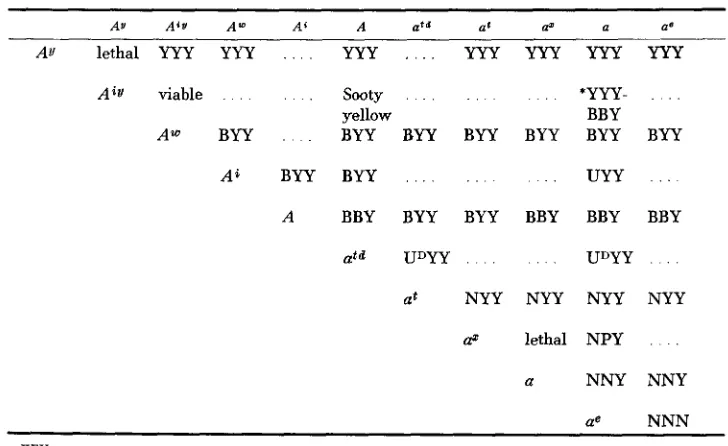
The action of A s seems to be to switch to the production of black pigment all the melanocytes in completely yellow hairs such as on the belly and in the ears, but it is unable to overcome the banding and deposition of yellow pigment pro- duced by A". If it is assumed that the yellow hairs of the belly and ears would react in a similar fashion to glutathione as do AY hairs, then an effect like that caused by A s could be attained by altering the sulfhydryl concentration of the follicle to a level lower than that required by AV hairs but not below that required by banded hairs at the peak of band formation. This could also account for the lower percentage of banded hairs in As A" phenotypes and for the fact that, when present, the band tends to be narrower than normal. In other words, A s could be having a regulatory effect on the other alleles causing either an alteration of the sulfhydryl level or the reaction of other alleles such as A" and at to that level. Table 6 shows the various effects of the A alleles except for Auy and an"; these differ from the other A alleles in causing phenotypic mosaicism. The various patches in the coat resemble the effects of other alleles and the mosaicism might
TABLE 6
Table of phenotypes of various combinations of A alleles (each phenotype, where known, is indicated by three symbols referring to back, belly and pinna hairs respectively)
AV A'U A" Ai A urd at a a'
AV lethal YYY YYY . . . . YYY , . . . YYY YYY YYY YYY
A i y viable sooty *YYY-
yellow BBY
A m BYY BYY BYY BYY BYY BYY BYY
Ai BYY BYY UYY
A BBY BYY BYY BBY BBY BBY
at NYY NYY NYY NYY
& lethal N P Y
a N N Y N N Y
ae NNN
KEY:
B = Banded (Agouti) U = Umbrous
UD= Umbrous combined with dark-agouti
Y = Yellow - ..__ . .
N = Non-yellow, unbanded hairs (i.e. black on black background). P = as for N but paler.
492 R. J. S. PHILLIPS
be due to variegated position effects such as are found in Drosophila. Such evi- dence as is available for am cannot as yet rule out small rearrangements but has
excluded somatic mutation and major rearrangements (RUSSELL 1964).
HOW can the phenotypes of the remaining A alleles be explained within the framework of the action of As as discussed above?
(1) The locus can be considered as divided into regions each of which is con- cerned with a separate part of the body.
WALLACE (1965) interprets the A locus as a complex of several closely linked “mini-loci”, where the agouti patterns of different parts of the body, (back, belly and ears) are separately controlled but varyingly epistatic to each other. That the
A alleles can be masked is known from data on other mutants affecting the black/yellow pigmentation and situated in other linkage groups such as Sombre
(BATEMAN 1961); dark (FALCONER 1956,1957); mahoganoid
(LANE
1960); andnon-agouti curly (PHILLIPS 1963) or in the same linkage group but not closely
linked to A (mahogany-LANE and GREEN 1960).
On the other hand there are various difficulties to this explanation: (a) As
shown earlier in this discussion, the yellow belly of atat animals is not equivalent to that of AwAw animals so that WALLACE’S interpretation would need to be modi- fied to a locus for banding and a locus for yellow belly rather than one for dorsal and one for ventral banding. (b) Amongst knolwn alleles there is an absence of such combinations as black ears and belly with yellow back or black ears with yellow belly. The relationship of back, belly and ears, as information stands at present, is such that if the ears are dark then so is the belly and if the belly is dark then so is the back. (c) This interpretation would require several of the known mutations to be multiple events. Aiy, which mutated in the C3H/HeJ ( A A ) stock (DICKIE 1966) would involve two events; dEt and A i , which mutated in the C57BL/6J ( m ) strain (five years apart) (LOOSLI 1963; DICKIE 1962b) also would both involve two events; finally ae which mutated in an A stock would probably involve three events as HOLLANDER and GOWEN (1956) pointed out. (d) As shows lack of complementation with effects in all three regions, showing that they are not in fact controlled independently.
These difficulties can be at least partly overcome by postulating that the locus consists of an operon of two or more cistrons which affect these different regions of the body and which show the polarity typical of operons. I n this case A s which seems to act coordinately on the other A alleles tested, could be assumed to be an allele of the operator or to be in the first cistron, and to effect transcription through the rest of the complex, cze could also be sited here, whilst uta would be an allele i n a subsequent cistron and only affect the transcription of a “banding” region. Two events would still be involved in the atd mutation unless the altera- tion causing yellow belly also affected the transcription of the “banding” region. This explanation is in line with the polarity phenomenon of operons mentioned earlier, and with the polarity of the A locus such that when the ears are dark, SO
is the belly and when the belly is dark then so is the back. The picture of the A
CIS-TRANS P O S I T I O N EFFECT O F MICE
// operator / ears f belly region / banding/ . .
.
and A $ could be filled to this framework somewhere within the banded region such that only the centre back was affected. At* could be considered as a mutant in the first or second cistron which increased the transcription of the belly and banded regions.
Further data are needed on the relative positions of the various alleles within the locus before one could consider this as more than a formal possibility.
(2) Still considering the locus to be an operon of various cistrons it is possible to devise and to fit the A alleles into a scheme based on (i) structural genes (affecting the ears, belly and whole body) which produce substances necessary for yellow pigment production in melanocytes, and on (ii) regulatory-type genes which control the structural genes. These second types of genes could be situated at various points along the locus or operon and allow transcription of any subse- quent structural genes (to give yellow hairs), cause transcription to be inter- mittent (to give banded hairs) or block transcription completely (to give black hairs) : o r the scheme could be completely reversed with the A alleles producing substances inhibiting yellow pigment production and their action being sup- pressed by the presence of sulfhydryls. As there is at present no experimental evidence for or against such an idea, it is only put forward as yet another possible method. in line with findings in microorganisms, for explaining the complexities of the A locus.
(3) Finally the locus could be considered as consisting of one cistron, the structural alleles of which act on the whole body but produce differentials be- tween one region and another.
Those alleles known to show crossing over with the rest, e.g. A s , a' and/or A*,
could be considered as mutations of the operator controlling the cistron; the other alleles would be structural mutants affecting the amount of some substances, such as sulfhydryls, on which the production of yellow pigment within the follicle depends. Alleles such as ae which could be envisaged as producing none of these substances are easy to explain. but more difficulty is encountered with the inter- mediate alleles atd
A i
and A".The umbrous, dark-agouti effect on the dorsum of atd animals mimics A s . I n the normal A" animal, the band width and percentage of banded hairs increase on the flanks compared with the centre back; therefore the effect of atd could be attained by a mutant of an A" type which produced the substances concerned in yellow pigmentation over a shorter period; the separate determination of belly colour would be as found in A" and a t .
Conversely, the production of yellow pigment inducing substances over a longer, variable period could account for the
Ai*
phenotype. A$, on the other hand, must be having its effect over the same period as A" as AtAA" is equivalent to A"; it is possible that A & is an A" allele with a slightly deficient product which is incapable of complete gene dosage compensation so that the heterozygotes A$ais an intermediate as found in many enzyme systems in man (HARRIS 1963). The position of ax and A* relative to the other alleles is uncertain. Both could
493
494 R . J . S. PHILLIPS
be explained as operator-type mutants; A d as a mutant with an opposite effect to A s and d as similar to As but more extreme, so that an d A / + a animal allowed no yellow banding on the flanks and only lightened the belly. Alternatively, both could be explained as structural mutants increasing or decreasing the length of
time available for yellow pigment production.
The mapping of a" and AY, which
RUSSELL
et al. (1963) determined askr-u"-0.5%-A~-un7 makes it likely that a" rather than AY is crossing over with the other A alleles because
( a )
RUNNER
(1959) found that the map of this region was kr-bp-0.3%-AY- un, and (b) linkage data of bp with a give a similar crossover value of 0.4%(Table 5 ) .
The difficulty here is that these data put d practically on top of bp. If a" is part of the A locus and is a mutation of the operator like A", then this puts A a also exceedingly close to bp but three-point tests with bp, A" and A s although giving no definite answer, indicate that it is unlikely that bp lies between A" and A" or that A" and bp are as close as d and bp appear to be (see RESULTS). One possibility is that bp lies 0.3% from the A complex as a whole and that crossing over within the locus is due to a different and independent mechanism from crossing over between loci. If one considers some intergenic crossover mechanism similar to that suggested by UHL (1965) then if intragenic crossing over occurred before the DNA double helices detach from their protein links, that is before intergenic crossing over occurs, it would have no effect on and be unaffected by any subse- quent intergenic crossover.
The action of the A alleles can therefore be explained reasonably satisfactorily on the basis of an operon probably consisting of one cistron, where A s and pos- sibily d are mutations of the operon and the remaining alleles are structural in type.
No definite conclusion as to which, if any, of the above schemes is correct, can be drawn from the limited amount of data available; it can be assumed, however, that the A locus is an operon of one or more cistrons and that A" is part of the locus, probably a mutation of the operator. Hence the use of the symbol A s
throughout, instead of As as the mutant was designated in Mouse News Letter
(PHILLIPS 1963).
My thanks are due to DR. M. F. LYON for many helpful discussions, to MR. D. G. PAPWORTH for help with the statistics and to MISS P. EVANS and MISS C. SPICER for technical assistance.
S U M M A R Y
CIS-TRANS POSITION E F F E C T O F M I C E 495
LITERATURE CITED
BATEMAN, N., 1961 Sombre, a viable dominant mutant in the house mouse. J. Heredity 52:
The elementary units of heredity. pp. 70-93. The Chemical Basis of Heredity.
Comparative genetics of complex loci. Quart. Rev. Biol. 34: 33-67. Agouti pigment cells in situ and in uitro. Ann. N.Y. Acad. Sci. 100:
A new viable yellow mutation in the house mouse. J. Heredity 53:
84-86.
-
19621, (Intermediate agouti ( A i ) ) . Mouse News Letter 27: 37.-
Intermediate Yellow ( A i v ) . Mouse News Letter 34: 30.FALCONER, D. S., 1956 (Dark ( d a ) . ) Mouse News Letter 15: 23.
-
1957 (Linkage of dark.) Mouse News Letter 17: 40.FINCHAM, J. R. S., and A. CODDINGTON, 1963 Complementation at the nm locus of Neurospora crassa: a reaction between different mutant forms of glutamate dehydrogenase. J. Mol. Biol. 6: 361-373.
GRUNEBERG, H., 1952 Genetics of the Mouse. 2nd edition. Martinus Nijhoff, The Hague.
HARRIS, H., 1963 The genetic control of enzyme formation in man. pp. 135-143. Second Znter- national Conference on Congenital Malformations. Intern. Med. Congr. Ltd., N.Y.
HOLLANDER, W. F., and J. W. GOWEN, 1956 An extreme non-agouti mutant i n the mouse. J. Heredity 47: 221-224.
JACOB, F., and J. MONOD, 1961 On the regulation of gene activity. Cold Spring Harbor Symp. Quant. Biol. 26: 193-211.
LANE, P. W., and M. C. GREEN, 1960 Mahogany, a recessive colour mutation in linkage group V of the mouse. J. Heredity 51 : 228-230.
LANE, P. W., 1960 LEWIS, E. B., 1961
16: 159-174.
LOOSLI, R., 1963 Tanoid, a new agouti mutant in the mouse J. Heredity 54: 26-29.
PHILLIPS, R., 1959 Agouti-Umbrous. Mouse News Letter 21: 39.
-
Mouse News Letter22: 30.
-
1961 A comparison of mutation induced by acute X and chronic gamma irradiation i n mice. Brit. J. Radiol. 34: 261-2M.-
1963 Renaming of mutants. Mouse News Letter 29: 37.-
1963 (Non-agouti curly ( n c ) . ) Mouse News Letter.29: 38. 186-189. BENZER, S., 1957
CARLSON, E. A., 1959 CLEFFMANN, G., 1963
DICKIE, M. M., 196%
Edited by W. D. MCELROY and H. B. GLASS, Johns Hopkins Press, Baltimore.
746-760.
(Mahogonoid ( m d ) ) . Mouse News Letter 22: 35.
Pseudoallelism and gene evolution. Cold Spring Harbor Symp. Quant. Biol.
RUNNER, M. N., 1959
RUSSELL, L. B., 1964
RUSSELL, L. B., M. N. C. MCDANIEL, and F. N. WOODIEL, 1963
SILVERS, W. K., 1961
UHL, C. H., 1965 Chromosome structure and crossing over. Genetics 51: 191-207.
WALLACE, M. E., 1954 A mutation or cross-over in the house mouse? Heredity 8 : 89-1C6. 1965 Pseudoallelism a t the agouti locus in the mouse. J. Heredity 56: 267-271. WELSHONS, W. J., 1965 Analysis of a gene i n Drosophila. Science 150: 1122-1129.
YANOFSKY, C., B. C. CARLTON, J. R. GUEST, D. R. HELINSKI, and U. HENNING, 1964 On the co-linearity of gene structure and protein structure. Proc. Natl. Acad. Sci. U.S. 51 : 266272.
Linkage of brachypodism. J. Heredity 50: 81-82.
Genetic and functional mosaicism in the mouse. Symp. Soc. Study Develop.
Crossing over within the a-locus
Growth 23: 153-181.
of the mouse. (Abstr.) Genetics 48: 907.
Genes and the pigment cells of mammals. Science 134: 368-373.