HIGH ENERGY EFFICIENT TARGET TRACKING
AND MAXIMAL THROUGHPUT IN WIRELESS
SENSOR NETWORK
V.Jayaraj
1S.Hemalatha
2 1Associate Professor,
2Research Scholar,
Bharathidasan University, Tiruchirappalli , TamilNadu, (India)
ABSTRACT
Target tracking is the most important applications in wireless sensor network. A target prediction scheme is
derived from kinematics rules and theory of probability which improved the energy efficiency. Face tracking
framework identifies the movements of a target with polygon tracking. However, target tracking
energy-efficiency is not sufficient for tracking applications. And, the target does not go behind the predictable path to
maintain the energy efficiency of the tracking. Routing protocol in wireless sensor network is designed with data
integrity and delay differential services. Routing algorithm is used to select the path for communicating the data
in networks. Integrity and delay appropriation improves the throughput to communicate sensed data to the
corresponding sink. But, low delay and high data integrity fails to attain at the same time. In this work, a high
energy efficient and maximal throughput on sensor node data communication aims to attain better quality of
service.
Keywords: Target Tracking, Target Prediction Scheme, Routing Protocol, Data Integrity, Wireless
Sensor Network.
I. INTRODUCTION
The continuous development in wireless sensor network technology formulates the possible method to realize the wireless sensor network (WSNs) in a wide range of situations. WSNs comprise thousands of small sensor nodes deployed in a physical environment for examination of interested events. The sensors in the vicinity of an event examine and account back to the sink. A sink sensor node connects with outside world like laptop, base station. Sensor nodes are used as an important part in traffic control, battlefield, habitat monitoring and intruder tracking. The traditional target tracking methods for Wireless Sensor Networks utilizes the centralized approach. Since the number of sensor increases in the network, more messages are not sent to the sink and uses extra bandwidth.
cluster head. Normally, target tracking has two steps. Initially, it requires to calculate or to forecast the target positions from noisy sensor data measurements. Next, it requires managing mobile sensor tracker to track or to collect the moving target. The issues of mobile target positioning in a sensor network comprise stationary sensors and a mobile sensor. The main aim of target tracking is to calculate the target position and to manage the mobile sensor for tracking the moving target.
In spite of many targets, three general processes take place in the keys of target tracking. Sensor nodes are limited with some errors and a distancemeasurement from the nodes to a target or a measurement of the target movements is essential. Nodes are categorized into groups to track a mobile target. Leader sensors report the target’s movement to a central sink. The sink is a resource-rich node which collects the information from the leaders. Mobile target tracking contains a number of practical applications with robotic navigation, wildlife monitoring, search-rescue and autonomous observation. The development of energy efficient target tracking and data collection in wireless sensor network aims to develop a high energy efficient and maximal throughput on sensor node data communication along with better quality of service
.
This paper is organized as follows: Section II discusses literature review of energy efficient target tracking and data collection, Section III shows the study and analysis of the existing target tracking and data collection applications, Section IV identifies the possible comparison between them Section V discusses the limitations existing energy efficient target tracking and data collection and Section VI concludes the paper, key areas of research is given to attain better quality of service using high energy efficient and maximal throughput on sensor node data communication.
II. LITERATURE SURVEY
Tracking performance is improved by executing the target motion with nodes. It attains better tracking accuracy and energy efficiency. Edge detection algorithm [1] is designed with face tracking framework that identifies the movements of a target with polygon tracking. Though, the target fails to take any form of classification and constructed polygons are not maintained in tracking. In order to improve the accuracy of tracking robustness, energy-efficient and trajectory algorithm [4] is designed with mobile sensor nodes. En-Tracked system maintains robust trajectory tracking and denotes needed robustness levels. It preserves robustness and accuracy bounds as needed by diverse location-aware applications and enhances tracking robustness at the cost of minor increases in power consumption. However, trajectory tracking does not aim on individual position. Optimizing energy-efficiency is not adequate for tracking applications.
To provide valid and convincing results than the simulation, Probability-based Prediction and Sleep Scheduling protocol (PPSS) [2] is implemented. PPSS protocol enhances the energy efficiency of proactive wake up and accurately chooses the nodes to awaken as well as to reduce their active time. However, PPSS protocol considers only single target tracking and the distance between two targets is over two times of the communication radius of nodes, the sleep scheduling actions triggered. The target detection is missed for the first time, as PPSS protocol is not started initially.
Wireless sensor network need to handle both data integrity and delay differentiated services with any target tracking routing protocol. Multi-path dynamic routing algorithm [6] is designed a novel potential-based dynamic routing algorithm. Integrity and Delay Differentiated Routing (IDDR) provide high integrity and delay-differentiated services using only local information. It also provides good scalability. But, low delay and high data integrity cannot be satisfied simultaneously. IDDR builds multiple potential fields temporally but does not maintain permanently.
To attain the large data collection, Mobile-Relay-Assisted Data Collection (MRADC) model [8] is planned. Multiple mobile relays are used to gather data from static sensors. The data are gathered from the environment. A sensor sends the data to the sink by means of multi-hop transmissions. The number of relays is decrease when compared with required threshold, throughput capacity gets decreased. To carry the measured information efficiently, Weighted tracking algorithm [7] is designed. The proposed algorithm provides good tracking performance and fast directs the mobile sensor. Here, the cubic function is used for navigating the movements of mobile sensors. The simultaneous localization of the mobile sensor and the target develop the tracking accuracy. However, source localization is not unconditional and depends on the sensor geometry target tracking and mobile sensor navigation arises when a mobile target fails in following the predictable path.
In order to attain the capacity gain better than optimal capacity of the snapshot data collection, Cell-based Path Scheduling (CPS) algorithm [10] is designed. Cell-based Path Scheduling achieves the order-optimal network capacity in the sense of expectation. Zone-based Pipeline Scheduling (ZPS) algorithm is used for continuous data collection. However, the deterministic network model assumption is not practical because of the transitional region phenomenon. Discrete-rate adaptation rule [9] is developed to transmit the information over the channels. A system with non- energy harvesting (EH) nodes, derive a throughput-optimal joint selection and rate adaptation rule. Average throughput is created randomly near the optimal throughput. But the node sets its rate and power to zero as it fails to transmit consistently. For finite battery capacity, the Discrete-rate adaptation rule need not be optimal.
II. TARGET TRACKING AND DATA COLLECTION IN WIRELESS SENSOR NETWORKS
Wireless sensor networks (WSNs) are predicted for gathering data like physical or environmental properties from a geographical area of interest. WSN contains large number of low-cost sensor nodes controlled by portable power sources. In various applications of WSNs, tracking a mobile target is the essential role. In the applications of WSNs, target tracking was extensively discussed from various views. Initially, tracking was considered as a series of continuous localization operations in various efforts. Next, target tracking is taken as dynamic state estimation issue on the trajectory and Bayesian estimation techniques. It is used to attain optimal or around optimal solutions. Target tracking is taken as the main application when equivalent performance metrics or real-time feature is aimed. Some efforts are performed derived from real implementation and highlighted the actual measurement for a tracking application. Target tracking efforts fails to differentiate tracking from similar efforts like detection and classification.
3.1 Probability-Based Prediction and Sleep Scheduling for Energy-Efficient Target Tracking in
Sensor Networks
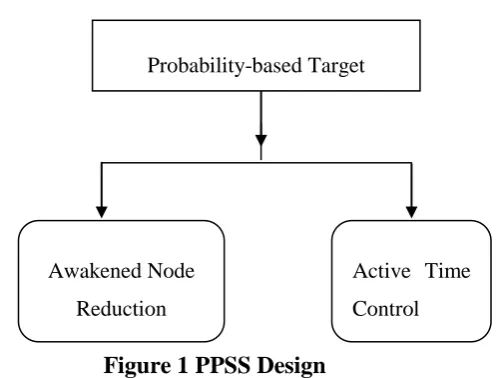
Different from detection, it studies discrete detection events. A target tracking system is needed repeatedly to guarantee constant monitoring. A probability-based target prediction and sleep scheduling protocol (PPSS) is designed to enhance theefficiency of proactive wake up and increase the energy efficiency with inadequate loss on the tracking results. With a target prediction method derived from both kinematics rules and theory of probability, PPSS forecasts a target’s next location and explains the probabilities to travel in all directions. Different from the physics-based prediction work, target prediction of PPSS provides a directional probability as the base of differentiated sleep scheduling in a geographical area. After derived from the prediction results, PPSS enhances energy efficiency through minimizing the number of awakened nodes and calculating active time in an incorporated method. Additionally, distributed algorithms are designed for PPSS which functions on individual nodes. It also enhances the scalability of PPSS for large-scale WSNs.
Figure 1 PPSS Design
Two approaches are employed to minimize the energy consumption during this practical wake-up process, namely reduce the number of awakened nodes and schedule the sleep pattern to cut down the active time. Initially, the number of awakened nodes is minimized, as nodes target already passed during the sleep delay fails to require to be awakened. Nodes locate on a direction where the target contains a low probability of passing. A concept of wake up region and a method is designed for calculating the scope of a wide awake region. The active time of selected awakened nodes are restrained as possible, as they wake up and remain active when the target is estimated to cross their sensing area. A sleep scheduling protocol is also designed that plans the sleep patterns of awakened nodes independently consistent with their distance and direction outside the existing motion state of the target.
Target prediction scheme comprise three steps: current state calculation, kinematics-based prediction and probability based prediction. After analyzing the current state, the kinematics-based prediction step computes the predictable displacement from the current location in the next sleep delay. The probability-based prediction step creates the probabilistic models for scalar displacement and the deviation. In awakened node reduction, the number of awakened nodes is decreased with two efforts are managing the scope of awake regions and selecting a subset of nodes in an awake region. Depending on the probabilistic models created with target prediction, PPSS plans an awakened node to be active, in order that the probability identifies the target is near to 1
3.2 Reducing Data Collection Latency in Wireless Sensor Networks with Mobile Elements
Data collection from the nodes is used in a sensing field. It is one of the most important tasks of wireless sensor networks. Normally, data collection depends on a wireless communications between sensor nodes and the sink node that suffers from the issues. Wireless communications on long-range ones uses restricted on-board energy supply of sensor nodes extremely because of the super linear path loss models. And also for shorter range, multihop wireless communications are implemented, because of the data aggregation to the sink. Nodes near the sink utilize more energy than others because of large volume of traffic transmitted by them resulting in a lesser network lifetime.
To solve these issues, a new angle is introduced. A progressive optimization approach is designed to minimize the tour length of MEs. So, the travel time with the assumption of a constant travel speed slowly through joining the collection sites for nearer data sources after that skipping and substituting few sites. The data sources are the
Probability-based Target
Prediction
Awakened Node
Reduction
Active Time
common sensor nodes in networks with a flat architecture or the cluster heads in hierarchical networks. Next, derived from the realistic wireless communication features, a multirate communication model is designed that permits MEs to gather data at a lower rate over a longer distance while traveling. CSS scheme is expanded derived from the model and attain the multirate CSS (MR-CSS) scheme. Many works are not taken on wireless communications features and so fails to use them. The accuracy of the progressive optimization approach calculates the performance derived from results of Geometrical Probability.
The main aim of the designed technique is threefold. By the creation of issues as exact cases of the traveling salesman problem with neighborhoods (TSPN), neighborhoods are interconnecting the continuous disks. Because of its NP-hardness several approximation and heuristic algorithms are designed. Though, approximation algorithms contain theoretical value because of their large approximation factors. Progressive optimization-based CSS scheme attains the results that are relatively nearer to the lower bound of the optimal solution. By using the nonzero wireless communication range between the ME as well as sensor nodes, it motivated through the information where the communication ranges of sensor nodes overlap with each other. The CSS scheme uses three steps to shorten the tour of the ME. It initiates with a TSP formulation based on the set of sensor nodes in the sensing field, through which the optimal TSP tour is attained using TSP solvers. After that, it joins the data collection sites by decisional Welzl’s algorithm and implements the skip-and-substitute algorithm to reduce the tour.
3.3 Dynamic Routing for Data Integrity and Delay Differentiated Services in Wireless Sensor
Networks
Wireless Sensor Networks are utilized to sense the physical world. It is an important part in the next generation networks. Because of the diversity and complexity of applications running over WSNs, the QoS guarantee in the networks gains interest in the research area.As a part of an information infrastructure, WSNs maintain many applications in the same platform. Different applications contain different QoS needs. Though, functions require several packets to arrive at the sink despite while they arrive.WSNs contain two fundamental QoS constraints, namely low delay and high data integrity resulting in delay sensitive applications and high-integrity applications respectively. Normally in a network with light load, both conditions are fulfilled. Though, a heavily loaded network experiences overcrowding when end-to-end delay gets increased.
IDDR also reduces the end-to-end delay for delay-sensitive applications. Each application is allocated with a weight that denotes the degree of sensitivity to the delay. By constructing the local dynamic potential fields with dissimilar slopes along with the weight values accepted by packets, IDDR permits the packets with better weight to select the shorter paths. Additionally, IDDR also utilizes the priority queue to reduce the queuing delay of delay-sensitive packets. IDDR neglects the variance between high integrity and low delay. The packets experiences a large end-to-end delay due to the additional hops and the delay-sensitive packets moves in a shorter paths to the sink immediately.
IV. COMPARISON OF
TARGET TRACKING AND DATA COLLECTION IN WIRELESS
SENSOR NETWORKS
In order to compare the target tracking and data collection in wireless networks, data size is taken to execute the experiment. Various parameters are used to measure the energy efficient target tracking and data collection.
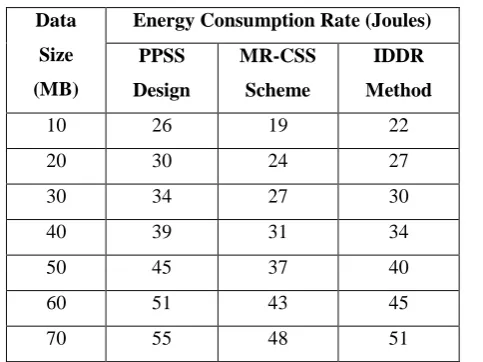
4.1 Energy Consumption Rate
Energy consumption rate is defined as the amount of energy consumed while tracking the target data. Energy consumption rate is measured in terms of Joules (J).
Data
Size
(MB)
Energy Consumption Rate (Joules)
PPSS
Design
MR-CSS
Scheme
IDDR
Method
10 26 19 22
20 30 24 27
30 34 27 30
40 39 31 34
50 45 37 40
60 51 43 45
70 55 48 51
Table 4.1 Tabulation for Energy Consumption Rate on Target Tracking and Data Collection in
Wireless Sensor Networks
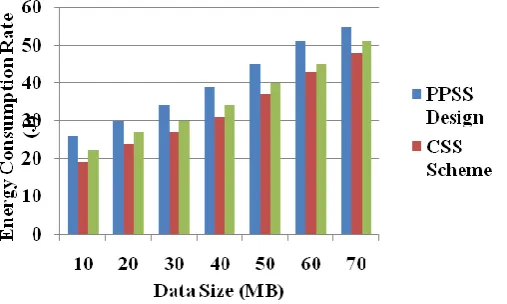
Figure 4.1 Energy Consumption Rate on Target Tracking and Data Collection in Wireless
Sensor Networks
From the fig. 4.1 describes the energy consumption rate on target tracking and data collection in wireless sensor networks. The experiment shows that Multi-rate Combine-Skip-Substitute (MR-CSS) decreases the energy consumption rate when compared with Probability-Based Prediction and Sleep Scheduling (PPSS) and Integrity and Delay Differentiated Routing (IDDR). Research in Multi-rate Combine-Skip-Substitute (MR-CSS) is 14 – 16 % lesser energy consumption when compared to Probability-Based Prediction and Sleep Scheduling and 6-15 % lesser consumption of energy when compared with Integrity and Delay Differentiated Routing (IDDR).
4.2
Throughput
Throughput is defined as the amount of data gets transferred in a given period of time. It is measured in terms of bits per second (bps).
Table 4.2 Tabulation for Throughput on Target Tracking and Data Collection in Wireless
Sensor Networks
Number
of Data
(Number)
Throughput (bps)
PPSS
Design
MR-CSS
Scheme
IDDR
Method
20 15 19 25
40 19 24 29
60 24 29 35
80 29 33 41
100 35 38 46
120 39 43 50
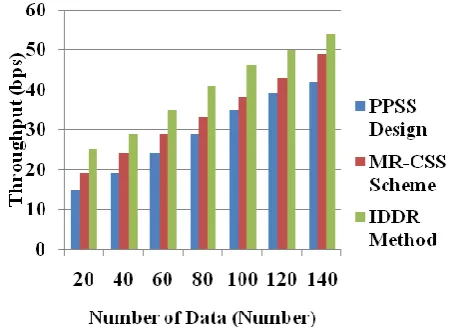
Figure 4.2 Throughput on Target Tracking and Data Collection in Wireless Sensor Networks
The throughput comparison takes place on existing Probability-Based Prediction and Sleep Scheduling, Multi-rate Combine-Skip-Substitute (MR-CSS) scheme and Integrity and Delay Differentiated Routing (IDDR). From the fig. 4.2, describes the throughput on target tracking and data collection in wireless sensor networks. The experiment shows that Integrity and Delay Differentiated Routing (IDDR) contains higher throughput level when compared with Probability-Based Prediction and Sleep Scheduling (PPSS) and Multi-rate Combine-Skip-Substitute (MR-CSS). Research in Integrity and Delay Differentiated Routing (IDDR) is 7 – 18 % higher throughput when compared to Probability-Based Prediction and Sleep Scheduling and 5-13 % higher throughput when compared with and Multi-rate Combine-Skip-Substitute (MR-CSS).
4.3 Target Tracking Accuracy
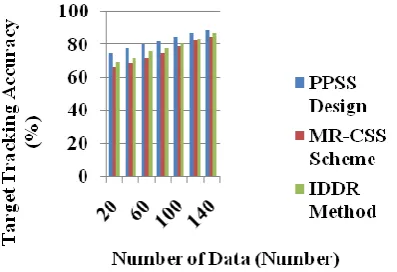
Target tracking accuracy is the measure of data that are exactly tracked to the destination. It is measured in terms of percentage (%).
Number of
Data
(Number)
Target Tracking Accuracy (%)
PPSS
Design
MR-CSS
Scheme
IDDR
Method
20 75 66 70
40 78 69 72
60 80 72 76
80 82 75 78
100 85 79 81
120 87 83 84
140 89 85 87
The target tracking accuracy comparison takes place on existing Probability-Based Prediction and Sleep Scheduling, Multi-rate Combine-Skip-Substitute (MR-CSS) scheme and Integrity and Delay Differentiated Routing (IDDR).
Figure 4.3Accuracy on Target Tracking and Data Collection in Wireless Sensor Networks
From the fig. 4.3, describes the accuracy on target tracking and data collection in wireless sensor networks. The experiment shows that Probability-Based Prediction and Sleep Scheduling contains higher accuracy when compared with Integrity and Delay Differentiated Routing (IDDR) and Multi-rate Combine-Skip-Substitute (MR-CSS). Research in Probability-Based Prediction and Sleep Scheduling is 7 – 15 % higher accurate when compared to Integrity and Delay Differentiated Routing (IDDR) and 10-27 % higher accurate when compared with and Multi-rate Combine-Skip-Substitute (MR-CSS).
V. DISCUSSION ON LIMITATION OF TARGET TRACKING AND DATA COLLECTION
IN WIRELESS SENSOR NETWORKS
In Multirate Combine-Skip-Substitute (MR-CSS) scheme, large data collection latency degrades the timeliness of the data and leads to the buffer overflow of sensor nodes. The resultant tour length of the CSS scheme fails to establish before the termination of the CSS scheme. Tour selection with CSS scheme is not always feasible. CSS scheme capable to attain solutions inside a small level of the lower bound of the optimal solution.
Probability-based Prediction and Sleep Scheduling protocol (PPSS) is a target prediction scheme derived from bothkinematics rules and theory of probability enhanced the energy efficiency. PPSS protocol consider single target tracking only. The distance between two targets is over twice communication radius of nodes, the sleep scheduling actions triggered. Before the target is identified for the first time, PPSS protocol is not created. Integrity and Delay Differentiated Routing (IDDR) provide high integrity and delay-differentiated services with local information.In many situations, low delay and high data integrity are not satisfied simultaneously. IDDR constructs multiple potential fields temporally but does not maintain all the possible fields. Delay-sensitive packets are not cached for the function of decreasing the end-to-end delay.
VI. CONCLUSION
has only less target tracking accuracy and consumed large amount of energy. In addition, it takes large amount of time to track the data and also the throughput is less. It is obtained from the previous work, the target tracking loses some of the messages and fails to send it to the sink. This type of issues makes the existing systems as ineffective one. Hence the classification rule mining techniques support in satisfying the effective diagnosis of stroke disease cause. The wide range of experiments on existing techniques calculates the relative performance of the various data collection techniques and its limitations. It observed that this research work can be used in the target tracking and data collection in order to attain better quality of service using a high energy efficient and maximal throughput on sensor node data communication.
The future direction of using energy efficient target tracking and data collection in wireless sensor network develops a high energy efficient and maximal throughput on sensor node data communication along with better quality of service.
REFERENCES
[1] Guojun Wang, Md Zakirul Alam Bhuiyan, Jiannong Cao and Jie Wu, Fellow., “Detecting Movements of a Target Using Face Tracking in Wireless Sensor Networks”, IEEE TRANSACTIONS ON PARALLEL AND DISTRIBUTED SYSTEMS, VOL. 25, NO. 4, APRIL 2014
[2] Bo Jiang, Student Member, IEEE, Binoy Ravindran, Senior Member, IEEE, and Hyeonjoong Cho, Member, IEEE, “ Probability-Based Prediction and Sleep Scheduling for Energy-Efficient Target Tracking in Sensor Networks”, IEEE TRANSACTIONS ON MOBILE COMPUTING, VOL. 12, NO. 4, APRIL 2013
[3] Liang He, Member, IEEE, Jianping Pan, Senior Member, IEEE, and Jingdong Xu, “A Progressive Approach to Reducing Data Collection Latency in Wireless Sensor Networks with Mobile Elements”, IEEE TRANSACTIONS ON MOBILE COMPUTING, VOL. 12, NO. 7, JULY 2013
[4] Sourav Bhattacharya, Henrik Blunck, Mikkel Baun Kjærgaard, and Petteri Nurmi., “Robust and
Energy-Efficient Trajectory Tracking for Mobile Devices”, IEEE TRANSACTIONS ON MOBILE
COMPUTING, VOL. 14, NO: 2, FEBRUARY 2015
[5] Xuefeng Liu, Jiannong Cao, Senior Member, IEEE, Wen-Zhan Song, Peng Guo, and Zongjian He., “Distributed Sensing for High-Quality Structural Health Monitoring Using WSNs”, IEEE TRANSACTIONS ON PARALLEL AND DISTRIBUTED SYSTEMS, VOL. 26, NO. 3, MARCH 2015
[6] Jiao Zhang, Member, IEEE, Fengyuan Ren, Member, IEEE, Shan Gao, Hongkun Yang, and Chuang Lin, Senior Member, IEEE., “ Dynamic Routing for Data Integrity and Delay Differentiated Services in Wireless Sensor Networks”, IEEE TRANSACTIONS ON MOBILE COMPUTING, VOL. 14, NO. 2, FEBRUARY 2015
[8] Wang Liu, kejie Lu, senior member, IEEE, Jianping Wang, Liusheng Huang and Dapeng Oliver Wu, senior member, IEEE, “On the Throughput Capacity of Wireless Sensor Networks with Mobile Relays”, IEEE TRANSACTIONS ON VEHICULAR TECHNOLOGY, VOL. 61, NO. 4, MAY 2012
[9] Parag S. Khairnar and Neelesh B. Mehta, Senior Member, IEEE. “Discrete-Rate Adaptation and Selection in Energy Harvesting Wireless Systems”, IEEE TRANSACTIONS ON WIRELESS COMMUNICATIONS, VOL.14, NO.1, JANUARY 2015
[10] Shouling Ji, Student Member, IEEE, Raheem Beyah, Senior Member, IEEE, and Zhipeng Cai, Member, IEEE, “Snapshot and Continuous Data Collection in Probabilistic Wireless Sensor Networks”, IEEE TRANSACTIONS ON MOBILE COMPUTING, VOL.13, NO. 3, MARCH 2014