89 | P a g e
WIRELESS AUTOMATION SYSTEM USING
BLUETOOTH TECHNOLOGY
R. Nivethitha
1, R. Karpaga Priya
21
Assistant Professor, Department of ECE, Vaigai College of Engineering. 2
Assistant Professor, Department of ECE, Vaigai College of Engineering.
ABSTRACT
Internet of Things (IOT) is an emerging technology using for industrial, domestic and wireless
applications. This paper reviews about the self-control mechanism of the domestic devices using Arduino
and Bluetooth module. Further, there is a framework which describes about the interconnecting
mechanism of various devices for monitoring purpose.
Keywords : Arduino, Bluetooth Module
I. INTRODUCTION
As an emerging technology, the Internet of Things (IoT) is expected to offer promising solutions to transform the operation and role of many existing industrial systems such as transportation systems and
manufacturing systems. It is an innovative and easy communicative platform for the variety of devices
like sensors, microcontrollers, displays, vehicles and home automation devices etc. The IoT is considered
as the future evaluation of the Internet that realizes machine-to-machine (M2M) learning. The basic idea
of IoT is to allow autonomous and secure connection and exchange of data between real world devices
and applications. The IoT links real life and physical activities with the virtual world.
Surprisingly the application of IOT continues in all domains such as Agriculture,
Automation,
Industries, Manufacturing, Home appliances, Health care, Security, Surveillance,Transportation etc. and it highly changes the normal world into a SMART world by using these
technologies. This paper focuses on the communication establishment between Arduino board and
Bluetooth module and its working on the home control system devices. Bluetooth is a wireless technology
standard has the ability to share information or data over short distances using short wavelength UHF
90 | P a g e and various building personal area networks. It can connect several devices and it overcomes the
synchronization problem which is faced by the network. In this paper, we presented a part of smart
technology which using the Bluetooth standard in a mobile device which is more easy, affordable and
efficient to use.
According to the research, Smart phone can provide computer mobility, ubiquitous data access, and
pervasive intelligence for each and every person day to day lives. It was used for almost every aspect of
business processes, working places and nowadays for security purpose.
With this never ending technology, Smart phone usually support one or more short range wireless
technologies such as Bluetooth making it possible to transfer data via these wireless connections. The use
of Bluetooth technology in a smart phone today is not just limited for the transfer of data and files only
also it uses can be elaborated to application of smart living makes us aware and helps us out in the
emergency situations. In recent years, the Bluetooth standard prototype includes the integrating design of
automation and sensor control of various real and virtual objects at a same time.
II. SYSTEM DESIGN
The design consists of two main parts hardware and software. The hardware design consists of various
parts such as,
• Arduino Uno
• Bluetooth module
• Android mobile phone
• LED
• Power supply
• Relay circuit
Software part consist of
• Arduino Integrated Development Environment (IDE)
• Bluetooth terminal smart phone application
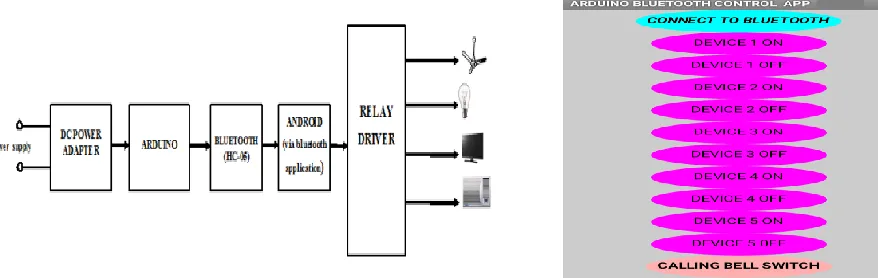
These devices can be used for wireless communication between smart phone and Arduino board. Fig. 1
illustrates block diagram of proposed Smart Switch automation system. The block diagram in Fig-1
91 | P a g e android mobile phone using Bluetooth module (HC-05 or HC06). This system has input from android
Smartphone, the overall system is controlled automatically and the output connected to the relay which can
be easily communicates with the various peripheral devices or household appliances. In this paper, the
automation system consists of two main hardware components: the smart phone and the Arduino BT
board. The script which can be uploaded to the arduino board enables the BT HC-05 or HC-06 to access
the home appliances and also the control commands for the appliances and it sets up communication
protocol between the two or more devices which allows controlling the behaviour of the Arduino BT
board.
Fig 1: Block diagram of Smart Switch using Arduino Fig 2 : Arduino Bluetooth Control Application
Arduino program is developed by free software integrated development environment (IDE) issued by
Arduino web. There are three steps should be done. First is compiling, second is to upload the machine
code(script written in Arduino Version 1.8.3), final step is to search Bluetooth device then connect it with
the mobile application. For test purposes, the LED is connected for indication to know about the device
actual status. The LED can be controlled to be on or off. Here we developed new mobile application
which creates the interface between Arduino and the home appliances.
The communication between Arduino and HC-05 Bluetooth module can be established by the Serial
port (UART or USTART) inbuilt in Arduino board which used to interact with computer or other devices.
Now, the written arduino program sketch uploaded which sends the status messages to confirm the transfer
of data through digital streams 0’s or 1’s. The relay driver circuit can be used to control two or more
92 | P a g e proposed system is that Arduino Bluetooth Control Application developed by cloud based tool MIT APP
Inventor which can be shown in the Fig 2. It enables us to change or edit the device name independently.
An additional feature TIMER was included in the proposed system which functions ON/OFF at a
particular time period should be given already.
Fig 3 : Wireless Automation System using IOT
III. CONCLUSION & FUTURE WORK
In this paper we have introduced wireless automation system using Arduino based Bluetooth
technology. By using this, a more flexible and reliable control to any number of devices was achieved. We
have tested our system, with nearly 4 devices and obtained more satisfactory results. The timers used in
this system provides flexibility to set time for the device to ON/OFF automatically without Manual control.
In future, we have planned to extend the system, using Wi-Fi and Cloud technology concepts for
automation, agriculture and various fields. By doing so, we are able to control our devices from any part of
the world irrespective of time and distance.
IV.REFERENCES
[1] B. Daskala, ed., Flying 2.0—Enabling Automated Air Travel by Identifying and Addressing the Challenges of IoT& RFID Technology, European Network and Information Security Agency, 2010; www.enisa.europa.eu /media/press-releases/flying-2.0-study-of-internet-of-things-rfid-in-air-travel.
[2] O. Garcia-Morchon et al., ―Security Considerations in the IP-Based Internet of Things,‖ IETF, Mar. 2011;http://tools.ietf.org/html/draft-garcia-core-security.
[3] J. Zheng, D. Simplot-Ryl, C. Bisdikian, and H. Mouftah, ―The Internet of Things,‖ in IEEE Communications Magazine, Volume:49 , Issue: 11,pp:30-31, 2011.
93 | P a g e [5] T. Fan and Y. Chen, ―A Scheme of Data Management in the Internet of Things,‖ in 2nd IEEE International
Conference on Network Infrastructure and Digital Content, Sept. 2010.
[6] Y. Huang and G. Li, ―A Semantic Analysis for Internet of Things,‖ in International Conference on Intelligent
Computation Technology and Automation (ICICTA), May 2010.
[7] A.R.Al-Ali and M. AL-Rousan. ―Java-Based Home Automation System‖. IEEE Transaction on Consumer
Electronics, Vol.50, No. 2, May 2004.
[8] C. Gomez and J. Paradells, ―Wireless Home Automation Networks: A Survey of Architectures and
Technologies,‖ IEEE Commun. Mag., vol. 48, no. 6, June 2010, pp. 92–101.
[9] C. Bisdikian, ―An Overview of the Bluetooth Wireless Technology,‖ IEEE Commun. Mag., vol. 39, no. 12, Dec.
2001, pp. 86–94.
[10]Namiot, D., & Sneps-Sneppe, M. (2014). On M2M Software. International Journal of Open Information Technologies, 2(6), 29-36.
[11]Kim, J., & Lee, J. W. (2014, March). OpenIoT: An open service framework for the Internet of Things. In Internet of Things (WF-IoT), 2014 IEEE World Forum on (pp. 89-93). IEEE.
[12] S. Schneider, J. Swanson and Peng-Yung Woo. ―Remote telephone control system‖. IEEE Transaction on Consumer Electronics, Vol.43, Issue 2, pp.103-111, 1997.