629 | P a g e
Smart Grid Administration using Big Data and Wireless
Sensor Networks
Srinivasa Rao Jangili
1, K Bikshalu
21
Department of Technical Education, Telangana
2
University College of Engineering, Kakatiya University
ABSTRACT
Wireless sensor networks provide abundant opportunities for smart grid applications including energy
monitoring, demand-side energy management, coordination of distributed storage, and integration of renewable
energy generators. Because of their economical cost and ease-of-deployment, Wireless sensor networks are
likely to be used on a large scale in future of smart power grids. The result is a massive volume of different
variety of data sets. Processing, analyzing and storage of these data divulge deeper insights that can help
experts to improve the operation of power grid to achieve better performance. The technology to collect massive
amounts of data is available today, but administering the data efficiently and extracting the required
information out of it remains a challenge. This paper discusses and provides recommendations and practices to
be used in the future of smart grid and Internet of things. We explore the different applications of Wireless
sensor networks in the domain of smart power grid. Also we discuss the techniques used to manage big data
generated by sensors and meters for application processing.
Keywords: Internet of Things; Smart Grid, Big Data; Wireless sensor Network; Hierarchical
Communication Infrastructure; smart sensors;
I. INTRODUCTION
The electricity demand globally is expected to increase more than two-thirds by the year of 2035 according to the International Energy Agency 1. Such increase in electricity demand will put a higher burden on the current outdated and overstressed power infrastructure. In addition, it will cause serious network congestion problems and degrade the quality of the transferred power. The existing power grid suffers from unreliability due to the lack of efficient monitoring, fault diagnostic, and automation techniques. The current network infrastructure suffers from inflexibility in integrating new distributed energy sources which makes adding renewable energy sources a challenging task. This will have a negative impact in providing solutions to have a cleaner environment.
630 | P a g e
sustainable 2. It achieves these goals through the integration of information and communication networks. Intelligent algorithms for information collection and processing are being and will be developed to provide automated control over the power grid. In smart grid, a reliable and real-time monitoring is highly required to provide solutions quickly when natural accidents or catastrophes occur to prevent power disturbance and outage. Hence, intelligent monitoring and sensing capabilities to insure real-time response from the power grid are necessary. Wireless sensor networks (WSNs) can be used as compared to traditional communication technologies because of its low-cost, rapid deployment, flexibility, and aggregated intelligence via parallel processing 3. However, better security solutions are needed to prevent the network from any malicious behaviors, sniffing, or attackers.The integration of WSNs, actuators, smart meters, and other components of the power grid with together with information and communication technology (ICT), is referred to as the Internet of Energy (IoE). IoE uses the bidirectional flow of energy and information within the smart grid to gain deep insights on power usage and predicts future actions to increase energy efficiency and low overall cost 4.
According to reports, 800 millions smart meters are expected to be installed globally by 2020 5. In order to achieve fine-grain monitoring and scheduling, information from the power grid needs to be collected within short intervals. Assuming that smart meters take one record every 15 minutes, this leads to about 77 billions of readings globally during one day. Such huge amount of data could overwhelm existing processing and storage techniques and systems. Utility companies need these readings to have a better understanding of end users’ behaviors regarding consumption and pricing policies 6.
To manage the massive amounts of data generated from smart meters and other components of the grid, utility companies can use services provided by cloud infrastructures. Services that are provided by cloud enterprises and infrastructures for smart grid users include: provide a storage space, energy resources management, and virtual power plant. Latency and security of cloud computing might be the reasons for utility companies not to adopt cloud systems. However, Fog computing or edge computing deals with the IoT in a distributed manner rather than using the centralized cloud computing model. It aims to minimize latency and improve the bandwidth usage. This paper is structured as follows. Section 2 provides a background discussion on the Internet of things and its applications in smart grid. Section 3 discusses some of the existing techniques to manage big data in the smart grid. And finally we conclude the paper in Section 4.
II. INTERNET OF THINGS
631 | P a g e
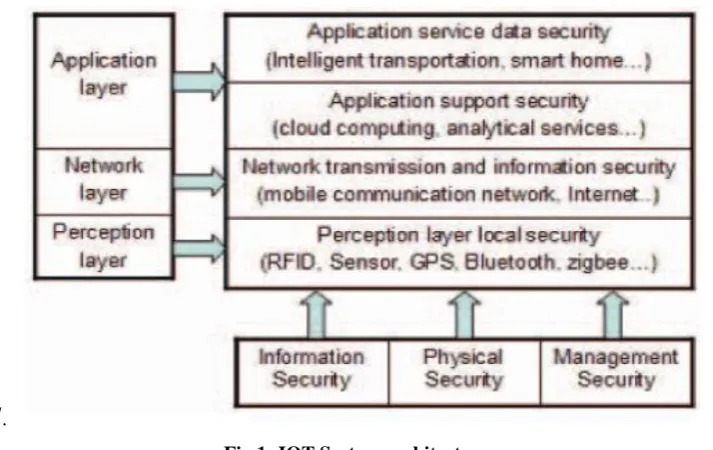
7.Fig 1: IOT System architecture
IoT system is composed of three layers: the perception layer, the network layer, and the application layer 8 as shown in Figure 1. The perception layer includes a group of Internet-enabled devices that can percept, detect objects, collect systems information, and exchange information with other devices through the Internet communication net-works. Sensors, Global Positioning Systems (GPS), cameras, and Radio Frequency Identification Devices (RFID) are examples of devices that exist at perception layer. The network layer is responsible of forwarding data from perception layer to the application layer under the constraints of devices’ capabilities, network limitation and the applications’ constraints. IoT systems use a combination of Internet and short-range networks based on the communicated parties 9. Short-range communication technologies such as Bluetooth and ZigBee, are used to carry the information from per-ception devices to a nearby gateway. Other technologies such as WiFi, 2G, 3G, 4G, and Power line Communication (PLC) carry the information for long distances based on the application. The upper layer is the application layer, where incoming information is processed to induce insights upon which we can design better power’s distribution and management strategies. Applications aim to create smart homes, smart cities, power system monitoring, demand-side energy management, coordination of distributed power storage, and integration of renewable energy generators. The next subsections discuss these groups of applications.
Smart homes and smart cities
632 | P a g e
A group of smart homes in a neighborhood are connected through a Neighbor Area Network (NAN) to form a smart community 10. In a smart community, homes share the results of their outdoor surveillance cameras to detect any accident and might inform police stations. Other applications of the smart community concept are in health care, managing shared resources, and enabling support social networking.The concept of a smart community is extended to develop a smart city in 11. In a smart city a comprehensive surveillance system is developed to monitor different activities within an entire city or a country.
Online monitoring of power lines
As more buildings and areas are being covered with power line systems, the number and severity of power outages become more serious leading to lower system’s reliability 12. Reliability is important as it causes serious negative impacts on public health and economical systems. Integration of IoTs technology together with the power grid, aims to improve the reliability of power grids through a continuous monitoring of transmission lines’ status; in addition to environmental behaviors and consumers’ activities to send periodic reports to the grid control units. The control units process and extract information from the reported data in order to detect faults, isolate the fault, and then resolve faults intellectually.
Performing energy restoration in smart grid must take into the account the location criticality of blackouts. For examples, It is critical to guarantee high reliability for health and industrial systems. The restoration problem be-comes a very complex problem when taking into the consideration the large number of combinations of switching operations which exponentially increases with the increase in system’s components 13,14. Designing the smart grid in a hierarchical model 15 divides the problem into multiple control units in charge of restoring power within its region or scope. This enhances the time needed to process the data and speeds up the restoration process. If some control units fail to restore energy in some regions within their scope, they forward the problem to upper levels for better action and handling as higher levels have a larger system’s view.
Demand-side energy management
Demand-Side Energy Management (DSM) is the change in consumers energy consumption profiles according to varying electricity price over time, and other payment’s incentives from utility companies 16. Demand response is used to minimize consumer’s electricity bill, shift peak’s load demand, minimize operation cost of the power grid, and minimize energy loss and greenhouse’s gas emissions 17,18. IoT components collect energy requirements of different home appliances and send them to smart meters. The control unit in smart grid schedules energy consumption of homes’ appliances according to the user’s preferences in a strategy that minimizes the electricity bill.
The DSM problem can be solved at different levels of the hierarchical smart grid infrastructure. It can be solved at the level of home premises to preserve consumers privacy 19,20. Also it can be solved at higher levels to generate more effective scheduling plan that do not only benefit consumers but also the utility company 21,22. Integration of distributed energy sources
633 | P a g e
renewable energy sources by 2050 23. Renewable energy suffers from available which has lead to high improvements in storage technology. IoT technology uses wireless sensors to collect real-time weather information to help in predicting the energy availability in the near future. Accuracy of the forecasted power amounts during the next time intervals is crucial for energy scheduling models 24. Different strategies and optimization solutions have been developed in research to efficiently manage renewable energy sources within the smart grid 15.Integration of electric vehicles
Electric Vehicles (EVs) are used as energy storage devices while they are idle. Also they provide efficient and clean transportation services. Developing efficient scheduling techniques for charging and discharging of electric vehicles can potentially lead to reduce emissions, shave peak load, and increase the used percentage of generated renewable 25. Perception devices collect information about electric vehicles identity, battery state, location, etc, to improve the efficiency of charging and discharging scheduling algorithms.
III. BIG DATA MANAGEMENT IN POWER GRID
IoT technology integrated within in the smart power grid comes with a cost of storing and processing large volume of data every minute. This data includes end users load demand, power line s faults, network’s components status, scheduling energy consumption, forecast conditions, advanced metering records, outage management records, enterprise assets, and many more 26. Hence, utility companies must have the software and hardware capabilities store, manage, and process the collected data efficiently 6.
The high volume data gather in smart grid is similar in size and characteristics to the concept of big data. Big data is defined as data with high volume, velocity, and variety. The sampling frequency from perception devices can make the data size very large. Data velocity reflects the required speed for collecting and processing the data. Hence, big data management and processing techniques (hardware, software, algorithms, AI, etc) can be borrowed and applied in the domain of IoT. In addition, some applications of smart grid can perform their tasks only at specific time a day, such as weather forecasting and one-day ahead of time energy distribution, which can be performed at the night of every day. However some other applications perform their tasks all day round, such as real-time applications that monitor the power grid components. This is needed to speed up energy outage recovery process and real-time response to emergent behaviors in power demands.
Even with today’s development in big data processing techniques, managing of data in the smart power grid poses new challenges that are based upon the criticality of power systems, real-time response, proactive solutions, accurate predictions, and security. Hence, we address first the question of where to store the smart grid big data.
634 | P a g e
local computers at the utility companies’ sites. The growing size of power grids induces a burden on utility companies to keep on updating and upgrade their infrastructure to handle the growth.The increasing number in services and capabilities of cloud computing make it a good candidate to host SCADA systems. Cloud computing is a model that enables a convenient on-demand access to a shared pool of computing resources such as network, storage, servers, applications, and services 27,28. Cloud computing enterprises deliver their services to end users in three models namely, Infrastructure as a Service (IaaS), Platform as a Service (PaaS), and Software as a Service (SaaS). IaaS provides end users with operating systems, storage, network, and database services deployed within the cloud. PaaS provides end users with capabilities to deploy their applications such as programming languages and libraries that are available within the cloud. SaaS cloud provides a ready to use application for end users.
Utility companies can benefit from the storage capabilities provided by the cloud in developing SCADA systems. Indeed, it can entirely transfer SCADA systems to the cloud and utilize the processing, storage, and other IaaS services. There are many advantages for using cloud services for SCADA systems such as: pay for only what you use, better collaboration, and reduce energy cost 29. On the other hand using cloud computing for SCADA systems raises security and network issues caused by the fact that the storage in the cloud is shared among several users. This makes it more vulnerable to attacks. Also the limitation on network bandwidth in some regions makes it hard for some applications to perform their tasks with low latency.
However, fog computing extends the paradigm of cloud computing to network edges so data can be processed within devices located on network edges without the need of transferring data to cloud for processing 30. Fog computing is a highly distributed and low latency model which makes it a good replacement of cloud computing for developing smart grid applications.
Finally we address the question of which computing paradigm fits processing big data in smart grid. Hadoop MapReduce technique is the most frequently used tool for analyzing large historical data sets 31. In MapReduce, the big data sets are divided into smaller data sets for processing. The small data sets are then processed on a number of machines in parallel using the same code. Generally MapReduce fits to be used in smart grid for static applications such as weather forecasting, one-day ahead energy scheduling, and all applications that do not require real-time response. However, when it comes to real-time applications such as online monitoring, fraud detection, and self-healing, Hadoop MapReduce is not efficient. On the other hand, stream processing is considered as an ideal platform to process big data streams and sensor’s data. It is designed to handle big data in real-time with a highly scalable, available, and fault-tolerant architecture. Stream processing has a great potential to be applied for data analytics in smart grids 32.
IV. CONCLUSION
635 | P a g e
processing on fog computing architecture supports a well-designed platform for real-time applications in the smart power grid.REFERENCES
[1].How will global energy markets evolve to 2035 WORLD ENERGY OUTLOOK FACTSHEET, International Energy Agency; 2013.
[2].Fang, X., Misra, S., Xue, G., Yang, D.. Smart grid; the new and improved power grid: A survey. Communications Surveys Tutorials, IEEE 2012;14(4):944–980.
[3].Gungor, V., Lu, B., Hancke, G.. Opportunities and challenges of wireless sensor networks in smart grid. Industrial Electronics, IEEE Transactions on 2010;57(10):3557–3564.
[4].Karnouskos, S.. The cooperative internet of things enabled smart grid. In: Proceedings of the 14th IEEE international symposium on consumer electronics (ISCE2010), June. 2010, p. 07–10.
[5].m2m: 800 million electric smart meters to be installed globally by 2020. 2015. URL: https://m2m.telefonica.com/.
[6].Managing big data for smart grids and smart meters. White Paper; 2012.
[7].Zanella, A., Bui, N., Castellani, A.P., Vangelista, L., Zorzi, M.. Internet of things for smart cities. IEEE Internet of Things Journal 2014;.
[8].Liu, J., Li, X., Chen, X., Zhen, Y., Zeng, L.. Applications of internet of things on smart grid in china. In: Advanced Communication Technology (ICACT), 2011 13th International Conference on. 2011, p. 13–17. [9].Yun, M., Yuxin, B.. Research on the architecture and key technology of internet of things (iot) applied on
smart grid. In: Advances in Energy Engineering (ICAEE), 2010 International Conference on. 2010, p. 69– 72.
[10].Li, X., Lu, R., Liang, X., Shen, X., Chen, J., Lin, X.. Smart community: an internet of things application. Communications Magazine, IEEE 2011;49(11):68–75.
[11].Stratigea, A.. The concept of smart cities. towards community development? Netcom, communication et territoires 2012;(26-3/4):375–388.
[12].Amin, M.. Challenges in reliability, security, efficiency, and resilience of energy infrastructure: Toward smart self-healing electric powergrid. In: Power and Energy Society General Meeting - Conversion and Delivery of Electrical Energy in the 21st Century, 2008 IEEE. 2008, p. 1–5.
[13].Solanki, J., Khushalani, S., Schulz, N.. A multi-agent solution to distribution systems restoration. Power Systems, IEEE Transactions on 2007;22(3):1026–1034.
[14].Zidan, A., El-Saadany, E.F., El Chaar, L.. A cooperative agent-based architecture for self-healing distributed power systems. In: Innovations in Information Technology (IIT), 2011 International Conference on. 2011, p. 100–105.
636 | P a g e
[16].Balijepalli, V., Pradhan, V., Khaparde, S., Shereef, R.M.. Review of demand response under smart gridparadigm. In: Innovative Smart Grid Technologies - India (ISGT India), 2011 IEEE PES. 2011, p. 236– 243.
[17].Siano, P.. Demand response and smart grids a survey. Renewable and Sustainable Energy Reviews 2014;30(0):461 – 478.
[18].Koutsopoulos, I., Tassiulas, L.. Control and optimization meet the smart power grid: Scheduling of power demands for optimal energy management. In: Proceedings of the 2Nd International Conference on Energy-Efficient Computing and Networking; e-Energy ’11. New York, NY, USA: ACM; 2011, p. 41–50. [19].Jaradat, M., Jarrah, M., Jararweh, Y., Al-Ayyoub, M., Bousselham, A.. Integration of renewable energy in
demand-side management for home appliances. In: Renewable and Sustainable Energy Conference (IRSEC), 2014 International. 2014, p. 571–576.
[20].Zhu, Z., Tang, J., Lambotharan, S., Chin, W.H., Fan, Z.. An integer linear programming based optimization for home demand-side management in smart grid. In: Innovative Smart Grid Technologies (ISGT), 2012 IEEE PES. 2012, p. 1–5.
[21].Nguyen, H.K., Song, J., Han, Z.. Demand side management to reduce peak-to-average ratio using game theory in smart grid. In: Computer Communications Workshops (INFOCOM WKSHPS), 2012 IEEE Conference on. 2012, p. 91–96.
[22].Molderink, A., Bakker, V., Bosman, M.G.C., Hurink, J., Smit, G.J.M.. Management and control of domestic smart grid technology. Smart Grid, IEEE Transactions on 2010;1(2):109–119.
[23].U.N.D., Social Affairs, D.f.S.D.. http://sustainabledevelopment.un.org/index.html. 2014.
[24].Potter, C., Archambault, A., Westrick, K.. Building a smarter smart grid through better renewable energy information. In: Power Systems Conference and Exposition, 2009. PSCE ’09. IEEE/PES. 2009, p. 1–5. [25].Saber, A., Venayagamoorthy, G.. Plug-in vehicles and renewable energy sources for cost and emission
reductions. Industrial Electronics, IEEE Transactions on 2011;58(4):1229–1238.
[26].Witt, S.. Data management and analytics for utilities 2014. 2015. URL: http://www.smartgridupdate.com. [27].Mell, P., Grance, T.. The nist definition of cloud computing 2011;.
[28].Jararweh, Y., Jarrah, M., kharbutli, M., Alshara, Z., Alsaleh, M.N., Al-Ayyoub, M.. Cloudexp: A comprehensive cloud computing experimental framework. Simulation Modelling Practice and Theory 2014;49(0):180 – 192. doi:http://dx.doi.org/10.1016/j.simpat.
[29].Markovic, D.S., Zivkovic, D., Branovic, I., Popovic, R., Cvetkovic, D.. Smart power grid and cloud computing. Renewable and Sustainable Energy Reviews 2013;24(0):566 – 577.
[30].Bonomi, F., Milito, R., Zhu, J., Addepalli, S.. Fog computing and its role in the internet of things. In: Proceedings of the First Edition of the MCC Workshop on Mobile Cloud Computing; MCC ’12. New York, NY, USA: ACM; 2012, p. 13–16.
[31].Mapreduce. 2015. URL: http://hadoop.apache.org.