http://dx.doi.org/10.4236/jbise.2015.89057
Smartphone Based Fall Detection and Logic
Testing Application Using Android SDK
Vinay Kumar Suryadevara, Maher Rizkalla
Department of Electrical and Computer Engineering, Purdue School of Engineering and Technology, Indiana University Purdue University Indianapolis (IUPUI), Indianapolis, IN, USA
Email: [email protected]
Received 23 June 2015; accepted 8 September 2015; published 11 September 2015
Copyright © 2015 by authors and Scientific Research Publishing Inc.
This work is licensed under the Creative Commons Attribution International License (CC BY).
http://creativecommons.org/licenses/by/4.0/
Abstract
Smart systems aimed at detecting the fall of a person have increased significantly due to recent technological advances and availability of modular electronics. This work presents the use of em-bedded accelerometer and gyroscope in mobile phones to accurately detect and classify the type of fall a person is experiencing before suffering an impact. Early classification of fall type helps in optimizing the algorithm of the fall detection. User acceptance, feasibility and the limitations in the accuracy of the existing devices have also been considered in this study. High efficiency and low power approaches were emphasized with wireless capability that enhanced the system per-formance for variety of applications. There is a need of reducing the time for analyzing the smart algorithms designed. It is also emphasized that this application will be a good platform that can be used to test various algorithms and multiple sensors at a time with ease and obtain data analysis in a short period.
Keywords
Accelerometer, Smartphone, Android, Embedded Systems, Wireless, Sensors
1. Introduction
General falls occur from the resting posture like slipping from bed, or fall from a sitting. Fall event may also occur while running or walking, or fall from supports such as ladders, tables etc. Among these different falls, each may have different fall characteristics and different threshold parameters in order to pre detect the falling event.
First Smart phone based fall detection device was introduced in 2009 by Sposaro et al. [1] by considering the impact and the difference in position before and after the fall. Later in 2010, a new system was developed using three positions at chest, waist, thigh, considering the wearers orientation and common step mechanics during the fall events [2]. This system was tested for different types of falls at various speeds. Fall detection applications were further optimized to send the fall report and location via messages and mail them to the care takers by Lopes et al. [3]. In 2012 a system was developed using MLMs using a large time series feature set from the ac-celeration signal [4]. But the system was designed with highly complex algorithms and near acceptable effi-ciency. Considering the impact developed later, applications may be suited for threshold based fall detection systems.
In most of the studies researchers used low complexity algorithms for the detections based on the impact thresholds of the accelerometer. Only a few researchers used multiple sensor and branching algorithms but they are proved to be less efficient, not smarter than required. One of the real issues with the current fall discovery gadgets is that they detect the fall after fall has happened. They are having restrictions as far as force, range of operation if there should arise an occurrence of gadgets having a base processor. Sometimes individuals disre-gard the fall detection gadgets as they are extra loads. Furthermore the available fall detection systems are ex-pensive. Since mobile phones are of highly carrying gadgets in the present days, and according to Pew Internet Project’s research 58% of Americans have a smartphone currently, utilization of smartphone in age groups higher than 65+ will increase in future.
Keen applications were consistently created now-a-days identified with the wellbeing and fitness, and safety. Developing a fall detection device using the embedded sensors in the mobile phones reduces the risk of damage due to falling events.
2. Overview of Fall Detection Systems
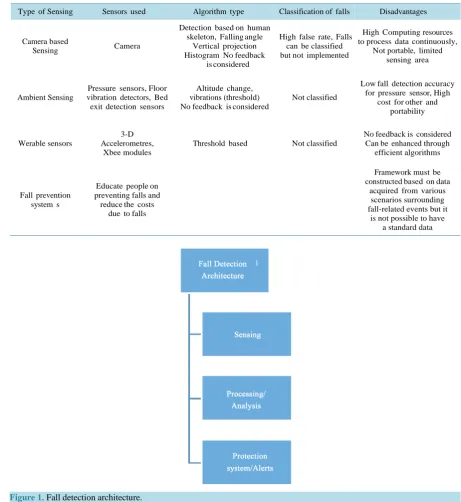
Table 1 compares the various modes of fall detection systems, showing, the classifications and disadvantages. These are useful for the system design.
3. Objectives and Methodologies
Fall detection and fall anticipation frameworks have the same fundamental structural engineering as shown in Figure 1. Both frameworks take after three regular periods of operation: sense, investigation, and alerts/corres- pondence. The fundamental contrast between the two frameworks lies in their investigation stage with contrasts in their gimmick extraction and order calculations. Fall recognition frameworks attempt to discover the event of fall occasions precisely by concentrating the peculiarities from the gained yield signal (s)/information of the sensor (s) and afterward distinguishing fall occasions from different exercises of everyday living (ADL). Then again, fall avoidance frameworks endeavor to anticipate fall occasions ahead of schedule by breaking down the yields of the sensors. Information/signal obtaining, peculiarity extraction and characterization, and correspon-dence for warning are the fundamental steps required for both fall recognition and anticipation frameworks. The number and kind of sensors and warning systems nonetheless, differ from framework to framework. In custo-mary frameworks, discrete fittings segments are utilized for the usage of every unit, though in SP-based frame-works, all obliged units might as of now be in-assembled inside a condition state-of art SP.
3.1. Sensing
This is the first period of any fall recognition and avoidance framework and in this stage, proper physical amounts are sensed or measured utilizing suitable sensors. Present day cellphone accompanies implicit sensors and that is one of the basic explanations behind picking cell phines as an option of ordinary fall detection and safety systems.
3.2. Processing/Analysis
Table 1. Comparison of fall detection systems.
Type of Sensing Sensors used Algorithm type Classification of falls Disadvantages
Camera based
Sensing Camera
Detection based on human skeleton, Falling angle Vertical projection Histogram No feedback
is considered
High false rate, Falls can be classified but not implemented
High Computing resources to process data continuously,
Not portable, limited sensing area
Ambient Sensing
Pressure sensors, Floor vibration detectors, Bed
exit detection sensors
Altitude change, vibrations (threshold) No feedback is considered
Not classified
Low fall detection accuracy for pressure sensor, High
cost for other and portability
Werable sensors
3-D Accelerometres,
Xbee modules
Threshold based Not classified
No feedback is considered Can be enhanced through
efficient algorithms
Fall prevention system s
Educate people on preventing falls and reduce the costs
due to falls
Framework must be constructed based on data
acquired from various scenarios surrounding fall-related events but it
[image:3.595.77.539.98.601.2]is not possible to have a standard data
Figure 1. Fall detection architecture.
analyzed for decision on fall. In this stage, the noteworthy peculiarities are concentrated from the sensor’s yields and preparatory choices are made by classifying and processing those concentrated gimmicks. Most SP-based arrangements, particularly answers for fall recognition, utilize a Threshold-Based Algorithm (TBA). The most basic explanation behind picking TBA’s is that these calculations are less intricate and subsequently require less computational power and resources [5], which serves to lower battery power utilization [6].
versatile edge which changes with client gave parameters, for example, stature, weight and level of action.
3.3. Alerts/Protection Systems
In the wake of asking for a reaction from the client, the framework holds up for a predefined period (regularly ≤ 1 min). On the off chance that the client does not react inside that time, the framework will consider the occa-sion as a fall. Fall recognition frameworks may neglect to discover a genuine fall occaocca-sion consequently. In such cases, a few frameworks provide help (or frenzy) catches, buttons and hence permit clients to look for help physically [9].
Cell phone based frameworks produce a few sorts of notifications to look for assistance from caretakers or for cautioning the clients about an unavoidable fall, for example SMS, automated voice calls, MMS, vibration, Short Message Service (SMS), Multimedia Messaging Service (MMS), and even programmed voice calls [10]. Mes-sages and Twitter informing have additionally been portrayed [11]. Warning mesMes-sages may contain data on time, Global Positioning System (GPS) area (coordinates) [12], and area map [13].
This section describes the hardware and the software specification utilized for the detection. A multi branch algorithm is discussed for classification of fall type and fall detection.
4. System and Application Development
4.1. System Overview
For the design of the system we have used a BOSCHBMA250 3-axis Accelerometer embedded in HTC one smartphone. Application was designed using Eclipse with Android SDK software using android programming (java environment). Since the falling speeds and fall types vary depending on the age, physical structure and falling environment. The system is designed for various sensitivities and thresholds that can be adjusted accordingly.
4.2. Algorithm Design
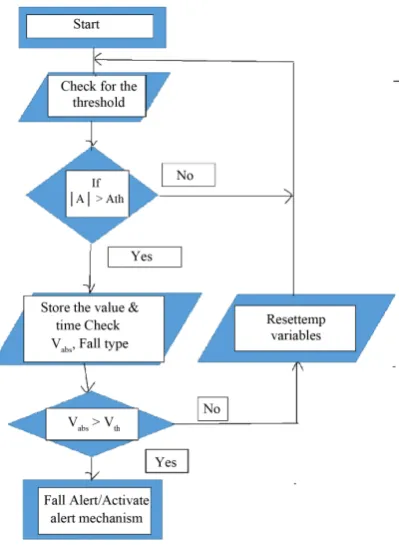
[image:4.595.217.417.431.706.2]The algorithm is designed to detect falls based on the impact thresholds and considering the absolute thresholds. The algorithm is described in the flowchart given in Figure 2.
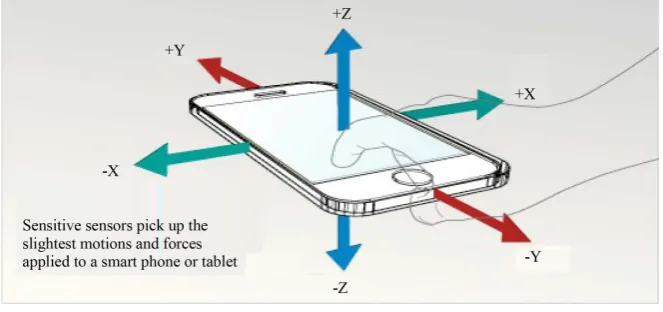
Initially the acceleration on the mobile will be 9.8 m/sec2 in the downward direction depending on the orien-tation of the mobile due to the earth’s graviorien-tational force. Signal magnitude for the acceleration vector is calcu-lated based using the phythogarus relation. The device 3D model followed in the design is given in Figure 3.
For the fall location this essential calculation just uses the module
( )
Ath of the aggregate acceleration of the phone. This module can be processed as:(
2 2 2)
(
2)
m sth x y z
A =Sqrt A + A + A
where Ax, Ay and Az are the quickening readings in headings of x, y, and z-axis measured by the accelerometer that is installed in the cell phone.
A fall is specifically expected if the measured module of the increasing speed surpasses a choice threshold. Consequently, the location choice just considers abrupt crests in the quickening, ignoring the examination of the complex conduct of the increasing speed vector at whatever point a fall happens. As a result, this calculation is inclined to the recognition of false positives.
If the magnitude of acceleration reaches the threshold it saves the orientation of the person and time to a tem-porary varibles. The temtem-porary variable was compared after 400 milliseconds for further confirmation of fall occurrence.
Perfalld calculation all the while considers the estimations of the modules of the aggregate increasing speed AVaba of the device and the speeding up at unquestionably the vertical absolute acceleration (AVaba), which can be
assessed as:
Vabv xsin z ysin y zcos ycos z
A = A
θ
+Aθ
−Aθ
θ
where θy and θz are the measured pitch and move values, which focus the cell telephone’s introduction. These edges are sensed by the gyroscope incorporated in the cell phone.
The calculations were independently investigated, layer by layer. In this way, with a specific end goal to sur-vey the event of a fall, the calculation considers two stages for both parameters.
Linear acceleration of the device is also verified in the detection window to resolve issues related to initial position of the person.
5. Results & Discussion
[image:5.595.147.479.554.710.2]The main aim of the application is to enhance the testing and development capacity of fall detection devices and for analyzing various patterns for different types of falls. This application can also be used readily to detect falls. The working principle of the designed application is an enhanced one for a single sensor fall detection, freely hanging fall detection pendants/devices. The logic is developed using the vector magnitude of the 3 axis of ac-celerometers describes the architecture of the fall detection process. Designed application was tested using HTC one mobile. Keeping the mobile in the side pocket, back pocket and on to the arm and as a pendant to the neck tested the application. The device was tested for front fall, back fall and sudden sit and sleeping. The application
has detected all the falls. One notable feature about the device is it showed a enhanced results and about 90% ef-ficient to reduce the false detection while running, and walking when the device is freely hanging on the chest.
5.1. Experimental Data
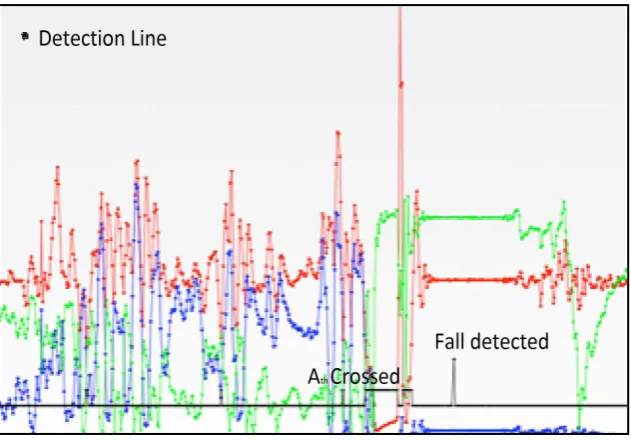
The application is designed to have a chart to display the live data from the sensors and options to select the type of data to be displayed fall detection application was initially developed by plotting the absolute acceleration (red), Absolute vertical acceleration (blue) and the orientation (green) in order to determine multi-level algo-rithms to enhance the fall detection.
Fall detection line (black). Whenever the acceleration threshold is met the detection line is raised to level 1 and then it checks for the orientation and absolute vertical acceleration and linear acceleration to confirm the fall and orientation. Figure 4 below shows the details of the pre-fall signals. The details of the fall orientations are given in Figure 5.
In the above plot clearly explains our concept of confirming the fall by analyzing the orientation the fall after the thresholds are been triggered. This type of approach helps in reducing false detections due to running, walk-ing down on steps etc. This also classifies the fall which helps the rescue team to predict the damage.
Final Application plots the magnitude of acceleration, absolute magnitude and linear acceleration and orienta-tion is programmed internally to find the orientaorienta-tion: front, side, and back.
5.2. Comparison of Efficiency of Algorithm with Existing
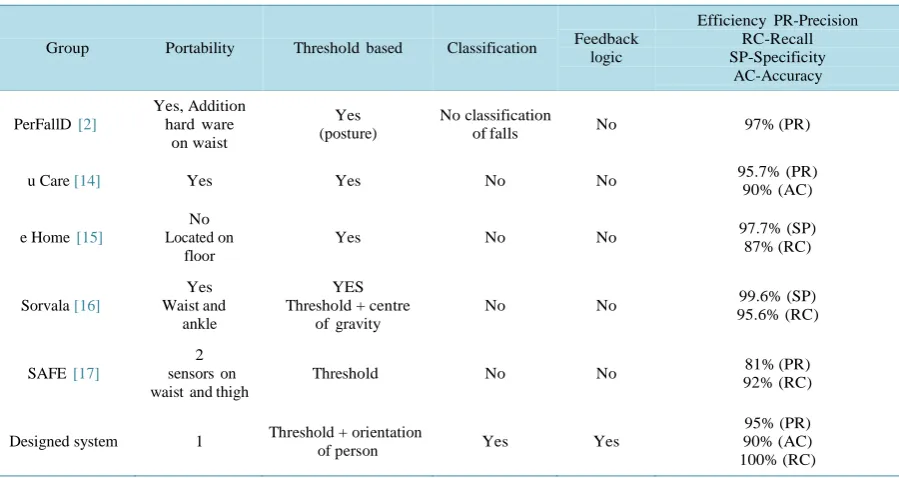
When compared to existing highly efficient applications our algorithm uses the feedback algorithm to confirm the threshold based fall detection by monitoring the posture the body. As given in Table 2, our approach has almost reached the expectations of other devices with almost 100% of recall activity for continuous monitoring. It has a reduced 90% of false detections which enhanced detection efficiency of nearly 95%. This algorithm also classified the falls whether the fall occurred is aback fall front fall or a side fall with a specificity of 90% which need to be further analyzed. This application is developed mainly to test and design a algorithms that can be in-corporated in any embedded system for fall detection. This application will reduce the data analysis time during a project to a great extent. This may be attributed to the high sensitivity of the tri-axial accelerometers within the mobile device [18].
5.3. Reduction of Algorithm Testing Time with This Application
[image:6.595.156.472.485.705.2]One of the important feature of this application is to decrease the algorithm testing time. Since for the development
Figure 5. Signals showing signals that determine the orientation of the
Table 2. Efficiencies of existing systems.
Group Portability Threshold based Classification Feedback logic
Efficiency PR-Precision RC-Recall SP-Specificity
AC-Accuracy
PerFallD [2]
Yes, Addition hard ware
on waist
Yes (posture)
No classification
of falls No 97% (PR)
u Care [14] Yes Yes No No 95.7% (PR) 90% (AC)
e Home [15]
No Located on
floor
Yes No No 97.7% (SP)
87% (RC)
Sorvala [16]
Yes Waist and
ankle
YES Threshold + centre
of gravity
No No 99.6% (SP)
95.6% (RC)
SAFE [17]
2 sensors on waist and thigh
Threshold No No 81% (PR)
92% (RC)
Designed system 1 Threshold + orientation
of person Yes Yes
95% (PR) 90% (AC) 100% (RC)
of wearable fall detection mechanisms the time taken for testing is done in data collection phase and data analy-sis phase where data needs to be processed in a computer for testing the algorithm. The designed application de-picts the required data and results lively, reducing the time to test while developing efficient algorithms and modifying thresholds, moreover modern smartphones are having almost all the sensors for data analysis and ap-plication development.
6. Conclusion and Future Work
A fall detection application for classified fall detection is designed. Moreover this application can also be used for further analysis of fall detection algorithms lively as the graphical data are readily available and reduce the time and effort for the testing and enhancing the logics. In the above-discussed application vector magnitude of 3-axis accelerometer, absolute vector magnitude and the orientation of the sensor are taken into account. This application is mainly designed to reduce the false detection in case of freely hanging detection devices, or parts of the devices that need to be kept on moving. However smartphones are widespread for applications, these de-vices may be limited to usability barriers for elders in addition to the limiting positions of the carriers, waist, wrist, chest, etc., intruding errors that are position-dependent.
References
[1] Sposaro, F. and Tyson, G. (2009) iFall: An Android Application for Fall Monitoring and Response. Proceedings of Annual International Conference of the IEEE Engineering in Medicine and Biology Society, In: Maxwell, J.C., A Trea-tise on Electricity and Magnetism, 3rd Edition, vol. 2. Clarendon, Oxford, 1892, 68-73.
[2] Dai, J., Bai, X., Yang, Z., Shen, Z. and Xuan, D. (2010) PerFallD: A Pervasive Fall Detection System using Mobile Phones. Proceedings of the 8th IEEE International Conference on Pervasive Computing and Communications Work-shops (PERCOM Workshops), Mannheim, 29 March-2 April 2010, 292-297.
[3] Igual, R., Medrano, C. and Plaza, I. (2012) Challenges, Issues and Trends in Fall Detection Systems. Biomedical En-gineering Online, 12, 66.
[4] Albert, M.V., et al. (2012) Fall Classification by Machine Learning Using Mobile Phones. PloS One, 7, e36556. [5] Tacconi, C., Mellone, S. and Chiari, L. (2011) Smartphone-Based Applications for Investigating Falls and Mobility.
Proceedings of the 5th International Conference on Pervasive Computing Technologies for Healthcare ( Pervasive-Health), Dublin, 23-26 May 2011, 258-261. http://dx.doi.org/10.4108/icst.pervasivehealth.2011.246060
the 6th International Conference on Pervasive Technologies Related to Assistive Environments, Rhodes, 28-31 May 2013, Article No. 11. http://dx.doi.org/10.1145/2504335.2504346
[7] He, Y., Li, Y. and Yin, C. (2012) Falling-Incident Detection and Alarm by Smartphone with Multimedia Messaging Service (MMS). E-Health Telecommunication Systems and Networks, 1, 1-5.
[8] Sposaro, F. and Tyson, G. (2009) iFall: An Android Application for Fall Monitoring and Response. Proceedings of the Annual International Conference of the IEEE on Engineering in Medicine and Biology Society (EMBC), Minneapolis, MN, 3-6 September 2009, 6119-6122. http://dx.doi.org/10.1109/iembs.2009.5334912
[9] Lee, J.-V., Chuah, Y.-D. and Chieng, K.T.H. (2013) Smart Elderly Home Monitoring System with an Android Phone.
International Journal of Smart Home, 7, 17-32.
[10] Hansen, T.R., Eklund, J.M., Sprinkle, J., Bajcsy, R. and Sastry, S. (2005) Using Smart Sensors and a Camera Phone to Detect and Verify the Fall of Elderly Persons. Proceedings of the European Medicine, Biology and Engineering Con-ference, Prague, 20-25 November 2005.
[11] Yavuz, G., Kocak, M., Ergun, G., Alemdar, H., Yalcin, H., Incel, O.D. and Ersoy, C. (2010) A Smartphone Based Fall Detector with Online Location Support. Proceedings of the International Workshop on Sensing for App Phones, Zurich, 2 November 2010, 31-35.
[12] Castillo, J.C., Carneiro, D., Serrano-Cuerda, J., Novais, P., Fernández-Caballero, A. and Neves, J. (2013) A Multi- Modal Approach for Activity Classification and Fall Detection. International Journal of Systems Science, 45, 810-824. [13] Bai, Y.-W., Wu, S.-C. and Yu, C.H. (2013) Recognition of Direction of Fall by Smartphone. Proceedings of the 26th
Annual IEEE Canadian Conference on Electrical and Computer Engineering (CCECE), Regina, SK, 5-8 May 2013, 1-6. http://dx.doi.org/10.1109/ccece.2013.6567781
[14] Shi, Y., Shi, Y.C. and Wang, X. (2012) Fall Detection on Mobile Phones Using Features from a Five-Phase Model.
Proceedings of the 9th International Conference on Ubiquitous Intelligence and Computing, and Autonomic and Trusted Computing, Fukuoka, 4-7 September 2012, 951-956. http://dx.doi.org/10.1109/uic-atc.2012.100
[15] Werner, F., Diermaier, J., Panek, P. and Schmid, S. (2011) Fall Detection with Distributed Floor-Mounted Accelero-meters: An Overview of the Development and Evaluation of a Fall Detection System within the Project eHome. Pro-ceedings of the 5th International ICST Conference on Pervasive Computing Technologies for Healthcare, Dublin, 23-26 May 2011, 354-361. http://dx.doi.org/10.4108/icst.pervasivehealth.2011.246088
[16] Sorvala, A., Alasaarela, E., Sorvoja, H. and Myllyla, R. (2012) A Two-Threshold Fall Detection Algorithm for Reduc-ing False Alarms. Proceedings of the 6th International Symposium on Medical Information and Communication Tech-nology (ISMICT), La Jolla, CA, 25-29 March 2012, 1-4. http://dx.doi.org/10.1109/ismict.2012.6203028
[17] Guyon, I. and Elisseeff, A. (2006) An Introduction to Feature Extraction. In: Guyon, I., Nikravesh, M., Gunn, S. and Zadeh, L., Eds., Feature Extraction, Springer Berlin Heidelberg, Zurich, Volume 207, 1-25.
http://dx.doi.org/10.1007/978-3-540-35488-8_1