http://dx.doi.org/10.4236/wjnse.2014.42006
Surface Effect of Silica Nano-Particles with
Different Size on Thermotropic Liquid
Crystalline Polyester Composites
Hiroki Fukatsu1,2, Masaaki Kuno3, Yasuhiro Matsuda3, Shigeru Tasaka1,3
1Graduate School of Science and Engineering, Shizuoka University, Hamamatsu, Japan 2Technical Solution Center, Polyplastics Co., Ltd., Fuji, Japan
3Graduate School of Engineering, Shizuoka University, Hamamatsu, Japan
Email: [email protected]
Received 16 March 2014; revised 16 April 2014; accepted 23 April 2014
Copyright © 2014 by authors and Scientific Research Publishing Inc.
This work is licensed under the Creative Commons Attribution International License (CC BY). http://creativecommons.org/licenses/by/4.0/
Abstract
Interface properties of nano-silica/thermotropic liquid crystalline polyesters (TLCP) composites were investigated by X-ray diffraction analysis and differential scanning calorimetory. The crys-tallinity of TLCP in the composites drastically decreased with an increase of nano-silica content, depending on the surface area of the silica particles. Little size effects (40 - 400 nm) in the par-ticles and strong interaction between silica surface and the C=O moieties of TLCP were observed by IR analysis. The glass transition temperature of TLCP (<20 nm) in silica surface increased about 20˚C higher than that in bulk.
Keywords
Component, Nano-Silica, Thermotropic Crystalline Polyester, Interface, Differential Scanning Calorimetry
1. Introduction
duce the anisotropy of TLCPs [3]-[8]. Bhama and Stupp [7] synthesized a random terpolymer of p-acetoxyben- zoic acid, diacetoxyhydroquine, and pimelic acid, and added CFs to investigate the interfacial structure of this TLCP. The orientation time of the TLCP determined by NMR was decreased by adding only 1 wt% of CFs, and polarizing optical micrographs (POM) of the composites of the TLCP and CFs indicated that the orientation rate of the TLCP was enhanced at the interfacial zones.
Lee et al. [8] prepared composites of a copolymer composed of 70 mol% of 4-hydroxybenzoic acid (HBA) and 30 mol% of 6-hydroxy-2-naphthoic acid (HNA) and GFs. To investigate the influence of chemical interac-tion between TLCP and GFs, they used three types of GFs; GFs treated with γ-methacrylate propyltrimethoxysi-lane (γ-MPS), which reacts with the TLCP, GFs treated with phenyltriethoxysilane (PTS) which does not react with the TLCP, and GFs without any treatments. A thin layer of TLCP with banded optical texture parallel to GFs was identified in the composite of TLCP and untreated GFs based on the experimental results of POM, scanning electron micrography, and X-ray diffractometry (XRD). This thin layer was induced by the guiding, anchoring, and packing effects of GFs. The same thin layer was also observed in the composite of TLCP and GFs treated with γ-MPS, but there was only thinner layer where TLCP randomly arranged in the composites of TLCP and GFs treated with PTS.
The conventional thermal analysis (DSC), X-ray diffraction (XRD) can obtain even enough interface infor-mation to increase the surface area by adding an excess of heterogeneous material in the polymer in our labora-tory. Then unique phenomenon was observed in TLCP and SNPs with different sizes [9]-[11]. Our final purpose is to provide a novel TLCP composite with various fillers which obtained interfacial information by the conven-tional method. Comparing the researches on the influence of adding fiber on the properties of TLCP, there have been much fewer reports on the effect of adding nano-particles on the properties of TLCPs.
It is expected to be difficult for the rigid chains of TLCPs to align at the curved surfaces of nano-particles, while it is easy for the rigid chains of TLCPs to align parallel to the fibers. The rigid chains of TLCPs in compo-sites with nano-particles may be forced to form structure which is different from the structure of TLCPs without fillers. This suggests that the influence of nano-particles on the properties of TLCPs can be different from that of fibers.
In this study, XRD, IR, differential scanning calorimetry (DSC) and dynamic mechanical analysis (DMA) were carried out for composites of a copolymer of HBA and HNA, and SNPs with different sizes to investigate the size effect of SNPs with on the interfacial structural of this TLCP.
This template, created in MS Word 2007, provides authors with most of the formatting specifications needed for preparing electronic versions of their papers. All standard paper components have been specified for three reasons: 1) ease of use when formatting individual papers, 2) automatic compliance to electronic requirements that facilitate the concurrent or later production of electronic products, and 3) conformity of style throughout a journal paper. Margins, column widths, line spacing, and type styles are built-in; examples of the type styles are provided throughout this document and are identified in italic type, within parentheses, following the example. Some components, such as multi-leveled equations, graphics, and tables are not prescribed, although the various table text styles are provided. The formatter will need to create these components, incorporating the applicable criteria that follow.
2. Experimental
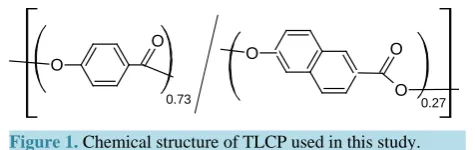
The TLCP used in this study is VECTRA A950 supplied by Polyplastics Co. Ltd, which is composed of 73 mol% of HBA and 27 mol% of HNA. The chemical structure of this TLCP is shown in Figure 1. The weight average molecular weight and molecular weight distribution of VECTRA A950 were reported to be 30,000 [12], and 2.45 [13], respectively. The random sequence distribution of this sample was also confirmed [14]-[19]. SNPs with average diameter of 51 nm were purchased from Kanto Chemical, and those with average diameter of 240 and 485 nm were the products of Amatecs. SNPs were dried for an hour in a vacuum oven heated at 300˚C to remove adsorbed water. The densities of the TLCP and SNPs are 1.4 g∙cm−3, and 2.2 g∙cm−3, respec-tively.
Figure 1. Chemical structure of TLCP used in this study.
and the final rotating torque of mixing was saturated under this condition. The contents of SNPs in the compo-sites were confirmed with a thermogravimetric analyzer (TGA Q-500, TA Instruments). The films of the com-posites for the measurements were prepared by hot-pressing at 300˚C, and then cooled slowly at room tempera-ture.
The thermal properties of the composites were measured with a Q1000 calorimeter manufactured by TA In-struments calibrated with analytical grade indium. The samples were heated and cooled at the rate of 10˚C/min under nitrogen atmosphere. XRD was carried out at room temperature with a RINT2500 manufactured by Ri-gaku using Cu Kα radiation as an X-ray source. Fourier transfer Infrared (FTIR) spectra were obtained using a FTIR-8900 of Shimadzu device of resolution 4 cm−1. Dynamic mechanical measurement (DMA) was performed by a rheometric solids analyzer RSA III (Rheometric Scientific). The measurements were carried out in tensile mode, both the frequency (Fr) and the strain amplitude (γ) are kept constant in each test interval; the only varia-ble parameter is temperature. The samples were heated with a ramp rate of 5˚C/min at constant γ = 0.1% and Fr = 1 Hz under a nitrogen environment.
3. Results and Discussion
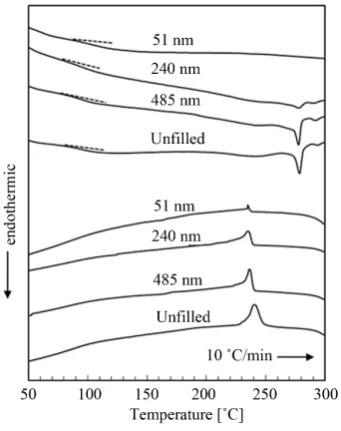
Figure 2 shows XRD patterns for the composites of TLCP and SNPs with different diameters. The fraction of SNPs was fixed to be 50 wt% (39 vol%). The sample designated as “Unfilled” is TLCP without SNPs. The in-tensity of the peak at 19.5˚, which is caused by the psudeohexagonal structure of VECTRA A950 [20] [21], was decreased by adding SNPs. SNPs with smaller diameter decreased the peak intensity more significantly, and the same tendency was also measured for the composites with different weight fraction of SNPs. This result sug-gests smaller SNPs prevent the formation of crystal structure of TLCP. The heating and cooling curves of DSC for the composites of TLCP and SNPs with different diameters are shown in Figure 3. The endothermic peak at 280˚C in the heating curve and exothermic peak at 230˚C in the cooling curve are caused by the phase transition from crystal to nematic and from nematic to crystal, respectively. Both the endothermic peak and exothermic peak became weaker by adding SNPs with smaller diameters. In addition, the abrupt change of the specific heat around 90˚C is caused by the glass transition of the amorphous regions of TLCP. The change of the specific heat around the glass transition temperature (Tg) became more significant by adding SNPs with smaller diameters. Moreover, Tg decreases with an increase of amorphous contents, and increases more than 20˚C with further adding SNPs of 51 nm. These DSC results suggest that smaller SNPs prevent the formation of crystal structure of the TLCP and increase the amorphous region, which was supported by the results of XRD. Figure 4 and
Figure 5 summarize the results of DSC for the composites of the TLCP and SNPs. ΔHm and ΔCp are the heat
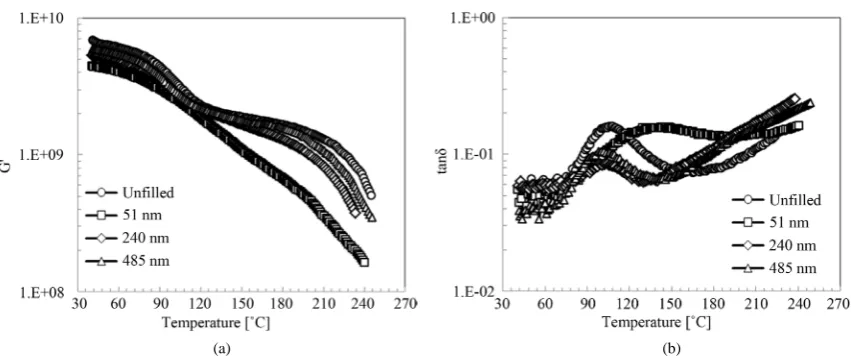
of fusion at 280˚C and the change of the specific heat at 90˚C, respectively. These clearly show a decrease of ΔHm and an increase of ΔCp by adding SNPs, and smaller SNPs was influenced on the changes of ΔHm and ΔCp. The results of XRD and DSC showed that the addition of SNPs to the composite of the TLCP and SNPs prevents the crystallization and induces the formation of amorphous regions of the TLCP, and that these tenden-cies became more significant when SNPs with smaller sizes were used for the sample preparation. This type of interfacial structures has been seen in polyamide/nano-silica composites [22]. Figure 6 shows IR changes of C=O stretching band sift for the composites of TLCP/SNPs. The doublet bands (~1740 cm−1) in TLCP and shift to lower and higher wave numbers with broadening, and changed in strength by mixing with SNPs. This beha-vior has no size dependences of SNPs in range of this experiment. The C=O groups get two states in amorphous. One is a constrained state and the other is a relatively free state. This means that a part of the C=O groups in TLCP chain is strongly bound in the surface of SNPs. Figure 7 shows storage modulus (a) and tanδ (b) for the composites of the TLCP and SNPs with different size as a function of temperature. The storage modulus of smaller SNPs showed much lower and especially drastic decrease over 150˚C. This result showed that stiffness decreased at high temperature due to increase of the amorphous region and decrease of the crystalline region as
O
O
O O
O
Figure 2. XRD patterns of the composites of TLCP and SNPs with different diameters indicated in the figure. The weight fraction of SNPs was fixed to be 50%. The sample designated as “Unfilled” indicates TLCP without SNPs.
Figure 3. DSC curves of the composites of TLCP and SNPs with different diameters indi- cated in the figure. The weight fraction of SNPs was fixed to be 50%. The sample designated as “Unfilled” indicates TLCP without SNPs. The 4 upper curves and 4 lower curves were ob- tained by heating and cooling measurements, respectively.
[image:4.595.213.384.334.550.2]Figure 4. The heat of fusion detected for the composites at 230˚C.
Figure 5. The change of the specific heat of Tg.
[image:5.595.193.404.319.579.2] [image:5.595.192.404.408.684.2](a) (b)
Figure 7. Temperature dependence of (a) storage modulus (G’); (b) tanδ of the composites of TLCP (0.7) and SNPs
(0.3) with different diameters.
When the TLCP chains align parallel to the curved interface of SNPs, the TLCP chains are forced to bend along the curved interface of SNPs. This deformation makes it difficult for the TLCP chains to form crystal structure because the chains of the TLCP without SNPs have high rigidity. We have no definite evidence that the TLCP chains align parallel to the curved interface of SNPs at this time, but there have been many reports that polymer chains of other TLCPs in composites with GFs or CFs aligned parallel to the interface with fibers [8] [9]. The stronger effect for SNPs with smaller sizes to depress the crystallization can be explained by the in-crease of the surface area. The surface area per weight of SNPs with diameter of 51 nm is 4.7 times as large as that of SNPs with diameter of 240 nm, and 9.5 times as large as that of SNPs with diameter of 485 nm. The de-crease of ΔHm for the composites of the TLCP and SNPs with diameters of 240 nm and 485 nm shown inFigure 4
can be explained by assuming that SNPs were completely dispersed in the composites, and that there are interfa-cial phase with thickness of over 100 nm where the TLCP cannot be crystallized. It is generally accepted that the thickness of interfacial phase between polymers and fillers is comparable to the dimension of a single polymer chain, and that the molecular mobility and structure of the polymers at this interfacial phase are different from those of the polymers at the bulk phase. The thick interfacial phase of the TLCP estimated in this study may be caused by the rigidity of the TLCP because rigid polymers usually have larger dimension than flexible polymers. The composite of SNPs with 51 nm has a small ΔHm value, which may be caused by the partial aggregation giving a decrease of the effective surface area of SNPs.
4. Conclusion
In this study, X-ray diffractometry (XRD) and differential scanning calorimetry (DSC) were carried out for composites of TLCP and SNPs with different diameters. Results show that the addition of SNPs to the compo-site of the TLCP and SNPs prevents the crystallization and induces the formation of amorphous regions of the TLCP, and that these tendencies became more significant when SNPs with smaller diameters were used for the sample preparation. This seems to make the strongly bended structure of TLCP molecules with distortion at the interface. The formation of these interfaces is important not only for physical interests, but also for the applica-tion of TLCPs as engineering plastics because the liquid crystalline structure dominates the mechanical proper-ties of TLCPs.
References
[1] Sawyer, L.C., Linstid, H.C. and Romer, M. (1998) Emerging Applications for Neat LCPs. Plastics Engineering (N.Y.),
54, 37-41.
Crystal Polymer. Journal of Materials Science, 21, 2889-2900. http://dx.doi.org/10.1007/BF00551508
[4] Chivers, R.A. and Moore, D.R. (1991) Influence of Fibre Reinforcement on the Mechanical Anisotropy of Liquid Crystal Polymers. Polymer, 32, 2190-2198. http://dx.doi.org/10.1016/0032-3861(91)90045-K
[5] Plummer, C.J.G., Zülle, B., Demarmels, A. and Kausch, H.-H. (1993) The Structure of Filled and Unfilled Thermo-tropic Liquid Crystalline Polymer Injection Moldings. Journal of Applied Polymer Science, 48, 751-766.
http://dx.doi.org/10.1002/app.1993.070480501
[6] Scaffaro, R., Pedretti, U. and La Mantia, F.P. (1996) Effects of Filler Type and Mixing Method on the Physical Proper-ties of a Reinforced Semirigid Liquid Crystal Polymer. European Polymer Journal, 32, 869-875.
http://dx.doi.org/10.1016/0014-3057(96)00009-2
[7] Bhama, S. and Stupp, S.I. (1990) Liquid Crystal Polymer-Carbon Fiber Composites. Molecular Orientation. Polymer Engineering & Science, 30, 228-234. http://dx.doi.org/10.1002/pen.760300406
[8] Lee, W.-G., Hsu, T.-C.J. and Su, A.C. (1994) Interphase Morphology of Liquid Crystalline Polymer/Glass Fiber Composites: Effect of Fiber Surface Treatment. Macromolecules, 27, 6551-6558.
http://dx.doi.org/10.1021/ma00100a046
[9] Zhang, X., Tasaka, S. and Inagakim N. (2000) Surface Mechanical Properties of Low-Molecular-Weight Polystyrene below Its Glass-Transition Temperatures. Journal of Polymer Science Part B: Polymer Physics, 28, 654-658.
http://dx.doi.org/10.1002/(SICI)1099-0488(20000301)38:5%3C654::AID-POLB2%3E3.0.CO;2-Z
[10] Zhang, X., Tasaka, S. and Inagaki, N. (2000) Studies on Surface Molecular Motion of Oligomeric Polystyrene by Differential Scanning Calorimetry. Polymers for Advanced Technologies, 11, 40-47.
http://dx.doi.org/10.1002/(SICI)1099-1581(200001)11:1%3C40::AID-PAT935%3E3.0.CO;2-%23
[11] Zhang, X., Tasaka, S. and Inagaki, N. (2003) Adhesion Behavior of Blends of Polybutadiene and Tackifiers. Journal of Adhesion Science and Technology, 17, 423-434. http://dx.doi.org/10.1163/156856103762864714
[12] Romo-Uribe, A. and Windle, A.H. (1996) “Log-Rolling” Alignment in Main-Chain Thermotropic Liquid Crystalline Polymer Melts under Shear: An In-Situ WAXS Study. Macromolecules, 29, 6246-6255.
http://dx.doi.org/10.1021/ma960211h
[13] Kromer, H., Khun, R., Pielartzik, H., Siebke, W., Eckhardt, V. and Schmidt, M. (1991) Persistence Length and Molecular Mass Distribution of a Thermotropic Main-Chain Liquid-Crystal Polymer. Macromolecules, 24, 1950-1954. http://dx.doi.org/10.1021/ma00008a036
[14] Chivers, R.A., Blackwell, J. and Gutierrez, G.A. (1984) The Structure of Copoly(4-hydroxybenzoic acid/2-hydroxy- 6-naphthoic Acid): 2. An Atomic Model for the Copolyester Chain. Polymer, 25, 435-440.
http://dx.doi.org/10.1016/0032-3861(84)90198-8
[15] Blackwell, J., Gutierrez, G.A. and Chivers, R.A. (1984) Diffraction by Aperiodic Polymer Chains: The Structure of Liquid Crystalline Copolyesters. Macromolecules, 17, 1219-1224. http://dx.doi.org/10.1021/ma00136a019
[16] Blackwell, J., Biswas, A. and Bonart, R.C. (1985) X-Ray Studies of the Structure of Liquid-Crystalline Copolyesters: Treatment of an Atomic Model as a One-Dimensional Paracrystal. Macromolecules, 18, 2126-2130.
http://dx.doi.org/10.1021/ma00153a010
[17] Chivers, R.A. and Blackwell, J. (1985) Three-Dimensional Structure of Copolymers of p-Hydroxybenzoic Acid and 2-Hydroxy-6-Naphthoic Acid: A Model for Diffraction from a Nematic Structure. Polymer, 26, 997-1002.
http://dx.doi.org/10.1016/0032-3861(85)90219-8
[18] Biswas, A. and Blackwell, J. (1987) X-Ray Diffraction from Liquid-Crystalline Copolyesters: Matrix Methods for In- tensity Calculations Using a One-Dimensional Paracrystalline Model. Macromolecules, 20, 2997-3002.
http://dx.doi.org/10.1021/ma00178a008
[19] Mitchell, G.R. and Windle, A.H. (1985) Diffraction from Thermotropic Copolyester Molecules. Colloid and Polymer Science, 263, 230-244. http://dx.doi.org/10.1007/BF01415509
[20] Gutierrez, G.A., Chivers, R.A., Blackwell, J., Stamatoff, J.B. and Yoon, H. (1983) The Structure of Liquid Crystalline Aromatic Copolyesters Prepared from 4-Hydroxybenzoic Acid and 2-Hydroxy-6-Naphthoic Acid. Polymer, 24, 937- 942. http://dx.doi.org/10.1016/0032-3861(83)90141-6
[21] Mitchell, G.R. and Windle, A.H. (1983) Measurement of Molecular Orientation in Thermotropic Liquid Crystalline Polymers. Polymer, 24, 1513-1520. http://dx.doi.org/10.1016/0032-3861(83)90164-7
[22] Achiha, O., Kyogoku, Y., Matsuda, Y. and Tasaka, S. (2012) Interfacial Structure of Composites of Poly(m-xylylen adipamide) and Silica Nano-Particles. Japanese Journal of Applied Physics, 51, 100204-1-3.
http://dx.doi.org/10.1143/JJAP.51.100204
[23] Soga, I. and Granick, S. (2000) Segmental Orientations of Trains versus Loops and Tails: The Adsorbed Polymethyl- methacrylate System When the Surface Coverage Is Incomplete. Colloids and Surface A, 170, 113-117.