How to cite this paper: Sarwa, P., Vijayakumar, R. and Verma, S.K. (2014) Adsorption of Acid Red 66 Dye from Aqueous So-lution by Green Microalgae Acutodesmus obliquus Strain PSV2 Isolated from an Industrial Polluted Site. Open Access Library Journal, 1: e712. http://dx.doi.org/10.4236/oalib.1100712
Adsorption of Acid Red 66 Dye from
Aqueous Solution by Green Microalgae
Acutodesmus obliquus
Strain PSV2 Isolated
from an Industrial Polluted Site
Prakash Sarwa, Ramya Vijayakumar, Sanjay Kumar Verma*Centre for Biotechnology, Department of Biological Sciences, Birla Institute of Technology and Science, Pilani, India
Email: *[email protected]
Received 1 April 2014; revised 14 May 2014; accepted 26 June 2014 Copyright © 2014 by authors and OALib.
This work is licensed under the Creative Commons Attribution International License (CC BY).
http://creativecommons.org/licenses/by/4.0/
Abstract
In the present study, Acutodesmus obliquus strain PSV2 was isolated from a textile and dyeing in-dustrial site and investigated as a cost effective and potential adsorbent for Acid red 66 dye. Batch kinetic experiments were carried out as a function of pH (1.0 - 6.0), contact time (0 - 180 min) and initial dye concentration (10 - 50 mg/L) to determine the decolorization efficiency of microalgae. The maximum adsorption of dye was observed at pH 2.0 during the initial 60 min of contact time. The Langmuir and Freundlich adsorption isotherms were applied to experimental data to investi-gate the efficiency of adsorbent and mechanism of adsorption. It was observed that Langmuir and Freundlich isotherm fitted well with Acid Red 66 dye data. Langmuir isotherm, described maxi-mum adsorption of dye (44.24 mg/g) with good correlation coefficient (r2 = 0.980) while Freun-dlich isotherm showed a high correlation coefficient (r2 = 0.994) with value of n greater than unity (n = 1.27). The present study showed that Acutodesmus obliquus strain PSV2 is an eco friendly and highly efficient adsorbent for removal of acid red 66 dye from dyeing and textile industrial wastewater.
Keywords
Acid red 66 Dye, Microalgae, Acutodesmus obliquus Strain PSV2, Adsorption, Isotherms
Subject Areas: Biotechnology, Environmental Sciences
OALibJ | DOI:10.4236/oalib.1100712 2 June 2014 | Volume 1 | e712 cochemical methods, low cost adsorbents are always preferred and are the major area of research in the last few decades.
The biological technique of adsorption by micro organisms is a cost effective, and efficient alternative for treatment of textile and dyeing industrial wastewater. Various micro organisms such as algae [7], fungi [8], bac-teria [9], etc. act as efficient adsorbents for removal of different types of dye molecules from wastewater. Amongst the microbial biomass, microalgae preferred as a better candidate for adsorption of dye molecules due to its abundance occurrence in all habitats of nature and high surface area to volume ratio. Microalgae can be easily cultivated in a pond without much cost and used for decolorization of dye containing wastewater [10] [11]. Microalgae consist of several functional groups on cell wall such as carboxyl, hydroxyl, amine, sulphate etc. which act as binding sites for dye molecules and helps in adsorption process [12] [13]. Although, wild type mi-crobes isolated from natural habitat are efficient in adsorption of dye molecules but sometimes their adsorption efficiency adversely affected by the toxicity of dyes. The microalgae growing in the close vicinity of industrial contaminated site possess some inherent defense mechanisms to cope up with excessive dye molecules along with high adsorption [12].
With this background, microalgae was isolated from a textile and dye contaminated industrial site and was investigated for the removal of Acid red 66 dye from aqueous solution.
2. Materials and Methods
2.1. Microalgae Isolation and Cultivation
Microalgae was isolated from soil samples collected from textile and dyeing industrial site of Sanganer town si-tuated at 26˚49'N - 26˚59'N and 75˚46'E - 75˚50'E near Jaipur district of Rajasthan, India. Sanganer is worldwide famous for its colorful and printed clothes. In Sanganer, more than 500 small and large scale dyeing and textile industries are involved in manufacturing and dyeing of different types of clothes. The colored wastewater gener-ated by these industries is directly discharged in to the Amani Shah Nallah drainage situgener-ated in the close vicinity of these industries [14]. A microalga was isolated using standard microbiological techniques and axenic cultures were maintained in BG-11 medium under cool-white fluorescent, 1000 lux at 25˚C ± 2˚C [15].
2.2. Identification and Characterization of Microalgae
The axenic cultures of microalga were identified and characterized using microscopy and molecular technique of 18S rRNA sequence analysis (Figure 1) [16]-[18]. After 18S rRNA sequences analysis of microalgae, se-quences were submitted to NCBI Gene Bank and get the Accession no. as JX 519262.1 (Acutodesmus obliquus strain PSV2). The algal strain labeled hereafter as Acutodesmus obliquus.
2.3. Preparation of Adsorbent
OALibJ | DOI:10.4236/oalib.1100712 3 June 2014 | Volume 1 | e712
Figure 1. Microscopy picture of Acutodesmus obliquus strain PSV2.
2.4. Adsorbate
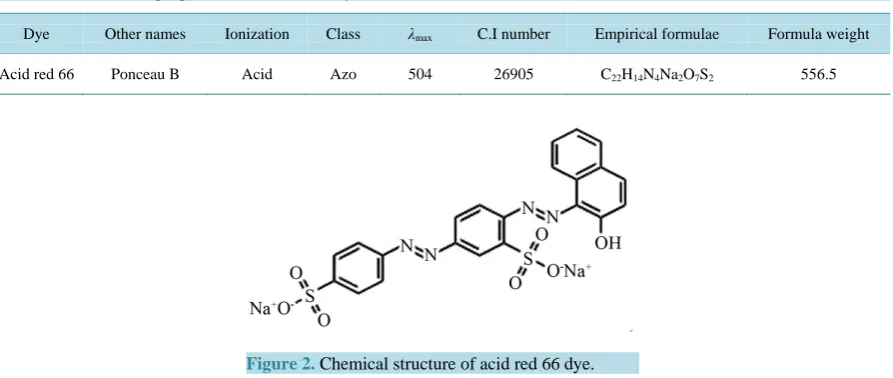
The Acid Red 66 (AR) dye used in this study was procured from Himedia (Mumbai, India). The properties of AR dye are represented in Table 1. Its chemical structure is shown in Figure 2. The chemical is used without any further purification.
2.5. Preparation of Dye Solution and Quantification
1000 mg/L stock solution of AR was prepared by dissolving it in distilled water. Dilutions of the stock solution were prepared according to the experiments. pH of the AR solutions were adjusted by adding either 0.1 M NaOH or 0.1 M HCl.
The concentration of AR before and after adsorption was quantified using UV spectrophotometer at a maxi-mum absorbance (λmax = 504 nm). The concentration of dye in the experimental samples was estimated from the
previously prepared calibration curves.
2.6. Adsorption
The adsorption experiments were conducted in a batch system to study the effect of pH, contact time and initial dye concentration for the removal of AR from aqueous solution. The batch studies were carried out in 250 mL erlenmeyer flasks containing 100 mL dye solution of desired concentration and kept on shaker at a constant speed of 180 rpm at room temperature.
The effect of pH was determined by preparing different pH solutions (range, 1.0 - 6.0) in separate flasks hav-ing dye concentration of 20 mg/L. 0.1 g of dry algal biomass was added in each flask and experiment was car-ried out for 3 hrs. Kinetic studies were carcar-ried out by exposing 0.1 g algal biomass with 20 mg/L dye concentra-tion at pH 2.0. A 5 mL sample was withdrawn from flask at an interval of 5, 15, 30, 60, 120, 150, and 180 min. The dye concentration was analyzed with spectrophotometer as mentioned earlier.
Adsorption equilibrium studies were conducted by adding 0.1 g algal biomass in a series of flasks containing dye concentration in the range of 10, 20, 30, 40 and 50 mg/L at pH 2.0. All flaks were kept on shaker for 3 hrs to reach the equilibrium. Dye concentrations in the flasks after equilibrium were analyzed as mentioned earlier.
2.7. Statistical Analysis
All the experiments were carried out in duplicates and values used in calculations are the arithmetic averages of experimental data. All statistical analysis was done using Sigma plot 8.0 Software.
The amount of dye adsorbed, qe (mg/g), by the algal biomass was calculated using mass balance equation (1),
(
)
1000
i f
e
C C V
q
W −
OALibJ | DOI:10.4236/oalib.1100712 4 June 2014 | Volume 1 | e712
Figure 2. Chemical structure of acid red 66 dye.
where, Ci(mg/L) is the initial dye concentration, Cf (mg/L) is the dye concentration after adsorption, W (g) is the
amount of adsorbent and V (mL) is the volume of the solution.
3. Results and Discussion
3.1. Effect of pHpH of dye solution is an important factor to be considered in adsorption process as it influences the surface charge of the adsorbent and the ionization of dye present in the solution. In a batch system, the effect of pH (range 1.0 - 6.0) was monitored to find out the optimum pH for maximum adsorption of dye molecules from so-lution. Removal of AR dye was found to be increased from pH 1.0 to 2.0 and then decreased on further increas-ing the pH up to 6.0. Maximum adsorption of dye observed at pH 2.0 (8.7 mg/g) with 20 mg/L initial dye con-centration (Figure 3). This pattern of AR adsorption at different pH could be attributed to electrostatic force of attraction between positively charged functional groups on the algal surface and negatively charged dye anion molecules [19]. On increasing the pH beyond 2.0, number of negatively charged group’s increased and positive-ly charged groups decreased on algal surface and thus results in decrement in adsorption at high pH [20]. Similar pattern of adsorption was also observed for reactive red 2 dye [21] and for Congo red dye [22].
3.2. Effect of Contact Time and Initial Dye Concentration
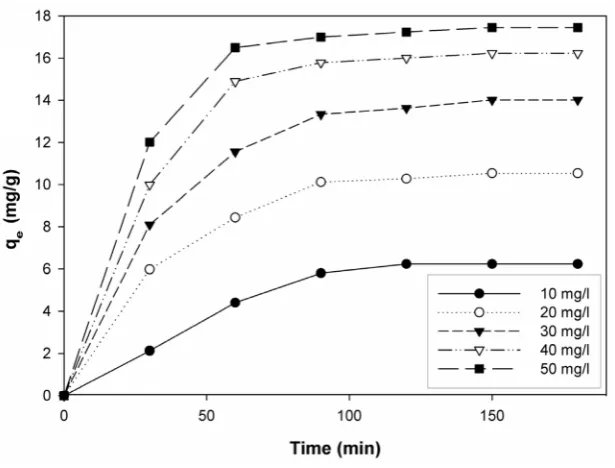
The effect of contact time (0 - 180 min) and initial dye concentration (10 - 50 mg/L) on dye adsorption is represented in Figure 4. The results indicate that AR dye adsorption was rapid for initial 60 min followed by a slower rate of adsorption for next 60 min. Saturation in the adsorption of dye was observed after 120 min of contact time. At higher contact time, AR adsorption decreases and gradually attained equilibrium due to satura-tion and less number of free binding sites on algal surface. Figure 4, clearly depicts the increase in adsorption of AR from 4.4 mg/g to 16.49 mg/g with increase in initial dye concentration from 10 mg/L to 50 mg/L. The in-crease in dye uptake with inin-crease in dye concentration could be attributed to the driving force created by higher initial dye concentration to overcome all resistances of the dye between the aqueous and solid phases, thus in-creasing the uptake. Remazol black B dye adsorption by Aspergillus flavus[23] and Congo red adsorption on organo attapulgite [24] showed similar findings.
3.3. Adsorption Isotherms
[image:4.595.93.540.95.284.2]OALibJ | DOI:10.4236/oalib.1100712 5 June 2014 | Volume 1 | e712
Figure 3. Effect of pH on adsorption of Acid red 66 dye by Acutodesmus obliquus.
Figure 4. Effect of contact time and initial dye concentration on adsorption of Acid red 66 dye by Acutodesmus obliquus.
3.3.1. Langmuir Isotherm
The Langmuir isotherm model represents the homogenous adsorption of adsorbate on adsorbent without any in-teraction with adjacent sites [25]. Its linear form is represented by equation (2)
max max
1
e e
e L
C C
q =q K +q (2)
where Ce is the equilibrium dye concentration in the solution (mg/L), qe is the equilibrium dye uptake on the
adsorbent (mg/g), qmax is the maximum adsorption capacity (mg/g) of the adsorbent, and KL is the Langmuir
[image:5.595.160.468.340.574.2]OALibJ | DOI:10.4236/oalib.1100712 6 June 2014 | Volume 1 | e712 geneity factor which is related to the capacity of the adsorption and Ce is the equilibrium concentration of dye
(mg/L). Figure 6 shows the linear form of Freundlich isotherm for AR adsorption by Acutodesmus obliquus. Freundlich isotherm parameters (Table 2) showed that isolated microalgae is efficient in adsorption of AR dye from aqueous solution with good correlation coefficient. The value of n was found to be greater than unity, showing favorable adsorption of AR on algal biomass. The results are in agreement with findings of Ozacar and Ayhan [29] who reported dye adsorption on pine saw dust.
4. Conclusion
From the present investigation, it was observed that Acutodesmus obliquus strain PSV2 is a highly efficient ad-
Table 2. Isotherm constants for adsorption of Acid red 66 dye by Acutodesmus obliquus.
Langmuir isotherm Freundlich isotherm
qmax (mg/g) KL r2 KF n r2
[image:6.595.88.542.384.703.2]44.24 0.012 0.980 0.811 1.276 0.994
OALibJ | DOI:10.4236/oalib.1100712 7 June 2014 | Volume 1 | e712
Figure 6. Freundlich isotherm for adsorption of Acid Red 66 dye by Acutodesmus ob-liquus.
sorbent for removal of acid red 66 dye from aqueous solution. Batch experiments showed that 1 gram of isolated microalgae can effectively adsorb 44.24 mg of acid red dye at pH 2.0 within 60 min of contact time. Isotherm models depicts the best fit with Freundlich isotherm and represents the heterogeneous adsorption of dye mole-cule on algal surface with high correlation coefficient (r2 = 0.99). The present study concluded that microalgae isolated from an industrial contaminated site are highly efficient in adsorbing dye molecules and can be suc-cessfully employed for treatment of textile and dyeing industrial wastewaters.
Acknowledgements
Authors are thankful to the BITS-Pilani for providing laboratory facilities. The financial assistance in the form of Senior Research Fellowship to Prakash Sarwa by the Council of Scientific and Industrial Research (CSIR), New Delhi, India is highly acknowledged.
References
[1] Mullan, G. (2001) Microbial Decolourization and Degradation of Textile Dyes. Applied Microbiology and Biotech-nology, 56, 81-87. http://dx.doi.org/10.1007/s002530000587
[2] Tunc, Ö., Tanacı, H. and Aksu, Z. (2009) Potential Use of Cotton Plant Wastes for the Removal of Remazol Black B Reactive Dye. Journal of Hazardous Materials, 163, 187-198. http://dx.doi.org/10.1016/j.jhazmat.2008.06.078
[3] Gupta, V.K. and Suhas (2009) Application of Low-Cost Adsorbents for Dye Removal—A Review. Journal of Envi-ronmental Management, 90, 2313-2342. http://dx.doi.org/10.1016/j.jenvman.2008.11.017
[4] Manu, B. and Chaudhari, S. (2002) Anaerobic Decolorization of Simulated Textile Wastewater Containing Azo Dyes.
Bioresource Technology, 82, 225-231. http://dx.doi.org/10.1016/S0960-8524(01)00190-0
[5] Saratale, R.G., Saratale, G.D., Chang, J.S. and Govindwar, S.P. (2009) Decolorization and Biodegradation of Textile Dye Navy Blue HER by Trichosporon beigelii NCIM-3326. Journal of Hazardous Materials, 166, 1421-1428.
http://dx.doi.org/10.1016/j.jhazmat.2008.12.068
[6] Crini, G. (2006) Non-Conventional Low-Cost Adsorbents for Dye Removal: A Review. Bioresource Technology, 97, 1061-1085. http://dx.doi.org/10.1016/j.biortech.2005.05.001
[7] Sarwa, P. and Verma, S.K. (2013) Decolourization of Orange G Dye by Microalgae Acutodesmus obliquus Strain PSV2 Isolated from Textile Industrial Site. International Journal of Applied Sciences and Biotechnology, 1, 247-252.
OALibJ | DOI:10.4236/oalib.1100712 8 June 2014 | Volume 1 | e712
Green Macro Algae Caulerpa scalpelliformis, Journal of Environmental Science and Health Part A, 42, 621-631.
http://dx.doi.org/10.1080/10934520701244383
[14] Mathur, N., Bhatnagar, P. and Verma, H. (2006) Genotoxicity of Vegetables Irrigated by Industrial Wastewater. Jour-nal of Environmental Sciences, 18, 964-968. http://dx.doi.org/10.1016/S1001-0742(06)60022-3
[15] Rippka, R., Deruelles, J., Waterbury, J.B., Herdman, M. and Stanier, R.Y. (1979) Generic Assignments, Strain Histo-ries and Properties of Pure Cultures of Cyanobacteria. Journal of General Microbiology, 111, 1-6.
http://dx.doi.org/10.1099/00221287-111-1-1
[16] Desikachary, T.V. (1959) Cyanophyta. Indian Council of Agriculture Research, New Delhi. [17] Prescott, G.W. (1962) Algae of the Western Great Lakes. Dubuque, Iowa, W. C. Brown Co.
[18] Liu, C., Huang, X., Wang, X., Zhang, X. and Li, G. (2006) Phylogenetic Studies on Two Strains of Antarctic Ice Algae Based on Morphological and Molecular Characteristics. Phycologia, 45, 190-198. http://dx.doi.org/10.2216/03-88.1
[19] Banat, I.M., Nigam, P., Singh, D. and Marchant, R. (1996) Microbial Decolorization of Textile-Dye Containing Efflu-ents: A Review. Bioresource Technology, 58, 217. http://dx.doi.org/10.1016/S0960-8524(96)00113-7
[20] Lora, J.H. and Glasser, W.G. (2002) Recent Industrial Applications of Lignin: A Sustainable Alternative to Nonre-newable Materials. Journal of Polymers and the Environment, 10, 39. http://dx.doi.org/10.1023/A:1021070006895
[21] Renganathan, S., Kalpana, J., Kumar, M.D. and Velan, M. (2009) Equilibrium and Kinetic Studies on the Removal of Reactive Red 2 Dye from an Aqueous Solution Using a Positively Charged Functional Group of the Nymphaea rubra
biosorbent. Clean, 37, 901-907.
[22] Zhou, J.L. and Banks, C.J. (1993) Mechanism of Humic Acid Color Removal from Natural Waters by Fungal Biomass Biosorption. Chemosphere, 27, 607. http://dx.doi.org/10.1016/0045-6535(93)90096-N
[23] Ranjusha, V.P., Pundir, R., Kumar, K., Dastidar, M.G. and Sreekrishanan, T.R. (2010) Biosorption of Remazol Black B Dye (Azo Dye) by the Growing Aspergillus flavus.Journal of Environmental Science and Health Part A, 45,1256- 1263. http://dx.doi.org/10.1080/10934529.2010.493812
[24] Chen, H. and Zhao, J. (2009) Adsorption Study for Removal of Congo Red Anionic Dye Using Organo-Attapulgite.
Adsorption, 15, 381-389. http://dx.doi.org/10.1007/s10450-009-9155-z
[25] Vannela, R. and Verma, S.K. (2006) Cu2+ Removal and Recovery by SpiSORB: Batch Stirred and Up-Flow Packed Bed Columnar Reactor System. Bioprocess Biosystem Engineering, 29, 7-17.
http://dx.doi.org/10.1007/s00449-006-0049-0
[26] Tunali, S., Ozcan, A., Kaynak, Z., Ozcan, A.S. and Akar, T. (2007) Utilization of the Phaseolus vulgaris L. Waste Biomass for Decolorization of the Textile Dye Acid Red 57: Determination of Equilibrium, Kinetic and Thermody-namic Parameters. Journal ofEnvironmental Science and Health Part A, 42, 591-600.
http://dx.doi.org/10.1080/10934520701244359
[27] Freundlich, H.M. (1906) Over the Adsorption in Solution. Journal of Physical ChemistryA, 57, 385-470.
[28] Vannela, R. and Verma, S.K. (2006) Co2+, Cu2+, and Zn2+ Accumulation by Cyanobacterium Spirulina platensis. Bio-technology Progress, 22, 1282-1293. http://dx.doi.org/10.1021/bp060075s
[29] Ozacar, M. and Ayhan, I.S. (2005) Adsorption of Metal Complex Dyes from Aqueous Solutions by Pine Sawdust.