International Journal of Computer Applications (0975 – 8887) Volume 74– No. 21, July 2013
An Emphasizing Approach based on Enhanced
Intuitionistic Fuzzy Logic Segmentation on Objects in
Video Sequences
D.Shanmuga Priyaa
Research Scholar, Karpagam University
S. Karthikeyan
,
Ph.DAssistant Professor, Department of Information Technology, College of Applied Sciences, Sohar,
Sultanate of Oman
ABSTRACT
In this paper, a potential moving object modeling suitable for video surveillance correspondence is introduced. Taking into concern the color and motion features of foreground objects in each independent video stream, the proposed method segments the existing moving objects based on the edge detection method and constructs an intuitionistic fuzzy graph-based structure to maintain the corresponding information of every segment. Using such graph structures reduces our correspondence problem to a subgraph finest isomorphism problem. The proposed approach is robust against diverse resolutions and orientations of objects at each view. This system uses the Intuitionsitc fuzzy logic to employ a human-like color perception in its decision making stage in order to handle color inconstancy. The computational time of the proposed method is made low to be applied in real-time applications. It also performs the similarity measure using the intuitionistic fuzzy logic based distance measure for computing the regions relationship.
Keywords
Region adjacency graph, Fuzzy graph, Intuitionistic fuzzy, subgraph, isomorphism.
1.
INTRODUCTION
The process of partitioning or segmenting an image into multiple segments is also known as superpixels. It simplifies the representation of an image meaningfully and makes analysis easier. Boundaries of objects like lines, curves, etc. in the image can be located using segmentation. Every pixel in an image is labeled using segmentation so that pixels with the same label can share certain visual characteristics. Each pixel in a region is similar with respect to color, intensity, or texture. Adjacent regions are significantly different with respect to the same characteristics.
This concept can be extended to video segmentation to group the pixels into spatio-temporal regions that have consistent appearance and motion. Such segmentation is useful for many tasks such as activity recognition, object tracking, content-based retrieval, and visual enhancement.
One of the most important tasks in computer vision is to find moving objects in image sequences. The moving objects are identified as those pixels in the image that differ significantly from the computed stationary background image. This approach is called as background subtraction method.
2.
RELATED WORK
A new algorithm has been proposed for automatic segmentation of moving objects in image sequences. The approach underlying in the algorithm is to classify regions obtained in an initial partition as foreground or background, based on motion information. The segmentation problem is formulated as detection of moving objects over a static background. Thus, the first step in the algorithm is to compensate the motion of the camera. The global motion is modeled by an eight-parameter perspective motion model and estimated using a robust gradient-based technique [2]. An initial spatial partition of the current frame is obtained by applying the watershed segmentation algorithm. For this purpose, the spatial gradient is estimated initially in the color space [1] through the use of Canny’s gradient [3]. Then, the optimized rainfalling watershed algorithm is applied [4]. Over segmentation is reduced by merging small regions together in a post-processing step based on spatio-temporal information. An object-based representation of video shots is composed by a background still image and moving objects. Moving objects segmentation is based on ego-motion compensation and on background modeling using tools from robust statistics. Mahalanobis distance between region descriptors in two subsequent frames is used for region matching and singular value decomposition is used to compute a set of correspondences satisfying both the principle of proximity and the principle of exclusion. The sequence is represented as a layered graph, and specific techniques are introduced to cope with crossing and occlusions. [5]
3.
PRELIMINARY WORK
3.1
Moving Object Segmentation
The hurdles faced by any motion detection system based on background subtraction are:
Gradual variations of the lighting conditions in the scene.
The small movements of non-static objects such as tree branches and bushes blowing in the wind. Poor quality image due to Noise pres
image.
Permanent variations of the objects in the scene, such as cars that park for a long period or depart after a long period.
Movements of objects in the background that leave parts of it different from the background model Sudden changes in the light conditions, (e.g. sudden
clouding), or the presence of a light switch (the change from daylight to artificial lights in the evening)
Moving of multiple objects in the scene both for long and short periods.
The moving objects are detected by the s regions that are projected by foreground objects
3.2
Region Adjacency Graph
According to region segmentation algorithm
of homogeneous color regions from each frame. Two adjacent regions may form either a same object or two different objects. Region Adjacency Graph (RAG) in image processing is used to represent these relationships.
regions of a frame have several important characteristics as follows:
Each region has its own spatial information represented by a position.
Each region has its own characteristics, such as color and a size of region.
The Region Adjacency Graph is defined as follows:
Given the nth frame fn in a video , a Region Adjacency Graph
of fn, Gr(fn), is a four-tuple Gr(fn)={V,Es,v,
finite set of nodes for the segmented regions in f
Es⊆ V x V is a finite set of spatial edges between
two adjacent node in fn,
ν : V → Av is a finite set of functions generating node attributes, and
∈: Es → A Es is a set of functions generating spatial edge attributes.
A node v ∈V, corresponds to a region r and a spatial edge e ∈ ES, represents a spatial relationship between two adjacent
nodes or regions. The node attributes AV are location
centroid of a region; size s is number of pixels in a region and color mean colors of the corresponding region. The spatial edge attributes AEs, indicate relationships between two
adjacent nodes such as spatial distance d between centroids of two regions and orientation φ is the angle between a line formed by two centroids and horizontal line. The attribute
Moving Object Segmentation
ny motion detection system based on
Gradual variations of the lighting conditions in the
static objects such as tree branches and bushes blowing in the wind. Poor quality image due to Noise present in an
Permanent variations of the objects in the scene, such as cars that park for a long period or depart
Movements of objects in the background that leave parts of it different from the background model.
the light conditions, (e.g. sudden clouding), or the presence of a light switch (the tificial lights in the
objects in the scene both for
The moving objects are detected by the shadow projected by foreground objects.
there are number of homogeneous color regions from each frame. Two adjacent regions may form either a same object or two different objects. Region Adjacency Graph (RAG) in image processing The segmented regions of a frame have several important characteristics as
Each region has its own spatial information
own characteristics, such as
The Region Adjacency Graph is defined as follows:
frame fn in a video , a Region Adjacency Graph )={V,Es,v, ∈}, where V is a finite set of nodes for the segmented regions in fn
V x V is a finite set of spatial edges between
Av is a finite set of functions generating
A Es is a set of functions generating spatial
corresponds to a region r and a spatial edge eS
represents a spatial relationship between two adjacent are location x, y is number of pixels in a region and of the corresponding region. The spatial indicate relationships between two between centroids of angle between a line formed by two centroids and horizontal line. The attribute
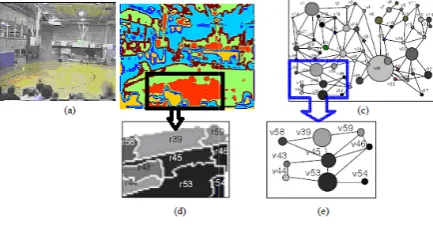
As illustrated in Fig 1, a RAG provides a spatial view of regions in a frame. Fig 1 (a) and
frame and its segmented regions respectively. frame 14 is constructed according to
in Fig 1 (c) as Gr (f14). Each circle indicates a segmented region and the radius, the color, and the center of correspond to the node attributes size (s),
(x; y), respectively. In addition, the length and angle of the edges represent the spatial edge attributes; spatial distance (d) and orientation φ between two adjacent nodes. Fig
(e), enlarge two parts in Fig (b) and (c) respectively to show more details on how to construct a RAG from segmented regions. For example, a region r58 in Fig
v58 in Fig 1 (e) preserving the attributes.
adjacent to two regions (r39 and r45), two spatial edges (eS (v58; v39) and eS (v58; v45)) are created.
Fig 1: (a) Real frame #14, (b) Region segmentation for (a), (c) Gr(f14) for (b), (d) Enlarging a part of (b), and (e)
Enlarging a part of (c).
Similarity between two objects mode
be approximated by measuring subgraph optimal isomorphism of their graphs. Two graphs are said to be isomorphic, if there is a one to one correspondence between their vertices and edges such that incidence relationship is preserved. If the isomorphism is encountered between a graph and a subgraph of another larger graph, then the
isomorphism. Due to changes in direction, size and colors of projections of an object, there will not be
between viewed RAGs of a single object. When nodes of graphs are attributed and perfect matching between a values of graphs is the target
subgraph optimal isomorphism. Therefore
use subgraph optimal isomorphism as similarity measurement. The main drawback of subgraph optimal isomorphism lies in its inherent computational complexity. The subgraph isomorphism problem is known to be NPcomplete, even for planar graphs. Many efforts have been directed to find efficient algorithm for this purpose.
approximate this similarity measurem
introduced in [8]. This method uses minimum cost sequence of elementary graph manipulation operators as similarity measurement between two graphs. These operators which transform one graph say v, into
of:
Deleting a node or an edge from Inserting a node or an edge into
1, a RAG provides a spatial view of and Fig 1 (b) below show a real frame and its segmented regions respectively. A RAG for constructed according to definition and is shown Each circle indicates a segmented the radius, the color, and the center of circle correspond to the node attributes size (s), color and location (x; y), respectively. In addition, the length and angle of the edges represent the spatial edge attributes; spatial distance (d) between two adjacent nodes. Fig 1 (d) and (b) and (c) respectively to show more details on how to construct a RAG from segmented regions. For example, a region r58 in Fig 1 (d) forms a node (e) preserving the attributes. Since a region r58 is acent to two regions (r39 and r45), two spatial edges (eS
(v58; v45)) are created.
(a) Real frame #14, (b) Region segmentation for (a), (c) Gr(f14) for (b), (d) Enlarging a part of (b), and (e)
Enlarging a part of (c).
between two objects modeled in term of RAGs can be approximated by measuring subgraph optimal isomorphism wo graphs are said to be isomorphic, if there is a one to one correspondence between their vertices and edges such that incidence relationship is preserved. If the isomorphism is encountered between a graph and a subgraph of another larger graph, then the problem is called subgraph isomorphism. Due to changes in direction, size and colors of there will not be graph isomorphism between viewed RAGs of a single object. When nodes of graphs are attributed and perfect matching between attributed target, then the problem is called subgraph optimal isomorphism. Therefore, it is more robust to use subgraph optimal isomorphism as similarity measurement. The main drawback of subgraph optimal isomorphism lies in
herent computational complexity. The subgraph isomorphism problem is known to be NPcomplete, even for planar graphs. Many efforts have been directed to find efficient algorithm for this purpose. The fuzzy based approach approximate this similarity measurement by adapting method . This method uses minimum cost sequence of elementary graph manipulation operators as similarity measurement between two graphs. These operators which say v, into another graph, say h, consist
[image:2.595.321.538.286.404.2]International Journal of Computer Applications (0975 – 8887) Volume 74– No. 21, July 2013
According to [8] it is better to decompose the two candidate RAGs to smaller subgraphs called Basic Attributed Relational Graphs (BARG). A BARG is one level tree, including a node (denoted by n) and all its neighbors. [7]
4.
PROPOSED WORK
Defining a suitable membership function to describe an image property is not a trivial task, since it depends on various factors that introduce different types of uncertainties, which finally translate into additional uncertainties about the membership function itself. Therefore, one must carefully seek more flexible, or even intuitive, ways in order to model uncertainty. Due to the imperfect and imprecise information in image segmentation when working with the uncleared edges to identify accurate region this was overcome with the idea of Atanassova’s innovation namely intuitionistic fuzzy Logic which reflects the better aspects of human behavior. A human being, who expresses the degree of belongingness of a given element to a set, does not often express correspondingly degree of non-belongingness as the complement to one. The psychological fact states that, the linguistic negation does not always coincide with the logical negation.
This work aims at providing a flexible environment for image processing, based on the elements of IFSs theory. Images are susceptible of bearing uncertainties associated with the intensity levels of pixels. The origin of this type of uncertainty can be traced back to the acquisition chain or to the noisy environment and the imaging mechanisms. The problem of analyzing/synthesizing the image in/from its corresponding intuitionistic fuzzy components is posed and heuristic, as well as analytical ways are proposed for solving it.
An intuitionistic fuzzy graph with underlying set V is defined to be a pair G = (A;B) where
• The functions µA : V → [0,1] and νA : V →[0,1]
denote the degree of membership of the element x ∈ V, respectively such that 0 ≤ µA (x) + νA (x) 1
for all x ∈ V,
• The functions µB : E ⊆ V x V → [0,1] and νB : E ∈ V
x V → [0,1] are defined by
µB ({x,y}) ≤ min (µA (x), µB (y)) and νB ({x,y}) ≥ max νA (x),
νA (y)) such that 0 ≤µB ({x,y}) νB ({x,y}) ≤ 1 for all {x,y} ∈
E
We call A the intuitionistic fuzzy vertex set of V, B the intuitionistic fuzzy edge set of G, respectively; B is a symmetric intuitionistic fuzzy relation on A. We use the notation xy for an element of E. Thus G = (A,B) is an intuitionistic graph of G* = (V,E) if
µB (xy) ≤ min (µA (x), µB (y)) and νB (xy) ≥ max νA (x), νA
(y)) for all xy ∈ E
The hesitation margin turns out to be important while considering the distances. For the A-IFSs, etc. i.e., the measures that play a crucial role in virtually all information processing tasks. In our further considerations we will use the following distances between fuzzy sets A,B in X = {x1,, . . . , xn} Szmidt and Baldwin [8], [9], Szmidt and Kacprzyk [10], [11]:
The normalized Hamming distance
(
)
(| ( ) ( )| | ( ) ( )| | ( ) ( )|)2 1 ,
1
i B i A i B i A i B i n
i
Ax x v x v x x x
n B A
lIFS =
∑
µ −µ + − +π −π=
and the normalized Euclidean distance
( )
2 2 21/21
) )) ( ) ( ( )) ( ) ( )) ( ) ( ( 2
1 (
, i B i A i B i A i B i
n
i
Ax x v x v x x x
n B A
qIFS =
∑
µ −µ + − +π −π=
For distances (6) and (7) we have 0≤ lIFS
(
A,B)
≤1and(
,)
10≤ qIFS A B ≤ . Clearly these distances satisfy the conditions of metric
Initially each region represents a “single element” subtree and all of them together form a forest. The subtrees with minimum pairwise cost are iteratively merged to form equivalence classes. The merging costs are updated by examining the dissimilarity between the region-members of the examined subtrees and keeping the maximum values. This process is completed in the following steps:
1. Map the Watershed regions onto RAG. 2. Form a forest that comprises of Ninitial subtrees.
3. Repeat until Νfinal subtrees are formed.
4. Find the minimum cost link between subtrees.
5. Merge the corresponding subtrees-regions and reduce total cardinality by 1.
6. Calculate the new merging costs between the subtrees that have been changed. For each pair of subtrees:
7. Calculate the dissimilarity values of the regions-members between the examined subtrees.
8. Find the maximum dissimilarity value.
9. Assign the maximum value to the cost between the subtrees.
10. Map the final subtrees onto the region map.
Each subtree consists of several regions that have been merged in previous iterations. The subtrees’ dissimilarity value is calculated by the maximum of the partial dissimilarities between the subtree regions-members. The final cost may therefore be determined by non-neighboring segments to preserve the transitivity property and produce equivalence classes. According to the theory of Intuitionistic Fuzzy Similarity Relations, an intuitionistic fuzzy equivalence relation is built and the final results are produced by applying lambda-cuts, i.e. hard thresholds, on the dissimilarity values and mapping the forest onto the region map. This Minimax operation is applied to the complete RAG structure of the image, thus the presented algorithm is denoted by RAG-Minimax. In the following paragraph the presented method is tested more extensively for several natural images
5.
EXPERIMENTAL RESULTS
Fig 2: Shows the segmentation, distance function and the Intuitionistic fuzzy based regional adjacency graph for the
[image:4.595.51.276.405.708.2]various video frames
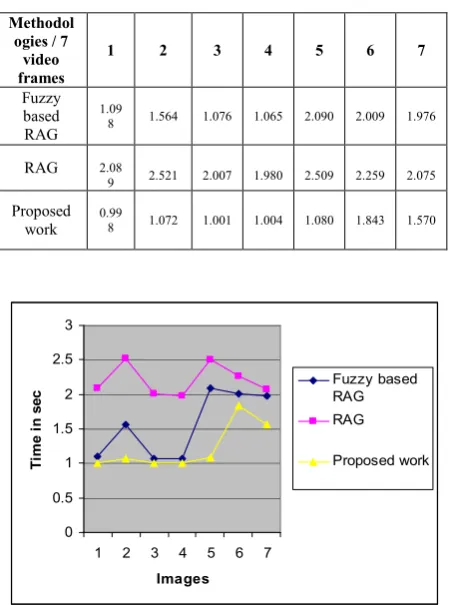
Table 1. Shows the performance of the proposed method with the existing approaches
Methodol ogies / 7 video frames
1 2 3 4 5 6 7
Fuzzy based RAG
1.09
8 1.564 1.076 1.065 2.090 2.009 1.976
RAG 2.08
9 2.521 2.007 1.980 2.509 2.259 2.075
Proposed work
0.99
8 1.072 1.001 1.004 1.080 1.843 1.570
Fig 3: Shows the performance of the various video frames using fuzzy based RAG, RAG and Intuitionistic fuzzy
based RAG methods
From the Table 1 it shows the performance of the proposed approach with other existing techniques based on the time factor. For performance comparison Regional Adjacency Graph and Fuzzy Adjacency Graph is selected. It is revealed that this proposed method takes less time than the existing ones. At the same time the accuracy of determining each objects based on Intuitionistic fuzzy based regional adjacency graph. The problem of segmenting the objects in the edges are easily identified using this method.
Seven video frames are considered for this work. Using Regional Adjacency Graph the highest time taken is 2.509, the lowest time taken is 2.090, using Fuzzy Adjacency Graph the highest time taken is 2.509, the lowest time taken is 1.076, and using the proposed work the highest time taken is 1.843, the lowest time taken is 0.998
6.
CONCLUSION
In this paper segmentation of objects in video frame based on Intuitionistic based Regional adjacency graph is taken into the account. Apart from using fuzzy based regional adjacency graph which takes only the membership value of each pixel of considering the segmentation process to define which the element is and which is the edge of an object, this work takes another degree of freedom into the consideration non-membership degree and the hesitation degree for accurate classification of edges of the objects. The proposed work outperforms the existing ones by considering the hesitation margin also which improves the performance of segmentation much better.
7.
ACKNOWLEDGEMENTS
The authors thank the management of Karpagam University for their kind support to do this article successfully and also they thank their friends for their support.
8.
REFERENCES
[1] Automatic Segmentation of Moving Objects in Video Sequences: A Region Labelling Approach Yaakov Tsaig and Amir Averbuch IEEE Transactions on Circuits And Systems for Video Technology, Vol. 12, No. 7, July 2002
[2] F. Dufaux and J. Konrad, “Efficient, robust and fast global motion estimation for video coding,” IEEE Trans. Image Processing, vol. 9, pp.497–500, 2000.
[3] J. Canny, “A computational approach to edge detection,” IEEE Trans. Pattern Anal. Machine Intell., vol. PAMI-8, pp. 679–698, Nov. 1986.
[4] P. De Smet and D. De Vleeschauwer, “Performance and scalability of a highly optimized rainfalling watershed algorithm,” in Proc. Int. Conf. Imaging Science, Systems and Technology, vol. CISST 98, Las Vegas, NV, July 1998, pp. 266–273.
[5] M. Aprile, A. Colombari, A. Fusiello, V. Murino, Segmentation and Tracking of Multiple Objects In Video Sequences
[6] Matthias Grundmann, Vivek Kwatra, Mei Han, Irfan Essa, Efficient Hierarchical Graph-Based Video Segmentation
[7] Y. El-Sonbaty, and M.A Ismail, “A new algorithm for subgraph optimal isomorphism,” in Trans. On pattern recognition, Vol. 31, No. 2, pp. 205-218, 1998.
0 0.5 1 1.5 2 2.5 3
1 2 3 4 5 6 7
Images
T
im
e
i
n
s
e
c
Fuzzy based RAG
RAG
International Journal of Computer Applications (0975 – 8887) Volume 74– No. 21, July 2013
[8] Szmidt E. and Baldwin J. (2004) Entropy for intuitionistic fuzzy set theory and mass assignment theory. Notes on IFSs, 10 (3), 15–28.
[9] Szmidt E. and Baldwin J. (2006) Intuitionistic Fuzzy Set Functions, Mass Assignment Theory, Possibility Theory and Histograms. 2006 IEEE World Congress on Computational Intelligence, 237–243.
[10]Szmidt E. and Kacprzyk J. (2000) On Measures on Consensus under Intuitionistic Fuzzy Relations. IPMU 2000, 1454–1461