Munich Personal RePEc Archive
Information projection: model and
applications
Madarasz, Kristof
London School of Economics
2008
Online at
https://mpra.ub.uni-muenchen.de/38612/
Information Projection: Model and Applications
KRISTÓF MADARÁSZ London School of Economics
First version received January 2010; Final version accepted September 2011 (Eds.)
Abstract
People exaggerate the extent to which their information is shared with others. This paper introduces the concept of suchinformation projection and provides a simple but
widely applicable model. The key application describes a novel agency con‡ict in a frictionless learning environment. When monitoring with ex-post information, biased evaluators exaggerate how much experts could have known ex-ante and underestimate experts on average. Experts, to defend their reputations, are too eager to base predic-tions on ex-ante information which substitutes for the information jurors independently learn ex-post, and too reluctant to base predictions on ex-ante information which comple-ments the information jurors independently learn ex-post. Instrucomple-ments which mitigate Bayesian agency con‡icts are either ine¤ective or directly back…re. Applications to de-fensive medicine are discussed.
Keywords: Biased Beliefs, Asymmetric Information, Hindsight Bias, Monitoring, De-fensive Medicine.
1
Introduction
Economic analysis commonly assumes that people understand the extent to which their information is private. Evidence from several important domains shows however that people systematically mispredict informational di¤erences. In particular, people too often think as if others knew what they did, and too often act as if others could guess their private information correctly.
Investigations after accidents – such as the collapse of Space Shuttle Challenger in ’86 – not only collect novel information about what went wrong, but cause people to exaggerate how easy it would have been to predict the tragedy ex-ante. Given the ex-post information, it is possible to understand how NASA o¢cials should have interpreted ex-ante facts in a way to avoid the disaster. What many investigators then typically fail to fully appreciate is that such insights are only possible in hindsight.
To understand such behavior more carefully, this paper introduces a simple but widely applicable model of suchinformation projection: people are aware of informational di¤erences
but project their private information, exaggerating the extent to which others have access to the content of their private information.
Section 3 of the paper presents the model. I consider a general environment where people receive signals about an underlying state privately. Having observed a signal s, a person exaggerates the probability with which others have also observed the content of this signal. A person who projects information in this fashion fails to appreciate the extent to which others need to think and act without the information she has. Through a clear identifying property, the model ties together a set of empirically well-documented social mispredictions – hindsight bias (Fischho¤, 1975), curse-of -knowledge (Camerer, Loewenstein and Weber, 1989) or the illusion of transparency (Gilovich, Medvec and Savitsky 1998) – and provides a framework to study their consequences in a uni…ed manner.
The main application of the model is to the classic problem of performance evaluation. Examples are ubiquitous: corporate boards need to learn about the talent of CEOs, gov-ernments about the e¤ectiveness of their intelligence agencies or their police force, patients about the quality of physicians etc. I show that information projection here gives rise to a novel form of agency con‡ict. Biased evaluators using ex-post information will underestimate the quality of experts. Experts in turn will have incentives to engage in speci…c defensive practices.
To illustrate this agency con‡ict, consider a medical example. Radiologists di¤er in skill; even when all have access to the same radiograph, the best ones hardly ever miss a tumor when it is visible on the X-ray while bad ones often do. Initially, all radiologist recommend a treatment based on an ambiguous X-ray s0. Once the recommendation is adopted and
results are in, an evaluator reviews the case.
The evaluator now has access to information s1 which was unavailable ex-ante: interim
medical outcomes are realized and new X-rays are ordered. A small tumor is typically di¢cult to spot on an initial X-ray. When the location of a major tumor is known ex-post, however, all radiologists have a much better chance of …nding the small one on the original X-ray. A biased evaluator thinks as if such ex-post information had already been available ex-ante. By projecting this information, the evaluator is thus too surprised when observing that the treatment failed and too often interprets a success to be the norm. Hence she underestimates the radiologist’s competence on average.
Evidence from law and medicine suggests that professionals do fear such underestimation and respond to it strategically. In medicine, the fear of the ’retrospectroscope’ refers to exactly such anticipation. To describe the possible strategic responses, let’s return to the medical example. In addition to the X-ray, the radiologist now has to decide what other tests s0
0 to run. He knows that independent of his choice evaluators will learn some novel
information s1 ex-post. How does the anticipation that evaluators will project s1 when
assessing his competence ex-post alter the radiologist’s incentives to produce an additional test ex-ante?
decreases how much additional information s1 reveals ex-post. A second MRI on a broken
bone contributes less to a successful diagnosis than the …rst one. If ordering an MRI ex-post is a likely event, the radiologist will have an incentive to order an MRI ex-ante even if the initial X-ray would have been medically su¢cient. In this manner, physicians might take too many biopsies, expose patients to too much radiation, or recommend surgery too often so that their ex-ante predictions appear less incompetent in hindsight.
An ex-ante test instead complements the ex-post information if knowings0
0 increases how
much additional informations1reveals ex-post. Suppose a social worker can make a valuable,
but still ambiguous, phone call to a foster family. Evaluators will ultimately always learn whether a child was injured, but this can only con…rm child abuse once combined with the content of the ex-ante phone call. Ironically, the social worker will enjoy a higher professional reputation if she does not make the phone call ex-ante. In this manner, engineers will be reluctant to record equivocal forecasts of catastrophes, and physicians will be reluctant to order vague radiological charts if they fear that ex-post biased evaluators will interpret these pieces of information as clean ex-ante evidence.
The above responses describe an agency con‡ict where increased ex-post scrutiny or stronger reputational incentives induce agents to distort the composition of the ex-ante pro-duced information from complement to substitute signals. Solutions that correct for standard agency con‡icts are either ine¤ective or may directly back…re. Instead, limiting monitoring can help restore e¢ciency. I specify conditions under which reputations formed on the ba-sis of monitoring successful cases more intensely than failed cases mitigate a radiologist’s incentives to engage in the above defensive practices.
The predictions of the model are consistent with evidence from defensive medicine,
de-…ned as medical practices adopted to minimize false liability rather than maximize cost-e¤ective health care. Studdert et al. (2005) show, that to protect their reputation, a vast majority of physicians engage in both the over-production and under-production of skill-intensive medical tests. Kessler and McClellan (1996, 2000) show that weaker liability pres-sure lowers medical costs but not the over-all quality of care, and that this occurs primarily through changes in diagnostic practices.
The paper is structured as follows. Section 2 summarizes evidence for the model which is presented in Section 3. Sections 4 describes the agency con‡ict. Section 5 discusses the robustness of the results and how selective monitoring can help mitigate this con‡ict. Section 6 provides a second application of the model to communication. Here the model provides a rationale for the use of communication protocols to improve information transmission and fairness at the workplace. Section 7 concludes.
2
Evidence
for the model.1
Informational asymmetries are inevitable when people learn over time. Here projection bias implies that those exposed to superior information in the present exaggerate how well others in the past could have predicted their current information. In a between-subject design, Fischho¤ (1975) showed that no matter which outcome of an uncertain event was reported ex-post, this signi…cantly increased how likely people thought that this event would occur ex-ante. Such hindsight bias is the most widely documented mistake in the judgment
literature. Hundreds of studies using various paradigms and debiasing techniques provide overwhelming support for Fischho¤’s original …ndings. For recent surveys see Rachlinski (1998) or Guilbault et al. (2004).
A signi…cant number of studies with professionals con…rm the prevalence of hindsight bias outside the lab. Among many others, Arkes et al. (1981) document signi…cant hindsight bias in a sample of 75 practicing physicians. In a study with 121anesthesiologists judging actual medical cases, Caplan et al. (1991) document the bias in ruling ex-ante negligence. In law, Anderson et al. (1997) demonstrate strong e¤ects with practicing judges, and Hastie et al. (1999) show dramatic hindsight bias with jury eligible citizens. Baron and Hersey (1988) demonstrate the same e¤ect when the ex-post information is simply the outcome of an objective lottery and the ex-ante choice is between monetary gambles.
Simultaneous exchanges are also ripe with informational asymmetries and evidence con-…rms projection in these domains as well. Newton (1990) provides an illustrative study in the context of communication. Subjects were randomly assigned to be tappers or listeners. Tappers privately picked a song from a public list and tapped out its rhythm in front of the listeners. Out of the 120 songs tapped, listeners correctly identi…ed only 2:5%. After
tapping, tappers were asked to predict these odds and the mean prediction was around50%:
Information projection here explains a twenty-fold overestimation. Informed bystanders who knew the selected song, but only listened to the tapping, also vastly overestimated the success rate (Heath and Staudenmayer, 2000), while uninformed bystanders did not, (Keysar and Henly, 2002). The same e¤ects were established in direct verbal communication, (Keysar and Henly, 2002), and email communication, (Kruger et al., 2005).
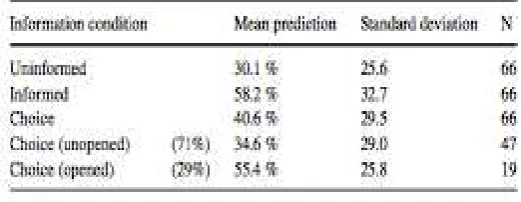
The quality of the tapper’s action directly a¤ects informational di¤erences in these ex-periments, but evidence suggests that people project private information in exchanges where di¤erences are …xed and people do not need to judge the quality of information transmission. In a study by Loewenstein, Moore and Weber (2006), subjects had to spot the di¤erence between two pictures. They were divided into three groups: an uninformed group with sub-jects who received no further information, an informed group with subsub-jects who were told the di¤erence, and a third group with subjects who could choose to learn the di¤erence for a fee. In all treatments, subjects had to guess the fraction of people who would correctly identify the di¤erence in the uninformed condition. Subjects were paid for the accuracy of
their predictions.
The true fraction was 20%. As Figure 1 indicates, informed subjects greatly overesti-mated this fraction relative to uninformed subjects. A signi…cant proportion of subjects
Figure 1: Loewenstein, Moore, and Weber (2006).
paid to learn the di¤erence, producing more biased estimates (55% versus 30%) and hence systematically lowered their earnings. Thus people not only acted as if they projected their
private information, but also paid for information that only biased their judgments.2
In the context of …nancial markets, Camerer, Loewenstein and Weber (1989) provide support for information projection. Subjects traded assets via a double-oral auction in two distinct markets. In the …rst, subjects were only told the past performance of the traded companies and asset returns were determined by current performance. In the second, subjects learned actual earnings as well, but here asset returns were determined by the prices established in the …rst market. The prices in the second market were biased by30%towards the actual earnings and individual judgments were biased by 60%: Traders with a smaller bias traded more aggressively, as if anticipating the bias of others. Camerer (1992) – also a precursor to LMW – con…rmed the …ndings of CLW, but showed that some subjects learned to avoid biasing information. When traders had the option to bid for extra information, bids started high, but converged to zero after a few repetitions. A few subjects even bid negative, indicating some awareness of potential information projection that is hard to reverse or resist. Finally, a set of other psychological mispredictions indicates that people project private information about their internal states as well. Gilovich, Medvec and Savitsky (1998, 2000) show that people greatly overestimate the probability that their emotions are detected by others or that their lies, once made, will be discovered.
2.1 Related Literature
To the best of my knowledge, the current paper is the …rst to introduce a model of infor-mation projection. The closest to my paper is the study of CLW (1989) who introduce an incomplete model of anchoring to explain their data. Although both their model of anchored expectations and the model of information projection explain these speci…c results, anchored expectations are generally inconsistent with information projection. A person who is an-chored to his own beliefs would typically violate information projection and vice versa. I
2Similar results were established for non-visual tasks such as the solution of a logical puzzle. To control
formally demonstrate this in the Appendix.
Biais and Weber (2009) complete the anchoring approach of CLW and o¤er a model of intrapersonal hindsight bias. There people correctly remember the variance of their past beliefs but misremember the mean. The authors specify conditions under which this leads to under-reacting to …nancial news and o¤er empirical support using investment bankers from London and Frankfurt. Mangelsdor¤ and Weber (1998) also follow the anchoring approach of CLW and provide a formal example of hindsight bias in the context where an agent chooses between binary lotteries.3
This paper also complements a recent literature on limited strategic reasoning in Bayesian games, (Eyster and Rabin, 2005), (Koessler and Jehiel, 2008). In these models, people’s aver-age beliefs are correct and people predict information di¤erences correctly, but fail to appreci-ate how much others condition their actions on their true privappreci-ate information. More broadly, this paper also relates to cognitive hierarchy approaches to strategic thinking, (Camerer, Ho and Chong, 2004) or (Crawford, Costa-Gomes and Iriberri 2010), where people have simpli-…ed models of the depth of reasoning by others.
3
Model
Consider an environment where people privately observe signals about the payo¤-relevant state! 2 . A signal is a function from the …nite set of states to the set of lotteries over a realization space, sj : ! Z. Signals are interpreted given a common prior 0 over the
state space. There are N signals and M people. Person k’s actual information is the set of signalsSk whose realizations she knows. The set of all possible information sets isN which
is the power set ofN:
To characterize the distribution of information, letpk
j 2(0;1]denote the initial probability that person k observes the realization of signal sj. Let us collect these probabilities over signals and across people into a vector p=ffpkjgjN=1gMk=1:This vector p describes the true
distribution of information in the environment. Each sub-vectorpk=fpkjgNj=1is a probability
distribution over N. An unambiguous increase in person’s k information is a change in the
sub-vector pk which weakly increases each of its components. In turn, the informational
environment can be summarized by the tuple =f ; ;fsjgNj=1; pg.
3.1 De…nition
The vector p determines the true distribution of signals and corresponds to rational
expec-tations. Information projection introduces a bias in these expecexpec-tations. A biased person exaggerates the probability that the signals whose realizations she knows are also in the information set of others. I introduce a parameter 2 [0;1] to express the degree of such
mistaken information projection.
De…nition 1 Person k with information set Sk exhibits information projection of degree
>0 if her perception of personi0s information distribution is given by pi( ) where
pij( ) = (1 )pij+ if sj 2Sk andpij( ) =pij if sj 2= Sk (1)
By projecting information, a person misperceives the distribution of information. Under full information projection, = 1, a person believes that all the information she knows is shared with others. In the case of partial information projection, 0 < < 1, she believes
that the probability that her information is available to others is between the truth and the full projection case. Finally, = 0 corresponds to correct expectations.4 Some remarks are
in order:
The degree of projection in above is uniform across signals. This is for notational simplicity only and the model immediately extends to heterogenous projection. There, the degree of projection is a vector, rather than a scalar. Formally, if k
j is the degree to which personk projects signalj, then collecting these terms into a vector k is person
k’s generalized degree of projection. Here an increase in the bias is an increase in any
component of this vector. All results extend to heterogenous projection.
The de…nition is formulated without explicit reference to time. If a di¤erent identity is assigned to the past or future selves of person i, then the de…nition claims that a biased person projects her current information onto the past or future selves of person
i. Thus a biased person exaggerates the extent to which person i has observed the
content of her information in the past or that he will know/remember her information in the future.
The de…nition adopts a simple linear form, but it is su¢cient to assume that pij( )
continuously increases in in the interval [pij;1]:Any functional form which satis…es
this will lead to the same predictions as those described in this paper.
While the literal meaning of the de…nition is that people exaggerate the probability that others observe their signals, in a more general interpretation people exaggerate the probability that the information content of their signals is re‡ected in the information available to others. Here projecting information is not a false belief about how public information transmission is but rather the extent to which one’s own views are the re‡ection of truly private information.
It is both intuitive and psychologically realistic that some types of information are more likely to be projected than others. While the model provides no a prior predictions on the degree to which a particular piece of information is subject to projection relative to another piece, it provides a potentially useful framework to establish such claims
4The model can be extended by allowingp to depend on the state !and hence to be state-dependent
random variables rather than state-independent parameters. In this formulation,p(!)is a projector’s updated belief about the distribution of information after receiving signals. The de…nition then can be applied to this updated vectorpi(!)in the same way as above. The model thus can be interpreted as one where people have
empirically. Importantly, for the purposes of this paper, the way in which information
di¤erences in are partitioned into di¤erent signals will matter neither for the key properties of the model nor for the main results derived in the context of the applica-tions. As I show this in Section 3.3, both of these will depend only on the fact that
0.
3.2 A Dinner Party
To illustrate the model, I turn to a simple example. Tanya is invited for dinner. Alex is her host and either prepares …sh or meat. If Alex is kind, his goal is to prepare Tanya’s favorite. If sel…sh or unkind, he cares only about his own taste. Tanya and Alex know their own tastes, but not the other party’s. Initially, Alex is equally likely to be kind or sel…sh and independently, he is equally likely to prefer …sh or meat.
Alex privately receives a noisy signal about Tanya’s taste. This signal conveys her true preference over …sh and meat 2
3 of the time, and the false one 13 of the time. The table below
summarizes the inferences of a Bayesian and a fully biased Tanya.
Bayesian, = 0 Fully biased, = 1
1( kindjx= right dish) = 2=23+1+2=3+2=3=3 = 47 1+1+11+1 = 23
1( kindjx=wrong dish) = 1=13+1+1=3+1=3=3 = 25 01 = 0
E 1( kind) = 127 47+125 25 = 12 127 23 = 187
Tanya makes two types of inferential mistakes: over-inferenceandunderestimation. First,
she overinfers kindness when served the meal she likes, and hostility when served the meal she dislikes. Second, Tanya underestimates Alex’s kindness on average.
To understand the …rst e¤ect, note that Tanya wrongly believes that Alex knows her taste for sure. She thus too often concludes that good intentions result in good outcomes and bad intentions in bad outcomes, and as a result, misattributes di¤erences in tastes to di¤erences in social intentions. On average, she attributes too much kindness to Alex if the two have the same taste, and too much hostility to Alex if their tastes di¤er. Numerically,
= 0 = 1
E 1( kindjsimilar taste) = 56 47 +61 25 = 1935 56 23 = 59
To understand the second e¤ect, note that the two overinference distortions don’t cancel each other out. The excess negative attribution is always larger than the excess positive attribution. Since a biased Tanya exaggerates how often a kind Alex serves the right dish, she expects to be served the dish she likes too often and underestimates Alex’s kindness on average. Such underestimation is a key mechanism for this paper. Similar calculations show that because Tanya also exaggerates how often Alex serves the right dish if their tastes coincide, she also underestimates the similarity their tastes an average.
In short, Tanya misattributes di¤erences in tastes to di¤erences in social intentions and underestimates both the kindness and the similarity of Alex on average. While the ex-ante expected Bayesian posterior is uniform, the biased one isf ks= 367 ; kd = 367; us= 367 ; ud=
15
36g. Tanya and Alex might then too often depart as foes rather than friends.
3.3 Information and Underestimation
Let’s return to the de…nition. As mentioned before, a key identifying property of the model is determined alone by the claim that >0. Below I show that this is true because, independent
of further details of the informational environment, by exaggerating the probability that Alex observes her signals, Tanya exaggerates how much Alex knows about the state. To make the above statement precise, suppose Alex maximizes a bounded and state-dependent von Neumann-Morgenstern utility function over a …nite action-set given information S N.
Formally, his expected payo¤ is:
u (S) = max
y E [uA(y; !)jS] (2)
Since Alex may receive signals privately, from Tanya’s perspective u (S) is a random variable distributed over N. A rational Tanya has correct beliefs about this distribution. A
fully biased Tanya instead wrongly believes that Alex maximizes his expected utility after combining the signals he truly observes with whatever signals she observes. Since more information always allows one to achieve a greater expected utility, Tanya misperceives this distribution and exaggerates how well Alex can achieve his objectives.
Let (u )2 Nbe a privately informed -biased Tanya’s belief about the distribution
of Alex’s expected payo¤. The next result shows that a biased Tanya always exaggerates Alex’s expected payo¤ and this exaggeration is increasing in her information.
Lemma 1 For all p, (u ) …rst-order stochastically dominates 0(u ) if > 0. If p=bp
except that pT anya pbT anya, then (u ) fosd b (u ) for all >0.
This lemma helps identify the model.5 First, it shows that greater information projection
leads to a greater exaggeration of a projectee’s payo¤. Second it shows that holding a projector’s bias constant, increasing a projector’s information leads to greater exaggeration. Since the comparative static is based purely on increasing the projector’s information, the
5The proof of this lemma is an application of the classic result of Blackwell (1953) on the comparison of
above result depends neither on the details of how information is distributed nor on how informational di¤erences are partitioned into signals. Speci…c restrictions on the environment , motivated by economic or psychological considerations, might be imposed on the signal structure and such restrictions will enrich the predictions of the model, but will not change the above result.6
Lemma 1 is useful to establish a general consequence of information projection to inference problems. In the dinner example, Tanya underestimated both the kindness and the similarity of Alex. To establish a similar result more generally, I consider a slightly more abstract setup. A reader not interested in a more abstract treatment can simply skip the analysis below. I re-state the relevant insights and provide intuition in the context of the applications.
Suppose Alex’s type is drawn from Rgiven a continuous prior 0( ):His preferences
may again depend on his type, but the set of signals he observes do not. Alex’s action y
results in an outcome x2X R whereX is …nite. Tanya observes only x, but both Alex
and Tanya might have private information about the state!:
I impose two assumptions on the distribution of the outcome. First, the dependence of the outcome distribution on Alex’s type and information can be su¢ciently expressed by a set of conditional distribution functions
(xj ; u (S)) : R! X
where u (S) is Alex’s expected payo¤ integrated over his type-dependent expected payo¤s
using the prior 0( ). Although this one-dimensional dependence of the outcome on Alex’s
information may seem restrictive, because observing more signals implies a higher expected utility for all types, monotone changes in information will a¤ect u in a monotone
man-ner as well. Furthermore, as Lemma 1 showed, information projection causes a monotone misperception of the value of Alex’s information in maximizing his payo¤. Second, the out-come process (xj ; u (S))satis…es the monotone-likelihood ratio property in and in the
quantityu . The formal de…nition is adopted from Milgrom (1981).
Condition 1 A set of densities (xj ; u (S))satis…es MLRP in if for allpand all > 0
and x > x0;
(xj ) (x0 j ) >
(xj 0)
(x0j 0) (3)
where for a …xed , (x j ) = Ep[ (x j ; u (S))]. The analogous condition holds for all
u > u 0:
The next result shows that if the above assumptions are satis…ed, Tanya’s expected inference about Alex’s type is decreasing in her bias. This result uses Lemma 1, which allows me to express the consequences of information projection in terms of Tanya’s exaggeration of the distribution ofu .
6In the Appendix, I show that this robust exaggeration of how much a projectee knows distinguishes my
Theorem 1 For all 0( ), Ep[ 1( )] decreases in in the sense of fosd where expectations
are taken with respect to the true distribution of signals. If p=pbexcept that pT pbT, then
Ep[ 1( )] fosd Epb[ 1( )] for all >0.
Since both more information and higher types shift the distribution of outcomes upwards, by exaggerating Alex’s information, Tanya expects a higher outcome distribution than she should. This way, she is too surprised observing outcomes below any particular level. She always overweighs how much information low outcomes reveal and hence underweighs how much high outcomes reveal about Alex’s type. As long as higher types increase the outcome distributions more, she underestimates Alex’s type on average.
Above, I assumed that a higher outcome is good news about Alex’s quality . Since the results depend only on the monotonicity assumption, when a higher outcome is bad news about – in the sense of Milgrom (1981) – a biased observer will overestimate on average, and whenx is neutral about ; no average misestimation is implied by information projection.
3.4 Substitute and Complement Information
Key comparative statics of the model will depend on how the value of the projected in-formation relates to Alex’s true inin-formation. I introduce an important distinction between complement and substitute information. I call two signals substitutes if the additional value of one decreases once the other is know. I call two signals complements if the opposite is true.
Suppose one needs to …nd a house in London. The street address and the full post code are substitute signals. In contrast, the latitude and the longitude coordinates of its location are complements. Only once both are know, does one have a reasonable chance of …nding it.
De…nition 2 Given u(!; y), two signals sl and sj are substitutes if u (sl[sj) u (sj) <
u (sl) u (;) and complements if u (sl[sj) u (sj)> u (sl) u (;). 7
Finally, people may anticipate the bias of others. Let the probability density function
i;k( ) 2 [0;1] describe the beliefs of person i about how much person k 6= i projects information. If i is not concentrated on 0, person i believes that there is a non-zero probability that personk is biased.
4
Defensive Agency
A supervisor evaluates an agent whose task involves processing information. To …x ideas, a radiologist receives a noisyX-ray s0, or set of radiographsS0, on the condition of the patient
!and is asked to recommend a treatmenty:A state- and action-dependent stochastic process
(xj!; y), leads to a success xS or a failurexF.
7Since information need not be continous, the appropriate de…nitions are in terms of super- and sub
Radiologists di¤er in skill. A radiologist’s ability to interpret the X ray correctly depends on his type 2[0;1]distributed according to 0. I assume that for any …xed set of
ex-ante radiographsS0, a higher type can identify the true state more often and that adding
a signal toS0 weakly increases this probability for all types.8
The evaluator observes the realization ofxalong with some novel informations1about!.
The evaluator uses all her information to learn about the radiologist’ talent. Since observing an outcome, particularly whether a treatment failed or succeeded, typically provides plenty novel medical information about the patient, this assumption is both natural and very weak. Furthermore, since the outcome process is state-dependent, in the standard Bayesian setting, this helps the evaluator to form better estimates of . Let’s denote the evaluator’s ex-post assessment by 1
To close the model, I assume that the radiologist prefers a higher reputation to a lower and thus maximizes an increasing function of the evaluator’s posteriorb( 1), whereb( 1) b( 01)
whenever 1 fosd 01. If this is commonly known, then in the e¢cient Bayesian equilibrium
of this game, the radiologist o¤ers a recommendationy which maximizes the probability of success given his beliefs about the patient 1,
y 2arg max
Y E 1[ (xS j!; y)] (4) and given her beliefs about! and the distribution of information, the evaluator updates her assessment of via Bayes rule.
4.1 Monitoring and Reputations
A Bayesian evaluator usess1 only to learn more about the ex-ante task. A biased evaluator
also projects s1 and exaggerates the ex-ante probability of success for all types. I call the
proportional exaggeration of this probability for a speci…c type the value of the information gap for this type. Formally, given Eq.(4):
g = (xsj ; s0; s1) (xsj ; s0)
with g being the probabilistic average of g given the prior on types. The …rst result is a
direct application of Theorem 1 to binary outcomes.
Proposition 1 For all 0, expected reputation Ex[ 1] is decreasing in and in g in the
sense of fosd.
Since a biased evaluator exaggerates the ex-ante probability of success for all types, she overweighs the information revealed by a failure, and hence underestimates the radiologist’s competenceon average.
8A simple example is where is the probability that the radiologist correctly understands the content of
The above result is true for all priors, hence long-run underestimation holds a fortiori. The next examples illustrate the comparative static results with respect to the value of the projected information, i.e., the information gapg.
In-depth Monitoring Obtaining additional signals about the true state of the world
– the nature of the ex-ante task – leads to lower reputations on average. Knowing more about what happened during the collapse of Challenger allows investigators to determine the correct interpretation of the ex-ante evidence. More intensive monitoring translates into lower valuations on average.
Scapegoating after Scandals The above logic implies that launching an investigation
against a person too easily turns this person into a scapegoat. The more the public learns about an alleged corruption case or a sex-scandal of a politician, the more likely it is that the public will think that she had poor judgement or character in the past. If one group of people (such as a salient minority group) is subject to more scrutiny than another, biased observers will ascribe worse qualities to the minority than to the majority.
Favoritism Similarly, information projection provides an endogenous mechanism for
favoritism. A fair-minded supervisor has to rank workers based on cognitive skill and dis-cipline alone. Her instructions will more easily be understood by a worker who shares the supervisor linguistic background than by a worker with a greater information gap such is an immigrant or a worker who speaks a di¤erent dialect.9 By projecting information the
supervisor misattributes the di¤erences in linguistic backgrounds to di¤erences in talent, and perceives the foreign worker as less focused and less talented.
While favoritism is typically explained as an exogenous preference of a supervisor for one worker over another, (Prendergast and Topel 1996), the model of information projection describes a di¤erent channel. Favoritism towards ’similar’ types here arises endogenously as a function of the di¤erences in information gaps. Furthermore, such favoritism is unintended. The same logic implies that fair treatment can mistakenly appear as favoritism. It is commonplace for investigations into questionable police shooting and episodes in war to yield results in which internal investigations …nd no wrongdoing. The cops and military investigators presumably can appreciate the ex ante perspective better (i.e. they realize how di¢cult it could be to predict whether a person or enemy has a weapon or presents a threat, or is a combatant or civilian), but to hindsight-biased outsiders it appears exactly like favoritism.
4.2 Attributing Luck and Skill
I now turn to the impact of information projection on conditional rather than average as-sessments. Conditional assessments matters in understanding short and medium-run per-formance di¤erences: whether evaluators attribute these to luck or skill. The results here depend on the type of the ex-post information revealed by monitoring. If knowing the pro-jected ex-post information ex-ante would have helped higher types more than lower ones, evaluators misattribute di¤erences in luck to skill and over-infer skill from performance.
When the reverse is true, evaluators misattribute di¤erences in skill to di¤erences in luck.
Proposition 2 If g is increasing in , then 1( j xS) is increasing in in the sense of
fosd. If g is decreasing in , then 1( jxS) is decreasing in in the sense of fosd.
Over-inferenceIn many professional settings, additional information helps higher types
more. An additional radiograph helps a well-trained radiologist more than it helps a quack. A careful CEO can adjust a company’s portfolio in anticipation of a future price-shock than someone who is negligent. If the price shock is truly an ex-post surprise however, the CEO’s ex-ante e¤ort makes little di¤erence. By projecting information, board members will act as the CEO could have anticipated the shock and reward him for good luck and punish him for bad luck.
Football coaches are routinely …red after a bad season, but there is no clear evidence how much coaching skill actually matters. If principals project skill intensive ex-post information, they will exaggerate the role of talent in determining performance. Successful coaches, exec-utives or politicians will be relatively over-valued and failed ones relatively under-valued.10
Under-inference In some professional settings, success itself is the creation of
easy-to-understand information. This information may well have the same content as an ex-ante already existing piece, but can be successfully processed by a much broader set of types. The prime example is that of a simple mathematical proof or a commercial invention. By projecting information, observers here fail to recognize how hard the original problem was ex-ante, and underappreciate the skill-content of a successful solution.
A clear application is patent law. Legal professionals will fail to appreciate how
non-obvious an invention was ex-ante and will grant too few patents. Mandel (2006) argues – in what he calls ’patently obvious" – that this is a signi…cant problem in patent law and provides supportive experimental evidence. 11
4.3 The Supply of Information
Let’s now turn to the key result of the paper, the agency con‡ict caused by the fear of
average underestimation. As mentioned before, evidence suggests that medical and legal professionals do fear biased evaluations. To understand the consequences of such a fear, let me turn to the optimal response of experts who anticipate biased evaluations.
Note …rst that no matter whether the radiologist anticipates projection or not, he will always want to o¤er the best diagnosis given his ex-ante information. This is true because his utility is always higher after a success than after a failure.
Lemma 2 For all ( ), the agent’s best-response is to maximize the ex-ante probability of success.
Anticipation of biased monitoring a¤ects the radiologist’s preference over which medical cases to undertake. The more valuable the ex-post medical information is, the worse
reputa-10Although the nature of the projected information is not controlled for, …eld evidence is consistent with
systematic over-inference. Jenter and Kanaan (2011) …nd that boards do not …lter out economic shocks from the evaluation of CEOs, and Wolfers (2007) provides similar evidence on the re-election of politicians following unanticipated price shocks.
tional prospect he faces. The best way to capture his strategic response is then to consider his preference over the ex-ante information contained in the case.
Suppose the radiologist has no direct choice over what medical cases to accept, but has discretion over what ex-ante information to order. In particular, he can decide whether to order, on top of s0, an additional ex-ante radiograph, s00. The social value of producing
s0
0 is given by some value a 2 R. Bene…ts of production include the additional knowledge
gained, while costs include the alternative use of medical resources, the delay in treatment, and increased pain or radiation. The radiologist privately observesaand publicly decides to
produce s0
0 before taking action ya. As standard in models of career concerns, e.g., Harris
and Holmström (1982), I assume that when making this decision the radiologist faces the same uncertainty about his skill as the evaluator.12
To assume away all direct agency con‡icts, I consider the case where the radiologist fully internalizesaand is risk-neutral over assessments 1. I relax both assumptions in Section 5.
The agent’s augmented objective is now:
u(y; a; !) = a+b( 1( )) (5)
where equals1 ifs0
0 is produced and 0 otherwise.
Letmbe the ex-ante probability that the a full evaluation occurs after task completion. In the Bayesian case, the agent producess0
0 whenever it is socially optimal: there is a neutrality
between the task solved and the expected reputation. In contrast when assessments are biased due to information projection, the same neutrality is violated. An agent best response is now
toover-produce tests that are substitutes of, andunder-produce tests that arecomplements
of the information the evaluator independently learns ex-post.
Proposition 3 For all 0; s0,s1the agent’s best response is given by a cut-o¤ strategya(m; )
wheres0
0is produced if and only ifa a( ; m). Furthermore,
1. For all andm; a(0; m) =a( ;0) = 0:
2. Ifs0
0 ands1 are substitutes,a( ; m)is increasing inmand >0:
3. If s0
0 ands1 are complements,a( ; m) is decreasing inm and >0:
The above proposition implies that as the probability of monitoring increases, physicians will increase the production of substitute tests and decrease the production of complement tests. The common force driving these opposite responses is the desire to reduce the value of the information gapg between the ex-ante and the ex-post stages.
Consider the case of substitute information. Suppose the radiologist can order an ad-ditional MRI ex-ante and knows that independent of his production choice the content of this MRI will become available to evaluators ex-post. Whenever the marginal value of the ex-post information is lower once one knows the outcome of the ex-ante MRI, the radiologist has an additional incentive to produce this MRI. Physicians who fear information projection will take too many biopsies, expose patients to too much radiation, or recommend surgery
12The qualitative results of Proposition 3 will continue to hold when the amount of inference about is held
too often so that their ex-ante predictions appear less incompetent in hindsight. Similarly, engineers might delay projects to collect information even if they know that the marginal value of this information is much lower than the additional cost of the delay.
The opposite happens when the result of an ex-ante test complements ex-post informa-tion. A physician who fears information projection avoids ordering complement information ex-ante. A noisy mammogram is often the best way to detect breast cancer at an early stage. Once the location of the tumor is known ex-post, an evaluator can easily determine whether a tumor was already developing ex-ante. Such ex-post insight is often impossible without the ex-ante mammogram. Ironically, the radiologist appears less incompetent on average if he does not order the mammogram ex-ante. In this fashion, doctors will be reluctant to order vague radiological charts, therapists will be reluctant to keep transcripts, social workers will be reluctant to make ambiguous phone calls, and engineers will be reluctant to keep equiv-ocal forecasts of catastrophes, because in hindsight evaluators will interpret these as clean ex-ante evidence.
The above proposition implies that as the liability pressure on physicians increases it is the
composition of the ex-ante information that changes. Whenever defensive practices cannot
fully eliminate underestimation, the model makes the following joint prediction: as liability pressure rises, the reputation of the average physician drops and the medicine practiced becomes less e¢cient.13 This joint prediction identi…es the agency problem.
Proposition 3 is stated for the case where evaluators observe a binary outcome variable, but the same qualitative result holds with the generality of Theorem 1. This is true because if the conditions of Theorem 1 are satis…ed, then from the fact that an increase in the information gap between the radiologist and the evaluator leads to a decrease in the expected reputational lottery – in the sense of …rst-order stochastic dominance – it follows that the radiologist wants to distort the production of information in the exact same ways. An additional ex-ante substitute signal increases and an additional complement signal decreases the reputational lottery.
4.4 Defensive Medicine
The agency con‡ict described above is consistent with evidence on defensive medicine de-scribed as procedures designed to minimize false liability rather than maximize cost-e¤ective health care.Leonard Berlin’s (2003) testimony to the US Senate Committee on Health, Edu-cation Labor and Pensions illustrates the potential scope of information projection in radiol-ogy. Based on empirical studies conducted in prestigious US medical institutions, he argues that in hindsight as many as many as90%of lung cancers and70%of breast cancers can be observed on radiographs previously read as normal.14
The study of Studdert et al. (2005) documents widespread defensive practices consistent with those described by Proposition 3. Studdert et al. (2005) interviewed physicians in
13The latter could – though need not – translate to both higher costs (substitute info) and lower quality
(complement info).
14Berlin, L. (2003), Statement of Leonard Berlin, M.D. To the U.S. Senate Committee on Health,
high-risk …elds in Pennsylvania. Of the 824 physicians interviewed, 93% engaged in defen-sive medicine involving both in ’assurance’ and ’avoidance’ behavior which correspond to the over- and under-production of medical tests. 90%of physicians reported ordering medically unwarranted diagnostic tests. The most common responses also included frequently avoid-ing the most e¢cient medical test. As an example, 36% of radiologists reported ordering
unnecessary MRIs and54%of radiologist reported that they often avoid ordering medically e¢cient mammograms.
Supporting the setup of this paper, in the economics literature, Kessler and Mclellan (1996) argue that the primary motivation for defensive medicine is not incomplete monetary insurance but the fear of reputational loss.15 Consistent with the model’s prediction, Kessler
and Mclellan (1996) use data from elderly heart patients to show that reducing liability pressure signi…cantly reduces medical expenditures without increasing mortality or medical complications. Kessler and McClellan (2002) also …nd that the main e¤ect of cost reduction is on diagnostic rather than on therapeutic practices, which also supports the mechanism of information projection since there is likely to be room for greater information projection in diagnostic practices.
Defensive practices are sometimes attributed to physicians’ fear of random judicial judge-ments. This statement alone has little explanatory or predictive power. If the cause of false liability however, is not random judgment, but fear that evaluators exaggerate the ex-ante accuracy of tests, as argued for example by Berlin and Hendrix (1998) or Berlin (2004), increased e¢ciency should operate through an observable and systematic change in the com-position of the diagnostic practices as speci…ed by the above result.
Proposition 3 can equivalently be expressed in the context of ex-ante choice of medical procedures or physicians’ timing of medical tests. The under-production of complement tests then has an implication to the problem ofpreventive medicine. Physicians in my model will
be reluctant to order early tests - especially if these will be accessible by evaluators ex-post – because in most scenarios looking at such radiographs once an illness has developed much later will allow evaluators to detect ’early signs’ of the illness too easily.
5
Discussion and Repairs
Proposition 3 is the key behavioral prediction of the model. It describes an agency con‡ict which does not exist under Bayesian assumptions. In this Section, I …rst demonstrate the robustness of this result and argue that instruments which correct for agency con‡icts that arise due to agent’s risk-aversion or because agents do not internalize the costs or bene…ts of information production are either ine¤ective or exacerbate defensive practices. I then turn to possible repairs and show how particular performance-sampling rules can mitigate defensive practices while not distorting Bayesian incentives.
15Kessler and McClellan (1996) argue that since virtually all physicians in their sample are fully insured
5.1 Extensions
Let me now demonstrate the robustness of Proposition 3 by allowing for (i) agents who are risk-averse, (ii) agents who do not fully internalize the cost or bene…t of production, and (iii) production wheres0
0 can be hidden from the evaluator.
Risk Aversion So far, I assumed that the radiologist was risk-neutral over
assess-ments. The same qualitative results hold under risk-aversion. This is true because informa-tion projecinforma-tion a¤ects the mean rather than the spread of the reputainforma-tional lottery. In fact, risk-aversion typically ampli…es defensive practices. As noted before, (Holmström, 1982), under correct expectations, risk averse agents have a preference for limiting the production of all skill-intensive information to prevent evaluators updating their beliefs.16 In contrast,
a risk-averse radiologist who fears underestimation will display di¤erential responses. She
would want to over-produce skill-intensive substitute information. Hence, production ine¢-ciency arises independent of the problem of optimal risk-sharing, the same directional e¤ects hold even when the amount of inference about the radiologist’s skill – the spread of the reputational lottery – is held constant.
IncentivesA moral hazard problem arises when radiologists do not fully internalize the
costs or the bene…ts of producings0
0 and calls for stronger or weaker production incentives.
A tax on production or a bonus after a success can correct for distortions in the volume, but not in the composition of the information produced ex-ante. A radiologist who is monitored by biased evaluators still enjoys a higher reputation if he distorts production in the manner described above.
Similarly, even if a third-party who was aware of the evaluator’s bias, such as a principal, in‡ated or de‡ated the evaluator’s assessments, this would not limit defensive practices. Suppose the principal decided to in‡ate the evaluator’s ex-post assessment 1 by shifting this distribution ’upwards’ in the sense of …rst-order dominance (for example such that in expectations it equaled 0). Since by distorting the ex-ante production of information, the
radiologist can still a¤ect the level of 1 in the same way as before, his defensive incentives are unchanged. For any …xed in‡ation or de‡ation policy, the radiologist would still want to distort the ex-ante composition of tests as described by Proposition 3. Di¤erential incentives for the production of substitute and complement information would be required to reduce defensive medicine.
Observability Finally, I also assumed above that if a signal was produced ex-ante,
the evaluator observed this. If the expert could produce s0
0 secretly, that is, in a way that
the evaluator believed s0
0 was not produced, then the expert would want to produce this
signal too often, independent of whether it is a substitute or a complement of s1. Such
over-production is not speci…c to the biased case. Secret production of information has the additional bene…t of raising reputations even when evaluators do not project information: it fools the evaluator into believing that the expert has solved a harder problem than he actually did.
5.2 Performance Sampling
Under Bayesian assumptions, ex-post information helps the evaluator form better estimates of . In the biased case, ex-post information leads to biased beliefs and a costly agency con‡ict. Maintaining observability but suppressing ex-post information from monitoring is typically not a viable strategy. The observation of an outcome typically cannot be separated from the observation of novel information about the task. The only possibility is to selectively suppress outcome information.
Consider the same setup as before, but emphasize more explicitly that the agent com-pletes a sequence of independent tasks. Evaluators then need to sample from this sequence. Furthermore, the sample need not be balanced: successful cases may knowingly be over-sampled and failed ones under-over-sampled. For example, in deciding on the promotion of a police o¢cer, his superiors might devote more careful attention to cases where the o¢cer identi…ed the o¤ender quickly than to cases where his e¤orts produced no timely results. In academia or industry research, promotion committees might only sample projects that led to decent inventions and have no detailed access to projects where the candidate ended up wasting resources.
To be more speci…c, let me de…ne a performance sampling rule. The de…nition below is clearly a limit case of a more realistic scenario where observability varies more smoothly.
De…nition 3 A sampling rule is a probability pair (mf; ms)such that given a task the
eval-uator observes (S0,s1,x) with probability mf if the outcome is a failure and probability ms if
the outcome is a success. In the remaining cases, the evaluator only observes the structure
of S0.
A performance sample allows for meaningful inference if the evaluator knows the sampling rule. Suppose that the sampling rule is common knowledge. Evaluators can then always infer the true success/failure ratio from the observed sample. Hence, in the Bayesian case the speci…cation of the sampling rule has no e¤ect on expected reputations. Agents here have no reason to distort information production.
Lemma 3 If = 0, then a(m;0) = 0for all ms,mf:
Consider now the biased case. The fact that (mf; ms) is common knowledge no longer guarantees e¢cient production. Instead, the speci…cation of the sampling rule directly a¤ects production. This follow from the fact that observers receive relevant ex-post information only if a case is sampled. By selecting a sampling rule(mf; ms)a designer can in‡uence whether evaluators are exposed to ex-post information more often after a failure or after a success. Since conditional assessments are not necessarily biased in the same direction after a success and a failure, an increase inms versus an increase inmf might a¤ect defensive practices in di¤erent ways.17
17A separate issue from the one discussed in the text is when evaluators are fooled about the sample. In the
agency setup fooling will not solve the problem. Suppose evaluators have wrong beliefs about(ms; mf):This
The analysis of how the exact choice of the sampling rule a¤ects production is complicated by the presence of over- and under-inference as described by Proposition 2. To simplify matters, let’s …rst focus on the case where these forces are not present and thus information projection leads only to underestimation. Assume also that simply inferring the outcome of a case provides no additional information about the state. Then investigating the reasons for successful performance but never for failures will eliminate the incentives for defensive practices entirely.
Proposition 4 Suppose g is constant in for alls0:The cut-o¤a(m; )is constant inms.
1. If s0
0 and s1 are substitutes, a( ; m) is decreasing in mf and >0:
2. If s0
0 and s1 are complements, a( ; m) is increasing in mf and >0:
3. For all >0,a(m; ) = 0 if and only if ms 0 andmf = 0.
Suppose that by projecting information evaluators exaggerate each type’s productivity by the same factor. Information projection here only distorts assessments after a failure – Proposition 2. If evaluators only sample cases where the expert succeeded, they only observe the ex-post information after a success. Of course from the number of successful cases she observes, the evaluatorinfers the radiologist’s rate of failure, but when thinking about those
failed cases she is constraint to adopt the ex-ante perspective. This eliminates the distortion due to information projection and guarantees that the ex-ante expected reputation and production incentives of the expert are unbiased.
The same qualitative insight holds more generally. A su¢cient condition can be expressed as a general complementarity relation between skill and ex-post information: the greater is the average additional value of the ex-post information the more it increases the productiv-ity of high types relative to low types. Under such conditions the incentives for defensive practices are again best reduced when the probability that a successful case is reviewed is higher than the probability that a failed case is reviewed. Letg0 denote the type-dependent information gap whens0
0 is also produced andg denote the same whens00 is not produced.
Proposition 5 Suppose g is constant and (g0 g)@g0 > 0. Then for all > 0, a(m; )
is decreasing in ms and increasing in mf and there exists ms( ) > mf( ) > 0 such that
a(m ( ); ) = 0.
Organizational Repairs. Selectively suppressing information can achieve three goals
simultaneously: (i) allow for some inference about the quality of the expert, (ii) leave Bayesian production incentives una¤ected, and (iii) improve production e¢ciency in the biased case. Doing so involves a departure from organizational practices that would be op-timal under Bayesian assumptions. Consider …rst the case where resource constrains on monitoring are non-binding. Here, in the unbiased case, a promotion committee would want to review all medical cases. In the presence of information projection – or experts’ fear thereof – a promotion committee shall instead review only a limited sample. The focus of
monitoring could also change as organizations become more concerned about information projection. Suppose resource constraints on monitoring are binding. Learning about the causes of failures could be more informative under Bayesian assumptions because this may allow for a better separation of low and high types. The above results imply that the pres-ence of information projection may shift the optimal allocation of monitoring resources from investigating failures to investigating successes. Future research can address these issues in more detail.
6
Communication
I now turn to a brief application of the model to the problem of communication. The main prediction here is that privately informed speakers will assume too much knowledge on behalf of their listeners. A biased speaker will fail to tailor her message to the actual background knowledge of her listener, and upon observing that as a result the listener acts more ’confused’, she will infer that he is dumb, inattentive or unable to execute.
Computer manuals or interfaces that are ideal for engineers are too technical for the average user. The value of a message is determined not only by its content, but also by its relation to what the audience knows to begin with. Describing information in a way which builds on the existing knowledge of listeners is key for e¢cient communication.
To understand the impact of projection bias on communication in the presence of such complementarity, I focus on the simplest coordination problem where a sender and a receiver have perfectly aligned interests. The sender sends a messageys, the receiver responds with an action yr. The receiver’s objective is to match the true state ! as often as possible. Suppose the true state! is decomposable into $1; $2 2 f 1;1gthe following way
!=$1 $2
There are three signals: s1 =$1 the ’technical language’, s2 =$2 the ’technical term’,
and s3 a noisy ’lay description’.The sender knows both s1 and s2. These two pieces of
information are perfect complements: one conveys information if and only if the other is also known. The lay description is an imperfect substitute of these two, and is given bys3 such
that Pr(s3 =! j!) =h <1:
The notion of a technical term is simple: the correct interpretation of most medical, technological or mathematical terms requires extensive prior knowledge of the relevant …eld. To illustrate how this di¤ers from a lay description, suppose communication takes place under binding time constraints. It takes much more time to e¤ectively convey the meaning of a medical diagnosis or an engineering idea to a layperson than to a trained doctor or engineer. Hence, when time is binding, the lay description ultimately conveys less information and thus can be modeled as less precise (needing to ignore important details), and hence allows the listener to identify the truth less often.18
18Alternatively, the results below can be re-phrased as a speaker’s decision on how much time to allocate
Suppose that communicating the technical language is prohibitively time-consuming. The sender thus faces three options: (i) send s2, (ii) sends3, or (iii) remain silent. The cost of
sending a message isc, and silence is free.19 Suppose that there is a symmetric prior on$
1
and $2:The table below summarizes a -biased speaker’s perception of the probability of a
correct choice by the receiver for each of the messages:
silence technical term lay term
1 2+
2
2 12 +2 h+ (1 h) 2
The proposition below summarizes a biased person’s communication strategy. Let = (h 12)=(1 h).
Proposition 6 If < , the speaker sends s3 if (1 2)(h 12) > c; and stays silent
otherwise. If > , the advisor sendss2 if 12( 2)> c ; and stays silent otherwise.
Consistent with earlier intuitions, biased experts send messages that are too di¢cult for lay people to understand. Relative to the unbiased case, information projection distorts communicational e¢ciency in two speci…c ways: experts speak too rarely, and when they speak, they send messages that are too technical. The above proposition shows that overall a biased speaker under-communicates information that substitutes for her expertise(s3)and
over-communicates information that complements it(s2).
It is easy to see, following Theorem 1, that if the speaker makes inferences about the attentiveness or his ability to utilize information by observing yr, she will be too surprise how often the listener’s action misses the true state. The above result illustrates that the option to send a technical term, because it wrongly increases the speaker’s belief of how much information can be transmitted, exacerbates such underestimation.
This above result is consistent with the evidence on the misattribution of the causes of communication failures, as mentioned in Section 2. The following story collected by Cusumano and Selby (1995) illustrates the above mechanism:
At one point, Microsoft started surveying users to see how many of them found it easy to use a particular feature. Software developers often refused to believe the statistics. “The usability group would tell the development group ‘Six out of ten couldn’t do this.’ And the developer’s reaction would be, ‘Where’d you …nd six dumb people?” The usual nonsense answer ‘Well, they can just look in the manual if they don’t know how to use it,’ or ‘My idea is brilliant; you just found ten stupid people’.
Favoritism and Protocols The presence of information projection provides a rationale
why communication protocols can improve e¢ciency. Importantly though, even in our simple example, mandating communication need not restore e¢ciency. In fact, when > , such a policy will back…re. Here banning silence will only increase experts’ negative attributions about listeners. Instead, protocols that restrict the use of messages which complement the
speaker’s background, but encourage the use of messages which substitute for it are necessary to restore e¢cient information transmission.
A close analogue of communication protocols is proof-reading. The above result
im-plies that the best people to judge the appropriateness of a text-book or a doctor-patient communication-protocol are not fellow experts, but people with less expertise.
Communication protocols can also help reduce favoritism in the workplace. Since in their interactions with employees supervisors misattribute di¤erences in information to di¤erences in skill, workers such as immigrants who do not share the linguistic background of the supervisor will su¤er relative to workers who do. This might prompt skilled immigrants to choose less productive self-employment, such as opening a restaurant, rather than joining a corporate hierarchy. 20
7
Discussion and Conclusion
The presence of hindsight bias, curse-of-knowledge and the illusion of transparency in human judgement illustrates a general mistake in information processing in the interpersonal context. I termed this mistake information projection. The aim of this paper has been to enrich the economic analysis of situations with asymmetric information by introducing a widely-applicable model of this information projection capturing a broad class of mispredictions in a parsimonious manner. Applications to agency and communication settings demonstrated the relevance of the model for economics.
The key application of the model introduced a novel form of agency con‡ict which does not exist under Bayesian assumptions. In this context, the model provided a uni…ed explanation of the types of assurance and avoidance behavior that medical observers have long attributed to defensive practices rather than cost-e¤ective health care. To protect their reputation, fully concerned and risk-neutral workers under-produced ex-ante tests that complemented the information evaluators independently learned ex-post, and over-produced skill-intensive ex-ante tests that substituted for the same information.
Various tests can help identify the model. The results on belief-updating allow for tests in dynamic inference problems. Information projection can be tested on disaggregated choice data such as combining choices over information sets and choices over outcomes, (e.g., Camerer, 1992 or Loewenstein et al., 2006). Such designs also allow to further understand the extents to which people are sophisticated about their own tendency as well as the ten-dency of others to project information. Non-standard comparative static results of the paper, such as the impact of monitoring on the value of agency relationships, can help identify the presence and signi…cance of information projection in economic data more generally.
An important limitation of my approach should be noted when testing the model. As many economic models, my model allows for heterogeneity in information projection, but it does not pin down such heterogeneity. Certain pieces of information can and are projected to a greater extent than others, but the model is limited by the fact that without additional
20Madarasz (2009) brie‡y discusses the a¤ect of information projection on listener’s understaning of
data, it cannot predict heterogeneity in a systematic manner. The key implications of the model and the results do not depend on the nature of such heterogeneity, but the model here provides a framework in which such heterogeneity can be established empirically and where various more ad hoc measures of informational mispredictions can be integrated.21
Information projection is likely to matter in agency problems and organizational settings not covered in this paper. Madarász (2009) contains an example where the model is applied to a problem with moral hazard. In a setting with limited liability and explicit contracting, information projection transforms a de jure negligence rule to de factostrict liability. Finer
monitoring and steeper incentives can back…re and induce physicians to exert less care. Optimal monitoring is coarser and incentives are weaker than under Bayesian assumptions. Empirical applications of the model could also help us understand anomalous evidence on CEO turnover, (Jenter and Kanaan, 2011), politician turnover (Wolfers, 2007), or unintended favoritism. Future work can also address optimal contracting problems in the presence of biased evaluations more generally.
The model applies to various other social inference problems. The dinner example of Section 3 can directly be extended into a more powerful analysis of social con‡ict. People in many natural learning environments people will mistakenly attribute taste di¤erences to di¤erences in social intentions, leading to segregation and false perceptions of hostility. Interventions that re-shape the structure of learning could …x broken links, and greatly reduce false con‡ict. Further lab and …eld evidence could also help test these predictions.
Although the paper focused on interpersonal information projection, it is possible to extend the model to the intrapersonal domain. For example, when considering a person’s own future selves, the model predicts that people will be overcon…dent about their prospective memory for those pieces of information that they currently know, but less so for information they know they will learn in the future. Exploring this link can shed new light on various puzzles in intertemporal choice, and provide novel predictions on the role of deadlines and reminders in mitigating self-control problems.
Finally, one possible theory of the source of information projection is limited perspective-taking, as discussed by Piaget and Inhelder (1967). In line with this interpretation, one can extend the model to consider the problem of ignorance projection, where people
underesti-mate the probability with which signals whose realizations they do not know, are unavailable to others.22 In the context of Bayesian games, Madarász (2011) develops a uni…ed model of
information and ignorance projection.
8
Appendix
Below, I …rst demonstrated that the incomplete model of anchored expectations employed by CLW (1989) generically violates information projection. I then turn to the proofs. Distrib-utions and random variables below depend on the underlying state!. To save on notation
21See e.g., Pohl et al (1993).
22Ignorance projection is unlikely to play a signi…cant role in the contexts studied in this paper but it might