A generalised semi-Markov reliability model.
BENDELL, Anthony.
Available from Sheffield Hallam University Research Archive (SHURA) at:
http://shura.shu.ac.uk/19340/
This document is the author deposited version. You are advised to consult the
publisher's version if you wish to cite from it.
Published version
BENDELL, Anthony. (1982). A generalised semi-Markov reliability model. Doctoral,
Sheffield Hallam University (United Kingdom)..
Copyright and re-use policy
See
http://shura.shu.ac.uk/information.html
Sheffield Hallam University Research Archive
^ a O o
S h e ffie ld
City
P o lytec h n icLibrary
r e f e r e n c e
o n l y
Fines are charged at 50p per hour
2 6 MAR 2003
. cProQuest Number: 10694221
All rights reserved
INFORMATION TO ALL USERS
The quality of this reproduction is dependent upon the quality of the copy submitted.
In the unlikely event that the author did not send a com plete manuscript and there are missing pages, these will be noted. Also, if material had to be removed,
a note will indicate the deletion.
uest
ProQuest 10694221
Published by ProQuest LLC(2017). Copyright of the Dissertation is held by the Author.
All rights reserved.
This work is protected against unauthorized copying under Title 17, United States C ode Microform Edition © ProQuest LLC.
ProQuest LLC.
789 East Eisenhower Parkway P.O. Box 1346
A GENERALISED SEMI-MARKOV RELIABILITY MODEL
by
Anthony Bendell B.Sc.(Econ), M.Sc., F.I.S., F.S.S., M.Sa.R.S.
Thesis submitted to the CNAA in partial fulfilment of the requirements for the degree of Doctor of Philosophy.
Sponsoring establishment: Collaborating establishment:
Sheffield City Polytechnic. National Centre of Systems Reliability, UKAEA.
\ j
« ( " \
5l°l. 2.^7 ) I
y
/— Sc
..-_ fr:o __
Anthony Bendell: A Generalised Semi-Markov Reliability Model
The thesis reviews the history and literature of reliability theory. The implicit assumptions of the basic reliability model are identified and their potential for generalisation investigated. A generalised model of reliability is constructed, in which components and systems can take any values in an ordered discrete or continuous state-space representing various levels of partial operation.
For the discrete state-space case, the enumeration of suitable system structure functions is discussed, and related to the problem posed by Dedekind in 1897 on the cardinality of the free distributive lattice. Some numerical enumerations are evaluated, and several recursive bounds are derived. In the special case of the usual dichotomic reliability model, a new upper bound is shown to be
superior to the best explicit and non-asymptotic upper bound previously derived. The relationship of structure functions to event networks is also examined. Some specific results for the state probabilities of components with small numbers of states are derived.
Discrete and continuous examples of the generalised model of reliability are investigated, and properties of the model are derived. Various forms of independence between components are shown to be
equivalent, but this equivalence does not completely generalise to the property of zero-covariance. Alternative forms of series and parallel connections are compared, together with the effects of replacement. Multiple time scales are incorporated into the formulation.
The above generalised reliability model is subsequently
specialised and extended so as to study the optimal tuning of partially operating components. Simple drift and catastrophic failure mechanisms are considered. Explicit and graphical solutions are derived, together with several bounds. The optimal retuning of such units is also
OBJECTIVES
The main objectives of the research in this thesis are:-(i) To investigate the nature of the basic reliability model,
to identify its implicit assumptions, and to examine their realism and potential for generalisation.
(ii) To construct a generalised model of reliability incorporating states of partial operation.
(iii) To consider the associated enumeration of such systems. (iv) To consider related optimisation problems in systems
management.
ADVANCED STUDIES
The following advanced studies were undertaken in connection with the programme of research for this thesis:
(i) Participation in research seminars at Sheffield City Polytechnic, Dundee College of Technology and the Universities of Sheffield and St. Andrews. (ii) Attendance at meetings/lectures of local groups of
the Royal Statistical Society, the Dundee Mathematical Association, and the Institute of Mathematics and its Applications.
(iii) Participation in the following conferences:
IMA Conference on the Mathematics and Statistics of Reliability, London 1975,
1st National Reliability Conference, Nottingham 1977,
11th European Meeting of Statisticians, Oslo 1978, 2nd National Reliability Conference, Birmingham 1979, 3rd National Reliability Conference, Birmingham 1981,
7th Advances in Reliability Technology Symposium, Bradford 1982,
EUROCON '82, Copenhagen 1982. (iv) Short secondments to:
The National Centre of Systems Reliability, during 1977, The Royal Military College of Science, during 1980.
(v) Appropriate reading.
During the registration period he has also acted as a referee for the IEEE Transactions on Reliability and the Journal of Physics Series A (Mathematical).
ACKNOWLEDGEMENTS AND INDIVIDUAL CONTRIBUTIONS TO JOINT RESEARCH Work for this thesis has been completed over a considerable period of part-time registration whilst the author was lecturing full-time at Sheffield City Polytechnic and subsequently Dundee
College of Technology. He would like to thank both of these institutions for their assistance and encouragement.
The thesis was originally conceived as concerned with the construction of a model for systems reliability at the level of greatest generality, with later chapters concerned with specific aspects of this generalisation. However, the breadth of this topic, together with the length of the period of registration and the
considerable amount of work published by the author in this area during this period, meant that the first draft of the thesis was long and unwieldy. In consequence, the thesis was redrafted to concentrate on the partial operation extension to the dichotomic reliability model, which formed Chapter 3 of the original version.
Though the general framework of the model and the treatment of each of the extensions to the usual dichotomic reliability
formulation was entirely the responsibility of the author, collaborative work took place with a number of colleagues on specific aspects of
was the major part of the identification, formulation and (where appropriate) analytic solution of the problems discussed. Numerical analysis, as well as the solution of illustrative examples, was largely done by the co-authors'.
The author would like to thank his collaborators on the above works, in particular Jake Ansell (now at the University of Keele) and Stephen Humble (now at the Royal Military College of Science) for their continued interest and perseverance in this collaboration. Thanks are also due to Colin Fraser (Dundee College of Technology) for his assistance with, and confirmation of, the evaluation of so many nasty integrals during the writing up of this thesis. He would also like to thank the staff of the National Centre of Systems
Reliability, and in particular Mr. A.J. Bourne, for useful discussion and assistance over a number of years. He is immensely grateful to his supervisors, Dr. M. Knott, Dr. W.G. Gilchrist and Dr. D.N. Shanbhag for their help and guidance, and for not giving up on him. Finally, the author would like to thank his wife, Sulli and Mary Combe for their help in the preparation and typing of this thesis, and the CNAA itself for having sufficient regulations to prevent him from avoiding to write up the thesis for any longer.
DECLARATION
CONTENTS
Pagg.
TITLE PAGE (i)
ABSTRACT (ii)
OBJECTIVES (iii)
ADVANCED STUDIES (iv)
ACKNOWLEDGEMENTS AND INDIVIDUAL CONTRIBUTIONS
TO JOINT RESEARCH (vi)
DECLARATION (viii)
CONTENTS (ix)
CHAPTER 1 INTRODUCTION
1.1 The Literature 1
1.2 Component Reliability 2
1.3 System Reliability 8
1.4 Possible Generalisations 25
CHAPTER 2
ENUMERATION OF MULTISTATE COHERENT SYSTEMS
2.1 Types of Multistate Coherent Systems 40
2.2 Terminology and Notation 43
2.3 Systems Enumeration % 45
2.4 Bounds on the Number of Semi-Coherent Systems 48
2.5 The Special Case of
Q
= 2 502.6 Bounds in the General Case 51
2.7 Relationship of Event Networks to Structure
Functions 54
Page 59 61 63 66 77 82 95 106 110 114 125 133 138 142 147 150 153 CHAPTER 3
THREE AND FIVE STATE MODELS Introduction
Analysis of Three -State Models Analysis of Five-State Model
CHAPTER 4
A GENERAL PARTIAL OPERATION MODEL Formulation
Measures of Component Performance Component Independence
Series/Parallel Connections Replacement
Multiple Time Scales and a Random Environment CHAPTER 5
OPTIMAL TUNING
Introduction and Specialisation of Model Analysis of Catstrophic Failure
Page SUMMARY OF ADVANCES IN KNOWLEDGE ACHIEVED AND CONCLUSIONS
REFERENCES
APPENDIX
PUBLISHED PAPERS ON THE WORK OF THE THESIS*
A1 Generalisation of Dedekind's problem of the enumeration of coherent structures. (Proceedings of the Royal Society of Edinburgh, Series A, Vol. 89, 1981.) A2 Three-state and five-state reliability models
(IEEE Transactions on Reliability, Vol. R-29, 1980: Supplement, NAPS Document No. 03582-B, Microfiche Publications, NY).
A3 Operating history and failure and degradation tendencies. (IEEE Transactions on Reliability, Vol. R-27, 1978.)
Other papers by the author, published within the period of registration for Ph.D. but of more peripheral interest to the work of this thesis, appear in the reference list under his name or that of a co-author, as referenced in the text.
(xi)
CHAPTER 1 INTRODUCTION 1.1 The Literature
Whilst the exact age of Reliability Theory is subject to some dispute (e.g. Barlow and Proschan (1963), Lomnicki (1973)), there is general agreement that it has not yet celebrated its thirtieth birthday. Of the main reliability journals, the IEEE Transactions on Reliability first appeared in 1931, Technometrics in 1959, Microelectronics and Reliability in 1961, and Reliability Engineering in 1980. More recent journals also aim specifically to publish material on reliability, e.g. Stochastic Processes and Their Applications (since 1972) and the Journal of Statistical Planning and Inference (since 1977). Papers on reliability and related replacement problems are also more widely dispersed across the literature, and important in this context are Operational
Research Quarterly (1950-1977), Journal of the Operational Research Society (since 1978), Operations Research (since 1953), Naval
Research Logistics Quarterly (since 1954), and Management Science (since 1955). Microelectronics and Reliability incorporates the World Abstracts on Reliability.
The major reliability books started appearing in the 1960s with Bazovsky (1961), Lloyd and Lipow (1962), Cox (1962),
Zelen ed. (1963), Polovko (1964, English edition 1968),
Today regular symposia and conferences on reliability take place in the U.K., U.S.A. and elsewhere. The relevant organisations and professional bodies in the field, as well as the industrial history of reliability are reviewed by Green (1977). See also Brewer (1977).
The important early papers which established the basic characteristics of the reliability model and the problem of systems reliability predictions were von Neuman (1956), Moore and Shannon (1956) and Birnbaum, Esary and Saunders (1961).
1.2 Component Reliability
Reliability of a component of age t (t^O), denoted by R(t), is defined as the probability that the item is still operating satis factorily at that age, and R(t) is taken to be monotonically non-
increasing with R(0)=1, R(O O) = 0. Related functions to this reliability or survivor function are the distribution function of time to failure
F(t) = l-R(t),
(
1.
1)
its derivative the probability density function of time to failure (if it exists everywhere)
(
1
.
2
)
and the hazard function, age-specific failure rate or failure intensity
h(t) = f(t)/R(t). (1.3)
Clearly, R(t) f(t)
Also of interest is the cumulative hazard
(1.5) and the moments of the time to failure distribution (if they
exist), in particular the mean time to failure (MTTF)
i oo
A
CO
POU
E(t) = JJtf(t)dt = J 0R(t)dt «
(1.6)
It is common to restrict attention to specific classes of life or time to failure distributions defined in terms of the above functions. Of greatest practical interest are classes of distributions which in some sense correspond to \i/earout or aging. Barlow, Marshall and Proschan (1963) and Barlow and Proschan (1963) consider the class of distrubutions with increasing hazard or failure rate (IFR), for which h(t) is increasing in t. Birnbaum, Esary and Marshall (1966) consider the increasing failure rate average (IFRA) class for which H(t)/t is increasing. Bryson and Siddiqui (1969) consider the class with decreasing mean residual life (DMRL) for
f co
dt is decreasing. Marshall and Proschan (1963) LJoR(s+t)/R(s)
which
consider both the new better than used (NBU) class for which R(s+t)^ R(s)R(t), and the new better than used in expectation
nflO
A C©
(NBUE) class for which JgR(s+t)dt^R(s) JgR(t)dt. Haines and Singpurwalla (1974) introduce a further class with decreasing
percentile residual life (DPRL), whilst Muth (1980a) defines the class with convex decreasing mean residual life, which is a proper subset of the IFR class. See also Marshall and Proschan (1972), Esary, Marshall and Prosohan (1973), Proschan and Serfling (1974), Barlow and Proschan (1973), Hollander (1978) and Ross (1979). Tests of the appropriateness of the various classes are developed by Proschan and Pyke (1967), Barlow and Proschan (1969), Bickel and Doksom (1969), Bickel (1969), Hollander and Proschan (1972, 1974) and Koul (1977).
Multivariate equivalents have also been considered (e.g. Harris (1970),
Brindley and Thompson (1972), Marshall (1975), Buchanan and Singpurwalla (1977), Esary and Marshall (1979), Block and Savits (1980, 1981a)).
Whilst any continuous density on [o,eojmay be hypothesised for f(t), interest in the reliability literature (and especially
amongst reliability engineers) has concentrated upon the one-parameter exponential density
f(t) = |j- exp(-t/0)
R(t) = exp(-t/0)
n (1.7)
h(t) =
j
E(t) =
0,
var(t) =02 , 0>O ,
since its constant hazard corresponds to random failure, or the central section of the so-called bath-tub curve popular amongst engineers (e.g. Shooman (1968), Lomnicki (1973)).
Despite e.g. Shooman (1968)'s early warning, it is still apparently true that many reliability engineers assume a constant hazard or age-specific failure rate unless there is evidence to the contrary (see e.g. Bourne (1973), Lomnicki (19.73), Cottrell (1977), Dorey (1979)), and this often causes serious error (Yasuda (1977), Moss (1978)). Indeed, in the literature reliability data is often presented implicitly based upon this assumption (e.g. Kujawski and Rypka
(1978), Gibson (1979), Snaith (1979), Henley and Kumamoto (1981)), and the administration of reliability data banks often shares this approach (e.g. George (1978), Silberberg (1979), Holmberg and Markling (1980), Colombo and Jaarsma (1980)). See also Shooman (1968)'s
comments on MIL-HDBK-217 and other published reliability data sources, and more recently Gaertner et al (1977), and O'Connor (1977).
a Markov Process, in this case a simple Poisson process, for the component (e.g. Feller (1968J. If upon failure the component is repaired and has an independent exponential repair time distribution,
Markov process. Some justification for the use of the exponential in systems is its arising as a limit* e.g. Feller (1971), Gnedenko, Belyayev and Solovyev (1970) . See also Gaver (1963), and SchOeller and Schwarz (1976).
the literature is the Weibull distribution named after Weibull (1939, 1951) but originally derived by Fisher and Tippett (1928). For this
The hazard function is monotonically increasing in t if p > l
(corresponding to aging, wearout or the third section of the bath-tub
to initial or burn-in failures, or the first section of the bath-tub). If j3= 1, the distribution reduces to the exponential (1.7).
model any section of the bath-tub curve partially explain the Weibull*s popularity in reliability work, as does its relationship to extreme value theory (e.g. Mann (1968)). One of its disadvantages is that standard methods of estimation are inconvenient; maximum likelihood estimation for example requiring iterative solution (e.g. Cohen (1965), Harter and Moore (1965, 1967), Wingo (1972), Ringer and Sprinkle (1972),
the alternating renewal process so generated forms a simple two-state
The other distributional form given increasing prominence in
0> 0, p>0.
curve), whilst it is monotonically (corresponding
Rockette, Antle and Klimko (1974), Zanakis (1979a), Archer (1980)).
However,alternative explicit estimation methods are available; Mann (1968) and Mann, Schafer and Singpurwalla (1974) give
extensive bibliographies. See also Hinds, Newton and Jardine (1977), Gross and Lurie (1977), Saylor (1977), Bennett (1977), Martz and Lian (1977), Kuchii, Kaio and Osaki (1979). In particular simple graphical estimation methods exist (e.g. Kao (1959, 1960),
King (1971), Cran (1976), Kaio and Osaki (1980)) and the appropriate special graph papers are commercially available (e.g. Chartwell 6572-3). Another disadvantage of the Weibull, relative say to the Gamma, is the complexity of results in renewal theory to which it leads (e.g. Cox (1962), Smith and Leadbetter (1963), Lomnicki (1966), Kay (1973), Nakagawa and Yasui (1978)).
The exponential and Weibull distributions above are respectively one and two parameter distributions. The fit to data can often be
improved substantially by the addition of an additional threshold parameter o(>0, so that each t in the right hand sides of f(t), R(t) and h(t) in (1.7) and (1.8) is replaced by (t-o0. (See Bob
Moss's contribution to the discussion of Lomnicki (1973)). Estimation, however, is correspondingly more complicated; e.g. Wingo (1973), Mann, Schafer and Singpurwalla (1974), Lemon (1975), Zanakis (1977, 1979a,b), Lehtinen (1979), Archer (1980), Dyer and Keating (1980).
The analytic inconvenience of the Weibull distribution has meant that a number of authors have investigated whether one can work satisfactorily with methods based on another distribution, usually the exponential, when the Weibull distribution applies. Zelen and Dannemiller (1961), although misquoted by Mann, Schafer and
Singpurwalla (1974),considered the robustness of four widely used
acceptance sampling procedures based upon the one-parameter exponential when the time to failure distribution was really two-parameter Weibull with an increasing hazard rate but the same mean life. They found that procedures based upon the recommendations of Task Group Two in
A.G.R.E.E. (1957) were very sensitive to departures from exponentiality, and that consequently applying them to data from a Weibull distribution with increasing hazard rate might result in substantially increasing the probability of accepting components having poor mean times to
failure. Harter and Moore (1976) show by Monte Carlo that the exponential based sampling plans in MIL-STD-781B are not robust under departures
from exponentiality and further give simple modifications for use when the Weibull distribution is appropriate. Posten (1973), also
building on the work of Zelen and Dannemiller, investigates the robustness of exponential-based reliability (point) predictions for series
systems of up to 15 identical components when the Weibull distribution is valid. Powers and Posten (1975) extend this to parallel systems. These two papers provide ranges of in which the error in using the exponential procedure is within an acceptable limit. Generally
these ranges are broader for the smaller numbers of components considered. Hager, Bain and Antle (1971) also demonstrate the lack of robustness of'exponential-based reliability estimation. For a connected Ba>esian problem, see Higgins and Tsokos (1977).
distribution, and the reliability for large time t.
1.3 System Reliability
The early papers on reliability by von Neuman (1956), Moore and Shannon (1956), and Birnbaum, Esary and Saunders (1961)
established the mathematical basis for the evaluation of the reliability of complex systems of components from knowledge of component reliability, and for the construction of reliable systems from relatively unreliable components. A methodology for the
computation of systems reliability from component reliability is
necessary as in most cases data on the reliability of complete systems or subsystems is virtually non-existent (e.g. Bourne (1973), Green and Bourne (1972), Snaith (1979)), and the complexity of the system and its often high reliability precludes the estimation of systems reliability by life tests on identical systems on time and cost criteria (e.g. Lomnicki (1973)). This point is given emphasis by the steady increase in the reliability of many components and thus systems through time (e.g. Kooi (1967), Shooman (1968)).
Whilst for single components for which life testing would take prohibitively long, the solution is accelerated life testing (i.e. life testing at environments more severe than those at which the component is expected to operate), this possibility is not available for complex systems. Accelerated testing (e.g. Mann, Schafer and Singpurwalla (1974)) was originally devised to provide failed components to be analysed so as to improve design. However, there is no guarantee that the basic physical processes of failure
encountered under excessively severe environments should be common
/
with those which would be encountered under long term exposure to a normal environment. According to Cox (1972) this is likely to
happen only when there is a single predominant mode of failure,
but see Kimball (1980).
For accelerated testing to provide a measure of the
reliability of a component under normal usage it is necessary to have some connection between the component's reliability under a normal
environment and its reliability under the excessively severe environments. Such a connection is sometimes no more than a purely graphical technique, though other times it is analytic and based on a theoretical model
of the mechanisms of failure. In fact, no satisfactory simple
connections exist for most components, although some generalised models with a theoretical background such as the Arrhenuis equation, are of some value. Often it is required to investigate in detail the physical structure of the particular component, model the operation of failure mechanisms upon these components, and then employ these theoretical mathematical models to obtain the connection between reliability under normal and excessively severe conditions (Jacobi (1968)). For complex systems, however, the assumption that the physical processes of failure under accelerated and normal environments are common is unlikely to be valid, as e.g. there will not be a single predominant mode of failure, and any connection between reliability under the normal and accelerated environments is likely to be
prohibitively complex. (However, see Nelson (1975)). Mann, Schafer and Singpurwalla (1974) discuss additional problems of accelerated life tests.
or equivalently u/hich combinations of operating components result in system operation. With the basic binary definition of reliability introduced in Section 1.2 and the usual implicit assumptions of the basic systems reliability model (given below), there are a number of equivalent representations of this aspect of system structure.
These are notably the structure function or truth table, the
reliability, event or switching network, and the Boolean hindrance or admission functions. See e.g. Hohn (1962),Flegg (1971), Green and Bourne (1972), Lomnicki (1973), Evans (1976).
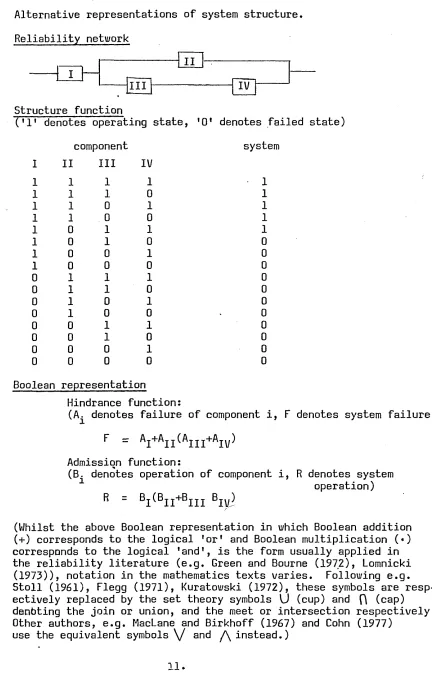
As an example of their application in the basic systems
reliability model, we show in Figure 1.1 these equivalent representations for a simple system which will only work if componentl and either II or (III and IV) work. An alternative representation which is not shown but which is gaining interest in the literature is event or fault trees (e.g. Barlow and Proschan (1975), Bazovsky (1977), Dhillon and Singh (1978)).
It is apparent from the figure that the implicit assumptions which make these representations equivalent - apart from the
assumptions that the system has a single function, the system's structure is static and components and system can each only take one
of two states - are that component and system operation is instantaneous, the order of component failures does not affect the state of the system, and that there is one unambiguous and homogeneous failure mode,
failure to operate (failure to idle is impossible). With these
assumptions, simple bounds of known accuracy can be put on the systems reliability for given component reliabilities by making use of the Inclusion-Exclusion Theorem and Bonferroni's Inequality (e.g.
Feller (1968), Lomnicki (1973)).
FIGURE 1.1
Alternative representations of system structure.
Reliability network
III Structure function
('l1 denotes operating state, '0' denotes failed state)
component system
II III IV
1 1 1
1 1 0
1 0 1
1 0 0
0 1 1
0 1 0
0 0 1
0 0 0
1 1 1
1 1 0
1 0 1
1 0 0
0 1 1
0 1 0
0 0 1
0 0 0
Boolean representation
Hindrance function:
(A^ denotes failure of component i, F denotes system failure)
F = Ai+Aii(Ai n +/W Admission function:
(B. denotes operation of component i, R denotes system operation) R = BjCBjj+Bjjj BivJ
(Whilst the above Boolean representation in which Boolean addition (+) corresponds to the logical 'or' and Boolean multiplication (•) corresponds to the logical 'and1, is the form usually applied in the reliability literature (e.g. Green and Bourne (1972), Lomnicki
(1973)), notation in the mathematics texts varies. Following e.g. Stoll (1961), Flegg (1971), Kuratowski (1972), these symbols are resp ectively replaced by the set theory symbols U (cup) and f\ (cap) denbting the join or union, and the meet or intersection respectively. Other authors, e.g. MacLane and Birkhoff (1967) and Cohn (1977)
[image:26.614.73.505.53.732.2]To proceed further and be able to evaluate the reliability
function of the system (for any t) from the reliability of the
components it is necessary to have information or make assumptions
about the interrelationships of component failures, or equivalently
of the dependence between the states of the various components. The
basic system reliability formulation assumes that component
failures are independent, or equivalently the absence of common-mode
or common-cause failures, so that systems reliability can be obtained
from the usual rules for combining the .probabilities of independent
events (e.g. Birnbaum, Esary and Saunders (1961),Shooman (1968),
Bourne (1973), Lomnicki (1973), Edwards and Watson (1979)). With
this assumption, the reliability function for the system of Figure 1.1
is
R(t) = R1(t)jRlI(t)+RI1I(t)RIV(t)-Rn (t)R1II(t)RIV(t)l .
For complex systems, however, the computation of system's
reliability by such a direct method can be difficult even under
the assumption of independence, and methods for simplifying and
computerising evaluation are of practical interest to the reliability
assessor (e.g. Shooman (1968), Misra (1970), Woodcock (1971),
Green and Bourne (1972), Rosenthal (1973), Aggarwal, Misra and
Gupta (1973 a, b r c), Fussell (1975), Sharma (1976), Lin, Leon and
Hwang (1976), Blin et al (1977), Nakazawa (1977), Satyanarayana and
Prabhakar (1978), Arnborg (1978), Aggarwal and Rai (1978), Rai and
Aggarwal (1978), Gupta and Sharma (1978a), Gopal, Aggarwal and
Gupta (1978b), Locks (1978, 1979b), Singh (1979), Boffey and Waters
(1979), Laviron, Berard and Quenee (1979), Misra (1979), Easton
and Wong (1980)).
The structure function in Figure 1.1 illustrates the fact
that with the above assumptions (but not necessarily including
independence of component failures) corresponding to n distinct
components each of which may be in either of two states - operating
(1) or failed (0) - there are 2n states for the system corresponding
to all combinations of operating and failed components. To each of
these states of the system may be assigned one of the two levels
1 or 0, so that there are possible systems of n components.
Thus the number of possible systems gets large very fast; for two
components there are 16 possible systems, for three components
236, and for four components 65,536. In theory, the smaller is
the number of possible system structures the less information is
needed for, and the easier is the identification of, the appropriate
structure function and reliability function for a real physical
system. Consequently, there has been considerable interest in the
literature (e.g. Birnbaum, Esary and Saunders (1961), Esary
and Proschan (1963), Lomnicki (1972, 1973, 1977), Barlow and Proschan
(1975)) in restricting the class of possible structure functions to
a sub-set which corresponds to the systems with real physical
analogues.
The class of series-parallel systems discussed e.g. by
MacMahon (1892), Riordan and Shannon (1942), Knddel (1950),
Carlitz and Riordan (1956), Lomnicki (1972, 1977), is too
restrictive to represent all such realistic systems, and does not
contain all the real systems to be found in the reliability texts.
In particular it excludes the so-called k-out-of-n (or k-out-of-n:G)
systems (whereby the system operates if any k or more of its
components operate), which are examples of symmetric Boolean
functions (e.g. Flegg (1971)), and are of great physical interest
Ansell and Bendell (1982a)). Birnbaum in the discussion of
Lomnicki (1973) suggested a generalised class of realistic systems
which contains the series-parallel and k-out-of-n systems, and
which is based on replacing single modules in a simple system by
k-out-of-n structures of components.
The class of 'realistic* systems which has received most
attention in the reliability literature, however, is the class of
so-called coherent (or monotonic) systems introduced by Birnbaum,
Esary and Saunders (1961). This class contains the two-terminal
systems of Moore and Shannon (1936), as well as all series-parallel
and k-out-of-n systems. A coherent system is a system of components
such that the system's state does not deteriorate from 1 to 0 if
a failed component is replaced by an operating one, and does not
improve from 0 to 1 if an operating component is replaced by a
failed one, and operates if all its components operate and fails
if all its components fail. Formally, we describe the state of an
n-component system by the state vector
s = (s^, •••» sn) th
where s ^ the state of the component may be 1 (operating)
or 0 (failed), and the resulting state of the system (1 or 0) is
described by the structure function f(sO. Then if we define
1 = (1, 1, ..., 1)
£ = (
0
,
0
, ...,
0
)
and
if xdC^
y©c ^or a-^~
•••* nand ^or some ^ >
it follows that a coherent system is defined by the requirements
f(x-)> f(j£) for all
x^> £
(1.9)f(l) = 1
(
1
.
10
)
f(0) = 0 .
The definition of coherent systems in the literature vary
somewhat from the original one above due to Birnbaum, Esary and
Saunders (1961), although this is also used by some other authors,
e.g. Esary and Marshall (1974). Lomnicki (1973, 1977) neglects to
include the conditions (1.10) in his definition of coherent systems,
so that his 'coherent systems' correspond to semi-coherent systems
as defined by Birnbaum, Esary and Saunders (1961). However, this
is an omission rather than an alternative definition, since his
enumerations correspond to the original definition. Barlow and
Proschan (1965) refer to the coherent systems of Birnbaum, Esary and
Saunders (1961) as 'monotonic systems' due to the obvious algebraic
connotation. However, Barlow and Proschan (1975) perhaps following
Kaufmann (1969) re-define monotonic systems to be those satisfying
(1.9) alone; i.e. the semi-coherent systems of Birnbaum, Esary and
Saunders (1961). Their definition of coherent systems is composed
of the condition (1.9) together with the requirement that every
component is relevant; i.e. that there is no component c< for which
f (s i» •••> Soi-i»1,ik + i > * * * ’ s n^ =
f(si, •••» s* - l ’ °» s^ + l » •••» sn^
for all s ^ ... s^ , s^+1, ..., sn , (1.11)
It follows from tHis requirement of relevancy and from (1.9) that
(1.10) must also hold, but the definition is more restrictive than
the original one of Birnbaum, Esary and Saunders (1961). Phillips
(1977) uses monotonic in the same way as Barlow and Proschan (1965),
and coherent in the same way as Barlow and Proschan (1975). In this
thesis we shall follow the original definitions of coherency and
semi-coherency due to Birnbaum, Esary and Saunders (1961), except
Since coherent systems (by either the Birnbaum, Esary and
Saunders (1961) or the Barlow and Proschan (1975) definitions) are
generally regarded as corresponding to the set of real physical
systems of practical interest, a lot of attention in the literature
has been devoted to the study of the desirable properties possessed
by coherent systems. See for example Birnbaum, Esary and Saunders
(1961), Esary and Proschan (1963), Birnbaum, Esary and Marshall
(1966), Esary and Marshall (1974), Haines and Singpurvi/alla (1974), and
Barlow and Proschan (1975).
The reliability texts generally neglect to indicate that
the set of non-coherent systems does contain some very plausible and
indeed simple physical systems (see Evans (1978)'s review of Barlow
and Proschan (1975)), so that whilst coherency is to date the most
satisfactory criterion for systems to be of physical interest, it is
not completely satisfactory. It is perhaps interesting that when
John Bourne in the discussion of Lomnicki (1973) raised the question
of whether there may not be other classes of structures of more physical
importance than coherent systems, and whether Mr. Lomnicki has
established coherent systems by a personal examination or whether he
has seen ways of doing so automatically", no response was received.
However, Lapp and Powers (1977) do consider a non-coherent system
associated with a nitric acid cooling process, and this is subject
to further debate in the December 1977, April 1979 and June 1980
issues of the IEEE Transactions on Reliability. Locks (1979a)
provides an interesting discussion of aspects of this system.
Fussell (1975), Locks (1978) and Amendola and Contini (1980) discuss
the occurrence of non-coherent systems, and Worrell produced a
relevant computer program as long ago as 1961 (Bell Telephone
Laboratories (1961)). More recent programs and approaches that
can deal with non-coherent as well as coherent systems are described
by Bennetts (1975), Caldarola and Wickenhauser (1977), Kumamato and
Henley (1978) and Locks (1979c). See also Ogunbiyi and Henley (1981).
As an example of a simple non-coherent system, the system
represented in Figure 1.2 is composed of four springs designed to
keep a load in place. As is apparent from its structure function,
the system is non-coherent since failure (breakdown) of a single
spring causes system failure as the load is pulled to one side,
whilst failure of two opposite springs leaves the system operating
(although less stable in relation to outside disturbances).
Whilst the number of series-parallel systems of n
components is now known for both the cases where all components
are distinct and where some are identical (MacMahon (1892), Knddel
(1950), Carlitz and Riordan (1956), Lomnicki (1972)), similar
results are not available for the class of coherent systems, for
which the number of systems of distinct components is only known
explicitly up to n = 7. The enumeration problem for coherent
systems is in fact identical to the problem posed by Dedekind in
1897 on the cardinality of the free distributive lattice generated
by the symbols s^, ...,
s^.
The known numbers of coherent systems of n distinct components following the original Birnbaum, Esary andSaunders (1961) definition (/} ) are given in column two of
Table 1.1, whilst the numbers corresponding to the more restrictive
definition of Barlow and Proschan (1975) (tn) are given in column
three. It is perhaps noteworthy that the plot of date of
publication against n = 4, 5, 6, 7 is approximately linear (especially
FIGURE 1.2
A non-coherent system.
Load C
Structure function
component system
A B
c D
1 1 1
1
1 1 0
0
1 0
1
0
1 0 0
1
0 1
1
0
0 1 0
0
0 0
1
0
0 0 0
0
0 1 1 1
0
0 1 1 0
0
0 1 0
1
0
0 1 0 o'
0
0 0
1 1
1
0 0
1 0
0
0 0 0
1
0
Kn ow n nu mb er s of c oh er en t sy st em s of n di st in ct c om po ne nt s, wi th fi rs t pu bl is he d so ur ce s. c
o ^ ->
•H
p--P p~
•H On
C i— 1
•H '—^
U-0 •H
T3 O
/— v •H
ia C p" E ON O i—1 v-x c CO c
JO 4J 1— 1 CM ON <P CM <p
o rH On VO rA
m rH CO O <P
o r' •»
f-t VO LA o
D_ CO o
p- <p
•D •*
C p-
p-CO CM
VO•*
o <P
1— 1 rH
pCO •*
CO CM
P"
On /— s. *—■>
CO o LA
c rH <p <'— . VO
o N_■' ON vo ON
•H 1— 1 i— 1
•P ~o V-r ON '—*
•H c rH
C •H JO v_x JO
•H Ot o o
U- 0 p "O p
O X) 3 p 3
T> o0 JOC_) CO X 13 o rH
NO .
ON i
rH 1— 1 <0- CO VO ON CM VO
*_/ 1— 1 VO LA On
1— 1 LA fA On
rH C r*
CO _ P- CO O
CM <P
-p ) CO o
0 p-•* CM•*
E CO
D0 vo
XIc I—1
p
•H •*
CO CM
Church’s result for n = 5 was unduly delayed) and a simple
least-squares fit predicts 1990 approximately for the publication of the
number of coherent systems of eight distinct components!
Since the numbers of coherent systems is in general
unknown, the obtaining of sharp upperbounds (and to a lesser extent
lowerbounds) for these has long been of interest; Dedekind (1897),
Gilbert (1954), Korobkov (1963), Hansell (1966) (misquoted by
Lomnicki (1977)), Kleitman (1969), Hanish, Hilton and Hirsch (1969),
Alekseev (1973), Kleitman and Markowsky (1975), Korsunov (1977).
The sharpest explicit and non-asymptotic upperbound published to
date is due to Hansel (1966) who proved that
J ^ n ^ 3 Mn (1.12)
where M is the middle Binomial n coefficient i.e.
n!
M = n
(n/2)! (n/2)! 5 lf n even
n * t* 5 if n odd ([n+l]/2) i ( [n-lj/2)’
However, in Chapter 2 we derive improvements to this bound as
bi-products of the generalisation to multistate systems.
The above discussion is for the case where all the components
are distinct. Lomnicki (1977) discusses enumeration for the case
where some or all of the components are identical, and tabulates the
corresponding numbers of possible coherent systems (according to the
Barlow and Proschan definition) of up to five components. Coherent
systems with all the components identical have received some
attention in the reliability literature since they are of interest
in the context of the problem of optimal redundancy in the presence
of opposite failure modes (e.g. Lomnicki (1977), Phillips (1980),
Ansell and Bendell (1982a)). It is also true that for series-
parallel systems the enumeration problem was first solved for
identical components (MacMahon (1892)). For coherent systems,
making all the components identical also greatly reduces the numbers of
possible systems and consequently substantially simplifies (numerical)
enumeration. The available numbers of coherent systems of identical
components (due to Lomnicki (1977) are presented in column two of
Table 1.2
However, despite the earlier work of Phillips (1976) in a
related context, Lomnicki failed to consider the fact that a
further substantive reduction in the number of coherent systems
could be achieved by assuming independence of component failures
and considering the reliability function instead of the structure
function or Boolean function. With the usual assumption of independence,
systems with different Boolean or structure functions reduce to the
same reliability function. The corresponding reduced numbers of
distinct coherent systems up to n = 5 are shown in column three of
Table 1.2. As an example of the reduction, Figure 1.3 shows two
systems of four identical components with distinct Boolean representations
(even after rotation of the indices 1, 2, 3, 4) or equivalently
structure functions, but identical reliability functions under the
assumption of independence of component failures. (The reliability %
of each identical component is denoted by x). It follows from
Phillips (1980) that the reliability functions of coherent systems
of n identical components are, under the assumption of independence,
convex combinations of the reliability functions of the k-out-of-n
systems. Ansell and Bendell (1982a) generalise this result to
dependent components.
As a final point in this section, we note that Figure 1.3 serves
TABLE 1.2
Number of coherent systems of exactly n Identical components.
(Barlow and Proschan (1975)'s definition of coherency).
n distinct structure functions distinct reliability
Lomnicki (1977) functions
1 1 1
2 2 2
3 5 5
4 20 17
FIGURE 1.3
Two systems of identical components with distinct Boolean representations, but identical reliability functions.
(i)
Boolean function: ®l^2+ ^3^4
2 4
Reliability function: 2x - *
(ii)
or equivalently
Boolean function: ^1^2 +^2^3 +^1^3^4
model between event networks and Boolean and structure functions
(e.g. Flegg (1971)) can only be accomplished for non-series-parallel
systems by multiple representation of single components (which
reduces the event network to a formal statement of logical structure
without intuitive physical back-up), or by the multiple route notation
used in Figure 1.3 (which soon gets confusing as the numbers of
components and routes rise) or by ad-hoc logic devices such as the
k-out-of-n gate (e.g. Buzacott (1967,1970)) or the priority-AND
gate (e.g. Fussell, Aber and Rahl (1976)) which have become standard
notation in the engineering literature. The limitations of the
event network as a conveyor of system structure is a subject to
which we shall be returning when we consider the generalisation of
1.4 Possible Generalisations
The basic systems reliability model introduced in the previous
two sections is based on the following (often implicit) assumptions:
(i) Time t is continuous and perfectly ordered onQ),0^ .
(ii) The system has a single function (or output) which is
required to be performed continuously and does not vary
in time, and which depends for satisfactory operation
upon the operation of the components in the way specified
in the event network or structure function or alternative
representation of system structure.
(iii) The system’s structure, the environment of the system,
and the conditions that define component failure are
stationary in time.
(iv) Components and the system can each only be in one of
two homogeneous states at any point in time; 1 (operating)
or 0 (failed). At time zero they are in state 1.
(v) In the absence of a repair or replacement mechanism the
component state 0 is an absorbing state whilst the initial
state 1 is not, so that by time components and coherent
systems are in state 0, and the probability that any
component, or coherent system, is in state 1 is a
monotonically non-increasing function of time.
(vi) The operation of the components and system are
simultaneous and instantaneous.
(vii) The order of component failure does not affect the state
of the system for a given set of failed components.
(viii) The states of the components are independent.
specialisation, limit the application of the basic systems reliability
model. They are expressed as generally as is consistent with the
procedure for evaluating systems reliability introduced in the last
section. Whilst these assumptions form the norm in reliability work
(e.g. Barlow and Proschan (1965), Shooman (1968), Kaufmann (1969),
Lomnicki (1973)), they are often fully or partly implicit (especially
assumptions (i), (ii), (iii), (vi) and (vii)) and the situation is
further confused by the fact that in parts of the theoretical develop
ment of reliability certain assumptions are unnecessary or can be
treated more generally. For example, the paper by Birnbaum, Esary
and Saunders (1966) avoids the element of time, and of the remaining
assumptions only makes explicit the assumptions that components
and systems only have t\i/o states and that the states of the components
are independent. For much of their development Barlow and Proschan
(1975) avoid the restrictive assumption of independence.
As one would expect from its wide-spread literature and use,
the basic systems reliability model corresponding to the above
assumptions fits reasonably well many real systems, or at least can
be regarded as a first approximation (e.g. Green (1977), Cannon and
Jones (1977), Snaith (1979)). Practical reliability engineers find
the complexity of reliability theory hard enough even in this
restricted form, without the complications of further mathematical
models (as the discussion of papers at the First National Reliability
Conference indicates; e.g. National Centre of Systems Reliability
(1978)). Further, limitations in the availability of data, and in
certain cases of appropriate statistical techniques, for even this
basic reliability model (e.g. Evans (1971, 1974), Konarski and Evert
(1975), Rosenthal (1975), Levine and Vesely (1977), Green (1977),
Shooman and Sinkar (1977), Anderson (1979), Dhillon (1979c), Haas and
Batt (1980)), imply that developing more sophisticated models may
not be worthwhile. Certainly in my experience of attempting to
obtain appropriate data for generalisations to the reliability model
I found that even with the assistance and data banks of the National
Centre of Systems Reliability I was only rarely able to find
appropriate data.
However, the unavailability of data etc. is a 'chicken-and-
egg1 argument, since it is not unreasonable to suppose that
appropriate data will by and large not be collected until there is a
purpose for it in terms of a method of analysis based on a generalised
reliability model. Indeed, apart from the hand of chance, problems
must be defined in appropriate generalised terms before appropriate
data can be collected to help solve them (Venton (1977)). (Maruvada,
Weise and Chamow (1978) discuss a related 'chicken-and-egg1 problem
whilst the comments of Evans (1977) on the gulf between the reliability
researcher and the reliability practitioner are also relevant).
Whilst the above arguments of the realism and good fit of
the basic system reliability model, the complexity of potential
generalisations and the unavailability of appropriate data for them,
may be taken to preclude the development of a generalised model of
reliability, the questions remain as to what would be the effects of
liberalising the assumptions, and whether a more general model of
reliability could be constructed without such restrictive assumptions.
Further, the reliability literature already contains many partial
extensions to the basic system reliability model, which are usually
in the form of generalisations of one specific aspect applied in the
IEEE Transactions on Reliability and Microelectronics and Reliability,
and specific cases are discussed as appropriate below. However, some
more systematic attempts at generalising the basic reliability model
are to be found in Green and Bourne (1972), Murchland (1975) and
Barlow and Proschan (1975). See also Papazoglou and Gyftopoulos
(1977), Virtanen (1977), Singh (1978) and Garribba, Mussio and
Naldi (1980). The existence of such generalisations of the basic
systems model in the literature, although largely in a piecemeal
fashion, does suggest that there is a general feeling amongst
reliability workers that the basic model is inadequate to describe
many real physical systems, and a more general model is required.
(See e.g. Barlow, Fussell and Singpurwalla (1975) and the introduction
by the editors to Section 2 of Apostolakis, Garribba and Volta (1980)).
For reasons of brevity, this thesis concentrates on the
partial operation extension to assumption (iv), though one can easily
broaden the model to generalise the other assumptions. Of course,
there is much justification for the generalisation of a single
assumption at a time, since it clarifies the effect of that assumption
on the methodology and results, it prevents the development of a
prohibitively complex model with associated data and inferential
problems, and it fcorresponds to the situation in applications where
it is often the case that only one or two standard assumptions are
in question at any one time.
There has, in particular, been much recent interest in the
extension of assumption (iv) to incorporate multistate systems with
ordered states, in an attempt to describe partial or degraded
operation. A number of plausible extensions to assumption (iv)
authors (e.g. Murchland (1975), Caldarola and
Wickenhadser (1977), Papazoglou and Gyftopoulos (1977) and Singh
(1978))) work generally with multistate reliability models not
restricted to a single direct physical analogue for the set of
states, most either decompose the operating stage 1 (or equivalently
the failed state 0) into an ordered set of states representing
various degrees of partial operation or degradation (e.g. Lloyd and
Lipow (1962), Derman (1963), Mine and Kawai (1974a, 1975, 1977),
Proctor and Wang (1975), Singh (1976),Maruvada, Weise and Chamow
(1978), Thomas, Derbalian and Bischel (1980)), or decompose the failed
state 0 into states representing multiple failure modes.
That even the most simple equipment is often subject to a
•large number of distinct failure modes is well accepted in the
engineering literature, as is the necessity to often consider various •
modes separately due to their differing system implications in terms
of repair time, safety, etc.; e.g. B^e (1974), Pau (1974), Mann,
Schafer and Singpurwalla (1974), Hyun (M.Gen)(1975), Banfi, Garribba,
Mussio, Naldi and Volta (1976), Dhillon (1976a,b,c,1977c,1978d),
Proctor and Singh (1976a,b), McCool (1976), Barbour (1977), Dahiya
(1977), Thomas (1977), Gopal, Aggarwal and Gupta (1978a), Legg (1978),
Caldarola (1980a)*. But see also Codier (1968) and Fertig and Murthy
(1978). Elsayed and Ziebib (1979) solve the general N-failure-mode
Markov model, whilst Yamashiro (1980) extends the solution to general
repair time distributions, and Yamashiro (1982) introduces standby
units. Another extension using a mixture model is given by Muth (1980b).
Mine and Nakagawa (1978) also employ a mixture formulation3whilst
Annello (1968) discusses competing risks. Bendell and Samson (1981)
modes. Shooman (1968) classifies the failure modes according to
the three regions of the bath-tub curve, and Gorg and Kumar (1977)
classify them into various minor and major failures. The occurrence
of distinct failure modes has been reported in amongst other systems
marine equipment (Bjrfe (1974)), weapon systems (Gower (1975)),
nuclear systems (Proctor and Singh (1976a), Dhillon (1976a)),
mechanical systems (Martin (1980)), power transmission systems,
electrical systems and aerospace equipment (Dhillon (1977c)).
An important special case of the multiple-failure-modes
extension to the basic reliability model is the case of opposite
failure modes for systems which are required to operate at certain
times and idle at others (in violation of assumption (ii)).
Codier (1968), Allen and De Oliveira (1977), Fertig and Murthy (1978),
and Gopal, Aggarwal and Gupta (1978a) give some justification for
grouping diverse failure modes into such opposite categories. There
are many real systems for which such switching between the operating
and idling states is necessary or desirable e.g. electronic equipment
(Elburn and Knight (1975)), electrical distribution networks (Allen
and De Oliveira (1977)), protective systems (Choy and Mazumdar (1975),
Gibson and Knowles (1977), Kontoleon (1978b)), weapons systems and
other emergency equipment (Nakagawa (1978)), nuclear power plants
(Apostolakis and Bansal (1977)), computer hardware (e.g. Lewis (1964),
Tasun (1977)), inertial navigation and ships power control systems
(Kujawski and Rypka (1978)), and avionic equipment (Kern (1978)).
See also Weiss (1961), Gaver (1964), Srinivasan (1966), Ueda (1972),
Osaki (1972), Rdde (1974), Nakagawa (1974, 1977), Kapur and Kapoor
(1975, 1978a,b), Nakagawa, Sawa and Suzuki (1976), Sasaki and
Hiramatsu (1976), Sasaki and Yanai (1977), Srinivasan and Bhaskar (1979),
Singh, Aggarwal and Kulkami (1979), Sasaski and Yokota (1980),
Berg (1981).
The existence of opposite failure modes-failures to operate
and failures to idle (or 'open1 and 'short' or 'closed' failures,
or 'passive' and 'active' failures, or 'fail-to-safe' and 'fail-
to-danger') in such real systems is also well known. Green and
Bourne (1972), for example, tabulate the proportions of total
failures which are of each of the two types for common components such
as fixed resistors, capacitors, coils and pneumatic and hydraulic
components. Jordan (1978) considers an opposite failure mode model
for iso-isolators. The literature discusses the design of systems
of components subject to opposite failure modes quite extensively,
having recently given particular emphasis to the identification of
optimum redundancy; e.g. Moore and Shannon (1956), Gordon (1957),
Barlow, Hunter and Proschan (1963), Barlow and Proschan (1965),
Lomnicki (1973, 1977), Phillips (1976, 1977, 1980), Proctor and
Proctor (1977), Kaufmann, Grouchko and Cruon (1977), Kontoleon (1978a),
Nakagawa and Hattori (1980), Ben Dov (1980),Bendell and Humble (1981)
and Ansell and Bendell (1982a).
Whilst components subject to opposite failure modes can be
considered to be 'in any one of four states at any t - failing to
operate, failing to idle, succeeding to operate, and succeeding to
idle - the literature usually combines the two success states into
a succeeding to operate or idle as required state, and thus produces
a three-state representation, (e.g. Roberts (1964), Barlow and
Proschan (1965), Shooman (1968), Lomnicki (1973), Allen and De Oliveira
(1977)). However, Mathur and De Sousa (1975) amongst others do obtain
of indeterminate failures, for u/hich it is not known whether they
are failures to operate or to idle. See also Tasun (1977) and
Dhillon (1977a). In contrast the four-state model of Berg (1981)
employs states of succeeding to operate, failing to operate and
being operational or failed when undemanded.
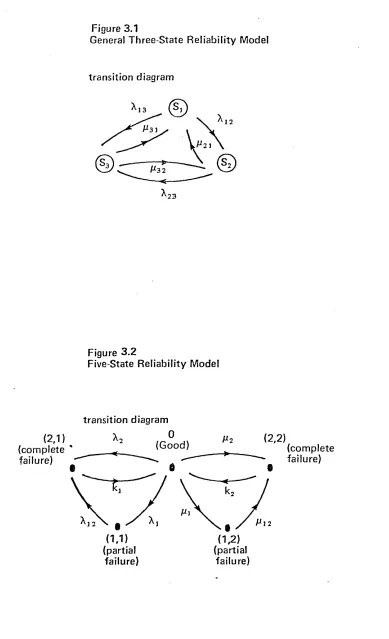
Three-state reliability models have appeared quite extensively
in the literature since they can be obtained from a number of
alternative extensions to the dichotomic reliability model as well
as that of opposite failure modes, and in each case represent the
simplest such extension. The general three-state Markov model was
solved by Biggerstaff and Jackson (1969) in the context of power
generation in which the three states considered represented full
operation, derated operation and failure, so that the model
corresponds to the simplest partial operation extension to the basic
reliability model. The paper was subsequently overlooked in much of
the three-state literature since the papers of Kontoleon and Kontoleon
(1974) and Proctor and Singh (1976a) contain no more than the solutions
to the reduced versions of the general three-state Markov model
corresponding to the partial operation case with limited repair,
and the opposite failure mode case respectively. Proctor and Singh
(1975a) apparently independently re-solve the general three-state
Markov model, whilst Dhillon (1976a) does not even get as far as
deriving the explicit time dependent solutions of the opposite
failure mode sub-model (although in the context of complete/
catastrophic failures).
Endrenyi (1970), Endrenyi, Maenhaut and Payre (1973),
Grover and Billington (1974) and Allen and De Oliveira (1977)
in the context of electrical networks. See also Billington,
Allen and De Oliveira (1977). Regulinski (1980) also employs
a reduced form of the general three-state Markov model in studying
computer networks. See also Chan and Downs (1978) and Das, Hendry
and Hong (1980) for reduced forms of the three-state model in the
context of imperfect repair. Shenk (1977) considers the opposite
failure mode submodel (in the sense that two of the states are
not directly connected) but with the partial operation formulation.
The two repair time distributions are allowed to be Erlangian or mixtures
of exponentials. Kontoleon, Kontoleon and Chrysochoides (1975)
analyse throw-away maintenance for modules subject to both partial
and catastrophic failures, whilst Tumolillo (1974) has a three-state
random stress model. Braff (1977) uses a three-state Markov chain
model in which the states are operating, failed and pending failure
(which is assumed observable) to analyse the relationship between
failure rate and technician visitation. Phillips (1979) evaluates the
reliability and MTTF of a three-state system in which, apart from
full operation, the states correspond to the occurrence of revealed
and unrevealed faults. Mine and Kawai (1974b) consider preventative
replacement for a three-state unit with a wear-out state. Beichelt
and Fischer (1979,'1980) allow for two types of failure; those
removable by minimal repairs, and those needing complete replacement.
See also Mendenhall and Hader (1958), Cox (1959), Fischer (1977),
and Gorg and Kumar (1977).
Dhillon (1977c) discusses the steady state availability of
parallel (and series) systems of components subject to two failure
modes, whilst Singh and Proctor (1977) and Ksir (1979) consider
failure modes and/or partial failures. Dhillon, Sambhi and Khan
(1979) consider the analysis of a parallel network of components
subject to opposite failure modes and common-cause failures, whilst
Dhillon (1978c) consider a k-out-of-n system of three-state devices
also subject to opposite failure modes and common-cause failures.
Gupta and Sharma (1979) discuss a k-out-of-n system of three-state
units but with states of operating, failed and being installed,
whilst Dhillon (1979a) considers a four-unit redundant system with
common-cause failures and units subject to opposite failure modes,
and Chung (1979) extends this to an n-unit redundant system.
Dhillon (1979b) considers a complex system subject to partial
failures. Kumar andAggarwal (1978) analyse a two-unit warm standby
system with two types of failures, whilst Khalil (1977) and Singh,
Kapur and Kapoor (1979) consider a cold standby equivalent. See
also Elsayed (1979). Dhillon (1978d) considers a system of n standby
components subject to two failure modes. Takami, Inagaki, Sakino
and Inoue (1978) and Kumar and Kapoor (1979) discuss the employment
of fault detectors with opposite failure modes for series systems.
See also Inagaki (1980).
Butler (1979a) discusses importance measures and rankings for
three-state components in three-state systems, in which the states
correspond to the partial operation formulation. This is also
the case considered by Hatoyama (1979) who shows that the calculation
of systems reliability can sometimes be reduced to that of a
corresponding two-state system, and thus obtains methods of evaluation
and bounds for the reliability of three-state systems. He also
presents some reliability properties of systems with independent
components, and some bounds for systems with associated components.
Dhillon (1977b) provides a limited bibliography on three-state
models covering the period 1956 - 1976, whilst Virtanen (1977) gives
a partial review of three-state models up to 1975. See also
Sankaranarayanan and Usha (1980), Subramanian and Usha (1980), Locks
(1980), Lee (1980) and the nominally unrelated models of e.g.
Shooman (1968), Subramanian and Natarajan (1980), Allen and
Billington (1980).
Whilst the general three-state model and its sub-models
can thus have various plausible physical interpretations as extensions
to the basic dichotomic reliability model, the opposite failure mode
formulation does have the special feature that with it the expression
for a systems probability of failure to idle in terms of the
component probabilities of failing to idle (and failing to operate
if the system is non-coherent) can be obtained as the dual of the
expression for the systems probability of failing to operate in terms
of the components probabilities of failing to operate (and to idle).
See e.g. Lomnicki (1973). Thus apart from the study of specific
systems corresponding to specific opposite failure mode models which
were reviewed in the previous paragraphs^ and apart from the literature
on optimum redundancy for such components (reviewed previously), a
number of general' methodological papers appear in the literature on
the reliability analysis of systems of three-state components subject
to failures to operate and to idle; e.g. Proctor and Singh (1975b),
Singh and Proctor (1976), Gupta and Sharma (1978a), Gopal, Aggarwal
and Gupta (1978b), Nakagawa and Hattori (1980).
Just as it is possible to provide various physical inter
pretations of three-state reliability models, it is equally possible
![Figure 4.1Relationship of T(s) and V(s) [equation (4.68)]](https://thumb-us.123doks.com/thumbv2/123dok_us/8017312.765422/98.615.52.512.72.772/figure-relationship-of-t-s-and-v-equation.webp)