M o d e l l i n g
(DBM)
o f N o n l i n e a r
E n v i r o n m e n t a l S y s t e m s
Christopher P. Fawcett, B.Sc. (Hons.)
A thesis submitted to the University o f Lancaster
fo r the degree o f D octor o f Philosophy
August 1999
Environmental Science Department
Institute o f Environmental and Natural Sciences
Lancaster University, United Kingdom
All rights reserved
INFORMATION TO ALL USERS
The qu ality of this repro d u ctio n is d e p e n d e n t upon the q u ality of the copy subm itted.
In the unlikely e v e n t that the a u th o r did not send a c o m p le te m anuscript and there are missing pages, these will be note d . Also, if m aterial had to be rem oved,
a n o te will in d ica te the deletion.
uest
ProQuest 11003635
Published by ProQuest LLC(2018). C op yrig ht of the Dissertation is held by the Author.
All rights reserved.
This work is protected against unauthorized copying under Title 17, United States C o d e M icroform Edition © ProQuest LLC.
ProQuest LLC.
789 East Eisenhower Parkway P.O. Box 1346
The experimental work described in this thesis was original work by the author
undertaken at the Department of Environmental Science, Lancaster University. The
material has not been submitted, in whole or in part for any degree, to this or any other
institution.
E
n v ir o n m e n t a lS
y s t e m s.
Submitted by
Christopher P. Fawcett, B.Sc. (Hons.).
A thesis submitted to the University of Lancaster
for the degree of Doctor of Philosophy
August 1999.
A
b s t r a c tThe main focus of the research studies presented in this thesis centre on the
application and development of data-based mechanistic (DBM) transfer function
models for nonlinear environmental systems. The data-based mechanistic modelling
approach exploits the available time series data, in statistical terms, to expose the
model structure, generating dynamic stochastic models that are parsimonious in nature
and can be interpreted in a physical manner.
For nonlinear systems, the DBM approach centres on the use of transfer function
models whose parameters are free to vary over time. The presence of such time
variable parameters may reflect either nonstationarity or nonlinearity; the latter arising
if the variations are also shown to be state dependent. Statistical time series methods
for estimating time varying parameters (TVP) and the use of these methods in state
dependent parameter modelling (SDPM) are discussed and applied to the modelling of
to investigate model uncertainty and over-parameterisation, set within the context of
data assimilation.
In each application, the DBM methodology is shown to successfully identify the
system nonlinearities, so providing additional physical insight and ensuring a good
explanation of the data with the minimum of model parameters (parsimony). Further,
the DBM approach provides an approach to both the evaluation and reduction in the
I would like to express my sincere gratitude to Professor Peter Young and Dr Arun
Chotai for their supervision and constant encouragement throughout the course of
these research studies. Dr John Rowan is also thanked for his guidance and
enthusiasm, and the assistance from Dr Mike Fasham is also appreciated.
Present and past members of the Systems and Control research group are also
mentioned for providing such welcome humorous relief from the computer terminals.
Paul deserves particular thanks for his helpful advice and suggestions. Mark, Glenda,
David, Simon and other colleagues from IENS are also thanked.
I am also grateful for the continued words of encouragement from friends and family
over the last four years. But most importantly, I would like to thank Laura for her
1. In t r o d u c t io n 1
1.1 Data-based mechanistic modelling 3
1.1.1 Transfer Function models 5
1.2 General scope of this thesis 9
1.3 Structure of this thesis. 10
2. Id e n t if ic a t io n a n de s t im a t io n o fl in e a r a n dn o n l in e a rs y s t e m s 13
2.1 General modelling procedure 14
2.2 General parameter estimation 15
2.3 Simplified refined instrumental variable estimation and model identification 17
2.3.1 Parameter estimation using the SRIV method 18
2.3.2 Model order identification 21
2.4 DBM identification and estimation of nonlinear systems 24
2.4.1 Background 26
2.4.2 Time varying parameter estimation using the Fixed Interval Smoothing 27
algorithm
Pass 1: ‘Forward Filtering’ 27
NVR estimation 30
Pass 2: ‘Backward Smoothing’ 31
2.4.3 State dependent parameter modelling 34
2.5 Stochastic and deterministic methods of parameter estimation 42
2.5.1 Deterministic parameter estimation: Nonlinear least squares 42
2.5.2 Stochastic parameter estimation: Maximum Likelihood 43
2.5.3 Linearised Kalman filter 45
2.5.4 ML estimation of continuous time nonlinear systems 48
2.5.5 Numerical optimisation algorithms 49
2.6 Conclusion 52
3. DBM
MODELLING OF THE LUCILIA CUPRINA POPULATIONS53
3.1 N icholson’s Lucila Cuprina experiments 53
3.2 M odelling N icholson’s blowfly 56
3.3 DBM modelling of Nicholson’s blowfly 60
3.3.1 Forward path linear TF model 61
3.3.2 TVP/SDPM Identification of the feedback nonlinearity 65
3.4 Optimisation of the deterministic blowfly model 70
3.5 Stochastic optimisation of the deterministic blowfly model 74
3.6 Extension of the stochastic blowfly model 79
3.7 Conclusion 87
4.
V a l i d a t i o n o f aDBM
n o n l i n e a r r a i n f a l l f l o w m o d e l89
4.1 Rainfall-flow modelling 91
4.1.1 Unit hydrograph theory 91
4.1.2 Conceptual models 92
4.2 Transfer function rainfall-flow models 95
4.2.1 Lancaster DBM rainfall-flow model 96
4.2.2 IHACRES rainfall-flow model 100
4.3 Model calibration and validation 102
4.3.1 The data 102
4.3.2 Linear transfer function model 105
4.3.3 Lancaster DBM model results 106
4.3.4 IHACRES model results 112
4.3.5 M onte-Carlo analysis 114
4.4 Comparison of the measured soil moisture variables with generated 115
surrogate soil moisture series
4.4.1 Comparison of the measured soil moisture variables with the 116
Lancaster DBM soil moisture surrogate
4.4.2 Comparison of the measured soil moisture variables with the 123
IHACRES soil moisture surrogate
4.4.3 Data Series 2 126
4.4.4 Comparison between Data Series 1 and Data Series 2 126
4.4.5 Summary for nonlinear modelling of Data Series 1 and 2 128
4.5 Further TVP analysis 129
4.5.1 Model fits with sorted data 132
4.6 Lancaster DBM model modification 133
DBM
a p p r o a c h : W y r e s d a l e P a r k c a t c h m e n tUK.
138
5.1 Wyresdale Park catchment and data 140
5.2 Rainfall flow model 144
5.2.1 Rainfall flow model on a seasonal scale 145
5.2.2 Rainfall-flow model for the 2 year time series 150
5.2.3 Rainfall-flow modelling and evapotranspiration 151
5.3 Suspended sediment load modelling 153
5.3.1 Wyresdale Rainfall-Sediment model 155
5.3.2 Wyresdale Rainfall-Sediment model for hindcasting 159
5.3.3 Reservoir sediment transmission model 161
5.4 Generating historical series 161
5.4.1 Monte Carlo uncertainty analysis 164
5.5 Validation of the model 165
5.5.1 Synthetic sediment accretion reconstruction 166
5.5.2 Lake sediment cores 167
5.5.3 Core extraction and analyses 168
5.5.4 Core validation 172
5.6 Concluding remarks 175
6.
O c e a n i c e c o s y s t e m m o d e l l i n g178
6.1 Chapter aims and objectives 179
6.1.1 Data assimilation 180
6.2.2 M ixed layer dynamics 184
6.3 Three component NPZ ecosystem model 185
6.3.1 Simulink representation of the ecosystem model 189
6.3.2 Biological data 193
6.3.3 Data for parameters and calibration 196
6.4 Review of optimisation methods 196
6.5 Deterministic parameter optimisation 197
6.6 Model uncertainty and sensitivity analysis 205
6.6.1 Stochastic simulation modelling 207
6.6.2 Generalised sensitivity analysis 208
6.6.3 Uncertainty analysis of the TCE model using GSA 210
6.7 Parameter estimation by Maximum Likelihood 217
6.7.1 ML estimation results 218
6.8 Model linearisation and reduction 222
6.8.1 Classical linearisation and model order reduction 223
6.8.2 Data based approach to model order reduction and linearisation 224
6.8.3 Results of classical and DBM model linearisation 225
6.9 Conclusions 229
7. Co n c l u s io n sa n dr e c o m m e n d a t io n sf o rf u t u r er e s e a r c h 2 3 2
7.1 Data-based mechanistic modelling 232
7.2 Applications of DBM modelling 232
Figure 2.1 Figure 2.2 Figure 2.3 Figure 2.4 Figure 2.5 Figure 3.1 Figure 3.2
Figure 3.3
Figure 3.4
Figure 3.5
Figure 3.6
Figure 3.7
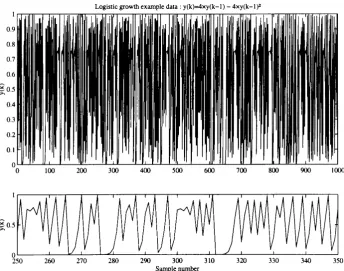
Response of the logistic growth equation 37
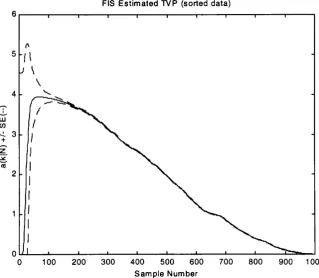
FIS estimate a{k I N ) with standard errors shown as a dashed 38
lines.
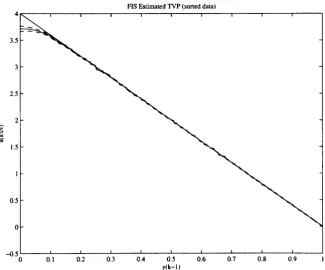
FIS estimate a{k I N ) versus y(k - 1 ) with standard errors 39
(red line). Actual nonlinear relationship 4 - 4 y ( k - \ ) (blue line).
A summary of the complete DBM modelling procedure. 41
Summary of Maximum Likelihood procedure. 48
Numbers of blowfly Lucilia Cuprina in a population cage. 55
Linear transfer function model between eggs/day and blowflies: 63
Data (circles); Model (full line).
Model response to an impulse of 100 eggs (block) assuming 64
an initial blowfly population of 100 adults (full line).
FIS estimate of TVP from sorted data (full line) and standard 66
error bands (dashed line).
Estimated feedback nonlinearities: FIS non-parametric estimate 67
of u{k) versus y(k) (circles) with standard error bands
(dot-dashed); parameterised WLS estimate of non-parametric
result (dashed).
The optimised deterministic nonlinear model output (full line) 71
compared with the noisy measured data (circles).
Figure 3.8
Figure 3.9
Figure 3.10
Figure 3.11
Figure 3.12
Figure 3.13
Figure 3.14.
deterministic, optimised model output (full).
Model errors (top). The autocorrelation and partial 73
autocorrelation functions for the least squares optimised
model are shown in the bottom left and bottom right figures
respectively. An instance above the dashed line in these
figures, indicates the model errors are correlated.
(a) M L optimised stochastic one-step-ahead predictions 77
(fine line) versus measured blowfly data (circles).
(b) Prediction Errors.
One-step-ahead-prediction errors (top), autocorrelation 78
(bottom left) and partial autocorrelation (bottom right)
functions for the stochastic model optimised by maximum
likelihood.
(a) One-step-ahead predictions (fine line) from the final 81
optimised stochastic model and blowfly time series data (circles)
(b) One-step-ahead prediction error series.
The output of the deterministic component of the final 82
stochastic model. Simulated blowflies (fine line) and
data (circles), Simulated Eggs/Day (fine line) and data (circles).
Multi-step-ahead predictions (fine line), standard errors 84
(dashed line) and blowfly population data (circles).
Estimated feedback nonlinearities: Non-parametric FIS 85
estimate (circles)with standard error bands (dashed line),
Figure 4.1 Soil moisture probes in situ at the Erienbach catchment. 103
Figure 4.2 M easured variables Data Series 1. 104
Figure 4.3 Measured variables Data Series 2. 104
Figure 4.4 Best constant parameter linear TF model between rainfall 106
and flow.
Figure 4.5 FIS estimate of TVP b0( k\ N) and standard error bands 107
(shown dashed), Data Series 1.
Figure 4.6 The most significant estimates of b0( k \ N) , shown as circles, 108
versus flow and the WLS estimate of the power law relationship.
Figure 4.7 The [1,3,0] Lancaster DBM model (full line), [1,2,0] IHACRES 109
model (dashed line) and the observed data (dots).
Figure 4.8 Parallel partitioning of flow processes. Where SSG denotes 111
the steady state gain and TC the time constant or residence time.
Figure 4.9 Parallel partitioning of the flow process. Where SSG denotes 113
the steady state gain and TC the time constant or residence time.
Figure 4.10 Parallel partitioning histogram. 114
Figure 4.11 (a) Surrogate soil moisture content lsm(k) (b) percentage 117
soil moisture content pwc(k) and (c) normalised inverse depth to
groundwater table,
Lancaster DBM model g w( k) , Data Series 1.
Figure 4.12 Simple regression of f ( k 1 N ) lsm(k) versus gw(k) 118
(a: Top Left b: Top Right) and soil moisture content p w c ( k)
(c: Bottom Left d: Bottom Right) from linear and non-linear
relationships, Lancaster DBM model, Data Series 1.
Figure 4.14 Estimates of (a: Top) Depth to groundwater table and 122
(b: bottom) soil moisture content from linear and nonlinear,
WLS relationships, Lancaster DBM model, Data Series 1. Data
(Dots); Linear relat. (Bold line); Nonlinear relat. (Fine line)
Figure 4.15 (a) Surrogate soil moisture content ihsm(k) , 123
(b) percentage soil moisture content pwc( k) , (c) normalised
inverse depth to groundwater table gw (k) , Data Series 1.
Figure 4.16 Estimates of depth to groundwater table and soil moisture 125
content from linear and non-linear, WLS relationships,
Lancaster DBM model, Data Series 1.
Figure 4.17 The most significant estimates of b0(k / N) versus flow and 130
the WLS estimate of two stage linear and nonlinear relationship,
Lancaster DBM model, Data Series 1
Figure 4.18 (a) Soil moisture surrogate lsm(k) , (b) percentage soil 133
moisture content pwc(k) and (c) normalised inverse depth to
groundwater table g w( k) .Lancaster DBM model, Data Series 1.
Figure 4.19 The most significant estimates of b0(k / N ) versus p w c ( k) and 134
the WLS estimate of the power law relationship.
measured data (dots).
Figure 5.1 Location map of Wyresdale catchment and reservoir. 142
Figure 5.2 Wyresdale Park catchment data. Rainfall measured at 144
Nicky Nook, flow and suspended sediment load measured at the
Wyresdale reservoir inflow, 15th May 1994 - 1st February 1996.
Figure 5.3 A section of the observed two year flow series (fine line) 151
and the nonlinear DBM model, (full line).
Figure 5.4 (a) SRIV estimated model residuals 15/05/1994 - 01/02/1996, 153
(b) Daily temperature (instantaneous measurement at 0900h),
measured at the Lancaster University Hazelrigg weather station
for the corresponding time period.
Figure 5.5 Schematic of the parameter optimisation procedure. 158
Figure 5.6 Nonlinear TF sediment model 159
Figure 5.7 Model fit of the hindcasting model 160
Figure 5.8 86 year (a)rainfall series (b)simulated flow, (c) simulated SSL 163
into the reservoir and (d) simulated SSL out of the reservoir
Figure 5.9 Cumulative sediment curves for the simulated 86 year SSL 165
output from the reservoir and the 2 year calibration data
Figure 5.10 Simulated sediment core (48cm deep in total): depth of 167
sediment deposited each year in millimetres (each successive year
1911-1995 is indicated by a different colour) reconstructed
deposition
Figure 5.12 Percentage content of sand, silt and clay in Core 2. 171
Figure 5.13 W et and dry bulk density of Core 2 172
Figure 5.14 Percentage sand content of Core 2 with dating chronology 173
Figure 5.15 Simulated and observed accretion sequence 174
Figure 6.1 Sim ulinkiconographic representation of the TCE Model 190
Figure 6.2 Sim ulinkiconographic representation of the Phytoplankton 190
System
Figure 6.3 Sim ulink iconographic representation of the Nutrient System 191
Figure 6.4 Sim ulink iconographic representation of the Zooplankton 191
System
Figure 6.5 Sim ulinkiconographic representation of the mixed layer 192
depth equations.
Figure 6.6 Sim ulink iconographic representation of the growth rate term. 192
Figure 6.7 Sim ulink iconographic representation of the mixing terms. 192
Figure 6.8 Repeated term. 193
Figure 6.9 Physical forcing terms of the ecosystem model 194
Figure 6.10 Observed nitrate, phytoplankton, NPP and zooplankton 195
concentration with ± one standard deviation uncertainty
Figure 6.11 Observation data (thin line) and simulation response to 200
optimised parameter set 1 (bold line) and 2 (dotted line ).
Units of concentrations are \lM N m3
Figure 6.12 Typical examples of a behavioural (dotted line) and non- 212
Figure 6.13
Figure 6.14
Figure 6.15
Figure 6.16
Figure 6.17
Significantly different B and B responses observed for 214
Parameter Set 1 parameter m.
Significantly similar B and B model responses observed for 214
parameter Set 2, parameter Kx.
Dissimilarity between B and B probabilistic histograms, 215
for parameter y 2 (Set 2).
Simulated and ML estimated model output 219
Table 3.1
Table 3.2
Table 4.1
Table 4.2
Table 4.3
Table 4.4
Table 5.1
Table 5.2
Best identified linear TF models listed in order of Rj 61
The sampling interval of the data is one day
Average blowfly population density deduced by Nicholson 86
(1954) and obtained from the stochastic DBM model
Best 5 DBM nonlinear TF models ordered in terms of YIC 108
Best five IHACRES nonlinear TF models ordered in terms 112
of YIC
Nonlinear Lancaster DBM models, Data Series 1. 135
Nonlinear Lancaster DBM models, Data Series 2. 135
Best identified nonlinear rainfall-flow models and the statistical 147
fitting criterion for each seasonal period
The performance of calibrated models (horizontal) simulated 149
using data from other seasonal periods (vertical). For example,
when the model, calibrated on the data of Summer 1995
( Rj - 0.819), is simulated using the Winter 1995 rainfall
data, the subsequent simulated flow series compares to the
(Matear, 1995)
Table 6.2 Optimal model parameters with standard errors given in 200
parenthesis.
Table 6.3 Correlation coefficients of the parameters in Set 1 203
Table 6.4 Re-optimisation of Solution 1 parameters. Parameters marked 204
with an asterix are held constant.
Table 6.5 Significant parameters of the TCE model determined by GSA. 213
Table 6.6 Parameters estimated using the ML method. 219
Table 6.7 Cross correlation matrix of ML estimated parameters 220
Table 6.8 Values of input variables for model linearisation and order 226
reduction
Table 6.9 Steady state conditions (SSC) calculated by continuous 226
sim ulation o f the TCE m odel and by constrained optim isation,
Ma tl a b/Sim ulink Trim function.
Table 6.10 Best linear TF models identified between input series M and 228
C
h a p t e r
1
I
n t r o d u c t io n
Mathematical modelling spans a wide range of philosophies and methodological
approaches. Models of environmental systems are predominantly deterministic in
nature which, in line with current paradigm, favours models that provide a physically
interpretable structure. An alternative systems approach, which has its origins in the
field of engineering and statistics, provides models that are developed directly from
time series data. Environmental modellers are beginning to embrace this data-based
modelling approach, realising the value of the enhanced statistical model estimation
tools and the parsimonious nature of data-based models.
Deterministic or mechanistic mathematical models are generally formulated to have a
structure that closely resembles the physical, chemical or biological reality of the
system as perceived by the modeller using classical dynamic conservation equations
(mass, energy and momentum) and are, therefore, heavily reductionist in nature. As a
consequence, these models are limited by the modeller’s experience and overall
understanding of the system and often become extremely complex and nonlinear as
that the modeller perceives in nature. Furthermore, as the parameters of deterministic
models often have a perceived physical interpretation, the feasibility, cost and time in
obtaining sufficiently informative data for their estimation, result in the models
becoming extremely difficult to validate.
Conversely, purely data-based (black box or time series) models are generated without
any prior assumptions regarding the systems internal behaviour. The m odel’s
structure is identified and parameters estimated objectively from observational time
series data using appropriate statistically-based methods. As such, data-based models
are simple in structure and parsimonious; characterised by only the number of
parameters that can be justified by the data. While such statistical models have the
advantage o f being data-based and stochastic, they are dependent upon the availability
and quality of data and are, consequently, often unsuitable for simulation purposes.
Furthermore, because they do not attempt to relate physically to the system they
surmise, many scientists consider the overall value of these types of model as low and
reject there utility on physical grounds.
The data-based mechanistic (DBM) modelling approach is a hybrid of these two
modelling extremes. Rejecting the deterministic-reductionist philosophy, DBM
models retain the statistical advantages and parsimony of the data-based modelling
approach but address the desire for a physical interpretation of the model. In the
majority of cases, the DBM methodology has been applied to linear systems, or where
nonlinear systems have been approximated by linear models. In the main, this has
been due to a restriction of computing capabilities, limiting the development of more
the DBM philosophy is invoked with a focus on the modelling of nonlinear systems
using techniques that have been developed more recently (Young, 1984; 1988; 1993)
and allow for the effective identification and estimation of nonlinear models.
This chapter introduces the DBM philosophy, with a particular emphasis placed on
nonlinear systems, and presents the novel contributions of this thesis, where the DBM
methodology and techniques are applied to model several different environmental
systems.
1.1 D
a t a-
b a s e d m e c h a n is t ic m o d e l l in gThe data-based mechanistic (DBM) modelling methodology is designed to be as
objective as possible, exploiting the available time series in statistical terms to expose
the m odel’s structure, rather than being based on prior assumptions, in order to
generate dynamic stochastic models that are parsimonious in nature. DBM modelling
is based around the simple input-output transfer function (TF) model, originally
derived in the control engineering literature and later exploited in discrete-time terms
in the statistical literature by Box and Jenkins (1970). Here, the TF model structure is
identified and its parameters estimated directly from the data using statistical methods.
This allows for any uncertainty associated with both the model and the noisy data; and
it ensures that the DBM model reflects only the dominant modes of the system
behaviour.
For nonlinear systems, the DBM modelling approach is centred around the utilisation
estimated from the time series by a powerful recursive Fixed Interval Smoothing (FIS)
algorithm (see e.g. Young, 1984; 1993). In this setting, any parameters that exhibit
significant temporal variation over the observation interval will reflect either non-
stationarity in the system (i.e. its characteristics change over time) or a nonlinearity in
the system dynamics. The modelling proceeds to determine whether any identified
time varying parameter can be related to any states of the system, so allowing for its
direct parameterisation into the model. If the nonlinearity has been effectively
identified and parameterised by the ‘State Dependent Parameter M odel’ (SDPM), then
the resulting nonlinear TF model will usually have time invariant parameters. A final
prerequisite of the DBM philosophy requires that, in addition to explaining the data
well, the final identified DBM model is credible in physical terms; in other words, it is
only accepted as a truly useful model of the system if its structure and parameters can
be interpreted in a physical manner.
As the DBM methodology is truly generic in its approach, it has been utilised over a
wide range of disciplines over the last 10 years, including the fields of engineering,
economics, biology, and environmental science. As an example of the range of DBM
applications: Lees et a l (1994) developed an online DBM flood forecasting model,
which utilises recursive time varying parameter estimation, for the River Nith in
Dumfriesshire; while at the other extreme, Jarvis et al., (1998) employed the DBM
modelling approach to investigate the dynamic response of plant stomatal conductance
to the reduction in atmospheric humidity. However, most of these applications
consider linear or near-linear systems. In this thesis, the same approach is directed
1.1.1 Transfer function (TF) models
Over the past 30 years, the extensive development of digital computing has
increasingly encouraged the development of systems models and theories expressed in
discrete-time terms, as opposed to continuous-time theories which tended to be
associated with analogue computing. Discrete-time models are based upon sampled
data and are often presented in terms of either the forward shift, zl , or backward shift
z~l operators which are defined as,
where x ( k) is a signal at the kth sampling instant. The transfer function model, which
derives from the use of such operators, is simple but effective in its approach, relating
an input signal to an output signal which, in discrete-time, is normally assumed to be
sampled regularly at a sampling interval of At time units. The discrete-time transfer
function model of a single-input, single-output (SISO) system takes the form,
y ( k) = B— ^ u{k - A) (1.3) A ( C ‘ )
where u ( k) and y ( k) are the discretely sampled input and output signals,
respectively, at the kth sampling instant (e.g. values sampled after kAt time units).
Here, A (z_1) and B ( z~l ) are the polynomials in the z ~X operator, defined as follows.
z lx ( k) = x (k + i) (1.1)
A( z 1) = 1 + a xz x +--‘ + a nz n (1.4)
B ( z ~ ' ) = b0 +bxz ~ ' + - + bmz~m (1.5)
The integers n and m are the number of parameters in polynomials (1.4) and (1.5)
respectively. No prior assumptions are made about the nature of the TF, which may
be marginally stable, unstable or possess non-minimum phase characteristics. Any
pure time delay in the system, which often characterises environmental systems,
appears in equation (1.3) as the delay of A time intervals associated with the input
u{k - A ) .
In this linear model (1.3), two physically meaningful properties can be derived from
the transfer function model if its eigenvalues are real and the model is stable: the
steady state gain and time constant. The steady state gain, G, defines the relationship
between the equilibrium output value when a constant input is applied to the system.
G is calculated by setting the z 1 operator in equation (1.3) to unity such that, in the
case of a first order TF,
G = - ^ -
(1.6)
1 + fl]
As a result, the steady state gain can be used to determine whether there has been any
physical gains or losses to the system. The time constant or residence time Tc is the
time required for the system output to decay to e~x (-37% ) of its maximum value in
t =--- — (1.7) log, ( - a , )
W here the polynomials in equation (1.3) have multiple-order (e.g. third order), the TF
model can sometimes be unambiguously decomposed into lower order (e.g. first or
second order) TF elements connected in serial, parallel or feedback form. For
example, a second order transfer function ( m = 1 and n = 2 in (1.4) and (1.5)
respectively) can be represented by two first-order TF models connected either in
parallel or in feedback. As such, the decomposition of multi-order TF models can
sometimes reveal useful information about the system’s internal behaviour that would
otherwise remain unknown.
In its present form, the constant parameter TF model defined by equation (1.3) is
suitable for modelling linear systems. As discussed in detail in Chapter 2, equation
(1.3) can be conveniently redefined into an alternative time varying parameter (TVP)
or state dependent parameter TF form, suitable for modelling systems that are either
non-stationary or nonlinear.
The approach to identifying systems using time variable parameter estimation used in
this thesis has its origins in the early 1970’s (e.g. Beck and Young, 1976), where the
Extended Kalman Filter (EKF) was used to infer the structural nature of models for
biochemical oxygen demand and dissolved oxygen in rivers. Since then, the use of
the EKF in this role has been explored in detail by Beck in a number of papers and
chapters in books e.g. Beck, (1985); Beck, (1987); Kleissen et al., (1990); Chen and
philosophical sense, with the alternative approach used in this thesis, although the
methodology apart from the exploitation of recursive estimation, is quite different.
Equation (1.8) below presents the general form of the time varying parameter TF
model. The nonlinear relationship existing between the system input u ( k ) and output
y ( k) is reflected by the time varying nature of the parameters.
m = u( k ) = h ' ( k ) + b , ( k ) z - ' + - + bm( t ) z - u( k ) ( 1 8 )
A ( k , z ) 1 + a x(k)z +--- + an(k)z n
In the situation where the model parameters vary rapidly (i.e. at a rate consecutive
with the variations in the states of the system itself), the behaviour of the time varying
parameters of TF (1.8) may be characterised by potentially nonlinear functions of
related variables that are present within a suitably defined nonminimum state space
(NMSS) vector x ( k ) . The resulting general form of this state dependent parameter
TF model is defined as,
B { { x { k ) } , z ) y{k) =
A({*(*)},z )
= M x m + b 1{ % ( k ) ) z - ' + - + b j X ( k ) } z - m
l + allX(k))z-'+-- + aJXm z " ‘
where the NMSS vector x ( k ) is defined as,
(1.9)
X ( k ) = [y(/: -1 ), • • •, y(k - n)u{k)T, • • •, u(k - m)T U ( k ) T , - - , U ( k - q ) T J (1. 10)
and the terms b0\ x ( k ) } , bx{x(k)}, bm{x(k)}, ax\ x { k) } , an\ x ( k ) } indicate that the
vector of past values of the system output y ( k) ; present and past values of the
deterministic input variables u { k) that are considered to be the principle inputs to the
system; and vector the U ( k ) , which contains present and past values of additional
input variables that may affect the system nonlinearly. The thesis will argue that this
kind of ‘State Dependent Parameter M odel’ (SDPM) can provide a generic model for
the identification and estimation of a wide class of nonlinear systems within the
environmental and ecological sciences.
1.2 G
e n e r a l s c o p e o f t h is t h e s isA summary of the overall aims of this thesis is given below.
□ This thesis emphasises the use of DBM methodology as a tool for modelling
nonlinear environmental systems. The techniques of time varying parameter
(TVP) estimation and state dependent parameter modelling (SDPM) which are
fundamental to objective nonlinear model development, are applied throughout
this thesis.
□ The DBM methodology is applied to environmental applications, specifically
modelling of nonlinear ecological and hydrological systems.
□ The DBM modelling philosophy generally rejects the use of large deterministic
models for systems where there is an abundant of quality observational data.
However, the use of much larger simulation models, which reflect the current
are available. But we believe that such simulation models must acknowledge
the uncertainty of the environmental system under consideration.
Consequentially, the third aim of this thesis is to show how stochastically
defined simulation models and data-based statistical methods can be used, in
combination, for the analysis of environmental systems that are poorly defined.
In this manner, it is possible to identify the strengths and limitations of the
simulation model, investigate alternative modelling approaches, and provide
more information about the system under consideration.
1.3 S
t r u c t u r e o f t h is t h e s isThe present chapter has briefly introduced the DBM methodology which will be used
throughout this thesis in different modelling applications. Chapter 2 discusses the
main statistical methods for the identification and estimation of linear and nonlinear
discrete-time models that are used in these applications. In particular, the following
two algorithms are described in detail: the Simplified Refined Instrumental Variable
(SRIV) algorithm (Young, 1984); and the recursive Fixed Interval Smoothing (FIS)
algorithm for time varying parameter estimation (see e.g. Young, 1984). Furthermore,
deterministic and stochastic methods for optimising the parameters of the final
nonlinear model are introduced, including the M aximum Likelihood method (see e.g.
Harvey, 1989).
Chapter 3 describes how the DBM modelling methodology can be used to effectively
model the nonlinear behaviour of the population dynamics in the data series of the
In Chapter 4, the Lancaster DBM nonlinear rainfall-flow model (Young, 1993; Young
and Beven, 1994) which incorporates an effective rainfall term as a physical indicator
of catchment antecedent soil moisture conditions, is validated for the first time using
groundwater table and soil moisture measurements. A comparison between the
nonlinear components of the Lancaster DBM and IHACRES rainfall-flow models
(Jakeman et al., 1990a) is made, with reference to field data collected by ETH, Zurich.
These data justify the form of the nonlinear component in the Lancaster model, which
is identified using DBM techniques and provides an alternative form of the model
where such additional data are available.
Chapter 5 investigates how the DBM methodology has been be applied to the small
upland catchment of Wyresdale Park, Lancashire, in order to extend contemporary
time series of suspended sediment load. A discrete-time TF model for the rainfall-
sediment relationship is identified and estimated from 2 years of field data. This
model is used, together with historical rainfall series, to simulate suspended sediment
load series over the past 100 years in order to generate a synthetic sediment flood
sequence for the catchment reservoir.
Chapter 6 presents a critical evaluation of a deterministic oceanic ecosystem
simulation model with the overall aim of incorporating it into a data assimilation
(Robinson et al., 1999) framework. By considering the deterministic simulation
equations of the system in stochastic form, statistical methods of Monte Carlo
Simulation (MCS) (see e.g. Young et al., 1996) and Generalised Sensitivity Analysis
(GSA) (Spear and Homberger, 1980) are used to expose the poorly identifiable
combined statistical linearisation and model order reduction procedure, to determine
whether a reduced, low order, model can be identified, which accurately describes the
dynamics of the ecosystem.
The final chapter summaries the contributions of this thesis and suggests some
possibilities for future research on the development and use of DBM modelling
C
h a p t e r
2
I
d e n t i f i c a t i o n
a n d
E
s t im a t io n
o f
L
i n e a r
a n d
N
o n l in e a r
S
y s t e m s
Over the last five decades much research has concentrated on developing methods for
model identification and estimation of linear systems (see e.g. Jazwinski, 1970;
Young, 1984). In contrast, because of the more complex nature of nonlinear systems,
the associated techniques for system identification and estimation are in a relative
stage of infancy. The main focus of the research studies presented in this chapter,
centres on the development of data-based mechanistic (DBM) transfer function (TF)
models for nonlinear systems and introduces the mathematical time series methods
that have been utilised for their identification and estimation.
The first section of this chapter presents a brief overview of the general modelling
procedure for both linear and nonlinear systems. Section 2.2 introduces the general
concepts of parameter estimation. In Section 2.3 the Simplified Refined Instrumental
Variable (SRIV) algorithm for parameter estimation and model identification for
and estimating models for nonlinear systems, specifically focussing on the recursive
filtering and powerful Fixed Interval Smoothing (FIS) algorithms.
2.1 G
e n e r a l m o d e l l in g p r o c e d u r eThere are four main stages in the process towards generating a DBM model of a linear
or nonlinear environmental system. The first stage involves the collection of time
series data that are sufficiently dynamic to enable the environmental system under
consideration to be described by a TF model. For most environmental systems this
stage will require the main input and output variables of the system to be identified
and relevant monitoring equipment installed to record their behaviour. However,
where possible, it is often extremely beneficial to perform carefully planned
experiments, where the system input(s) are controlled, such that the system is
perturbed over its full dynamic range.
Having obtained sufficiently informative time series data from the system, a ‘suite’ of
model structures is selected from which the best model is chosen. The models may
be: deterministic or stochastic; have a linear or nonlinear structure; have constant or
time varying parameters; involve more than one input and output variable; and have
different orders. The perception and experience of the modeller will determine what
class of model is added to the ‘suite’ and will often involve additional detailed
analysis of the time series data.
Having determined the ‘suite’ of models, the parameters of each model must be
but perhaps the most well known is the least squares (LS) algorithm. LS forms the
basis of a number of derivative algorithms including weighted least squares (WLS),
extended least squares (ELS) and generalised least squares (GLS). The favoured
parameter estimation approaches adopted in the research reported in this thesis are the
Simplified Refined Instrumental Variable (SRIV) and the M aximum Likelihood (ML)
methods which are discussed in following sections of this chapter. Further details of
these and other techniques can be found in many texts on the subject, including
Jazwinski (1970), Young (1984), Ljung (1987), and Soderstrom and Stoica (1989).
Finally, each of the models are evaluated by objective statistical identification criteria,
in order to select the ‘best’ overall model. When making this choice, the intended
purpose of the model should not be disregarded. In some cases, the mechanistic
interpretation of the optimal model structure may challenge traditional perceptions of
the systems internal behaviour and require further investigation.
2.2 G
e n e r a l p a r a m e t e r e s t im a t io nThis section introduces the general methodology underlying TF model parameter
estimation. Most parameter estimation techniques are based upon the formulation of a
cost function from the TF model equations which, when minimised, provides the
optimal estimates of the model parameters. Consider the following generalised
discrete-time, linear, TF model of a single-input-single-output (SISO) system,
where y ( k ) and u ( k) are the system output and input respectively at the kth time
instant; 5 is the system pure time delay; and A(z_1) and B(z~l) are the TF
denominator and numerator polynomials respectively, defined as,
A (z_1) = l + alz~1 H— t-a z~n
1 " (2.2)
B ( z - l) = b0 +blz - l -h- + bmz - m
where z~l is the backward shift operator, that is z~'y(k) = y ( k - i ); and the integers n
and m are the number of parameters in the respective polynomials. By rearranging
equation (2.1) a simple cost function can be formulated from the difference between
the observed system and estimated model output, which is described as the response
error e ( k).
A j
e(fc) = y (* )~ . , u ( k -5) (2.3)
A(z"‘)
However, this cost function is limited by its nonlinear parameterisation which can only
be minimised by numerical methods (discussed in further detail in Section 2.5.5). An
alternative arrangement of (2.1) yields the equation error (2.4) which is linear about
its parameters and can be subsequently solved analytically, avoiding the necessity to
utilise numerical techniques.
e(k) = [yC/OAU'1) - B( z~‘ )u(k - 5)] (2.4)
A(z )
One possible method of obtaining the analytical solution to (2.4) is to utilise the
'normal equation o f linear least squares' (see e.g. Young, 1984 for its derivation)
The linear least squares algorithm provides good model parameter estimates,
providing measured system data without any stochastic noise disturbance is obtained.
However in practice, the observed data is usually corrupted by undesirable structured
‘coloured’ noise. The linear least squares algorithm acts to amplify the effects of the
noise during the estimation process, further contaminating the data sequence such that
parameter estimates are biased (Young, 1984). As a result, the presence of any noise
on the data will cause the parameter estimates to be asymptotically biased, and
statistically inconsistent regardless of the length of time series data utilised in the
procedure.
2.3 S
im p l if ie dR
e f in e dI
n s t r u m e n t a lV
a r ia b l eESTIMATION AND MODEL IDENTIFICATION
To overcome this fundamental limitation of linear least squares estimation, a suite of
instrumental variable (IV) algorithms has been developed (see e.g. Young, 1984) that
provides consistent unbiased parameter estimates which require no a priori statistical
information regarding the noise sequence. The Simplified Refined Instrumental
Variable (SRIV) identification and estimation method is an extension of the original
IV estimation procedure which was first introduced by Young (1970) and a
simplification of the Refined Instrumental Variable (RIV) approach (see e.g. Young,
1976; Young and Jakeman, 1979; Young, 1984). It was shown (Young, 1985), that
under the assumption that the noise process is a serially uncorrelated series of white
noise with Gaussian distribution, that the complex RIV estimation algorithm could be
2.3.1 Parameter estimation using the SRIV method
The SRIV algorithm was first introduced in the discrete-time domain but has since
been extended for modelling systems using the delta operator (Young, 1991;
McKenna, 1998) and in the continuous-time domain (Young and Jakeman, 1980;
Foster, 1995; Price, 1999).
For the purposes of estimation, the stochastic TF model (2.1) can be conveniently
rewritten in alternative vector format,
)>(&) = z(*)Ta + riOt);
k = l,2,— , N (2.5)where r|(/fc) = A ( z ' , )e(k) and the vector z( k) and parameter vector a are defined in
the general case respectively as,
z(£) = [- yih - 1) - y( k - 2), y(k - n), u(k), u{k -1 ), • • •, u(k - m ) J (2.6)
a
= [al, a l,---,an,b0,bl,---bmJ (2.7)with dimensions determined by the polynomials of (2.1).
Instrumental Variable (IV) estimation involves the introduction of an instrumental
variable (IV) vector \ { k ) defined as follows,
Here, the instrumental variable x ( k) , is defined as the 'noise free' estimate of the
system output jc(£) and is assumed to be serially uncorrelated with the noise process
r](&). It is generated from the j - h h iteration of the following ‘adaptive auxiliary
m odel’,
In contrast to the simple IV method (Young, 1984), in the case of SRIV estimation,
x ( k) and the associated variables are ‘pre-filtered’ utilising the y'-ith adaptive estimate
of the auxiliary model polynomial A ( z~l) , in the following manner,
The adaptive pre-filter F. acts to remove any undesirable high frequency components
from the input signal, which would otherwise reduce the efficiency of the estimation
results, whilst retaining those frequencies that are essential for system analysis.
For a given sample size N, the non-recursive optimal SRIV estimate a of the
parameter vector a is then obtained from the solution of the following SRIV
algorithm,
(2.9)
(2.10)
_ * = i
where,
z*(k) = [- y \ k - 1),- / ( k - 2),- • • y(k - n)*, u ( k f , u { k - \ ) r -,u ( k -m ) f (2.13)
x*(k) = [—jc*(A:-1),— x ( k - n ) , u*(k), u * ( k - l ) , - - - u * ( k - m ) J (2.14)
In the first instance, to initiate the algorithm the a priori estimate of the IV vector
x * ( k) can be obtained from the 'auxiliary model' using linear least squares parameter
estimates. This preliminary IV vector is subsequently inserted into the SRIV
algorithm to yield an initial estimate of the parameter vector a . The statistical
efficiency of a is further refined through subsequent iterations of this procedure,
where at each iteration, the parameters of the adaptive pre-filter and auxiliary model
are updated. It has been demonstrated, however (Young, 1976, 1985; Young and
Jakeman, 1979), that optimum SRIV parameter estimates can be obtained following
only three iteration steps.
Having determined the optimal parameter vector a from the final iteration step, the
SRIV algorithm also generates the inverse o f the instrumental product matrix (IPM)
P ( N) defined as,
-l
(2.15)
and the covariance matrix P * ( N),
P \ N ) = c ? P ( N ) (2.16)
P(AD =
k=N
X m * ( k ) T
k=
1
k = N
x ( k ) y ( k )
k = 1
where an estimate a 2 of the noise variance a 2 can be obtained from model residuals
e ( k) where
e( k) = y ( k ) - x ( k ) ; and a 2 = — ' S ' e ( k f (2.17)
N t?,
The covariance matrix P * ( N ) provides essential information regarding the level of
uncertainty associated with each parameter estimate. The leading diagonal elements
of the matrix distinguish the variance of each parameter estimate whilst a measure of
the parameter covariance is provided by the matrix off diagonal elements. In this
regard, the covariance matrix can be utilised within the context of Monte Carlo
uncertainty and sensitivity analyses (see Chapters 4 and 6).
2.3.2 Model Order Identification
Having estimated the parameters of a variety of different models, an optimal model
structure must be selected. Model order identification, namely the process of
identifying the most appropriate values of n, m and 5 in (2.1), is chiefly undertaken,
although not exclusively, with the assistance of carefully selected objective statistical
criteria. In combination, these objective methods should provide both a measure of
how well the model output explains the data and indicate the presence of model over-
parameterisation. In this study, model identification is based upon the coefficient of
determination, R j , and Young’s Identification Criterion, YIC, (see e.g. Young, 1989).
The coefficient of determination provides a statistical measure of how close the model
where a 2 is the sample variance of the model residuals e(k) (2.3), and a 2 is the
sample variance of the measured output y ( k) about its mean value y . Clearly, a
good model fit is obtained where the variance of the model residuals a 2 is low in
comparison to the variance of the data a 2 and the R 2 approaches unity. Conversely,
a poor model has a residual variance a 2 that is close to the magnitude of the sample
variance a 2 and the R 2 tends towards zero. It is important to differentiate R 2 from
the more conventionally adopted coefficient of determination R2. The latter is based
upon the variance of the one-step ahead prediction errors, rather than the model
response errors and, whilst this is a popular criterion for assessing the performance of
forecasting models, it is less suited for TF model order identification. In particular,
model one-step ahead prediction errors are relatively straightforward to minimise, as
the predictions are based upon past values of the system output itself; in contrast, the
model response errors are more difficult to minimise as the model output is
formulated based on the system input only. In a hydrological context, R 2 is also
commonly called the Nash and Sutcliffe efficiency criterion with unity power.
Although an excellent measure of model fit, the R 2 criterion should not generally be
utilised independently to assess the merits of a model, since it does not consider the
models relative complexity or the level of uncertainty associated with the parameter
For this reason, an additional statistical measure, which incorporates both of these
features, is utilised within the process of model identification. The heuristic Young’s
Identification Criterion Y IC, is defined as
rr2 1 i=np fT 2 f)
YIC = log, — + log, {ATEWV}; NEVN = — Y (2.19)
Gy np
,=1
where the variables of the leading term are defined as in equation (2.18);
np = n + m + 1 is the number of parameters in the TF model (2.1) denominator (n) and
numerator (m) polynomials; at is the ith element in the parameter vector a ( N ); p u is
the ith diagonal element of the covariance matrix P (A ) (where N is the total number
of samples); such that a p u is an estimate of the error variance associated with the ith
element of the parameter vector a ( N) after N samples.
The first term of equation (2.19) is a normalised measure of how well the model fits
the data; as the model fit improves, the ratio of decreases and the term
becomes more negative. The second term provides an indication of the relative
uncertainty of each ith parameter estimate, normalised with respect to all the
parameters in the npth order model; as the parameter error variance decreases, so the
parameter is better defined and the second term becomes smaller. A model that fits
the data well, but has a high order, with ill defined parameters, will have a
correspondingly high YIC value because of the large magnitude of the second term.
The YIC criterion, therefore, provides a compromise between model fit and over
parameterisation. An optimal model, with a low YIC, should give a good fit to the
In practice, the minimisation of the YIC will not necessarily identify the best overall
model and should, therefore, be used in conjunction with the R j criterion. This will
ensure that the model selected will fit the data well, without compromising parametric
efficiency and uncertainty. Additionally, it is important not to carry out the process of
model order identification without due regard to the physical nature of the system
under consideration. For example, if the system is known to have parallel or feedback
processes operating within it, model structures that can describe these behaviours
should be evaluated. Furthermore, the philosophy underpinning DBM modelling
should not be disregarded during the identification stage; a model structure that has a
clear physical interpretation may be favoured for selection over an alternative
structured model with slightly superior identification statistics. An additional, tertiary
model order identification criterion utilised in the research reported in this thesis was
the AIC criterion (see Box and Jenkins, 1970).
2 .4 D B M
IDENTIFICATION AND ESTIMATION OF NONLINEAR
SYSTEMS
Many environmental systems are non-stationary and nonlinear in nature and as a
consequence, alternative approaches to model identification and estimation need to be
adopted in order to develop models that successfully characterise their behaviour, e.g.
the EKF (Whitehead and Homberger, 1982; Chen and Beck, 1993). In this section a
novel DBM approach to modelling nonlinear systems is presented which has been
successfully applied in the areas of economics, ecology, biology, engineering and
1997; Young, 1998a). The DBM approach has the overall objective of identifying a
nonlinear TF with time invariant parameters through a process of objective statistical
inference applied to the time series data.
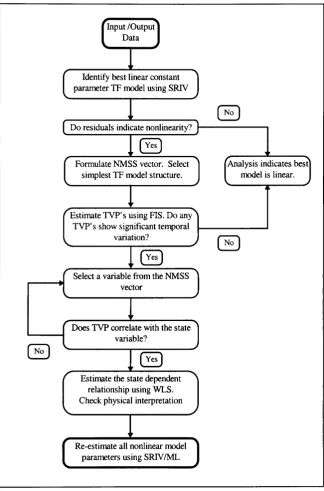
The preliminary stage of the DBM methodology is to determine that the system in
consideration is in fact nonlinear. This can be ascertained in the first instance, by
analysing the residuals of the best SRIV identified constant parameter linear TF
model, using standard statistical tests (e.g. Billings and Voon, 1986). In the second
instance, this may be achieved by allowing the parameters of a linear TF to vary over
time. The powerful Fixed Interval Smoothing (FIS) method of recursive estimation
(Young, 1993) can be used to obtain a non-parametric estimate of the model time
varying parameters (TVP). Any parameter that is found to be significantly time
variant over the observation interval, may reflect the non-stationary or nonlinear
behaviour of the system. Analysis then proceeds to investigate whether the identified
temporal parameter variations are state dependent and can be efficiently
parameterised. In accordance with DBM philosophy, in addition to enhancing the
model fit to the data, it is essential that the identified state has a clear mechanistic
interpretation in relation to the system under consideration. Having identified the
structure of the nonlinear dynamic model, the final stage of the DBM methodology is
to re-estimate all the model parameters against the time series through nonlinear
2.4.1 Background
The following discussion assumes that the behaviour of a discrete-time, dynamic
nonlinear and/or non-stationary environmental system can be represented by a general
dynamic, stochastic model which can be expressed as;
y(*) = 3 { x (* ),n (* )} (
2
.20
)where y ( k ) is the measured output of the system under consideration and 3{ } can be
regarded as a well behaved nonlinear function of the variables that are contained
within the non minimum state space (NMSS) state vector %{k) ,
X(k) = \y(k - 1), ■• ■■ ■■, y (k - n ) u ( k)T,■ ■■ •, u( k - m f V ( k f, • • • ,U (k - q)T f (2.21)
Here, %(k) constitutes a vector of past values of the system output y ( k) ; present and
past values of the deterministic input variables u{k) that are considered to be the
principle inputs to the system; and vector U ( k ) , which contains present and past
values of additional input variables that may affect the system nonlinearly, which at
this preliminary stage of the analysis, are yet to be determined. In addition, the
unobserved, serially uncorrelated, zero mean white noise process p(&), introduces the
stochasticity into the model and is assumed to be statistically independent to the input
variables u (k) and U ( k ) .
For explanatory purposes, consider a nonlinear system with only one principle input
reasonable to assume that the nonlinear model (2.20) can, in most cases, be
approximated by a linear TF with time varying parameters, which in the general form
can be written as,
y ( t ) = ^ ) + M * )z ' +’" ' ' +b" W z ” U(k) + S ( k ) (2.22)
1 + al (k)z +,-'-,+an(k)z
Here, the time variant nature of the parameters may reveal any non-stationary or
nonlinear behaviour present in the system. The noise term C,(k) arises from stochastic
disturbances in p ( £ ) .
2.4.2 Time varying parameter (TVP) estimation using the Fixed Interval
Smoothing (FIS) algorithm
Having presented the theoretical background to the DBM nonlinear modelling
concept, the following section discusses how the time variable parameters (TVP) are
estimated using a two pass recursive (forward filtering and backward smoothing)
operation on the time series data.
Pass 1: ‘Forward filtering’
In vector format, equation (2.22) can be represented in the form,
y (k) = z ( k ) Ta(.k) + r\(.k)Jc = 1,2 , - , N (2.23)
z ( k) = [- y(k - 1 ) ,- y(k - 2),— y(k - n)jt (k) ji( k — 1),- " u ( k - m j \ (2.24)
(2.25)
and where the noise process q(&) is assumed initially to be 'white' noise with variance
a 2. Having formulated model (2.21), it is necessary to characterise the temporal
variation shown by the parameters in vector a ( k) by some form of mathematical
description. One method, that has been demonstrated by Young (1978, 1984, 1993) as
capable of modelling these parameter variations, is the following Gauss-Markov
stochastic process,
where x(k) is a ‘state vector’ representing the parameters in a ( k) as well as other
elements that are necessary to characterise their complete temporal evolution. F ( k)
and G ( k) are transition and input matrices respectively and q{k) is a vector of
serially uncorrelated, random noise with zero mean and covariance Q. Here, the
transition matrix F { k ) determines the relationship between successive parameter
vectors, whilst the magnitude of parameter variation, introduced into the model by the
stochastic disturbance q ( k ), is regulated by the input matrix G ( k ) and Q. It is worth
noting, that when F ( k) and G{k) are both identity matrices, equation (2.24) can be
simplified to the well known random walk (RW) model,
x(k) = F(*)x(* -1 ) + G (*)q(*) (2.26)
It follows that from (2.26) that the best a priori estimate of vector x(fc), at the
previous time instant, is generated simply using,
x ( k \ k - l ) = F x ( k - l ) (2.28)
where the argument (k \ k - l) represents the estimate of x at time k, conditional on
the previous estimate at k-l. The a priori estimate of the covariance matrix associated
with equation (2.28) is obtained from,
V(k | k - 1) = F(k)P(k - 1)F(£)t + G0fc)QrG (* )T (2.29)
It has been shown (Young, 1984) that for estimation purposes, the ratio of Q and a 2
is important, rather than their explicit values. Therefore, the noise variance ratio
(NVR) matrix Qr is introduced into the estimation procedure and is defined as
Qr = Q / o l (2.30)
If model (2.23) was defined in its alternative state space form where the state vector
\ ( k ) = st(k) and the observation vector H(k) = z ( k)T , a recursive, prediction-
correction filtering algorithm for estimating the time varying parameters in model
(2.23) can be formed by combining equations (2.28 - 2.29) with a recursive time
variant form of the least squares parameter estimation algorithm. Thus, the ‘forward
pass’ of the TVP estimation routine is defined and takes the following form,
Prediction
x { k \ k - \ ) = ¥ { k ) x ( k - \ )

![Figure 4.7 The [1,3,0] Lancaster DBM model (full line),](https://thumb-us.123doks.com/thumbv2/123dok_us/8001316.761697/130.493.57.455.141.466/figure-lancaster-dbm-model-line.webp)