Lancaster University Management School
Working Paper
2007/031
Does profit sharing increase training by reducing turnover?
Colin Green and John Heywood
The Department of Economics Lancaster University Management School
Lancaster LA1 4YX UK
© Colin Green and John Heywood
All rights reserved. Short sections of text, not to exceed two paragraphs, may be quoted without explicit permission,
provided that full acknowledgement is given.
The LUMS Working Papers series can be accessed at http://www.lums.lancs.ac.uk/publications/
Does Profit Sharing Increase Training by Reducing Turnover?
Colin Green
Department of Economics, Lancaster University
John S. Heywood
Department of Economics, University of Wisconsin-Milwaukee and Birmingham Business School, University of Birmingham
Abstract
We test the theoretical prediction that profit sharing reduces worker separations and by doing so increases the incidence of training. Using individual level UK data, we confirm that profit sharing is a robust determinant of lower separation rates and of greater training incidence. Critically, we cannot confirm the predicted link between separations and training. Instead, the evidence supports alternative theories suggesting a direct link between profit sharing and training. Our results suggest that profit sharing changes employer-worker relations in a way that leads to greater formal and informal investment in worker skills but that this is independent of its influence on reducing separations.
KEYWORDS: PROFIT SHARES, PERFORMANCE PAY, TRAINING, TURNOVER
JEL CODES: M52, M53, J63.
Corresponding Author: Colin Green, Department of Economics, Lancaster University, Lancaster, LA1 4YT, UK.
1. INTRODUCTION
Profit sharing has been shown to be associated with higher firm profitability, labor productivity
and worker wages (Bhargara 1994, Cable and Wilson 1989, Estrin et al. 1997, Hubler 1993,
Kruse 1992, Wadhwani and Wall 1990). While the expectation that linking pay and performance
will increase worker productivity stands at the center of personnel economics, the causation in the
case of profit sharing remains less obvious. The recognized 1/N problem suggests that free riding
dramatically limits the effectiveness of profit sharing as a direct incentive device to elicit greater
effort. While particular technologies or forms of group behavior can help reduce the 1/N problem
(Fitzroy and Kraft 1987 and Adams 2006), there exists a largely alternative causation that has not
received sufficient attention. Profit sharing changes employment relations so as to create greater
investment in worker training and it is this training that improves productivity.
We pursue this second line of causation reviewing variations from the theoretical literature
suggesting that profit sharing spurs training. We contrast two broad strands within this second
line of reasoning. First, profit sharing reduces the likelihood of separations between workers and
the firm. This reduced turnover increases the expected amortization period for investments in
training that, in turn, increases the likelihood of training. Thus, profit sharing plays an indirect
role on training through its influence on separations (Azfar and Danninger 2001). Second, profit
sharing plays a direct role on training either by creating a contract that rewards the training by
reducing fears of a hold-up problem and/or by encouraging co-workers to provide training. We
are the first to investigate which of these two strands is predominant and to incorporate the roles
of types of performance pay beyond profit sharing.
We use two separate data sources to present detailed UK individual level hazard estimates of the
probability of separation showing it to be lower in the presence of profit sharing. We also
demonstrate that this result remains robust to a wide set of alternative specifications including
using panel data to hold worker fixed-effects constant, using alternative controls for tenure and
jointly estimating the provision of training and separation risk. Further, we confirm that profit
sharing stands as an important determinant of both the probability of receiving training and of its
intensity. While these results would seem to support the view that profit sharing influences
training through its influence on separation, we cannot confirm this despite numerous attempts at
simultaneous estimation. Instead, we find that the influence of separation probabilities on
training is typically absent, or even perversely positive. Yet, even as the predicted separation
probability is included and fails to play a role, profit sharing continues to be positively associated
with training.
Thus, using a wide range of testing strategies, we confirm that profit sharing positively influences
training and that it appears to do so directly rather than indirectly through its influence on the
probability of separation. In addition, we show that individual performance pay plays virtually
no role in determining separations but plays a largely similar role in determining training. This
casts further doubt on the existence of an indirect role for profit sharing through its influence on
separations and speaks to the importance of a contract that rewards the productivity growth
caused by training. At the same time, we have a unique indicator of informal training reflecting
circumstances in which co-workers are crucial. Consistent with the second direct effect, profit
sharing stands as a significant positive determinant of such training. Finally, individual
co-workers. Thus, by contrasting profit sharing and alternative performance pay schemes, we
present further support for both of the predicted direct causation paths between profit sharing and
training.
The next section presents the theory suggesting that profit sharing enhances productivity with a
special emphasis on the role of training. It reviews past evidence which indicates the value added
by using new data from a country not yet examined and the critical need for a new testing
strategy. The third section reviews our data and the methods used. The fourth section presents
the evidence on the association between profit sharing and job separation while the fifth section
presents the initial evidence on the association between profit sharing and training. The sixth
section summarizes our estimates that allow for both direct effects of profit sharing and indirect
effect through reduced turnover. A final section concludes.
2. PROFIT SHARING PRODUCTIVITY AND TRAINING
At its simplest, profit sharing aligns the interests of workers with those of owners leading
employees to work harder or smarter. There is evidence that workers under profit sharing
arrangements have reduced absence rates.1 In addition there is evidence of a correlation between
labor productivity and profit sharing (Kruse 1992, 1993 and Estrin et al. 1997). Yet, the
causation is not as straightforward as it may first appear once one recognizes that the "incentive
for effort" argument is undermined by the well-recognized 1/N problem. Highly interdependent
worker productivities may reduce the power of the associated free riding (Adams 2006 and
Heywood and Jirjahn 2006) as may strong horizontal peer monitoring (FitzRoy and Kraft 1987).
1
Also, discontinuous incentives that require a certain profitability to be achieved before there is
any profit sharing payments can alleviate free riding (Holmstrom and Milgrom 1987 and Petersen
1992). Yet, these take on the characteristics of special cases needed to overcome the more
general free-riding problem implied by such a broad group reward as profit sharing.
Parent (2004) takes the influence of profit sharing on productivity as given, but presents evidence
that it does not occur by eliciting extra effort. He shows that those workers who received profit
sharing on a previous job receive higher wages on their current job. This he claims is unlikely in
a model of eliciting effort but fits with the alternative conjecture that profit sharing is associated
with greater investment in skills and that these skills stand at the base of improved productivity.
It also suggests that at least a portion of the skills acquired due to the influence of profit sharing
may be general and thus of value to later employers.
There exist at least three variations in the literature as to why profit sharing may increase training
and so influence worker productivity. The first emphasizes the importance of profit sharing on
separations and we label this a model of indirect causation as it suggests that the reduced
separations are ultimately responsible for the greater incidence of training and so the higher
productivity. The second two variations are largely unrelated to separation and we label these
models of direct causation. Among our major objectives, we will distinguish empirically
between the direct and indirect models.
Profit sharing may reduce employee separations encouraging investment in firm specific capital
as the expected amortization period for such investments grows. Kruse (1992) argues that
identification with the firm" and because workers may value the stronger link between
compensation and effort implied by profit sharing. At the same time, firms may reduce their
initiated separations because profit sharing reduces the marginal cost of labor during periods of
weak firm performance making redundancy less likely (Weitzman 1984). The existing evidence
on the relationship between profit sharing and separation is mixed. D'Art and Turner (2004) fail
to find any influence of profit sharing on separation in their large survey of firms in 11 European
countries. Chelius and Smith (1990) found only "borderline" evidence in earlier US data
claiming it was at best "suggestive." These studies contrast with the more recent US individual
level estimations of Azfar and Danninger (2001) showing a strong negative influence of profit
sharing on the probability of a worker being made redundant and also showing a negative
influence of profit sharing on the probability of a worker quitting.2
Azfar and Danninger (2001) combine their evidence that profit sharing reduces separations with
similarly strong evidence that profit sharing is associated with increased training. They show
that workers with profit sharing were 25 percent more like to receive training and that when
trained, they received significantly more training as well. They argue that the combined findings
that profit sharing reduces separations and that it increases training "support our hypothesis that
greater job stability increases investment in firm-specific training." (Azfar and Danninger 2001,
p. 626)
While recognizing the importance of these findings, the pattern of indirect causation between
profit sharing and training relies upon a strong link between the likelihood of separation and
2
training. Although longer expected tenure is taken as a basic determinant of training (Lynch
1991, 1993), the influence of reduced separation probabilities on training may not be large if firm
specific training is actually rare, as indicated by Lowenstein and Spletzer (1999), and most
periods of unemployment following separation are short or non-existent. Thus, Royalty (1996)
estimates the influence of predicted separation probabilities on the incidence of
employer-provided training. She finds that the probability of "job to job" separation (the majority of
separations for men) has no influence on training and that only the probability of "job to
non-employment" separation has a negative influence. This confirms the importance of expected
employment duration not expected tenure duration. Veum (1997) finds a positive association
between training off-the-job and worker separation and, at best, a weak negative association
between employer-provided training and separation. Levine (1993) finds no evidence that plants
that provide greater training have lower turnover rates and Sieben (2005) finds evidence from
European survey data that periods of general training actually trigger increased job search
behavior. Using UK data Green et al (2000) find no relationship between training and mobility.
In short, researchers interested in the influence of profit sharing on training should not take for
granted that a reduced probability of separation necessarily increases training. There may,
instead, be a direct link with profit sharing. Two channels have been suggested in the literature
explaining how profit sharing may directly increase training.
First, profit sharing has been seen as an explicit contract that helps alleviate the well-known
"hold-up problem" associated with investments in firm specific training (FitzRoy and Kraft
1987). Firm specific skills are inherently difficult to contract upon and because they have no
reputation effects. Moreover, even for general training, workers may fear a hold-up problem
from their current employer if it is costly or time consuming to find alternative employment.
Thus, "by writing a contract in which it is specified that workers get a certain percentage of
profits, workers can feel more confident that they will not be held up ex post (Parent 2004: 38)."
Thus, workers under profit sharing arrangements may choose to devote more time investing in
skills. Interestingly, this function might well be played by alternative performance pay schemes
that allow workers to capture returns on their investment in training and improved performance
(Kraft 1991). As a result, we will examine the role of both profit sharing and individual
performance pay throughout our analysis. In either case, it is the explicit contract that rewards
increased productivity that causes the investment not an indirect influence through a decreased
risk of separation.
Second, profit sharing has been seen as directly encouraging "helping effort" in which workers
allocate effort not only to their own tasks but also to assisting with the tasks of coworkers (Itoh
1991). Profit sharing thus helps reduce the confirmed tendency under individual incentives of
ignoring the profitable allocation of effort to helping coworkers (Drago and Garvey 1996).
Critically, training has very large elements of helping effort. Co-workers provide a large share of
both formal and informal on-the-job training and do so by taking time away from other duties
(Barron et al. 1989). The time and effort workers spend training co-workers has been thought to
depend on the incentives they face. Profit sharing reduces the tendency to under-provide training
effort. Indeed, Morrison and Wilhelm (2004) emphasize the role played by co-worker training in
professional service firms (such law firms) arguing that partnership arrangements in which the
trained workers retain a share of profit are critical to ensuring that the appropriate degree of
receiving a share of firm profits rather than receiving earnings based on their individual
contributions are more likely to consult with one another about cases and provide their expertise
to colleagues. Thus, in this view profit sharing increases the incentive for informal and on-the-job
training by co-workers and supervisors who might otherwise emphasize their own tasks. In this
case, individual performance pay should work in the opposite direction as profit sharing. Explicit
rewards for workers' own productivity should be at odds with helping and training newer hires as
the diverted time increases overall productivity but not in ways rewarded by an individual based
scheme.
We present estimates using UK data on profit sharing as a determinant of individual worker
separations. Using two UK data sets and controlling for alternative performance pay schemes
beyond profit sharing, we confirm a robust role for profit sharing in reducing separations for male
employees. We show that profit sharing is associated with greater likelihood and intensity of
training but we fail to find evidence for the hypothesized indirect causation through reduced
separations. Instead, the evidence supports the existence of a direct influence of profit sharing on
training.
3. DATA
We use two longitudinal data sets from the UK that sample very similar populations in similar
time frames, the British Household Panel Survey (BHPS) and the 5 quarter longitudinal version
of the UK Labour Force Survey (LFS). The BHPS is an annual longitudinal survey from 1991 to
2004. The longitudinal version of the LFS we use has been running since 1992 and comprises a
five quarter rolling panel where each quarter a new cohort is observed. For both data sets, we
We use these two data sets as each has off-setting strengths with respect to payment method
information. The chief advantage of the LFS is its detailed measures of payment methods. From
1999 onwards, individuals record separately if they received tips, piece rates, bonuses, profit
shares and a variety of compensatory wages (locality allowances, shift allowances etc).3
However, payment information is only available in the LFS for the first and last quarter that the
individual is observed. Hence, for our purposes, it has only a limited panel dimension. The
information on payment schemes in the BHPS is available for 1998 onwards and the questions
asked are, "In the last 12 months have you received any bonuses such as a Christmas or quarterly
bonus, profit-related pay or profit sharing bonus, or an occasional commission?", this excludes
overtime payments; and "Does your pay include performance related pay" (Taylor et al, 2006).
Hence the categorization of profit share receipt in the BHPS is broad. A key difference between
the two data sets is the time domain that the payment method questions cover. For the BHPS,
these relate to payments made in the last year. Due to the quarterly nature of the LFS, payment
method information is effectively for the previous 13 weeks.
Both data sets allow the disaggregation of job separations into a number of categories, including
quits, fires and redundancies. We observe job separations in the year following the observation of
pay type. For the BHPS we have a panel of separations of up to 8 years, whereas with the
structure of the LFS we effectively only observe one year of separation data on each individual.
Training information is quite detailed in the BHPS, and has been extensively used by researchers
in the past (see for instance Arulampalam and Booth (1998) and Booth and Bryan (2006)). We
3
focus on the incidence and intensity of employer funded training, general training and specific
training. The LFS contains less detailed information on training, and much of this is only
available for certain subsets of the data. However, unlike the BHPS, it has an explicit question on
the incidence of informal on-the-job training. We use this to examine the role of profit shares on
helping effort.
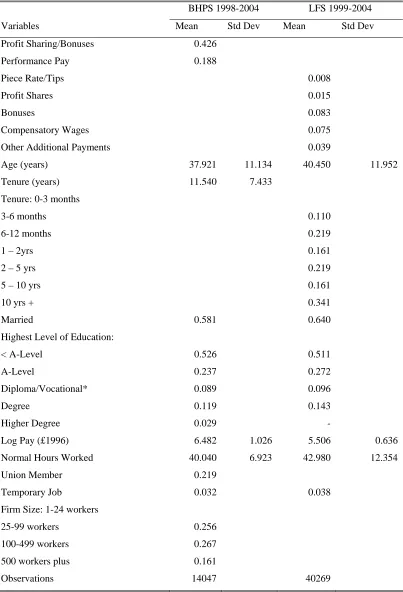
Table 1 provides summary statistics for the two data sets. In the BHPS roughly 42 percent of our
sample report receiving a "profit share or bonus" in the past year and 19 percent report some form
of performance pay. The more detailed pay scheme rates in the LFS appear somewhat lower;
however recall that these are reported rates of payment in the past quarter. If these rates are
roughly annualized, then profit share/bonuses are received by approximately 39 percent of male
non-public sector employees. Whether the receipt of performance related pay is of a comparable
level is dependant on how respondents in the BHPS viewed payments classified as compensatory
wages and the other additional payments listed in the LFS. Otherwise the two samples appear
roughly comparable, although there are slight variations by age and hours worked. Log weekly
pay rates are noticeably lower in the LFS.
4. RESULTS: THE DETERMINANTS OF SEPARATION
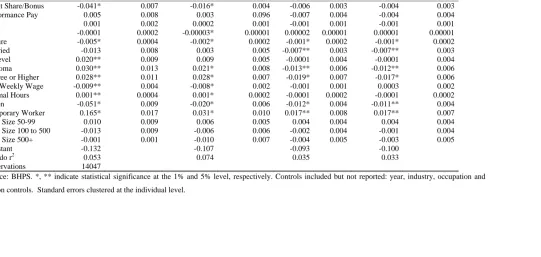
Probit estimates of the risk of job separation are reported in Table 2 and Table 3 for the BHPS
and LFS, respectively. For ease of interpretation we report marginal effects. We present overall
estimates of separation and subsequent estimates disaggregated by quits, fires and redundancies
(a subset of fires). Initially, risk of separation is estimated across the pooled sample for the BHPS
the receipt of profit sharing is associated with a lower risk of separation. Furthermore, profit
sharing appears to be associated with both lower incidence of employee initiated separations
(quits), employer initiated separations (fires) and redundancy. Such systematic effects are not
observed for other performance pay and there is even some evidence that other performance pay
types are associated with a higher risk of separation.
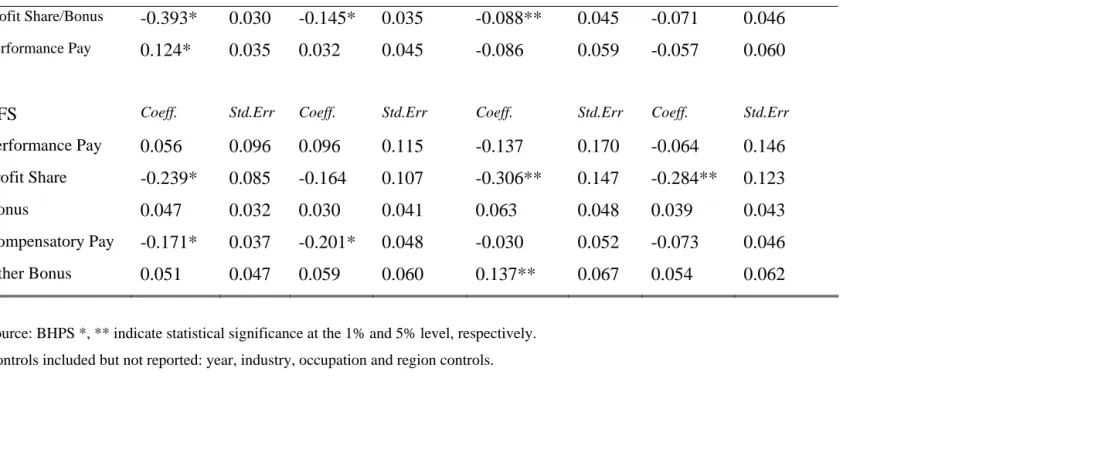
Greater tenure may simply reflect a lower probability of separation. This mechanical relationship
may over-control the determinants of separation allowing misleading results to emerge. As a
robustness check, Appendix Table A1 demonstrates that the reported effects of profit sharing on
turnover are robust to the omission of tenure, which in a pre-sorted sample such as the BHPS and
LFS is likely to be endogenously related to separation risk.
It has been suggested that any observed relationship between profit shares and job turnover may
simply reflect the sorting of individuals by unobservable characteristics. As one illustration,
workers who form strong bonds with co-workers may both sort into employers using profit
sharing and be less likely to quit (Heywood et al. 2005). To investigate this and related
possibilities, we re-estimate the models of overall separations for the BHPS where we utilize a
fixed effects logit estimator in an attempt to control for unobserved individual level
heterogeneity.4 The results from this model are reported in table 4. This demonstrates that the
sign and magnitude of profit sharing effects on separations are robust to the inclusion of
individual level fixed effects. 4
5. RESULTS: THE DETERMINANTS OF TRAINING
Table 5 provides probit estimates of the impact of profit sharing on training incidence with
standard errors clustered at the individual level. The estimates are reported for overall training
incidence, along with the incidence of employer funded training, general training and specific
training. Such a detailed level of disaggregation is not possible in the LFS, so reported estimates
are from the BHPS. Nonetheless, estimates of the influence of payment method on overall
training incidence from the LFS are reported as appendix A2. All control variables are as
reported in table 2 and 3, respectively, but for brevity only the estimated payment method effects
are reported.
The estimates of overall training incidence in table 5 and appendix Table A2 demonstrate
that the receipt of profit sharing stands as a positive determinant of the incidence of training. The
estimates for the disaggregated training incidence models also suggest a positive association
between profit share receipt and the receipt of employer-funded training, specific training and
general training. The magnitudes of these effects are roughly similar. Furthermore, evidence from
the LFS indicates that profit sharing is positively associated with a higher incidence of informal
on-the-job training (Column 5, Table A2), an effect that is not evident for performance pay.
When combined with our inability to find a role for reduced separation probability on training
(see section 6), this finding is consistent with the notion that profit sharing increases helping
effort and so training within the workplace.
The estimated association between training and profit shares may merely signal that
profit sharing arrangements. We investigate this by again controlling for individual specific
unobservable characteristics by re-estimating the model of overall training incidence via fixed
effects logit.5 These estimates are reported in table 6. These retain the same signs to those
reported in table 5, although the effect of profit sharing on overall training incidence just misses
significance at the 10 per cent level.
6. DIRECT VS. INDIRECT EFFECTS - THE ROLE OF SEPARATIONS
As discussed, Azfar and Danninger (2001) argue that profit sharing increases the receipt of
training by reducing the likelihood of separation, increasing the amortization period for
investment and so making a larger share of training investments profitable. At the same time
profit sharing may directly influence training receipt by alleviating the hold up problem in
training and by increasing the willingness of coworkers to provide training. In this subsection we
allow for the possibility of both direct and indirect effects. We investigate this by creating an
instrument for the risk of separation and including it as a regressor in a 2SLS estimation of
training incidence.6 In both the instrumental equation on separation risk and in the training
incidence equation profit sharing stands as a critical variable of interest. The combination of a
significant role for profit sharing in the instrumental estimation of separation risk and a role for
the instrumented separation risk variable in training incidence would indicate an indirect effect of
profit sharing. A significant role for profit sharing in the second stage estimation of training
5
Again this strategy may introduce sample selection bias into our estimates. We re-estimated all the models reported in table 6 by linear probability model with fixed effects. This produced similar estimates of the effect of profit sharing/bonuses and performance pay on the incidence of training.
6
would indicate a direct role. The ability to distinguish between these direct and indirect effects
depends upon the success of the instrumental variable approach.
The identification of our instrument exploits a long recognized association between
cigarette smoking and risk preference. Thus, Hersch and Viscusi (1990) and Hersch and Pickton
(1995) use cigarette smoking to proxy individuals with greater risk preference. Experiments
confirm this association by asking participants to engage in experimental lotteries designed to
measure their risk aversion. At the conclusion of the experiment Barsky et al. (1997) found that
those who undertook the larger risks in the laboratory were significantly more likely to smoke.
Critically cigarette smoking has been correlated with important labor market choices. Viscusi
and Hersch (2001) demonstrate that US workers who smoke take substantially more risky jobs
(in terms of injuries on the jobs). In the UK Brown et al. (2006) show that smokers are more
likely to accept jobs with greater earnings and employment risk. The critical point we apply from
this literature is that smokers can be expected to receive less disutility from a given risk of job
separation. As a consequence, in a hedonic labor market, we anticipate that workers that smoke
will sort into jobs with higher expected separation risks all else equal.
At the same time that our identification scheme requires a variable that strongly
determines a workers separation risk, that same variable should not influence the incidence of
training itself. While some forms of training may be more risky than others, there is nothing
about the association between smoking and risk that we think should influence the decision
whether or not to undertake training itself. Statistically, the number of cigarettes smoked daily
appears to be a highly satisfactory instrument insofar as it is statistically significant in the
separation equation (T-Stat = 5.13), unrelated to any of the measures of training incidence (an
outlined by Stock and Yogo (2005) to detect weak instruments. We experimented with another
instrumental variable that met the same statistical criteria, whether the individual reported having
a poor financial situation. We included this in estimates both in conjunction with the number of
cigarettes smoked and in estimations where the smoking variable was omitted. In none of the
training models did this materially affect the magnitude or sign of the profit sharing or
performance pay effects on training incidence.
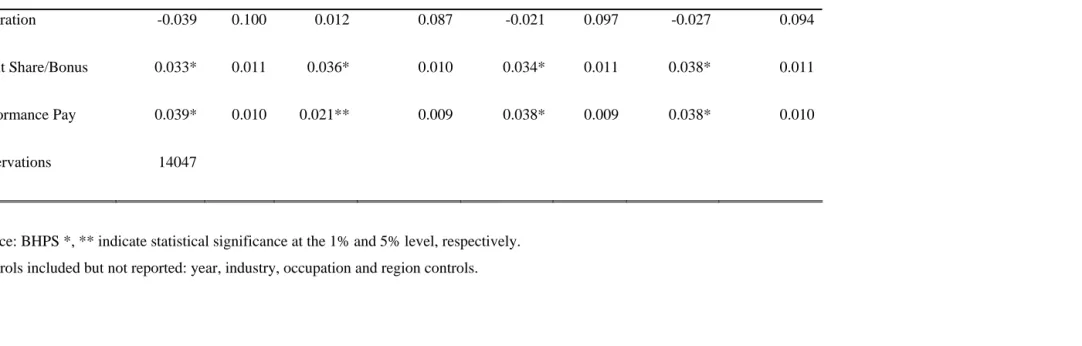
Estimates from the 2SLS model are reported as Table 7. The addition of the smoking
variable does not change the important role that profit sharing plays as a negative determinant of
probability of job separation. Thus, the indirect effect will be confirmed if the predicted
probability of separation influences training.
Two critical observations emerge from Table 7. First, the predicted probability of
separation never takes a statistically significant coefficient. Indeed, it is worth nothing in passing
that if one ignores the proper instrumenting of the separation probability and simply includes
separation as a normal regressor, it often takes not only positive a positive coefficient but one
statistically significant from zero.7 Thus, even though profit sharing lowers the rate of
separation, the lowered rate of separation plays no role in increasing training. In short, we find
no support for the indirect path of causation. Second, despite the addition of the estimated
probability of separation, the role of profit sharing on training remains in the second stage
estimates presented in Table 7. Profit sharing takes a significantly positive coefficient in all four
estimates for the different types of training and thus appears to have a strong and robust direct
influence on training.
It might be thought that our estimation is missing the critical role played by separation
because of the range of tenures in our sample. Specifically, most separations may happen early
7
in a workers' tenure and it is also at this time that most training is undertaken (Greenhalgh and
Marvotas 1996). Thus, our estimations might fail to uncover the true negative influence of the
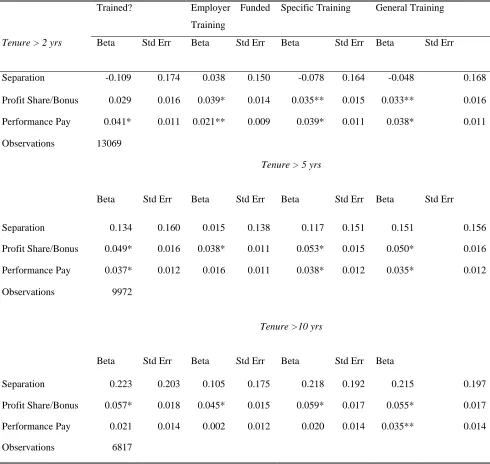
separation probability on training that happens throughout most of a worker's later tenure. To test
this we re-estimate our model in Table 8 eliminating all workers within their first two years of
tenure. While the point estimates move modestly, the direct effect of profit sharing remains
strongly confirmed and there is no significant role for the estimated separation probability. We
went further eliminating all of those with less than five years and than all of those with less than
ten years. Neither set of estimations show the predicted negative influence of the estimated
probability of separation and both strongly confirm the continuing direct role of profit sharing.
Furthermore, the 2SLS estimates of profit shares effects on training reported in tables 7
and 8 are robust to a number of additional tests and specifications. First, estimating the impact of
separation within the next year on training is an arbitrary time interval. We estimated additional
models using separation within the next 2 years and next 3 years, respectively. In no case did this
markedly affect the point estimates of profit shares effect on training incidence or reveal an
indirect effect. Second, separation may represent too coarse a turnover variable. Instead risk of
employer initiated separations (fires) may be more likely to effect employers’ decisions on who
to train (especially in firm specific skills). We re-estimated the models in table 7 using fires
instead of separations, again the point estimates of profit shares on training remain essentially
unchanged.
In addition, we estimate separate 2SLS models of training incidence for two sub-groups
where there is an expectation of longer term employment relationships, unionised workers and
permanent (i.e. non-temporary) workers. For both groups we expect longer expected duration of
its indirect influence on turnover. Conversely, temporary workers and non-unionised workers
should have relatively lower expected tenure, suggesting greater scope for indirect effect through
separation. We estimate the 2SLS models of training incidence for non-unionised workers (there
are too few observations to estimate a model for temporary workers alone). For permanent
workers, the estimates of profit sharing effects on training are essentially unchanged to those
reported in table 5. For unionized workers, estimated profit sharing effects are marginally higher
than those in table 5 (marginal effects = 0.047 [0.018]). In neither case is there any evidence of
an indirect effect of profit sharing on training through reduced separation risk. Estimates for the
non-unionised sub-sample indicate a marginally lower direct effect (although still statistically
significant) of profit sharing on training, but still no effect of separation risk on training
incidence. Taken together, these estimates provide a further indication that the observed effect of
profit sharing on training is being driven by a direct effect rather than indirectly through lower
separation rates.
In an alternative robustness check, we examine the joint estimation of separation risk and
training recognizing that common unobservable factors may influence both contemporaneous
separation risk and training incidence. We estimate bivariate probit models (Zellner and Lee,
1965) which account for common errors and report the results in Table 9. Again we use number
of cigarettes as the identifying variable. Indeed, unobservable individual level factors that
increase separation risk are also associated with higher levels of training incidence. Yet, the
presence of this association this does not fundamentally change the estimated effect of profit
7. CONCLUSION
Previous research demonstrates the link between the use of profit sharing schemes and increased
profitability, labour productivity and worker wages. However, relatively little is understood
about how profit sharing increases worker productivity. This paper investigated one particular
channel, the effect of profit sharing on worker training. In particular, we distinguish between the
direct effect of profit sharing on training through creating a contract that rewards training and/or
encouraging co-workers to provide training, and the potential indirect effect through reduced
separations and hence longer expected amortization period.
As a first step we use UK data to demonstrate that profit sharing is associated with lower
separation rates. In turn, we demonstrate a positive, direct and statistically significant effect of
profit sharing on the provision of worker training. This is true of overall training incidence and
intensity, but also for sub-categories of training such as employer-funded, specific and general
training. These results are robust to the inclusion of controls for individual fixed effects,
simultaneity of training and separation, and remain once we attempt to control for the effect that
profit sharing has on reducing the likelihood of future separation from the firm.
More generally, these direct effects on training are also present for other performance
related pay. However, unlike performance related pay schemes that directly reward individual
productivity, profit sharing may also increase informal and on-the-job training provision by
co-workers. We present evidence that profit sharing does indeed increase the provision of informal
on the job training, and that no such effect is present for direct performance related pay.
Together, our results suggest that profit sharing changes employer-worker relations in a
one likely source of the previously demonstrated worker productivity enhancing effect of profit
sharing arrangements. We emphasize that we found no evidence that profit sharing has an
TABLE 1 Summary Statistics, Male Non-Public Sector Employees Aged 20-65
BHPS 1998-2004 LFS 1999-2004
Variables Mean Std Dev Mean Std Dev
Profit Sharing/Bonuses 0.426
Performance Pay 0.188
Piece Rate/Tips 0.008
Profit Shares 0.015
Bonuses 0.083
Compensatory Wages 0.075
Other Additional Payments 0.039
Age (years) 37.921 11.134 40.450 11.952
Tenure (years) 11.540 7.433
Tenure: 0-3 months
3-6 months 0.110
6-12 months 0.219
1 – 2yrs 0.161
2 – 5 yrs 0.219
5 – 10 yrs 0.161
10 yrs + 0.341
Married 0.581 0.640
Highest Level of Education:
< A-Level 0.526 0.511
A-Level 0.237 0.272
Diploma/Vocational* 0.089 0.096
Degree 0.119 0.143
Higher Degree 0.029 -
Log Pay (£1996) 6.482 1.026 5.506 0.636
Normal Hours Worked 40.040 6.923 42.980 12.354
Union Member 0.219
Temporary Job 0.032 0.038
Firm Size: 1-24 workers
25-99 workers 0.256
100-499 workers 0.267
500 workers plus 0.161
Observations 14047 40269
TABLE 2 Turnover Estimates – Marginal Effects, Male Non-Public Sector Employees Aged 20-65, 1998-2004, BHPS.
Separations Quits Fires Redundancies
Coeff. Std.Err Coeff. Std.Err Coeff Std.Err Coeff Std.Err
Profit Share/Bonus -0.041* 0.007 -0.016* 0.004 -0.006 0.003 -0.004 0.003 Performance Pay 0.005 0.008 0.003 0.096 -0.007 0.004 -0.004 0.004
Age 0.001 0.002 0.0002 0.001 -0.001 0.001 -0.001 0.001
Age2 -0.0001 0.0002 -0.00003* 0.00001 0.00002 0.00001 0.00001 0.00001 Tenure -0.005* 0.0004 -0.002* 0.0002 -0.001* 0.0002 -0.001* 0.0002 Married -0.013 0.008 0.003 0.005 -0.007** 0.003 -0.007** 0.003 A-Level 0.020** 0.009 0.009 0.005 -0.0001 0.004 -0.0001 0.004
Diploma 0.030** 0.013 0.021* 0.008 -0.013** 0.006 -0.012** 0.006 Degree or Higher 0.028** 0.011 0.028* 0.007 -0.019* 0.007 -0.017* 0.006
Log Weekly Wage -0.009** 0.004 -0.008* 0.002 -0.001 0.001 0.0003 0.002 Normal Hours 0.001** 0.0004 0.001* 0.0002 -0.0001 0.0002 -0.0001 0.0002
Union -0.051* 0.009 -0.020* 0.006 -0.012* 0.004 -0.011** 0.004 Temporary Worker 0.165* 0.017 0.031* 0.010 0.017** 0.008 0.017** 0.007
Firm Size 50-99 0.010 0.009 0.006 0.005 0.004 0.004 0.004 0.004 Firm Size 100 to 500 -0.013 0.009 -0.006 0.006 -0.002 0.004 -0.001 0.004 Firm Size 500+ -0.001 0.001 -0.010 0.007 -0.004 0.005 -0.003 0.005
Constant -0.132 -0.107 -0.093 -0.100
Pseudo r2 0.053 0.074 0.035 0.033
Observations 14047
TABLE 3 Turnover Estimates - Marginal Effects, Male Non-Public Sector Employees Aged 20-65, 1999-2004, LFS
Separations Quits Fires Redundancies
Coeff. Std.Err Coeff. Std.Err Coeff Std.Err Coeff Std.Err
Profit Share -0.029** 0.013 -0.009 0.009 -0.015 0.008 -0.020** 0.009 Performance Pay 0.010 0.015 0.009 0.009 -0.007 0.009 -0.005 0.011
Bonus 0.009 0.005 0.003 0.003 0.004 0.003 0.003 0.003
Compensatory Pay -0.015* 0.006 -0.011* 0.004 0.001 0.003 -0.004 0.004 Other Bonus 0.009 0.007 0.005 0.005 0.008** 0.004 0.004 0.005
Age 0.001 0.001 0.001 0.001 0.0004 0.004 0.002* 0.0005
Age2 -0.00003* 0.00001 -0.0002* 0.000006 -0.00005 0.00005 -0.00001** 0.000006 Log Weekly Wage -0.010* 0.003 -0.008* 0.002 0.0001 0.002 0.002 0.002
Hours 0.001* 0.0001 0.0002* 0.00008 0.0002** 0.0001 0.0001 0.0001 Tenure: 3-6 months -0.028* 0.007 -0.018* 0.005 -0.007** 0.003 -0.002 0.005
6-12 months -0.033* 0.006 -0.014* 0.004 -0.014* 0.003 -0.008 0.005 1 – 2yrs -0.048* 0.006 -0.023* 0.004 -0.016* 0.003 -0.010** 0.004 2 – 5 yrs -0.076* 0.006 -0.030* 0.004 -0.024* 0.003 -0.016* 0.004 5 – 10 yrs -0.104* 0.006 -0.049* 0.004 -0.024* 0.003 -0.017* 0.004 10 yrs+ -0.146* 0.006 -0.071* 0.004 -0.032* 0.058 -0.023* 0.004
Married 0.010* 0.003 0.005** 0.002 0.001 0.032 -0.007* 0.002
A-Level 0.003 0.005 0.001 0.003 0.003 0.003 -0.002 0.003
Voc/Diploma 0.008** 0.004 0.042 0.029 -0.001 0.003 -0.001 0.002 Degree or higher -0.008** 0.004 -0.116* 0.040 -0.001 0.003 -0.001 0.003
Temporary Worker 0.050* 0.006 0.006 0.050 0.040* 0.003 0.014* 0.004
Constant -0.095 -0.067 -0.109 -0.185
Pseudo r2 0.072 0.073 0.053 0.017
Observations 40269
Source: LFS. *, ** indicate statistical significance at the 1% and 5% level, respectively. Controls included but not reported: year, industry, occupation, region and ethnicity controls. Robust standard errors.
TABLE 4 Fixed Effects Estimates of Payment Method Effects on Separation (Average Effects), Male Non-Public Sector Employees Aged 20-65.
Fixed Effects
Coeff. Std.Err
Profit Share/Bonus -0.809* 0.078
Performance Pay 0.199** 0.093
Observations 5,963
TABLE 5 The Effect of Payment Method on Training Incidence and Intensity, Male Non-Public Sector Employees Aged 20-65,
1998-2004.
Trained? Employer Funded Training Specific Training General Training
Incidence (marginal effects) Beta Std Err Beta Std Err Beta Std Err Beta Std Err
Profit Share/Bonus 0.038* 0.008 0.036* 0.007 0.041* 0.008 0.037* 0.008
Performance Pay 0.034* 0.011 0.017** 0.008 0.031* 0.010 0.032* 0.011
Intensity (hours) Training Time Employer Funded Training Specific Training General Training
Beta Std Err Beta Std Err Beta Std Err Beta Std Err
Profit Share/Bonus 2.074* 0.661 2.668** 1.213 2.025 1.599 3.387** 1.444
Performance Pay 2.568* 0.750 0.087 1.519 0.207 2.003 0.176 1.809
Observations 14047
TABLE 6 Fixed Effects Estimates of Training Incidence (Average Effects), Male Non-Public Sector Employees Aged 20-65.
Trained? Employer Funded Training
Specific Training General Training
Coeff. Std.Err Coeff. Std.Err Coeff. Std.Err Coeff. Std.Err
Profit Share/Bonus 0.105 0.069 0.241* 0.077 0.200* 0.072 0.146** 0.071 Performance Pay 0.134 0.080 0.083 0.089 0.155 0.082 0.153 0.082
Observations 7043 5633 6501 6692
TABLE 7 IV Estimates of Payment Method on Training, Male Non-Public Sector Employees Aged 20-65.
Trained? Employer Funded Training Specific Training General Training
Coeff. Std.Err Coeff. Std.Err Coeff. Std.Err Coeff. Std.Err
Separation -0.039 0.100 0.012 0.087 -0.021 0.097 -0.027 0.094
Profit Share/Bonus 0.033* 0.011 0.036* 0.010 0.034* 0.011 0.038* 0.011
Performance Pay 0.039* 0.010 0.021** 0.009 0.038* 0.009 0.038* 0.010
Observations 14047
TABLE 8 IV Estimates of the Effect of Payment Method on Training Incidence by Tenure Bands, Male Non-Public Sector Employees Aged 20-65, 1997-2004, BHPS.
Trained? Employer Funded
Training
Specific Training General Training
Tenure > 2 yrs Beta Std Err Beta Std Err Beta Std Err Beta Std Err
Separation -0.109 0.174 0.038 0.150 -0.078 0.164 -0.048 0.168 Profit Share/Bonus 0.029 0.016 0.039* 0.014 0.035** 0.015 0.033** 0.016 Performance Pay 0.041* 0.011 0.021** 0.009 0.039* 0.011 0.038* 0.011
Observations 13069
Tenure > 5 yrs
Beta Std Err Beta Std Err Beta Std Err Beta Std Err
Separation 0.134 0.160 0.015 0.138 0.117 0.151 0.151 0.156
Profit Share/Bonus 0.049* 0.016 0.038* 0.011 0.053* 0.015 0.050* 0.016 Performance Pay 0.037* 0.012 0.016 0.011 0.038* 0.012 0.035* 0.012
Observations 9972
Tenure >10 yrs
Beta Std Err Beta Std Err Beta Std Err Beta
Separation 0.223 0.203 0.105 0.175 0.218 0.192 0.215 0.197
Profit Share/Bonus 0.057* 0.018 0.045* 0.015 0.059* 0.017 0.055* 0.017 Performance Pay 0.021 0.014 0.002 0.012 0.020 0.014 0.035** 0.014
Observations 6817
TABLE 9 Bivariate Probit Estimates of Profit Share Effects on Training and Separation, Male Non-Public Sector Employees Aged
20-65
Trained? Employer Funded Training Specific Training General Training
Coeff. Std.Err Coeff. Std.Err Coeff. Std.Err Coeff. Std.Err
Profit Share/Bonus 0.084* 0.029 0.066** 0.032 0.085* 0.030 0.078* 0.030 Performance pay 0.062 0.038 0.059** 0.039 0.064 0.038 0.062* 0.037
Separation Profit Share/Bonus -0.161* 0.029 -0.162* 0.029 -0.162* 0.029 -0.162* 0.029
Performance pay 0.034 0.036 0.034 0.037 0.034 0.037 0.034 0.037 Number Cigs 0.005* 0.001 0.005* 0.002 0.005* 0.002 0.005* 0.002 Rho 0.045** 0.019 0.012 0.020 0.007 0.019 0.045** 0.019
Observations 12842
TABLE A1 Turnover Estimates Omitting Tenure, Male Non-Public Sector Employees Aged 20-65
Separations Quits Fires Redundancies
BHPS Coeff. Std.Err Coeff. Std.Err Coeff. Std.Err Coeff. Std.Err
Profit Share/Bonus -0.393* 0.030 -0.145* 0.035 -0.088** 0.045 -0.071 0.046
Performance Pay 0.124* 0.035 0.032 0.045 -0.086 0.059 -0.057 0.060
LFS Coeff. Std.Err Coeff. Std.Err Coeff. Std.Err Coeff. Std.Err
Performance Pay 0.056 0.096 0.096 0.115 -0.137 0.170 -0.064 0.146
Profit Share -0.239* 0.085 -0.164 0.107 -0.306** 0.147 -0.284** 0.123
Bonus 0.047 0.032 0.030 0.041 0.063 0.048 0.039 0.043
Compensatory Pay -0.171* 0.037 -0.201* 0.048 -0.030 0.052 -0.073 0.046
Other Bonus 0.051 0.047 0.059 0.060 0.137** 0.067 0.054 0.062
Appendix A2 Training Incidence, LFS, Marginal Effects
LFS Trained in last 13 weeks? On the Job Training in Last 4 weeks?*
Beta Std Err Beta Std Err
Performance Pay -0.001 0.025 -0.007 0.014
Profit Share 0.092* 0.019 0.044* 0.013
Bonus 0.033* 0.008 0.009 0.005
Compensatory Pay 0.090 0.009 0.044* 0.006
Other Bonus 0.053* 0.012 0.002 0.007
Observations 40269
* "On the job training" means learning by example and practice while actually doing the
REFERENCES
Adams, C. P. (2006). ‘Optimal Team Incentives with CES Production’. Economics Letters, vol. 92, pp. 143–48.
Arranz-Aperte, L. (2005). ‘Profit Sharing and Employment Stability: Does Profit Sharing help You Keep Your Job?’, Working Paper, Swedish School of Economics and Business Administration.
Arulampalam, W. and Booth, A. (1998). ‘Training and Labour Market Flexibility: Is There a Trade-off’, British Journal of Industrial Relations, vol. 36, pp. 521-536.
Azfar, O. and Danninger, S. (2001). ‘Profit Sharing, Employment Stability and Wage Growth’, Industrial and Labor Relations Review, vol. 54, pp. 619–30.
Barron, J.M., Black, D.A. and Lowenstein, M.A. (1989). ‘Job Matching and On-the-Job Training’, Journal of Labor Economics, vol. 7, pp. 1–19.
Barsky, R.B., Juster, F.T., Kimball, M.A. and Shapiro, M.D. (1997). ‘Preference Parameters and Behavioral Heterogeneity: An Experimental Approach in the Health and Retirement Study’, Quarterly Journal of Economics, vol. 112, pp. 537–79.
Bassanini, A., Booth, A., Brunello, G., De Paola, M. and Leuven, E. (2005). ‘Workplace Training in Europe’, IZA Discussion Paper No. 1640.
Bhargara, S. (1994). ‘Profit Sharing and the Financial Performance of Companies: Evidence from UK Panel Data’, Economic Journal, vol. 104, pp. 1044–56.
Brown, S., Fakhafkh, F. and Sessions, J.G. (1999). ‘Absenteeism and Employee Sharing,’ Industrial and Labor Relations Review, vol. 52, pp. 234–51.
Brown, S., L. Farrell, Harris, M.N. and Sessions, J.G. (2006). ‘Risk Preference and Employment Contract Type’, Journal of the Royal Statistical Association A, vol. 169, pp. 849–863.
Cable, J. and Wilson, N. (1989). ‘Profit Sharing and Productivity: An analysis of UK Engineering Firms’, Economic Journal, vol. 99, pp. 366–75.
Chelius, J. and Smith, R.S. (1990). ‘Profit Sharing and Employment Stability’, Industrial and Labor Relations Review, vol. 43, pp. 256-81.
D'Art, D. and Turner, T. (2004). ‘Profit Sharing, Firm Performance and Union Influence in Selected European Countries’, Personnel Review, vol. 33, pp. 335–350.
Drago, R. and Garvey, G.T. (1996). ‘Incentives for Helping on the Job: Theory and Evidence’, Journal of Labor Economics, vol. 16, pp. 1–25
Encinosa, W.E., Gaynor, Martin. and Rebitzer, J.B. (2007), `The sociology of groups and the economics of incentives: Theory and evidence on compensation systems`, Journal of Economic Behavior & Organization, vol. 62, pp. 187-214.
Estrin, S., Perotin, V., Robinson, A. and Wilson., N. (1997). ‘Profit-Sharing in OECD Countries: A Review and Some Evidence’, Business Strategy Review, vol. 8, pp. 27–32.
FitzRoy, F. and Kraft. K. (1987). ‘Cooperation, Productivity and Profit Sharing’, Quarterly Journal of Economics, vol. 85, pp. 23–35.
Greenhalgh, C. and Mavrotas, G. (1996). ‘Job Training, New Technology and Labour Turnover’, British Journal of Industrial Relations, vol. 34, pp. 131–50.
Hersch, J. and Pinkton, T.S. (1995). ‘Risk Taking Activities and Heterogeneity of Job-Risk
Tradeoffs’. Journal of Risk and Uncertainty, vol. 11, pp. 205–17.
Hersch, J. and Viscusci, W.K. (1990). ‘Cigarette Smoking, Seatbelt Use and Differences in Job-Risk Tradeoffs’, Journal of Human Resources, vol. 25, pp. 202–27.
Heywood, J.S and Jirjahn, U. (2004). ‘Teams, Teamwork and Absence’, Scandinavian Journal of Economics, vol. 106, pp. 765–83.
Heywood, J.S. and Jirjahn, U. (2006). ‘Performance Pay: Determinants and Consequences’, in (D.Lewin ed), Contemporary Issues in Employment Relations, Champaign Illinois: Labor and Employment Relations Association.
Heywood, J.S., Jirjahn, U. and Tsertsvardze, G. (2005). ‘Getting along with Colleagues: Does Profit Sharing Help or Hurt?’, Kyklos, vol. 58, pp. 447–73.
Holmstrom, B. and Milgrom. P. (1987). ‘Aggegation and Linearity in the Provision of Intertemporal Incentives’, Econometrica, vol.55, pp.303-28.
Hubler, O. (1993). ‘Productivity, earnings, and profit sharing: An econometric analysis of
alternative models’, Empirical Economics, vol. 18, pp. 357–80.
Itoh, H (1991). "Incentives to Help in Multi-agent Situations", Econometrica, vol. 59, pp. 611-36.
Kruse, D.L. (1991). ‘Profit Sharing and Employment Variability: Microeconomic Evidencce on the Weitzman Theory’, Industrial and Labor Relations Review, vol. 44, pp. 437–53.
Kruse, D.L. (1992). ‘Profit Sharing and Labor Productivity: Microeconomic Evidence from the United States’, Economic Journal, vol. 102, pp. 24–36.
Kruse, D.L. (1993). Profit Sharing: Does it Make A Difference, W.E. Upjohn Institute, Kalamazoo MI.
Levine, D. (1993). ‘Worth Waiting For? Delayed Compensation, Training, and Turnover in the United States and Japan’, Journal of Labor Economics, vol. 11, pp. 724-752.
Lowenstein, M.A. and Spletzer, J.R. (1999). ‘General and Specific Training: Evidence and Implications’, Journal of Human Resources, vol. 34, pp. 710–34.
Lynch, L. (1991). `The Role of Off-the-Job vs. On-the-Job Training for the Mobility of Women Workers’, American Economic Review, vol. 81, pp. 151-56.
Lynch, L. (1993). `The Economics of Youth Training in the United States`, The Economic Journal, vol. 103, pp. 1292-1302.
Morrison, A.D. & Wilhelm, W.J. (2004). 'Partnership Firms, Reputation, and Human Capital',
American Economic Review, vol. 94, pp. 1682-1692.
Office of National Statistics (ONS). (2005). Labour Force Survey User Guide.
Parent, D. (2004). ‘Incentives? The Effect of Profit Sharing Plans Offered by Previous Employers
on Current Wages’, Economics Letters, vol. 83, pp. 37–42.
Royalty, A. B. (1996). ‘The Effects of Job Turnover on the Training of Men and Women,’ Industrial and Labor Relations Review, vol. 49, pp. 506–21.
Sieben, I. (2005). ‘Does Training Trigger Turnover … or Not?’ Research Memoranda 001,
Maastricht : ROA.
Stock, J. and Yogo, M. (2005). ‘Testing for Weak Instruments in Linear IV Regression’, NBER Technical Working Paper 284.
Taylor, M.F., Brice, J., Buck, N. and Prentice-Lane, E. (2006). British Household Panel Survey
User Manual Volume B: Codebook. Colchester: University of Essex.
Veum, J.R. (1997). ‘Training and Job Mobility Among Young Workers in the United States’, Journal of Population Economics, vol. 10, pp. 219 -33.
Viscusi, W.K. and Hersch, J. (2001) "Cigarette Smokers as Job Risk Takers", Review of Economics and Statistics, vol. 83, pp. 269-280.
Wadhwani, S. and Wall, M. (1990). ‘The Effects of Profit Sharing on Employment, Wages, Stock Returns and Productivity: Evidence from UK Micro-Data’, Economic Journal, vol. 100, pp. 1–17.
Weitzman, M. 1984. The Share Economy Cambridge MA: Harvard University Press.
Wooldridge, J. M. (2002) Econometric Analysis of Cross Section and Panel Data, Cambridge, MA: MIT Press.