Northumbria Research Link
Citation: Corbally, Linda, Wilkinson, Mick and Fothergill, Melissa A. (2020) Effects of Mindfulness Practice on Performance and Factors Related to Performance in Long-Distance Running: A Systematic Review. Journal of Clinical Sport Psychology. pp. 1-23. ISSN 1932-9261 (In Press)
Published by: Human Kinetics
URL: https://doi.org/10.1123/jcsp.2019-0034 <https://doi.org/10.1123/jcsp.2019-0034>
This version was downloaded from Northumbria Research Link: http://nrl.northumbria.ac.uk/42039/ Northumbria University has developed Northumbria Research Link (NRL) to enable users to access the University’s research output. Copyright © and moral rights for items on NRL are retained by the individual author(s) and/or other copyright owners. Single copies of full items can be reproduced, displayed or performed, and given to third parties in any format or medium for personal research or study, educational, or not-for-profit purposes without prior permission or charge, provided the authors, title and full bibliographic details are given, as well as a hyperlink and/or URL to the original metadata page. The content must not be changed in any way. Full items must not be sold commercially in any format or medium without formal permission of the copyright holder. The full policy is available online: http://nrl.northumbria.ac.uk/pol i cies.html
This document may differ from the final, published version of the research and has been made available online in accordance with publisher policies. To read and/or cite from the published version of the research, please visit the publisher’s website (a subscription may be required.)
Effects of mindfulness practice on performance and factors related to
1
performance in long-distance running: a systematic review
2
Linda Corbally, PhD; Talking Matter North East
3
Mick Wilkinson, PhD; Northumbria University
4
Melissa Fothergill, PhD; Newcastle University
5 6
Effects of mindfulness practice on performance and factors related to
7
performance in long-distance running: a systematic review
8 9 10
Fatigue, boredom, pain, performance anxiety, and negative thoughts are challenges
11
characteristic of competitive running. Psychological skills training (PST) has been
12
suggested to help athletes to better deal with these challenges and to improve
13
performance, but the empirical support for PST techniques is equivocal. One
14
psychological technique that is gaining support and has been successfully
15
implemented in sport is the practice of mindfulness. Where conventional
16
psychological skills training interventions aim to change dysfunctional thoughts
17
and emotions, mindfulness focuses on altering the relationship to physiological and
18
psychological states. This could help in dealing with the demands of distance
19
running but this has yet to be examined. The review was focused on reviewing
20
mindfulness interventions on performance and performance based factors in long
21
distance running, assessing (a) mindfulness scores; (b) physiological
performance-22
related factors; (c) psychological performance-related factors and; (d) performance
23
outcomes. A search of relevant electronic databases yielded seven studies which
24
met the inclusion criteria. The review provided some tentative support for the use
25
of mindfulness interventions regarding, reducing competitive anxiety, attenuating
26
immune responses to high-intensity running and increasing state mindfulness.
27
However, due to the methodological weakness of studies more research is required
28
using high-quality RCT designs.
29
Keywords: mindfulness, running, applied sport psychology, systematic review
30 31 32 33 34
Introduction
35
In common with other sports, success in long-distance running requires both physical and mental
36
training. Fatigue, boredom, pain, performance anxiety, and negative thoughts are challenges
37
characteristic of competitive running (Tuffey, 2000). It has been suggested that psychological
38
skills training can help athletes to better deal with these challenges to improve performance
39
(American Psychological Association Division 47, 2016). In the field of sport psychology,
40
interventions have typically been based upon traditional psychological skills training (PST) such
41
as self-talk, goal setting and imagery which are grounded in cognitive-behavioral techniques
42
(Gustafsson, Lundqvist, & Tod, 2017; Whelan, Mahoney, & Myers, 1991). Despite the support
43
for PST there is still concern that athletes experience difficulty in effective implementation
44
(Birrer et al., 2012). Moreover, until a recent meta-analysis suggesting PST could be beneficial
45
for endurance athletes (McCormick, Meijen, & Marcora, 2015), the utility of psychological
46
strategies for endurance performance has not received much attention. In a subsequent
47
qualitative study, it was suggested that experimental research should be directed at examining the
48
ability of psychological interventions to reduce the psychological demands of endurance sports
49
(McCormick, Meijen, & Marcora, 2018).
50
The empirical support for PST techniques has been equivocal, with performance benefits
51
suggested as limited (Moore, 2009). However, one psychological technique that is gaining
52
support and has been successfully implemented in sport is the practice of mindfulness (Gardner
53
& Moore, 2017). Mindfulness is defined as a structured mind set to being aware of the
present-54
moment experience in an accepting, non-judging, and non-avoiding way (Kabat-Zinn, 1994). A
55
classic study of world-class marathon runners showed that they adopted an associative strategy,
56
engaging with the sensations of fatigue and the thought processes they experienced during
competition (Morgan & Pollock, 1977). This could suggest a possible link between a mindful
58
approach to long-distance running and performance. Moreover, merging of action and
59
awareness, and complete focus on the task at hand are elements of being mindful and also
60
characteristics of flow, a state suggested to be optimal for performance (Jackson et al., 1998).
61
Meta-analyses have consistently established that optimal performance in a range of sports is
62
associated with internal experiences like mood (Beedie, Terry, & Lane, 2000), self-confidence
63
(Craft, Magyar, Becker, & Feltz, 2003; Moritz, Feltz, Fahrbach, & Mack, 2000; Woodman &
64
Hardy, 2003), and anxiety control (Jokela & Hanin, 1999), suggesting a potential benefit for
65
mindfulness practice. Related research encompasses several forms of mindfulness practice (e.g.
66
different types of meditation or yoga) (Bergomi et al., 2015) or informal mindfulness practice in
67
everyday life (Cebolla et al., 2017). Mindfulness is considered to potentially influence
68
physiological and psychological states through various processes, such as bare attention,
69
experiential acceptance, non-attachment, or clarity about one’s internal life (Moore, 2009). Most
70
conventional psychological skills training interventions aim to change dysfunctional thoughts
71
and emotions (Pineau et al., 2014). In contrast, mindfulness focuses on altering the relationship
72
to physiological and psychological states.
73
The National Institute for Health and Clinical Excellence (NICE) recommend
74
Mindfulness Based Cognitive Therapy as a treatment approach for individuals who have had
75
three or more episodes of depression with it being found to be as found to be as effective as
76
antidepressants in preventing relapse as antidepressants (Williams et al, 2014). Mindfulness has
77
also been found to be an effective intervention with individuals who have long term health
78
conditions. Carlson (2012) conducted a narrative review evaluating the evidence and found
79
reductions in stress, anxiety and depression. A Parliamentary all-party group published the
Mindful Nation report (2015) outlining recommendations for the role of Mindfulness in health,
81
education, the workplace and the criminal justice system. There has been a burgeoning increase
82
in research into the effectiveness of mindfulness in recent years in affecting psychological health
83
and growing interest how it may be used as an intervention in sport.
84
The first reported mindfulness intervention in sport was in the early 1980s in rowing
85
(Kabat-Zinn et al., 1985). After this introduction of mindfulness in sport, only a few applications
86
of mindfulness and meditation are reported before the turn of the century. After years of growing
87
popularity in clinical psychology and psychotherapy (Chiesa & Serretti, 2010; Martin, 1997) an
88
increasing interest in mindfulness-based interventions has been observed in sports.
89
This interest led to the development of two sport-specific mindfulness-based intervention
90
programs: the Mindfulness-Acceptance and Commitment approach (MAC) (Gardner and Moore,
91
2004) and the Mindfulness Sport Enhancement Program (MSPE) (Kaufman et al., 2009). Both
92
are group interventions comprising multiple sessions over several weeks. There has been some
93
recent support for the MAC approach suggesting it is more effective for reducing emotion
94
regulation difficulties in athletes compared to PST (Josefsson et al., 2019).
95
Other interventions with athletes have applied exercises stemming from non-sport-specific
96
mindfulness intervention programs. For example, Aherne et al. (2011) taught university-standard
97
athletes from a range of sports several mindfulness exercises from Kabat-Zinn’s
Mindfulness-98
Based Stress Reduction Program (MBSR). The results showed that mindfulness practice
99
improved performance and increased mindfulness and global flow scores.
100
The first systematic review of mindfulness-based interventions in sport evaluated
single-101
case and qualitative studies, as well as non-randomized and randomized trials (Sappington &
102
Longshore, 2015). Positive influences of mindfulness-based interventions on performance were
reported in some of the studies. The effects of mindfulness practice on sports performance and
104
related parameters has been examined using a meta analytic approach twice. One review
105
concluded that practice in mindfulness improves mindfulness scores and enhances performance
106
in precision sports such as shooting and darts (Buhlmayer et al., 2017). The other concluded that
107
mindfulness versus no intervention produces large effect sizes for improvement in mindfulness,
108
flow and performance, and reduces competition anxiety (Noetel et al., 2017). While both reviews
109
include some studies on or containing long-distance runners, neither focusses on long-distance
110
running specifically. As such, it is not possible to separate the effects of mindfulness training on
111
performance or associated factors in long-distance running from the effects synthesized from a
112
wide variety of team and individual sports. Therefore, the potential benefits of mindfulness
113
practice for long-distance running from the available evidence are currently unknown.
114
This systematic review aims to synthesize the effects of mindfulness-based interventions
115
on performance and performance-related factors in long-distance runners by examining the
116
effects of mindfulness training and practice on: 1. mindfulness scores; 2. physiological
117
performance-related factors; 3. psychological performance-related factors and; 4. performance
118
outcomes.
119
Methods
120
Search Strategy and Study Selection
121
We conducted the review according to the Preferred Reporting Items for Systematic
122
Reviews and Meta Analyses (PRISMA) guidelines (Hutton et al., 2015). The content of four
123
databases (Web of Science, PsycINFO, MEDLINE, and SPORTDiscus) was searched from
124
inception to February 13th 2019 by two researchers independently. The databases
were chosen due to comprehensive date coverage and their use in related meta analyses
126
(Buhlmayer et al., 2017; Noetel et al., 2017). The following search terms were applied: Run*
127
AND Performance AND Mindful* OR Meditation OR Present moment OR Acceptance-based
128
OR MAC approach OR Acceptance and Commitment Therapy. The search was restricted to
129
studies written in English. We included studies if they were available at any time before the date
130
of the search.
131
Articles from the search were tracked and a further search of potentially relevant articles
132
and review papers in the reference sections was conducted. Duplicates were removed and the
133
remaining studies were further screened by title, abstract and full text. Irrelevant articles were
134
excluded. Inclusion or exclusion decisions were based on the judgment of the two independent
135
researchers. Any discrepancies were resolved through discussion, and a third author was
136
consulted in cases where agreement could not be reached.
137
Inclusion criteria
138
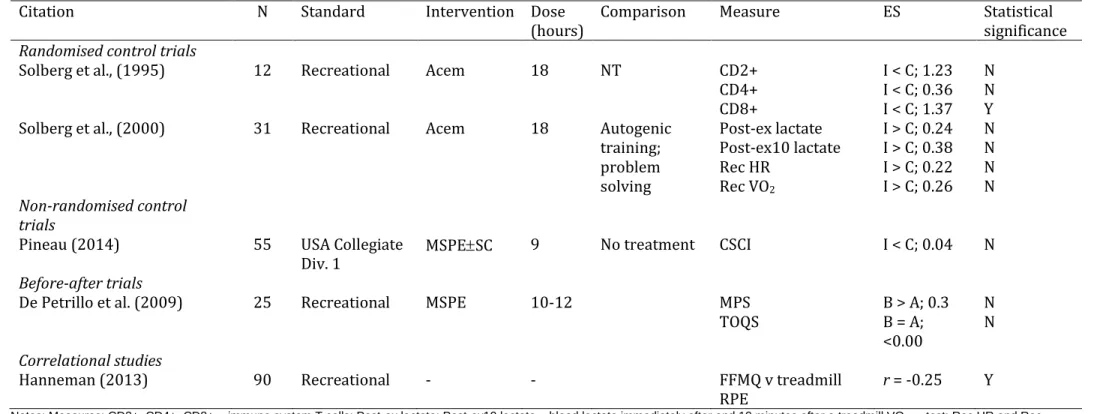
In accordance with the PICOS approach [population (P), intervention (I), comparators (C),
139
main outcome (O), and study design (S)], the following inclusion criteria were used:
140
Participants were healthy (novice/recreational, intermediate or elite) adults or adolescents
141
over 16 years of age with no clinical conditions who regularly undertook distance
142
running (P).
143
Interventions focused on mental practice that promote a structured mind set to being
144
aware of the present-moment experience in an accepting, non-judging, and non-avoiding
145
way as defined by Kabat-Zinn (1994) (i.e. mindfulness/acceptance/commitment/
146
meditation) (I).
Passive-inactive or alternative-active control groups not receiving mindfulness
148
interventions were acceptable controls in RCTs (C).
149
Mindfulness, physiological performance surrogates (i.e. heart rate, maximal and
150
submaximal oxygen uptake, lactate response, rating of perceived exertion, immune
151
function), psychological performance surrogates (i.e. anxiety, confidence/self-efficacy,
152
thoughts during running) and performance (i.e. objective and self-reported race times)
153
constituted the outcome measures (O).
154
We chose not to limit the review to randomized controlled trials (RCTs). Studies of all design
155
types were included because non-randomized trials and simple before–after and case-control
156
designs have been suggested to still have value in systematic reviews for exploring unknown
157
benefits and harms, and adding to evidence from RCTs (Sterne et al., 2016) (S).
158
Quality Assessment
159
Studies were evaluated using a modified Downs and Black tool due to its ability to assess
160
both randomized and non-randomized designs (Downs & Black, 1998). Two independent
161
researchers completed the risk of bias assessments. As with study inclusion, discrepancies were
162
resolved through discussion, with a third researcher consulted to resolve disagreements.
163
Data Extraction
164
We extracted participant characteristics, study design, type and characteristics of
165
intervention (if used), type of control/comparison group (if included), outcome measures, and
166
effect sizes for post-intervention difference between intervention and control/comparison groups
167
(RCT and non-randomized CT), or before-to-after intervention difference in cohort studies. For
168
correlational analyses, we extracted r values for relationships between mindfulness outcomes and
169
performance or psychological surrogates of performance.
Effect size was calculated as Cohen’s d using the mean difference and pooled SD when reported.
171
Where SD was not reported, it was calculated either from the reported exact p values or from t or
172
F statistics using formulas provided in the Cochrane Handbook for Systematic Reviews of
173
Interventions (Higgins & Green, 2011).
174
We extracted only composite scores from questionnaires with subscales, and where two
175
or more variations of mindfulness intervention were delivered, effect size was calculated as the
176
mean response of intervention groups combined compared to the control/comparison group
177
mean.
178
Synthesis of Results
179
There were limited studies on the population of interest. Moreover, few shared similar
180
designs, interventions, comparison groups or outcome measures. Therefore, quantitative
181
synthesis via meta-analysis would not lead to meaningful results (Deeks, Higgins & Altman,
182
2008). As such, we created summary tables for primary outcomes and assessed the available
183
evidence in light of the study quality assessment using the Downs and Black tool (Downs &
184 Black, 1998). 185 Results 186 Study Selection 187
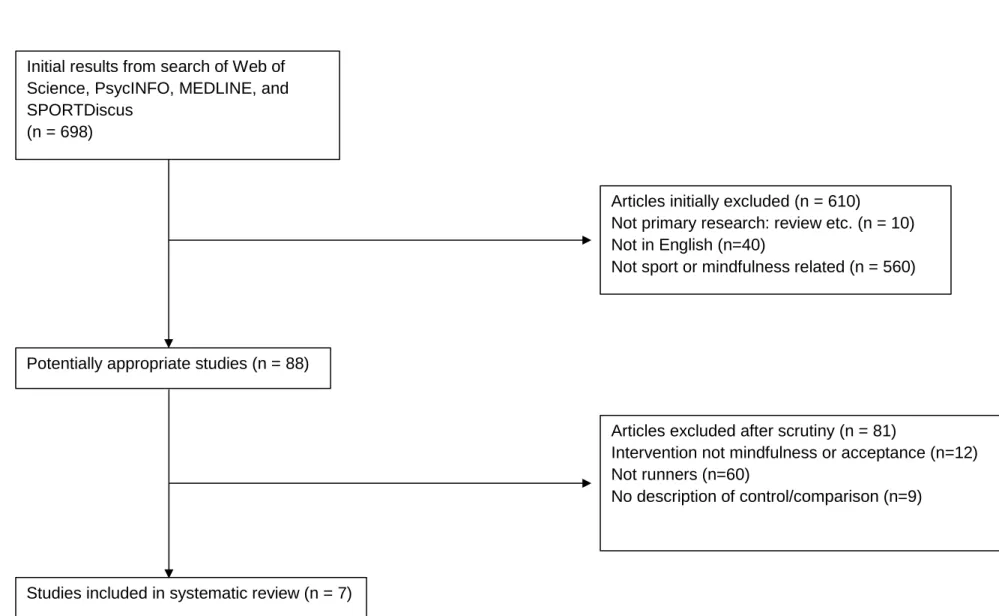
After removal of duplicates, 698 papers were screened by abstract, 88 full-text papers
188
were reviewed and seven met the criteria for inclusion (Figure 1).
189
Figure 1, flow diagram of search results about here
190
Study Characteristics
191
There were 235 runners across the seven studies ranging in standard from recreational to
192
USA collegiate division 1 with an average age of 34 years. Six studies evaluated the effects of a
mindfulness intervention. Of those, three were RCTs, two were non-randomized control trials
194
and one was a cohort/before-after study. One RCT available in conference abstract form only,
195
reported no data and was not considered in the synthesis of results. One of the non-randomized
196
control trials, using a waiting-list group as a comparison, subsequently pooled data from the first
197
group to receive the intervention and the waiting-list group after they had received the
198
intervention, and so became a simple cohort study (De Petrillo et al., 2009). The
cohort/before-199
after study of Thompson et al. (2011) included archers and golfers in addition to runners. Only
200
outcomes that were reported for runners separately were used. There was one observational study
201
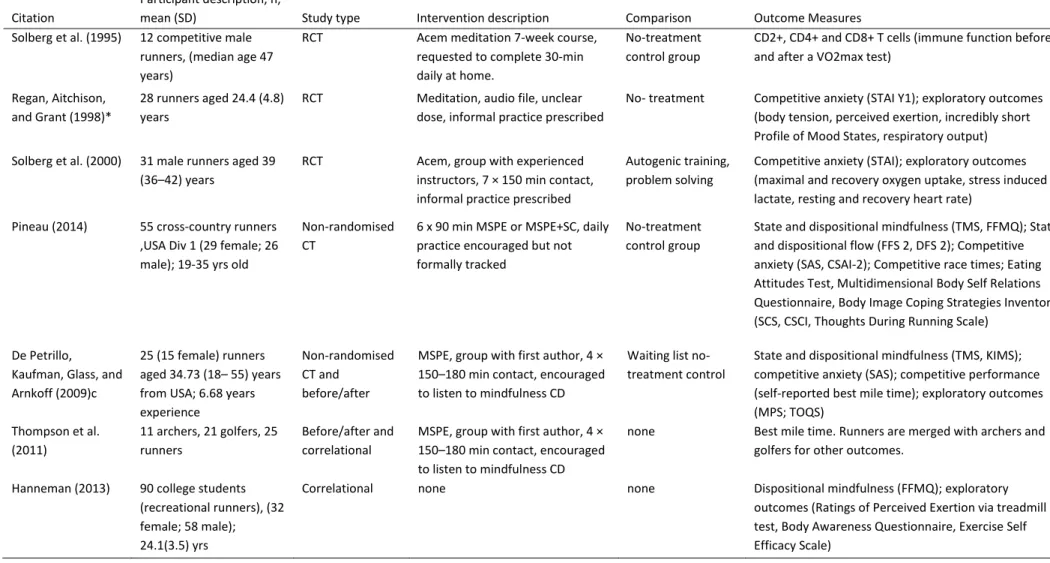
using correlational analysis. Studies meeting inclusion criteria are summarized in table 1.
202
Table 1 summary of studies here
203
Quality Assessment
204
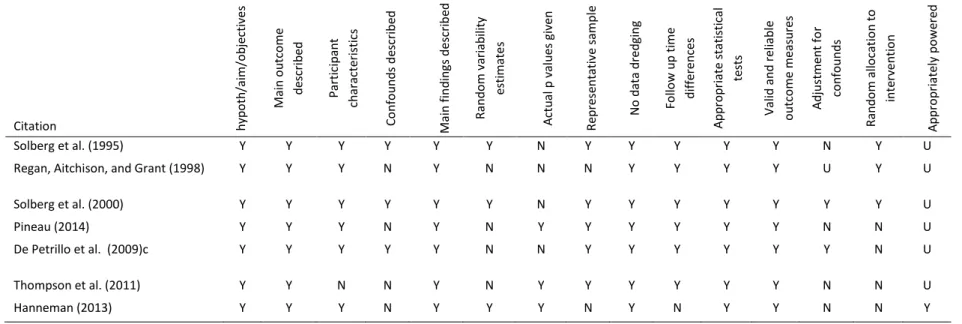
The two included RCTs (Solberg et al., 1995; Solberg et al., 2000) did not conceal group
205
allocation, and failed to blind participants, therapists and researchers to the allocation. Moreover,
206
Solberg et al. (1995) also failed to adjust for difference at baseline in the subsequent analysis.
207
The remaining non-randomized control trials (De Petrillo et al., 2009; Pineau, 2014), cohort
208
study (Thompson et al., 2011) and observational study (Hanneman, 2013) all had high risk of
209
bias from non-random allocation, and lack of control for other confounds (see table 2).
210
Table 2 Downs and Black tool scores here
211
Evidence for Improving Mindfulness
212
Neither of the RCTs had mindfulness as an outcome. The remaining non-randomized
213
control trials, which had high risks of bias, are summarized in table 3. Pineau (2014) reported a
214
very small and non-significant effect of mindfulness training, and De Petrillo et al., (2009)
215
reported no significant differences in either state or trait mindfulness between the intervention
and waiting-list control group, but reported no descriptive or inferential data for this.
Post-217
workshop data for the initial intervention group and for the waiting-list group after they had
218
completed the intervention were subsequently pooled by these authors and analysis was
219
performed on the pre-post change in the pooled sample. There was a large increase in state
220
mindfulness but only a small and non-significant increase in trait mindfulness. Thompson et al.
221
(2011) did not report changes in mindfulness in runners separately from archers and golfers. The
222
mixture of effect sizes, difference in tools used to measure mindfulness change, and the low
223
quality of the available evidence suggests an uncertain effect of short-term mindfulness training
224
for improving mindfulness in distance runners.
225
Table 3 here
226
Evidence for Reducing Competitive Anxiety
227
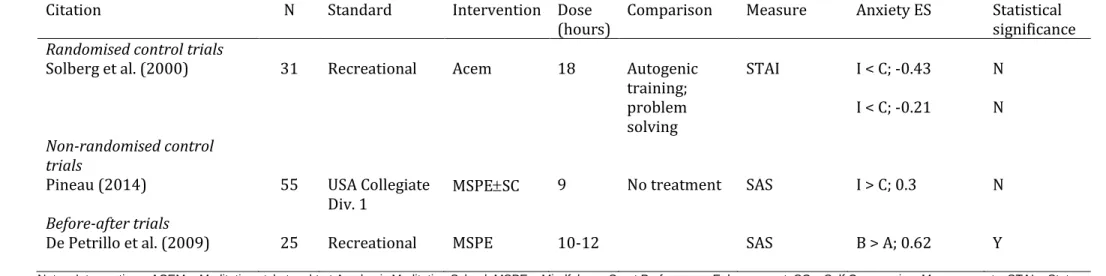
One RCT (Solberg et al., 2000), one non-randomized control trial (Pineau, 2014) and one
228
before-after study (De Petrillo et al., 2009) explored the effect of mindfulness interventions on
229
competitive anxiety (see table 4). Though scoring well on the quality assessment tool, the RCT
230
did not specify allocation procedures, did not blind participants or researchers to the allocation,
231
had evidence of baseline differences between groups and did not attempt to power the study for a
232
predetermined effect size. These sources of bias should be considered when interpreting the
233
small-to-moderate reductions observed in the intervention group compared to the two types of
234
control. The non-randomized control trial reported a small increase in state anxiety in
235
comparison to the waiting-list controls. The non-random allocation, and other confounds such as
236
the intervention delivery setting (open concourse of a busy sports centre) should be considered in
237
interpreting this effect. Finally, the before-after trial reported a significant, moderate reduction in
238
state anxiety after the MSPE intervention period. Though two of the three studies suggest small
to moderate reductions in anxiety, bias in the designs means the quality of this evidence was 240 judged to be low. 241 Table 4 here 242
Evidence for Improving Performance
243
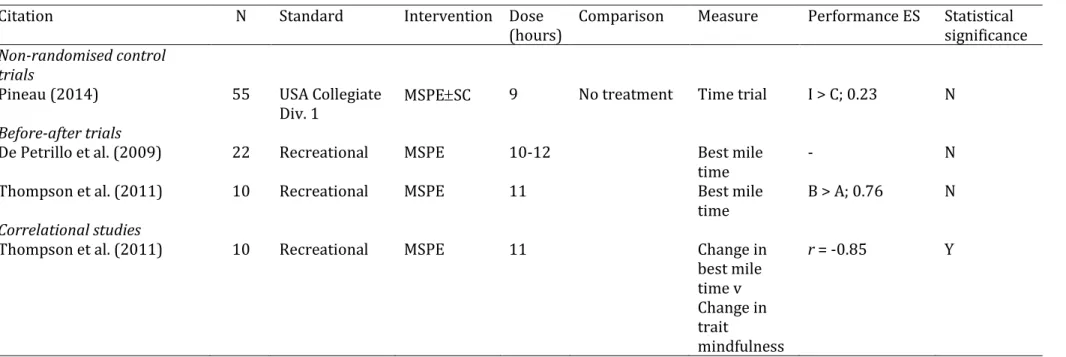
The effects of mindfulness interventions on distance running performance were explored
244
by three studies comprising one non-randomized control trial (Pineau, 2014) and two
before-245
after trials (De Petrillo et al., 2009; Thompson et al., 2011) with the latter also including
246
correlational analysis of before-after change in performance with change in trait mindfulness.
247
The non-randomized trial reported a small (non-significant) decrease in performance on a
248
standardized time trial of an unspecified distance between the intervention and waiting-list
249
controls. In an unplanned before-after comparison of intervention and control groups combined,
250
De Petrillo et al., (2009) reported no significant change in best mile time but failed to provide
251
data from which effect size could be calculated. Thompson et al. (2011) was a follow up study of
252
the participants used by De Petrillo et al. (2009) and examined changes in best mile time for
253
runners that received the intervention and were willing to return one year after their baseline
254
measurement from the 2009 study. A large reduction in best mile time was reported though it
255
should be noted that the effect is confounded by among other things, the design and the duration
256
between time trials. The correlation analysis showed a large-negative association between
257
change in trait mindfulness and change in best mile time.
258
Overall, the few studies that have examined performance enhancement in distance running after
259
mindfulness training are of low quality and show inconsistent effects.
260
Table 5 here
261 262
Other Outcomes
263
Five studies included other psychological or physiological outcomes possibly linked with
264
performance (see table 6). One RCT showed large reductions in immune system response after a
265
maximal-intensity treadmill run in the intervention group compared to no-treatment controls
266
(Solberg et al., 1995) while another showed small and non-significant impairments in
267
physiological measures of recovery from a maximal-intensity treadmill run.
268
Pineau’s (2014) non-randomized control trial found no effect of mindfulness training on
269
confidence, and the before-after analysis of De Petrillo et al., (2009) reported no change in
270
thought disruption or perfectionism. Finally, there was evidence of a moderate association
271
between a mindfulness measure and perceived exertion during a submaximal treadmill run in an
272
observational study.
273
In summary, there is some evidence of improved immune function and reduced effort perception.
274
While the quality of the evidence is low, these outcomes could be possible avenues for future
275
research of better quality.
276
Table 6 here
277
Discussion
278
The aim of this systematic review was to synthesize the effects of mindfulness-based
279
interventions on performance and performance-related factors in long-distance runners by
280
examining the effects of mindfulness training and practice on mindfulness, physiological and
281
psychological performance-related factors and distance-running performance outcomes.
282
There were a limited number of studies examining the effects of mindfulness on performance
283
and factors linked to performance in distance runners. While there is some evidence for positive
284
effects of mindfulness-type interventions, the evidence is currently of generally low quality.
Effects ranged from very small to large for improvements in state mindfulness; small/moderate
286
for reductions in anxiety and none/small/moderate for improvements in running performance.
287
For all outcomes, the high risks of bias reduce confidence in interpretations of benefit. Our
288
review also found some preliminary evidence for positive effects of mindfulness on immune
289
function and reduced perception of effort, the latter arising from a simple observational study.
290
Changes in Mindfulness
291
The limited evidence specific to distance runners suggests limited effects of mindfulness
292
practice on mindfulness skill. Two intervention studies attempted to measure mindfulness as an
293
outcome. Only the cohort study of De Petrillio et al. (2009) showed improvements, and only in
294
state and not in trait mindfulness. The non-randomized trial of Pineau (2014) used a different
295
tool and found no change in the intervention group. These findings are in contrast to the
296
consistently large effects reported in previous systematic reviews encompassing other sports
297
(Bulmayer et al., 2017; Noetel et al., 2017). The durations of interventions were similar in
298
studies on runners and those on other sports (4-8 weeks) so exposure is unlikely to explain the
299
limited effects seen in runners. It has been previously suggested that benefits of mindfulness
300
practice depends on tenacity and engagement with the sessions (Zhang et al., 2016). Such
301
engagement in the practice process is difficult to determine yet remains a possible reason for lack
302
of improvement in the runners studied. However, the difference in effects on mindfulness in
303
runners compared to the evidence in other sports is most likely due to the limited number and
304
low quality of the studies specific to distance runners. The development of mindfulness skills in
305
runners after mindfulness interventions needs further study with high-quality randomized trials.
306 307 308
Changes in Psychological and Physiological Surrogates of Performance
309
Our findings on anxiety reduction in runners after mindfulness practice are largely
310
consistent with previous reviews of other sports (Sappington and Longshore, 2015; Bulmayer et
311
al., 2017; Noetel et al., 2017), and are also commensurate with previous research in clinical
312
populations (Hofmann et al., 2010), with moderate reductions found for state anxiety, albeit from
313
studies of generally low quality. Mindfulness interventions have an intended key mechanism of
314
change where creating a different relationship with thoughts reduces the rumination or worry that
315
maintains negative mood states. This could be a mechanism underpinning anxiety reduction
316
effects, though it could be argued to using mindfulness to target anxiety reduction is at odds with
317
the cultivation of simple non-judgmental acceptance of the anxiety that is present. Studies
318
designed to compare anxiety reduction strategies with acceptance interventions would allow
319
exploration of this suggestion.
320
Since distance running success is underpinned to a large extent by physiological factors,
321
we also explored the effects of mindfulness on physiological responses that could impact on
322
performance. One RCT showed slightly slower recovery from a high-intensity treadmill run as
323
indicated by heart rate and blood lactate responses in the intervention group (Solberg et al.,
324
2000). No studies have explored the effects of mindfulness on physiological responses during
325
running and it is worth noting that long distance races are not performed at the limit of oxygen
326
uptake used by Solberg et al. (2000). Moreover, the observed association of reduced perception
327
of effort in recreational runners during submaximal treadmill running at speeds similar to race
328
paces, and self-reported mindfulness, suggest a potential benefit of mindful awareness during
329
running and could be related to the key mindfulness attitudes encouraged in practice of
330
acceptance, non-judgmental awareness and letting go. Well controlled randomized intervention
trials are required to explore this. However, a study (Schuker, Schmeing & Hageman, 2016)
332
examining running economy, a powerful predictor of race performance (Bassett & Howley,
333
2000), showed worse economy with an associative task focus on breathing and stride rate in
334
recreational runners. Early work by Morgan and Pollack (1977), showed elite marathon runners
335
adopted an associative strategy. The potential benefits of mindfulness on physiological responses
336
during running are far from clear. Nevertheless, RCT evidence does suggest a potential benefit
337
on immune responsiveness to exercise in runners. Solberg et al. (1995) found a reduced rise in
338
immune markers after an intense treadmill run in the mindfulness intervention group. Lower
339
salivary cortisol has been previously reported in elite shooters (John, Verma & Khanna, 2011)
340
and both results agree with findings in healthy non-athletic populations (Sanada et al., 2016).
341
These findings suggest that regular mindfulness practice could serve to reduce post-exercise
342
inflammation and enhance recovery from training sessions in runners. Further studies should
343
evaluate this proposal.
344
Effects on Running Performance
345
Only three studies have explored the effects on mindfulness interventions on distance
346
running performance with inconsistent and mixed effects from none to moderate improvements.
347
Interpretations of the effects are confounded by the low quality of the studies and by large
348
durations between performance measures where many other factors could explain changes.
349
Reviews of other sports have also reported limited study numbers, weak quality of many studies
350
and inconsistent effects (Noetel, et al., 2017). Of the few high-quality RCTs in other sports, there
351
seems to be some benefits to performance in precision sports of darts and shooting (Bulmayer et
352
al., 2017). Success in such sports lacks the heavy dependence on physiological parameters
353
characteristic of other sports, particularly distance running. This could explain lack of and
inconsistent evidence for performance benefits, in addition to the general dearth of high-quality
355
studies on the effects of mindfulness intervention in runners.
356
Mindfulness practice versus other PST interventions
357
While there were some positive effects of mindfulness, similar to PST approaches, the
358
evidence in support of mindfulness interventions for endurance running also remains far from
359
clear. Though the quality of evidence was generally weak, our review found moderate reductions
360
in performance anxiety after MSPE interventions. This is similar to other mindfulness-based
361
interventions in sport which show some effectiveness in improving performance-based wellbeing
362
(Gardner & Moore, 2012; Sappington & Longshore, 2015). PST approaches have also been
363
deemed effective at reducing anxiety specifically through imagery in footballers (see Maynard,
364
Smith & Warwick-Evans, 1995) and self-talk in tennis players (see Hatzigeorgiadis, Zourbanos,
365
Mpoumpaki, & Theodorakis, 2009). Interestingly, relaxation has garnered more support in
366
anxiety reduction for sport performance with beneficial effects noted in swimming and football
367
(Fletcher & Hanton, 2001; Maynard et al., 1995). However it should be noted that just like
368
mindfulness interventions, there are very few studies that have examined PST and anxiety in the
369
context of endurance sports, and even fewer in running.
370
Our review found that one study reported a small non-significant decrease in endurance
371
performance in a standardized time-trial, however, as this finding is non-significant and the
372
effect size very small, little practical inference can be drawn. In comparison, traditional PST
373
approaches including goal setting, self-talk and imagery have been reported to improve
374
endurance performance in runners (Blanchfield et al., 2014; Burhans, Richman & Bergey, 1988;
375
Tenenbaum, Spence & Christensen, 1999). However, these studies are also not without
376
limitations, with many acknowledging confounds pertaining to the ecological validity of time to
exhaustion protocols that are not representative of running performance (performance being time
378
to complete a set distance), issues with placebo groups and the omission of a placebo group
379
respectively. Finally, in a whole-body endurance systematic review, PST was found to improve
380
performance in five out of the 25 included studies on practical psychological interventions
381
(McCormick, Meijen & Marcora, 2015). Upon review and despite some evident advantages for
382
mindfulness-based running interventions, it is apparent that the research is susceptible to the
383
same limitations that are often observed in PST approaches. These limitations specifically
384
pertain to the difficulty in measuring performance, lack of placebo controls, lack of
double-385
blinding and the omission of key psychological mediating variables such as perception of effort
386
and self-efficacy.
387
Strengths and Limitations of this Review
388
We performed this review in accordance with PRISMA guidelines (Hutton et al., 2015).
389
To our knowledge, this is the first systematic review to synthesise the effects of mindfulness
390
interventions from the available evidence in distance runners. There were a limited number of
391
studies using different standards of runner, different tools for assessing study outcomes, a variety
392
of mindfulness interventions and only two RCTs among the six included studies. These factors
393
led us to avoid pooling effect sizes due to the many sources of heterogeneity, and is a limitation
394
of our study. The overall quality of the included studies ranged from mid-level for RCTs to low
395
for the non-randomised, cohort and observational studies. Nevertheless, the review represents the
396
best available overview of currently available evidence on the topic of mindfulness effect on
397
performance and psychological and physiological factors linked with performance in distance
398
runners.
399 400
Conclusions and Future Recommendations
401
The evidence suggests tentatively that mindfulness interventions have potential to
402
increase state mindfulness, reduce competitive anxiety and attenuate immune responses to
high-403
intensity running. There is also some evidence that mindfulness skill could reduce perception of
404
effort. Currently there is little evidence for direct benefits to running performance. All findings
405
should be interpreted with caution in light of the limited range and generally weak quality of
406
studies on this population. More research using high-quality RCT designs are required with
407
distance-running participants to further explore the potential benefits we have identified. These
408
studies should include recognized mindfulness interventions delivered by qualified practitioners
409
and should investigate effects on mindfulness, physiological surrogates of performance during
410
running at race intensities, and should attempt to assess engagement with the mindfulness
411 practices prescribed. 412 413 References 414
Aherne, C., Moran, A.P., & Lonsdale, C. (2011). The effect of mindfulness training on
415
athletes’ flow: An initial investigation. The Sport Psychologist, 25, 177-189.
416
American Psychological Association Division 47. (2016). Exercise and Sport Psychology.
417
Retrieved from http://apadivisions.org/division-47/.
418
Åstrand (Eds.), Endurance in sports (2nd ed., pp. 451–457). Oxford: Blackwell Science.
419
Bassett, D.R., & Howley, E.T. (2000). Limiting factors for maximum oxygen uptake and
420
determinants of endurance performance. Medicine and Science in Sports and Exercise, 32(1),
70-421
84.
Beedie, C.J., Terry, P.C., & Lane, A.M. (2000). The profile of mood states and athletic
423
performance: Two meta-analyses. Journal of Applied Sport Psychology, 12, 49-68.
424
Bergomi, C., Tschacher, W., & Kupper, Z. (2015). Meditation practice and self-reported
425
mindfulness: a cross-sectional investigation of meditators and non-meditators using the
426
comprehensive inventory of mindfulness experiences (CHIME). Mindfulness, 6(6), 1411-1421.
427
Birrer, D., Röthlin, P., & Morgan, G. (2012). Mindfulness to enhance athletic performance:
428
Theoretical considerations and possible impact mechanisms. Mindfulness, 3(3), 235-246.
429
Blanchfield, A. W., Hardy, J., De Morree, H. M., Staiano, W., & Marcora, S. M. (2014).
430
Talking yourself out of exhaustion: the effects of self-talk on endurance performance. Medicine
431
and Science in Sports and Exercise, 46(5), 998-1007.
432
Buhlmayer, L., Birrer, D., Rothlin, P., Faude, O., & Donath, L. (2017). Effects of mindfulness
433
practice on performance-relevant parameters and performance outcomes in sports: A
meta-434
analytic review. Sports Medicine, 47, 2309-2321.
435
Burhans, R.S., Richman, C.L., & Bergey, D.B. (1988). Mental imagery training: effects on
436
running speed performance. International Journal of Sport Psychology, 19(1), 26–37.
437
Carlson, L.E. (2012). Mindfulness based interventions for physical health conditions: A
438
narrative review evaluating levels of evidence. International Scholarly Research Network -
439
Psychiatry, doi:10.5402/2012/651583.
440
Cebolla, A., Campos, D., Galiana, L., Oliver, A., Tomas, J.M., Feliu-Soler, A., Soler, J.,
441
Garcia-Campayo, J., Demarzo, M., & Banos, R.M. (2017). Exploring relations among
442
mindfulness facets and various meditation practices: Do they work in different ways?
443
Consciousness and Cognition, 49, 172-180.
Chiesa, A., & Serretti, A. (2010). A systematic review of neurobiological and clinical features
445
of mindfulness meditations. Psychological Medicine, 40, 1239–1252.
446
Craft, L.L., Magyar, T.M., Becker, B.J., & Feltz, D.L. (2003). The relationship between the
447
competitive state anxiety inventory-2 and sport performance: A meta-analysis. Journal of Sport
448
and Exercise Psychology, 25, 44-65.
449
Deeks, J.J., Higgins, J.P.T., and Altman, D.G. (2008). Analysing data and undertaking meta
450
analyses. In J.P.T. Higgins & S. Green (Eds.), Cochrane handbook for systematic reviews of
451
interventions (pp. 243-296). Chichester: John Wiley & Sons.
452
De Petrillo, L.A., Kaufman, K.A., Glass, C, R., & Arnkoff, D.B. (2009). Mindfulness for
453
long-distance runners: an open trial using Mindful Sport Performance Enhancement (MSPE).
454
Journal of Clinical Sport Psychology, 4, 357-376.
455
Downs, S.H., & Black, N. (1998). The feasibility of creating a checklist for the assessment of
456
the methodological quality both of randomised and non-randomised studies of health care
457
interventions. Journal of Epidemiology and Community Health, 52, 377-384.
458
Fletcher, D., & Hanton, S. (2001). The relationship between psychological skills usage and
459
competitive anxiety responses. Psychology of Sport and Exercise, 2(2), 89-101.
460
Gardner, F. L., & Moore, Z. E. (2017). Mindfulness-based and acceptance-based interventions
461
in sport and performance contexts. Current Opinion in Psychology, 16, 180-184.
462 463
Gustafsson, H., Lundqvist, C., & Tod, D. (2017). Cognitive behavioral intervention in sport
464
psychology: A case illustration of the exposure method with an elite athlete. Journal of Sport
465
Psychology in Action, 8(3), 152-162.
Hanneman, S.M. (2013). Exploring the potential relationship between mindfulness and
467
ratings of perceived exertion. Louisville, Kentucky: (Doctor of Philosophy), University of
468
Louisville. Retrieved from
469
ir.library.louisville.edu/cgi/viewcontent.cgi?article=3354&context=etd.
470
Hatzigeorgiadis, A., Zourbanos, N., Mpoumpaki, S., & Theodorakis, Y. (2009). Mechanisms
471
underlying the talk–performance relationship: The effects of motivational talk on
self-472
confidence and anxiety. Psychology of Sport and exercise, 10(1), 186-192.
473
Higgins, J.P.T and Green, S (editors). Cochrane Handbook for Systematic Reviews of
474
Interventions Version 5.1.0 [updated March 2011]. The Cochrane Collaboration, 2011. Available
475
from http://handbook.cochrane.org.
476
Hofmann, S. G., Sawyer, A. T., Witt, A. A., & Oh, D. (2010). The effect of
mindfulness-477
based therapy on anxiety and depression: A meta-analytic review. Journal of Consulting and
478
Clinical Psychology, 78(2), 169.
479
Hutton, B., Salanti, G., Caldwell, D.M., Chaimani, A., Schmidt, C.H., Cameron, C., Ioannidis,
480
J.P., Straus, S., Thorlund, K., Jansen, J.P., Mulrow, C., Catala-Lopez, F., Gotzche, P.C.,
481
Dickersin, K., Boutron, I., Altman, D.G., & Moher, D. (2015). The PRISMA extension statement
482
for reporting systematic reviews incorporating network meta-analyses of health care
483
interventions: checklist and explanations. Annals of Internal Medicine, 162(11), 777-784.
484
Jackson, S.A., Kimiecik, J.C., Ford, S.K., Marsh, H.W. (1988). Psychological correlates of
485
flow in sport. Journal of Sport and Exercise Psychology, 20, 358-378.
486
John, S., Verma, S.K., & Khanna, G. (2011). The effects of mindfulness meditation on
HPA-487
axis in pre-competition stress in sports performance of elite shooters. National Journal of
488
Integrated Research in Medicine, 2, 15-21.
Jokela, M., & Hanin, Y.L. (1999). Does the individual zones of optimal functioning model
490
discriminate between successful and less successful athletes? A meta-analysis. Journal of Sports
491
Sciences, 17, 873-887.
492
Josefsson, T., Tornberg, R., Gustafsson, H., & Ivarsson, A. (2019). Practitioners’ reflections
493
of working with the Mindfulness-Acceptance-Commitment (MAC) approach in team sport
494
settings. Journal of Sport Psychology in Action, 1-11, doi:10.1080/21520704.2018.1549641
495
Kabat-Zinn, J., Beall, B., & Rippe, J. (1985). A systematic mental training program based on
496
mindfulness meditation to optimise performance in collegiate and Olympic rowers. Poster
497
presented at World Congress in Sport Psychology, Copenhagen, Denmark.
498
Kabat-Zinn, J. (1994). Wherever you go there you are. New York: Delta.
499
Kaufman, K.A., Glass, C.R., & Arnkoff, D.B. (2009). Evaluation of mindful sport
500
performance enhancement (MSPE): A new approach to promote flow in athletes. Journal of
501
Clinical Sport Psychology, 3, 334-356.
502
Martin, J. R. (1997). Mindfulness: a proposed common factor. Journal of Psychotherapy
503
Integration, 7, 291–312.
504
Maynard, I. W., Smith, M. J., & Warwick-Evans, L. (1995). The effects of a cognitive
505
intervention strategy on competitive state anxiety and performance in semi-professional soccer
506
players. Journal of Sport and Exercise Psychology, 17(4), 428-446.
507
Mindful Nation UK – report by the Mindfulness All-Party Parliamentary Group (MAPPG).
508
(2015). Published by The Mindfulness Initiative. Retrieved from http://www.
509
themindfulnessinitiative.org.uk/.
510
McCormick, A., Meijen, C. and Marcora, S. (2015). Psychological determinants of
whole-511
body endurance performance. Sports Medicine, 45(7), 997-1015.
513
McCormick, A., Meijen, C. and Marcora, S., (2018). Psychological demands experienced by
514
recreational endurance athletes. International Journal of Sport and Exercise Psychology, 16(4),
515
415-430.
516
Moore, Z. E. (2009). Theoretical and empirical developments of the
Mindfulness-Acceptance-517
Commitment (MAC) approach to performance enhancement. Journal of Clinical Sport
518
Psychology, 3(4), 291-302.
519
Morgan, W.P., & Pollock, M.L. (1977). Psychologic characterisation of the elite distance
520
runner. Annals of the New York Academy of Sciences, 301, 382-403.
521
Moritz, S.E., Feltz, D.L., Fahrbach, K.R., & Mack, D.E. (2000). The relation of self-efficacy
522
measures to sport performance: A meta-analytic review. Research Quarterly for Exercise and
523
Sport, 71, 280-294.
524
Noetel, M., Ciarrochi, J., Van Zanden, B., & Lonsdale, C. (2017). Mindfulness and
525
acceptance approaches to sporting performance enhancement: a systematic review. International
526
Review of Sport and Exercise Psychology, doi: 10.1080/1750984X.2017.1387803.
527
Pineau, T.R., Glass, C.R., Kaufman, K.A., & Bernal, D.R. (2014). Self- and team-efficacy
528
beliefs of rowers and the relation to mindfulness and flow. Journal of Clinical Sport Psychology,
529
8, 142-158.
530
Pineau, T.R. (2014). Effects of mindful sports performance enhancement (MSPE) on running
531
performance and body image: Does self-compassion make a difference? Washington, D.C.
532
(Doctor of Philosophy), The Catholic University of America. Retrieved from
533
cuislandora.wrlc.org/islandora/object/cuislandora%3A28232 EBSCOhost psych database.
Regan, L., Aitchison, T., & Grant, S. (1998). The effect of meditation on running economy
535
and various psychological variables. Journal of Sports Sciences, 16, 101.
536
Sanada, K., Montero-Marin, J., Alda Diez, M., et al. (2016). Effects of mindfulness-based
537
interventions on salivary cortisol in healthy adults: a meta analytical review. Frontiers in
538
Physiology, 7, 471.
539
Sappington, R., & Longshore, K. (2015). Systematically reviewing the efficacy of
540
mindfulness-based interventions for enhanced athletic performance. Journal of Clinical Sport
541
Psychology, 9(3), 232-262.
542
Schuker, L., Schmeing, L., & Hageman, N. (2016). “Look around while running!” Attentional
543
focus effects in inexperienced runners. Psychology of Sport and Exercise, 27, 205-212.
544
Solberg, E.E., Halvorsen, R., Sundgot-Borgen, J., Ingier, F., & Holen, A. (1995). Meditation:
545
a modulator of the immune response to physical stress? A brief report. British Journal of Sports
546
Medicine, 29(4), 255-257.
547
Solberg, E.E., Ingier, F., Holen, A., Sundgot-Borgen, J., Nilsson, S., & Holme, I. (2000).
548
Stress reactivity to and recovery from a standardised exercise bout: a study of 31 runners
549
practising relaxation techniques. British Journal of Sports Medicine, 34, 268-272.
550
Sterne, J.A.C., Hernan, M.A., Reeves, B.C. et al. (2016). ROBINS-I: a tool for assessing risk
551
of bias in non-randomised studies of interventions. British Medical Journal, 355, i4919.
552
Tenenbaum, G., Spence, R., & Christensen, S. (1999). The effect of goal difficulty and goal
553
orientation on running performance in young female athletes. Australian Journal of Psychology,
554
51(1), 6-11.
Thompson, R.W., Kaufman, K.A., De Petrillo, L.A., Glass, C.R., & Arnkoff, D.B. (2011).
556
One year follow-up of Mindful Sport Performance Enhancement (MSPE) with archers, golfers,
557
and runners. Journal of Clinical Sport Psychology, 5, 99-116.
558
Tuffey, S. (2000). Psychological preparation of endurance performers. Endurance in Sport,
559
451-457.
560
Whelan, J.P., Mahoney, M.J., & Meyers, A.W. (1991). Performance enhancement in sport: A
561
cognitive behavioural domain. Behaviour Therapy, 22, 307-327.
562
Williams, J.M., Crane, C., Barnhofer, T. Brennan, K., et al. (2014). Mindfulness-based
563
cognitive therapy for preventing relapse in recurrent depression: A randomised dismantling trial.
564
Journal of Consulting and Clinical Psychology, 82(2), 275-286.
565
Woodman, T., & Hardy, L. (2003). The relative impact of cognitive anxiety and
self-566
confidence upon sport performance: A meta-analysis. Journal of Sports Sciences, 21, 443-457.
567
Zhang, C-Q., Si, G., Duan, Y, et al. (2016). The effects of mindfulness training on beginners’
568
skill acquisition in dart throwing: a randomised controlled trial. Psychology of Sport and
569 Exercise, 22, 279-285. 570 571 572 573 574 575 576 577 578 579 580 581 582 583 584 585
Table 1. Characteristics of studies meeting inclusion criteria.
Notes: Interventions: ACEM = Meditation style taught at Academic Meditation School; MSPE = Mindfulness Sport Performance Enhancement; SC = Self Compassion. * abstract only, no data, not included in results. FFMQ = Five Facet Mindfulness Questionnaire; KIMS = Kentucky Inventory of Mindfulness Scale; TMS = Toronto Mindfulness Scale; STAI = State Trait Anxiety Inventory; SAS = Sport Anxiety Scale; CSAI-2 = Competitive State Anxiety Inventory; CSCI = Carolina Sport Confidence Inventory; MPS = Multidimensional Perfectionism Scale; TOQS = Though Occurrence Questionnaire for Sport; DFS 2 = Dispositional Flow Scale; FFS 2 = Flow State Scale.
Citation
Participant description, n,
mean (SD) Study type Intervention description Comparison Outcome Measures
Solberg et al. (1995) 12 competitive male runners, (median age 47 years)
RCT Acem meditation 7-week course,
requested to complete 30-min daily at home.
No-treatment control group
CD2+, CD4+ and CD8+ T cells (immune function before and after a VO2max test)
Regan, Aitchison, and Grant (1998)*
28 runners aged 24.4 (4.8) years
RCT Meditation, audio file, unclear
dose, informal practice prescribed
No- treatment Competitive anxiety (STAI Y1); exploratory outcomes (body tension, perceived exertion, incredibly short Profile of Mood States, respiratory output) Solberg et al. (2000) 31 male runners aged 39
(36–42) years
RCT Acem, group with experienced
instructors, 7 × 150 min contact, informal practice prescribed
Autogenic training, problem solving
Competitive anxiety (STAI); exploratory outcomes (maximal and recovery oxygen uptake, stress induced lactate, resting and recovery heart rate)
Pineau (2014) 55 cross-country runners ,USA Div 1 (29 female; 26 male); 19-35 yrs old
Non-randomised CT
6 x 90 min MSPE or MSPE+SC, daily practice encouraged but not formally tracked
No-treatment control group
State and dispositional mindfulness (TMS, FFMQ); State and dispositional flow (FFS 2, DFS 2); Competitive anxiety (SAS, CSAI-2); Competitive race times; Eating Attitudes Test, Multidimensional Body Self Relations Questionnaire, Body Image Coping Strategies Inventory, (SCS, CSCI, Thoughts During Running Scale)
De Petrillo, Kaufman, Glass, and Arnkoff (2009)c
25 (15 female) runners aged 34.73 (18– 55) years from USA; 6.68 years experience
Non-randomised CT and
before/after
MSPE, group with first author, 4 × 150–180 min contact, encouraged to listen to mindfulness CD
Waiting list no-treatment control
State and dispositional mindfulness (TMS, KIMS); competitive anxiety (SAS); competitive performance (self-reported best mile time); exploratory outcomes (MPS; TOQS) Thompson et al. (2011) 11 archers, 21 golfers, 25 runners Before/after and correlational
MSPE, group with first author, 4 × 150–180 min contact, encouraged to listen to mindfulness CD
none Best mile time. Runners are merged with archers and
golfers for other outcomes. Hanneman (2013) 90 college students
(recreational runners), (32 female; 58 male); 24.1(3.5) yrs
Correlational none none Dispositional mindfulness (FFMQ); exploratory
outcomes (Ratings of Perceived Exertion via treadmill test, Body Awareness Questionnaire, Exercise Self Efficacy Scale)
Table 2. Downs and Black quality assessment. Citation hyp o th /aim/o b je cti ve s Mai n o u tco me d es cri b ed Pa rt ic ip an t ch arac te ri sti cs Co n fo u n d s d es cri b ed Mai n fin d in gs d e sc ri b ed R an d o m v ari ab ili ty es ti mate s A ctu al p val u es g ive n R ep re se n tati ve s amp le N o d ata d re d gi n g Fo llo w u p ti me d iff ere n ce s A p p ro p ri ate s ta ti sti cal te sts V ali d an d re liab le o u tco me me as u re s A d ju stme n t fo r co n fo u n d s R an d o m all o cat io n to in te rve n ti o n A p p ro p ri ate ly p o w ere d Solberg et al. (1995) Y Y Y Y Y Y N Y Y Y Y Y N Y U
Regan, Aitchison, and Grant (1998) Y Y Y N Y N N N Y Y Y Y U Y U
Solberg et al. (2000) Y Y Y Y Y Y N Y Y Y Y Y Y Y U
Pineau (2014) Y Y Y N Y N Y Y Y Y Y Y N N U
De Petrillo et al. (2009)c Y Y Y Y Y N N Y Y Y Y Y Y N U
Thompson et al. (2011) Y Y N N Y N Y Y Y Y Y Y N N U
Table 3. Effects of mindfulness interventions for improving mindfulness.
Citation N Standard Intervention Dose
(hours)
Comparison Measure Mindfulness ES Statistical
significance
Non-randomised control trials
Pineau (2014) 55 USA Collegiate
Div. 1 MSPESC 9 No treatment FFMQ I > C; 0.07 N
Before-after trials
De Petrillo et al. (2009) 25 Recreational MSPE 10-12 KIMS (trait)
TMS (state) B<A; 0.32 B<A; 1.15 N Y
Notes: Measures: FFMQ = Five Facet Mindfulness Questionnaire; KIMS = Kentucky Inventory of Mindfulness Scale; TMS = Toronto Mindfulness Scale. Interventions: MSPE = Mindfulness Sport Performance Enhancement; SC = Self Compassion. Statistical significance N = p > 0.05; Y = p < 0.05.
Table 4. Effects of mindfulness interventions for reducing competitive anxiety.
Citation N Standard Intervention Dose
(hours) Comparison Measure Anxiety ES Statistical significance
Randomised control trials
Solberg et al. (2000) 31 Recreational Acem 18 Autogenic
training; problem solving STAI I < C; -0.43 I < C; -0.21 N N Non-randomised control trials
Pineau (2014) 55 USA Collegiate
Div. 1 MSPESC 9 No treatment SAS I > C; 0.3 N
Before-after trials
De Petrillo et al. (2009) 25 Recreational MSPE 10-12 SAS B > A; 0.62 Y
Notes: Interventions: ACEM = Meditation style taught at Academic Meditation School; MSPE = Mindfulness Sport Performance Enhancement; SC = Self Compassion: Measurements: STAI = State Trait Anxiety Inventory; Sport Anxiety Scale. I < C = Intervention reduced more than controls; I > C = controls reduced more than intervention; B > A = reduced from before to after intervention. Statistical significance N = p > 0.05; Y = p < 0.05.
Table 5. Effects of mindfulness interventions for improving distance running performance.
Citation N Standard Intervention Dose
(hours) Comparison Measure Performance ES Statistical significance
Non-randomised control trials
Pineau (2014) 55 USA Collegiate
Div. 1 MSPESC
9 No treatment Time trial I > C; 0.23 N
Before-after trials
De Petrillo et al. (2009) 22 Recreational MSPE 10-12 Best mile
time
- N
Thompson et al. (2011) 10 Recreational MSPE 11 Best mile
time B > A; 0.76 N
Correlational studies
Thompson et al. (2011) 10 Recreational MSPE 11 Change in
best mile time v Change in trait mindfulness r = -0.85 Y
Notes: Interventions: MSPE = Mindfulness Sport Performance Enhancement; SC = Self Compassion. I > C = intervention slower than control; B > A = faster time trial after intervention. Statistical significance N = p > 0.05; Y = p < 0.05.
Table 6. Effects of mindfulness on other psychological and physiological factors related to performance.
Citation N Standard Intervention Dose
(hours) Comparison Measure ES Statistical significance
Randomised control trials
Solberg et al., (1995) 12 Recreational Acem 18 NT CD2+
CD4+ CD8+ I < C; 1.23 I < C; 0.36 I < C; 1.37 N N Y
Solberg et al., (2000) 31 Recreational Acem 18 Autogenic
training; problem solving Post-ex lactate Post-ex10 lactate Rec HR Rec VO2 I > C; 0.24 I > C; 0.38 I > C; 0.22 I > C; 0.26 N N N N Non-randomised control trials
Pineau (2014) 55 USA Collegiate
Div. 1 MSPESC 9 No treatment CSCI I < C; 0.04 N
Before-after trials
De Petrillo et al. (2009) 25 Recreational MSPE 10-12 MPS
TOQS B > A; 0.3 B = A;
<0.00
N N
Correlational studies
Hanneman (2013) 90 Recreational - - FFMQ v treadmill
RPE
r = -0.25 Y
Notes: Measures: CD2+, CD4+, CD8+ = immune system T cells; Post-ex lactate; Post-ex10 lactate = blood lactate immediately after and 10 minutes after a treadmill VO2max test; Rec HR and Rec
VO2 = reduction in heart rate and VO2 5 mins after VOmax treadmill test; CSCI = Carolina Sport Confidence Inventory; MPS = Multidimensional Perfectionism Scale; TOQS = Though Occurrence
Figure 1. Flow diagram of study selection process.
Initial results from search of Web of Science, PsycINFO, MEDLINE, and SPORTDiscus
(n = 698)
Potentially appropriate studies (n = 88)
Articles initially excluded (n = 610)
Not primary research: review etc. (n = 10) Not in English (n=40)
Not sport or mindfulness related (n = 560)
Studies included in systematic review (n = 7)
Articles excluded after scrutiny (n = 81)
Intervention not mindfulness or acceptance (n=12) Not runners (n=60)