5
XI
November 2017
A Study of an Expert System in the Irrigation
Management Using Surface Drip for Grape Crop
S. K. Jadhav1, Dr. R. D. Kumbhar2 1
Assistant Professor Krishna Institute of Computer Appli & Management Wathar-Karad
2
Assistant Professor, K.B.P. Institute of Research & Management, Satara
Abstract: This paper presents the study of an expert system for the irrigation management in grape crop. Water is essential for the growth and survival of grapevine. The prototype model of rule based expert system will help the grape growers, agricultural experts and professional to control or manage the needed water supply to grape crop throughout its various life cycle stages. On the basis of information like crop period, whether pruning is foundation or forward pruning and expected pan evaporation (mm) calculated by using evapo-transpiration (pan evaporation) method, this system will suggest approximate usage of water using surface drip irrigation.
Keywords: Expert System, pan evaporation, drip irrigation
I. INTRODUCTION
An expert system is a computer program that contains the knowledge and analytical skills of one or more human experts. It emulates the decision making ability of human expert.
Water is essential for the growth and survival of all plant life. In a grapevine, water acts as a universal solvent for nutrients and minerals needed to carry out important physiological functions. Vine receives these by absorbing the nutrient-containing water from the soil. Due to insufficient water in the soil, the root system of the vine may face difficulties in absorbing these nutrients.
Irrigation is the process of applying extra water in the cultivation of grapevines. It is considered both controversial and essential to grape production. In the physiology of the grapevine, the amount of available water affects photosynthesis and hence growth, as well as the development of grape berries. The presence of adequate water in the vines can help to keep the internal temperature of the leaf only a few degrees above the temperature of the surrounding air. However, if water is severely lacking then that internal temperature could jump nearly 18 °F (10 °C) warmer than the surrounding air which leads the vine to develop heat stress.
This study deals with the irrigation management for grape crop. The main aim of the study is to offer the decision support system to grape growers, which suggest how much water their grape crop will need at different life cycle stages.
II. IRRIGATION SYSTEMS IN MAHARASHTRA
There are mainly 3 types of irrigation that can be used in vineyard.
A. Surface or Flood irrigation B. Sprinkler irrigation C. Drip irrigation
Historically, surface or flood irrigationwas the most commonly used irrigation system. In this systems water is moving over the land by simple gravity flow in order to wet it and to infiltrate into the soil. They can be subdivided into furrow, border strip or basin irrigation. In sprinkler or overhead irrigation, water is piped to one or more central locations within the field and distributed by overhead high-pressure sprinklers or guns. It involves the installation of a series of sprinkler units throughout the vineyard, often spaced as several rows about 65 feet (20 m) apart. The sprinklers can be set on an electronic timer and release predetermined amount of water for a set period of time. While this provides more control and uses less water than flood irrigation.
The irrigation system that provides the most control over water management, though conversely the most expensive to install, is drip irrigation. This system involved long plastic water supply lines that run down each row of vines in the vineyard with each individual grape vine having its own individual dripper. With this system, a grape grower can control the precise amount of water that each grapevine gets down to the drop.
III. VARIOUS METHODS USED TO DETERMINE THE NEED OF WATER
There are three methods. The first is to measure the soil water potential directly i.e. soil moisture determination. Under this method, we have different methods like Feel method, Gravimetric method, Tensiometer and Electrical resistance blocks. But these methods are difficult to implement practically. The other two are use of grapevine as indicator and evapo-transpiration (pan evaporation). For this study, researcher has make use of Evapo-transpiration method.
Pan evaporation is a measurement that combines or integrates the effects of several climate elements like temperature, humidity, rain fall, drought dispersion, solar radiation, and wind. Evaporation is greatest on hot, windy, dry, sunny days; and is greatly reduced when clouds block the sun and when air is cool, calm, and humid. Pan evaporation measurements enable farmers to understand how much water their crops will need. Evapo-transpiration is based on climate, solar radiation, winds and growth characteristics of the vine. An evaporimeter is a pan of standard size containing water and placed in a suitable location. Depth of water evaporating is daily measured. These pan data, multiplied by a factor suitable for grape, will give Evapo-Transpiration (ET) for grapes growth in the vicinity of the pan. Irrigating the vines based upon evapo-transpiration (determined from class A pan evaporation) at four days interval in drip irrigated vines was found most economic (Kovachev, 1988).
[image:3.612.115.502.276.566.2]Following table 1 represents recommended irrigation schedule for various growth stages of grapevine based upon pan evaporation.
Table 1: Recommended irrigation schedule of grapevine based on Pan-evaporation
Stage Growth Stage Expected Duration
(Days after Pruning)
Quantity of water
(liters/day/hector/mm of evaporation)
Foundation Pruning
I Shoot growth 1 to 40 4200
II Fruit bud differentiation 41-60 1400
III Shoot Maturity 61-120 1400
IV Fruit bud development 121- fruit Pruning 1400
Forward /Fruit Pruning
V Shoot Growth 1 to 40 4200
VI Bloom to shatter 41-55 1400
VII Berry growth 56-105 4200
VII Ripening 106-Harvest 4200
IX Rest Period Harvest to
Foundation pruning Nil
(Source: TechBul3 Appropriate economical water use grapevine Published by National Research Center for Grape)
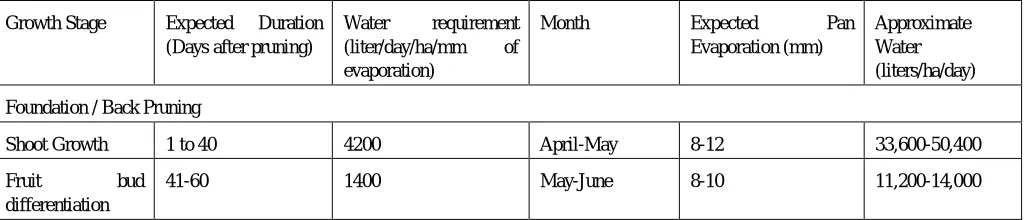
[image:3.612.52.565.618.728.2]Following table 2 represents information about water requirement for drip irrigated vines based on Pan Evaporation without mulch.
Table 2: Water requirement for drip irrigated vines based on Pan Evaporation without mulch
Growth Stage Expected Duration
(Days after pruning)
Water requirement
(liter/day/ha/mm of
evaporation)
Month Expected Pan
Evaporation (mm)
Approximate Water (liters/ha/day)
Foundation / Back Pruning
Shoot Growth 1 to 40 4200 April-May 8-12 33,600-50,400
Fruit bud
differentiation
Shoot Maturity 61-120 1400 June-August 0-6 0-8,400
Fruit bud
development
121- fruit Pruning 1400 August - Fruit
pruning
0-6 0-8,400
Forward /Fruit Pruning
Shoot Growth 1 to 40 4200
October-November
8-10 33,200-42,000
Bloom to shatter 41-55 1400
November-December
4-6 5,600-8,400
Berry growth 56-105 4200
December-January
3-6 12,600-25,200
Ripening 106-Harvest 4200 January-March 8-10 33,600-42000
Rest Period Harvest to
Foundation pruning
-- March-April 8-10 --
(Source: Published by By: Dr. A.K. Upadhyay and Dr. J. Sharma from National Research Centre for Grapes)
IV. THE RULE BASE OR KNOWLEDGE BASE
In expert system, the knowledge base is expressed with natural language rules IF ... THEN For examples:
A. “IF the leaves color is yellow THEN nitrogen deficiency is observed
B. "IF the identity of the germ is not known with certainty AND the germ is gram-positive AND the morphology of the organism is "rod" AND the germ is aerobic THEN there is a strong probability (0.8) that germ is of type enterobacteriacae"
This formulation has the advantage of speaking in everyday language which is very rare in computer science. Rules express the knowledge to be exploited by the expert system. There exist other formulations of rules, which are not in everyday language, understandable only to computer scientists.
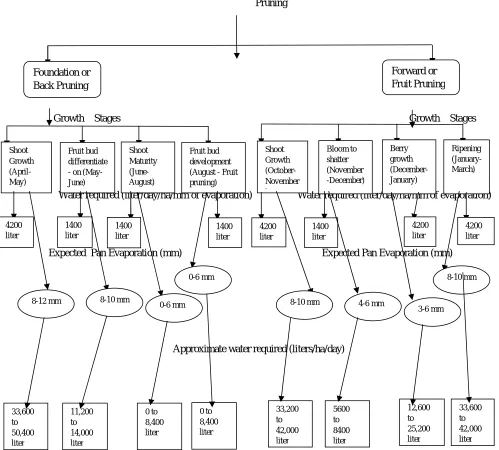
Following rules and tree structure illustrates how the knowledge base has been represented in the form of ‘IF-THEN’ rules.
V. RULE BASE SYSTEM FOR DRIP IRRIGATION MANAGEMENT:-
For the goal driven forward chaining expert system, the final goals are: suggesting approximate usage of water (required) using surface drip irrigation. Anyone can have 8 resulting combinations (If-then rules in Rule base), based on which he/she decide how much water should be apply? The system ultimately has to reach one of these goals after processing all the parameters under each rule to complete the evaluation process and provide the final decision about the use of water. Following rules represents the expert’s knowledge in the form of IF-THEN rules.
A. Rule #1
IF PRUNING IS FOUNDATION
AND GROWTH STAGE IS SHOOT GROWTH (I.E. 1 TO 40 DAYS AFTER PRUNING) AND CROP PERIOD IS IN APRIL-MAY
AND EXPECTED PAN EVAPORATION (mm) IS 8 TO 12 mm
THEN APPLY WATER APPROXIMATELY 33600 TO 50400 liters/ha/day TO GRAPE VINE.
B. Rule #2
IF PRUNING IS FOUNDATION
AND GROWTH STAGE IS FRUIT BUD DIFFERENTIATION (I.E. 41 TO 60 DAYS AFTER PRUNING) AND CROP PERIOD IS IN MAY-JUNE
AND EXPECTED PAN EVAPORATION (mm) IS 8 TO 10 mm
Pruning
Growth Stages Growth Stages
Water required (liter/day/ha/mm of evaporation) Water required (liter/day/ha/mm of evaporation)
Expected Pan Evaporation (mm) Expected Pan Evaporation (mm)
[image:5.612.35.534.80.530.2]Approximate water required (liters/ha/day)
Figure 1: Tree structure representing Rule base to decide water required for grapevine based on Pan Evaporation system
C. Rule #3
IF PRUNING IS FOUNDATION
AND GROWTH STAGE IS SHOOT MATURITY (I.E. 61 TO 120 DAYS AFTER PRUNING) AND CROP PERIOD IS IN JUNE-AUGUST AND EXPECTED PAN EVAPORATION (mm) IS 0 TO 6 mm THEN APPLY WATER APPROXIMATELY 0 TO 8,400 liters/ha/day TO GRAPE VINE.
D. Rule #4
IF PRUNING IS FOUNDATION
AND GROWTH STAGE IS FRUIT BUD DEVELOPMENT (I.E. 121 TO FRUIT PRUNING) AND CROP PERIOD IS IN AUGUST TO FRUIT PRUNING
AND EXPECTED PAN EVAPORATION (mm) IS 0 TO 6 mm
THEN APPLY WATER APPROXIMATELY 0 TO 8,400 liters/ha/day TO GRAPE VINE. Foundation or Back Pruning Forward or Fruit Pruning Shoot Growth (April-May) Fruit bud differentiate - on (May-June) Shoot Growth (October-November ) Fruit bud development (August - Fruit pruning) Shoot Maturity (June-August) Bloom to shatter (November -December) Berry growth (December-January) Ripening (January-March) 4200 liter 1400 liter 1400 liter 1400 liter 4200 liter 1400 liter 4200 liter 4200 liter
8-12 mm 8-10 mm
0-6 mm
0-6 mm 8-10 mm 4-6 mm
E. Rule #5
IF PRUNING IS FORWARD OR FRUIT
AND GROWTH STAGE IS SHOOT GROWTH (I.E. 1 TO 40 DAYS AFTER PRUNING) AND CROP PERIOD IS IN OCTOBER-NOVEMBER
AND EXPECTED PAN EVAPORATION (mm) IS 8 TO 10 mm
THEN APPLY WATER APPROXIMATELY 33,200 TO 42,000 liters/ha/day TO GRAPE VINE.
F. Rule #6
IF PRUNING IS FORWARD
AND GROWTH STAGE IS BLOOM TO SHATTER (I.E. 41 TO 55 DAYS AFTER PRUNING) AND CROP PERIOD IS IN NOVEMBER-DECEMBER
AND EXPECTED PAN EVAPORATION (mm) IS 4 TO 6 mm
THEN APPLY WATER APPROXIMATELY 5,600 TO 8,400 liters/ha/day TO GRAPE VINE.
G. Rule #7
IF PRUNING IS FORWARD
AND GROWTH STAGE IS BERRY GROWTH (I.E. 56 TO 105 DAYS AFTER PRUNING) AND CROP PERIOD IS IN DECEMBER-JANUARY
AND EXPECTED PAN EVAPORATION (mm) IS 3 TO 6 mm
THEN APPLY WATER APPROXIMATELY 12,600 TO 25,200 liters/ha/day TO GRAPE VINE.
H. Rule #8
IF PRUNING IS FORWARD
AND GROWTH STAGE IS RIPENING (I.E. 105 TO 120 DAYS AFTER PRUNING) AND CROP PERIOD IS IN JANUARY-MARCH
AND EXPECTED PAN EVAPORATION (mm) IS 8 TO 10 mm
THEN APPLY WATER APPROXIMATELY 33,600 TO 42,000 liters/ha/day TO GRAPE VINE.
I. Sample Rule
Consider following rule from above rule base, Rule #1
If pruning is foundation
And growth stage is shoot growth (i.e. 1 to 40 days after pruning) And crop period is in april - may
And expected pan evaporation (mm) is 8 to 12 mm
Then apply water approximately 33600 to 50400 liters/ha/day to grape vine.
Here forward chaining method is used to reach to the result. The available data is stage of crop life cycle (i.e. Foundation pruning), life cycle stage (i.e. shoot growth), age of crop (i.e. 1-40 days after pruning), crop period [here crop period i.e. shoot growth stage is in the month of April to May (summer season). Therefore expected pan evaporation is high. It is 8 to 12 mm]. Hence Rule # 1 is selected, because its antecedent matches the available data. Now the consequent is added to data. Nothing more can be inferred from this information, but we have now accomplished our goal of suggesting approximate water in liters/ha/day. Thus forward chining is implemented here. In this way remaining rules are prepared.
VI. IMPLEMENTATION
Many expert systems are built with products called expert system shells. The shell is software which contains the user interface, knowledge base and inference engine. The knowledge engineer uses the shell to build a system for a particular problem domain. For the proposed study, author developed a prototype model using ASP.net and Ms-Access.
This Knowledge Based System is helpful to grape growers, agricultural professional and academicians to take decisions related to the irrigation management using drip irrigation. This expert system checked by grape growers as well as agricultural expert and initial feedback collected which have been positive. With further work, the scope of the expert system can be widened.
REFERENCES
[1] Dan W. Patterson, Introduction to Artificial Intelligence And Expert system, Fourth Edition, Prentice Hall Of India Pvt. Ltd. , New Delhi.
[2] Package of Practices for Managing Major Diseases and Insect Pests on Grapes, Technical Bulletin No. 8 Published By, National Research Centre For Grapes Pune- India.
[3] Mr. Jagdev Sharma, “Appropriate and Economical use of water in grapevine cultivation”, Technical Bulletin No. 3 Published By, National Research Centre For Grapes Pune- India.
[4] B. L. Desai & R. V. Kulkarni, “Rule Based Expert System For SSI Term Loan Evaluation For Banks & Financial Institutes”, Vivek,13,(October 2000). [5] Faisad Baig, Naima Nawaz, Saif-Ur- Rehman, “Expert system for decision making in Agriculture sector”, Journal Of Agriculture And Social Sciences,
1813-235|2005|1-2-208-211
[6] S.K. Jadhav & S.J.Yelapure, “ Rule based expert system in the use of inorganic fertilizers for sugarcane crop”, International Journal of Computer Applications (0975 – 8887) Volume 36– No.4, December 2011
[7] S.K. Jadhav & S.J.Yelapure, “ Fuzzy prolog rules in knowledge based diagnosis of nutrient deficiency in sugarcane crop”, International Journal of computing and corporate research, volume 2, issue 1, January 2012