Study of Variable Compression Ratio Engine
(VCR) and Different Innovations to Achieve
VCR
Ibraheem Raza Khan1,Mayur Kailas Takalkar2
Abstract:One of the important design parameters for internal combustion engines is the geometric compression ratio. It is defined by the ratio of the maximum volume of the combustion chamber at the bottom dead centre (BDC) piston position and a minimum volume of the combustion chamber at the top dead centre (TDC) piston position. Conventional engines have this parameter set unchangeable, what is not the solution ensuring optimal benefits coming from the heat release in the combustion process, especially under altering conditions of load and speed in which they perform powering the road vehicles. It is reflected mainly in exhaust emission problem. Despite a considerable progress, further improving the ecological and energetic performances of the piston engines faces severe system limits, elimination of which requires major changes in engine design, including conversion the fixed compression ratio into the flexible one. For such innovative engine designs with so-called variable compression ratio VCR feature the geometric compression ratio parameter is as the one of the operation regulators. Keywords:Variable Compression Ratio, Variable-Length Connecting rod, Variation of Combustion Chamber Volume, Connecting Rod Linkages, Variation of Piston Deck Height, Moving Crankshaft Axis
I. INTRODUCTION
One key features affecting thermal efficiency is the compression ratio, which is always a compromise in fixed compression ratio spark ignition (SI) engines. If the compression ratio is higher than the designed limit, the fuel will pre-ignite causing knocking, which could damage the engine. Generally, the operating conditions of SI engines vary widely, such as stop and go city traffic, highway motoring at constant speed, or high-speed freeway driving. Unfortunately, most of the time SI engines in city driving conditions operate at relatively low power levels under slow accelerations, low speeds, or light loads, which lead to low thermal efficiency and hence higher fuel consumption [1].
As the engine load decreases, the temperature in the end gas drops, so that high compression ratio could be employed without the risk of knocking in naturally aspirated or boosted engines. Raising the compression ratio from 8 to 14 produces an efficiency gain from 50 to 65 per cent (a 15 per cent gain), whereas going from 16 to 20 produces a gain from 67 to 70 per cent (a 3 per cent gain). The effects of compression ratio with respect to thermal efficiency. Designing high performance vehicles that are fuel efficient and clean is difficult since we also want them to remain inexpensive. It is therefore necessary to find simple, low cost and effective solutions and that is the whole strategy of the Variable Compression Ratio (VCR) engine producers. Far from being a revolution, VCR engines are a major evolution of conventional engines.
The concept of variable compression ratio (VCR) promises improved engine performance, efficiency and reduced emissions. The higher cylinder pressures and temperatures during the early part of combustion and small residual gas fraction owing to higher compression ratio give faster laminar flame speed. Therefore, the ignition delay period is shorter. As a result, at low loads, the greater the compression ratio, the shorter is the combustion time.
II. BENEFITS AND ECONOMICS
A. Benefits of the VCR engine can be summarized as follows
1) Optimum combustion efficiency in the whole load and speed range.
2) Low fuel consumption and low exhaust emissions.
3) The VCR provides better control over pollutant generation and after-treatment than a conventional fixed compression ratio (FCR) engine also extends the life expectancy of a three way catalytic converter.
4) As the geometrical volumetric ratio is under control on VCR engines, the engine always operates below the knock limit, whatever the load.
5) The VCR engine provides excellent fuel flexibility, since the compression ratio can be varied and adjusted to suit the properties of the fuel, and therefore the engine will always run at the compression ratio best suited to the fuel being used for bi-fuel (compressed natural gas (CNG)/gasoline) power-trains; the realization of VCR is of specific interest. High fuel flexibility, with optimal combustion efficiency.
6) Very smooth idle and full load accelerations are achieved.
7) It provides better indicated thermal efficiency than that of FCR engines.
8) It allows for a significant idle speed reduction because of reduced misfiring and cyclic irregularities, resulting in low vibration levels.
9) Reduction in low-frequency noise because of constant peak pressures.
10) Smoother combustion because the rate of heat release is the same (short) both at low and high compression ratios.
11) Cold starting emissions can be reduced greatly by early catalyst warm-up in the catalytic converter.
12) Improvement in the low end torque of a petrol engine without the risk of detonation.
13) Potential technology for future high-boosting super lean burn engines.
14) Low CO2 emissions by down-sizing for the same power output.
15) Good idling performance at low ambient temperatures.
16) Constant frictional losses owing to almost constant peak pressures.
B. Economics
Choosing an appropriate VCR technology is a decisive step to determine the cost of VCR implementation in future vehicle. The different available VCR technologies have to be compared by focusing on all the positive and negative impacts on engine components and their operations. The benefits of VCR also include increased power density, reduced number of cylinders, sophisticated injection technologies, and complex after-treatment Indeed, to be marketable, the VCR technology has to present indispensable features such as robustness, durability, easy integration into all vehicles and low noise and vibration levels. The real potential of VCR engines will be realized when they are used in combination with down-sizing and supercharging.
III. METHODS TO ACHIEVE VCR A. Variable-length connecting rod,
Figure 1
IV. NAMED SVC (SAAB VARIABLE COMPRESSION),
The inclinable cylinder head and cylinder, the SVC engine has a cylinder head with integrated cylinders - which is known as mono head as shown in figure 2. The mono head is pivoted at the crankcase and its slope can be adjusted slightly up to 4 degreesin relation to the engine block, pistons, crankcase etc. By means of a hydraulic actuator, therefore the volume of the combustion chamber, when piston is in compressed position, can be varied. SAAB VCR engine.SVC is cleverer than any previous patents for variable compression ratio engines because it involves no additional moving parts at the combustion chamber or any reciprocating components, so in theory is simple, durable and free of leakage. The mono head is self-contained, that means it has its own cooling system. Cooling passages across the head and the cylinder wall [5]. There is a rubber sealing between the mono head and engine block. The VC allows the Saab engine to run on very high supercharging pressure - 2.8 bar. So high that today’s turbochargers cannot provide. Therefore it employs supercharger instead. At other speed, the VC is adjustable continuously according to needs - depends on load, temperature, fuel used, all decided by engine management system. Therefore power and fuel consumption can be optimized at any conditions.
VARIATION OF COMBUSTION CHAMBER VOLUME
In order to vary the combustion chamber volume a secondary piston or valve is used .The piston could be maintained at an Intermediate position, as shown in figure 3, corresponding to the optimum compression ratio for a particular condition .The combustion chamber volume is increased to reduce the compression ratio by moving a small secondary piston or valve which communicates with the Chamber [6].
Figure 3
VI. CONNECTING ROD LINKAGES
A popular approach has been developed to replace the conventional con rod with a two piece design in which an upper member connects with the piston while a lower member connects with the crankshaft [7]. The shorter crank throw allowed room for the link system, as shown in figure 4 which is anchored by an eccentric rotary actuator.
VII. VARIATION OF PISTON DECK HEIGHT
The Daimler-Benz VCR piston design shows variation in compression height of the piston and offers potentially the most attractive route to a production VCR engine, as shown in figure 5 since it requires relatively minor changes to the base engine architecture when compared to other options [8].
Figure 5
VIII. MOVING THE CRANKSHAFT AXIS
In this method a crankshaft bearings are carried in an eccentrically mounted carrier that can rotate to raise or lower the top dead centre (TDC) positions of the pistons in the cylinders as shown in figure 6. The compression ratio is adjustable by varying the rotation of the eccentric carrier [9].
Figure 6
IX. FUTURE SCOPE
X. CONCLUSION
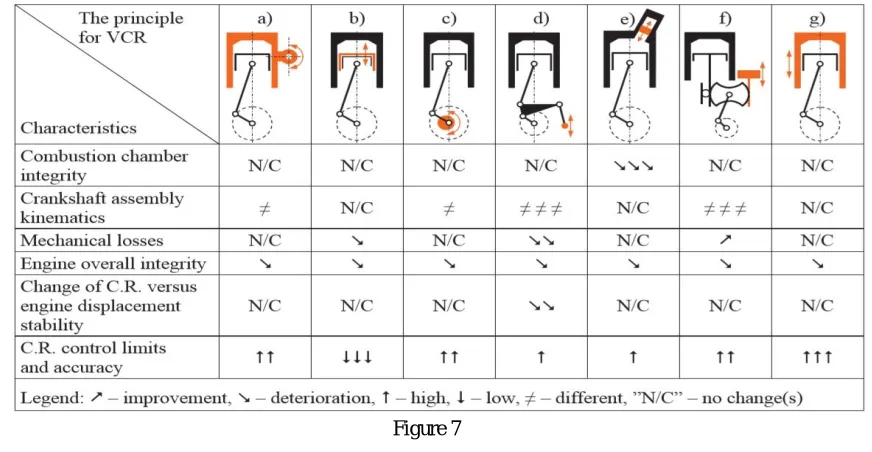
[image:7.612.93.529.222.448.2]The VCR engine has great potential for improving part-load thermal efficiency, more efficient operation, ability to down size the engine, multi fuel flexibility and reducing the harmful emissions when compared to other competing technologies. The main obstacles to adoption of VCR are incompatibility with major components in current production and difficulties of combining VCR and non-VCR manufacturing within existing plant. The Potential of these technologies needs to be evaluated by a trade -off between cost and consumption benefit. It is potentially one of the profitable sources to investigate for the automotive industry. Under full load conditions, the performance and efficiency of an engine with a compression ratio that is adapted to load demands is capable of reducing knock susceptibility. In addition, the risk of pre-ignition, mega knocking effects and engine jerking, as the result of retarded combustion phases, can be reduced. The VCR also provides further potential to control the exhaust gas temperature, contributing to protecting component temperatures. Combustion, a reduced CR results in a lower peak firing pressure. A compiled view of all the possible innovation is shown in figure 7.
Figure 7
REFERENCES
[1] M. P. Joshi, “VARIABLE COMPRESSION RATIO (VCR) ENGINE- A REVIEW OF FUTURE POWER PLANT FOR AUTOMOBILE,” InternationInternational Journal of Mechanical Engineering Research and Development (IJMERD), ISSN 2248 – 9347, vol. 2, no. 1, pp. 2-3, 2012. [2] U. K. Saha, “Internal Combustion Engine,” QIP-D Cell Project, 2008, pp. 5-8.
[3] R. mishra, “Design of Variable Length Connecting rod for VCR Engine,” International Journal of Engineering Research and Applications (IJERA) ISSN: 2248-9622 , vol. 2, no. 1, pp. 2-3, 2014.
[4] H. K. Paweá WoĞ, “EXHAUST EMISSION FEATURES OF VARIABLE COMPRESSION RATIO (VCR) DIESEL ENGINE,” Journal of KONES
Powertrain and Transport, vol. 17, no. 3, pp. 3-6, 2010.
[5] M. S. S. A. Supee, “Performance of Diesel-Compressed Natural Gas (CNG) Dual Fuel (DDF) Engine via CNG-Air Venturi Mixjector Application,” Arab J Sci Eng, vol. 10, no. 2, pp. 1-3, 2014.
[6] S. A. P. Quadri, “Emission Study of CNG Substituted Diesel Engine under Dual Fuel Mode,” Scholars Journal of Engineering and Technology (SJET) , vol. 4, no. 3, pp. 1-3, 2013.
[7] T. J. Rychter, “VARIABLE COMPRESSION RATIO ENGINE - VR/LE CONCEPT,” in Institute of Heat Engineering Warsaw University of Technology , Warsaw, 1995, pp. 18-23.
[8] S. Tomar, “Optimisation of Connecting Rod Design to Achieve Vcr,” Savita tomar et al Int. Journal of Engineering Research and Applications , vol. 3, no. 6, pp. 281-286, 2013.
[9] K.Satyanarayana, “Variable Compression Ratio Diesel Engine Performance Analysis,” International Journal of Engineering Trends and Technology (IJETT, vol. 28, no. 1, pp. 6-11, 2015.