Computational Methods for Behavior Analysis
Thesis by
Eyrun Eyjolfsdottir
In Partial Fulfillment of the Requirements for the degree of
Doctor of Philosophy
CALIFORNIA INSTITUTE OF TECHNOLOGY Pasadena, California
2017
c
2017
Eyrun Eyjolfsdottir
ABSTRACT
Behavioral scientists strive to decode the functional relationship between sensory input and motor output of the brain, which requires quantitive measurement of an-imal behavior. Artificial intelligence researchers aim to build intelligent systems, capable of understanding, predicting, and generating behavior. Our research lies on the intersection of the two fields; our goal is to automate measurement of animal behavior and to model their sensory-motor relationship using machine learning.
We have developed a tool that tracks the pose of multiple fruit flies and aims to maintain their identity throughout a video. It outputs motion trajectories that can be used to quantify behavioral differences between individuals, for example by com-paring histograms of velocities and wing angles. We show that the tool also works well on non-fly-like animals such as zebrafish larvae.
Embedded in these motion trajectories are temporal patterns that constituteactions. We developed two supervised learning frameworks for action detection: a sliding window framework and a structured output framework. Both frameworks learn to classify actions from motion trajectories and expert annotated action intervals. Our results show that the simpler sliding window framework achievers better results in spite of being much faster to train, reaching 90% of human performance.
Supervised learning requires a lot of training data which involves time consuming and painstaking annotation. To alleviate that we have built a semi-supervised neu-ral network framework that, in addition to classifying actions, learns to predict how an animal will move next given its motion and sensory inputs so far. Our model archives as good results as its supervised counterpart with only half of the expert labels. In addition, we show that motion prediction can be used to generate convinc-ing simulations of fruit fly behavior and handwritten text, and that our model learns to represent high level information, such as identity, when trained unsupervised.
PUBLISHED CONTENT AND CONTRIBUTIONS
[Asa+14] Kenta Asahina, Kiichi Watanabe, Brian J Duistermars, Eric Hoopfer, Carlos Roberto González, Eyrún Arna Eyjólfsdóttir, Pietro Perona, and David J Anderson. “Tachykinin-expressing neurons control male-specific aggressive arousal in Drosophila”. In:Cell156.1 (2014), pp. 221–
235.url:http://www.sciencedirect.com/science/article/
pii/S0092867413015365.
E.E. developed fly tracking software used for the behavior analysis.
[Eyj+14] Eyrun Eyjolfsdottir, Steve Branson, Xavier P Burgos-Artizzu, Eric D Hoopfer, Jonathan Schor, David J Anderson, and Pietro Perona. “De-tecting social actions of fruit flies”. In:Computer Vision–ECCV 2014. Springer, 2014, pp. 772–787.url:https://link.springer.com/
chapter/10.1007/978-3-319-10605-2_50.
E.E. made algorithmic contributions, collected data, designed the ex-periments, and analyzed the results.
[Eyj+17] Eyrun Eyjolfsdottir, Kristin Branson, Yisong Yue, and Pietro Perona. “Learning recurrent representations for hierarchical behavior model-ing”. In: ICLR 2017 (2017). url: https : / / openreview . net /
forum?id=BkLhzHtlg¬eId=BkLhzHtlg.
E.E. designed the algorithms, prepared the data, designed the experi-ments, and analyzed the results.
[Lim+14] Rod S Lim, Eyrún Eyjólfsdóttir, Euncheol Shin, Pietro Perona, and David J Anderson. “How food controls aggression in Drosophila”. In:
PloS one9.8 (2014), e105626.url:http://journals.plos.org/
plosone/article?id=10.1371/journal.pone.0105626.
TABLE OF CONTENTS
Abstract . . . iii
Published Content and Contributions . . . iv
Table of Contents . . . v
List of Illustrations . . . vi
Chapter I: Introduction . . . 1
1.1 Behavior analysis and its automation . . . 1
1.2 Contributions and thesis outline . . . 2
Chapter II: Tracking . . . 3
2.1 Evaluation . . . 3
2.2 Detection . . . 9
2.3 Tracking . . . 14
2.4 Pose estimation . . . 21
2.5 Behavior quantification . . . 23
Chapter III: Action detection . . . 26
3.1 Background . . . 27
3.2 Fly-vs-Fly . . . 29
3.3 Feature representation . . . 30
3.4 Sliding window classification . . . 35
3.5 Structured output classication . . . 36
3.6 Experiments and analysis . . . 38
3.7 Discussion . . . 46
Chapter IV: Behavior modeling . . . 50
4.1 Background . . . 51
4.2 Model . . . 52
4.3 Applications . . . 56
4.4 Data . . . 57
4.5 Experiments and analysis . . . 60
4.6 Discussion . . . 69
Chapter V: Conclusion . . . 71
LIST OF ILLUSTRATIONS
Number Page
2.1 Tracker summary . . . 3
2.2 Tracker comparison . . . 4
2.3 Identity accuracy . . . 6
2.4 Pose accuracy . . . 8
2.5 Performance on zebrafish larvae . . . 9
2.6 Background computation . . . 10
2.7 Chamber detection . . . 12
2.8 Fly detection . . . 13
2.9 Tracking procedure overview . . . 14
2.10 Stitching of tracklets . . . 18
2.11 Pose estimation . . . 21
2.12 Heat map of individual’s location . . . 23
2.13 Heat map of relative position . . . 24
2.14 Histogram of wing angles and body lengths . . . 24
3.1 Synoptic table of action datasets . . . 28
3.2 Fly-vs-Fly dataset . . . 30
3.3 Actions of fruit flies . . . 31
3.4 Action statistics . . . 32
3.5 Feature representation . . . 33
3.6 Feature distribution for actions . . . 33
3.7 Performance measures . . . 39
3.8 Frame vs. bout discrepancy . . . 40
3.9 Human performance . . . 41
3.10 Human comparison . . . 41
3.11 Method comparison on Fly-vs-Fly . . . 42
3.12 Performance clustering and feature importance . . . 43
3.13 Method comparison on CRIM13 . . . 44
3.14 Confusion matrix for CRIM13 . . . 45
3.15 Results on Boy meets boy . . . 47
3.16 Results on Aggression . . . 48
4.1 Model architecture . . . 53
4.2 Data overview . . . 58
4.3 Data representation . . . 59
4.4 Classification performance . . . 61
4.5 Effect of diagonal connections cost . . . 62
4.6 Motion prediction performance . . . 63
4.7 FlyBowl simulation . . . 64
4.8 Fly-vs-Fly simulation . . . 65
4.9 Handwriting simulation . . . 65
4.10 SynthFly simulation . . . 66
4.11 Fly-vs-Fly discovery . . . 67
4.12 Handwriting discovery . . . 68
C h a p t e r 1
INTRODUCTION
1.1 Behavior analysis and its automation
Behavior can be defined as the coordinated responses to external and/or internal stimuli [LLF09]. It is a function of the brain that involves interaction with a dy-namic environment and can be perceived at various scales [Gom+14].
Behavioral scientists strive to understand the functional relationship between stim-uli and response and how neural systems mediate these relations [Moo02]. Ethol-ogists study the natural behavior of animals, e.g. how it is composed of internected actions, while neuroscientists and psychologists study behavior in a con-trolled environment where they can measure and manipulate neural activations and environmental stimuli. These studies require measuring (describing and/or quanti-fying) behavior in order to derive correlations or causal relationships between be-haviors over time or between behavior and stimuli. Traditionally, behavior has been measured by manual observation but in recent years scientists are turning towards automated systems for more objective and precise measurements, allowing for sig-nificantly increased throughput [AP14].
Artificial intelligence (AI) researchers are also concerned with behavior. Like be-havioral scientists, they are interested in finding a functional relationship between the input and output of the brain, but not necessarily the underlying physiological processes. In fact, AI systems may eventually outperform humans at any given task. One branch of AI is working on machine understanding and prediction of human activity, which can be applied to surveillance, assisted living, and sports analytics. Another branch focuses on generating intelligent behavior, for applications such as self driving vehicles, robots, and virtual assistants.
1.2 Contributions and thesis outline
In this thesis I present my work towards automating behavior analysis, which in-volves: 1) computing motion from video, 2) detecting and classifying actions, 3) predicting future motion, and 4) simulating behavior. The work is organized into three main chapters, each describing one or more of my contributions:
Chapter II describes a system that tracks multiple fruit flies in a video, keeps track of their identity, and outputs motion trajectories describing their pose at every frame. The results demonstrate that these features are useful for quantifying fly behavior.
Chapter III compares two action detection frameworks that learn from expert pro-vided labels to detect and classify actions in motion sequences, allowing for se-mantic analysis of behavior. It introduces the Fly-vs-Fly dataset which contains videos of fruit fly interactions and is used for measuring performance of the tried algorithms.
Chapter IV proposes a neural network architecture that simultaneously classifies actions and predicts motion. Learning the two objectives simultaneously requires fewer expert labels to train good action classifiers. The structure of this architec-ture facilitates discovery of high level behavioral phenomena. In addition, motion prediction can be used to simulate behavior, which may become useful for under-standing the underlying mechanism of behavior.
video motion actions
future motion
1 2
3 behavior
analysis
4
C h a p t e r 2
TRACKING
FlyTracker is a system that aims to track the pose (position, orientation, size, wing-and leg positions) of multiple flies wing-and maintain their identities throughout a video. In addition to trajectories, it outputs features (such as velocity, distance to walls, wing angles) useful for behavior analysis. FlyTracker comes with an interface that lets users: 1) calibrate the system on their experimental setup, 2) track all flies in videos, 3) visualize results and correct errors, and 4) annotate behavior of individual flies. It has been tested on videos containing up to 20 individuals, recorded at 25-200 frames per second, and with resolution of 6-60 pixels per body length.
In Section 2.1 we evaluate the performance of FlyTracker, and in Sections 2.2-2.4 we describe in detail the computer vision algorithms behind it which can be divided into: detection, tracking, and pose estimation. FlyTracker is available at
www.vision.caltech.edu/Tools/FlyTracker.
detection
pose estimation tracking
Figure 2.1: Three stages of FlyTracker: detection(extract fly bodies and chamber boundaries),tracking(connect body components across frames), andpose estima-tion(fit body, wing, and leg components to detected flies).
2.1 Evaluation
Related work
CADABRA [Dan+09] and Ctrax [Bra+09] are two of the first available fly tracking systems, they were released around the same time but serve different purposes. CADABRA is tailored towards fly pairs and outputs the detailed pose of each fly as well as their mutual position and orientation. Ctrax, on the other hand, tracks multiple flies and uses motion continuity and segmentation of overlapping bodies to keep track of their identity. Both tools have been used extensively for fly behavior analysis, i.e. in the work of [WA10; Wan+11; Lim+14; OZR11; Ram+15], to list a few. IdTracker [Pér+14] is a more recent software that tracks any type of animal, its main strength is re-identification which allows it to keep track of individuals throughout the video and recover from mistakes. It does not attempt to separate bodies that are merged due to overlapping but instead re-identifies them based on an appropriately computed ‘fingerprint’ after they have been separated again.
FlyTracker combines the strengths of each of the above. It tracks multiple flies and extracts a detailed pose of each fly at every frame, which it uses to re-identify flies when motion trajectories are ambiguous. Like Ctrax it resolves touching bodies, and similar to idTracker it uses appearance features to re-identify flies. Its appear-ance features are less elaborate than those of idTracker, but they are also less com-putationally expensive and do not make assumptions about lighting or resolution. Figure 2.2 summarizes the difference between the different tracking softwares. A more comprehensive list can be found in [Del+14] which includes software that is commercial, tailored to different animals, or requires an elaborate setup (i.e. multi-ple cameras or specialized hardware).
CADABRA Ctrax idTracker FlyTracker
# animals 2 >20 >20 >20
resolves overlap yes yes no yes
stitches gaps yes no yes yes
pose
Figure 2.2: Comparison of different tracking tools. Resolves overlap refers to whether individual bodies are segmented apart when bodies are overlapping.
Stitches gaps refers to whether trajectory identities are re-assigned when
Identity accuracy
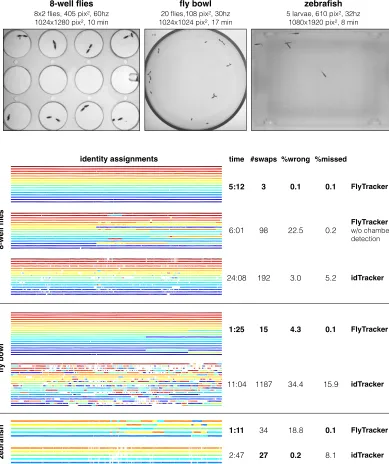
We measure the identity accuracy on three different videos, shown in Figure 2.3, and compare the performance of Flytracker with idTracker which also aims to keep track of subject’s identity.8-well fliescontains 8 fly pairs, each in a separate cham-ber, with 405 pixels on each fly’s body. This video has two main challenges, 1) when flies are close to chamber walls their reflection can be mistaken for a true fly, and 2) during aggressive behaviors the flies are in close contact and sometimes jump quickly away from each other. However, for each fly pair one of the flies has one wing clipped so that their identities can be determined by a human annota-tor. FlyTracker automatically detects chamber boundaries, and therefore treats this video as 8 separate tracking problems, but for comparison with idTracker we also include results where the video is treated as a single chamber with 16 flies. Fly bowlcontains 20 flies, half of which are female, with 108 pixels on each fly’s body. The main challenge of this video is that multiple male flies often chase a female at the same time, with bodies of 2 or more flies frequently touching. Zebrafish
contains 5 zebrafish larvae with 610 pixels covering each body on average, and the main challenge in this video is that fish can swim over each other.
Figure 2.3 compares the two tracking systems in terms of their tracking time (on OSX with 4 cores and 8GB memory), the percent of frames that a fly was not detected (%missed), the percent of frames that a fly was misclassified (%wrong), and how many identity swaps (#swaps) would be necessary for correct assignment (ignoring misidentifications shorter than 1 second). The percent misclassified and number of swaps exclude undetected frames. In addition, we visualize identity assignments to give intuition for the meaning of these errors.
The results show that globally idTracker performs better, as the percent of mis-identified fly-frames is lower, but locally FlyTracker performs better, as the percent of missed detections (when animals are touching) is lower, and the number of swaps needed to correct identities is lower on average. On the bowl video, idTracker fails to recover identities. This may be due to a few reasons: 1) although the authors report good results for as low as 50 pixels per body, they recommend 150 pixels for good performance, 2) they report that identity recovery can be compromised when crosses are ubiquitous, which is the case with this video, and 3) the video is backlit and might therefore not have enough detail on the fly body for fingerprinting.
touch-5 larvae, 610 pix2, 32hz 1080x1920 pix2, 8 min 8x2 flies, 405 pix2, 60hz
1024x1280 pix2, 10 min
20 flies,108 pix2, 30hz 1024x1024 pix2, 17 min
zebrafish 8-well flies fly bowl
identity assignments time #swaps %wrong %missed
5:12 3 0.1 0.1 FlyTracker
6:01 98 22.5 0.2
FlyTracker
w/o chamber detection
24:08 192 3.0 5.2 idTracker
1:25 15 4.3 0.1 FlyTracker
11:04 1187 34.4 15.9 idTracker
1:11 34 18.8 0.1 FlyTracker
2:47 27 0.2 8.1 idTracker
fly bowl
8
-w
e
ll
fl
ie
s
ze
b
ra
fi
s
[image:13.612.112.501.134.598.2]h
ing, idTracker is better (with the caveat that relatively high resolution is required). If one cares about position when animals are in contact and/or the pose of the an-imals, FlyTracker is a better choice. In addition, FlyTracker is considerably faster than idTracker, especially when animals frequently touch or overlap.
Pose accuracy
In order to measure pose accuracy, we collected ground truth annotations for the 8-well fly video described in the previous section. An annotator was presented with randomly selected frames, zoomed in on a randomly selected fly, and asked to click on its head, the tip of its abdomen, both sides of its body, the two wing tips, and on the tips of all visible legs. In order to measure accuracy during difficult cases, additional frames were sampled where flies are touching and where their bodies overlap. The annotator was asked ignore frames where she could not determine the pose of the fly.
Figure 2.4 plots the pose errors for 1) flies not touching, 2) flies touching, and 3) flies overlapping, and compares ground truth pose to the pose estimated by Fly-Tracker, showing five smallest and five largest body pose error for each case, mea-sured as a function of position-, orientation-, and length error, and the precision and recall of the wings and legs. We matched wings and legs using a one to one match-ing with a maximum threshold, and the wmatch-ing- and leg position errors are reported only for matched legs and wings. Precision refers to the percentage of detected wings/legs that matched with a ground truth wing/leg, and recall to the percentage of ground truth wings/legs that were matched with a predicted wing/leg. Results are based on 510 annotated fly-frames, 150 of which flies are touching, and 110 of which they overlap.
0.01 0.1 1 error (mm) 0
0.1 0.2
position
0.1 1 10 100
error (deg) 0
0.1 0.2
orientation
0.01 0.1 1
error (mm) 0
0.1 0.2
length
0.01 0.1 1
error (mm) 0
0.1 0.2
wing position
0.01 0.1 1
error (mm) 0
0.1 0.2
leg position
count: 250 count: 149 count: 110
body wings legs
median position error (mm)
median orientation error (deg)
median length error (mm)
recall precision median position error (mm)
recall precision
median position error (mm)
not touching 0.04 1.1 0.10 94 100 0.10 83 96 0.09
touching 0.03 1.4 0.12 94 99 0.10 73 91 0.09
overlapping 0.08 2.4 0.16 73 97 0.10 68 89 0.11
lowest errors highest errors
gr
ound truth
FlyT
racker
gr
ound truth
FlyT
racker
gr
ound truth
FlyT
racker
o
ve
rl
a
p
p
in
g
to
u
ch
in
g
n
o
t
to
u
ch
in
[image:15.612.109.504.128.584.2]g
Performance on other animals
FlyTracker is optimized for tracking fruit flies. It makes use of constraints specific to a fly (elliptical body, 2 wings, 6 legs) to fit a skeletal representation to its body. However, it can in theory track any type of animal as long as the background is constant throughout the video and the animals are all of similar size. We showed in Figure 2.3 the identity performance on a video containing 5 zebrafish, and Figure 2.5 shows that the results also look promising when considering segmentation of overlapping fish and pose. The zebrafish larvae do not have wings or legs and their body is non-rigid, but the tracker fits an ellipse to the thicker part of their body and a leg to its tail. The shape of the ellipse and the relative position of the "leg" could be used to infer the curvature of the fish.
Figure 2.5: Zebrafish larvae tracked using FlyTracker. This example shows a case where identity swap was successfully disambiguated.
2.2 Detection
Background estimation
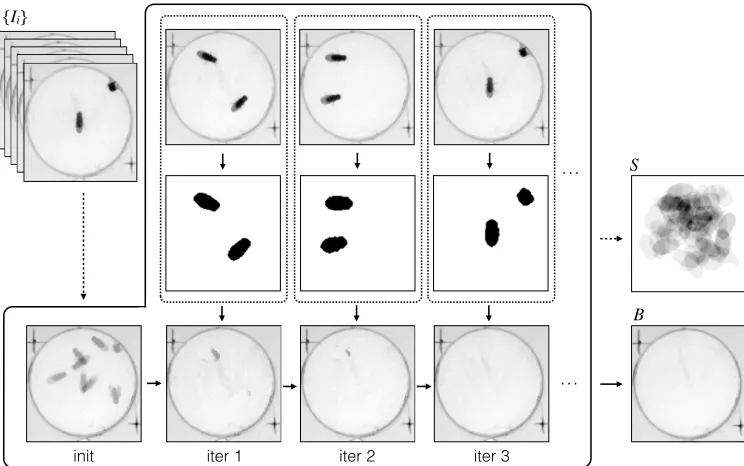
Two common background computation methods [Ben+08] are 1) taking the mean of all images in a video, which is susceptible to ghost effects when flies stay in place over extended periods of time; and 2) taking the median over all pixels, which is subject to noise and makes the assumption that pixels are not covered by foreground at least half of the time. Our approach combines these two ideas to obtain a smooth background image without ghosting effects, assuming each area of the background is visible in at least one frame.
The background image is computed by iteratively adding weighted images to a background sum. First, a rough background is estimated and at each successive iteration a randomly selected image is added, weighted such that areas believed to belong to the foreground contribute a negligible amount. This is described in Algorithm 1 which takes as input aT-frame video,{Ii :i ∈[1,T]}, and a minimumn and maximumN number of frames to use for background computation, and outputs background image,B, and weight sum,S, which indicates how many images were used to compute the value for each pixel. Figure 2.6 shows steps of the algorithm for an example video.
B
S
B S
B0 B1 B2 B3
W3
W2
W1
I1 I2 I3
iter 1 iter 2 iter 3
{Ii}
init
…
[image:17.612.120.492.397.630.2]…
Algorithm 1WeightedBackground
Input: {Ii :i ∈[1,T]},n,N
Output: B,S
1: B =mean({Ii :i ∈1 : bT/nc :T}) .rough background estimate
2: τ=inferThresh(IbT/2c − B) .foreground threshold
3: BS = 0 .initialize background sum
4: S =0 . initialize sum weights
5: fori ∈randi(T,N)do .loop through N random frames
6: W = (Ii− B) < τ .background mask
7: BS = BS+Ii.*W .add weighted image to background
8: S = S+W . update weight sum
9: α= S==0 .mask for zero weight pixels
10: B = BS./S.* (1−α)+ B.*α .update background
11: if min(S)> nAND converged(B)thenbreak
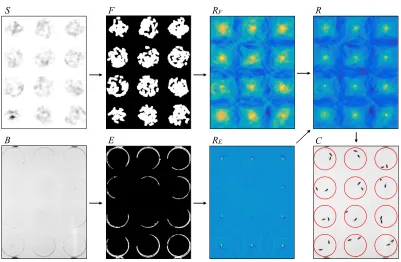
Chamber detection
Algorithm 2ChamberDetect
Input: B,S,N,(param)
Output: {Ci:i ∈[1,N]}, param
1: G,O =imGradient(B) .magnitude and orientaiton of gradient
2: τ=mean(G)+std(G); .gradient threshold
3: E =G > τ .edge mask
4: F = S <prctile(S,99) .cumulative foreground mask
5: if nargin<4then
6: rmax=0, param=[] .initialize parameters
7: P=getParameterRange(O,N) .infer chamber parameter range
8: for p∈ Pdo . loop through range
9: KE,KF =generateFilters(p) . edge and foreground filters
10: r =max(conv(E,KE)+conv(F,KF)) . max total response
11: ifr > rmaxthenrmax =r, param= p .update parameters
12: KE,KF =generateFilters(param)
13: R=conv(E,KE)+conv(F,KF) .response image
14: C =getTopResponses(R,N, param) .top N chamber locations
R
C
S F RF
[image:19.612.107.508.345.607.2]B E RE
Fly detection
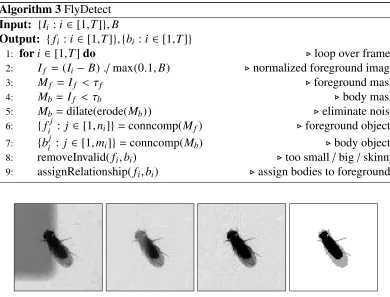
Using the same principle as in background computation, where moving objects are located using a rough background estimate, we subtract background, B, from each image to detect flies. The background subtracted image (signal) is normalized with the background itself to account for non-uniform environments: the signal strength of a fly walking on top of a dark area is weaker than a signal of a fly on top of a bright area, as shown in Figure 2.8. The foreground image is thresholded to obtain a foreground mask (weak threshold,τf) and a body mask (strong threshold,
τb) and from the masks we extract connected components (using (±1,±1) pixel neighborhood). This is described in Algorithm 3 which takes as input a video and a background image, and outputs, for each frame, i, a list of foreground objects,
{fij : j ∈ [1,ni]}, and body objects, {bij : j ∈ [1,mi]}. Each object is defined in terms of a pixel list, centroid, and area, and foregrounds point to the list of bodies it contains (children), and bodies to their corresponding foreground (parent); if two or more flies are touching, their bodies are the children of a single foreground. Tracking can be done for each chamber individually, considering only detections within each chamber’s boundary.
Algorithm 3FlyDetect
Input: {Ii :i ∈[1,T]},B
Output: {fi :i ∈[1,T]},{bi :i ∈[1,T]}
1: fori ∈[1,T]do .loop over frames
2: If = (Ii− B) ./max(0.1,B) .normalized foreground image
3: Mf = If < τf .foreground mask
4: Mb= If < τb .body mask
5: Mb=dilate(erode(Mb)) .eliminate noise
6: {fij : j ∈[1,ni]}=conncomp(Mf) .foreground objects
7: {bij : j ∈[1,mi]}=conncomp(Mb) .body objects
8: removeInvalid(fi,bi) . too small/big/skinny
[image:20.612.109.499.387.684.2]9: assignRelationship(fi,bi) . assign bodies to foregrounds
merge
trajectories: split
stitch
correct
blobs:
tracklets: link
[image:21.612.120.463.56.413.2]frame 1 frame 2 frame 3 frame 4 frame 5 frame 6
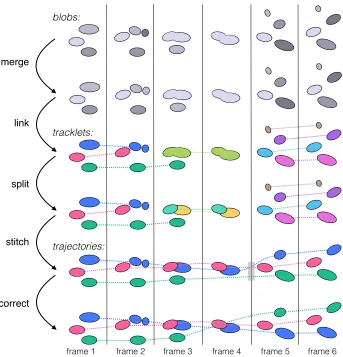
Figure 2.9: A synthetic example demonstrating the tracking procedure. The top row shows blob detections (colored in a shade of grey according to their identity within the frame) which include anomalies such as split, merged, missing, and false blobs. Our tracking algorithm is split into the following steps: 1)mergesmall blobs with nearest sibling, 2)linkblobs across frames unless matching is ambiguous, 3)split
tracklets containing more than one fly, 4)stitchtracklets into full length trajectories, and 5)correctpotential identitiy swaps based on appearce.
2.3 Tracking
Merging
From now on we will refer to detected body,bij, as ablob, as it may not represent a self-contained body but rather multiple bodies, body fragment, or noise. We want to split blobs that contain more than one fly, and merge blobs that belong to a single fly, but solving both issues simultaneously is a circular problem: if two blobs in framei match to one blob in framei+1, should the blobs in frameibe merged or the blob in frame i+ 1 be split? Framesi −1 andi+ 2 could help disambiguate that, however, further merging or splitting of blobs in surrounding frames, as well as missing and false blobs, can further complicate things. By merging small blobs with nearby blobs (whose body they potentially belong to), the problem reduces to splitting only. A blob’s survival is based on itscardinality,c, which measures how many fly bodies a blob is believed to contain. Blobs with 0-cardinality are merged with their closest sibling (with smallest distance between closest pixels).
Algorithm 4Merge
Input: {bi :i ∈[1,T]}
Output: {bi :i ∈[1,T]}
1: ma =mediani,j(b j
i.area) .expected size of blob
2: for b∈ {bij}do
3: b.c=round(b.area/ma) .blob cardinality
4: if isLargestChild(b)thenb.c=max(b.c, 1) .keep largest/only child
5: if b.c==0thenmergeWithClosestSibling(b)
Linking
Algorithm 5Link
Input: {bi :i ∈[1,T]}
Output: {ti :i ∈[1,N]}
1: N = |b1| .current number of tracklets
2: inds =[1,N] .current tracklet indices
3: fori ∈[1,N]do
4: ti=init(bi1,1,0) .start tracklet at frame 1 with 0 matches
5: fori ∈[1,T]do . loop through frames
6: A=Match(bi,bi+1) .assignments
7: A∗=removeOneMany(A) .one-to-one assignments
8: for j,k ∈find(A∗ ==1) do
9: tinds(j).append(bik+1) . append to existing tracklet
10: for j ∈find(sum(A∗,1) ==0) do
11: c=sum(A(j,:)) .number of matches from tracklet
12: tinds(j).end(i,c) .end tracklet at frameiwithcmatches 13: inds= inds\inds(j) .remove index from current indices
14: for k ∈find(sum(A∗,2) ==0do
15: c=sum(A(:,k)) .number of matches to tracklet
16: tN+1=init(bik+1,i+1,c) .start tracklet at framei+1 withcmatches
17: N = N +1
18: inds= inds∪(N+1) .add index to current indices
19:
20: functionMatch(bi,bi+1)
21: C=Cost(bi,bi+1) .match cost
22: n,m=size(C)
23: C0=1((n+m)) * max(C)*2 .add high-cost dummy nodes ...
24: C0(1 : n,1 : m) =C .... for non-matches
25: A0=hungarian(C0) .one-to-one matching
26: A0=greedySwap(C0,A0,bi.c,bi+1.c) .swap to cheaper if allowed 27: A= A0(1 : n,1 :m) .remove dummy matches
28: A(C > τC) =0 .un-assign invalid matches
29: A(ambiguous(A, τdC)) =0 .un-assign ambiguous matches
30: return A
31:
32: functionCost(bi,bi+1)
33: for bj ∈ {bi},bk ∈ {bi+1}do
34: Co(j,k)=1 - (bj∩bk)/(bj ∪bk) .overlap cost
35: Cd(j,k)=distance(bj,bk) .distance cost
Splitting
Some of the tracklets may contain more than one fly (in the case where flies over-lap). The next step is to determine the cardinality of each tracklet, similar to what we did with blobs before. The cardinality is determined based on how many track-lets match to and from the tracklet, as well as blobs-cardinality within the tracklet, and is set such that cardinality is consistent between matching tracklets. Once the algorithm has determined tracklet-cardinalities, it split blobs of tracklets with car-dinalityc > 1 by fitting a mixture ofc 2-dimensional Gaussians to the blob pixels using Expectation-Maximization [DLR77]. It then set the cardinality of all blobs to 1 and rerun the linking algorithm to obtain M ≤ N 1-fly tracklets.
Algorithm 6Split
Input: {ti :i ∈[1,N]}, {bi :i ∈[1,T]}
Output: {ti :i ∈[1,M]}
1: {ci}=computeCardinality({tj : j ∈[1,N]})
2: for j ∈find({ci} > 1)do .split high cardinality tracklets
3: for bik ∈tj.blobsdo
4: {bl : l ∈[1,cj]}=splitBlob(bki,cj) .fit mixture ofcj Gaussians
5: bi.remove(bki) .remove blob from framei 6: bi.add({bl :l ∈[1,cj]}) .add blobs to framei 7: for b∈ {bij}dob.c=1 .set all cardinalities to 1
8: {ti:i ∈[1,M]}=Link({bi :i ∈[1,T]}) .re-link all blobs
Stitching
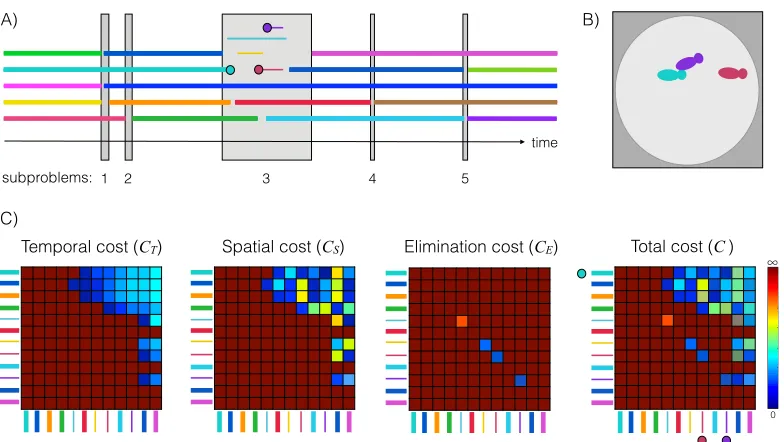
The next step is to stitch together the tracklets to form full trajectories for each fly (similar to linking blobs to tracklets) and discard tracklets containing nosie. The tracklets may be separated because of ambiguous or expensive matches, missing blobs, or noise blobs. The first step of stitching is to identify sub-problems, or intervals of overlapping gaps. Between sub-problems there exist exactly as many
confidenttracklets as there are flies, and a sub-problem involves all tracklets whose
start or end overlaps with the sub-problem’s interval. This is visualized in Figure 2.10 A). A tracklet’s confidence is a function of its duration and distance traveled.
1 2 3 4 5
time
A) B)
C)
subproblems:
∞
0 Total cost (C) Spatial cost (CS) Elimination cost (CE)
[image:25.612.112.504.69.290.2]Temporal cost (CT)
Figure 2.10: A) Tracklets arranged greedily. Overlapping gaps define a subproblem. Note that only tracklets whose boundaries overlap with the subproblem window belong to that subproblem. B) Location of blobs at time indicated by circles in A). C) Cost matrices for subproblem 3.The total cost shows that it is more optimal to match the cyan tracklet to the purple one rather than the pink one.
of tracklet j, using their predicted location at the frame between the tracklets, and
elimination cost,CE, is the cost of eliminating trackletibased on its duration,
dis-tance, and confidence. Space and time costs between trackleti and j are infinite if
j starts beforei ends, and all confident tracklets have infinite elimination cost. The tradeoffbetween time and space cost is such that when duration between tracklets is low, space cost weighs higher, and when duration is high the time cost dominates the total cost (because flies my have traveled arbitrarily far).
This can be solved as a one-to-one matching problem, again using the Hungarian al-gorithm, with a guaranteed path between the confident tracklets at the beginning and end of the subproblem (a confident tracklet cannot connect with a self-eliminating tracklet, because, by definition, self eliminating sequences connectfromthemselves
tothemselves). All tracklets that match to themselves can be discarded as noise.
Algorithm 7Stitch
Input: {ti :i ∈[1,M]},nf lies
Output: {ti :i ∈[1,nf lies]},F
1: S=FindSubproblems({ti :i ∈[1,M]})
2: AG = 0 .Global, M x M, assignment matrix
3: for s ∈Sdo
4: C=ComputeCost({ti :i ∈ s.inds}) .cost of matching tracklets
5: A=hungarian(C) .one-to-one assignment
6: F =[Fflag(A, τ)] .add ambiguous matches to flagsF 7: AG(s.inds,s.inds)= A .update global assignment
8: {ti:i ∈[1,nf lies]}=removeAndLink({ti :i ∈[1,M]},AG)
9:
10: functionComputeCost({ti :i ∈[1,n]})
11: CT = CS=CE =∞(n,n)
12: fori ∈[1,n]do
13: for j ∈[1,n]do
14: if start(j)>end(i)then
15: CT(i,j)=start(j)-end(i) .temporal cost
16: CS(i,j)=spaceCost(ti,tj) .spatial cost
17: ifi unconfidentthen
18: CE(i,i)=elimCost(votes, dur, dist) .elimination cost
19: W =1/(1+exp(-(CT +1)) .time-space tradeoff
20: CT =sqrt(CT)
21: C =min(W .*CS+(1−W) .*CT,CE) .total cost
22: returnC
23:
24: functionFindSubproblems({ti :i ∈[1,M]})
25: count= 1 .1 x T vector
26: {ci :i ∈[1,M]}=confidence({ti :i ∈[1,M]}) .tracklet confidence
27: fori ∈find(ci > 0)do
28: count(ti.start+1 :ti.end −1) =count(ti.start+1 : ti.end−1)+1
29: S=conncomp(count < nf lies) .framerange for each subproblem
30: for s ∈Sdo .assign trajectories to subproblems
31: s.inds=findBoundyOverlap(s,{ti :i ∈[1,M]})
Automatic identity correction
Finally, potential identity swaps are disambiguated using appearance features such as body width, length, and area, and length of wings. But first, in order to obtain such a description of each fly, pose extraction (described in the next section) is performed on the detection and tracking outputs. Each identity swap involves two flies (if more flies are involved, they are treated as independent swaps). Using appearance features from frame 1 to the swap frame, f, a binary classifier (logistic regression on binned appearance features) is trained and applied to the appearance features from f to the next swap frame for each fly. The output of the classification at every test frame is aggregated into a probability matrix. If the probability of swapping exceeds a threshold, then blobs from f onward are swapped between the two trajectories, and flags are updated accordingly.
In cases where fly appearances vary significantly, for example when comparing male vs. female or when one of the flies has its wing clipped, auto-identification works well, but in cases where flies are very similar, ambiguous matches may need further correcting. The FlyTracker interface allows the user to loop through poten-tial swaps and manually correct them.
Algorithm 8AutoCorrect
Input: {ti :i ∈[1,nf lies]},F
Output: {ti :i ∈[1,nf lies]}
1: for a,b,f ∈F do .trajectoriesaandbat frame f 2: Xa=shapeFeat(ta,1,f −1),Ya =0 .extract features from start...
3: Xb=shapeFeat(tb,1,f −1),Yb= 1 .... until swap
4: Xtr =[Xa,Xb],Ytr =[Ya,Yb] .training data
5: fa=nextFlag(F,a,f), fb=nextFlag(F,b, f)
6: Xa=shapeFeat(ta, f +1, fa),Ya= 0 .extract features from swap...
7: Xb=shapeFeat(tb, f +1, fb),Yb= 1 .... until next swap
8: Xte =[Xa,Xb],Yte = [Ya,Yb] .test data
9: model=train(Xtr,Ytr) . train binary classifer
10: S=predict(Xte, model) .apply classifier
11: p=aggregate(S) . p(i,j),i,j ∈ {a,b}
12: if p(a) =b− p(a) = a> τthen .if confidently swap
21
c)
a) b)
Figure 2.11: a) Foreground (gray) and body (black), b) wings, legs, and body seg-ments, c) flies parameterized with body ellipse, wing segments and leg positions.
2.4 Pose estimation
In addition to tracking individual flies, a skeleton is fit to each fly such that their lo-comotion can be measured as well as their whereabouts. This is done by segmenting the masks output from detection into body-, wing-, and leg pixels, and fitting an ori-ented ellipse to the body pixels, a line segment to the wing pixels, and points to the tips of the leg pixels, as visualized in Figure 2.4 and described in Algorithm 9.
For each body object output by the detection algorithm, a Gaussian ellipse is fit to the list of pixels it contains by computing the mean and covariance over the pixel locations. The orientation of the ellipse is the angle between the image x-axis and the major x-axis length of the fly, but it may be flipped by 180 degrees to enforce consistency with 1) fly’s wing positions, 2) velocity, or 3) surrounding frames, depending on which one is most trusted.
Next, the foreground objects are used to extract legs and wings: each foreground’s mask is eroded and dilated such that "skinny" regions of the mask disappear. Con-nected components of pixels that disappeared are considered leg candidates. Leg pixels and the dilated body masks and then subtracted from the foreground mask, and connected components of remaining pixels for candidate wings. Validity of legs and wings, and to which fly they belong (when multiple bodies contained in foreground) is determined using size/pose constraints. Each body is assigned at most 6 legs and 2 wings, and if a fly has only one wing component it is split along its major axis to form two wing components. The position of wing/leg segments is represented by the location of the pixel furthest away from the body ellipses center, and are ordered based on their signed angle with respect to the fly’s major axis.
Algorithm 9ExtractPose
Input: {fi :i ∈[1,T]},{bi :i ∈[1,T]},{ti:i ∈[1,nf lies]}
Output: {ti :i ∈[1,nf lies]}
1: for bij ∈ {bi :i ∈[1,T]}do
2: bij.(centr oid,ori,axes)=fitEllipse(bij) .fit ellipse to each body
3: fort ∈ {ti :i ∈[1,nf lies]}do .disambiguate orientation using...
4: t =bwdDisambiguateOri(t) .... velocity- and backwards consistency
5: fori ∈[1,T]do
6: for f ∈ fido .loop through foregrounds in frame
7: MFed =dilate(erode(MF)) .remove "skinny" regions
8: ML = MF − MFed .leg mask
9: ccL =conncomp(ML) .leg candidates
10: MW = MF − ML− dilate(MB) .wing mask
11: ccW =conncomp(MW) .wing candidates
12: for b∈ f do .loop through bodies in foreground
13: b.ori=fwdDisambiguateOri(b.t)
14: b.wings=assignWings(b,ccW)
15: b.legs=assignLegs(b,ccL)
16:
17: functionAssignWings(b,cc)
18: trusted=strictConstraints(b,cc) .large, same side, 1 resting body
19: if trustedthen
20: b.ori=disambiguateWing(b,cc) .adjust ori to fit wing positions
21: valid=constraintsWings(b,cc) .shape and pose constraints
22: if |valid| ==1then .if wings merged as one
23: cc,valid =splitMiddle(b,cc(valid)) .split along major axis
24: wings=fitVector(cc(valid),b.centr oid) .use furthest pixel from body
25: returnwings(1 : max(2,|wings|)) .return 2 best candidates
26:
27: functionAssignLegs(b,cc)
28: valid=constraintsLegs(b,cc) .shape and pose constraints
29: legs=fitVector(cc(valid),b.centr oid) .use furthest pixel from body
Figure 2.12: Heat map for the position of each larva in the zebrafish video. Here we can see that the larvae are attracted to one corner of the arena, and that individual 3 explores more than the others.
2.5 Behavior quantification
Global measurementsHaving extracted motion trajectories from videos, one can
begin to quantify behavior. Global measurements of the data, such as histograms or heat maps for an individual or a group can be very informative about their be-havior. For example, Figure 2.12 shows a heat map for each larva in the zebrafish video, from which it can be inferred that the north-west corner of the chamber was attractive to the group. It can also be seen that individual number 3 spent more time exploring the chamber than the others. Another example that involves a heat map computed from the position of animals is shown in Figure 2.13 which sums up the relative position of other individuals with respect to each individual. Here we can see that females (bottom two rows) have individuals located behind them and males (top two rows) generally have other individuals in front of them. This is indicative of a chasing behavior between males and females. On interesting thing to note here is that male number 5 does not seem to chase females.
Figure 2.13: Heat map for the position of flies relative to each fly in the fly bowl. The top two rows are male flies and the bottom two are femals. Here it is clear that females are chased by males, except that male 5 seems to also be a chasee.
2 5 10 20 45 90
wing angle (deg) 0
0.02 0.04 0.06
2 2.5 3
body length (mm) 0
0.05 0.1
[image:31.612.113.503.84.396.2]leg histogram
Local measurements One might also be interested in measuring how a fly’s pose evolves over time or in the spatio-temporal patterns in its pose, which constitute
actions. This could be done by specifying thresholds for features, such as wing
C h a p t e r 3
ACTION DETECTION
Machine understanding of human behavior is potentially the most useful and trans-formative application of computer vision. It will allow machines to be better aware of their environment, enable rich and natural human-machine interaction, and it will unleash new applications in a number of industries including automotive, entertain-ment, surveillance and assisted living. Development of automated vision systems that can understand human behavior requires progress in object detection, pose esti-mation, tracking, action classification and detection, and activity analysis. Progress on the latter (actions and activities) is hampered by two difficulties. First, track-ing and pose estimation is very difficult in humans due to variation in clothing, the amount of occlusion in natural environments and in social conditions, and the sheer complexity and number of human body motions. Second, it is difficult (both tech-nically and legally) to film large numbers of humans acting spontaneously while they perform interesting activities. As a result, human action datasets are small and unrepresentative, especially when social behavior is concerned.
A good strategy for computer vision researchers to make progress on behavior anal-ysis is to shift their attention to the simpler world of laboratory animals [Bur+12a]. We collaborate with behavioral neurobiologists who are interested in measuring and analyzing behavior across genotypes, in order to understand the link between genes, brains, and behavior. One of their most popular model organism is the fruit fly, Drosophila melanogaster: it is easy to care for, has a fast life cycle, and exhibits a wide range of behaviors despite having merely 105 neurons. Through this col-laboration we have put together a large annotated dataset of fruit flies interacting spontaneously in controlled environments. This dataset allows us to study natural actions and develop insight into how to represent, segment and classify them. If our effort is successful, we can both advance the state of the art in human action anal-ysis and provide biologists with tools for automatic labeling of actions, enabling them to do experiments at a scale which would otherwise be extremely expensive or impossible.
1) We consider two different action detection architectures: sliding window detec-tors and structured output detecdetec-tors. By comparing five variants of the two architec-tures on our dataset, we find that sliding window detectors outperform the structured output detectors, in spite of being orders of magnitude faster.
2) We describe bout featuresthat extract statistical patterns from frame-level fea-tures over an interval of time, and emphasize the similarities of bouts within an action class. Our experiments show that actions cannot be well detected using frame-level features alone, and that bout features improve performance by 28%.
3) We discuss pitfalls of measures commonly used for benchmarking action de-tection in continuous video and demonstrate which measures are most suitable, suggesting a protocol for comparing the performance of different algorithms.
4) We introduce Caltech Fly-vs-Fly Interactions (Fly-vs-Fly for short), a dataset containing 22 hours of fruit flies interacting spontaneously and sporadically. It comes with complete labeling of 10 actions, annotated by neurobiologists, and a second layer of annotations that can be used as a reference point for action detection performance. Along with the videos and annotations we publish a number of time-varying trajectory features, computed from the tracked pose (position, orientation, wing angles, etc.) of the flies. The dataset is available atwww.vision.caltech.
edu/Video_Datasets/Fly-vs-Fly.
3.1 Background
Datasets A large number of human action datasets have been published. KTH
Dataset Year #Citations Duration #Actions+ Natural Social Continuous Articulated
pose
KTH 2004 1634 3 hours* 6 x x x x
Weizmann 2005 986 5 minutes* 10 x x x x
HumanEva 2006 583 22 minutes 6 x x ✓ ✓
HDM05 2007 107 3 hours 70 x x ✓ ✓
TUM Kitchen 2009 98 1 hour* 13 x x ✓ ✓
CMU MMAC 2009 97 6 hours* 16** x x ✓ ✓
Hollywood 2(1) 2009 436(1327) 20 hours 12 ✓ ✓ x x
Olympic Sports 2010 196 2 hours* 16 ✓ x x x
UT Interactions 2010 41 20 minutes 6 x ✓ ✓ x
HMDB51 2011 137 2 hours 51 ✓ ✓ x x
VIRAT 2011 91 29 hours 23 ✓ x ✓ x
UCF-101(50,11) 2012 40(57,477) 27 hours 101 ✓ ✓ x x
CAD-60/120 2011/13 175/34 2 hours* 22** x x ✓ ✓
UCSD mice 2005 1458 2 hours 5 ✓ x x x
Honeybee 2008 61 3 minutes 3 ✓ x ✓ x
Home-cage behs
2010 60 13 hours 8 ✓ x ✓ x
CRIM13 2012 15 37 hours 12 ✓ ✓ ✓ x
Fly-vs-Fly 2014 - 22 hours 10 ✓ ✓ ✓ ✓
[image:35.612.119.506.75.308.2]*estimated upper limit, **sub-activities (actions/verbs), +excluding the null category
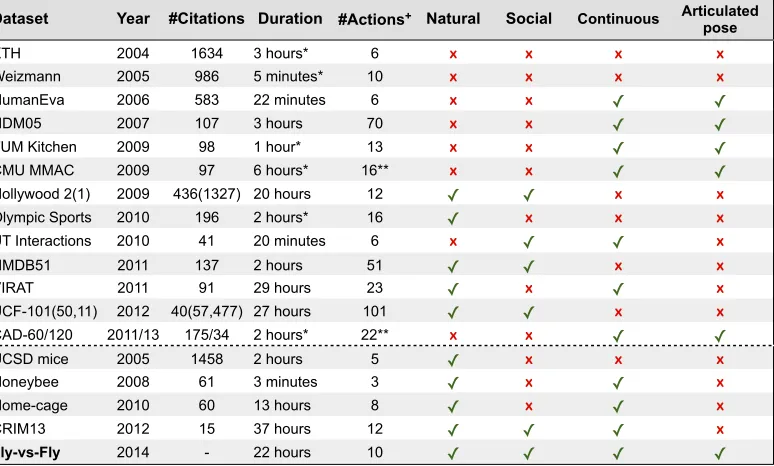
Figure 3.1: Synoptic table of action datasets shown in chronological order, grouped by human vs. animal. Properties desired for detecting realistic social actions from articulated pose are highlighted in green.
these datasets are small, and their actions are acted. Figure 3.1 compares the detail of the mentioned datasets.
Publicly available datasets of animal behavior video are Honeybee Dance [Oh+08], UCSD mice [Dol+05], Home-cage behaviors [Jhu+10a], and CRIM13 [Bur+12a]. The latter two are suitable for action detection, containing long videos of spon-taneous mouse actions, but both are parameterized with only the tracked centroid of the subject and spatial-temporal features. A large and well annotated dataset containing unsegmented, spontaneous, social actions, that includes tracking of ar-ticulated body motion has not yet been published. Our dataset aims to fill that place.
Action detectionA common approach to action detection is frame-by-frame
segmenta-tions, outputting structured sequences of actions: [Jhu+10a] used an SVMHMM, described in [A+03], for detecting actions of single housed mice; [HLD11] used a multi-class SVM with structured inference for segmenting the dance of the honey-bee; and [Shi+11] used a discriminative semi-Markov model for segmenting human actions.
We implemented three variants of the above approaches, specifically comparing a sliding window SVM detector against two structured output SVM detectors, ex-pecting the latter to improve frame-wise consistency and better capture structured actions. For reference, we compare our results with the methods described in [Kab+12] and [Bur+12a] and with the performance of trained novice annotators.
3.2 Fly-vs-Fly
In collaboration with biologists we have collected the Fly-vs-Fly dataset, which contains a total of 22 hours (1.5m frames recorded at 200Hz and 2.2m frames at 30Hz) of 47 pairs of fruit flies interacting. The videos are organized into three subsets, each of which was collected for a different study:
Experimental setup
Boy meets boy is designed to study the sequence of actions between two male
flies, whose behaviors range from courtship to aggression. The flies are placed in a 4x5 cm2 chamber with a food patch in its center and walls coated with Fluon, constraining the flies to walking on the floor [Hoy+08]. It contains six 20 minute videos recorded at 200Hz with 12 pix/mm (24 pixels covering the 2mm fly body length).
Aggressioncontains videos of two hyper aggressive males [Hoo+15] and is used to
quantify the effect of genetic manipulation on their behavior. The flies are placed in a circular 16mm diameter chamber with uniform food surface [Asa+14]. It consists of ten 30 minute videos recorded at 30Hz with 8 pix/mm.
Courtshipvideos contain a female and a male, which in some cases are wild type
and in the rest are so-called hyper courters [Hoo+15]. This set of videos was used to study how genetic manipulation affects male courtship behavior. It consists of 31 videos recorded with the same chamber and video settings as Aggression.
16 mm 16 mm 40 mm
Boy meets boy Aggression Courtship
200 fps, 12 pix/mm 30 fps, 8 pix/mm 30 fps, 8 pix/mm
Monday, December 2, 13
Figure 3.2: Experimental setup for Boy meets boy, Aggression, and Courtship.
Annotations
The entire dataset was annotated by, or under the supervision of, biologists, with 10 action classes that have been identified for the study of fruit fly interactions [Che+02; Hal94; Dan+09]: wing threat, charge, lunge, hold, andtussle (aggres-sive), wing extension, circle, copulation attempt, and copulation(courtship), and
touch(neutral). Each action is described and visualized in Figure 3.3.
Annotating a video involves finding all time intervals that contain an action of in-terest, also referred to as action bouts, and requires recording the start frame, end frame, and class label of each detected bout. The dataset is annotated such that ac-tions can overlap, for instance tussling usually includes lunging, wing threat some-times includes a charge, and wing extension and circling tend to overlap. Each action class takes up less than 2% of the total frames in a video, apart from touch (7%) and copulation (57%), and some classes have substantial intraclass variation, both in terms of duration and appearance. Figure 3.4 summarizes the dataset.
The Fly-vs-Fly dataset, including videos, trajectory features, and annotations, is available atwww.vision.caltech.edu/Video_Datasets/Fly-vs-Fly.
3.3 Feature representation
TOUCH The fly touches the leg, wing, or body of the other fly.
The fly touches the leg, wing, or body of the other fly, and in doing so its gustatory organs sample chemicals that may help identify gender. (Introductory)
The fly extends, and raises, both wings and presents them to the other fly.
(Aggressive)
The fly extends both wings fully and charges towards the other fly. (Aggressive)
The fly raises itself on its hind legs, then slams down onto (or close to) the other fly’s body. (Aggressive)
After lunging, the fly sometimes holds onto the body of the other fly for an extended period. (Aggressive)
The two flies lunge at each other repeatedly and tumble around in a hold.
(Aggressive)
The fly extends one wing and vibrates it while presenting it to the other fly.
(Courtship)
The fly moves along an arc around the other fly while facing it. (Courtship)
The fly approaches the other fly from behind, curls its abdomen towards it and tries to copulate, but is unsuccessful. (Courtship)
The fly approaches the fly from behind, curls its abdomen towards it and successfully copulates. (Courtship)
0 ms 117 ms
0 ms 70 ms
0 ms 50 ms
0 ms 20 ms
0 ms 96357 ms
0 ms 64 ms
0 ms 230 ms
0 ms 5 ms
0 ms 8 ms
0 ms 250 ms
640 ms 2300 ms 50 ms 80 ms 2500 ms 1170 ms 700 ms 500 ms 200 ms 16 minutes WING EXTENSION The fly
extends one wing and vibrates it while presenting it to the other fly.
CIRCLE The fly moves along an arc around the other fly while facing it.
COPULATION ATTEMPT
The fly approaches the other fly from behind, curls its abdomen towards it and tries to copulate, but is unsuccessful.
COPULATION The fly
approaches the other fly from behind, curls its abdomen towards it and successfully copulates.
The fly touches the leg, wing, or body of the other fly, and in doing so its gustatory organs sample chemicals that may help identify gender. (Introductory) The fly extends, and raises, both wings and presents them to the other fly. (Aggressive)
The fly extends both wings fully and charges towards the other fly. (Aggressive) The fly raises itself on its hind legs, then slams down onto (or close to) the other fly’s body. (Aggressive)
After lunging, the fly sometimes holds onto the body of the other fly for an extended period. (Aggressive)
The two flies lunge at each other repeatedly and tumble around in a hold. (Aggressive)
The fly extends one wing and vibrates it while presenting it to the other fly. (Courtship)
The fly moves along an arc around the other fly while facing it. (Courtship) The fly approaches the other fly from behind, curls its abdomen towards it and tries to copulate, but is unsuccessful. (Courtship)
The fly approaches the fly from behind, curls its abdomen towards it and successfully copulates. (Courtship)
0 ms 117 ms
0 ms 70 ms
0 ms 50 ms
0 ms 20 ms
0 ms 96357 ms
0 ms 64 ms
0 ms 230 ms
0 ms 5 ms
0 ms 8 ms
0 ms 250 ms
640 ms 2300 ms 50 ms 80 ms 2500 ms 1170 ms 700 ms 500 ms 200 ms 16 minutes
The fly touches the leg, wing, or body of the other fly, and in doing so its gustatory organs sample chemicals that may help identify gender. (Introductory)
The fly extends, and raises, both wings and presents them to the other fly.
(Aggressive)
The fly extends both wings fully and charges towards the other fly. (Aggressive)
The fly raises itself on its hind legs, then slams down onto (or close to) the other fly’s body. (Aggressive)
After lunging, the fly sometimes holds onto the body of the other fly for an extended period. (Aggressive)
The two flies lunge at each other repeatedly and tumble around in a hold.
(Aggressive)
The fly extends one wing and vibrates it while presenting it to the other fly.
(Courtship)
The fly moves along an arc around the other fly while facing it. (Courtship)
The fly approaches the other fly from behind, curls its abdomen towards it and tries to copulate, but is unsuccessful. (Courtship)
The fly approaches the fly from behind, curls its abdomen towards it and successfully copulates. (Courtship)
0 ms 117 ms
0 ms 70 ms
0 ms 50 ms
0 ms 20 ms
0 ms 96357 ms
0 ms 64 ms
0 ms 230 ms
0 ms 5 ms
0 ms 8 ms
0 ms 250 ms
640 ms 2300 ms 50 ms 80 ms 2500 ms 1170 ms 700 ms 500 ms 200 ms 16 minutes
The fly touches the leg, wing, or body of the other fly, and in doing so its gustatory organs sample chemicals that may help identify gender. (Introductory) The fly extends, and raises, both wings and presents them to the other fly. (Aggressive)
The fly extends both wings fully and charges towards the other fly. (Aggressive) The fly raises itself on its hind legs, then slams down onto (or close to) the other fly’s body. (Aggressive)
After lunging, the fly sometimes holds onto the body of the other fly for an extended period. (Aggressive)
The two flies lunge at each other repeatedly and tumble around in a hold. (Aggressive)
The fly extends one wing and vibrates it while presenting it to the other fly. (Courtship)
The fly moves along an arc around the other fly while facing it. (Courtship) The fly approaches the other fly from behind, curls its abdomen towards it and tries to copulate, but is unsuccessful. (Courtship)
The fly approaches the fly from behind, curls its abdomen towards it and successfully copulates. (Courtship)
0 ms 117 ms
0 ms 70 ms
0 ms 50 ms
0 ms 20 ms
0 ms 96357 ms
0 ms 64 ms
0 ms 230 ms
0 ms 5 ms
0 ms 8 ms
0 ms 250 ms
640 ms 2300 ms 50 ms 80 ms 2500 ms 1170 ms 700 ms 500 ms 200 ms 16 minutes
The fly touches the leg, wing, or body of the other fly, and in doing so its gustatory organs sample chemicals that may help identify gender. (Introductory) The fly extends, and raises, both wings and presents them to the other fly. (Aggressive)
The fly extends both wings fully and charges towards the other fly. (Aggressive) The fly raises itself on its hind legs, then slams down onto (or close to) the other fly’s body. (Aggressive)
After lunging, the fly sometimes holds onto the body of the other fly for an extended period. (Aggressive)
The two flies lunge at each other repeatedly and tumble around in a hold. (Aggressive)
The fly extends one wing and vibrates it while presenting it to the other fly. (Courtship)
The fly moves along an arc around the other fly while facing it. (Courtship) The fly approaches the other fly from behind, curls its abdomen towards it and tries to copulate, but is unsuccessful. (Courtship)
The fly approaches the fly from behind, curls its abdomen towards it and successfully copulates. (Courtship)
0 ms 70 ms
0 ms 50 ms
0 ms 20 ms
0 ms 96357 ms
0 ms 230 ms
0 ms 5 ms
0 ms 8 ms
0 ms 250 ms
2300 ms 50 ms 80 ms 2500 ms 700 ms 500 ms 200 ms 16 minutes
WING THREAT The fly extends and raises both wings and presents them to the other fly.
CHARGE The fly extends both wings fully and charges towards the other fly.
LUNGE The fly stands up on its
hind legs and thrusts down onto (or close to) the other fly’s body.
HOLD After lunging, the fly holds onto the body of the other fly for an extended period of time.
TUSSLE The two flies lunge at
each other repeatedly and tumble around interlocked.
The fly touches the leg, wing, or body of the other fly, and in doing so its
gustatory organs sample chemicals that may help identify gender. (Introductory)
The fly extends, and raises, both wings and presents them to the other fly. (Aggressive)
The fly extends both wings fully and charges towards the other fly. (Aggressive)
The fly raises itself on its hind legs, then slams down onto (or close to) the other
fly’s body. (Aggressive)
After lunging, the fly sometimes holds onto the body of the other fly for an
extended period. (Aggressive)
The two flies lunge at each other repeatedly and tumble around in a hold. (Aggressive)
The fly extends one wing and vibrates it while presenting it to the other fly. (Courtship)
The fly moves along an arc around the other fly while facing it. (Courtship)
The fly approaches the other fly from behind, curls its abdomen towards it and
tries to copulate, but is unsuccessful. (Courtship)
The fly approaches the fly from behind, curls its abdomen towards it and
successfully copulates. (Courtship)
0 ms 117 ms
0 ms 70 ms
0 ms 50 ms
0 ms 20 ms
0 ms 96357 ms
0 ms 64 ms
0 ms 230 ms
0 ms 5 ms
0 ms 8 ms
0 ms 250 ms
640 ms 2300 ms 50 ms 80 ms 2500 ms 1170 ms 700 ms 500 ms 200 ms 16 minutes
The fly touches the leg, wing, or body of the other fly, and in doing so its gustatory organs sample chemicals that may help identify gender. (Introductory)
The fly extends, and raises, both wings and presents them to the other fly.
(Aggressive)
The fly extends both wings fully and charges towards the other fly. (Aggressive)
The fly raises itself on its hind legs, then slams down onto (or close to) the other fly’s body. (Aggressive)
After lunging, the fly sometimes holds onto the body of the other fly for an extended period. (Aggressive)
The two flies lunge at each other repeatedly and tumble around in a hold.
(Aggressive)
The fly extends one wing and vibrates it while presenting it to the other fly.
(Courtship)
The fly moves along an arc around the other fly while facing it. (Courtship)
The fly approaches the other fly from behind, curls its abdomen towards it and tries to copulate, but is unsuccessful. (Courtship)
The fly approaches the fly from behind, curls its abdomen towards it and successfully copulates. (Courtship)
0 ms 117 ms
0 ms 70 ms
0 ms 50 ms
0 ms 20 ms
0 ms 96357 ms
0 ms 64 ms
0 ms 230 ms
0 ms 5 ms
0 ms 8 ms
0 ms 250 ms
640 ms 2300 ms 50 ms 80 ms 2500 ms 1170 ms 700 ms 500 ms 200 ms 16 minutes
The fly touches the leg, wing, or body of the other fly, and in doing so its gustatory organs sample chemicals that may help identify gender. (Introductory)
The fly extends, and raises, both wings and presents them to the other fly.
(Aggressive)
The fly extends both wings fully and charges towards the other fly. (Aggressive)
The fly raises itself on its hind legs, then slams down onto (or close to) the other fly’s body. (Aggressive)
After lunging, the fly sometimes holds onto the body of the other fly for an extended period. (Aggressive)
The two flies lunge at each other repeatedly and tumble around in a hold.
(Aggressive)
The fly extends one wing and vibrates it while presenting it to the other fly.
(Courtship)
The fly moves along an arc around the other fly while facing it. (Courtship)
The fly approaches the other fly from behind, curls its abdomen towards it and tries to copulate, but is unsuccessful. (Courtship)
The fly approaches the fly from behind, curls its abdomen towards it and successfully copulates. (Courtship)
0 ms 117 ms
0 ms 70 ms
0 ms 50 ms
0 ms 20 ms
0 ms 96357 ms
0 ms 64 ms
0 ms 230 ms
0 ms 5 ms
0 ms 8 ms
0 ms 250 ms
640 ms 2300 ms 50 ms 80 ms 2500 ms 1170 ms 700 ms 500 ms 200 ms 16 minutes
The fly touches the leg, wing, or body of the other fly, and in doing so its gustatory organs sample chemicals that may help identify gender. (Introductory) The fly extends, and raises, both wings and presents them to the other fly. (Aggressive)
The fly extends both wings fully and charges towards the other fly. (Aggressive) The fly raises itself on its hind legs, then slams down onto (or close to) the other fly’s body. (Aggressive)
After lunging, the fly sometimes holds onto the body of the other fly for an extended period. (Aggressive)
The two flies lunge at each other repeatedly and tumble around in a hold. (Aggressive)
The fly extends one wing and vibrates it while presenting it to the other fly. (Courtship)
The fly moves along an arc around the other fly while facing it. (Courtship) The fly approaches the other fly from behind, curls its abdomen towards it and tries to copulate, but is unsuccessful. (Courtship)
The fly approaches the fly from behind, curls its abdomen towards it and successfully copulates. (Courtship)
0 ms 117 ms
0 ms 70 ms
0 ms 50 ms
0 ms 20 ms
0 ms 96357 ms
0 ms 64 ms
0 ms 230 ms
0 ms 5 ms
0 ms 8 ms
0 ms 250 ms
640 ms 2300 ms 50 ms 80 ms 2500 ms 1170 ms 700 ms 500 ms 200 ms 16 minutes
The fly touches the leg, wing, or body of the other fly, and in doing so its gustatory organs sample chemicals that may help identify gender. (Introductory) The fly extends, and raises, both wings and presents them to the other fly. (Aggressive)
The fly extends both wings fully and charges towards the other fly. (Aggressive) The fly raises itself on its hind legs, then slams down onto (or close to) the other fly’s body. (Aggressive)
After lunging, the fly sometimes holds onto the body of the other fly for an extended period. (Aggressive)
The two flies lunge at each other repeatedly and tumble around in a hold. (Aggressive)
The fly extends one wing and vibrates it while presenting it to the other fly. (Courtship)
The fly moves along an arc around the other fly while facing it. (Courtship) The fly approaches the other fly from behind, curls its abdomen towards it and tries to copulate, but is unsuccessful. (Courtship)
The fly approaches the fly from behind, curls its abdomen towards it and successfully copulates. (Courtship)
0 ms 117 ms
0 ms 70 ms
0 ms 50 ms
0 ms 20 ms
0 ms 96357 ms
0 ms 64 ms
0 ms 230 ms
0 ms 5 ms
0 ms 8 ms
0 ms 250 ms
[image:38.612.109.510.79.682.2]640 ms 2300 ms 50 ms 80 ms 2500 ms 1170 ms 700 ms 500 ms 200 ms 16 minutes
10 10^2 10^3 2344
95 150 146 77
touch lunge wing threat
charge wing ext.
92% 6.9% 0.1% 0.9% 0.1% 0.3%
10 10^2 10^3 10^4 10^5
0 0.1 0.2 0.3 0.4 10 10^2 10^3 3195
184 117 132 410
lunge wing threat
charge tussle hold
95% 1.2% 2.8% 0.0% 0.2% 0.7%
10 10^2 10^3 10^4 10^5
0 0.2 0.4 0.6 0.8 1 10 10^2 10^3 918 361 83 31 wing ext. circle
coupul. atmpt copulation
57% 41%
1.6% 0.3% 0.1%
10 10^2 10^3 10^4 10^5
0 0.1 0.2 0.3 0.4 duration (ms)
touch lunge wing threat
charge wing ext.
lunge wing
threat charge hold tussle
wing ext. circle copul. attempt copul. B o y m e e ts bo y A g g re ssion C our tship
Number of bouts Fraction of time spent in action Histogram of durations
[image:39.612.112.506.70.312.2]fra ct io n fra ct io n fra ct io n
Figure 3.4: Action statistics: Left: Number of bouts for each action. Center: Frac-tion of time a fly spends in each acFrac-tion, where the gray area represents the grab-bag categoryother. Right:Distribution of bout durations for each action class.
Frame features
From the tracking output, described in Chapter 2, we derive a set of features that are designed to be invariant of the absolute position and orientation of a fly, and relate its pose to that of the other fly. The features (illustrated in Figure 3.5) can be split into two categories: individual features which include the fly’s velocity,
angular velocity, min and max wing angles, mean wing length, body axis ratio,
foreground-body ratio, andimage contrastin a window around the fly; and relative
features which relate one fly to the other withdistance betweentheir body centers,
leg distance(shortest distance from its legs to the foreground of the other fly),angle
between, and facing angle. Analysis of the feature distributions showed that the
velocities, wing angles, and foreground-body ratio are better represented by their log values, becoming more normal distributed. Figure 3.6 shows the distribution of each feature, for all actions in the Boy meets boy sub-dataset, giving an idea of which features are important for which action. In addition, we take the first two time derivatives of each feature, resulting in a feature space of 36 per-frame
Individual features 1) velocity
2) angular velocity 3) min wing angle 4) max wing angle 5) mean wing length 6) body axes ratio 7) fg body ratio 8) image contrast
Relative features 9) distance between 10) leg distance 11) angle between 12) facing angle 3)
4) 11)
[image:40.612.111.506.392.604.2]12)
Figure 3.5: Illustration of features derived from the tracked fly skeletons. Individ-ual features describe the fly’s motion and are invariant of its absolute position and orientation, and relative features relate the pose of the fly to that of the other fly.
0.1 1 10 100
0 0.05 0.1
mm/s
vel
0.1 1 10 100
0 0.05 0.1
rad/sec
ang_vel
0.01 0.1 1
0 0.1 0.2 rad min_wing_ang 0.1 1 0 0.1 0.2 0.3 0.4 rad max_wing_ang
0.6 0.8 1 1.2 1.4
0 0.1 0.2 0.3 0.4 proportion
norm mean_wing_length
0.6 0.8 1 1.2
0 0.1 0.2 0.3
proportion
norm axis_ratio
2.5 4 6.3 10
0 0.05 0.1 0.15 0.2 ratio fg_body_ratio
0.5 1 1.5
0 0.05 0.1
proportion
norm contrast
0 10 20
0 0.2 0.4 0.6 mm dist_to_other
0 1 2 3
0 0.05 0.1
rad
angle_between
0 1 2 3
0 0.05 0.1 0.15 rad facing_angle
0 5 10
0 0.2 0.4 0.6 0.8 mm leg_dist touch lunge wing threat charge wing extension hold tussle circle copul. attempt copulation frame based bout based
velocity (mm/sec) angular velocity (rad/sec) min wing angle (rad) max wing angle (rad)
foreground/body ratio
normalized mean wing length normalized axes ratio normalized image contrast
facing angle (rad)
distance to other (mm) angle between (rad) leg distance (mm)
log scal
e
log scale log scale log scale
log scale
fra ct io n fra ct io n fra ct io n