www.ijraset.com Volume 4 Issue XI, November 2016 IC Value: 13.98 ISSN: 2321-9653
International Journal for Research in Applied Science & Engineering
Technology (IJRASET)
©IJRASET: All Rights are Reserved
201
Optimization of MRR on ECM Using Taguchi
Method
Viveka Nand1, Meeraj Ahmad2, Dwivesh Kumar Dubey3, Dibya Tripathi4, Sourabh Rai5
1,2,3,4,5
Department of Mechanical Engineering,
1,2,3
Rajkiya Engineering Colleger,Azamgarh U.P, INDIA.
4,5
Madan Mohan Malviya University of Technology, Azamgarh U.P, INDIA.
Abstract: Non-conventional machining has grown out as the need to machine different engineering materials, composites and ceramics having good mechanical properties and thermal properties as well as better electrical conductivity. The work has been carried out on mild steel specimen having good thermal and electrical conductive properties. The work on output parameters like as Material Removal Rate (MRR) and Surface Roughness (SR) of stainless steel as a work piece material. Respect on the selection of input parameters of ECM such as Voltage, Electrolyte Concentration and feed rate are suitable for improving the productivity and other output parameters. This work formulates the relationship between input and output variables for improving the ECM operation. The Regression analysis is used for making the relationship between independent and dependent variables. Our main objective is to determine the optimal value of the process parameter commonly used in the ECM process which is Voltage, Electrolyte Concentration and Feed Rate so as to improve the output parameter such as Material Removal Rate and Surface Roughness by Minitab Taguchi optimization technique method.
Keywords: ECM, MRR, SR, Regression analysis, Taguchi optimization technique.
I. INTRODUCTION
Electro-chemical Machining (ECM) is one of the most potential unconventional machining processes. This process generally belongs to a category called as chemical category. ECM process may be considered as the antonym or opposite of electro-chemical process or electro-electro-chemical displacement process. Thus a guided anodic dissolution at very molecular level of the work piece that is electrically conductive in nature by any tool respective of flow of high current at closely low potential difference with the flow of an electrolyte which is generally conductive neutral brine or NaCl salt solution is referred as Electro-chemical process.
II. EXPERIMENTAL WORK
For this experimental analysis, the total work is done out by Electrochemical Machining set up at SunMax Auto Engineering Private Ltd. , Manesar, Gurgaon, which is having Supply of - 425 v +/- 11%, 3 φ AC, 51 Hz.
III. PROCEDURE OF THE EXPERIMENT
Before starting the experiment the initial weight of the work piece is taken to calculate the MRR. Precaution has been taken so that end tip of the electrode should not come in contact with the surface of the work piece. The time of machining of the work-piece at fixed feed and voltage V is noted down during the through process.
A. Observation tables: Experiment No.1: - Taguchi design (mild steel)
S.no. Voltage (V) Feed F (mm/min) Concentration (C) MRR (mm3/min) SR (μm)
1 8 0.2 12 0.0129000 5.20
2 8 0.4 14 0.0345700 6.91
3 8 0.6 16 0.0856000 9.20
4 10 0.2 14 0.0166500 7.20
5 10 0.4 16 0.0540600 7.00
6 10 0.6 12 0.0852000 9.60
7 12 0.2 16 0.0132243 6.60
8 12 0.4 12 0.0232400 10.25
Technology (IJRASET)
B. Calculation of Material Removal Rate (MRR)-
MRR is calculated by the following formula:-
= ( )×
× /min (4.7)
MRR = Material removal rate
W0= initial weight
W1 = final weight
ρw = density of the workpiece
C. Calculation of Surface roughness (SR)-
Surface roughness is measured by Handysurf E35B tracing driver profilometer.
IV. RESULTS & DISCUSSIONS
A. Effects on the value of MRR by S/N ratio
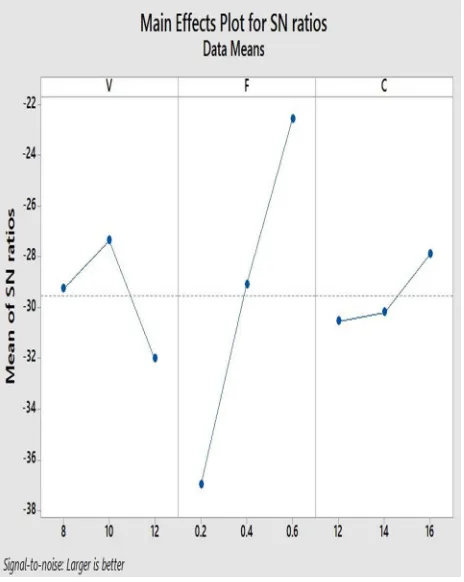
[image:3.612.192.424.329.620.2]Electrolyte concentration, feed rate and voltage are the dominant factor on the value of MRR. Effects of different input machining parameters on MRR (and means of MRR) are shown in fig.1. When increasing the feed rate, The MRR value is increasing slightly. After that the factor which affects the MRR value the most is feed rate. But MRR increases with increases in concentration then increases furthermore with a faster rate with further increase in electrolyte concentration.
Figure - 1
www.ijraset.com Volume 4 Issue XI, November 2016 IC Value: 13.98 ISSN: 2321-9653
International Journal for Research in Applied Science & Engineering
Technology (IJRASET)
©IJRASET: All Rights are Reserved
203
concentration (C=16g/l) as shown in figures.
REFERENCES
[1] S. K. Mukherjee, S. Kumar, and P. K. Srivastava “Effect of electrolyte on the current- carrying process in electrochemical machining” Proc. I Mech. Engg. Vol. 221 Part C: J. Mechanical Engineering Science
[2] K. P. Rajurkar, B. Wei, C. L. Schnacker “Monitoring and Control of Electrochemical Machining (ECM)” Journal of Engineering for Industry May 1993,Vol. 115/217.67
[3] B. Bhattacharyya, M. Malapati, J. Munda, A. Sarkar “Influence of tool vibration on machining performance in electrochemical micro-machining of copper” International Journal of Machine Tool and Manufacture 47 (2007) 335–342.
[4] Liu JW, Yue TM, Guo ZN. “Wire electrochemical discharge machining of Al2O3 particle reinforced aluminum alloy 6061”. Mater Manufacturing Process 2009; 24(4):446-53.
[5] Jo ao Cirilo da Silva Neto, Evaldo Malaquias da Silva , Marcio Bacci da Silva “Intervening variables in electrochemical machining” Journal of Materials Processing Technology 179 (2006) 92–96.
[6] Sekar T, Marappan R. “Experimental investigations into the influencing parameters of electrochemical machining of AISI 202”. Journal of Advanced Manufacturing Systems 2008; 7(2):337-43.
[7] Neto JCdS, Silva EMd, Silva MBd. “Intervening variables in electrochemical machining”. J Mater Process Technology 2006; 179(1-3):92-6.
[8] Bhattacharyya B, Munda J. “Experimental investigation on the influence of electrochemical machining parameters on machining rate and accuracy in micromachining domain”. Int J. Mach. Tools Manufacturing 2003; 43(13):1301-10.
[9] S.K. Mukherjee, S. Kumar, P.K. Srivastava, Arbind Kumar “Effect of valance on material removal rate in electrochemical machining of aluminum”. Journal of materials processing Technology 202 (2008) 398–401.
[10] V.K. Jain, S. Adhikary “On the mechanism of material removal in electrochemical spark machining of quartz under different polarity conditions” Journal of materials processing Technology 200(2008) 460–470 .
[11] K.L. Bhondwe, Vinod Yadava, G. Kathiresan “Finite element prediction of material removal rate due to electro-chemical spark machining” International Journal of Machine Tools & Manufacture 46 (2006) 1699–1706.
[12] S.K. Mukherjee, S. Kumar, P.K. Srivastava, Arbind Kumar “Effect of valence on material removal rate in electrochemical machining of aluminum” Journal of materials processing technology 202(2008) 398–401.