© 2017, IRJET | Impact Factor value: 5.181 | ISO 9001:2008 Certified Journal | Page 2420
ASSESSMENT OF HEAVY METALS CONTENT IN SURFACE AND SUB
SURFACE SOIL SAMPLES IN WASTE DUMPSITES OF GUNTUR, ANDHRA
PRADESH.
M.Jyothi
1, D.Srinivasarao
2, G.Swarnalatha
3, G.Sudhakar
41, 2, 3 & 4
Dept of Environmental Sciences, Acharya Nagarjuna University, Guntur, Andhra Pradesh, India
---***---Abstract - In present the environment is highly polluted
by various toxic metals, which create a danger for all living beings, the major (heavy metal) pollutants in the environment, particularly in areas with anthropogenic activities and industrial activities etc., the levels of heavy metals were assessed in five randomly chosen in dump site, samples were drawn at the depth of 0-15 cm and 15-30cm on each of the two sampling points, The result of the analysis carried out showed that the level of heavy metals were generally higher at surface soils than subsurface soils, with mean values of 1291.08 mg/kg and 1236.9 mg/kg for Iron (Fe), 87.96 mg/kg and 83.28 mg/kg for Lead (Pb), 69.54 mg/kg and 201.94 mg/kg for Zinc (Zn), 11.01 mg/kg and 13.12 mg/kg for cadmium (Cd), 10.61 mg/kg and 13.56 mg/kg for Nickle (Ni), 7.76 mg/kg and 7.42 mg/kg for Copper (Cu) and 1.06 mg/kg and 101 mg/kg for Chromium (Cr) in surface and subsurface, respectively, These results indicates a higher concentration of heavy metals in surface and subsurface soils at waste dumpsites. In this aspect the present study pointed out the pollutants concentration in dumping site, as per the CPCB direction should avoid discharge of waste without segregation and treatment, and it has been observed that high amounts of heavy metals such as Fe, Zn, Pb, Cd, Ni, Cu, and Cr according to the Indian Standards. And indicates percolation of heavy metals into the subsurface soils and contaminate the ground water in and around the waste dumping sites, and there is no proper management of solid waste in the study area.
Key Words:
1.Anthropogenic, 2.Dumping sites,
3.Environment, 4.Heavy metals, 5.Standards.
1. INTRODUCTION
The environmental contaminant is a serious problem in recent years facing human since these metals constitute a hazard to organisms andmay cause health problems to the consumers (Vasques, et al., 1993), Municipal solid waste landfills often represent a major environmental problem due to their proximity to inhabited areas. According to Chiemchaisri et al. (2007), the presence of heavy metals in the environment is of great ecological significance due to their toxicity at certain concentrations, translocation through food chains and non biodegradability which is
responsible for their accumulation in the biosphere (Aekola et al., 2008). Urban MSW is usually generated from human settlements, small industries and commercial activities (Singh et al., 2011), they require a more serious attention, and one of the major sources of heavy metal in the world is leachate from waste dumpsites. Due to the rapid increase in the population and urbanization, a high degree of generation of solid waste is taking place at a rate faster than they can be evacuated collection and disposal of solid waste has therefore become one of the greatest problems facing today, heavy metals are the metals and metalloids having atomic densities greater than 5g/cm3 (Wild, 1993), At some levels of exposure and absorption, they are harmful to most living things. Heavy metals are released into the environment through anthropogenic activities like domestic, industrial, commercial activities, industrial effluents, pesticides and fungicides as well as from manure, (Ukpong, et al., 2013).
© 2017, IRJET | Impact Factor value: 5.181 | ISO 9001:2008 Certified Journal | Page 2421
2. MATERIALS AND METHODS
2.1 Study area:
Guntur is a city in the Guntur district, Andhra Pradesh. India (Figure 1). It is situated in Guntur revenue division. The city is a municipal corporation, It is a part of Andhra Pradesh Capital Region, under the jurisdiction of APCRDA. It is the third most populous city in the state with a
population of 743,354, and an urban
agglomeration population of 1,028,667. Guntur Plains: Guntur is located at 16.20°N 80.27°E. It has an average elevation of 33 m (108 ft) and is situated on the plains. Thousands of kg releases the solid waste from different regions in the city that has been dumped in the dumping regions which around the Guntur city outs cuts. l. 2
Figure: 1. Study area map
2.2 Sample Collection and Sample Treatment
five soil samples were collected from waste dumpsite in selected points, each soil samples was collected at a depth of between 0-15cm and 15-30cm. five samples were also collected away from the dumpsites, at depth of between 0-15cm, and 15-30 cm, samples were packed in separate bags and taken to the laboratory for analysis.
2.3 Soil Samples:
At the laboratory; the soil samples were air dried and ground to powdery form using a pestle and mortar. The sample was sieved with a 2mm sieve. The soil sample (1g) was weighed into a digestion flask. Concentrated nitric acid (20ml) was added and the mixture was digested using hot plate. After digestion it was allowed to cool and 30 ml of distilled water was added and filtered with Whatman filter paper. The digest was made up to 50 ml solution with distilled water. Then, the digest was use for the determination of heavy metals using atomic absorption spectrometer (AAS).
3. Results and discussion
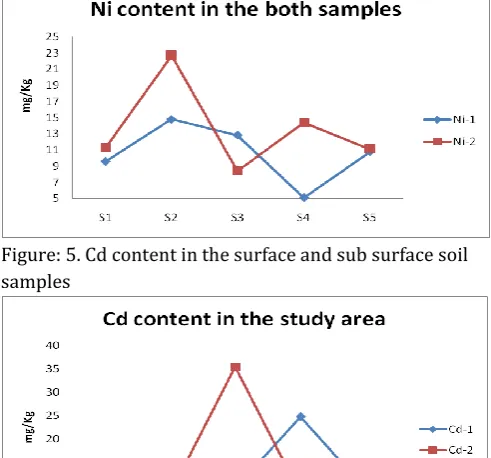
Heavy metal contents of soil are of major significance because of their non-degradable nature and ability to accumulate for long period of time (Gallego et al., 2002; Wu and Zhang, 2010), Rapid urbanization, industrialization, population explosion, fertilizer and pesticide use have resulted in heavy metal pollution of land and water resources (He et al., 2004, CPBC, 2008). The results revels that Surface soil and sub surface soil samples having heavy metals content in the Sample –I (S1), 1523.2 mg/kg and 1624.8 mg/kg for Iron and the mean value in both samples are 1291.08, 1236.9, and the minimum and maximum values were present in the table 3 and table 4, the graphical representation (Figure 2) shows that the sub surface soils having maximum level of Iron, it indicates percolation of heavy metals into the ground layers. The Lead (figure 9 & 10) maximum contents in all sampling stations of both soil samples the mean values are 87.96 mg/kg, 83.28 mg/kg, minimum values are 74.12 mg/kg and 64.2mg/kg, maximum 110.5 mg/kg and 92.8 mg/kg, the graphical representation (Figure 3) shows that surface soils have maximum content. Similar studies were observed in some sites in Nigeria (Oviasogie and Omoruyi, 2007; Gungshik and Mohammed, 2008; Gungshik et al., 2008). Ultimately, lead enriched in the body of humans through the food chain and endangered their health (Liu et al., 2003). Pb like the other three elements of Zn, Cu and Cd is generally the metal of great concern as well as being phytotoxic while heavy metals like Ni, Pb, Cu, Zn, and Cr were typical entropic elements (Udom et al., 2003). the zinc content in the both surface and sub surface soils the maximum 775 mg/kg is in subsurface soils and the minimum value 41.3mg/kg in the same subsurface soil samples only (table 1 and 2, figure 7, 9 and 10).
© 2017, IRJET | Impact Factor value: 5.181 | ISO 9001:2008 Certified Journal | Page 2422 minimum values are 6.3 mg/kg, 5.8mg/kg and the maximum
content is 9.1mg/kg and 8.7 mg/kg (Figure 8,9 and 10).
Table: 1. Heavy metals concentration in surface soil
S1 S2 S3 S4 S5
Fe 1523.2 1435.6 1235.8 1185.4 1075.4
Pb 75.34 95.34 110.5 74.12 84.5
Ni 9.58 14.8 12.8 5.1 10.8
Cd 6.58 5.2 9.4 24.8 9.1
Cr 1.4 0.8 0.8 1.8 0.5
Zn 68.3 74.9 66.7 58.3 79.5
Cu 6.3 7.8 9.1 8.7 6.9
Table: 2. Heavy metals concentration in sub surface soil
S1 S2 S3 S4 S5
Fe 1624.8 1025.4 985.1 1249.5 1299.7
Pb 85.3 85.5 92.8 64.2 84.6
Ni 11.24 22.7 8.4 14.36 11.1
Cd 6.8 8.3 35.4 8.3 6.8
Cr 1.0 0.5 0.6 1.9 1.5
Zn 775 73.2 52.8 41.3 67.4
Cu 5.8 8.3 7.9 6.4 8.7
Table: 3. mean minimum and maximum values of surface soil samples
Fe Pb Ni Cd Cr Zn Cu
Mean
1291.08 87.96 10.61 11.016 1.06 69.54 7.76
min
1075.4 74.12 5.1 5.2 0.5 58.3 6.3
max
1523.2 110.5 14.8 24.8 1.8 79.5 9.1
Table 4: mean minimum and maximum values of sub surface soil samples
Fe Pb Ni Cd Cr Zn Cu
mean
1236.9 83.28 13.56 13.12 1.1 201.94 7.42
min
985.1 64.2 8.4 6.8 0.5 41.3 5.8
max
1624.8 92.8 22.7 35.4 1.9 775 8.7
[image:3.595.311.550.138.264.2]Figure:2. Fe content in both surface and sub surface soil samples
[image:3.595.308.554.287.410.2]Figure: 3. Pb Content in the soil and sub surface soil samples in the study area
[image:3.595.308.554.296.525.2]Figure: 4. Ni content in the surface and sub soil samples
Figure: 5. Cd content in the surface and sub surface soil samples
Figure: 6.Cr content in the surface and sub surface soil samples
© 2017, IRJET | Impact Factor value: 5.181 | ISO 9001:2008 Certified Journal | Page 2423 Figure:8. Cu content in the surface and sub surface soil
samples
Figure: 9. Min, max and average of heavy metals in the surface soil samples
Figure: 10. Min, max and average of heavy metals in the sub surface soil samples
4. CONCLUSION:
The results indicate a higher concentration of heavy metals in surface and subsurface soils at waste dumpsites. In this aspect the present study pointed out the pollutants concentration in dumping site, as per the CPCB direction should avoid discharge of waste without segregation and treatment, and it has been observed that high amounts of heavy metals such as Fe, Zn, Pb, Cd, Ni, Cu, and Cr according to the Indian Standards. And indicates percolation of heavy metals into the subsurface soils and contaminate the ground water in and around the waste dumping sites, and there is no proper management of solid waste in the study area.
REFERENCE
[1]. Vasques. G. F., Delgado, H. D. and De la Huerta, C. J. (1993). Trace Heavy Metals in Sam Andress Lagoon, Tamaulipa, Mexico. Environmental International, Vol-19, pp-71-77.
[2]. Chiemchaisri, C., Juanga, J.P., Visvanathan, C., 2007. Municipal solid waste managementin Thailand and disposal emission inventory. Environ. Monit. Assess. 135, 13-20
[3]. F.A. Aekola, N. Salami, S.O. Lawal, Research Communications in chemistry, 2008, 1:1, 24 – 30.
[4]. Singh,R.P., Singh,P., Arouja,A.S.F, Ibrahim M.H, Sulaiman O, (2011), Management of urban solid waste vermicomposting a sustainable option, resource. Conservation,Recyl, 55, 719-729.
[5]. Wild, A. (1993). Soil and the Environment: Great Britain Cambridge. University Press.
[6]. Ukpong, E. C, Antigha, R. E, Moses, E. O. , (2013), Assessment of Heavy Metals Content In Soils and Plants around Waste Dumpsites in Uyo Metropolis, Akwa Ibom State, International Journal of Engineering and Science (IJES), Vol-2(7), pp-75-86.
[7]. Nuzhat Shafi, Ashok K. Pandit, Azra N. Kamili, Basharat Mushtaq , (2013 ), Heavy Metal Accumulation by Azolla pinnata of Dal Lake Ecosystem, India, Journal of Environment Protection and Sustainable Development , Vol. 1, No. 1, 2015, pp. 8-12.
© 2017, IRJET | Impact Factor value: 5.181 | ISO 9001:2008 Certified Journal | Page 2424 [9]. Gallego, J.L.R., Ordonez, A. and Loredo, J. (2002).
Investigation of trace element sources from an industrialised area (Aviles, northern Spain) using multivariate statistical methods. Environmental International 27: 589-596.
[10]. Wu, C. and Zhang, L. (2010). Heavy metal concentrations and their possible sources in paddy soils of a modern agricultural zone, south eastern China. Environmental Earth Science, 60: 45-56.
[11]. He, Z. L., Zhang, M. K., Calvert, D. V., Stoffella, P. J., Yang, X. E. and Yu, S. (2004). Transport of heavy metals in surface runoff from vegetable and citrus fields, Soil Sci. Soc. Am. J. 68: 1662-1669.
[12]. Central Pollution Control Board (2008). Status of water quality in India 2007, New Delhi, India: CPCB.
[13]. Oviasogie, P.O and Ofomaja, A. (2007). Available Mn, Fe, Pb and physicochemical changes associated with soil receiving cassava mill effluent. Journal of Chemical Society of Nigeria, 32(1): 69-73,
[14]. Gungshik, J,R. and Mohammed, J.D. (2008). Impact of mining on trace metal contents of soil. AfricanJournal of Natural Sciences 10: 21-24.
[15]. Gungshik, J.R., Lohdip, Y.N. and Bewarang, E.S. (2008). Speciation of trace metals in top soils in Jos industrial areas. African Journal of Natural Sciences, 10: 15-19.
[16]. Liu, J.G., Li, K.Q., Xu, J.K., Zhang, Z.J., Ma, T.B., Lu, X.L., Yang, J.H., Zhu, Q.S., (2003), Lead toxicity, uptake, and translocation in different rice cultivars. Plant Sci,Vol-165, pp-793-802.
[17]. Udom B.E., MbagwuJ.S.C., Adesodun J.K., Aghim, (2003), Distribution of zinc, copper, cadmium and lead in tropical ultisol after long term disposal of sewage sludge, Environ ,Int.30,467-470.
[18]. Sandalio, L.M., Dalurzo, H.C., Gomez, M., Romero-Puertas, M.C., del Rio, L.A.(2001) , Cadmium-induced changes in the growth and oxidative metabolism of pea plants. J. Exp. Bot. Vol-52, pp- 2115-2126.
BIOGRAPHIES
Jyothi Mittisila, Pursuing her Ph.D in the Dept of, Environmental Sciences, her research interest is Phyto Remediation of Heavy metals. She has published research papers on relevant works also, and having eight years teaching experiences.
Srinivasarao.D, working as Associate Professor in PACE Engg college, Ongole, Prakasam Dist. He has 15 years Teaching Experiences and Publish several Publications on his research area and relevant field. He has pursuing his Ph.D in the Dept of Environmental Sciences, Acharya Nagarjuna University.Guntur
Swarnalatha.G, pursuing Ph.D in the Dept of Environmental Sciences, Acharya Nagarjuna university, she has published eight International journal papers on the research and other relevant works
Dr. Sudhakar. G, have Completed M.Sc, Ph.D in Environmental Sciences, Dept of Environmental Sciences, Acharya Nagarjuna University, Guntur, He has qualified UGC-NET, and Published eleven International Peer reviewed journals on his research point, and relevant works, and having ten years Teaching Experience. His research interest is Groundwater quality in coastal Andhra Pradesh.