Big Data towards Customer Relationship
Management
Rajesh Rojanala1, S Hemanth2 1
Software Developer, KenExcel Software Private Ltd, Hyderabad, India
2
(Bachelor of Information Sciences and Technology), Penn State University, USA
Abstract: The rapid development of wireless technology has accelerated the use of mobile devices and mobile services between customers and business. Hefty amount of data are unprecedentedly generated within a second. Under the big data era, making full use of the benefits of mobile devices will enable the co-creation of value to realize the increased customer retention. Hence, the capability to process large-scale data poses an interesting but critical challenge for contemporary business organizations. It becomes urgent research issues result to efficiently and effectively conducts data mining mechanisms with respect to massive amount of data to meet the organizational strategic objectives. In this paper we introduce multi agent systems from the data mining aspect, followed by the value of data mining from a Customer Relationship Management (CRM) aspect. Finally, we propose a three-step data-mining model to support mobile service, which can help business organizations to dig out potential value to manage CRM optimally.
Keywords: Big Data, System Multi-Agent, Mobile Service, Customer Relationship Management.
I. INTRODUCTION
With the increasing use of mobile devices and development of Internet, search engines hosting diversified streams of information have created unprecedented scattered data. Instead of traditional data-computing devices, massive information requires a superior data-processing technology to achieve high-speed data transferring and integration. Such a wave of information that has overcapacity on data mining and integration compared with conventional database management system is big data.
Big data is also called “massive data”. Big data processing has higher requirement on speed. Big data has four main features: Volume, Variety, Velocity, and Value. People are eager to look for regular characteristics through examining all relevant data. During the big data era, everyone is a big contributor of data. The expansive resources of data include, but are not just limit to the following: social media, such as Weibo, We Chat, email, video, audio, web scanning, GPS, traffic monitoring systems, and other media. Users are expanding their digital footprint and creating more data whenever they use these media. Personal information, consuming habits, preferences, and even relevant social networking will be identified under big data era. Undoubtedly, such a data collec- tion and mining are beneficial for business through providing valuable clues for future strategic management.
Customers are expanding their online footprints extensively, which makes it hard to extract data value through data collection and data mining. Due to the distributed databases embedded based on heterogeneous platforms, business organizations are facing problematic challenges. How to continue data mining accurately has challenged enterprises to probe for new technologies with stronger processing power to find the value that hidden inside data. The Multi-Agent System (MAS) makes it easier to retrieve the most suitable results for users by processing massive data into an explicit reasoning engine. A M.A.S. is a system composed of multiple interacting intelligent agents within an environment. Comparing with Intelligent Agent (IA), M.A.S. accelerates the cooperation and communication between IAs as the information processor. Users can retrieve accurate target information in a timely manner via the assistance of new technology.
Enterprises can have a better understanding of customers through integrating and analyzing various data such as historical transaction records, geography, frequency of web scanning and other data. Retail can use big data processing and analysis to achieve the demand forecasting, price and merchandizing optimization;
Some of the literature suggests that CRM is understood as a customer-oriented management approach in which in- formation systems provide information to support operational, analytical, and collaborative CRM processes and thus contribute to customer profitability and retention [3]. Various data resources are mushrooming. Collecting customers’ information and analyzing the information using data mining techniques are the primary processes of CRM. Currently, commonly used data mining techniques include: classification, outlier analysis, k-means algo- rithm, regression analysis, and clustering. Also, models using Bayesian networks, decision trees, artificial neural networks and association rules have been advocated in many enterprises to serve for CRM through analyzing valuable customers’ information. On the basis of these achievements, this paper will focus on the discussion about another data mining model to extract data value effectively. This data mining approach has three steps including using K-means to cluster massive data. In addition, we generalize data to focus on relevant attributes via using a user-defined threshold for the information loss calculation, and information gain ratio calculation method to make decision trees for extracting potential valuable knowledge purpose.
II. RELATED WORKS A. The Cooperation Mechanism of Multi-Agent Systems (MAS)
M.A.S. is a computerized system composed of multiple interacting intelligent agents within an environment. The intelligent agent is a part of Distributed Artificial Intelligence (DAI), which carries out a goal-directed behavior through sensors-based observation and actuators-orientated action as the information processor. By means of contemporary interrelated networking systems, an IA is able to communicate, collaborate, or even to negotiate with other IAs with semantic reasoning capability [2, 5, 6, 9]. M.A.S. has improved a lot on data transferring and integration compared with IA. M.A.S. can accelerate the cooperation and communication among different intelligent agents [27]. For M.A.S., how to ensure the autonomous characteristic of every single IA as a coherent behavior has become a challenge. Based on the related researches, social autonomy is believed to be one of the most important behaviors concerning the interactions among the agents in M.A.S. [10, 18]. In other words, adoption of goals is a reflection of social autonomy. On the contrary, it is hard for individual IA to integrate massive data in a timely manner to provide users the most useful information accurately based on its limited capability. Fortunately, the M.A.S. can be the intelligent director as the information processor due to its capability of direct- ing the cooperation or negotiation between different IAs [26].
In other words, the M.A.S. can call for different IAs to work together for problem solving in an efficient way. One IA can delegate its task or responsibility to the other IAs based on cooperation purpose or specialized function. Also, IA can choose its intelligent partner based on interactive platforms and databases support. Of course, these IAs act like a real problem-solving team. There may be some conflicts between IAs during this cooperation process. It is time-consuming to deal with negotiation between different IA platforms. One intermediary system that acts as the communicator and decision maker among IAs is exceedingly important and meaningful under the big data era. Luckily, the M.A.S. acts as such a role to direct IAs to cooperate and negotiate with each other to provide users the most useful information in a timely manner. Under the big data era, high accuracy and high efficiency are main points for data mining technology.
B. Big Data and Data Mining in CRM
With the increasing use of mobile devices, people are expanding their footprints extensively, from web scanning, keywords input in search engines and click stream within the site, to online transaction, online video, and point of entry to the site. Such a massive data requires a superior data-processing technology to achieve high-speed data transferring and integration.
Intent here, firms have been investing billions of dollars in order to enhance the hardware and software platforms for mobile commerce to create more personalized services for customers. Mobile applications that target a service provision will be in line with the core competency of business. However, literately, time criticality has been identified as a value-added characteristic of the mobile channel [20, 22]. Consequently, mobile services under the big data era has put higher requirement on information processing speed. A wave of information that has overcapacity on data mining and integration compared with conventional database management system is big data. The big data era advocates higher requirements on data integration and analysis, which push the development of more advanced data analysis technologies. The process of extracting valuable information through probing for regular patterns of data based on effective data analysis technologies is data mining.
of business. For business, data mining can be regarded as the technology that can be used for categorizing customers based on different attributes such as purchasing behavior, attitudes to serve for future effective business strategy and CRM strategy [13]. As far as the CRM in business, how to set up a customer profile through finding patterns in a customer database is the key point. Businesses can achieve targeted marketing strategies through targeting of specific promotions to existing and potential customers. Also, businesses can continue market-based analysis accurately. With data mining, retailers can determine which products to stock and how to display them within a store. In addition, businesses can hold customer retention by determining characteristics of a customer who is likely to leave for a competitor. Furthermore, some financial institutions such as banks and insurance company can achieve fraud detection through identifying potentially fraudulent transactions. The achievement of the above purposes cannot survive without effective data mining functions. The commonly used data mining methods include but are not just limited to classification, clustering, regression, association rules, the abnormal detection and other methods or models.
III. RESEARCH ANALYSES A. Data Mining Model from CRM Respect
The mushrooming use of multimedia will generate more information, include both structured and unstructured data, and these data will continue to increase the exponential growth. Diverse data resources and nature has made it to be a challenge to analyze these data for extracting potential useful information. Collecting customer information and analyzing the information using data mining techniques are the primary processes of CRM.
CRM optimizes profitability, revenue, and customer satisfaction by organizing around customer segments, fostering customer-satisfying behaviors, and implementing customer-centric business models [17]. CRM isunderstood as a customer-oriented management approach in which information systems provide information to support operational, analytical, and collaborative CRM processes and thus contribute to customer profitability and retention [3]. On the other hand, consumer behavior analysis is concerned with the study of interactions among the consumers, products and operations such as purchasing, brand choice, etc. How to analyze these data through clustering, integrating, and modeling is the main concern of this paper.
In view of the importance of CRM in business, this paper will propose a model to elaborate its contributions for business. This model is a three-step process, including using K-means to cluster massive data; Generalizing data to focus on relevant attributes via using a user-defined threshold for the information loss calculation; Calculating information gain ratio to make decision trees for extracting potential valuable knowledge purpose.
B. K-means Algorithm-Based Clustering
Clustering is a process for grouping a set of objects into classes (or clusters) to find groups of customers with similar behavior within a group, but is very dissimilar to objects in other clusters. Clustering methods proposed in different literature include: hierarchical clustering, divisive clustering, density-based clustering with DBSCAN algorithm, grid-based clustering, and model-based clustering. As one of the most typical clustering methods, the goal of K-means is grouping data into K clusters model-based on parameter K and target data. After picking up several data randomly, we can image that each data stands for one average number of one cluster. Then, grouping other data based on their distance to these identified average number. Again, repeat this process to get a new average number for each cluster, until the criterion function is converged to get the best clustering result. Compared to other clustering methods, K-means method is more efficient based on its simple application principle and fast speed.
C. Attribute Selection
In fact, within a group of customers (cluster), not all original attributes are pertinent (or informative) and some of them should be discarded. Here again, we developed an entropy-based approach to decide whether or not an attribute is important with regard to a given group of customers using a user-defined threshold for the information loss. As a measure for the “information” conveyed by an attribute, we will use the entropy based on the frequency of the values taken by that attribute within a given cluster. By applying the clustering approach to a given attribute within a given group of customers, we obtain a set of clusters each embedding values for that attribute that are very similar; and therefore considered as being a single value occurring as many times as the size of the corresponding cluster.
D. Learning Customer Model
In this third and final step, our main objective is modeling the knowledge embedded in each already reduced cluster (or group of customers). Several approaches have been proposed in the literature including neural net- works, association rules, self-organizing Feature Maps and other approaches. In our approach, we will use decision trees in order to extract the most important features
(characteristics) for each group of customers on the basis of the first two steps stated above.
E. Experiment
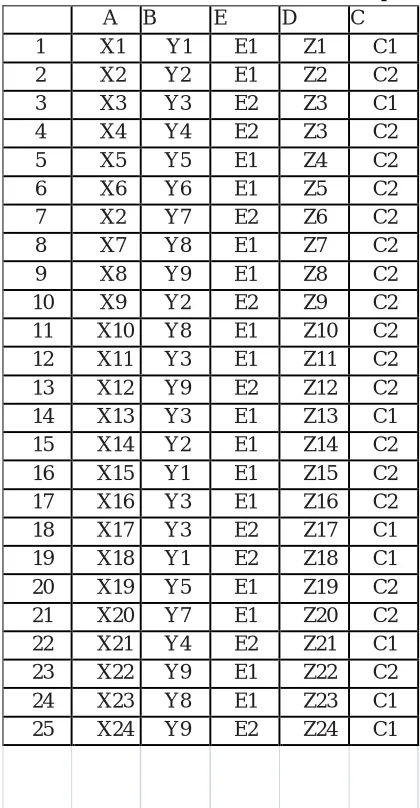
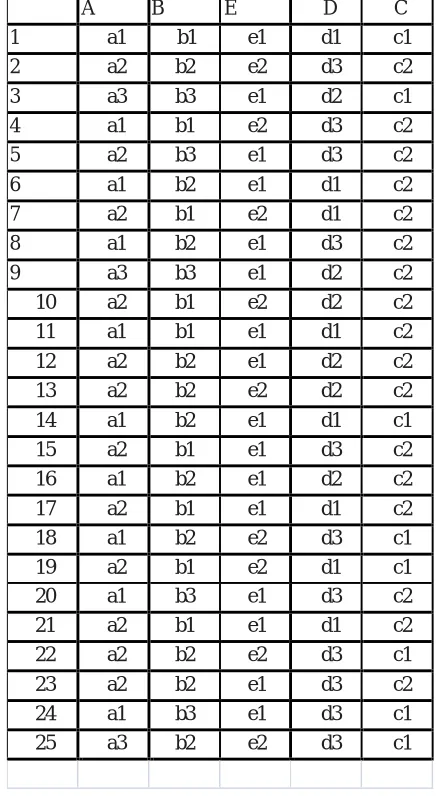
For our research purpose, we can assume that we were given a series of data about customers’ potential purchasing behaviors, on the basis of the clustering and attribute selection process stated above, we can assume that the selected most informative attributes for clustered groups are A, B, C, D, E, and each attribute include some different values. For instance, attribute A may include X1, X2, and X3… B may include Y1, Y2, and Y3…. the same, other informative attributes also include different factors. For the convenience of our research, we can assume here that all kinds of variable factors under A attribute value could be categorized into three general ranges: a1, a2, a3, the same, other variable factors under different attributes also could be categorized into differ- ent ranges: attribute B could include b1, b2, b3… C could include c1, c2, c3…D could include d1, d2, d3…. E could include e1, e2, e3….
[image:5.612.173.383.281.685.2]Then, it is time to use information gain and information entropy calculation method to make decision trees for extracting potential valuable knowledge purpose (See Table 1). This paper will use this assumed database as an example to illustrate the application of proposed model.
Table 1. Attributes value of customers’ sample A B E D C 1 X1 Y1 E1 Z1 C1 2 X2 Y2 E1 Z2 C2 3 X3 Y3 E2 Z3 C1 4 X4 Y4 E2 Z3 C2 5 X5 Y5 E1 Z4 C2 6 X6 Y6 E1 Z5 C2 7 X2 Y7 E2 Z6 C2 8 X7 Y8 E1 Z7 C2 9 X8 Y9 E1 Z8 C2 10 X9 Y2 E2 Z9 C2 11 X10 Y8 E1 Z10 C2 12 X11 Y3 E1 Z11 C2 13 X12 Y9 E2 Z12 C2 14 X13 Y3 E1 Z13 C1 15 X14 Y2 E1 Z14 C2 16 X15 Y1 E1 Z15 C2 17 X16 Y3 E1 Z16 C2 18 X17 Y3 E2 Z17 C1 19 X18 Y1 E2 Z18 C1 20 X19 Y5 E1 Z19 C2 21 X20 Y7 E1 Z20 C2 22 X21 Y4 E2 Z21 C1 23 X22 Y9 E1 Z22 C2 24 X23 Y8 E1 Z23 C1 25 X24 Y9 E2 Z24 C1
Table 2. Generalized attributes value of sampled customer group
A B E D C
1 a1 b1 e1 d1 c1 2 a2 b2 e2 d3 c2 3 a3 b3 e1 d2 c1 4 a1 b1 e2 d3 c2 5 a2 b3 e1 d3 c2 6 a1 b2 e1 d1 c2 7 a2 b1 e2 d1 c2 8 a1 b2 e1 d3 c2 9 a3 b3 e1 d2 c2 10 a2 b1 e2 d2 c2 11 a1 b1 e1 d1 c2 12 a2 b2 e1 d2 c2 13 a2 b2 e2 d2 c2 14 a1 b2 e1 d1 c1 15 a2 b1 e1 d3 c2 16 a1 b2 e1 d2 c2 17 a2 b1 e1 d1 c2 18 a1 b2 e2 d3 c1 19 a2 b1 e2 d1 c1 20 a1 b3 e1 d3 c2 21 a2 b1 e1 d1 c2 22 a2 b2 e2 d3 c1 23 a2 b2 e1 d3 c2 24 a1 b3 e1 d3 c1 25 a3 b2 e2 d3 c1
F. Explaining Attributes-Decision Trees
Here we use decision trees method, because we don’t have to make any changes on the target data set if the data set belongs to “IF-THEN” format. Decision trees can make data analysis processes easier by showing the Mapping relationship between object properties and object values in one visual and intuitionist way. Consequently, compared to other data models, this method is easier to understand, and can clearly explain the mapping relation- ships among data within a relative short time.
On the basis of the two steps stated above, decoding the qualitative and quantitative information that are encoded on table is another main task. This paper mainly proposes the use of decision trees to explain the value hidden in big data. This paper recommends the use of the information gain-ID3 calculation method. The specifics are shown as following:
From the Table 2, it is easy to know that there are two different values for the C attribute: so we identify m=2. Here we can identify these two values are C1, and C2. So 17 samples are included in C1, and 8 samples are included in C2. Our goal is probing for the most important test attribute of decision trees as the root node. In view of information-gain and information gain rate-based calculation. This root node can be obtained through calculating and comparing the information gain rate among different attributes.
G. Experiment Results and Discussion
Based on the above example and discussed techniques, it is easy to find that attribute “E” has the highest information gain, so this attribute will be regarded as another new node for further establishment of decision trees. After dealing with P2 using the same method, the final decision tree is formed as follows:
tree, we can find the following patterns: 1. The C2 is more popular among customers in d3 group. 2. C1 is more popular among d2 group customers and d1 group customers. 3. Among different attribute B values, C2 is more popular for a1 group, but C1 is more popular for a2 group customers and a3 group customers.
Based on the above analysis, business can sense that the target group of C2 is a1 group customers with d3 attribute, and the target groups of good C1 should be a2 group customers and a3 group customers. Consequently, it is the right time to accelerate advertisement about newly C2 among a1 group customers; especially among a1 members with d3 attribute and promote newly C1 good among d2 group customers and a3 group customers.
Based on such a data-mining model, businesses can extract valuable information to achieve accurate marketing strategies. Businesses can promote personalized marketing strategies through finding inner regular patterns on the basis of data clustering and integration. It is no doubt that business can lower the operation cost, and optimize the customers’ retention rate for better CRM.
IV. CONCLUSIONS
Based on the above discussion about this proposed three-step data mining model including using K-means to cluster massive data; Generalizing data to focus on relevant attributes via using a user-defined threshold for the information loss calculation; Calculating information gain ratio to make decision trees for extracting potential valuable knowledge purpose. More importantly, such a data-mining model simplifies the data analysis process, and provides logical basis for analysis. Unarguably, data data-mining model can bring amazing value for CRM, no matter for business, government, or for public institutions. CRM will work effectively with the speedy data integration and data mining. This model also sets up a good foundation for future data research under “big data era”.
V. ACKNOWLEDGMENT
This work was supported in part by National Taichung University of Education, Taiwan, under Grant NTCU- F104201.
References
[1] D. Anthony, H. Oscar, J. Gandy, “All that glitters is not gold: digging beneath the surface of data mining,” Journal of Business Ethics, Vol. 40, No. 4, pp. 373-386, 2002
[2] I. Bittencourt, E. Costa, M. Silva, E. Soares, “A computational model for developing semantic web-based educational systems,” Knowledge Based Systems, Vol. 22, No. 2, pp. 302-315, 2009
[3] A. Bueren, R. Schierholz, L. Kolbe, W. Brenner, “Customer Knowledge Management: improving performance of customer relationship management with knowledge management,” in Proceedings of The 37th IEEE Hawaii
International Conference on System Sciences, IEEE Computer Society Press, 2004.
[4] C. Hung, and C. Tsai, “Market segmentation based on hierarchical self-organizing map for markets of multimedia on demand,” Expert System, pp. 780–787, 2008
[5] D. Chen, N. Vachharajani, R. Hundt, X. Li, S. Eranian, W. Chen, W. Zheng, “Taming hardware event samples for precise and versatile feedback directed optimizations,” IEEE Transactions on Computers, Vol. 62, No. 2., pp. 76-389, 2013
[6] X. Chen, Z. Zheng, X. Liu, Z. Huang, H. Sun, “Personalized QoS-aware web service recommendation and visualization,” IEEE Transactions on Services Computing, Vol. 6, No. 1, pp. 35-47, 2013
[7] C. Huang, M. Chen, “Credit scoring with a data mining approach based on support vector machine,” Expert Systems with Applications, Vol. 33, No. 4, pp. 847–856, 2007.
[8] G. Fung, L. Mangasarian, “Proximal support vector machine classifiers,” in Proceedings of Knowledge Discovery and Data Mining (KDD), pp. 77–86, 2001.
[9] C. Hsu, S. Chen, T. Chen, “Message transmission techniques for low traffic P2P services,” International Journal of Communication Systems, Vol. 22, No. 9., pp. 1105-1122, 2009
[10] C. Hsu, Y. Chen, H. Kang, “Performance-effective and low-complexity redundant reader detection in wireless RFID networks,” EURASIP Journal on Wireless Communications and Networking, Vol. 2008, Article ID: 604747, 2008.
[11] J. Gehreke, “Decision trees,” in The Handbook of Data Mining, pp. 3–25, 2003.
[12] Y. Kuoa, L. Ana, W. Wanga, J. Chungbi, “Integration of self-organizing feature maps neural network and genetic
K- means algorithm for market segmentation,” Expert System with Applications, Vol. 30, No. 2, pp. 313–324, 2006.
[13] B. Lotfi, A. Romdhane, N. Fadhel, B. Ayeb, “Building customer models from business data: an automatic approach based on fuzzy clustering and machine learning,” International Journal of Computational Intelligence and Application, Vol. 8, No. 4., pp. 445-465, 2009.
[14] N. Hsieha, “A data mining and behavioral scoring model for analyzing bank customers,” Expert Systems with Applications, Vol. 27, No. 4, pp. 623–633, 2004.
[15] P. Giudici, G. Passerone, “Data mining of association structures to model consumer behavior,” Computer Statistics Data Analysis, Vol. 38, No. 4, pp. 533– 541, 2002.
[16] P. Soukakos, N. Georgopoulos, V. Economou, “Interrelated frame-works proposed for mapping and performance measurement of customer relationship management strategies,” International Journal of Knowledge and Learning, Vol. 3, No. 2-3, pp. 299–315, 2007.
[17] S. Thomas, and R. Moore, “E-education 3.0: challenges and opportunities for the future of I-campuses,” in Proceedings of International Conference on Digital Object Identifier, pp. 953-958, 2012.
[18] L. Romdhane, N. Fadhel, B. Ayeb, “Building customer models from business data: an automatic approach based on fuzzy clustering and machine learning,” International Journal of Computational Intelligence and Applications, Vol. 8, No. 4, pp. 445–465, 2009.
[19] S. Susanne, S. Gerhard, “Designing for mobile value co-creation-the case of travel counseling,” Electronic Markets, Vol. 24, pp. 5-17, 2014. [20] N. Nhat, D. Cavada, F. Ricci, “Trip at device-mobile extension of a case-based travel recommender system,” in
Proceedings of 2nd International Conference on Mobile Business (ICMB), 2003.
[21] K. Mirella, K. Ruyter, W. Martin, “An assessment of value creation in mobile service delivery and the moderating role of time consciousness,” Journal of Retailing, Vol. 83, No. 1, pp. 33-46, 2006.
[22] -S. Wang, H.-H. Lin, P. Luarn, “Predicting consumer intention to use mobile service,” Information Systems Journal,
Vol. 16, No.2, pp. 157-179, 2006.
[23] Y. Shuk, H. Sai, “The attraction of personalized service for users in mobile commerce: an empirical study,” ACM SIGecom Exchanges, Mobile Commerce, Vol. 3, No. 4, pp. 10-18, 2002.
[24] J. Fink, J. Koenemann, S. Noller, I. Schwab, “Personalization into Practice,” Communications of the ACM, Vol. 45, No. 5, pp. 41-42, 2002.
[25] H.C. Chu, D.J. Deng, J.H. Park, “Live data mining concerning social networking forensics based on a facebook session through aggregation of social data,” IEEE Journal on Selected Areas in Communications, Vol. 29, No. 7, pp.
[26] 1368- 1376, 2011.
[27] M.H. Guo, H.T. Liaw, D.J. Deng, H.C. Chao, “Cluster-based secure communication mechanism in wireless ad hoc networks,” IET information security, Vol. 4, No. 4, pp. 352-360, 2012.
[28] Shoban Babu Sriramoju, " Review on Big Data and Mining Algorithm" in “International Journal for Research in Applied Science and Engineering Technology”, Volume-5, Issue-XI, November 2017, 1238-1243 [ ISSN : 2321-9653], www.ijraset.com
[29] Shoban Babu Sriramoju, “OPPORTUNITIES AND SECURITY IMPLICATIONS OF BIG DATA MINING” in “International Journal of Research in Science and Engineering”, http://ijrise.org/asset/archive/17Dec7.pdf, Vol-3, Issue-6, Nov-Dec 2017, 44-58 [ ISSN : 2394-8299 ].
[30] Shoban Babu Sriramoju, “A FRAMEWORK FOR SOLVING IDENTITY DISCLOSURE PROBLEM IN COLLABORATIVE DATA PUBLISHING” in “International Journal of Research in Science and Engineering”, http://ijrise.org/asset/archive/17Dec8.pdf, Vol-3, Issue-6, Nov-Dec 2017, 59-66 [ ISSN : 2394-8299 ].
[31] Shoban Babu Sriramoju, "Heat Diffusion Based Search for Experts on World Wide Web" in “International Journal of Science and Research”, https://www.ijsr.net/archive/v6i11/v6i11.php, Volume 6, Issue 11, November 2017, 632 - 635, #ijsrnet
[32] Dr. Shoban Babu Sriramoju, Prof. Mangesh Ingle, Prof. Ashish Mahalle “Trust and Iterative Filtering Approaches for Secure Data Collection in Wireless Sensor Networks” in “International Journal of Research in Science and Engineering” Vol 3, Issue 4, July-August 2017 [ ISSN : 2394-8299 ].
[33] Dr. Shoban Babu, Prof. Mangesh Ingle, Prof. Ashish Mahalle, “HLA Based solution for Packet Loss Detection in Mobile Ad Hoc Networks” in “International Journal of Research in Science and Engineering” Vol 3, Issue 4,July-August 2017 [ ISSN : 2394-8299 ].
and Research” Index Copernicus Value(2015):78.96 [ ISSN : 2319-7064 ].
[35] Sriramoju Ajay Babu, Dr. S. Shoban Babu, “Improving Quality of Content Based Image Retrieval with Graph Based Ranking” in “International Journal of Research and Applications” Vol 1, Issue 1,Jan-Mar 2014 [ ISSN : 2349-0020 ].
[36] Dr. Shoban Babu Sriramoju, Ramesh Gadde, “A Ranking Model Framework for Multiple Vertical Search Domains” in “International Journal of Research and Applications” Vol 1, Issue 1,Jan-Mar 2014 [ ISSN : 2349-0020 ].
[37] Mounika Reddy, Avula Deepak, Ekkati Kalyani Dharavath, Kranthi Gande, Shoban Sriramoju, “Risk Aware Response Answer for Mitigating Painter Routing Attacks” in “International Journal of Information Technology and Management” Vol VI, Issue I, Feb 2014 [ ISSN : 2249-4510 ]
[38] Mounica Doosetty, Keerthi Kodakandla, Ashok R, Shoban Babu Sriramoju, “Extensive Secure Cloud Storage System Supporting Privacy-Preserving Public Auditing” in “International Journal of Information Technology and Management” Vol VI, Issue I, Feb 2012 [ ISSN : 2249-4510 ]
[39] Shoban Babu Sriramoju, “An Application for Annotating Web Search Results” in “International Journal of Innovative Research in Computer and Communication Engineering” Vol 2,Issue 3,March 2014 [ ISSN(online) : 2320-9801, ISSN(print) : 2320-9798 ]
[40] Shoban Babu Sriramoju, “Multi View Point Measure for Achieving Highest Intra-Cluster Similarity” in “International Journal of Innovative Research in Computer and Communication Engineering” Vol 2,Issue 3,March 2014 [ ISSN(online) : 2320-9801, ISSN(print) : 2320-9798 ]
[41] Shoban Babu Sriramoju, Madan Kumar Chandran, “UP-Growth Algorithms for Knowledge Discovery from Transactional Databases” in “International Journal of Advanced Research in Computer Science and Software Engineering” Vol 4,Issue 2,February 2014 [ ISSN : 2277 128X ]
[42] Shoban Babu Sriramoju, Azmera Chandu Naik, N.Samba Siva Rao, “Predicting The Misusability Of Data From Malicious Insiders” in “International Journal of Computer Engineering and Applications”, Vol V, Issue II, Febrauary 2014 [ ISSN : 2321-3469 ]
[43] Ajay Babu Sriramoju, Dr. S. Shoban Babu, “Analysis in Image Compression Using Bit-Plane Separation Method” in “International Journal of Information Technology and Management” Vol VII, Issue X, November 2014 [ ISSN : 2249-4510 ]
[44] Shoban Babu Sriramoju, “Mining Big Sources Using Efficient Data Mining Algorithms” in “International Journal of Innovative Research in Computer and Communication Engineering” , Vol 2, Issue 1,January 2014 [ ISSN(online) : 2320-9801, ISSN(print) : 2320-9798 ]
[45] Mr. Ajay Babu Sriramoju, Dr. S. Shoban Babu, “Objective Quality Metric Design for Wireless Image and Video Communication” in “International Journal of Information Technology and Management”, Vol VII, Issue 10, November 2014 [ ISSN : 2249-4510 ]
[46] Ajay Babu Sriramoju, Dr. S. Shoban Babu, “Study of Multiplexing Space and Focal Surfaces and Automultiscopic Displays for Image Processing” in “International Journal of Information Technology and Management”, Vol V, Issue I, August 2013 [ ISSN : 2249-4510 ]
[47] Dr. Shoban Babu Sriramoju, “A Review on Processing Big Data” in “International Journal of Innovative Research in Computer and Communication Engineering” Vol-2, Issue-1, January 2014 [ ISSN(online) : 2320-9801, ISSN(print) : 2320-9798 ]
[48] Shoban Babu Sriramoju, Dr. Atul Kumar, “An Analysis around the study of Distributed Data Mining Method in the Grid Environment : Technique, Algorithms and Services” in “Journal of Advances in Science and Technology” , Vol-IV, Issue No-VII, November 2012 [ ISSN : 2230-9659 ]
[49] Shoban Babu Sriramoju, Dr. Atul Kumar, “An Analysis on Effective, Precise and Privacy Preserving Data Mining Association Rules with Partitioning on Distributed Databases” in “International Journal of Information Technology and management” Vol-III, Issue-I, August 2012 [ ISSN : 2249-4510 ]
[50] Shoban Babu Sriramoju, Dr. Atul Kumar, “A Competent Strategy Regarding Relationship of Rule Mining on Distributed Database Algorithm” in “Journal of Advances in Science and Technology” , Vol-II, Issue No-II, November 2011 [ ISSN : 2230-9659 ]
[51] Shoban Babu Sriramoju, Dr. Atul Kumar, “Allocated Greater Order Organization of Rule Mining utilizing Information Produced Through Textual facts” in “International Journal of Information Technology and management” , Vol-I, Issue-I, August 2011 [ ISSN : 2249-4510 ]
[52] Ramesh Gadde, Namavaram Vijay, “A SURVEY ON EVOLUTION OF BIG DATA WITH HADOOP” in “International Journal of Research in Science and Engineering”, Vol-3, Issue-6, Nov-Dec 2017, 92-99 [ ISSN : 2394-8299 ].
[53] Namavaram Vijay, S Ajay Babu, "Heat Exposure of Big Data Analytics in a Workflow Framework" in “International Journal of Science and Research”, Volume 6, Issue 11, November 2017, 1578 - 1585, #ijsrnet
[54] Ajay Babu Sriramoju, Namavaram Vijay, Ramesh Gadde, “SKETCHING-BASED HIGH-PERFORMANCE BIG DATA PROCESSING ACCELERATOR”
in “International Journal of Research in Science and Engineering”, Vol-3, Issue-6, Nov-Dec 2017, 92-99 [ ISSN : 2394-8299 ]