MHD Three Dimensional Flow of Jeffrey Fluid
over an Exponentially Stretching Sheet
M. Krishna Murthy1 1
Sri Venkateswara University, Tirupati, A.P
Abstract: The MHD three dimensional flow of Jeffrey fluid over an exponentially stretching sheet is studied. Using similarity transformations the governing partial differential equations are transformed to ordinary differential equations and are solved using shooting technique. The effects of non dimensional governing parameters on velocity and temperature profiles are discussed through graphs. Also, the coefficient of skin friction and the Nusselt number are presented through tables. It is found that present results have been good agreement with the existed studies under some special cases.
Keywords: MHD, Jeffrey parameter, exponentially stretching sheet.
I. INTRODUCTION
Boundary layer flows having a many applications in engineering and industrial research such as drawing the plates in an electrically conducting fluid subjected to a transverse magnetic field is used to control the cooling rate, extrusions of plastic sheets, paper production, glass blowing, metal and polymer extrusion, crystal glowing and drawing plastic films etc. The electrically conducting fluids are very important in engineering applications such as MHD generators, plasma fluids, geothermal energy extraction and nuclear reactors engineers and designers used the concept of magneto hydrodynamic in the design of pumps, design of heat exchangers, control and reentry space vehicle propulsion and thermal protection. Soret and Dufour effects in three dimensional flow over an exponentially stretching surface with porous medium, chemical reaction and heat source/sink examined Hayat et al. [1]. Kartini Ahmad et al. [2] studied mixed convection Jeffrey fluid flow over an exponentially stretching sheet with magneto hydrodynamic effect. MHD three dimensional flow by an exponentially stretching surface with convective boundary condition reported Hayat et al. [3]. Mahanta et al. [4] presented 3D Casson fluid flow past a porous linearly stretching sheet with convective boundary condition. Flow and heat transfer for three dimensional flow over an exponentially stretching surface discussed Chung Liu et al. [5]. Magyari et al. [6] investigated heat and mass transfer in the boundary layers on an exponentially stretching continuous surface. Hayat et al. [7] discussed three dimensional flow of Jeffrey fluid over a bidirectional stretching surface with heat source/sink. Three dimensional flow of nanofluid induced by an exponentially stretching sheet: An application to solar energy examined Junaid Ahmad Khan et al. [8]. Alsaedi et al. [9] analyzed MHD three dimensional flow of viscoelastic fluid over an exponentially stretching surface with variable thermal conductivity. Hayat et al. [10] found three dimensional flow of a Jeffrey fluid over a linearly stretching sheet. Tasawar Hayat et al. [11] studied on three dimensional flow of Eyring Powell nano fluid over an exponentially stretching sheet. Shehzad et al. [12] carried out on MHD three dimensional flow of Jeffrey fluid with Newtonian heating. Radiative hydromagnetic flow of Jeffrey nano fluid by an exponentially stretching sheet performed by Tariq Hussian et al. [13]. Fazle Mabood et al. [14] studied on MHD flow over exponentially radiating stretching sheet using homotopy analysis method. effects of variable fluid properties on MHD flow and heat transfer over a stretching sheet with variable thickness. The effects of variable fluid properties on the hydromagnetic flow and heat transfer over a non- linearly stretching sheet. Effects of variable fluid properties on the thin film flow of Ostwald de waele fluid over a stretching surface analyzed Prasad et al. [15-17]. MHD boundary layer flow of Casson fluid passing through an exponentially stretching permeable surface with thermal radiation was discussed Swati Mukhopadhyay et al. [18]. Sreenadh et al. [19-20] studied on MHD boundary layer flow of Jeffrey fluid over a stretching/shrinking sheet through porous medium. Flow of a Jeffrey fluid between torsionally oscillating disks. The present study reveals that the steady MHD three dimensional flow of Jeffrey fluid over an exponentially stretching sheet. Using self similarity transformations the governing partial differential equations are transformed to nonlinear differential equations and are using solved shooting technique. The effect of pertinent parameters on velocity, temperature profiles, the skin friction coefficient and the rate of heat transfer are discussed in detailed.
II. MATHEMATICAL FORMULATION
the fluid flow and the induced magnetic field assumed to be negligible. The sheet at z = 0 is stretched in the
x
andy
directions with velocitiesU
wandV
w respectively. The continuity, momentum and energy equations for the present boundary layer flow are to the following equations0
u
v
w
x
y
z
(1)2 2 0 2 1
1
B
u
u
u
u
u
v
w
u
x
y
z
z
(2)2 2 0 2 1
1
B
v
v
v
v
u
v
w
v
x
y
z
z
(3)2 2
p
T
T
T
k
T
u
v
w
x
y
z
c
z
(4)The associated boundary conditions of equations (2) – (4) are
0
x y L w
u
U
U e
, 0x y L w
v
V
V e
,w
0
,T
T
w atz
0
(5)0
u
,v
0
,T
T
asz
(6)where
u v
,
andw
are velocity components in thex
,y
andz
- directions respectively.
is the kinematics viscosity,
1 is the Jeffrey parameter,B
0 is the magnetic induction,
is the electrical conductivity,k
is the thermal conductivity,c
p is the specificheat at constant pressure, the subscript
w
denotes the wall conduction,L
is the reference length andT
is the ambient temperature.The similarity transformations of equations (1)-(4) are introduced as
1 2 0 0 0 0 2 0,
,
2
,
2
x y x y x y
L L L
A x y x y
L L
U
u
U e
f
v
V e
g w
e
f
f
g
g
L
U
T
T
T e
e
z
L
(7)Where
A
is the temperature exponent.Using the dimensionless variables and similarity transformations in equations (1)-(4) are reduces to the given below
1
1
2
0
1
f
f
g f
f
g
f
Mf
(8)
1
1
2
0
1
g
f
g g
f
g g
Mg
(9)
Pr
f
g
Pr
A f
g
0
(10)The corresponding boundary conditions (5) and (6) becomes
0
f
g
,f
1
,g
,
1
at
0
(11)0
where 0
0
V
U
is the stretching ratio,Pr
c
pk
is the Prandtl number,2 0
2
wB L
M
U
is the magnetic parameter and primesdenotes with respect to
.The physical quantities of interest are the skin friction coefficients along the
x
- andy
-directions are given by0 1 2
1
1
2
z fx wu
z
C
U
and 1 02
1
1
2
z fy wv
z
C
U
(13)the skin friction coefficients in dimensionless form are
1 2 3 2 1
0
Re
2
1
x y L fxf
C
e
and
1 2 32 1
0
Re
2
1
x y L fyg
C
e
(14)The local Nusselt number
Nu
xis defined as
1 2 2 0Re
0
2
x y L x w zx
T
x
Nu
e
T
T
z
L
(15)where
Re
is the Reynolds number defined byRe
U L
w
.III. SOLUTION OF THE PROBLEM
The present study on MHD three dimensional flow of Jeffrey fluid over an exponentially stretching sheet for the both Newtonian and Non Newtonian cases. The transformed governing equations are solved numerically using shooting technique with fourth order Runge-Kutta method. The numerical computations are performed for several values of dimensionless parameters involved in the equations, viz. Mis the magnetic parameter, 1is the Jeffrey parameter,
is the stretching ratio parameter, Pr is the Prandtl number andA
is the temperature exponent. The numerical computations have been carried out for various values of the parameters on velocity and temperature are depicts in figures 1- 8.In order to assure the accuracy of the applied numerical scheme the computed values of Skin friction coefficient
1
0
1
f
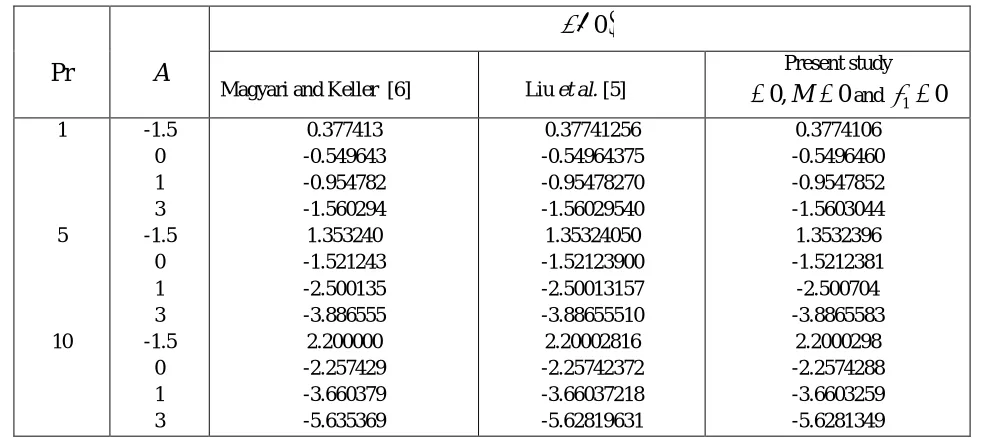
iscompared with the available results of Liu et al. [5] in Table-1 and Table-2 depicts the local Nusselt number
0
compared the results of Magyari and Keller [6] for the two dimensional case
0
are have been found in good agreement.The variations of the stretching ratio parameter
, the Jeffrey parameter
1and the Magnetic parameterM
on the velocity
f
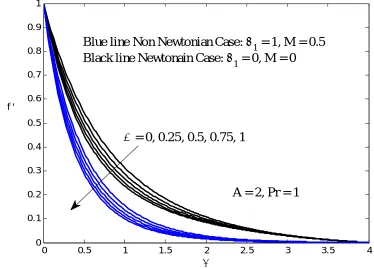
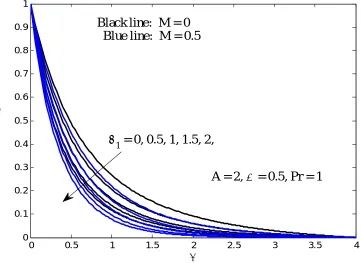
are depicts in figures 1-3 for both Newtonian and Non Newtonian cases. From figure 1 we examine that the velocity andmomentum boundary layer thickness decreases with increasing
which is natural result due to the bi stretching sheet effect. From figure 2, it is noticed that for higher values of Jeffrey parameter
1it reduces both boundary layer thickness and the Jeffreyparameter
1. From figure 3, we observe that the magnitude of velocity that for higher values of magnitude parameterM
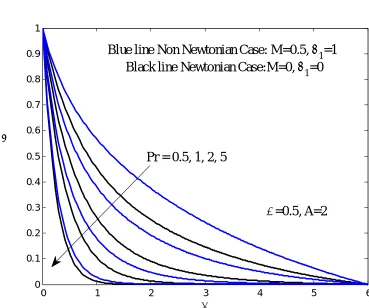
it reduces [image:4.612.37.530.59.400.2]Figures 4 and 5 illustrates the temperature
profiles for several values of Prandtl number Pr withA
2
andA
2
.We report that for increasing values Prof thermal boundary layer thickness reduces, which owes that the smaller thermal diffusive effect.
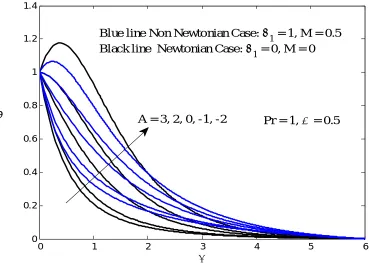
The effects of the temperature exponent
A
on temperature
is depict in figure 6. We reveals that the temperature augmentand the enlarging effect becomes more pronounced for small values of
A
,correspondingly the shortening of thermal boundary layer thickness becomes thickened for decreasingA
.The variation on temperature
in different values of stretching ratio parameter
are display in figures 7 and 8. We examinethat the temperature profile decreases from unity to zero as the distance
from0
to infinity forA
1
. The slopes at the surface for these curves corresponding toA
1
are zero, indicates that there is no heat transfer between the wall and the fluid. We examine shortening of thermal boundary layer thickness for enhancing
is a natural consequence of increased entrainmentintensity of the cooler fluid from the ambient to the hotter fluid near the surface.
The skin friction coefficient
1
0
1
f
and
1
0
1
g
for various values of stretching ratio parameter
are shown inTable-1. When the absence of Jeffrey parameter and magnetic parameter (i.e.
M
0,
1
0
) we examine that
increases thevalues of -
f
0
and -g
0
enhances accordingly. This reveals that the shear stress acting along the respectivedirections are both enhanced when the surface is stretched in the orthogonal directions for
0
1
. We conclude that the flow far from the surface compensates towards the stretching surface due to the bidirectional driving effect.The temperature gradient
0
for different values of stretching ratio parameter
is depicts in Table-2. We observe that thedifferent values of
Pr
andA
the temperature gradient
0
increases negatively although this conclusion applies for the two [image:5.612.107.481.447.716.2]dimensional case
0
the results of Magyari and Keller [6] are exist in good agreement.Fig 1. Velocity profile for different values of alpha
0 0.5 1 1.5 2 2.5 3 3.5 4
0 0.1 0.2 0.3 0.4 0.5 0.6 0.7 0.8 0.9 1
f '
A = 2, Pr = 1
Blue line Non Newtonian Case:
1= 1, M = 0.5
Black line Newtonain Case:
1= 0, M = 0
Fig 2. Velocity profile for different values of lambda
Fig 3. Velocity profile for different values of M
0 0.5 1 1.5 2 2.5 3 3.5 4
0 0.1 0.2 0.3 0.4 0.5 0.6 0.7 0.8 0.9 1
f '
1
= 0, 0.5, 1, 1.5, 2,
A = 2,
= 0.5, Pr = 1
Black line: M = 0
Blue line: M = 0.5
0 0.5 1 1.5 2 2.5 3 3.5 4
0 0.1 0.2 0.3 0.4 0.5 0.6 0.7 0.8 0.9 1
f '
A = 2,
= 0.5, Pr = 1
Blue line Non Newtonian Case:
1= 0.5
Black line Newtonian Case:
1= 0
Fig 4. Temperature profile for different values of Pr
Fig 5. Temperature profile for different values of Pr
0 1 2 3 4 5 6
0 0.2 0.4 0.6 0.8 1 1.2 1.4
Blue line Non Newtonian case:
1= 1, M = 0.5
Black line Newtonian case:
1= 0, M = 0
Pr = 0.5,1 , 2
= 0.5, A = -2
0 1 2 3 4 5 6
0 0.1 0.2 0.3 0.4 0.5 0.6 0.7 0.8 0.9 1
Pr = 0.5, 1, 2, 5
Blue line Non Newtonian Case: M=0.5,
1
=1
Black line Newtonian Case:M=0,
1
=0
[image:7.612.108.477.394.702.2]Fig 6. Temperature profile for different values of A
Fig 7. Temperature profile for different values of alpha
0 1 2 3 4 5 6
0 0.2 0.4 0.6 0.8 1 1.2 1.4
Blue line Non Newtonian Case:
1= 1, M = 0.5
Black line Newtonian Case:
1= 0, M = 0
Pr = 1,
= 0.5
A = 3, 2, 0, -1, -2
0 1 2 3 4 5 6
0 0.1 0.2 0.3 0.4 0.5 0.6 0.7 0.8 0.9 1
Blue line Non Newtonian Case:
1= 1, M = 0.5
Black line Newtonian Case:
1= 0, M = 0
= 0, 0.25, 0.5, 0.75, 1
Fig 8. Temperature profile for different values of alpha
Table 1: comparative table values of
1
0
1
f
and
10
1
g
for various values of
whenM
0,
1
0
Liu et al [5] Present results (
1
0,
0
M
)-
f
0
-g
0
-f
0
-g
0
0 0.5 1.0 1.28180856 1.56988846 1.81275105 0 0.78494423 1.81275105 1.2818114 1.5699104 1.8127654 0 0.7849552 1.8127654Table 2: comparison of
0
of Magyari and Keller [6 ] and Liu et al. [5 ] with the present study for
0,
M
0
and
1
0
Pr
A
0
Magyari and Keller [6]
Liu et al. [5]
Present study
0,
M
0
and
1
0
1 5 10 -1.5 0 1 3 -1.5 0 1 3 -1.5 0 1 3 0.377413 -0.549643 -0.954782 -1.560294 1.353240 -1.521243 -2.500135 -3.886555 2.200000 -2.257429 -3.660379 -5.635369 0.37741256 -0.54964375 -0.95478270 -1.56029540 1.35324050 -1.52123900 -2.50013157 -3.88655510 2.20002816 -2.25742372 -3.66037218 -5.62819631 0.3774106 -0.5496460 -0.9547852 -1.5603044 1.3532396 -1.5212381 -2.500704 -3.8865583 2.2000298 -2.2574288 -3.6603259 -5.62813490 1 2 3 4 5 6
0 0.1 0.2 0.3 0.4 0.5 0.6 0.7 0.8 0.9 1
Blue line Non Newtonian Case: 1 = 1, M = 0.5 Black line Newtonian Case: 1 = 0, M = 0
A = 2, Pr = 1
[image:9.612.60.553.512.731.2]REFERENCES
[1] Tasawar Hayat, Taseer Muhammad, Sabi Ali Shehzad and A. Alsaedi, Soret and dufour effects in three dimensional flow over an exponentially stretching surface with porous medium, chemical reaction and heat source/sink, International Journal of Numerical Methods for Heat and Flow, 25 (4),2014, 762-781.
[2] Kartini Ahmad, Zahir Hanouf and Anuar Ishak, mixed convection Jeffrey fluid flow over an exponentially stretching sheet with magnetohydrodynamic
effect.Journal of AIP Advances, 6, 2016.
[3] Hayat T, Shehzad S.A and Alsaedi.A, MHD three dimensional flow by an exponentially stretching surface with convective boundary condition, Journal of Aerospace Engineering, 2014.
[4] Mahanta G and Shaw S, 3D Casson fluid flow past a porous linearly stretching sheet with convective boundary condition, Alexandria Engineering Journal,
54(3), 2015, 653-659
[5] Chung Liu. I, Hung Hsun Wang and Yih ferng peng, Flow and heat transfer for three dimensional flow over an exponentially stretching surface, Chemical
Engineering Communications, 200(2), 2013, 253-268.
[6] Magyari E and Keller B, heat and mass transfer in the boundary layers on an exponentially stretching continuous surface, Journal of Physics D: Applied Physics, 32(5), 1998, 577-585.
[7] Hayat T, Shehzad S.A and Alsaedi, Three dimensional flow of Jeffrey fluid over a bidirectional stretching surface with heat source/sink, Journal of Aerospace
Engineering, 27(4), 2014.
[8] Junaid Ahmad Khan, Mustafa M, Hayat T, Sheikholeslami M and Alsaedi A, Three dimensional flow of nanofluid induced by an exponentially stretching
sheet: An application to solar energy, Journal.pone., 1-18, 2015.
[9] Alsaedi A, Hayat T, Muhammad T and Shehzad S.A, MHD three dimensional flow of viscoelastic fluid over an exponentially stretching surface with variable
thermal conductivity, Computational Mathematics and Mathematical Physics, 56(9), 1665-1678, 2016.
[10] Hayat T, Awais M and Obaidat S, Three dimensional flow of a Jeffrey fluid over a linearly stretching sheet, Commun Nonlinear Sci Numer Simulat, 17,
699-707, 2012.
[11] Tasawar Hayat, Bilal Ashraf, Sabir Ali Shehzad and Elbaz Abouelmagd, Three dimensional flow of Eyring Powell nanofluid over an exponentially stretching
sheet, International Journal of Numerical Methods for Heat and Fluid flow, 25(3), 593-616, 2015.
[12] Shehzad S.A, Hayat T, Alhuthali and Asghar S, MHD three dimensional flow of Jeffrey fluid with Newtonian heating, Journal of Central South University, 21,
2014, 1428-1433.
[13] Tariq Hussain, Sabir Ali Shehzad, Tasawar Hayat, Ahmed Alsaedi, Falleh Al Solamy and Muhammad Ramzan, Radiative hydromagnetic flow of Jeffrey
nanofluid by an exponentially stretching sheet, Plos, 9(8), 2014, 1-9.
[14] Fazle Mabood, Khan W.A and Ismail A.I.Md, MHD flow over exponentially radiating stretching sheet using homotopy analysis method, Journal of King Saud
University-Engineering Sciences, 29(1), 2017, 68-74.
[15] Prasad K.V, Vaidya H, Vajravelu K and Rashidi M.M, effects of variable fluid properties on MHD flow and heat transfer over a stretching sheet with variable
thickness, Journal of Mechanics, 33(4), 2017, 501-512.
[16] Prasad K.V, Vajravelu k and Datti P.S, The effects of variable fluid properties on the hydromagnetic flow and heat transfer over a non- linearly stretching sheet,
International Journal of Thermal Sciences, 49, 2010, 603-610.
[17] Prasad K.V, Vajravelu k and Raju B.T, Effects of variable fluid properties on the thin film flow of Ostwald de waele fluid over a stretching surface, Journal of
Hydrodynamics Series B, 25, 2013, 10-19.
[18] Mukhopadyay S, Moindal IC, Hayat T, MHD boundary layer flow of Casson fluid passing through an exponentially stretching permeable surface with thermal
radiation, Chinese Physics B, 23(10), 2014, 104701.
[19] Eswara Rao M, Sreenadh. S, MHD boundary layer flow of Jeffrey fluid over a stretching/shrinking sheet through porous medium, Global Journal of Pure and
Applied Mathematics, 13(8), 2017, 3985-4001.
[20] Reddy GB, Sreenadh S, Reddy RH, Kavitha A, Flow of a Jeffrey fluid between torsionally oscillating disks, Ain Shams Engineering Journal, (2015), 6:355–