5
X
October 2017
Characterization of Municipal Solid Waste and
Evaluation of Subsurface Water Quality In The
Vicinity of Dumping Sites
Rakesh Kumar Pandey1K.P. Mishra2 and R.P. Tiwari3
1
Research Scholar, MGCGV Chitrakoot, Satna, (M.P.), India 2
Associate Professor, MGCGV Chitrakoot, Satna,(M.P.), India 3
Professor, Rewa Engineering College, Rewa (M.P.) India
Abstract: The physical characterization of municipal solid waste is done in order to measure the quantity of the recoverable and to study the effect of the physical composition on the strength and stability characteristics of the MSW. Municipal Solid Waste (MSW) is composite refuse consisting of various materials with different properties. The characteristics of municipal solid waste
play a key role in many aspects of waste disposal facilities and landfills. Proper management of growing quantities of municipal
solid wastes (MSW) has been a major concern of environmental professionals. Leachate resulting from this is hazardous pollutant to the soil and ground water underlying. Leaching of this leachate and heavy metals into the soil leads to the pollution of both soil and subsurface water. Municipal solid waste disposal on land has become one of the challenges in landfill engineering design. The stability of landfill is governed by the physical properties and strength parameters of MSW. In this paper results of laboratory investigation of the physical properties of MSW and impact of municipal solid waste dumping on subsurface water quality.
Keywords: Municipal Solid waste (MSW), Leachate, Characterization, Landfill, Water
I. INTRODUCTION
In India the most preferred method of waste disposal is landfill. Most of landfills areas in India are open dumping areas. The characteristics of municipal solid waste (MSW) play a key role in many aspects of waste disposal facilities and landfills. Because most of a landfill is made up of MSW, the overall stability of the landfill slopes is governed by the strength parameters and physical properties of the MSW. On the other hand, the composition of the waste, which affects the geotechnical behavior of the MSW, is dependent on a variety of factors such as climate, disposal technology, the culture and habits of the local community.
It is therefore essential that the design and stability evaluations of landfills in each region be performed based on the local conditions and the geotechnical characteristic of the MSW [1-4]. Design and implementation of new landfills or expansion of existing landfills is necessary to accommodate this ever increasing volume of MSW. Geotechnical engineering properties of MSW such as compressibility and shear strength are of prime importance in design and maintenance of these landfills [8]. Wastes placed in dumping yards/landfills are subject to either groundwater underflow or infiltration from precipitation and as water percolates through the waste, it picks up a variety of inorganic and organic compounds, flowing out of the wastes to accumulate at the bottom of the landfill. The resulting contaminated water is termed ‘leachate’ and can percolate through the soil [22]. Leachate resulted from municipal solid waste, is most hazardous pollutant for the soil underlying and subsequently ground water. Leaching of nutrients and heavy metals into the soil which leads to soil and groundwater contamination [28]. Fortunately no lethal failures have occurred in India to date, despite uncontrolled loose dumping. However from the view of enormous increase in the solid waste generation, escalating of grades of the existing landfills and proposals for the upcoming engineered landfills, it is imperative to undertake extensive investigation of the engineering behavior of MSW under static and dynamic conditions so as to avoid such disastrous failures in India and other developing countries in future [12]. This paper attempts to explore the physical and geotechnical characteristics of municipal solid waste such as composition, water content, specific gravity, Atterberg’s limits, and compressibility characteristics of municipal solid waste of selected site samples and assessment of subsurface water quality in and around the municipal solid waste dump sites of study area.
II. MATERIALS AND METHODS
The Municipal solid waste samples were collected randomly from the selected dumping sites. Samples were collected into the separate bags and some relatively small portion of the collected samples were placed in air tight polythene bags for the purpose of measuring natural moisture content. Random sampling was adopted for fair representation of municipal solid waste bottom sediments. The collected samples were subsequently transported to the Geotechnical laboratory for testing. Different geotechnical tests were conducted on these collected samples in accordance with the Indian Standard (I.S.) as well as American Society of Testing and Materials (ASTM).
B. Field Sampling and Laboratory Analysis of Subsurface Water
Subsurface water samples were collected from near the municipal solid waste dumping sites, sampling locations consisting of bore wells and hand pumps were selected in the study area. Sampling was done in accordance with grab sampling methods in 1litre plastic containers and prior to collection all the bottles were washed with non-ionic detergent and rinsed with de-ionized water prior to usage. Before the final water sampling was done, the bottles were rinsed three times with well water at the point of collection. During sampling from hand pumps and bore wells, the water pumped to waste for about five minutes and sample was collected directly. Each bottle was labeled according to sampling location while all the samples were preserved at 4ºC and transported to the laboratory.
III. CHARACTERIZATION OF MUNICIPAL SOLID WASTE
The physical characterization of municipal solid waste is done in order to measure the quantity of the recoverable and to study the effect of the physical composition on the strength and compressibility characteristics of the municipal solid waste.
A. Waste Composition
The waste is segregated by hand sorting into paper, plastics, inert (rubber, leather), glass, stones and the organic fraction of the waste. The physical characterization of the waste passing through 100 mm sieve was done by hand sorting and on the weight basis. The MSW samples used for all the experiments were those passing through the 20 mm sieve and retained by the 4.75 mm sieve. Therefore the composition analysis of the 4.75 mm sieve retained waste was done and results are summarized in Figure -1.
0 5 10 15 20 25 30 35 40 45
Paper Plastic Cloths Glass Stones Compost
rejects Rubber/ metals Misllaneous
%
C
o
m
p
o
si
si
o
n
Waste Components
Site A Site B Site C Site D
Figure-1 Composition of municipal Solid waste at different dumping sites
B. Moisture content
Table -1 Moisture content of municipal solid waste samples
Serial No. Sample site Moisture content on dry weight basis
1. Station A 23.27 % to 27.33%
2. Station B 30.60 % to 34.01 %
3. Station C 14.95 % to 18.05 %
4. Station D 16.94 % to 19.75%
Moisture contents measured were ranged from 14.95% to 34.01 % on dry weight basis, for different municipal solid waste dumping sites. The Minimum water content was found in Station C sample site and maximum water content was found in Station B sample.
C. Specific Gravity
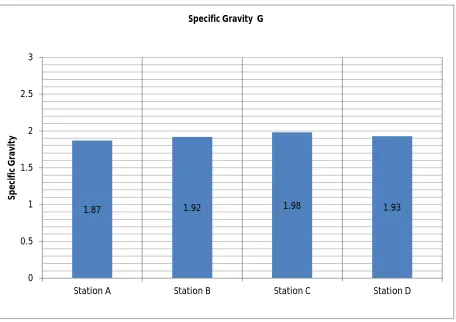
Pycnometer method was employed to determine specific gravity for municipal solid waste in laboratory. Specific gravity of for municipal solid waste samples is summarized in Figure-2.The specific gravity of municipal solid waste samples are found to be 1.87 to 1.98. The lower value of specific gravity can be attributed to the presence of decomposed organic matter.
1.87 1.92 1.98 1.93
0 0.5 1 1.5 2 2.5 3
Station A Station B Station C Station D
Sp
e
ci
fi
c
G
ra
vi
ty
Specific Gravity G
Figure 2 Specific gravity values of samples collected from dumping sites
D. Atterberg’s limits
The Atterberg limits are the basic measure of the critical water contents of a fine-grained soil. The moisture contents at which the
consistency changes from one state to the other state are called Atterberg limits. The Atterberg limits are the liquid limit (wL),
plastic limit (wP), shrinkage limit (wS) and plasticity index. The result of Atterbeg limits (liquid limit, plastic limit and plasticity
[image:4.612.80.536.321.643.2]35.05 36.3 36.2 37
26.48 26.23 27.1 27.48
8.57 10.07 9.1 9.52
0 5 10 15 20 25 30 35 40
Station A Station B Station C Station D
Atterberg Limits of MSW Site Samples
LL
PL
PI
[image:5.612.76.541.78.251.2]Figure: 3 Atterberg limits of MSW site samples
E. Compressibility TeS
Compressibility of municipal solid waste was tested in general accordance with ASTM D2435. The compression index (Cc) can also
be estimated more quickly and easily without a consolidation test, and on the knowledge of liquid limit, as the two empirically related by Terzaghi as:
For undisturbed soil of normal sensitivity
Cc = 0.009 [L.L- 10] ……….. (a)
For remoulded soil
Cc = 0.007 [L.L- 10] ……….. (b)
Where L.L = Liquid limit moisture content in percentage.
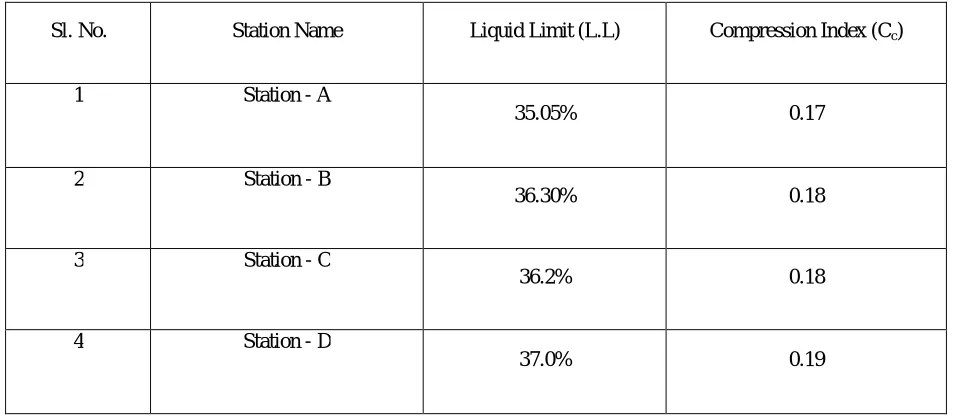
In present study of compressibility, compression index (Cc) is calculated by the use of empirical relation given by the Terzaghi for
remoulded soil sample. The result of compressibility test is summarized in Table 2
Table 2 Compressibility characteristic of municipal solid waste
Sl. No. Station Name Liquid Limit (L.L) Compression Index (Cc)
1 Station - A
35.05% 0.17
2 Station - B
36.30% 0.18
3 Station - C
36.2% 0.18
4 Station - D
37.0% 0.19
IV. PHYSICO CHEMICAL ANALYSIS OF SUBSURFACE WATER
[image:5.612.68.546.445.654.2]sources were selected, for taking water samples, namely- open wells (all depth less than 20 m), tube wells and hand pumps. Results of the physico-chemical analysis of subsurface water are summarized in Table-3.
Table- 3 Physico-Chemical parameters of the subsurface water samples near MSW dump sites Sl.
No. Parameters S1 S2 S3 S4 S5 S6 S7 S8 S9 S10 S11
1 Temperature ( 0C) 24.8 28.9 28.5 29.2 27.8 25.5 27.8 25.5 24.5 28.1 28.4
2 pH 7.20 6.82 7.92 7.89 6.70 7.85 7.54 6.67 6.73 7.80 7.35
3 Turbidity (NTU) 1.5 2.9 1.5 1.5 2.0 1.7 1.5 2.0 1.9 2.8 2.5
4 Electrical Conductivity
(μS/cm) 728 822 714 845 802 671 812 794 819 802 703
5 TDS (mg/l) 760 886 780 837 880 646 774 756 807 751 769
6 TSS (mg/l) 79 72 46 54 35 40 59 45 67 56 45
7 Total Solids (mg/l) 839 958 826 891 915 686 833 801 874 807 814
8 Total Alkalinity (mg/l) 164 170 159 153 140 148 156 145 167 138 164
9 Total Hardness (mg/l) 396 398 386 359 365 359 320 345 312 332 329
10 Calcium Hardness (mg/l) 268 256 258 247 248 267 232 243 214 228 227
11 Magnesium Hardness
(mg/l) 128 142 128 112 117 92 88 102 98 104 102
12 Dissolved Oxygen (mg/l) 5.1 4.6 5.1 4.2 5.0 4.3 4.2 5.2 5.2 6.4 5.7
13 COD (mg/l) 6.8 8.8 9.3 8.0 6.3 8.4 7.6 5.8 6.3 8.0 6.3
14 BOD (mg/l) 3.0 3.5 3.1 3.3 2.8 3.2 3.0 3.2 3.4 3.0 2.8
15 Chlorides (mg/l) 245 55 76 85 33 76 79 53 67 70 47
16 Fluorides (mg/l) 0.80 0.70 0.40 0.50 0.90 0.70 0.60 0.50 0.30 0.10 0.40
17 Nitrate (mg/l) 2.60 3.50 4.12 1.78 4.65 0.10 0.01 0.60 0.35 3.45 5.80
18 Nitrite (mg/l) 0.15 1.25 0.20 5.25 5.22 3.67 5.50 0.30 2.20 5.10 0.30
19 Sulphate (mg/l) 64.0 3.33 3.45 2.40 0.68 3.17 3.80 2.79 1.21 1.08 4.59
20 Iron as Fe (mg/l) 0.05 0.12 0.21 0.42 0.30 0.39 0.35 0.31 0.20 0.03 0.38
21 Lead as Pb (mg/l) ND ND ND 0.01 ND ND ND ND 0.01 ND ND
22 Zink as Zn (mg/l) ND ND ND ND ND ND ND ND ND ND ND
V. SUMMARY AND CONCLUSION
The characterization include the physical composition, water content, specific gravity, Atterberg’s limits and compressibility properties were measured. The obtained geotechnical properties were compared to data reported in the literature. Study of physico-chemical analysis of subsurface water in the vicinity of municipal solid waste dumping sites was done. The obtained results were compared with the BIS and WHO standards of drinking water.
gravity of municipal solid waste in the present study was found to be 1.87 to 1.98. The lower value of specific gravity can be recognized to the presence of organic matter.
Atterberg’s limits test results shows that the selected municipal solid waste stations are similar in nature. Plasticity index results shows that the municipal solid waste samples are fine sand and silt type group and having intermediate plastic properties. For present work the compression index calculated by using Terzaghi empirical equations for the remoulded sample are found to be 0.17 to 0.19. These values falls in the range of values reported in the published literature.
The results of physico-chemical analysis of the subsurface water samples are presented in the Table 3. These results were compared with BIS and WHO standards of drinking water. From study of physico-chemical analysis of subsurface water in the vicinity of municipal solid waste dumping sites, it is found that most of the parameters like pH, Turbidity, Alkalinity, Dissolved Oxygen, COD, BOD, Chlorides, Fluorides, Nitrates, Metals, etc. are under the permissible limits of Indian Standard for drinking water (BIS) and WHO. Some of the parameters like Electrical Conductivity, Total Dissolved Solid (TDS), Total Hardness (TH), Calcium and Magnesium concentration are above the limits of Indian Standard for drinking water (BIS) and WHO.
Hence it is concluded that at present the municipal solid waste has minimal impact on the subsurface water quality. Although the water quality is just good but it needs to be maintained from being polluted due to municipal solid waste dumping sites for the future.
REFERENCES
[1]. Sharholy, M., K. Ahmad, G. Mahmood & R. C. Trivedi, (2008), Municipal solid waste management in Indian cities – A review. Waste Management 28:
459-467.
[2]. Sethi Sapna et al. (2013) Characterization of Municipal Solid Waste in Jalandhar City, Punjab, India, J. Hazard. Toxic Radio act. Waste 2013.17: 97-106.
[3]. Reddy, K. R., Hettiarachchi, H., Gangathulasi, J., Bogner, J. E., and Lagier, T. (2009c). “Geotechnical properties of synthetic municipal solid waste.” Int. J.
Geotech. Eng., 3(3), 429–438
[4]. Sandro Lemos Machado et al. (2010), Evaluation of the geotechnical properties of MSW in two Brazilian landfills Waste Management 30 (2010) pp 2579–2591
[5]. Sivakumar Babu G.L et al. (2012), Study Of Engineering Properties Of Municipal Solid Waste Of Bangalore City Proceedings of Indian Geotechnical
Conference December 13-15, 2012, Delhi, (Paper No G 705).
[6]. Dixon, N., and D. R. V. Jones. (2005). Engineering Properties of MSW. Geotextiles and Geomembranes. (23)3. Pg. 205 – 233.
[7]. Phani K Adappa et al.(2006) Municipal Solid Waste – A Review of Classification System A CSBE/ASABE Inter Sectional Meeting Presentation Paper
Number: MBSK 06-209.
[8]. Ayininuola, G.M.(2014), Decomposed solid waste impact on soil shear strength and California bearing ratio IOSR-JMCE Volume 11, Issue 3 Ver. VII (May-
Jun. 2014), PP 15-17
[9]. ASTM. (2007), Standard test method for laboratory compaction characteristics of soil using modified effort, D1557, West Conshohocken, PA.
[10].Sivakumar Babu G.L., Krishna R.R., Sandeep K. C. and Hanumanth S.K. (2010) Prediction of long-term municipal solid waste landfill settlement using constitutive model, Practice Periodical of Hazardous, Toxic, and Radioactive Waste Management, ASCE, April 2010, 139-150.
[11].Reddy, K.R et al.(2011),Geotechnical properties of municipal solid waste at different phases of biodegradation, Waste Management 31 (2011) pp 2275–2286
[12].Reddy, K.R., Hettiarachchi, H., Parakalla, N., Gangathulasi, J., Bogner, J., 2009b. Geotechnical properties of fresh municipal solid waste at Orchard Hills Landfill,USA. Waste Management 29 (2), 952–959.
[13]. ASTM, 2008, Annual Book of Standards. American Society of Testing and Materials,West Conshohocken, PA.
[14].Gabr, M.A., Valero, S.N., (1995), Geotechnical properties of municipal solid waste. Geotechnical Testing Journal, ASTM 18 (2), 241–251.
[15].Gabr, M.A., Hossain, M.S., Barlaz, M.A., 2007. Shear strength parameters of municipal solid waste with leachate recirculation. ASCE Journal of Geotechnical
and Geoenvironmental Engineering 133 (4), 478–884.
[16].Jones, D.R.V., Taylor, D.P., Dixon, N., 1997. Shear strength of waste and its use in landfill stability. Proc. of the Geoenvironmental Engineering Conference,
Thomas Telford, 343–350.
[17].Musa Alhassan (2012), Effect Of Municipal Solid Waste On Geotechnical Properties Of Soils, IJESMER Vol.1 (5), Pp. 204 - 210, Sept. - Oct., 2012
[18].Vilar, O. M., and Carvalho, M. F. (2004). “Mechanical properties of municipal solid waste.” J. Test. Eval., 32(6), pp 438–449.
[19].Pandey,R K and Tiwari, R P (2015), “Physical Characterization and Geotechnical Properties of Municipal Solid Waste” IOSR-JMCE Vol. 12, Issue 1 Ver. II
(Jan- Feb) PP 15-21.
[20].Fard , M. Karimpour et al (2014), “An experimental investigation on the mechanical behavior of MSW” International Journal of Civil Engineering, Vol. 12 No.
4, PP 292-303
[21]. APHA.(1998), “Standard methods for examination of water and wastewater”, 19th edition American Public Health Association, Water Environment
Federation Publication, Washington, DC.
[22].Mor, S., Ravindra K., Dahiya R.P., Chandra A. (2006), “Leachate characteristics and assessment of groundwater pollution near Municipal Solid Waste landfill
site”, Journal of Environmental Monitoring and Assessment, 118, pp 435-456.
[23]. Ikem A., Osibanjo O., Sridhar, MKC and Sobande, A. (2002), “Evaluation of groundwater quality characteristics near two waste sites in Ibadan and Logas ,
Nigeria”, Journal of Water, Air and Soil Pollution 140, pp 307-333.
[24]. Dhere, A.M.et.al., (2008), “Municipal solid waste disposal in Pune city- An analysis of air and groundwater pollution”. Current Science, 95(6), 774 -777.
[25]. El-Fadel et.al. (1971), “Environmental impact of solid waste-land filling”, Journal of Environmental and Management, 50, pp 1-25.
[26].Sabahi , Esmail Al et .al.,(2009), “ Assessment of groundwater pollution at municipal solid waste of Ibb landfill in Yemen”, Bulletin of the Geological Society
[27].Fatta D., Papadopoulos A., Loizidou M., (1999), “A study on the landfill leachate and its impact on the groundwater quality of the greater area,” Environ. Geochem. Health, 21(2): 175-190.
[28].United States Environmental Protection Agency (USEPA) (1984). Office of Drinking Water, a Groundwater Protection Strategy for the Environmental
Protection Agency, 11 p.
[29].Aderemi Adeolu O. et.al. (2011), “Assessment of groundwater contamination by leachate near a municipal solid waste landfill”, African Journal of Environ.
Science and Technology 5 (11), pp. 933-940.
[30].Badmus, B.S., (2001), “Leachate contamination effect on ground water exploration”, African Journal of Environmental Studies, 2, pp 38-41
[31].Iqbal, M.A.; Gupta, S.G. (2009), “Studies on Heavy Metal Ion Pollution of Ground Water sources as an Effect of Municipal Solid Waste Dumping”, African
Journal of Basic and Applied Sciences, 1 (5-6), 117-122.
[32].Christensen, TH; Kjeldsen, P; Bjerg, PL; Jensen, DL; Christensen, JB; Baun A (2001). “Biogeochemistry of landfill leachate plumes”, Applied Geochemistry,
16, pp 659–718.
[33]. Lee GF, Jones-Lee A (1993), “Ground water Quality Protection: A Suggested Approach for Water Utilities”, Report to the CA/NV AWWA Section Source
Water Quality Committee, Aug, 8 p.
[34].Loizidou, M. and Kapetanios, E.G., (1993), “Effect of leachate from landfills on underground water quality”, Sci. Total Environ., 128: 69-81.
[35]. WHO (1993). Guidelines for drinking water quality: recommendations, vol.1. World Health Organization, Geneva.
[36].Ogundiran, O.O. and Afolbi, T.A. (2008). “Assessment of the physicochemical parameters and heavy metals toxicity of leachates from municipal solid waste
open dumpsite”, International Journal of Environmental Science & Technology, 5 (2), 243-250.
[37].Shanti, P. and Meenabal, T. (2012). “Physicochemical analysis of ground water near municipal solid waste dumping sites in Coimbatore city”, Engineering Science and Technology: An International Journal, 2(5), 889-893.
[38].Tripathi, I.P. et.al. (2013), “Characterization of Diffuse Chemical Pollution in Satna District of Vindhya Region, India”, International Res. J. Environment Sci.
Vol. 2(11), 46-60.
[39].Bundela P.S, Pandey Priyanka, et.al. (2012), “Physicochemical Analysis of Ground Water Near Municipal Solid Waste Dumping Sites in Jabalpur”, Int. J. Plant, Animal and Environmental Sci., Vol. 2(1), 217- 222.
[40].Pandey R.K., Tiwari, R.P. and Kirloskar S.G. (2013), “Impact of Municipal Solid Waste on Subsurface Water Quality near the Landfill Site”, IJERT, Vol. 2
(11), 3767-3772.
[41].Bouwer, (1978), Groundwater Hydrology, McGraw Hill, New York.
[42].Punamia, B.C. and Jain, A.K. (1998), Wastewater Engineering, Laxmi Publication (P) Ltd, New Delhi.
[43].Jawad, A. et.al. (1998), “Aquifer Groundwater Quality”, Science of Total Environment, 128, 69-81.