S O F T W A R E
Open Access
EpiTEome
: Simultaneous detection of
transposable element insertion sites and
their DNA methylation levels
Josquin Daron and R. Keith Slotkin
*Abstract
The genome-wide investigation of DNA methylation levels has been limited to reference transposable element positions. The methylation analysis of non-reference and mobile transposable elements has only recently been performed, but required both genome resequencing and MethylC-seq datasets. We have createdepiTEome, a program that detects both new transposable element insertion sites and their methylation states from a single MethylC-seq dataset.EpiTEomeoutperforms other split-read insertion site detection programs, even while functioning on bisulfite-converted reads.EpiTEomecharacterizes the previously discarded fraction of DNA
methylation at sites of new insertions, enabling future investigation into the epigenetic regulation of non-reference and transposed elements.
Keywords:Methylome, Transposable elements, Insertion site, Bisulfite, Split reads, Bioinformatics, MethylC-seq
Background
Transposable elements (TEs) are mobile fragments of DNA that inhabit the nuclear genome of all eukaryotes. TEs are dynamic, insert into chromosomal loci, generate polymorphisms, and create mutations in protein-coding genes [1, 2]. TE sequences have diversified and are classified by families with common sequences, domains, structures, and mobilization strategies [3, 4]. Some TE families have been evolutionarily successful, going through bursts of activity [5], which result in the expan-sion and rearrangement of genomes [6, 7]. Due to their ability to create rearrangements and mutations, TEs are targeted for epigenetic silencing. Multiple overlapping mechanisms recognize TE sequences and modify their chromatin with DNA and histone methylation, resulting in the formation of heterochromatin that lacks protein-coding expression (reviewed in [8]).
5-Methylcytosine is a DNA modification targeted to TEs to inhibit their transcriptional activity. DNA methyla-tion is originally targeted to cytosines (Cs) in any sequence context by the activity of small RNA-directed DNA methylation (RdDM) (reviewed in [8]). Once established
in plants and vertebrates, DNA methylation can be copied and epigenetically maintained at the TE by the activity of methyltransferase proteins. In plants, DNA methylation is maintained at different levels by distinct methyltransferase proteins in the CG, CHG, and CHH sequence contexts (where H = A, C, or T). DNA methylation is detected by bisulfite sequencing, where non-methylated cytosines are chemically converted and appear as thymine via DNA sequencing, while methylated cytosines are not con-verted. Bisulfite-conversion whole-genome sequencing (MethylC-seq) is performed by subjecting an adapter-ligated genomic library to bisulfite conversion before library amplification and sequencing [9]. The standard method of MethylC-seq data analysis involves mapping MethylC-seq reads to a reference genome. Consequently, DNA methylation levels of non-reference and mobile TE positions are overlooked.
The detection of non-reference and mobile TE inser-tion sites has been tradiinser-tionally performed individually on single TE families [10]. However, whole-genome sequencing has enabled TE insertion site detection of all TE families simultaneously. The preferred approach would be to sequence various genomes andde novo as-semble each one, identifying polymorphic TE insertion sites. However, short read-length, genome complexity, * Correspondence:[email protected]
Department of Molecular Genetics, The Ohio State University, Columbus, OH, USA
and high cost prohibit this strategy. Alternatively, genome resequencing and alignment to an available assembled reference genome sequence has been used to detect TE insertion sites. This is accomplished by focusing on the se-quencing reads that do not match the reference genome using a split-read mapping strategy to align one end of a single read to the reference genome, while the other half of the read maps to a known TE end [11]. Two such programs are SPLITREADER and TEPID, which have suc-cessfully detected TE insertion sites across the resequen-cing of 216 Arabidopsis natural ecotypes, identifying evolutionarily active TE copies and transposition hotspots [12, 13]. These new insertions sites are generally excluded from the genome-wide analysis of DNA methylation by MethylC-seq. Only recently has the genome-wide DNA methylation of new TE insertion sites been assayed; how-ever, this required both whole-genome resequencing and MethylC-seq datasets [12].
We aimed to utilize the vast and available MethylC-seq data the epigenomics community generates to iden-tify new TE insertion sites rather than resequencing these genomes. We have combined the fields of DNA methylation and TE insertion site detection by creating a program called epiTEome. This program can for the first time identify a TE insertion from MethylC-seq reads, as well as determine the methylation state of the new TE insertion and surrounding insertion site. This program circumvents the necessity to perform genome resequencing to identify new TE insertion sites, reducing the required cost to analyze TE insertion site and DNA methylation data to a single MethylC-seq experiment.
Results
Description of theepiTEomeprogram
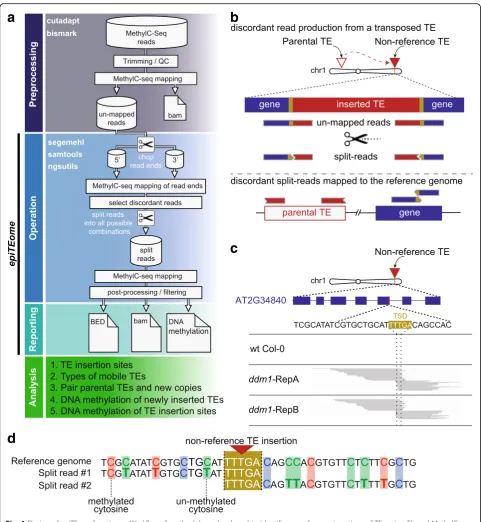
Unlike other programs developed to identify new TE in-sertion sites,epiTEome was developed to initiate analysis with MethylC-seq reads generated from whole-genome sequencing of bisulfite-converted DNA. Before mapping, reads are trimmed and processed to remove adapters, low quality and imperfect sequencing reads from a FASTQ file (preprocessing, Fig. 1a). The trimmed and filtered reads are then mapped to the reference genome using Bismark [14] or any MethylC-seq mapping pro-gram. Stringent filtering and sensitive mapping are sug-gested to reduce the fraction of low quality unmapped reads, as the MethylC-seq reads that fail to map to the reference genome are the input toepiTEome(Fig. 1a).
EpiTEomesplits and maps each MethylC-seq read that failed to align to the reference genome. The initial length of each spit-read end is user-defined; however, it should be over 25 nucleotides (nt).EpiTEomefirst identifies the reads with discordant (map to different locations in the genome) ends using the mapping programSegemehl[15] (operation, Fig. 1a). Once the discordant reads are
identified, the corresponding full-length read is split into all possible combinations with a minimal length of 25 nt. Each variation of the split-read is mapped to the reference genome to identify the breakpoint location on the read where one half maps to a TE and the other half to the new insertion site (Fig. 1b). This process identifies the point of the read that transitions from one discord-ant position to another and only the read split at this position is retained for analysis of TE insertion sites (Fig. 1c) and DNA methylation (Fig. 1d).
Discordant split reads are processed by filtering for those with at least one end at the edge of an annotated TE (operation, Fig. 1a). If both ends discordantly map to the same TE family (likely due to frequent TE internal deletions), the read is discarded. Discordant reads are next clustered based on their location in the genome and further filtered. Read clusters are filtered for: (1) the number of split-reads supporting the new insertion site (>5); (2) both ends of the same TE must be represented at the insertion site; and (3) the overlap of the reads at the insertion site should not extend beyond the target site duplication (TSD) generated by TE insertion (Fig. 1c). EpiTEome results are reported as coordinate positions of each TE insertion site, TE family, and paren-tal TE copy (reporting, Fig. 1a). Application of this work-flow identifies sites of new TE insertion, the TE TSD, and mobile TE families (analysis, Fig. 1a).
To this point in the workflow,epiTEomefunctions simi-larly to SPLITREADER and TEPID to identify new TE insertion sites (Fig. 1b). The added value ofepiTEomeis the ability to detect the DNA methylation status of the trans-posed TE and insertion site using the exact split-reads that identified the transposition event. DNA methylation is reported as single-insertion alignments (Fig. 1d), as well as meta-analysis of all insertion sites in the sample. The methylation is split into CG, CHG, and CHH contexts for both the 5′ and 3′ (non-TE) flank of the insertion site (Fig. 1d), as well as the 5′and 3′TE ends (analysis, Fig. 1a).
Detection of simulated TE insertions
a
b
c
d
Fig. 1Design ofepiTEomefunction.aWorkflowof methodology developed to identify non-reference insertions of TEs using filtered MethylC-seq reads that fail to align to the reference genome.bPrinciple behind split-read detection of new TE insertion sites. Reads that fail to fully map to the reference genome are used to identify the sites of new TE insertion. Non-mapping reads are split and mapped to the reference genome to identify reads with one end that maps to a TE and the other end to the site of insertion.cExample of a new TE insertion detected byepiTEome
in Arabidopsis:ddm1mutants undergo TE transcriptional reactivation and transposition [30]. Split reads not present in wild-type (wt Col-0) identify a TE insertion into the gene At2g34840 in two biological replicates ofddm1MethylC-seq (RepA and RepB). The 5′and 3′flanking spit reads overlap (dashed lines) at the target site duplication (gold sequence) generated by TE insertion.dIn addition to identifying new TE insertion sites,
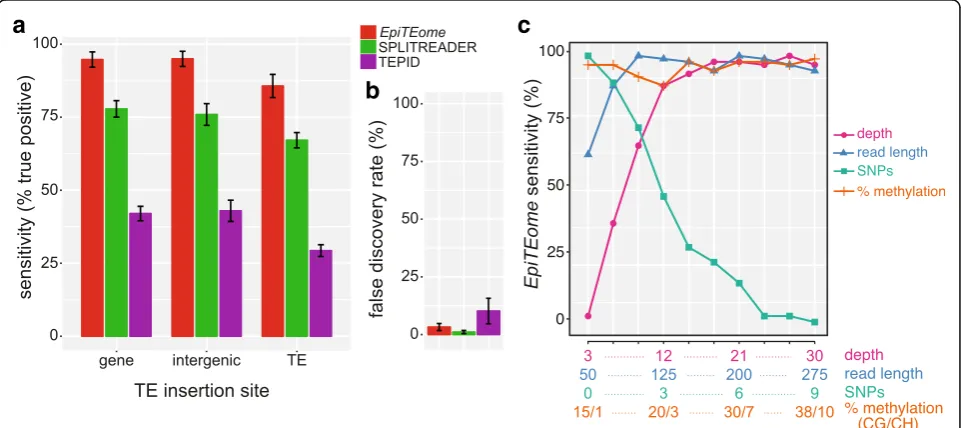
[image:3.595.57.539.85.608.2]LINE element (ATLINE2) [12, 13]. We created simulated insertions into the chromosomal contexts of genes, TEs, and non-TE/non-gene “intergenic” regions. We tested SPLITREADER and TEPID usingin silicogenerated DNA sequencing reads and epiTEomeon the same dataset that wein silicobisulfite-converted assuming the genome-wide rates of CG and CH methylation (see “Methods”). We found that TE insertions were detected at 92% sensitivity byepiTEomeusing bisulfite-converted reads, a higher sensi-tivity compared with programs that do not use bisulfite-converted reads (Fig. 2a). For insertions into repetitive regions, reduced sensitivity occurs for each of the programs tested, including a drop from 95% (insertion into a gene) to 86% (insertion into a TE) sensitivity forepiTEome(Fig. 2a). However, epiTEome remains the most sensitive TE inser-tion site detecinser-tion program independent of TE inserinser-tion site (Fig. 2a), even while using bisulfite-converted MethylC-seq reads. We also calculated the false discovery rate (FDR) ofepiTEome(3.26%) and demonstrate that it is comparable to SPLITREADER and TEPID (Fig. 2b). We therefore con-clude thatepiTEomeis a comparably sensitive and accurate detector of TE insertion sites, while using the distinct MethylC-seq data source.
To determine the factors responsible for accurate TE insertion detection from MethylC-seq data byepiTEome, we tested epiTEome sensitivity while altering four parameters: sequencing depth; read length; methylation level; and number of non-bisulfite conversion-induced single nucleotide polymorphisms (SNPs). We in silico
distributed 84 TE copies randomly on Arabidopsis chromosome 2 and independently tested each of the four variables (see “Methods”). We found that the level of methylation and read length are not critical, as long as the read length is over 75 nt (post-trimming) (Fig. 2c). More critical are the depth of sequencing/genome coverage and the number of (non-bisulfite-induced) SNPs present be-tween the reads and reference sequence. Therefore, as a best practice to identify TE insertions from MethylC-seq data, we suggest sequencing using≥100 nt length reads, depth of≥18x, while using a closely related reference genome.
EpiTEome accurately detects TE insertions from MethylC-seq data
To determine ifepiTEome can detect TE insertions from biologically relevant MethylC-seq data, we investigated naturally occurring Arabidopsis ecotypes because these samples have been subjected to both genome resequen-cing and MethylC-seq analyses [16–18]. We chose the Ha-0 and Rou-0 closely related ecotypes because both SPLITREADER and TEPID have previously identified unique insertions in Ha-0 compared with Rou-0 and the reference Col-0 ecotype based on genome resequencing data [12, 13].EpiTEomewas launched on publicly avail-able MethylC-seq reads from Ha-0 (85 nt reads, 21x coverage, 0.31 SNPs/read compared to the Col-0 refer-ence calculated in [18]) [17]. The overlap between iden-tified Ha-0 TE insertions between all three programs is
a
c
b
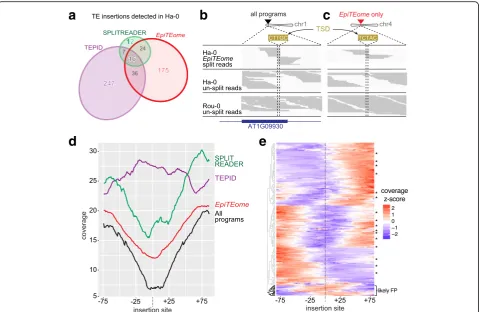
[image:4.595.58.539.447.661.2]shown in Fig. 3a. Sixteen TE insertions were identified by all programs (black), including the ATCOPIA93 (Evadé) insertion into At1g09930 (creating the target site duplica-tion CTTGC) shown in Fig. 3b. Therefore,epiTEomecan successfully detect known TE insertion sites from the unique MethylC-seq data source.
AlthoughepiTEome, SPLITREADER, and TEPID identi-fied some non-reference TE insertion sites in common, many insertions were uniquely identified by only one pro-gram (Fig. 3a). To determine if a detected TE insertion site is real, we performed a verification analysis based on the mapping coverage of the un-split reads. For example, due to the TE insertion into At1g09930 in the Ha-0 ecotype, un-split read coverage at this site is absent compared with the flanking DNA. This lack of un-split read coverage is due to all of the reads from this region having TE content and thus not mapping the reference genome that lacks the TE insertion (Fig. 3b). This is in contrast to the full un-split read coverage of the closely related ecotype Rou-0
that does not carry the TE insertion (Fig. 3b). TE inser-tions detected by split-reads can therefore be confirmed by a reduced coverage of un-split reads at the insertion site compared to the flanking DNA.
We next investigated a TE insertion site only detected by epiTEome. An ATCOPIA58 insertion into chromosome 4 was detected in the MethylC-seq split reads byepiTEome and is verified by the lack of un-split read coverage at the insertion site (compared to Rou-0 which does not have the TE insertion) (Fig. 3c). To determine if a majority of the 175 TE insertions identified only byepiTEome(Fig. 3a) are true positives, we performed a meta-analysis of the un-split MethylC-seq read coverage of TE insertion sites that were detected by all programs (black), or uniquely byepiTEome (red), TEPID (purple) or SPLITREADER (green) (Fig. 3d). We find the highest confidence in the TE insertions de-tected by all three programs, while the unique TE insertions detected by epiTEome (from MethylC-seq) are supported by decreased un-split read coverage at the insertion site.
a
b
c
d
e
[image:5.595.59.539.87.399.2]The 12 TE insertion sites uniquely detected by SPLITREA-DER are likely missed byepiTEome(false negatives [FNs]), while the 247 insertions uniquely identified by TEPID are not supported in the MethylC-seq data. These unconfirmed insertions detected by TEPID are likely not due to the accuracy of the program, but rather due to the fact that TEPID TE insertions are identified based on genome rese-quencing, not the MethylC-seq dataset that we are testing it against. To further determine the rate at whichepiTEome was detecting FPs, we investigated the un-split MethylC-seq read coverage of each of the TE insertion sites uniquely detected by epiTEome or detected by all three programs. This analysis demonstrates that a decrease in un-split read coverage occurs for 93% of these TE insertion sites (Fig. 3e), providing confidence that the majority of TE insertions detected by only epiTEome are true positives from the MethylC-seq raw data.
Detection of new TE insertions in repetitive crop genomes
To determine if epiTEomecould function to identify TE insertions within larger and more complex plant crop
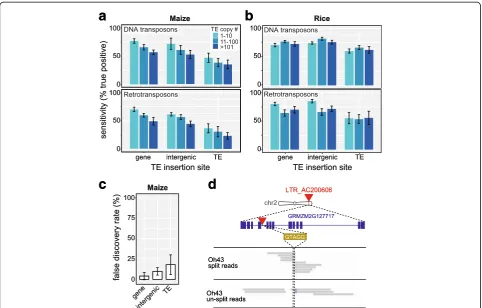
genomes, we performed a simulated detection of new TE insertions in maize (2.3 Gbp, 85% TEs [19]) and rice (389 Mbp, ~35% TEs [20]). As expected, epiTEome functions with the highest sensitivity on low copy number TEs inserted into genic regions (Fig. 4a, b). When the retro-transposon copy number exceeds 100, and when inserted into TE regions of the genome, the sensitivity ofepiTEome drops to 25% in maize and 56% in rice (Fig. 4a, b). This sensitivity drop represents the computationally most diffi-cult TE insertions to detect and these TE-into-TE inser-tion events are associated with an increase in FDR (Fig. 4c). This suggests thatepiTEomewill function better for less repetitive genomes or when performed on highly repetitive genomes such as maizeepiTEomewill be most sensitive to detect insertion of DNA TEs into genes.
To test epiTEome on biological data, we investigated published maize MethylC-seq data to identify TE insertion variation in the standard inbred line Oh43 compared with the reference genome strain B73. We chose Oh43 because it represents a computational challenge due to the large variation (non-bisulfite-induced SNPs) between maize inbred lines. In addition, the Oh43 MethylC-seq had not
a
c
d
b
a
c
d
b
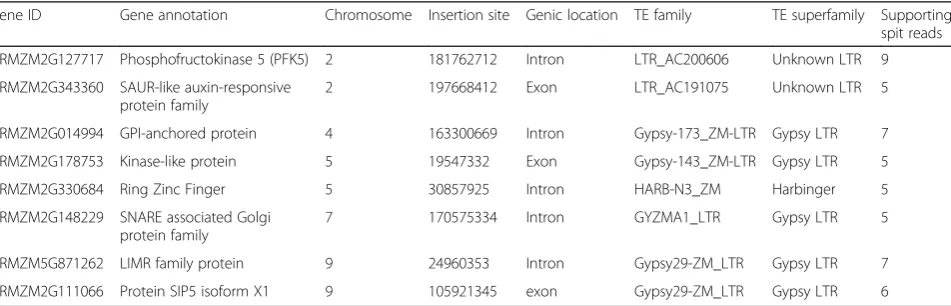
[image:6.595.57.540.364.672.2]been subjected to target enrichment via sequence capture, but rather represented the whole genome at 13x coverage [21]. We found 18 TE insertions (eight into genes, Table 1) in Oh43 compared with B73. For example, we identified an LTR retrotransposon TE inserted into an intron of the PFK5 protein-coding gene, which was verified as a gap in un-split read coverage at this site (Fig. 4d). This analysis demonstrates thatepiTEomeis capable of detecting TE in-sertions from MethylC-seq datasets produced from repeti-tive crop genomes.
EpiTEomeidentifies the cytosine methylation status of non-reference TEs and flanking DNA
To demonstrate epiTEome’s ability to capture and report the DNA methylation state of TE insertion sites, we used the Arabidopsis Ha-0 ecotype and calculated the average DNA methylation at: (1) each non-reference TE insertion; (2) the flanking non-TE DNA of the insertion site; (3) these same loci without the insertion in the reference Col-0; and (4) the parental TEs that produced the transposed copies in Ha-0 (Fig. 5). We confirmed that transposition of a TE recruits DNA methylation to the insertion site (Fig. 5, mid-dle), which without TE insertion have low DNA methyla-tion levels (Fig. 5, top) [12, 22]. These non-reference TEs and flanking DNA have similar DNA methylation levels compared with their parental TE loci (Fig. 5, bottom). Of note, we observed higher CHH methylation levels at the more recently inserted TEs and flanking sites compared to the parental TE copies, suggesting that the more recent copies are more efficient targets of small RNA-directed DNA methylation. Using a MethylC-seq read of 85 nt, we were able to determine DNA methylation states of 60 bp on either side of the TE insertion site (Fig. 5, right side). This window of resolution will increase with longer sequencing reads; however, it is long enough to detect a difference between DNA methylation contexts at the TE insertion sites: while CG and CHG methylation linearly decrease from the flanks of a more recent TE insertion site,
CHH methylation exponentially decreases to a low level within 40 bases of the insertion site (Fig. 5, middle right).
Discussion
EpiTEomerepresents an improvement both in the sensi-tivity of TE insertion site detection (Fig. 2a), as well as the ability to use MethylC-seq data. However, there are technical and biological limitations that must be im-posed on epiTEome to reduce the number of FPs. For example, sequencing depth greatly impacts epiTEome sensitivity (Fig. 2c). Increased sequencing depth in-creases the likelihood of reads with discordant break-point junctions near their center. Due to the reduced complexity of the DNA code using bisulfite-converted DNA, the number of non-bisulfite-induced SNPs be-tween the reads and reference genome also significantly alters epiTEome sensitivity (Fig. 2c). This will limit TE insertion site detection in lines without a closely related reference genome and will work better for investigation of tissues or mutants within one strain, rather than be-tween multiple strains.
[image:7.595.62.538.578.731.2]In addition to mapping limitations,epiTEomefiltering steps remove TE insertion sites within a TE of the same family. This limits insertion detection for TEs that both compose and target heterochromatin, such as some LTR retrotransposons, which are often inserted into similar TE copies [23]. This filtration was necessary to avoid the split-read detection of frequent TE internal deletions produced by non-homologous recombination (not real transposition events).EpiTEomewill also be more sensi-tive to detect germinal transposition events rather than somatic. Germinal events will be present in all of the sampled DNA and thus appear in multiple reads along with a correlation of decreased un-split read coverage at that TE insertion site. Somatic insertion split-reads may be rare (depending on the timing/size of the sector) and likely will not have an observable decrease of un-split read coverage.
Table 1EpiTEome-identified non-reference TE insertions in maize Oh43 genes compared to the B73 reference
Gene ID Gene annotation Chromosome Insertion site Genic location TE family TE superfamily Supporting spit reads
GRMZM2G127717 Phosphofructokinase 5 (PFK5) 2 181762712 Intron LTR_AC200606 Unknown LTR 9
GRMZM2G343360 SAUR-like auxin-responsive protein family
2 197668412 Exon LTR_AC191075 Unknown LTR 5
GRMZM2G014994 GPI-anchored protein 4 163300669 Intron Gypsy-173_ZM-LTR Gypsy LTR 7
GRMZM2G178753 Kinase-like protein 5 19547332 Exon Gypsy-143_ZM-LTR Gypsy LTR 5
GRMZM2G330684 Ring Zinc Finger 5 30857925 Intron HARB-N3_ZM Harbinger 5
GRMZM2G148229 SNARE associated Golgi protein family
7 170575334 Intron GYZMA1_LTR Gypsy LTR 5
GRMZM5G871262 LIMR family protein 9 24960353 Intron Gypsy29-ZM_LTR Gypsy LTR 7
The major breakthrough of epiTEome is the ability to detect new TE insertion sites from a data source
designed to detect cytosine DNA methylation.
EpiTEome is efficient at TE insertion site detection, but also will identify the DNA methylation status of those sites. Even with both genome resequencing and MethylC-seq data in hand, the methylation of new TE insertion sites has not been investigated because both of these datasets are mapped to the reference genome, failing to identify non-reference TE positions. Our proof-of-principle results on one Arabidopsis mutant, one Arabidopsis ecotype, and between two maize in-bred lines demonstrates thatepiTEomecan assay DNA methylation at new TE insertion sites in both simple and complex/repetitive genomes. We confirm DNA
methylation recruitment to new TE insertion sites and a differential level of methylation between the non-reference and parental TE insertions. By generating the epiTEome program, we have provided the epigen-etics community the resource to obtain more out of their data and assay two new features:TE insertion sites and their DNA methylation status, from existing or future MethylC-seq data.
Conclusions
EpiTEome provides, for the first time, the ability to de-tect new TE insertion events from new or existing MethylC-seq data. This program combines the analysis of new TE insertion sites with the analysis of TE DNA
[image:8.595.60.538.87.486.2]methylation into a single analysis, reducing the require-ment to perform both genome resequencing and MethylC-seq on the same samples. EpiTEome enables new epigenomic investigation of previously overlooked non-reference TE insertion sites.
Methods
Identification of new TE insertion sites
All FASTQ files were trimmed for adapters and pre-processed to remove low quality reads using cutadapt [24] with the following parameters: -q 30 –max-n 0. Trimmed FASTQ reads were then mapped to a refer-ence genome using the MethylC-Seq mapping pro-gram Bismark [14] using the following parameters: –bowtie2 –ambiguous –unmapped –R 10 –score_min L,0,-0.6 -N 1. Identification of new TE insertion sites was performed using epiTEome (Fig. 1a). As output, epiTEomeprovides a file that contains the coordinates of the non-reference TE insertion sites, the type of mobile TEs, and the parental TE copy. In addition, epi-TEome also outputs the methylation level at the edge of the non-reference TE and flanking insertion site.
Simulated data
For the analysis in Fig. 2a and b, 14 different types of TEs were inserted into a total of 84 loci on Arabidop-sis chromosome 2. Three different TE insertion con-texts (genic, intergenic, and TE) were chosen for each of the 84 neo-insertion sites, generating a synthetic chromosome 2 FASTA sequence. Among the three different TE insertion contexts, TE insertion sites were randomly chosen using bedtools shuffle and TEs were inserted using the custom Perl script insertTE-sintoFasta.pl (available as part of epiTEome software package). We next in silico bisulfite-converted DNA sequencing reads with Sherman [25], using the rates of 20% CG and 3% CH, which represent the average methylation level on Arabidopsis chromosome 2. In silico sequencing reads were produced using Sherman with a read length of 85 nt, a 20x genome coverage, and no SNPs. All three programs were launched on either the non-bisulfite-converted reads (TEPID and READSPLI-TER) or bisulfite-converted reads (epiTEome) and the out-putted coordinates of TE neo-insertion sites were compared with the reference using bedmap[26]. This comparison allowed us to estimate the accuracy of each program by calculating the sensitivity (TP/(TP + FN)) and the FDR (FP/(TP + FP)). The same procedure was reproduced for the analysis in Fig. 2c using only epiTEome, 84 random insertion sites, and by altering independently the variables: depth of coverage; read length; number of SNPs; and percentage of methyla-tion. A similar procedure was performed for Fig. 4a–c:
LTR retrotransposons and DNA transposons were se-lected from TE families having a low (1–10), medium (11–100), and high (>101) copy number of TEs. Four hundred TEs were randomly inserted within three differ-ent TE insertion contexts (genic, intergenic, and TE) of maize chromosome 1 or rice chromosome 1.
EpiTEomeanalysis of the Ha-0 accession
Coordinates of new TE insertion sites from the Arabidop-sis ecotype Ha-0 identified by either SPLITREADER and TEPID were downloaded from [12] and [13]. Comparison of the new TE insertion site coordinates predicted by epiTEome with the two other methods was performed usingbedmap. The proportional Venn diagram in Fig. 3a was produced usingeulerAPE [27]. Validation of new TE insertion sites detected specifically by epiTEome was performed by calculating the un-split read coverage at each new TE insertion site (+/−80 bp). In Fig. 3e, the un-split read coverage standard score at the insertion site is clustered using the Ward’s method of hierarchical cluster analysis (R packageggdendro).
Analysis of non-reference TE insertions in maize
The coordinates of new TE insertion sites were identified byepiTEomeby aligning 100 bp bisulfite-converted reads to the maize reference genome (version 3) and corre-sponding version 3 annotation [28]. EpiTEomedisplayed enhanced sensitivity using the improved version 4 B73 ref-erence sequence and annotation (unpublished data).
Analysis of DNA methylation level
DNA methylation level was assayed in each of the three cytosine contexts (CG, CHG, and CHH) at the flanking DNA surrounding the new TE insertion site and at both edges of the newly inserted TE. Only MethylC-seq discordant split-reads identified by epiTEomewere used to calculate this methylation level. Meta-analysis was performed by averaging methylation levels at the 5′and 3′ of the new insertion site within 10 nt windows. For any given window, the variation in methylation across all elements was used to calculate the 95% CI.
Availablility and Requirements
The authors thank Kaushik Panda for his comments on this work.
Funding
This work is supported by the Ohio Supercomputer Center and the U.S. National Science Foundation grant MCB-1252370 to RKS.
Availability of data and materials
MethylC-seq data forArabidopsis thalianaaccessions were obtained from the NCBI SRA archive GSE43857 [17]. MethylC-Seq data from theddm1mutant are from GSE79746 [29]. MethylC-seq data for the maize inbred lines were obtained from the NCBI SRA archive SRP048795 [21].
EpiTEomeis freely available at https://github.com/jdaron/epiTEome under a GNU General Public License and the source code has been deposited at Zenodo (doi:10.5281/zenodo.495189). The general procedure by which
epiTEomefunctions is described in Fig. 1 and in more detail within the README file distributed with the software package.
Authors’contributions
RKS contributed research funding. JD generated and testedepiTEomeand analyzed the results. RKS and JD identified the initial research direction and co-wrote the paper. Both authors read and approved the final manuscript.
Competing interests
The authors declare that they have no competing interests.
Ethics approval and consent to participate
N/A.
Publisher’s Note
Springer Nature remains neutral with regard to jurisdictional claims in published maps and institutional affiliations.
Received: 31 January 2017 Accepted: 5 May 2017
References
1. Kidwell MG, Lisch D. Transposable elements as sources of variation in animals and plants. Proc Natl Acad Sci U S A. 1997;94:7704–11. 2. Hancks DC, Kazazian HH. Roles for retrotransposon insertions in human
disease. Mob DNA. 2016;7:9.
3. Levin HL, Moran JV. Dynamic interactions between transposable elements and their hosts. Nat Rev Genet. 2011;12:615–27.
4. Wicker T, Sabot F, Hua-Van A, Bennetzen JL, Capy P, Chalhoub B, et al. A unified classification system for eukaryotic transposable elements. Nat Rev Genet. 2007;8:973–82.
5. Daron J, Glover N, Pingault L, Theil S, Jamilloux V, Paux E, et al. Organization and evolution of transposable elements along the bread wheat
chromosome 3B. Genome Biol. 2014;15:546.
6. Kidwell MG. Transposable elements and the evolution of genome size in eukaryotes. Genetica. 2002;115:49–63.
7. Zhang J, Yu C, Krishnaswamy L, Peterson T. Transposable elements as catalysts for chromosome rearrangements. Methods Mol Biol. 2011;701:315–26. 8. Fultz D, Choudury SG, Slotkin RK. Silencing of active transposable elements
in plants. Curr Opin Plant Biol. 2015;27:67–76.
9. Urich MA, Nery JR, Lister R, Schmitz RJ, Ecker JR. MethylC-seq library preparation for base-resolution whole-genome bisulfite sequencing. Nat Protoc. 2015;10:475–83.
10. Jiang N, Bao Z, Zhang X, Hirochika H, Eddy SR, McCouch SR, et al. An active DNA transposon family in rice. Nature. 2003;421:163–7.
11. Ewing AD. Transposable element detection from whole genome sequence data. Mob DNA. 2015;6:164.
12. Quadrana L, Bortolini Silveira A, Mayhew GF, LeBlanc C, Martienssen RA, Jeddeloh JA, et al. The Arabidopsis thaliana mobilome and its impact at the species level. Elife. 2016;5:e15716.
13. Stuart T, Eichten S, Cahn J, Karpievitch Y, Borevitz J, Lister R. Population scale mapping of transposable element diversity reveals links to gene regulation and epigenomic variation. Elife. 2016;5:e20777.
14. Krueger F, Andrews SR. Bismark: a flexible aligner and methylation caller for Bisulfite-Seq applications. Bioinformatics. 2011;27:1571–2.
treated sequencing data. Bioinformatics. 2012;28:1698–704.
16. Cao J, Schneeberger K, Ossowski S, Günther T, Bender S, Fitz J, et al. Whole-genome sequencing of multiple Arabidopsis thaliana populations. Nat Genet. 2011;43:956–63.
17. Kawakatsu T, Huang S-SC, Jupe F, Sasaki E, Schmitz RJ, Urich MA, et al. Epigenomic diversity in a global collection of Arabidopsis thaliana accessions. Mol Cell. 2016;166:492–505.
18. 1001 Genomes Consortium. 1,135 genomes reveal the global pattern of polymorphism in Arabidopsis thaliana. Cell. 2016;166:481–91. 19. Schnable PS, Ware D, Fulton RS, Stein JC, Wei F, Pasternak S, et al. The B73
maize genome: complexity, diversity, and dynamics. Science. 2009;326:1112–5. 20. International Rice Genome Sequencing Project. The map-based sequence of
the rice genome. Nature. 2005;436:793–800.
21. Li Q, Eichten SR, Hermanson PJ, Zaunbrecher VM, Song J, Wendt J, et al. Genetic perturbation of the maize methylome. Plant Cell. 2014;26:4602–16. 22. Ahmed I, Sarazin A, Bowler C, Colot V, Quesneville H. Genome-wide
evidence for local DNA methylation spreading from small RNA-targeted sequences in Arabidopsis. Nucleic Acids Res. 2011;39:6919–31. 23. SanMiguel P, Tikhonov A, Jin YK, Motchoulskaia N, Zakharov D,
Melake-Berhan A, et al. Nested retrotransposons in the intergenic regions of the maize genome. Science. 1996;274:765–8.
24. Martin M. Cutadapt removes adapter sequences from high-throughput sequencing reads. EMBnet J. 2011;17:10–2.
25. Krueger F. Sherman - bisulfite-treated Read FastQ Simulator. 2014. https:// www.bioinformatics.babraham.ac.uk/projects/sherman.
26. Neph S, Kuehn MS, Reynolds AP, Haugen E, Thurman RE, Johnson AK, et al. BEDOPS: high-performance genomic feature operations. Bioinformatics. 2012;28:1919–20.
27. Micallef L, Rodgers P. eulerAPE: drawing area-proportional 3-Venn diagrams using ellipses. PLoS One. 2014;9:e101717.
28. Law M, Childs KL, Campbell MS, Stein JC, Olson AJ, Holt C, et al. Automated update, revision, and quality control of the maize genome annotations using MAKER-P improves the B73 RefGen_v3 gene models and identifies new genes. Plant Physiol. 2014;167:25–39.
29. Panda K, Ji L, Neumann DA, Daron J, Schmitz RJ, Slotkin RK. Full-length autonomous transposable elements are preferentially targeted by expression-dependent forms of RNA-directed DNA methylation. Genome Biol. 2016;17:100.
30. Miura A, Yonebayashi S, Watanabe K, Toyama T, Shimada H, Kakutani T. Mobilization of transposons by a mutation abolishing full DNA methylation in Arabidopsis. Nature. 2001;411:212–4.
• We accept pre-submission inquiries
• Our selector tool helps you to find the most relevant journal
• We provide round the clock customer support
• Convenient online submission
• Thorough peer review
• Inclusion in PubMed and all major indexing services
• Maximum visibility for your research Submit your manuscript at
www.biomedcentral.com/submit