Technology (IJRASET)
Design of Tuning Methods for Fractional order
PI
λ
D
μ
Controller using PSO Algorithm
M.Suresh Kumar1, Smt.K.Vindhya Smitha2
1
PG student, [C.S],EEE Department, Gudlavalleru Engineering College (JNTUK), Gudlavalleru, AP, India
2
Associate professor, EEE Department, Gudlavalleru Engineering College, Gudlavalleru, AP, India
Abstract: - PID controllers are widely used in many industrial applications due to their simplicity and robustness. In conventional PID controllers such as Ziegler’s-Nicholas tuning method it has been found that the controller designed using conventional PID may not be able to satisfy required performance criterion. To overcome this difficulty, in this paper a new fractional order PID controller is proposed using PSO technique. The proposed PSO-FOPID strategy determines the controller parameters by optimizing performance index such as ISE. The performance of the closed loop system with FOPID controller is much better than conventional order PID controller for the same system by using the MATLAB/Simulink.
Keywords: - Fractional calculus, fractional order controller, fractional order toolbox for MATLAB, PSO algorithm.
I. INTRODUCTION
Technology (IJRASET)
reduced and the results compared with conventional PID.
II. TUNING OF INTEGER ORDER PID CONTROLLER
A proportional–integral–derivative controller (PID controller) is a generic control loop feedback mechanism (controller) commonly used in industrial control systems– a PID is the most frequently used feedback controller. A PID controller calculates an "error" value as the difference between a measured plant variable and a preferred set point. The controller attempts to reduce the error by tuning the plant control inputs. The proportional, integral, and derivative terms are adding to calculate the output of the PID controller. Defining u(t) as the controller output, the PID algorithm final form is:
u(t) = K e(t) + K ∫ e(τ)dτ + K e(t) (1)
The PID controller transfer function in Laplace transform form is
c(s) = K + + K s (2)
The PID controller transfer function is given as
G(S) = ( )(
) (3)
Then according to tuning method ZEIGLER-NICHOLAS
Kp= 0.6Kcu Ti= 0.5Pcu Td= 0.2Pcu
(4)
PID (IOPID) controller integer order is given as.
(5)
III. FRACTIONAL CALCULUS
Fractional calculus is a mathematical subject with more than 300-year history, but the application in physics and engineering has been newly attracted lots of attention. During past three centuries, this subject was through mathematicians, and single in last few years, this was pulled to some (applied) fields of engineering, science and economics. In engineering mainly in plant control, fractional calculus is suitable for hot topic in both modeling and control area.
A frequently used definition of the fractional differ integral is the Riemann-Liouville definition
aD∝f(t) =
( ∝) ∫
( )
( ) ( ∝)
∝ dτ (6)
form − 1 <∝< m where Γ(・) is the well-known Euler’s gamma function. An alternative definition, based on the concept of fractional differentiation, is the Grunwald-Letnikov definition given as
aD∝f(t) = lim
⟶ (∝) ∝∑
(∝ )
( )f(t − kh)
( ∝)/ (7) ) 1 1 ( )
( T s
s T K s G d i
p
s s
s
Technology (IJRASET)
One can examine that by introducing the notion of fractional order operator aD∝f(t) , the differentiator and integrator can be
combined.
Another helpful tool is the Laplace transform, a fractional order differential equation, provided both the signals u(t) and y(t) at t = 0, can be expressed in a transfer function form is given by
G(s) = ∝ ∝ ⋯
∝
⋯ (8)
Where (a , b ) ∈ R , (∝ , β ) ∈ R , ∀ (m ∈ N)
Fractional derivatives provide an outstanding instrument for the description of memory and hereditary properties of various materials and processes. This is the main benefit of fractional derivatives in comparison with classical integer order models, in which such effects are in fact ignored. The importance of fractional order control is that it is a generalization of classical integral order control theory, which could lead to more adequate modeling and more robust control performance. The benefits of fractional derivatives become obvious in modeling mechanical and electrical properties of real materials, as well as in the description of rheological properties of rocks, and in several other fields
IV. FRACTIONAL ORDER PID (FOPID) CONTROLLER
The integral-differential equation defining the control action of a fractional order PID controller is given as
u(t) = K e(t) + K D e(t) + K D e(t) (9)
Where e(t) is the tracking system error signal, u(t) is the control signal, Applying Laplace transform to this equation with null basic conditions, the transfer function for fractional order PID controller can be expressed as
c(s) = K + + K s (λ, μ >0)
In a graphical way, the control possibilities using a fractional-order PID controller are shown in Fig 2.
Fig 2.: Fractional-order PID vs classical PID
Expansion of the four control points of the classical PID to the range of control points of the quarter-plane defined by selecting the values of λ and μ
A. Tuning method for the fractional order PID controller
The tuning parameters of fractional order PID controllers are Kc, Ti, Td,lambda and mu. Ziegler-Nichols tuning rule is useful for tuning the parameters Kc, Tiand Td. Having obtained the parameters Kc, Tiand Tdin the first step, the optimum settings of the fractional integration of order lambda and the fractional differentiation of order mu of the PID controller are determined by using optimization method.
(10)
V. PARTICLE SWARM OPTIMIZATION
The PSO techniques have been employed effectively to solve difficult optimization problems. PSO first introduced by Kennedy and
79 . 0 39
.
1
3
.
75
63
.
1
6
.
3
)
(
s
s
s
Technology (IJRASET)
Eberhart is one of the modern heuristic procedures; it has been forced by the behavior of organisms, such as fish schooling and bird flocking. Commonly, PSO is characterized as a easy concept, simple to implement, and computationally capable.
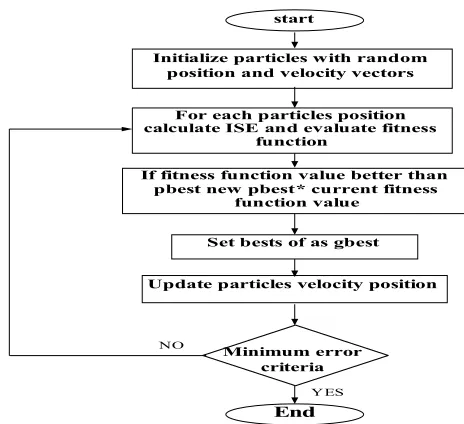
[image:5.612.186.418.496.708.2]PSO is a robust stochastic optimization method based on the movement and intelligence of swarms.PSO applies the idea of social interaction to problem solving. It uses a number of particles that constitute a swarm moving around in the search space looking for the best solution .Each particle is taken as a point in a N-dimensional. Each particle keeps path of its coordinates in the explanation space which are related with the best result (fitness) that has achieved so far by that particle. This value is called personal best, pbest.Another best value that is tracked by the PSO is the best value obtained so far by any particle in the locality of that particle. This value is called gbest. The fundamental concept of PSO lies in accelerating each particle toward its pbest and the gbest positions, with a random weighted acceleration at each time step as shown in Fig14.
Fig 3: idea of modification of a searching point by PSO
The alteration of the particle’s position can be mathematically changed. According the following equation: Vik+1 = wVik +c1 rand1 (…) x (pbesti- sik) + c2 rand2 (…) x (gbest-sik) …..(11)
A. Performance Indices for the PSO Algorithm
The main function considered is based on the error working criterion. The working of a controller is best calculation in terms of error criterion. A number of such criteria are accessible and in the proposed work, controller’s performance index is evaluated in terms of Integral of square error, it gives
(12)
B. Arrangement PSO for FOPID Controller parameters
start
Initialize particles with random position and velocity vectors
For each particles position calculate ISE and evaluate fitness
function
If fitness function value better than pbest new pbest* current fitness
function value
Set bests of as gbest
Minimum error criteria
Update particles velocity position
End NO
Y ES
e
t
dt
Technology (IJRASET)
C. Parameters of PSO algorithms
TABLE1: Parameters of PSO algorithms
Population size 50
No. of iterations 50
Wmax 0.9
c1 1.2
c2 0.12
VI. DESIGN OF PIλDμ CONTROLLER WITH OPTIMAL PSO ALGORITHM
The closed loop system with negative unity feedback control system simulation with MATLAB shown in fig. where the fractional order PID (FOPID) controller Gc(s) developed by using fractional control toolbox the integral of time square error (ISE) as objective function and the process G(s) were developed by MATLAB toolbox.
( ) = + +
G(s) = 1
s(s + 1)(s + 2)
A. Implementation of PSO-PID&PSO-FOPID Algorithm
The optimal values of the conventional PID controller parameters Kp, Ki &Kd, is found using PSO-PID. After getting optimized value of Kp,Ki,,Kd replacement in FOPID block and find lambda, mu values using PSO-FOPID and attuned so as to reduce the objective function ISE.
Fig5:simulink diagram for PSO-PID
Technology (IJRASET)
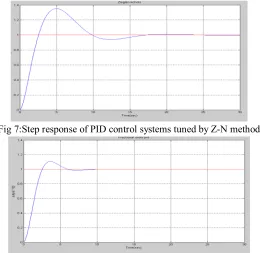
Fig 7:Step response of PID control systems tuned by Z-N method
[image:7.612.177.438.89.342.2]Fig 8: Step response of fractional order PID controller
Fig 9: Step response of FOPID controller tuned by PSO
TABLE 2 .Parameters of PID&FOPID controller
Tuning method and controller
Parameters
kp ki kd lambda mu
Z-N PID 3.6 1.63 1.98 1 1
FOPID 3.6 1.63 1.98 1.39 0.79
[image:7.612.186.427.378.503.2]Technology (IJRASET)
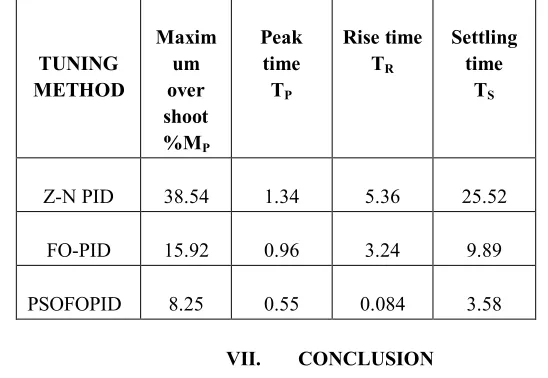
TABLE 3: Step response specification of PID , FOPID & PSO-FOPID controller
TUNING METHOD
Maxim um over shoot %MP
Peak time TP
Rise time TR
Settling time
TS
Z-N PID 38.54 1.34 5.36 25.52
FO-PID 15.92 0.96 3.24 9.89
PSOFOPID 8.25 0.55 0.084 3.58
VII. CONCLUSION
The proposed PSO-FOPID strategy determines the controller parameters by optimizing performance index such as ISE. In this paper the PSO algorithm has been utilized to get the optimal parameters of FOPID controller while reducing the ISE. The system with FOPID controller exhibits excellent time domain response as compared with the integer order PID controller by using the MATLAB/Simulink.
REFERENCES
[1] V. Shekher, P. Rai, and O. Prakash, “Tuning and Analysis of Fractional Order PID Controller,” International Journal of Electronic and Electrical Engineering,
vol. 5, no. 1, 2012, pp.11-21.
[2] I.Podlubny, “Fractional-order systems and PIλDμ controllers,” IEEE Transactions on Automatic Control, vol. 44, no. 1, 1999, pp.208-214.
[3] Jun-Yi Cao and Bing-Gang Cao,” “Design of fractional order controllers based on particle swarm optimization”, 1st IEEE Conference on Industrial Electronics
and Applications, 24-26 May 2006, pp. 1-6, Singapore
[4] MajidZamani, MasoudKarimi-Ghartemani, Nasser Sadati and MostaParniani, “Design of a fractional order PID controller for an AVR using particle swarm
optimization”, Control Engineering Practice, Volume 17, Issue 12, pp. 1380-1387, December 2009.
[5] Concepcion A. Monje, Blas M. Vinagre, Vicente Feliu and YangQuanChen,“Tuning and auto-tuning of fractional order controllers for industry applications”,
Control Engineering Practice, Volume 16, Issue 7, pp. 798-812, July 2008.
[6] MasoudKarimi-Ghartemani, MajidZamani, Nasser Sadati and MostafaParniani, “An optimal fractional order controller for an AVR system using particle
swarm optimization algorithm”, 2007 Large Engineering Systems Conference on Power Engineering, pp. 244-249, 10-12 Oct. 2007, Montreal, Que
[7] MajidZamani, MasoudKarimi-Ghartemani and Nasser Sadati, “Design of an H∞optimal FOPID controller using particle swarm optimization”, Chinese Control
Conference, CCC 2007, pp. 435-440, 26-31July 2007, Hunan
[8] Ching-Hung Lee and Fu-Kai Chang, “Fractional-order PID controller optimization via improved electromagnetism-like algorithm”, Expert Systems with
Applications, Volume 37, Issue 12, pp. 8871-8878, December 2010.
[9] Duarte Valerio and Jose Sa da Costa, “Variable-order fractional derivatives and their numerical approximations”, Signal Processing, Volume 91, Issue 3, pp.
470-483, March 2011