©IJRASET 2014: All Rights are Reserved
474
Design and Implementation of Intelligent
Controller for a Continuous Stirred Tank Reactor
System
D. Siva Nagaraju1, G. Ramesh2
M. Tech – Control System, Asst. Professor, Department of Electrical and Electronic Engg Gudlavalleru Engg College, Gudlavalleru, Krishna
Abstract: All the industrial process applications require the solutions of a specific chemical strength of the chemicals or fluids considered for analysis. Continuous Stirred Tank Reactor (CSTR) is one of the common used reactors in chemical process. Such specific concentrations are achieved by mixing of a full strength solution with water in the desired proportions. In this paper, a controller is designed for controlling the concentration of one chemical with the help of other. This paper features the influence of different controllers like PI, PID, Fuzzy logic controller and Genetic algorithm (GA) upon the process model. Model design and simulation are done in the MATLAB/ SIMULINK software. The concentration control is found better controlled with the addition of Genetic algorithm (GA) instead of fuzzy logic and conventional PID controllers. The improvement of the process is observed.
Keywords: Genetic Algorithm (GA) Fuzzy Logic controller (FLC), conventional PID Controller, Chemical Concentration, CSTR.
I. INTRODUCTION
The Continuous Stirred Tank Reactor system (CSTR) is a complex nonlinear system. Due to its strong nonlinear behaviour, the problem of the identification and control of CSTR is always a challenging task for control systems engineer[1]. Chemical reactors often have significant heat effects, so it is important to be able to add or remove the heat from them. In a CSTR (continuously stirred tank reactor) the heat is add or removed by virtue of the temperature difference between the jacked fluid and reactor fluid. Often, the heat transfer fluid is pumped through agitation nozzle that circulates the fluid through the jacket at a high velocity. The reactant conversion in a chemical reactor is a function of a residence time or its inverse, the space velocity. For a CSTR, the product concentration can be controlled by manipulating the feed flow rate, which change the residence time for a constant chemical reactor.
The primary benefit of the fuzzy system theory is to approximate the system behaviour, where numerical functions or analytical functions do not exist. Hence, Fuzzy systems have high potential to understand the systems that are devoid of analytical formulations in a complex System. Complex systems can be a new systems that have not been tested, they can involve with the human conditions such as biological or medical systems. The ultimate goal of the fuzzy logic is to form the theoretical foundation for reasoning about the imprecise reasoning, such reasoning is known as approximate reasoning.
Genetic Algorithm (GA) was first introduced by Holland [10] and popularized by Goldberg [11]. It is one of the modern heuristic algorithms based on a principle of Charles Darwinian theory of evolution to natural biology. The GA technique can generate a high quality solution within shorter calculation time and stable convergence characteristics. GA method is an excellent method for solving the optimal PID controller parameters. Therefore, this study develops the GA-PID controller to search optimal PID parameters.
In this paper, CSTR is used to mix ethylene oxide with water to make ethylene glycol. Here the purpose is to control the concentration of ethylene glycol with the help of concentration of ethylene oxide. But undershoot; overshoot and inverse response come in the considered system while performing in a conventional way. But after implementation of PID controller to the process, removing of those shoots can be seen but still the design requirement is not achieved. So finally auto tuning method of PID controller is implemented in order to achieve the design requirement [3].
II. CONTINUOUS STIRRED TANK REACTOR (CSTR) MODELLING
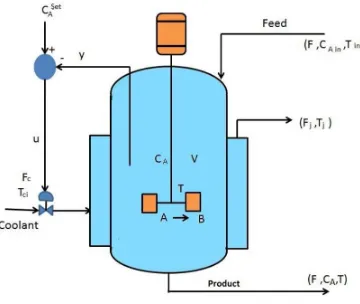
reactor (CSTR) to form ethylene glycol (Z) .Assume that the CSTR is manipulated at a constant temperature and that the water is in large excess.
Fig .1. CSTR Control System
The stoichiometric equation is
X+Y= Z………(1)
The reactant conversion in a chemical reactor is a function of residence time or its inverse, the space velocity. For an isothermal CSTR, the product concentration can be controlled by manipulated the feed flow rate, which change the residence time (for a constant volume reactor). It is convenient to work in molar units when writing components balances, particularly if chemical reaction is involved. Let C and C represent the molar concentration of X and Z (mol/volume).
dVC
dt = F CX − FC + vr … … (2)
dVC
dt = −FC + vr … … … . (3)
Where r and r represents the rate of generation of species X and Z per unit volume, and c represents the inlet concentration of species X. If the concentration of the water change than the reaction rate is second order with respect to the concentration of Ethylene oxide.
r = −K C − K C … … … (4)
Where K , K & K are the reaction rate constants and the minus sign indicate that X is consumed in the reaction. Each mole X reacts with a mole of Y and produces one mole of Z, so the rate of generation of Z is
r = K C − K C … … … (5)
Expanding the left hand side of equation (1)
= V + C ………(6)
Combining eq (1) & (5)
dC
dt =
F
V C − C − K C − K C . . (7)
476
dCdt = −
F
VC + K C − K C … (8)
III. PROBLEM FORMULATION
The linear space model or case study of CSTR is given by
.
x = Ax + Bu ……… (9) y = Cx + Du ……….. (10)
Where the states, inputs and outputs are in deviation variable form.
The first input(dilution rate) is manipulated and the second(feed concentration of A) is a disturbance input. Linearization of the two modelling equations (from equation (6) & (7)) at steady state solution to find the following state space matrices is done:
The manipulated input and output process transfer function G(s)= C(SI − A) B
is calculated with the help of Matlab.
G (S) = −1.117S + 3.1472
S + 4.6429S + 5.3821… (10)
It is desired to produce 100 million pounds per day of ethylene glycol. The feed stream concentration is 1.0 lbmol/ft3 and an 80% conversion of ethylene oxide has been to be determined reasonable. Since 80% of ethylene oxide is converted to ethylene glycol, the ethylene glycol concentration is 0.8 lbmol /ft3. In this process it is seen that the process has inverse response with delay time as well as overshoot while tunning in conventional PI, PID and fuzzy logic controllers are used. To overcome this problem and to obtain the desired response For that, soft computing based optimization method is used.
IV. PID CONTROLLER
Industrial PID controllers usually available as a form and to perform well with the industrial process problems, the PID controllers structures require modifications. The structures are given below
( ) = 1 + 1 + … … (11)
the controller parameters are calculated. The desired parameters for the PID controller are the proportional gain (K ), integral gain (K ) and the differential gain ( ). Firstly, find and solve for the characteristic equation of the process which is given by
+ (4.6429 – 1.117K ) s + (5.3821 + 3.1472 ) = 0………. (12)
Where kc is the critical(ultimate) gain. The value of kc can be calculated by the Routh Hurwitz criterion and the other parameters can be calculated by the Ziegler Nichols tuning method.
Fig 2:Block diagram of conventional PID controller
A. Ziegler-Nichols Tuning Method
ZN tuning rule was the first such effort to provide a practical approach to tune a PID controller. According to the rule, a PID controller is tuned by firstly setting it to the P-only mode but adjusting the gain to make the control system in continuous oscillation. The corresponding gain is referred to as the ultimate gain uK and the oscillation period is termed as the ultimate period uP . The key step of the ZN tuning approach is to determine the ultimate gain and period. Then, the PID controller parameters are determined from uK and uP using the ZN tuning Table I.
©IJRASET 2014: All Rights are Reserved
478
P 0.5 - -
Pi 0.45 0.83 - Pid 0.6 0.5 0.125
Table 1. Commonly used Ziegler-Nichols rules.
By putting the proportional gain (KP), integral gain (KI) and the differential gain (KD) values in the simulink PID controller, the response for the step input is obtained. We see that the output have overshoot little inverted response and also its settling time and rise time is little bit more. That is not the desired response. Now for the better control, the Fuzzy logic controller is used.
B. Fuzzy logic controller
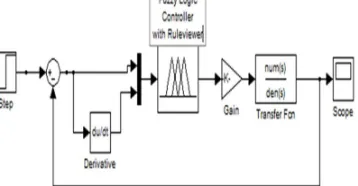
When we connect a Fuzzy logic controller, then we should require a multiplexer to give input to the controller. The inputs to the controller are error (difference of the set point and output) and feedback output (output as the feedback). Now construct the membership function for the inputs and the output taking triangular memberships.
In this paper, the input is unit step input. In this process, the 80% of the ethylene oxide converted in to the ethylene glycol (output is 80% of the input). Thus the range for the output is [0 – 0.8]. The second input is error and its range is [0 – 0.2]. Using these values, make fuzzy rules in the fuzzy rule base editor and observe the response that there is no inverted response, no overshoot, no undershoot, rise time and settling time are reduced.
C. Genetic Algorithm
The GA is a global optimization and search technique based on the principles of genetics and natural selection. GA differs significantly from most classical optimization techniques in many aspects. First of all, unlike classical methods, GAs are not a gradient based, i.e. they do not require the objective functions to be continuous, neither do they need information about the derivatives of the objective functions, therefore they can handle problems with discrete solution spaces. Second, the search mechanism is stochastic in nature, which makes them capable of searching the entire solution space with more likelihood of finding the global optima. Third, GAs are able to solve problems with non-convex solution space, where classical procedures usually fails. All these differences make GA superior over classic methods in some real world applications, particularly for some very complex engineering problems, for example: complex truss-beam design, component’s design, and structure design. GAs features can be explained for solving complex control system engineering problems
A. Controller design
B. System Identification
C. Fault Diagnosis
D. System Analysis
E. Robotics
F. Further control related combination problem
.
Fig.3 Genetic algorithm process flowchart
Simple GA has three basic operators:
Selection
Crossover
Mutation
A GA starts iteration with an initial population. Each member in this population is evaluated and assigned a fitness value. Strings with higher fitness values have more opportunities to be selected for reproduction in next step. Reproduction makes the clones of good chromosomes but does not create new one because of this crossover operator is applied. Crossover operator produces new individuals which have some part of both the parents genetic material. The crossover probability indicates how often crossover is performed. Using reproduction and crossover on their own will generate a large amount of different strings. However there are two main problems with this:
Depending on the initial population chosen, there may not be enough diversity in the initial strings to ensure the GA searches the entire problem space.
The GA may converge on sub-optimum strings due to a bad choice of initial population
These problems overcome by the introduction of a mutation operator into the GA. Mutation are the occasional random alteration of a value of a string position. The probability of mutation is normally low because a high mutation rate would destroy fit strings and degenerate the GA into a random search.
V. SIMULATION, TESTING AND RESULTS
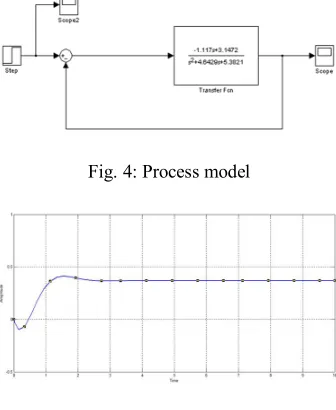
[image:7.612.108.438.472.688.2]The process is represented by the transfer function given in fig. 4, and fig. 5 depicts the output of the process.
Fig. 4: Process model
Fig. 5: step response of uncontrolled process
[image:7.612.221.389.481.686.2]480
[image:8.612.213.404.105.485.2]the desired magnitude. By using P controller there is not much effect to the output response as compared to uncontrolled process. The tuning of controller parameters is done by Zeigler & Nichols method.
Fig. 6: Process model with PID –controller
Fig. 7: step response with P controller
Fig. 8:step response with PID controller
[image:8.612.219.398.526.619.2]There is a time delay and inverted response. So Fuzzy controller is used to reduce the rise time, settling Time, overshoot and also try to remove the time delay and inverted response
Fig. 10: Fuzzy If – then rules
Fig. 10: step response with fuzzy controller
To overcome the problems occurs in fuzzy logic controller we are using the soft computing technique. By using the Gentic algorithm we can reduce the rise time, settling time is shown in the fig 17.
[image:9.612.201.411.393.699.2]Fig. 16 : step response for Genetic algorithm
©IJRASET 2014: All Rights are Reserved
482
Parameter s/ Type Peak over shoot (%) Rise time (Sec) Delay time (Sec) Settling time (Sec)PI- 80% 0.9 0.5 16 PID 52% 0.95 0.5 6 Fuzzy 2% 3.5 1.3 5 GA 0 1.6 1.1 2.2
Table.2:comparision table of pid, Fuzzy logic and genetic algorithm
VI. CONCLUSION
When there is no control to the process, it generates an inverse response together with an overshoot and considerable delay time. But when the PID controller and fuzzy logic controllers is implemented to the process, the problems of inverse response and delay time are controlled in the ongoing process and are removed considerably but then it is showing instability in terms of rise time, overshoot and settling time. To overcome this instability in rise time, overshoot & in settling time a soft computing technique Genetic algorithm used and the results are shown in the above figs, so the Rise time and settling time and overshoots are also reduced. Genetic Algorithm will give better concentration control and also improve the dynamic performance of the system in a better way by comparing with ZN and Fuzzy logic controller by the selection of an appropriate objective function.
VII. FUTURE SCOPE
This work may be extended with the help of differential evolutions and hybrid differential evolution algorithms.
REFERENCES
[1] Schmidt, Lanny D. (1998). The Engineering of Chemical Reactions. New York: Oxford University Press. ISBN 0-19-510588-5 [2] Yung C. Shin, Chengying Xu ―Intelligent Systems: Modeling, Optimization, and Control‖ CRC Press 2009.
[3] Fried land B., ―Advanced Control System Design‖, Prentice Hall, New Jersey, 1996.
[4] Hyeong-Pyo Hong, Suk-Joon Park, “A Design of Autotuning PID controller using Fuzzy logic", IEEE Trans, pp.971-976, 1992.
[5] Jaya, N. , Sivakumar, D. and Anandanatarajan, R. (2007)— Implementation of fuzzy gain scheduling of PID controllers for a two capacity interacting nonlinear process, paper presented at TIMA, January
[6] K.J. Astrom, & T. Hagglund, ―The future of PID control Control Engineering Practice”, pp.1163 -1175. 2001.
[7] Luis E. Zarate, Peterson Resende, & M. Benjamin,” A Fuzzy Logic and Variable Structure Base Controller forCSTR Control‖. Annual conference of IEEE, 2001.
[8] Xiao-Feng Li, Jian Sun, Hui-Yan Wu, Wei-Dong Zong, “Application of the fuzzy PID to the Power Plant‖, IEEE 2007.
[9]YunLi, Kiam Heong Ang and Gregory C.Y.Chong,―PID Control System Analysis and Design – Problems,Remedies, and Future Directions‖. IEEE control system magazine, February 2006 pp. 32-41,2006
[10] Haupt.R.L,S.E.Haupt, Practical Genetic Algorithm, Wiley Pub, 2004.
[11] Sivandam S.N, S.N.Deepa, Introduction to Genetic Algorithms, Springer-Verlag Berlin Heidelberg, 2008.