Recourse Optimization in Wireless Sensor Network
Sowmyashree M S1, Saritha I G2
1,2Department of Telecommunication BMS Institute of Technology and Management Bangalore, India
Abstract: Wireless sensor networks (WSN’s) are a group of sensors each of which is used to measure a particular parameter such as pressure, sound etc. One of the major considerations in deployment of sensors is bandwidth, it is a scarce resource and needs to be utilized to its full potential to increase efficiency. Simply defined bandwidth is the volume of the channel. The project deals with TDMA and how we have incorporated it’s variations along with CSMA in order to maximize the bandwidth in a network. CSMA is used in order to avoid situations such as inappropriate utilization of time slot thereby not using the bandwidth efficiently and thereby reducing overall system efficiency. Scheduling is also incorporated in our system so as to solve the problem of multiple nodes trying to gain access to a particular time slot. Dynamic scheduling incorporated allows our system to ensure bandwidth fairness among contending nodes. This proposed system is compared with the existing system which uses only TDMA.
Keywords: CSMA, TDMA, Dynamic bandwidth Allocation, Optimization, Scheduling
I. INTRODUCTION
In recent years, wireless sensor networks (WSNs) have been widely used in a wide range of applications such as military operations,medical treatments, and the monitoring of animal activity and the environment in the forest. The basic assumption in many applications is that sensor nodes have to know their positions. For example, the sensed data must combine with location information, for a server instantly to know where an event has happened. In order to get sensors’ positions, one simple and precise solution is that each sensor node must carry Global Positioning System (GPS) equipment. Unfortunately, it is too expensive to realize and is useless indoors. Moreover, most applications require coarse localization accuracy. As such, the reasonable solution is that some nodes of sensor network should be equipped with a GPS device, while the others get their positions automatically by a localization scheme. In general, the location-aware nodes are called anchor nodes, and the remaining nodes are called normal nodes. Many localization schemes have been proposed in the past few years. Most of them are designed for static sensor networks. However, some applications assume that sensors are mobile and location ware. For example, in target tracking, the sensor nodes know their areas by tracking locations of moving objects. In addition, sensor nodes are mobile for enlarging the sensing region. Thus, a designed localization scheme for mobile sensor networks is necessary. A Monte Carlo Localization (MCL) scheme specifically designed for a mobile sensor network is proposed in. In MCL, all sensor nodes are mobile. Each normal node collects the locations of its one-hop and two- hop anchor nodes via message exchange, and constructs a new possible location set in each time slot. The possible location set consists of various coordinates where the normal node may locate. The possible locations are also constrained by the communication range of anchor nodes and the moving region of location set in the previous time slot. However, the localization error with low anchor density in MCL does not work well. The Mobile and Static sensor network Localization (MSL) is one another range-free algorithm that uses the Monte Carlo method. MSL improves localization accuracy by using the location estimation of all neighbors (not just anchor nodes). The above methods are time-consuming because they need to keep sampling and filtering until enough samples are obtained to construct a new possible location set in each time slot. A bounding box (BB) method used to reduce the scope of searching the candidate samples.
Hybrid carrier-sense multiple access with collision avoidance (CSMA/CA) and time-division multiple access (TDMA) protocols such as the IEEE 802.15.4 standard-based medium access control (MAC) protocol are useful in realizing low-power and low- rate wireless networks. TDMA is a collision-free channel access mechanism whereas CSMA/CA is a contention-based MAC protocol. TDMA is desirable to reduce collisions and to conserve power for channel access. However, CSMA/CA could be used by the wireless nodes to send the channel access request. In a hybrid CSMA/CA- TDMA-based wireless network with beacon-enabled mode (e.g., IEEE 802.15.4 network), wireless nodes synchronize their superframes with the coordinator by the help of a beacon frame. The CSMA/CA operation requires a node to perform carrier sensing to make sure that the channel is free for transmission. The node competes with other nodes during contention access period (CAP) to get access to the channel and transmit packets to the coordinator using the CSMA/CA mechanism. On the other hand, a node can transmit packets in a collision- free manner using TDMA slots during contention- free period (CFP) without using any carrier- sensing mechanism. Whenever a node requires a certain guaranteed bandwidth for transmission, the node sends a reservation request for TDMA slot by using CSMA/CA during CAP. Upon receiving the request, the coordinator first checks the availability of the TDMA slots and it informs the node of the allocation of the TDMA slot. When a TDMA slot is allocated, the node 23 can turn its receiver circuitry during CAP and go to low power mode to save its limited battery power. Transmission using TDMA slot also reduces congestion during CAP. Although reservation-based TDMA provides collision-free transmission, a node has to transmit the reservation request successfully during CAP. Some disadvantages of using only TDMA slot-based transmissions are:
due to the fixed frame length, the packet transmission delay increases with increasing frame length (i.e., beacon interval), ii) the channel under-utilized when traffic demand is low, and iii) when traffic demand is high, there is only fixed amount of allocated bandwidth (or limited number of TDMA slots). Transmissions using CSMA/CA during CAP can avoid some of the above mentioned problems of the TDMA slot-based transmissions; however, only with CAP, packet transmission requirements (e.g., throughput, energy efficiency) may not be satisfied, especially when the network is congested. For transmissions during CAP, since the nodes compete with each other to get access to the channel, the network gets congested as the network size grows. Congestion drives the network into saturation worsening the performance in terms of latency and energy-consumption. In such a scenario, the nodes may have to take multiple back-offs before attempting their transmissions. Congestion may occur during CAP even when the total packet arrival rate into the network does not exceed the low capacity of the contention period. Hidden node collision, which is a common problem in CSMA/CA- based wireless networks, also affects packet transmissions during CAP. An increased number of collisions results in an increase in the number of retransmissions and hence leads to reduced packet service rate. In a similar manner, signal attenuation due to channel fading as well as interference may lead to increased congestion in the network. The channel access scheme in the network should therefore be able to adapt to the network dynamics and perform efficiently in congestion scenarios. In particular, dynamic switching between the transmission modes using CAP and CFP would be desirable to achieve a superior channel access performance.The two parameters describing a connection are namely bandwidth and priority as shown in fig 1. Which connection would be rerouted, if high priority user need resources but there is a no room to accommodate them, can be determined by optimizing the resources over these parameters of the connection and the number of connection to be rerouted.
A. Queuing
All fair scheduling algorithms are running based on a bandwidth allocation scheme. The scheme should be feasible in order to be applied in practice, and should be efficient to fully utilize available bandwidth and allocate bandwidth in a fair manner. However, since a single input port or output port of a switch has only the bandwidth information of its local flows (i.e., the flows traversing itself), it is difficult to obtain a globally feasible and efficient bandwidth allocation scheme.Fair queuing is scheduling algorithm used in computer and communication network to allow multiple packets to fairly share the link capacity. It can be interpreted as a packet approximation of generalized processor sharing. The buffer space is divided into many queues, each of which is used to hold the packets of one flow, defined for instance by source and IP address. Priority will be set to the user who has paid higher for getting higher bandwidth but also bandwidth will be borrowed if necessary for providing minimum bandwidth to other user.
B. System Design
C. Authentication
The user which is getting access to the internet through our server must be valid user otherwise unauthorized access can eat much of the bandwidth through its application. So there is a need to authenticate the user. We can do it by either checking its IP address or its MAC address, but problem with the IP address is that IP is liable to change and we have to keep track of that user which is very difficult task. A better way is to check the MAC address of the terminal through which the user is accessing. Thus we have to maintain the database of MAC address of different user. This is more secure way to authenticate and unauthorized can be protected. Once a user gets access, then we have to determine the bandwidth requirement of the user according to application he is using, by checking the protocol of the services he is running on his terminal.
D. Packet Capturing
proposed a strategy to force the nodes to go to sleep mode after each successful transmission. This strategy also helps reduce collision during CAP presented a Markov-based model taking into account the sleep mechanism of the IEEE 802.15.4. All of these work focused only on contention-based channel access. The use of contention access and TDMA access can be also optimized to enhance the performance (in terms of throughput and/or delay and/or energy) of the network presented a knapsack model taking into account the bandwidth demand from nodes to allocate the guaranteed time slots to improve the through-put performance in the IEEE 802.15.4 networks presented a Markov decision process model to make the best use of CSMA/CA and guaranteed time slots to enhance the throughput and energy performance of the IEEE 802.15.4 networks. However, the problem of under-utilization of TDMA slots degrades the network performance, Some work considered the queue length-based TDMA slot allocation scheme to enhance the throughput and energy performance of hybrid random access and TDMA-based networks. In the model presented, the coordinator allocates slots to the nodes according to their queue lengths to improve the throughput and energy efficiency performance in the IEEE 802.15.4 networks. Similarly the coordinator takes the queue lengths of nodes as the indicator of traffic. The allocation of slots in these work is similar to that of longest queue (LQF) scheduling method which is considered to be throughput maximal. To the best of our knowledge, the problem efficient channel access in a hybrid CSMA/CA-TDMA framework considering energy consumption, packet delivery ratio, the hidden node collision problem as well as traffic heterogeneity has not been addressed in the literature. The MDP-based transmission strategies presented in this work consider the above aspects and handle congestion in the network in a way to improve the channel access performance in terms of packet delivery ratio and energy consumption.
E. Objectives
1) To design distributed algorithms for sharing network bandwidth resources among wireless sensor networks. 2) To prove that fixed size window control can achieve fair bandwidth sharing according to any of the criteria. 3) To consider a distributed random scheme where each traffic source varies its sending rate randomly, based on bina
feedback information from the network.
4) To guarantee QOS dynamically for diverse services of next generation network (NGN), especially to guarantee their required bandwidth resource.
F. Problem Statement
1) A certain amount of bandwidth is available in the network however it is not utilized to its maximum potential due to lack of bandwidth management.
2) Due to energy and cost issues we limit our survey to TDMA and its variations along with CSMA. 3) A variable bandwidth allocation scheme uses time & frequency slot assignments.
4) Scheduling is discussed which increases overall bandwidth utilization.
G. Methodology
1) Implementation of distributed algorithms for sharing network bandwidth resources among wireless sensor networks. 2) Proving that fixed size window control can achieve fair bandwidth sharing according to any of these criteria. 3) Simulation basically means modeling of a set of events.
5) Network Simulator (NS2) is a discrete event driven simulator developed at UC Berkeley. 6) It is suitable for designing new protocols, comparing different protocols and traffic evaluation. 7) The most widely used standard version of NS2 is version 2.33.
8) The transport protocol being used is UDP.
9) Finally the output of the simulator is viewed in the NAM(network animator)window.
Wireless sensor networks are very attractive because these networks enable promising applications, but there are many system challenges to resolve like the limited communication bandwidth of the sensors, energy, that is an essential problem since sensors are usually battery- powered, and in some emergency applications, a short time of data collection is also required, and to satisfy the above requirements, TDMA is a good choice towards such a data gathering sensor networks. Saving energy is done by eliminating collisions, avoiding idle listening, entering inactive states where another sensors transmit there packets, bounding the delays of packets which is important for the time-driven data aggregation and guaranteeing reliable communication, which is maintained by TDMA protocol, as a collision-free access method. An essential paradigm for wireless routing in sensor networks which is put forward called “Data aggregation”.
The idea is to combine the incoming data from different child nodes eliminating redundancy, minimizing the number of transmissions and thus saving energy. This paradigm shifts the focus from finding short routes between pairs of addressable end-nodes (address-centric) to finding routes from multiple sources to a single destination that allows in-network consolidation of redundant data (data-centric). Wireless sensor networks (WSNs) have been widely used for monitoring applications. For example, the problem of distributed detection of an event in a homogeneous field is studied in. A bandwidth efficient algorithm is proposed where each sensor is restricted to send one bit message to the center.
The problem of detection of an event in an inhomogeneous field is more practical and challenging. Based on different assumptions about the dependence of the underlying states at local sensors, the problem of distributed event region detection in an inhomogeneous field has been studied in, in each sensor updates its decision based on how many of its neighbors have the same decision as itself to achieve fault-tolerant detection. Implementation of TDMA which leads to wastage of time slots and thereby bandwidth. To overcome this limitation by using CSMA along with TDMA to achieve a dynamic TDMA system where we can prevent wastage of time slots and thereby bandwidth. If at all it is node which has to send data however due to node failure or any other reason does not have data to send, however another node in the network has data to send, it can sense the channel and thereby utilize the channel and maximize the efficiency. The use of contention access and TDMA access can be also optimized to enhance the perform of the network presented a knapsack model taking into account the bandwidth demand from nodes to allocate the guaranteed time slots to improve the through-put performance in the networks.
II. LITERATURE SURVEY
star topology will have a coordinator device and multiple end devices. All the neighbors are within one hop distance and can listen to everyone within the network. Such a network does not face the problems of hidden node, exposed or slot shortage. [2]. In the literature, MDP-based models have been used for optimizing channel access in a wireless network and Seyedi and Sikdar developed an MDP model for wireless body-area sensor networks to balance the tradeo_ between energy consumption and packet error rate. Liu and Elhanany presented a rein-forcement learning-based solution for the MDP model to maximize the throughput and energy-efficiency in a wireless sensor network. Angen and Fine considered the slotted ALOHA random access protocol and proposed an MDP model to take the optimal action. Based on the state (i.e., idle or backlogged), users choose their optimal transmit power and retransmission probability at the beginning of each time slot. The model was also extended for the general case where users do not have the information about the backlogged users. Phan et al. developed an MDP model for the transmission strategy of users in the IEEE 802.11 MAC-based wireless sensor networks. Using MDP, the users decide whether to transmit or defer transmission depending on the state (i.e., channel state, idle or active state of node) to minimize energy-consumption and frame error rate. Mastronarde and Schaar presented a post-decision state to cope with unknown traffic and channel condition in the network. [3]. Bandwidth resource allocation and scheduling has posed a challenging problem in wireless sensor networks. This paper provides a survey on the current state-of-the-art researches in this important area. Bandwidth reservation is considered in terms of time slot allocation in a pure TDMA or TDMA/CSMA based networks. We first overview different approaches for time slot allocation in a star network topology, and then elaborate the problem of time slot allocation and scheduling in a multi-hop wireless communication network in the presence of interference. Since the problem in multi-hop wireless network is proved to be NP-complete, most of the exiting solutions use different heuristics to resolve this problem. We address some of these heuristics and algorithms and their impact in wireless sensor networks. Finally, we provide some of the advantages, limitations and possible extensions in the context of IEEE 802.15.4 communications protocol which is being widely used for wireless sensor networks. Network topology is an important issue in WSNs. The topology has a significant impact on the interference and hence the bandwidth allocation in WSNs. A WSN with a good topology that is designed for the pertinent application will help to increase the bandwidth utilization. This requires a good model for describing various aspects of the spatial interference, routing and resource allocation. The problem of time slot scheduling in a multi hop communication networks is NP-complete and as such many of the existing solutions rely on heuristic algorithms which may provide near optimal solutions. The knowledge about the network topology and spatial interference is a key to reducing the inherent constraints in wireless communication and increasing the bandwidth utilization and throughput in QoS based TDMA networks. [4].
III. PROPOSED SYSTEM MODEL
Our proposed WMCL algorithm describe the three main parts of WMCL: bounding-box construction weights computing, and maximum possible localization error computing. Before starting sampling, each sensor node constructs a bounding-box from which the candidate samples are drawn. For each candidate sample, its weight is computed with our proposed weight computing methods. Finally, before broadcasting the estimated position information to other sensor nodes, each sensor node computes its maximum possible localization error with our proposed maximum possible localization error computing method. The iterative WMCL (IWMCL), which can dramatically improve localization accuracy when nodes move very fast.
A. Building the Bounding-Box
In MCL, the sampling efficiency will decrease when vmax or sd increases, which will cause high computational cost accordingly. In
samples are drawn from the bounding- box.then the shadowed region doesn’t contain p; otherwise q will be p’s one-Hop neighbor. So we can eliminate the shadowed region without any loss of valid samples.Now suppose each sensor node knows its maximum localization error in x-axis ERx and maximum localization error in axis ERy Let us use Rt;p and Et;p to denote a sensor node p’s real position and estimated position in time unit t, respectively. Assuming q 2 USðpÞ, we have:
where Xð_Þ/Y ð_Þ means the x/y value of _ and ERx;tðqÞ/ ERy;tðqÞ means q’s ERx/ERy in time unit t. The boundingbox can be further shrunk (take xmin as an example):
A sensor node’s estimated position estimation in last time unit can also be used to shrink the bounding-box. Take xmin as an example as shown in fig 3:
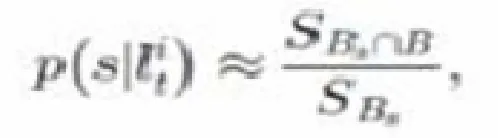
After the bounding-box is built, the candidate samples are drawn from the bounding-box.The first method needs to know the whole set of samples of all the sensor neighbors, which incurs high communication cost. As illustrated in Fig. 4, if we know S’s bounding box Bs, we can approximately compute the probability as:
Computing ERx and ERy. after obtaining N valid samples, a sensor node computes the weighted average of these samples as its position estimation. Using the position estimation and the bounding box, a sensor node can compute its ERx and ERy.
[image:9.612.192.441.389.458.2]The IWMCL algorithm is described as follow: There aretwo phases in IWMCL:
Phase 1: normal run of WMCL. Every sensor node collects its sensor neighbors’ position estimations in last time unit and computes its position estimation using WMCL.
Phase 2: special run of WMCL with the assumption vmax ¼ 0. After every sensor node gets its position estimation in the current time unit, it broadcasts this information to its neighbors. Then every sensor node runs WMCL with the assumption that vmax ¼ 0. This phase can repeat several times in order to improve the localization accuracy.By replacing WMCL with WMCL-A the communication cost can be dramatically reduced.
IV. DESIGN AND IMPLEMENTATION ENVIRONMENT
Network simulator (NS) is an object–oriented, discrete event simulator for networking research. NS provides substantial support for simulation of TCP, routing and multicast protocols over wired and wireless networks. The simulator is a result of an ongoing effort of research and developed. Even though there is a considerable confidence in NS, it is not a polished product yet and bugs are being discovered and corrected continuously.
A. NS can Simulate the following 1) Topology: Wired, wireless.
2) Scheduling Algorithms: RED, Drop Tail. 3) Transport Protocols: TCP, UDP. 4) Routing: Static and dynamic routing.
5) Application: FTP, HTTP, Telnet, Traffic generators.
B. Network Components
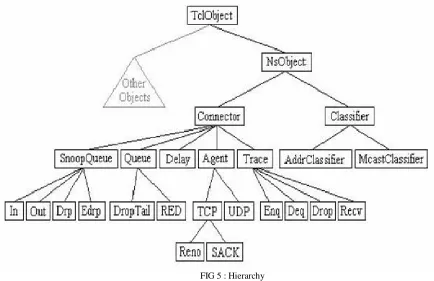
[image:10.612.76.510.414.695.2]This section talks about the NS components, mostly compound network components. Figure 5 shows a partial OTCL class hierarchy of NS, which will help understanding the basic network components.
FIG 5 : Hierarchy
super class of all basic network component objects that handle packets, which may compose compound network objects such as nodes and links. The basic network components are further divided into two subclasses, Connector and Classifier, based on the number of the possible output DATA paths. The basic network and objects that have only one output DATA path are under the Connector class, and switching objects that have possible multiple output DATA paths are under the Classifier class.
C. Class Tcl
The class Tcl encapsulates the actual instance of the OTCL interpreter and provides the methods to access and communicate with that interpreter, code. The class provides methods for the following operations:
1) Obtain a reference to the Tel instance.
2) Invoke OTCL procedures through the interpreter. 3) Retrieve, or pass back results to the interpreter. 4) Report error situations and exit in an uniform manner. 5) Store and lookup "Tcl Objects".
6) Acquire direct access to the interpreter.
A single instance of the class is declared in -tclcl/Tcl.cc as a static member variable. The statement required to access this instance is Tel& tel = Tcl::instance();
D. Invoking OTCL Procedures
There are four different methods to invoke an OTCL command through the instance, tcl. They differ essentially in their calling arguments. Each function passes a string to the interpreter that then evaluates the string in a global context. These methods will return to the caller if the interpreter returns TCL_OK. On the other hand, if the interpreter returns TCL_ERROR, the methods will call tkerror{}. The user can overload this procedure to selectively disregard certain types of errors.
Passing Results to/from the Interpreter : When the interpreter invokes a C++ method, it expects the result back in the private member variable, tcl-> result.
Error Reporting and Exit: This method provides a uniform way to report errors in the compiled code.
E. Command Methods: Definition and Invocation
For every TclObject that is created, ns establishes the instance procedure,cmd{}, as a hook to executing methods through the compiled shadow object. The procedure cmd{} invokes the method command() of the shadow object automatically, passing the arguments to cmd{} as an argument vector to the command() method. The user can invoke the cmd {} method in one of two ways, by explicitly invoking the procedure, specifying the desired operation as the first argument, or implicitly, as if there were an instance procedure of the same name as the desired operation. Most simulation scripts will use the latter form. Consider the distance computation in SRM is done by the compiled object. It is often used by the interpreted object. It is usually invoked as $srmObject distance? (agent Address)If there is no instance procedure called distance? the interpreter will invoke the instance procedure unknown{}, defined in the base class Tcl Object. The unknown procedure then invokes $srm Object cmd distance? (agentAddress) to execute the operation through the compiled object's command() procedure. The user could explicitly invoke the operation directly. One reason for this might be to overload the operation by using an instance procedure of the same name.
For example,
Agent/SRM/Adaptive instproc distance? addr
{
$self instvar distanceCache_($addr) if![info exists distanceCache_($addr)] {
set distanceCache_($addr) [$self cmd distance? $addr]
}
set distanceCache_($addr)
The following shows how the command() method using SRMAgent::command()int ASRM Agent::command(int argc, const char*const*argv
{
Tcl& tcl = Tcl::instance(); if (argc == {
if (strcmp(argv[1], "distance?") == 0) { int sender = atoi(argv[2]);
SRMinfo* sp = get_state(sender); tcl.tesultf("%f", sp->distance_); return TCL_OK; '
}
}
return (SRMAgent::command(argc, argv));
F. The following Observations are made from this Piece of Code
The function is called with two arguments. The first argument (argc) indicates the number of arguments specified in the command line to the interpreter. The command line arguments vector (argv) consists of argv[0] contains the name of the method, "cmd" and argv[1] specifies the desired operation. If the user specified any arguments, then they are placed in argv[2...(argc - 1)]. The arguments are passed as strings. They must be converted to the appropriate data type.If the operation is successfully matched, the match should return the result of the operation,command () itself must return either TCL_OK or TCL_ERROR to indicate success or failure as its return code. If matched in this method, it must invoke its parent's command method, and return the corresponding result. This permits the user to conceive of operations as having the same inheritance properties as instance procedures or compiled methods.In the event that this command method is defined for a class with multiple inheritance, one of two implementations can be chosen
1) Either they can invoke one of the parent's command method, and return the result of that invocation.
2) They can each of the parent's command methods in some sequence, and return the result of the first invocation that is successful. If none of them are successful, then they should return an error.
G. Mobile Networking In Ns
The wireless model essentially consists of the Mobile Node at the core with additional supporting features that allows simulations of multi-hop ad-hoc networks, wireless LANs etc. The Mobile Node object is a split object. The C++ class Mobile Node is derived from parent class Node. A Mobile Node thus is the basic Node object with added functionalities of a wireless and mobile node like ability to move within a given topology, ability to receive and transmit signals to and from a wireless channel etc. A major difference between them is that a mobile Node is not connected by means of Links to other nodes or mobile nodes.
Mobile Node is the basic nsNode object with added functionalities like movement, ability to transmit and receive on a channel that allows it to be used to create mobile, wireless simulation environments. The class Mobile Node is derived from the base class Node. The four ad-hoc routing protocols that are currently supported are, Dynamic Source Routing (DSR), Temporally ordered Routing Algorithm (TORA) and Adhoc On-demand Distance Vector (AODV).
The general structure for defining a mobile node in ns2 is described as follows: $ns node-config - adhocRouting $opt (adhocRouting)
-IIType $opt (II) -macType $opt (mac)
-ifqType $opt (ifq) -ifqLen $opt (ifqlen) -antType $opt (ant)
-proplnstance [new $opt (prop) -phyType $opt (netif) -channel [new $opt (chan)]
The above API configures for a mobile node with all the given values of ad hoc-routing protocol, network stack, channel, topography, propagation model, with wired routing turned on or off (required for wired-cum-wireless scenarios) and tracing turned on or off at different levels (router, mac, agent).
V. HARDWARE AND SOFTWARE SPECIFICATION
A. Hardware Specification
Main processor : Pentium IV processor 1.13 GHz. Hard disk
capacity : 40GB.
Cache memory : 512 MB.
Monitor : LG Digital Color Monitor. Keyboard : Samsung.
Mouse : Logitech.
B. Software Specification
Operating system : Fedora 8 (linux)
Scripting language : Network Simulator 2.33
Protocol developed : C++
Scripting : Tool Command Language
VI. PERFORMANCE EVALUATION
In the existing system we have only implementation of TDMA which leads to wastage of time slots and thereby bandwidth. If we consider a network of 20 nodes in the existing system, the frame duration will be divided into 20 equal slots. In the existing system if the time slot for a particular node isn’t being utilized irrespective of whether or not other nodes have data to send leads to wastage of bandwidth since at a given time the node that has access to the channel may or may not have data.
We overcome this limitation by using CSMA along with TDMA to achieve a dynamic TDMA system where we can prevent wastage of time slots and thereby bandwidth. If at all it is node 6 which has to send data however due to node failure or any other reason does not have data to send, however another node in the network has data to send, it can sense the channel and thereby utilize the channel and maximize the efficiency. The use of contention access and TDMA access can be also optimized to enhance the performance (in terms of throughput and/or delay and/or energy) of the network presented a knapsack model taking into account the bandwidth demand from nodes to allocate the guaranteed time slots to improve the through-put performance in the networks. TDMA is scheduling based, it provides delay guarantee, avoids collisions due to allocation of time slots with different time frames. Along with these advantages TDMA has some of the negative factors as well. It uses topology information, limited adaptability and scalability to changes in WSN nodes and to avoid the end-to-end delay time synchronization is needed. The survey presents the detailed overview of WSNs with its advantages and associated constraints. WSN with a good topology that is designed for the pertinent application will help to increase the bandwidth utilization. This requires a good model for describing various aspects of the spatial interference, routing and resource allocation. Implementation of TDMA which leads to wastage of time slots and thereby bandwidth. To overcome this limitation by using CSMA along with TDMA to achieve a dynamic TDMA system where we can prevent wastage of time slots and thereby bandwidth
SNAP SHOTS Creation of nodes
Packet Drop in existing System
Node Failure and Data Transmission
A. Simulation Results
Comparison of Existing and Proposed System
throughput
Delayed Packets
VII. CONCLUSION AND FUTURE SCOPE
A. Conclusion
1) The distributed algorithm for sharing network Bandwidth resources among wireless sensor networks have been designed.
2) Implementation of fixed-size window control i.e. usage of TDMA/CSMA MAC schemes has achieved fair bandwidth sharing.
3) To consider distributed random scheme where each node varies its sending rate based on the feedback from the network i.e. through sensing the channel (CSMA Scheme) and if any node failure occurs, by taking-over the time-slot of that particular node.
4) To guarantee efficient QOS i.e. during node failure or if any particular node does not have data then efficiently utilizing that particular time-slot, thereby increasing the throughput and reducing the delay of packets to reach the destination(server).
VIII. FUTURE SCOPE
We have addressed the problem of modeling and analysis of CSMA/TDMA protocols. Such MAC protocols are inherently energy efficient because of features like inactive period in the super frame. Also, the devices which are allocated time slots can go to low power mode during CSMA/CA period while the rest go to low power mode during TDMA period. The effect of inactivity period can be analyzed in the future. Also, the end-to-end delay is an important performance metric in wireless sensor networks. However, there is a trade off between end-to-end delay, throughput, and energy efficiency. This research has focused on improving the throughput and B.W efficiency performance without considering the end-to-end delay. In the future, such MAC protocols can be designed to satisfy the quality-of-service (QoS) in terms of delay requirement in the network. The modeling approach developed can be analyzed in the context of multihop wireless sensor networks.
REFERENCES
[1] W. Shu, X. Liu, Z. Gu, and S. Gopalakrishnan, “Optimal sampling rate assignment with dynamic route selection for real-time wireless sensor networks,” in Proc. of IEEE RTSS, 2016.
[2] C. Thejaswi and R. K. Patro, “Distributed detection in bandwidth constrained wireless sensor networks,” in Proc. IEEE Radio Wireless , Jan. 2016. [3] R. Niu and P. K. Varshney, “Target location estimation in sensor networks with quantized data,” IEEE Trans. Signal Process., vol. 54, no. 12, Dec.-201 [4] Yu-Kai Huang , Ai-Chun Pang , Hui-Nien Hung “An Adaptive GTS Allocation Scheme for IEEE 802.15.4,” IEEE Transactions on Parallel and Distributed
Systems. IEEE Press Piscataway, NJ, USA. 2014.
[5] Chewoo Na , Yaling Yang, Amitabh Mishra. “An optimal GTS scheduling algorithm for time- sensitive transactions in IEEE 802.15.4 networks,” Computer Networks: The International Journal of Computer and Telecommunications Networking. Elsevier. 2013.
[6] A Koubaa, A Cunha, M Alves. “A Time DivisionBeacon Scheduling Mechanism for IEEE 802.15.4/Zigbee Cluster-Tree Wireless Sensor Networks,” Euromicro Conference on Real-Time Systems (ECRTS 2007), 2013
[8] Anthony Rowe, Rahul Mangharam, Raj Rajkumar. “RT-LINK: A Time-Synchronized Link Protocol for Energy-Constrained Multi-hop Wireless Networks,” Mesh and Ad Hoc Communications and Networks Reston, VA, September 2012.
[9] Aslam, N. Robertson, W. Sivakumar, S.C. Phillips, W. “Reservation based Medium access control Protocol for Wireless Sensor Networks,” Consumer Communications and NetworkingConference. 2012.
[10]Kuei-ping Shih, Chih-yung Chang, Yen-da Chen, Tsung-han Chuang, “Dynamic bandwidth allocationfor QoS routing on TDMA-based mobile ad hoc networks,” Computer Communications.Volume 29,Issue 9, 31 May 2011, Pages 1316-1329
[11]L. Crenshaw, Ajay Tirumala, Spencer Hoke, Marco Caccamo. “A Robust Implicit Access Protocol for Real-Time Wireless Collaboration,” Proceedings of the 17th Euromicro Conference on Real-Time Systems. 2011.
[12]J Tang, G Xue, C Chandler, “Interference aware routing and bandwidth allocation for QoS provisioning in multihop wireless networks,” Wireless Communications and Mobile Computing. Volume 5 , Issue 8, Pages: 933– 943, December 2011.
[13]G. Allard, L. Georgiadis, P. Jacquet, and B. Mans, “Bandwidth Reservation in Multihop Wireless Networks: Complexity, Heuristics and Mechanisms,” Int'l J. Wireless and Mobile Computing, May 2010.
[14]Venkatesh Rajendran, Katia Obraczka, J. J. Garcia- Luna-Aceves. Energy-efficient, collision-free medium access control for wireless sensor networks. Conference On Embedded Networked Sensor Systems.Pages:181 192. 2010
[15]IEEE 802.15.4 Standard-2003, “Part 15.4: WirelessMedium Access Control (MAC) and Physical Layer(PHY)Specifications for Low-Rate Wireless Personal Area Networks (LR- WPANs)”, IEEE-SA Standards Board, 201
[16]Chenxi Zhu, M. Scott Corson. “QoS routing for mobile ad hoc networks,” INFOCOM 200
[17]]Wireless medium access control and physical layer specifications for low-rate wireless personal area networks. IEEE Standard, 802.15.4-14,ISBN 0-7381-3677-5,2009
[18]I.F. Akyildiz et al., “Wireless Sensor Networks: A Survey,” Journal of Computer Networks, vol.38, no.4, pp. 393-422, Mar. 2009
[19]Jane W.S. Liu, “Priority – Driven Scheduling of Periodic Tasks,” in Real Time Systems, pp. 133- 134, Pearson Education Publishers 8th reprint, 2009 [20]H. Peng et al., “An adaptive real-time routing scheme for wireless sensor networks,” in Proc. Of IEEE Advanced Information Networking and Applications
Workshops, pp.918 – 922, Canada, 2008.
[21]M. Cherian and T. R G. Nair, “A Deadline Aware Real-time Routing Protocol for Wireless Sensor Networks,” International journal of Innovative Systems Design and Engineering, vol.2, no.4, pp.336- 349, Sept. 2008.
[22]T Qureshi and D.A.Zighed, “Proposition and Simulation of a Network Layer based Hard Real time Protocol for Wireless Sensor Networks,” in Proc. of IEEE Mobile and Wireless Communications Summit, pp. 1-5, Budapest, Hungary, 2008.
[23]Yanjun Li et al., “Real-time QoS support in wireless sensor networks: a survey ,”in Proc. of 7th IFAC International Conference on Fieldbuses & Networks in Industrial & Embedded Systems - FeT’2007, pp. 46-60, France, 200
[24]B.A. Forouzan, “Wireless LANs” in Data Communications and Networking, Tata McGraw- Hill 4th ed., pp. 423-434, 2007.