Implementation of High Speed Vedic Multiplier for
Digital Signal Processing Using Multiplexer Based
Adder
Neha Tyagi1, Neeraj Kumar Sharma
1Electronics and Communication Department, Vivekanand Institute of Technology, Ghaziabad, India 2Associate Professor, Vivekanand Institute of Technology, Ghaziabad, India
Abstract: Digital signal processors (DSPs) are very important in various engineering disciplines. Fast multiplication is very :important in DSPs for convolution, Fourier transforms, etc. A fast method for multiplication based on ancient Indian Vedic mathematics is proposed in this paper. The whole of Vedic mathematics is based on 16 sutras (word formulae) and manifests a unified structure of mathematics. Among the various methods of multiplication in Vedic mathematics, Urdhava tiryakbhyam is discussed in detail. Urdhava tiryakbhyam is the general multiplication formula applicable to all cases of multiplication. The coding is done in Verilog and synthesis is done using Xilinx ISE 14.5. The combinational delay obtained after the synthesis is compared with existing multiplier. Further, this Vedic multiplier is used in matrix multiplication. This Vedic multiplier can bring great improvement in the DSP performance.
Keywords: Vedic multiplier,Urdhava tiryakbhyam, Verilog HDL, DSP.
I. INTRODUCTION
Multipliers are frequently used in DSP, image processing architectures and microprocessors. It plays an important fundamental function in arithmetic operations. These days in modern VLSI design delay in data path is considered as a critical parameter. In present time designers are demanding high speed of operation, so it is essential to minimize the delay. There has been lot of researches and work to reduce the delay and now designers have shifted their focus on making a multiplier circuit which are efficient and considerably faster.
A high speed processor performance greatly depends on the multiplier, in most digital signal processing systems as well as in all-purpose processors which is one of the essential hardware components also its consumed area is more. Vedic multiplier gives the fast speed of operations than the conventional multiplier and requires less system memory. As compared to existing multiplier design this multiplier requires very small area. Here in this work we use MUX based adder for designing Vedic multiplier, this adder minimize the delay and reduced consumed area. In this paper 16- bit Vedic multiplier using MUX based adder has been designed The results shows that the proposed 16- bit Vedic multiplier is faster than 16- bit Vedic multiplier with normal adder. The reduction in the delay is approximately 30.6%. The main purpose of this work is to design and implement a high speed 16 X 16 bit Vedic multiplier by combining the best technique in Vedic mathematics named Urdhva Tiryagbhyam and MUX based adder.
II. VEDIC MATHEMATICS
“Vertically and crosswise”. This Sutra has been conventionally used for multiplication of two numbers in the decimal number system. The same idea has been applied for binary multiplication in this work. By breaking into smaller sizes, this can solve the multiplication of larger number (N X N bits). The 2 x 2 Vedic multiplier are basic building module through which higher multiplier are designed by splitting into smaller sizes.
This algorithm can be implemented into three steps which are as follows: Step-1: The first step is vertical multiplication of LSB of both multiplicands. Step-2: Second step is crosswise multiplication and additions of the partial products. Step-3: Third step is vertical multiplication of MSB of the multiplicand and addition with the carry propagated from step 2.
For better understanding consider 2-bit two binary number are a1a0 and b1b0. The below figure 1 shows the 2 bit multiplier.
Fi gur e 1: Line Diagram for 2 X 2 Bit binary multiplication using Urdhva Tiryagbhyam Sutra
B. Algorithm for 16 X 16 Bit binary numbers Multiplication Using Urdhva Tiryagbhyam:
A=A15A14A13A12A11A10A9A8 A7A6A5A4A3A2A1A0 X1 X0
B=B15B14B13B12B11B10B9B8 B7B6B5B4B3B2B1B0 Y1 Y0
X1 X0 * Y1 Y0
F E D C
CP = X0 * Y0 = C
CP = X1 * Y0 + X0 * Y1 = D CP = X1 * Y1 = E Where CP=Cross product
C. Nikhilam Sutra
Nikhilam Sutra literally means “all from 9 and last from 10”. Although it is applicable to all cases of multiplication, it is more efficient when the numbers involved are large.
To perform multiplication with Nikhilam Sutra, compliment of the numbers from the nearest base is required, larger is the original number, lesser the complexity of the multiplication. So this method is more efficient for large numbers which are nearer to the base. We first illustrate this Sutra by considering the multiplication of two decimal numbers (97 * 94) where the chosen base is 100 which is nearest to and greater than both these two numbers.
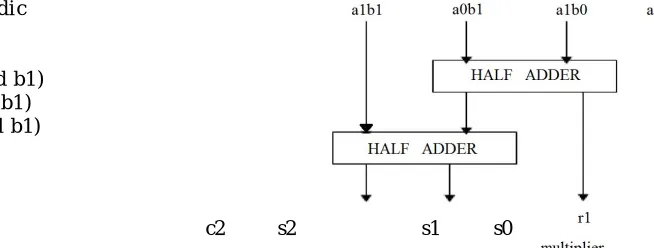
c2 s2 s1 s0
Th e ex pr essi on of t wo bi t Ved i c m ult ip li er i s:
s0 = a 0 an d b0
s1 = (a 1 an d b0 ) XOR (a 0 an d b1 ) c1 = (a 1 an d b0) an d (a 0 an d b1 )
s2 = c1 XOR (a 1 an d b1) c2 = c1 an d (a1 an d b1 )
[image:3.612.224.551.236.360.2]Fi gur e 2: Mul tip li cati on Usin g Ni kh ilam Sutr a
The right hand side (RHS) of the product can be obtained by simply multiplying the numbers of the Column 2 (3*6 = 18). The left hand side (LHS) of the product can be found by cross subtracting the second number of Column 2 from the first number of Column 1or vice versa 97 - 6 = 91 or 94 - 3 = 91. The final result is obtained by concatenating RHS and LHS (Answer = 9118).
III. MUX BASED ADDER
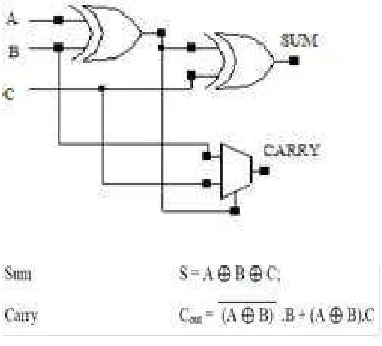
For efficient implementation adders become a critical hardware unit of multiplier. The speed of multiplier ultimately increased when the delay of the adder is reduced. In terms of delay and power dissipation, it is observed that full adder with multiplexer and XOR gate gives best performance, especially. It consists of two XOR gates and one 2xl MUX as shown in Fig. 4.
By using logical effort method we can calculate delay mathematically instead of using simulation tools. It gives a simple m et h od to select best logical topology. Let us assumed ‘d’ is the delay for a single stage network in term of is logical effort ‘g’, electrical effort ‘h’ and parasitic delay ‘p’, than the delay can be calculated by the equation (1) as given below
d =g*h+p; (1)
where 'g 'represents logic gate's ability to produce output current (Compared to inverter, how much worse it is in producing output current), 'h' gives ratio of output capacitance to input capacitance and p
Fi gur e 3: Ar ch it ect ur e of Ni kh ila m Su tr a
[image:4.612.298.498.79.223.2] [image:4.612.186.377.389.562.2]The 2 x 2-bit Vedic multiplier is the basic building section for the system. Two Half adders are required in designing 2 x2 Vedic Multiplier, Figure 5 gives the architecture of 2 x 2 bit Vedic multiplier.
Fi gur e 5 ar ch it ect ur e of 2 x 2 bi t Vedi c Mult ip li er
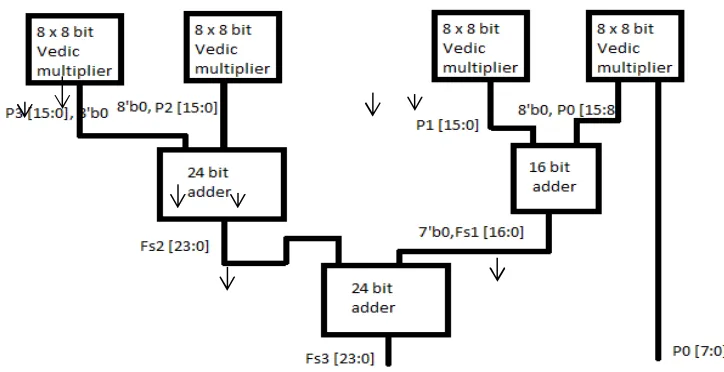
The 4 x 4-bit multiplier is designed by using four 2 x 2-bit Vedic multiplier . The 8 x 8 bit Vedic multiplier is designed by using four 4 x 4 bit Vedic multiplier building blocks. The approach applied for designing a 16 x 16-bit Vedic multiplier by using four 8 x 8 bit multiplier blocks and two 24-bit and one 16-bit MUX based adder blocks is shown in figure 6.
Fi gur e 6 Bl ock di agr am of 1 6 x 16 bit Ved i c Mu lti pl i er u sin g MUX ba sed a d d er
V. RESULT
A. Synthesis
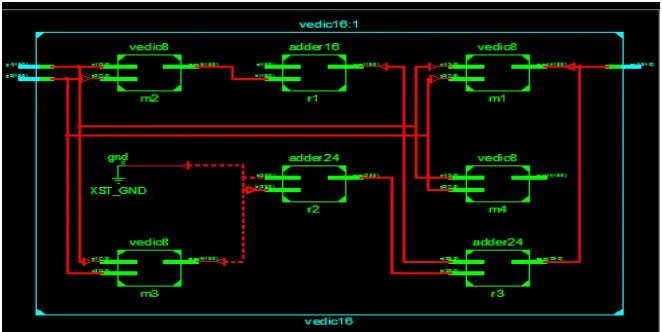
The Verilog code of proposed Vedic multipliers (using MUX based adder) and conventional Vedic multiplier are synthesized using XILINX ISE 14.5. The figure 7 & 8 shows the RTL diagrams of both multipliers.
[image:5.612.163.414.118.272.2] [image:5.612.118.480.366.552.2]Figure 7: RTL view of 16x16 conventional Vedic multiplier
Figure 8: RTL view of 16x16 Vedic multiplier using MUX based adder
B. Simulation
[image:6.612.88.521.537.682.2]Type No. of Bits No.of bonded IOs Delay (ns) Level of logic Number of Slice LUTs
16 64 20.347 23 623
Vedic multiplier using MUX based adder
16 64 16.142 23 513
Table 1:
Conventional Vedic multiplier
V. CONCLUSION AND FUTURE WORK
This paper work presents a high performance design for multiplication by combining the feature of Vedic mathematics and MUX based adder. When we compared our purposed design with conventional Vedic multipliers proposed design gives much less delay. We conclude that the proposed Vedic multiplier is a p p r o x i m a t e l y 30% faster from conventional Multiplier. The multiplier architecture and fast performance makes this particularly attractive for VLSI implementations. For future work, its performance within MAC unit and ALU can be tested and compared with other conventional and Vedic designs. This 16 bit Multiplier can be further extended to 32 bit or 64 bit multiplier.
REFERENCES [1] Computure arithmetic “Algorithm and hardware design” by “Behrooz Parhami
[2] Gaurav Sharma , Arjun Singh Chauhan , Himanshu Joshi, Satish Kumar Alaria “Delay Comparison of 4 by 4 Vedic Multiplier based on Different Adder Architectures using VHDL” International Journal of IT, Engineering and Applied Sciences Research (IJIEASR), Volume 2, No. 6, June 2013.
[3] Diptendu Kumar Kundu, Supriyo Srimani, Saradindu Panda, Prof. Bansibadan Maji “Implementation of Optimized High Performance 4x4 Multiplier using Ancient Vedic Sutra in 45 nm Technology” 2014 2nd International Conference on Devices, Circuits and Systems (ICDCS), 978-1-4799-1356-5/14/$31.00 ©2014 IEEE.
[4] Saji. M. Antony , S.Sri Ranjani Prasanthi, Dr.S.Indu, Dr. Rajeshwari Pandey , “Design of High Speed Vedic Multiplier using Multiplexer based Adder” 2015 International Conference on Control, Communication & Computing India (ICCC) 19-21 November 2015,IEEE.
[5] S R Panigrahi, 0 P Das, B B Tripathy, T K Dey, "FPGA Implementation of a 4x4 Vedic Multiplier", International Journal of Engineering Research and Development,Volume 7, Issue 1 (May 2013), PP. 76-80.
[6] Poornima M, Shivaraj Kumar Patil, Shivukumar , Shridhar K P, Sanjay H, "Implementation of Multiplier using Vedic Algorithm" International Journal of Innovative Technology and Exploring Engineering,Volume-2, Issue-6, May 2013
[7] Maroju SaiKumar, Dr. P. Samundiswary "Design and Performance Analysis of Various Adders using Verilog", IJCSMC, Vol. 2, Issue. 9, September 2013, pp. 128-138
[8] M. Zamin Ali Khan , Hussain Saleem, Shiraz Afzal and Jawed Naseem“An Efficient 16-Bit Multiplier based on Booth Algorithm” International Journal of Advancements in Research & Technology,Volume 1, Issue 6, November-2012.
[9] Shamim Akhter,” VHDL implementation of fast N×N multiplier based on Vedic mathematic”, in 18th European Conference on Circuit Theory and Design, Sevilla Spain, pp. 472-475, August,2007.
[10] S. S. Kerur,PrakashNarchi, Jayashree C N Harish M Kittur and Girish V A, “Implementation of Vedic Multiplier for Digital Signal Processing”, International Conference on VLSI, Communication & Instrumentation (ICVCI) 2011.